REVIEW 5 minor 129 references
A regular black hole with a zero-point-length core rings faster than Schwarzschild once frequencies are measured in ADM units.
Reviewed by Pith at T0; open to challenge. T0 means a machine referee read the full paper against a public rubric. the ladder, T0–T4 →
T0 review · grok-4.5
2026-07-12 01:37 UTC pith:H3XNOZY5
load-bearing objection Solid axial gravitational QNM catalog for the Jusufi–Singleton regular metric: ADM-scaled Re(ω) rises with l0, methods check out, novelty is extension-level.
Gravitational perturbations of a regular T-duality inspired black hole: Quasinormal modes, excitation factors, and time-domain evolution
The pith
A machine-rendered reading of the paper's core claim, the machinery that carries it, and where it could break.
Core claim
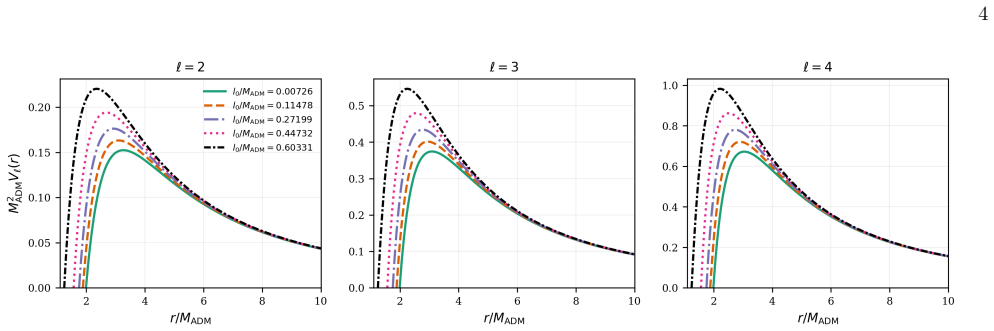
When the zero-point length is turned on, the real parts of the ADM-scaled frequencies increase for the axial gravitational modes with ℓ=2,3,4, so the ringdown oscillates faster than in the Schwarzschild limit; the damping rates change more gradually—initially rising slightly, then decreasing near the largest deformations—consistent with a higher effective potential barrier, while the corresponding excitation-factor magnitudes vary much less strongly.
What carries the argument
The axial gravitational master equation on the self-energy regular background: after reduction to a Regge–Wheeler-type Schrödinger problem in the tortoise coordinate, the effective potential is V_ℓ(r)=f(r)/r²[ℓ(ℓ+1)−2+2f(r)−r f′(r)], whose barrier height rises with the zero-point length and thereby drives the increase in oscillation frequency.
Load-bearing premise
The axial wave potential is taken from general formulas for anisotropic regular fluids rather than re-derived from the linearized Einstein equations for this paper’s particular bare-plus-self-energy source.
What would settle it
Recompute the fundamental ℓ=2 quasinormal frequency by an independent method (high-order continued fractions or Leaver’s series) on the same metric at a mid-range zero-point length (for example l0/MADM≈0.45) and check whether the real part still lies above the Schwarzschild value while the damping follows the reported non-monotonic trend.
If this is right
- ADM-scaled frequency tables can be interpolated as functions of l0/MADM inside damped-sinusoid ringdown templates for Bayesian model comparison.
- Observed faster ringdown oscillation at fixed asymptotic mass would be a possible signature of this zero-point-length deformation.
- The leading Price-law late-time tail remains t−(2ℓ+3), so the asymptotic decay cannot distinguish the model from Schwarzschild.
- Excitation-factor moduli stay nearly constant, so amplitude priors need not be retuned strongly with the deformation parameter.
- The same axial potential can be used to reconstruct grey-body factors and test the quasinormal-mode–scattering correspondence for this geometry.
Where Pith is reading between the lines
- Because the paper treats only non-rotating geometries, any precision comparison with real merger remnants will require a spinning generalization before the frequency shifts can be claimed as observational discriminants.
- The mild sensitivity of residues relative to pole locations suggests that, for this class of regular cores, spectroscopy will be driven mainly by frequency and damping shifts rather than by changes in mode excitation strength.
- If the axial potential formula is later confirmed by a full linearization for this source, the same pipeline can be reused for polar gravitational and massive-field sectors with little additional cost.
Editorial analysis
A structured set of objections, weighed in public.
Referee Report
Summary. The paper studies axial gravitational perturbations of the neutral regular black-hole geometry of Jusufi and Singleton, in which a T-duality-inspired zero-point length l0 regularizes both the source and the gravitational self-energy. Using high-order WKB–Padé methods (14th and 16th order) and independent time-domain evolution with Prony extraction, the authors compute fundamental and overtone quasinormal frequencies for ℓ=2,3,4, together with the corresponding excitation factors. In ADM units they find that Re(MADM ω) increases monotonically with l0/MADM, so the ringdown oscillates faster than in Schwarzschild, while the damping rates vary more mildly (a shallow maximum then a decrease near the near-extremal end). The trends track the rise of the axial barrier; late-time tails recover Price’s law; and |Bℓn| varies less strongly than the frequencies themselves.
Significance. The work completes the spectral picture of this regular self-energy black hole by treating the gravitational sector rather than test fields, which is the sector most directly relevant to ringdown. Strengths include transparent ADM rescaling, high-order Padé-WKB tables with essentially vanishing order-to-order differences for fundamentals, a time-domain cross-check at the ~10⁻⁵% relative level for a sample mode, recovery of the Schwarzschild limit and of Price-law tails, and a consistent set of excitation factors in a fixed tortoise convention. The results are falsifiable numerical predictions for a one-parameter deformation and are suitable ingredients for future Bayesian ringdown comparisons or grey-body reconstructions, even though the present geometry is nonrotating and only axial modes are treated.
minor comments (5)
- Eq. (15) and the surrounding paragraph in Sec. II cite the general anisotropic-fluid axial potential [51–54] but do not re-derive the linearized Einstein equations for the specific ρ_bare+ρ_GSE source. A short appendix or a few intermediate steps confirming that pr=-ρ and the given density profile yield exactly that master potential would remove a presentational gap, even though the Schwarzschild limit and internal consistency already support the formula.
- Figure captions for the time-domain plots (Figs. 4 and 5) appear swapped relative to the text: the ℓ=2, l0=0.65 discussion points to Fig. 5 while the ℓ=3, l0=0.8 discussion points to Fig. 4. Please align figure numbers, captions, and in-text references.
- In Sec. V the matching residual |A(-)| < 4×10⁻¹⁰ and K=12 are stated; a brief note on how the five-point derivative for dA(-)/dω was validated (step size, comparison with higher-order differences) would strengthen reproducibility of the residues in Table III.
- Tables I–II report frequencies in units of the bare M=1; the ADM-rescaled plots are the physically transparent presentation. Consider adding a short column or supplementary table of MADM ω for the fundamental modes so that readers can use the numbers without recomputing MADM from Eq. (10).
- A few typographical and formatting issues: “SP ACETIME” and “EXCIT A TION F ACTORS” in section headings; occasional missing spaces in “l0/MADM”; and the arXiv-style citation list could be cleaned for journal style.
Circularity Check
No significant circularity: QNM frequencies, damping trends, and excitation factors are numerical outputs of a fixed external metric and standard wave equation, not forced by definition or self-fit.
full rationale
The paper takes the Jusufi–Singleton regular metric (and its ADM mass) as an external input from prior literature, inserts the standard axial master potential for static spherical anisotropic fluids with pr = −ρ (Eq. 15, citing the general derivations [51–54]), and then solves the resulting Regge–Wheeler-type equation by high-order WKB–Padé, independent time-domain Prony extraction, and residue evaluation for excitation factors. The reported trends (ADM-scaled Re(ω) rising with l0/MADM, milder non-monotonic damping, higher barrier, weakly varying |Bℓ0|) are direct numerical consequences of that fixed potential; they are not fitted to data, not redefined by the ADM unit choice, and not smuggled in via a self-citation uniqueness claim. Recovery of the Schwarzschild limit as l0 → 0 at fixed MADM, 16th-vs-14th Padé agreement, TD/WKB relative difference ∼10−5 %, and Price-law tails supply internal consistency checks rather than circular reinforcement. Self-citations appear only for methods or related test-field spectra and do not load-bear the gravitational results. The derivation chain is therefore self-contained against its stated inputs.
Axiom & Free-Parameter Ledger
free parameters (1)
- l0 (zero-point length) / l0/MADM =
scanned, e.g. l0 up to 0.82 for M=1 (l0/MADM up to ~0.603)
axioms (4)
- domain assumption Classical Einstein equations with the anisotropic fluid source ρ=ρ_bare+ρ_GSE, pr=−ρ, and pt fixed by conservation yield the given mass function and metric f(r).
- domain assumption Axial gravitational perturbations reduce to a single Regge–Wheeler-type master equation with potential Eq. (15) for this anisotropic source.
- standard math High-order WKB with symmetric Padé resummation accurately approximates QNMs for a single-barrier potential of this shape, especially fundamentals.
- standard math Quasinormal boundary conditions are purely ingoing at the horizon and purely outgoing at infinity.
invented entities (1)
-
T-duality-inspired zero-point length regular black hole with gravitational self-energy (Jusufi–Singleton geometry)
no independent evidence
read the original abstract
We study axial gravitational perturbations of the neutral regular black hole generated by a non-local, T-duality-inspired zero-point length and the associated gravitational self-energy. In this geometry, the usual point source is replaced by a regular core, and the zero-point length controls the departure from the Schwarzschild limit. We compute the fundamental quasinormal modes and several overtones using high-order WKB--Pad\'e methods, and we verify the dominant mode via direct time-domain evolution. When the zero-point length is turned on, the real parts of the ADM-scaled frequencies increase for the gravitational modes with $\ell=2,3,4$, so the ringdown oscillates faster than in the Schwarzschild limit. The damping rates change more gradually: they initially increase slightly and then decrease near the largest deformation values considered here. This behavior is consistent with the effective potential, whose barrier becomes higher as the deformation parameter increases. We also compute the corresponding excitation factors and find that their magnitudes vary much less strongly than the quasinormal frequencies.
Figures


Reference graph
Works this paper leans on
-
[1]
E. Berti, V. Cardoso, and A. O. Starinets, Class. Quant. Grav. 26, 163001 (2009) , arXiv:0905.2975 [gr-qc]
Pith/arXiv arXiv 2009
-
[2]
R. A. Konoplya and A. Zhidenko, Rev. Mod. Phys. 83, 793 (2011) , arXiv:1102.4014 [gr-qc]
Pith/arXiv arXiv 2011
-
[3]
Nollert, Class
H.-P. Nollert, Class. Quant. Grav. 16, R159 (1999)
1999
-
[4]
K. D. Kokkotas and B. G. Schmidt, Living Rev. Rel. 2, 2 (1999) , arXiv:gr-qc/9909058
Pith/arXiv arXiv 1999
-
[5]
S. V. Bolokhov and M. Skvortsova, Grav. Cosmol. 31, 423 (2025)
2025
-
[6]
R. A. Konoplya and A. Zhidenko, JHEAp 44, 419 (2024), arXiv:2209.00679 [gr-qc]
Pith/arXiv arXiv 2024
-
[7]
V. Cardoso, A. S. Miranda, E. Berti, H. Witek, and V. T. Zanchin, Phys. Rev. D 79, 064016 (2009) , arXiv:0812.1806 [hep-th]
Pith/arXiv arXiv 2009
-
[8]
E. Ayon-Beato and A. Garcia, Phys. Rev. Lett. 80, 5056 (1998), arXiv:gr-qc/9911046
Pith/arXiv arXiv 1998
-
[9]
K. A. Bronnikov, Phys. Rev. D 63, 044005 (2001) , arXiv:gr-qc/0006014
Pith/arXiv arXiv 2001
-
[10]
A. Bonanno and M. Reuter, Phys. Rev. D 62, 043008 (2000), arXiv:hep-th/0002196
Pith/arXiv arXiv 2000
-
[11]
R. A. Konoplya and A. Zhidenko, Phys. Lett. B 856, 138945 (2024) , arXiv:2404.09063 [gr-qc]
Pith/arXiv arXiv 2024
-
[12]
S. A. Hayward, Phys. Rev. Lett. 96, 031103 (2006) , arXiv:gr-qc/0506126
Pith/arXiv arXiv 2006
-
[13]
Dymnikova, Gen
I. Dymnikova, Gen. Rel. Grav. 24, 235 (1992)
1992
-
[14]
P. Nicolini, A. Smailagic, and E. Spallucci, Phys. Lett. B 632, 547 (2006) , arXiv:gr-qc/0510112
Pith/arXiv arXiv 2006
-
[15]
K. A. Bronnikov, Phys. Rev. D 110, 024021 (2024) , arXiv:2404.14816 [gr-qc]
Pith/arXiv arXiv 2024
-
[16]
R. A. Konoplya and A. Zhidenko, Phys. Rev. D 113, 043011 (2026) , arXiv:2511.03066 [gr-qc]
arXiv 2026
- [17]
-
[18]
A. M. Bonanno, R. A. Konoplya, G. Oglialoro, and A. Spina, JCAP 12, 042 (2025) , arXiv:2509.12469 [gr- qc]
arXiv 2025
-
[19]
S. V. Bolokhov, K. A. Bronnikov, and M. V. Skvortsova, Grav. Cosmol. 30, 265 (2024) , arXiv:2405.09124 [gr-qc]
Pith/arXiv arXiv 2024
-
[20]
C. F. B. Macedo, L. C. B. Crispino, and E. S. de Oliveira, Int. J. Mod. Phys. D 25, 1641008 (2016) , arXiv:1605.00123 [gr-qc]
Pith/arXiv arXiv 2016
-
[21]
D. Mahdavian Yekta, M. Karimabadi, and S. A. Alavi, Annals Phys. 434, 168603 (2021) , arXiv:1912.12017 [hep-th]
Pith/arXiv arXiv 2021
-
[22]
R. A. Konoplya, Z. Stuchlik, A. Zhidenko, and A. F. Zinhailo, Phys. Rev. D 107, 104050 (2023) , arXiv:2303.01987 [gr-qc]
Pith/arXiv arXiv 2023
-
[23]
Y. Guo, H. Xie, and Y.-G. Miao, Phys. Lett. B 855, 138801 (2024) , arXiv:2402.10406 [gr-qc]
Pith/arXiv arXiv 2024
-
[24]
J. Li, K. Lin, and N. Yang, Eur. Phys. J. C 75, 131 (2015), arXiv:1409.5988 [gr-qc]
Pith/arXiv arXiv 2015
-
[25]
M. Skvortsova, Grav. Cosmol. 30, 279 (2024) , arXiv:2405.15807 [gr-qc]
Pith/arXiv arXiv 2024
-
[26]
O. Pedraza, L. A. López, R. Arceo, and I. Cabrera- Munguia, Mod. Phys. Lett. A 37, 2250057 (2022) , arXiv:2111.06488 [gr-qc]
Pith/arXiv arXiv 2022
-
[27]
S. V. Bolokhov, Annals Phys. 488, 170416 (2026) , arXiv:2511.12859 [gr-qc]
arXiv 2026
-
[28]
S. V. Bolokhov, Phys. Rev. D 109, 064017 (2024)
2024
-
[29]
Skvortsova, (2026), arXiv:2603.28415 [gr-qc]
M. Skvortsova, (2026), arXiv:2603.28415 [gr-qc]
arXiv 2026
-
[30]
D. Pedrotti and S. Vagnozzi, Phys. Rev. D 110, 084075 (2024), arXiv:2404.07589 [gr-qc]
Pith/arXiv arXiv 2024
-
[31]
S. Vagnozzi et al. , Class. Quant. Grav. 40, 165007 (2023), arXiv:2205.07787 [gr-qc]
Pith/arXiv arXiv 2023
-
[32]
M. Calzà, D. Pedrotti, and S. Vagnozzi, Phys. Rev. D 111, 024010 (2025) , arXiv:2409.02807 [gr-qc]
Pith/arXiv arXiv 2025
-
[33]
R. A. Konoplya, JCAP 07, 001 (2023) , arXiv:2305.09187 [gr-qc] . 11
Pith/arXiv arXiv 2023
-
[34]
A. Flachi and J. P. S. Lemos, Phys. Rev. D 87, 024034 (2013), arXiv:1211.6212 [gr-qc]
Pith/arXiv arXiv 2013
-
[35]
A. Arbey, J. Auffinger, M. Geiller, E. R. Livine, and F. Sartini, Phys. Rev. D 103, 104010 (2021) , arXiv:2101.02951 [gr-qc]
Pith/arXiv arXiv 2021
-
[36]
S. V. Bolokhov, (2026), arXiv:2603.22310 [gr-qc]
arXiv 2026
-
[37]
A. Held, R. Gold, and A. Eichhorn, JCAP 06, 029 (2019), arXiv:1904.07133 [gr-qc]
Pith/arXiv arXiv 2019
-
[38]
D. M. Gingrich, Phys. Rev. D 110, 084045 (2024) , arXiv:2404.04447 [gr-qc]
Pith/arXiv arXiv 2024
-
[39]
G. Panotopoulos and Á. Rincón, Eur. Phys. J. Plus 134, 300 (2019) , arXiv:1904.10847 [gr-qc]
Pith/arXiv arXiv 2019
-
[40]
A. Dubinsky, Int. J. Grav. Theor. Phys. 2, 6 (2026) , arXiv:2603.17644 [gr-qc]
arXiv 2026
-
[41]
Skvortsova, EPL 154, 49001 (2026) , arXiv:2509.18061 [gr-qc]
M. Skvortsova, EPL 154, 49001 (2026) , arXiv:2509.18061 [gr-qc]
arXiv 2026
-
[42]
B.-H. Huang, H.-W. Hu, and L. Zhao, JCAP 03, 053 (2024), arXiv:2311.12286 [gr-qc]
Pith/arXiv arXiv 2024
-
[43]
Y. Yang, D. Liu, Z. Xu, Y. Xing, S. Wu, and Z.-W. Long, Phys. Rev. D 104, 104021 (2021) , arXiv:2107.06554 [gr-qc]
Pith/arXiv arXiv 2021
-
[44]
A. Arbey, J. Auffinger, M. Geiller, E. R. Livine, and F. Sartini, Phys. Rev. D 104, 084016 (2021) , arXiv:2107.03293 [gr-qc]
Pith/arXiv arXiv 2021
-
[45]
K. Lin, J. Li, and S. Yang, Int. J. Theor. Phys. 52, 3771 (2013)
2013
-
[46]
L. A. López and V. Ramírez, Eur. Phys. J. Plus 138, 120 (2023) , arXiv:2205.10166 [gr-qc]
Pith/arXiv arXiv 2023
-
[47]
A. Arbey, M. Calzà, L. Malacher, D. Pedrotti, and Y. F. Perez-Gonzalez, (2026), arXiv:2606.06355 [gr-qc]
Pith/arXiv arXiv 2026
-
[48]
K. Jusufi and D. Singleton, Eur. Phys. J. C 86, 530 (2026), arXiv:2509.13335 [gr-qc]
Pith/arXiv arXiv 2026
-
[49]
B. C. Lütfüoğlu, A. Shermatov, S. Murodov, R. Javlon, and M. Umaraliyev, 10.13140/RG.2.2.34442.22726
-
[50]
Quasinormal modes and excitation fac- tors of a regular black hole with zero-point length,
M. Skvortsova, “Quasinormal modes and excitation fac- tors of a regular black hole with zero-point length,” (2026), arXiv:2606.15785 [gr-qc]
arXiv 2026
-
[51]
M. Bouhmadi-López, S. Brahma, C.-Y. Chen, P. Chen, and D.-h. Yeom, JCAP 07, 066 (2020) , arXiv:2004.13061 [gr-qc]
Pith/arXiv arXiv 2020
-
[52]
R. A. Konoplya and O. S. Stashko, Phys. Rev. D 111, 084031 (2025) , arXiv:2502.05689 [gr-qc]
Pith/arXiv arXiv 2025
-
[53]
R. A. Konoplya and O. S. Stashko, Phys. Rev. D 111, 104055 (2025) , arXiv:2408.02578 [gr-qc]
Pith/arXiv arXiv 2025
-
[54]
S. V. Bolokhov and M. Skvortsova, Eur. Phys. J. C 86, 374 (2026) , arXiv:2508.19989 [gr-qc]
Pith/arXiv arXiv 2026
-
[55]
R. A. Konoplya, A. Zhidenko, and A. F. Zinhailo, Class. Quant. Grav. 36, 155002 (2019) , arXiv:1904.10333 [gr- qc]
Pith/arXiv arXiv 2019
-
[56]
Iyer and C
S. Iyer and C. M. Will, Phys. Rev. D 35, 3621 (1987)
1987
-
[57]
R. A. Konoplya, Phys. Rev. D 68, 024018 (2003) , arXiv:gr-qc/0303052
Pith/arXiv arXiv 2003
-
[58]
J. Matyjasek and M. Opala, Phys. Rev. D 96, 024011 (2017), arXiv:1704.00361 [gr-qc]
Pith/arXiv arXiv 2017
-
[59]
J. Matyjasek and M. Telecka, Phys. Rev. D 100, 124006 (2019), arXiv:1908.09389 [gr-qc]
Pith/arXiv arXiv 2019
-
[60]
Y. Hatsuda, Phys. Rev. D 101, 024008 (2020) , arXiv:1906.07232 [gr-qc]
Pith/arXiv arXiv 2020
-
[61]
J. Matyjasek, R. A. Konoplya, and A. Zhidenko, Int. J. Grav. Theor. Phys. 2, 5 (2026) , arXiv:2603.12466 [gr- qc]
arXiv 2026
-
[62]
R. A. Konoplya, J. Matyjasek, and A. Zhidenko, (2026), arXiv:2605.25705 [gr-qc]
Pith/arXiv arXiv 2026
-
[63]
A. Dubinsky and A. Zinhailo, Eur. Phys. J. C 84, 847 (2024), arXiv:2404.01834 [gr-qc]
Pith/arXiv arXiv 2024
-
[64]
R. A. Konoplya and A. Zhidenko, Phys. Lett. B 686, 199 (2010) , arXiv:0909.2138 [hep-th]
Pith/arXiv arXiv 2010
-
[65]
R. A. Konoplya and A. Zhidenko, Class. Quant. Grav. 40, 245005 (2023) , arXiv:2309.02560 [gr-qc]
Pith/arXiv arXiv 2023
-
[66]
B. C. Lütfüoğlu, Phys. Lett. B 872, 140082 (2026) , arXiv:2510.25969 [gr-qc]
arXiv 2026
-
[67]
R. A. Konoplya and A. Zhidenko, Phys. Rev. D 82, 084003 (2010) , arXiv:1004.3772 [hep-th]
Pith/arXiv arXiv 2010
-
[68]
Malik, (2026), arXiv:2605.03659 [gr-qc]
Z. Malik, (2026), arXiv:2605.03659 [gr-qc]
Pith/arXiv arXiv 2026
-
[69]
A. Dubinsky, Phys. Lett. B 861, 139251 (2025) , arXiv:2409.16569 [gr-qc]
Pith/arXiv arXiv 2025
-
[70]
H. Kodama, R. A. Konoplya, and A. Zhidenko, Phys. Rev. D 81, 044007 (2010) , arXiv:0904.2154 [gr-qc]
Pith/arXiv arXiv 2010
-
[71]
Malik, EPL 147, 69001 (2024) , arXiv:2410.04306 [gr- qc]
Z. Malik, EPL 147, 69001 (2024) , arXiv:2410.04306 [gr- qc]
Pith/arXiv arXiv 2024
-
[72]
S. Fernando, Gen. Rel. Grav. 48, 24 (2016) , arXiv:1601.06407 [gr-qc]
Pith/arXiv arXiv 2016
-
[73]
H. Guo, H. Liu, X.-M. Kuang, and B. Wang, Phys. Rev. D 102, 124019 (2020) , arXiv:2007.04197 [gr-qc]
Pith/arXiv arXiv 2020
-
[74]
S. Albuquerque, I. P. Lobo, and V. B. Bezerra, Class. Quant. Grav. 40, 174001 (2023) , arXiv:2301.07746 [gr- qc]
Pith/arXiv arXiv 2023
-
[75]
Z. Malik, Int. J. Theor. Phys. 63, 199 (2024) , arXiv:2308.10412 [gr-qc]
Pith/arXiv arXiv 2024
-
[76]
R. A. Konoplya and R. D. B. Fontana, Phys. Lett. B 659, 375 (2008) , arXiv:0707.1156 [hep-th]
Pith/arXiv arXiv 2008
- [77]
- [78]
-
[79]
R. A. Konoplya, Phys. Lett. B 550, 117 (2002) , arXiv:gr-qc/0210105
Pith/arXiv arXiv 2002
-
[80]
Q. Tan, W.-D. Guo, and Y.-X. Liu, Phys. Rev. D 106, 044038 (2022) , arXiv:2205.05255 [gr-qc]
Pith/arXiv arXiv 2022
discussion (0)
Sign in with ORCID, Apple, or X to comment. Anyone can read and Pith papers without signing in.