REVIEW 2 major objections 5 minor 25 references
Diffusion language models can stop early safely if they verify the extracted answer candidate itself, not a fixed-region confidence proxy, while speeding only non-final blocks.
Reviewed by Pith at T0; open to challenge. T0 means a machine referee read the full paper against a public rubric. the ladder, T0–T4 →
T0 review · grok-4.5
2026-07-31 15:51 UTC pith:H5IJHVHM
load-bearing objection Clean two-axis DLM early-exit that actually holds accuracy on long CoT; the real limit is format-localizable answers, which they already own. the 2 major comments →
Where and When to Commit: Candidate-Aware Decoding for Diffusion Language Models
The pith
A machine-rendered reading of the paper's core claim, the machinery that carries it, and where it could break.
Core claim
Training-free acceleration of diffusion language models separates into a when-axis (global termination) and a where-axis (local commitment pace). Matching each axis to evidence of its own scope—candidate identity and stability for stop, block-local confidence for non-final pace—yields large speedups while keeping accuracy within 2.0 points of full decoding across all 22 zero-shot settings under one frozen hyperparameter tuple that transfers cross-backbone untuned.
What carries the argument
LATCH (Localized Acceleration with Tracked-Candidate Halting): Confidence-Verified Commit (CVC) re-extracts and relocates the candidate answer every step and commits only when mean span confidence and adaptive run-length stability both clear frozen thresholds; Block-Wise Early Commit (BWEC) opportunistically commits high-confidence tokens in non-final blocks and skips their remaining budget, leaving the final block and global fill-and-stop under CVC.
Load-bearing premise
The method assumes each task has a single short answer span that a fixed, format-specific parser can find and track every step inside a pre-chosen buffer region.
What would settle it
Run the same frozen LATCH settings on a task family with no single extractable answer span (for example free-form code generation or multi-span long-form writing) and check whether accuracy still stays within 2 points of full decoding while early stop still fires; if the gate either never stops usefully or corrupts the output, the candidate-span premise fails.
If this is right
- Short-answer DLM decoding can be sped up by roughly an order of magnitude end-to-end without per-task retuning or suffix-prompt anchors.
- Long chain-of-thought DLM runs can still gain about 2–3× by accelerating only intermediate blocks while protecting final-answer verification.
- Prior fixed-region confidence gates and pure adaptive samplers are not interchangeable with verified candidate termination; the two axes compose rather than compete.
- A single calibration on one backbone can transfer to another open DLM family if the gate verifies the extracted candidate rather than a schedule proxy.
Where Pith is reading between the lines
- Any generation system that exposes revisable full-sequence drafts (not only masked diffusion) could reuse the same split: verify the task answer object for halt, use cheaper local rules elsewhere.
- Code and multi-hop outputs would need the candidate unit redefined per function or sub-answer before CVC-style stopping applies; BWEC alone might still cut non-final cost.
- If monotonic early commits corrupt later context, a cheap reconstruct-check before commit could trade a little speed for a lower BWEC threshold.
Editorial analysis
A structured set of objections, weighed in public.
Referee Report
Summary. The paper proposes LATCH, a training-free acceleration method for diffusion language models that separates two control axes: Confidence-Verified Commit (CVC) decides when the full sequence may stop by requiring joint confidence and sustained argmax stability over a dynamically extracted, task-format-specific candidate span (Eq. 4), while Block-Wise Early Commit (BWEC) decides where to accelerate by applying a cheaper local confidence-plus-scheduled-top-k rule only to non-final blocks (Eq. 5), leaving the final block and global termination under CVC. Evaluated zero-shot on 11 tasks with LLaDA-8B and Dream-7B under one frozen hyperparameter tuple, LATCH stays within 2.0 points of full-decoding accuracy on all 22 settings and reports end-to-end TPS speedups of 9.3–17.8× on short-answer tasks and 2.0–3.3× on long-reasoning tasks, without suffix-prompt anchors. Component ablations, a candidate-free position-stability control, suffix-prompt fairness checks, and paired McNemar/bootstrap analyses support that both gates and candidate extraction are load-bearing within the stated regime.
Significance. If the results hold, this is a clear and useful systems contribution for DLM inference: it cleanly separates termination from adaptive sampling, matches each decision to evidence of appropriate scope, and demonstrates cross-backbone transfer of a single frozen configuration with strong accuracy preservation where prior early-exit and sampling baselines fail on long CoT. Strengths include end-to-end TPS (not step-proxy-only) measurement, extensive ablations (Tables 2, 9–10), a suffix-prompt fairness replication (Table 8), paired significance checks (Appendix C), and an honest Limitations section on non-localizable outputs. Code release further raises reproducibility. The work is incremental relative to Prophet/SchED/Fast-dLLM-style lines but the candidate-aware termination criterion and axis separation are concrete and well evidenced inside short-span answer tasks.
major comments (2)
- [§5.1, Appendix C, Table 6] Appendix C and Table 6: the paper’s operational claim is accuracy within ±2.0 points of baseline on every cell, yet several paired bootstrap 95% CIs on Δacc are wider than that margin (e.g. GSM8K/LLaDA [−2.0,+5.0], ASDiv/Dream [−5.0,+0.0], MATH/LLaDA [−3.0,+3.0]). McNemar non-significance is expected at these n and does not certify the tolerance. Please either (i) frame ±2.0 as a prespecified practical tolerance with explicit non-equivalence language in §5.1, or (ii) add equivalence/TOST-style bounds or larger n on the long-reasoning suite so the headline tolerance is statistically supported rather than only point-estimate supported.
- [§4.2, Appendix A.2/E.1, §H] §4.2–4.3, Appendix A.2/E.1, Limitations H: CVC’s safety and the “prompt-anchor-free” claim rest on a deterministic, task-format extractor plus a fixed search_mode (first-5 vs trailing tail_frac=0.3). This is disclosed, but the main results narrative still reads as if format knowledge is minor scaffolding. For the central claim’s scope, please state up front in §1/§5 which task families are in-scope (single localizable short span) and report a brief failure or N/A case when the extractor is intentionally misspecified (wrong search_mode or disabled normalization) on at least one long-reasoning task, so readers can see how brittle the verified-stop guarantee is to format misspecification—not only to wholly non-localizable outputs like code.
minor comments (5)
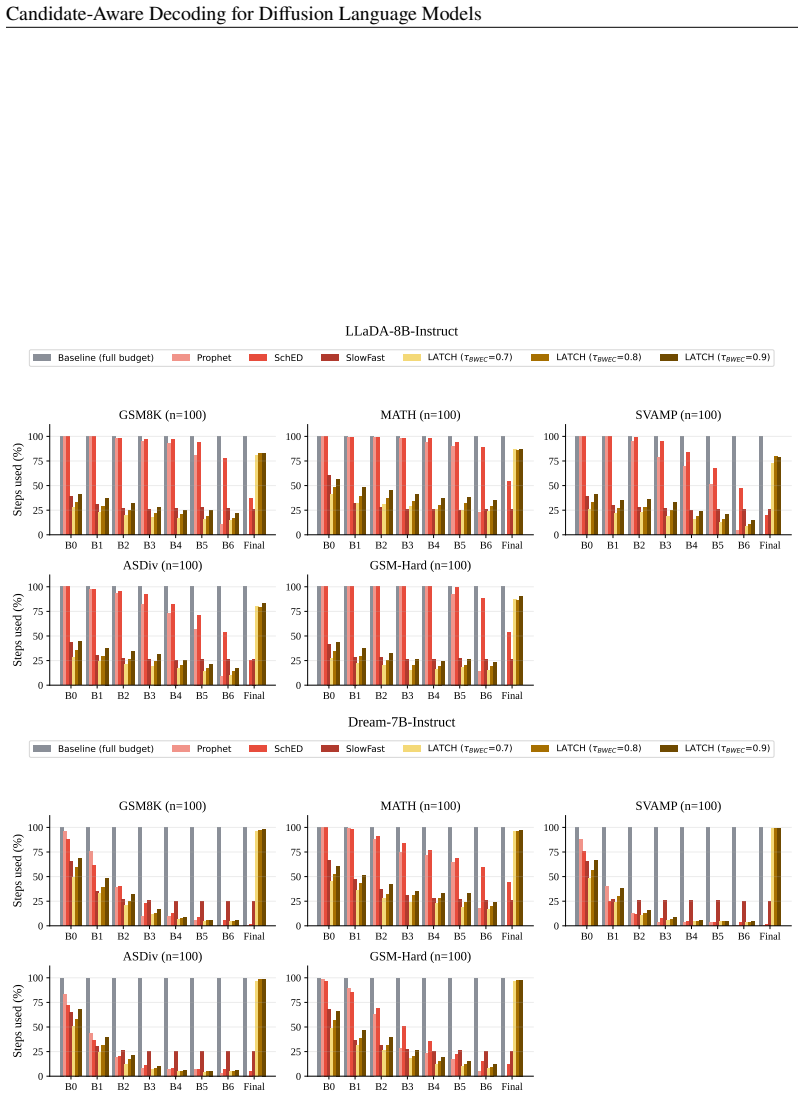
- [Figure 1, Figures 13–20] Figure 1 and several appendix figures use dense multi-panel layouts with small type; ensure axis labels and premature-commit percentages remain legible in single-column print.
- [§4.2, Appendix A.3] Eq. 4’s run_t “pauses, not resets” when no candidate is extractable is important; a one-line pseudocode block in §4.2 or App. A.3 would make the counter semantics easier to reimplement than the prose alone.
- [Table 1] Table 1 marks accuracy drops beyond tolerance in red in the text description; if the camera-ready uses color, also add a non-color marker (e.g. bold or dagger) for accessibility.
- [Title/Abstract] Minor typos/spacing artifacts appear in the compiled text (e.g. “Candidate-A ware”, “generation-timeearly exit”, duplicated title lines). A proofread pass would help.
- [§2] Related work cites many concurrent 2026 arXiv items; where possible, briefly distinguish LATCH from LESS/STDec/TACG on the termination-vs-sampling axis in one sentence each to sharpen novelty.
Circularity Check
No significant circularity: empirical systems method with frozen calibration and external held-out accuracy measurement.
full rationale
LATCH is a training-free decoding procedure (CVC Eq. 4 + BWEC Eq. 5), not a first-principles derivation. Hyperparameters (τ_CVC, γ, p_min, τ_BWEC, tail_frac) are calibrated once on a small LLaDA development pool and then frozen; accuracy and TPS are measured end-to-end against full-decode baselines on held-out examples across 11 tasks and two backbones. Nothing in the central claim reduces by construction to those fitted thresholds: staying within 2.0 points of baseline accuracy is an empirical outcome that could have failed (and does fail for Prophet/SchED/SlowFast/KLASS under the same protocol). There is no self-definitional loop, no fitted quantity renamed as a prediction, no load-bearing uniqueness theorem, and no ansatz smuggled in via overlapping-author citation. Ordinary offline calibration plus format-aware extractors is standard systems practice, not circular derivation. Score 0.
Axiom & Free-Parameter Ledger
free parameters (5)
- τ_CVC =
0.7
- γ (stability multiplier) =
2.0
- p_min =
3
- τ_BWEC =
0.9 (deployed)
- tail_frac =
0.3
axioms (4)
- domain assumption DLM generation is iterative unmasking of a discrete corrupted sequence with revisable per-position predictions at each step.
- ad hoc to paper Under block-wise decoding, non-final blocks can be advanced with local confidence commits without owning the global fill-and-stop decision.
- domain assumption Each evaluated task has a single short answer span recoverable by a deterministic format-specific parser in a fixed search region.
- domain assumption Exact-match accuracy after task-specific extraction is the right quality metric for early-exit safety comparisons.
invented entities (3)
-
Confidence-Verified Commit (CVC)
no independent evidence
-
Block-Wise Early Commit (BWEC)
no independent evidence
-
LATCH
no independent evidence
read the original abstract
Diffusion language models (DLMs) expose a provisional prediction at every denoising step, creating an opportunity for generation-time early exit that stops decoding before the schedule is exhausted. Existing early-exit gates decide termination from fixed-region confidence statistics or schedule-dependent rules, evidence too coarse for a decision that freezes every remaining position at once, so they fire prematurely on long chain-of-thought outputs whose answers stabilize only near the end. Adaptive sampling, the other axis of training-free acceleration, paces how quickly positions commit while decoding continues but never verifies that the output itself has stabilized. We introduce a training-free, candidate-aware early-exit framework that keeps the two axes separate and matches each decision to evidence of its own scope. Confidence-Verified Commit (CVC) governs when the sequence may stop by verifying confidence and sustained argmax stability over the dynamically extracted candidate span using a deterministic parser specified from each task's output format. Block-Wise Early Commit (BWEC) governs where to accelerate by applying a cheaper local rule to non-final blocks, while leaving the final block and global termination under CVC. We refer to their combination as LATCH (Localized Acceleration with Tracked-Candidate Halting). Unlike prior methods, LATCH needs no suffix-prompt construction; it is prompt-anchor-free but format-aware. We evaluate LATCH end to end on 11 tasks under zero-shot settings using LLaDA and Dream. LATCH stays within 2.0 percentage points of full-decoding accuracy across all 22 evaluation settings, with one frozen hyperparameter set that transfers cross-backbone untuned, while achieving end-to-end TPS speedups of 9.3-17.8x on short-answer tasks and 2.0-3.3x on long-reasoning tasks.
Figures






Reference graph
Works this paper leans on
-
[2]
The dataset provides a standard separator between the reasoning chain and the final result. We define the answer region as the tokens following this separator
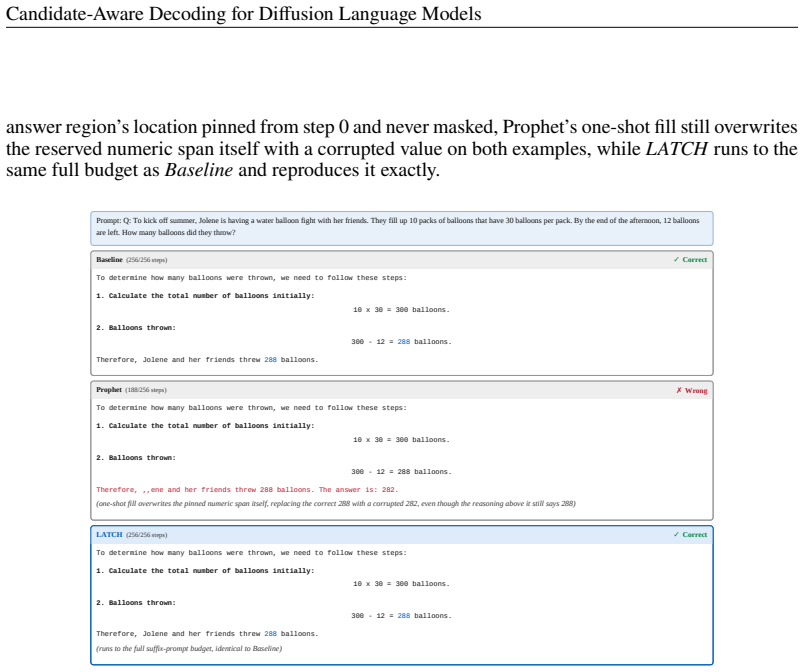
Cakes bought by the friend: The friend bought 140 cakes from the baker. To find out how many cakes the baker still has, we need to subtract the number of cakes bought by the friend from the initial number of cakes. 155 - 140 = 15 So, the baker still has 15 cakes. (CVC never clears its confidence bar early on this example; runs to the full budget and still...
2026
-
[4]
the answer
exists to survive without needing a suffix prompt; a candidate like130or220is briefly "the answer" and may even holdrun≥1for a step or two, but it is competing against four later re-writes, so it rarely accumulates the argmax stability and confidence needed to pass the gate, whereas Prophet’s¯𝑔𝑡 has no equivalent protection, monitoring the same free-form ...
2026
-
[5]
Jiyeon Kim, Sungik Choi, Yongrae Jo, Moontae Lee, and Minjoon Seo
URLhttps://arxiv.org/abs/2506.17298. Jiyeon Kim, Sungik Choi, Yongrae Jo, Moontae Lee, and Minjoon Seo. Early decisions matter: Proximity bias and initial trajectory shaping in non-autoregressive diffusion language models. arXiv preprint arXiv:2604.10567,
-
[6]
Seo Hyun Kim, Sunwoo Hong, Hojung Jung, Youngrok Park, and Se-Young Yun
URLhttps://arxiv.org/abs/2604.10567. Seo Hyun Kim, Sunwoo Hong, Hojung Jung, Youngrok Park, and Se-Young Yun. KLASS: KL- guided fast inference in masked diffusion models. InAdvances in Neural Information Processing Systems 38 (NeurIPS), Spotlight,
-
[7]
arXiv:2511.05664. Pengxiang Li, Yefan Zhou, Dilxat Muhtar, Lu Yin, Shilin Yan, Li Shen, Yi Liang, Soroush Vosoughi, and Shiwei Liu. Diffusion language model knows the answer before it decodes. InThe Fourteenth International Conference on Learning Representations (ICLR),
-
[8]
URLhttps://openreview.net/forum?id=DriG3hgh42. arXiv:2506.06295. AaronLou,ChenlinMeng,andStefanoErmon. Discretediffusionmodelingbyestimatingtheratios ofthedatadistribution. InProceedingsofthe41stInternationalConferenceonMachineLearning (ICML), volume 235 ofProceedings of Machine Learning Research, pp. 32819–32848,
-
[9]
The+1.0 MATH cells sit above baseline because of a single grading-boundary example (the replayed full decode grades32.0against Table 1’s31.0). the final block; we call the ablation that instead makes this same fill-and-stop action eligible from anyblock theany-block-eligible CVC commit; it removes the final-block scoping from theglobal commit decision, no...
2026
-
[10]
11 Candidate-Aware Decoding for Diffusion Language Models Arkil Patel, Satwik Bhattamishra, and Navin Goyal
URL https://openreview.net/forum?id=sMyXP8Tanm. 11 Candidate-Aware Decoding for Diffusion Language Models Arkil Patel, Satwik Bhattamishra, and Navin Goyal. Are NLP models really able to solve simple math word problems? InProceedings of the 2021 Conference of the North American Chapter of the Association for Computational Linguistics (NAACL),
2021
-
[13]
Jiaxin Shi, Kehang Han, Zhe Wang, Arnaud Doucet, and Michalis K. Titsias. Simplified and gener- alized masked diffusion for discrete data. InAdvances in Neural Information Processing Systems 37(NeurIPS),2024. URLhttps://proceedings.neurips.cc/paper_files/paper/2024/ hash/bad233b9849f019aead5e5cc60cef70f-Abstract-Conference.html. Jascha Sohl-Dickstein, Eri...
2024
-
[15]
Chengcheng Wang, Tingzhang Luo, Wenhao Li, Jianyuan Guo, and Chang Xu
URLhttps://arxiv.org/abs/2508.02193. Chengcheng Wang, Tingzhang Luo, Wenhao Li, Jianyuan Guo, and Chang Xu. TACG: Trajectory- aware commit gating for diffusion language model decoding.arXiv preprint arXiv:2607.03236,
-
[16]
URLhttps://openreview.net/forum?id=Uh17FiwF4q. arXiv:2506.10848. Chengyue Wu, Hao Zhang, Shuchen Xue, Zhijian Liu, Shizhe Diao, Ligeng Zhu, Ping Luo, Song Han,andEnzeXie.Fast-dLLM:Training-freeaccelerationofdiffusionLLMbyenablingKVcache and parallel decoding. InThe Fourteenth International Conference on Learning Representations (ICLR),
-
[17]
URLhttps://openreview.net/forum?id=3Z3Is6hnOT. arXiv:2505.22618. Andrea Wynn, Metod Jazbec, Charith Peris, Rinat Khaziev, Anqi Liu, Daniel Khashabi, and Eric Nalisnick. Controlling the risk of corrupted contexts for language models via early-exiting. In Proceedings of the 43rd International Conference on Machine Learning (ICML),
-
[18]
URL https://openreview.net/forum?id=8bUDbWMo5v. arXiv:2510.02480. Zhongyu Xiao, Zhiwei Hao, Jianyuan Guo, Yong Luo, Jia Liu, Jie Xu, and Han Hu. Streaming- dLLM: Accelerating diffusion LLMs via suffix pruning and dynamic decoding.arXiv preprint arXiv:2601.17917,
-
[19]
URLhttps://arxiv.org/abs/2601.17917. Yangxinyu Xie, Tao Wang, Soham Mallick, Yan Sun, Georgy Noarov, Mengxin Yu, Tanwi Mallick, WeijieJ.Su,andEdgarDobriban. Statisticalearlystoppingforreasoningmodels. InProceedings of the 43rd International Conference on Machine Learning (ICML),
-
[20]
URLhttps:// openreview.net/forum?id=TJshRZDdyW. arXiv:2602.13935. 12 Candidate-Aware Decoding for Diffusion Language Models Chenxu Yang, Qingyi Si, Yongjie Duan, Zheliang Zhu, Chenyu Zhu, Qiaowei Li, Minghui Chen, Zheng Lin, and Weiping Wang. Dynamic early exit in reasoning models. InThe Four- teenth International Conference on Learning Representations (ICLR),
-
[21]
Jiacheng Ye, Zhihui Xie, Lin Zheng, Jiahui Gao, Zirui Wu, Xin Jiang, Zhenguo Li, and Lingpeng Kong
URLhttps: //openreview.net/forum?id=NpU7ZXafRi. Jiacheng Ye, Zhihui Xie, Lin Zheng, Jiahui Gao, Zirui Wu, Xin Jiang, Zhenguo Li, and Lingpeng Kong. Dream7B:Diffusionlargelanguagemodels.arXivpreprintarXiv:2508.15487,2025. URL https://arxiv.org/abs/2508.15487. RowanZellers,AriHoltzman,YonatanBisk,AliFarhadi,andYejinChoi.HellaSwag: Canamachine really finish ...
Pith/arXiv arXiv 2025
-
[22]
URLhttps://openreview.net/forum?id=bmKHxLWkz9. arXiv:2602.04096. Kaiwen Zheng, Yongxin Chen, Hanzi Mao, Ming-Yu Liu, Jun Zhu, and Qinsheng Zhang. Masked diffusion models are secretly time-agnostic masked models and exploit inaccurate categorical sampling. InTheThirteenthInternationalConferenceonLearningRepresentations(ICLR),2025. URLhttps://openreview.net...
arXiv 2025
-
[26]
is not a one-sided bet against accuracy: on long-reasoning tasks the downside is not even visible in the metric an aggressive choice is trying to improve. 27 Candidate-Aware Decoding for Diffusion Language Models B0 B1 B2 Final 0 25 50 75 100Steps used (%) MMLU (n=200) B0 B1 B2 Final 0 25 50 75 100 ARC-C (n=200) B0 B1 B2 Final 0 25 50 75 100 HellaSwag (n=...
2026
-
[2018]
Trainingverifierstosolve mathwordproblems.arXivpreprintarXiv:2110.14168,2021
Karl Cobbe, Vineet Kosaraju, Mohammad Bavarian, Mark Chen, Heewoo Jun, Lukasz Kaiser, MatthiasPlappert,JerryTworek,JacobHilton,ReiichiroNakano,etal. Trainingverifierstosolve mathwordproblems.arXivpreprintarXiv:2110.14168,2021. URLhttps://arxiv.org/abs/ 2110.14168. MuzhiDai,ChenxuYang,andQingyiSi.S-GRPO:Earlyexitviareinforcementlearninginreasoning models. ...
Pith/arXiv arXiv 2021
-
[2020]
AmrMohamed,GuokanShang,andMichalisVazirgiannis.LESSismore: Mutual-stabilitysampling for diffusion language models. 2026a. arXiv:2606.16908. Amr Mohamed, Yang Zhang, Michalis Vazirgiannis, and Guokan Shang. Fast-decoding diffusion language models via progress-aware confidence schedules. InFindings of the Association for Computational Linguistics: ACL 2026,...
arXiv 2026
-
[2021]
Jiaoyang Ruan, Xin Gao, Yinda Chen, Hengyu Zeng, Liang Du, Guanghao Li, Jie Fu, and Jian Pu. Reasoning on the manifold: Bidirectional consistency for self-verification in diffusion language models. InProceedingsofthe43rdInternationalConferenceonMachineLearning(ICML),2026. URLhttps://openreview.net/forum?id=CUVBdw2tKy. arXiv:2604.16565. Subham Sekhar Sahoo...
Pith/arXiv arXiv 2026
-
[2022]
DPad: Efficient diffusion language models with suffix dropout
Xinhua Chen, Sitao Huang, Cong Guo, Chiyue Wei, Yintao He, Jianyi Zhang, Hai Helen Li, and Yiran Chen. DPad: Efficient diffusion language models with suffix dropout. In The Fourteenth International Conference on Learning Representations (ICLR), 2026a. URL https://openreview.net/forum?id=0yOsSMU1eY. Yuzhe Chen, Jiale Cao, Xuyang Liu, Jin Xie, Aiping Yang, ...
-
[2024]
Keisuke Sakaguchi, Ronan Le Bras, Chandra Bhagavatula, and Yejin Choi
URLhttps://proceedings.neurips.cc/paper_files/paper/2024/ hash/eb0b13cc515724ab8015bc978fdde0ad-Abstract-Conference.html. Keisuke Sakaguchi, Ronan Le Bras, Chandra Bhagavatula, and Yejin Choi. WinoGrande: An adversarial Winograd schema challenge at scale.Communications of the ACM, 64(9):99–106,
2024
-
[2025]
URL https://openreview.net/forum?id=wNMK5o0Vfg. Zhenbang Du, Kejing Xia, Xinrui Zhong, Yonggan Fu, Nicolai Oswald, Binfei Ji, Brucek Khailany, Pavlo Molchanov, and Yingyan Lin.𝑅2-dLLM: Accelerating diffusion large language models via spatio-temporal redundancy reduction.arXiv preprint arXiv:2604.18995,
-
[2026]
URLhttps://openreview.net/forum?id=KUfKvlX3VY. arXiv:2505.21467. InceptionLabs,SamarKhanna,SiddhantKharbanda,ShufanLi,HarshitVarma,EricWang,Sawyer Birnbaum, Ziyang Luo, Yanis Miraoui, Akash Palrecha, Stefano Ermon, Aditya Grover, and Volodymyr Kuleshov. Mercury: Ultra-fast language models based on diffusion.arXiv preprint arXiv:2506.17298,
discussion (0)
Sign in with ORCID, Apple, or X to comment. Anyone can read and Pith papers without signing in.