REVIEW 3 major objections 4 minor 141 references
All six isovector form factors of the D, D*, B, and B* mesons follow from pion-pion rescattering, with the rho(770) couplings extracted from the pole residues.
Reviewed by Pith at T0; open to challenge. T0 means a machine referee read the full paper against a public rubric. the ladder, T0–T4 →
T0 review · deepseek-v4-flash
2026-08-02 18:22 UTC pith:HAHVCYUP
load-bearing objection A careful dispersive analysis that delivers solid isovector form factors and two ρ couplings, but overclaims the extraction of 'all' ρ couplings since the g^(3) quadrupole coupling is unconstrained. the 3 major comments →
Dispersive Analysis of D- and B-Meson Form Factors with Chiral and Heavy-Quark Constraints
The pith
A machine-rendered reading of the paper's core claim, the machinery that carries it, and where it could break.
Core claim
The central claim is that a single dispersive framework, with pion–pion P-wave rescattering incorporated via the Omnès function and with anomalous-threshold corrections from triangle diagrams, determines all six isovector vector form factors of the heavy–light mesons at low energies. The required M(*)M̄(*) → ππ P-wave amplitudes are built from heavy-meson chiral perturbation theory at leading order in the heavy-quark expansion, with the only fitted contact term (the NLO constant c4) fixed by the D* magnetic moment. The paper shows that the resulting form factors respect heavy-quark symmetry to a few percent, with the most pronounced deviations coming from anomalous thresholds that move onto
What carries the argument
The load-bearing object is the once-subtracted, unitarized dispersive representation of the form factors, built from the unitarity cut relation disc F_i(s) = 2i θ(s−4Mπ²) pπ³/(12π√s) T_i(s) (Fπ^V(s))*, where T_i(s) are the P-wave M(*)M̄(*) → ππ amplitudes and Fπ^V is the pion vector form factor. The T_i are obtained by adding the P-wave projected t/u-channel Born exchanges (with vector- and pseudoscalar-meson poles) to polynomial contact terms, then unitarized through the Muskhelishvili–Omnès equation so that their phase matches the ππ P-wave phase shift. The analysis tracks anomalous thresholds: when the vector-meson mass exceeds the pseudoscalar-plus-pion mass, a triangle singularity moves
Load-bearing premise
The unitarized M(*)M̄(*) → ππ P-wave amplitudes are built from tree-level chiral/heavy-quark effective Lagrangians and then unitarized, but this left-hand-cut model has never been tested against actual heavy-meson–pion scattering data; only the NLO constant c4 is fixed from the D* magnetic moment, while the NNLO constant dNNLO is a dimensional-analysis estimate that changes g(3) by an order of magnitude.
What would settle it
A single reliable measurement of the πD → πD P-wave amplitude in the 0.3–1 GeV region, or a lattice QCD calculation of the D-meson isovector form factors below 1 GeV, would directly validate or refute the input amplitudes; the predicted sharp cusp in F3,B*B* near s ≈ 0.07 GeV² is a particularly clean signature to look for.
If this is right
- The six isovector form factors and the rho(770) couplings to D, D*, B, and B* are predicted without a tunable rho model, fixing c4 from the D* magnetic moment alone.
- Heavy-quark symmetry is approximately reproduced, with deviations concentrated in the D* system and attributed to anomalous-threshold effects—this sharpens expectations for symmetry-breaking patterns in related observables.
- The predicted isovector radii, comparable to the pion radius but with large imaginary parts for the D* multipole radii, can be confronted with future lattice QCD or experimental determinations.
- The anomalous cusp in the B* form factors near s ≈ 0.07 GeV² and the logarithmic divergence in F3 for D* at small negative s provide concrete signatures in eD* → eD* scattering if the unstable-particle issue is resolved.
- The extracted rho couplings provide input for meson-exchange potentials and for models of hidden-charm/bottom XYZ states that are dominated by D(*)D̄(*) thresholds.
Where Pith is reading between the lines
- If the input amplitude model is a faithful low-energy description, the same machinery could be extended to scalar or tensor form factors and to charged-current transitions like D → π lν, where the anomalous-threshold structure would appear in a different kinematic configuration.
- The order-of-magnitude sensitivity of g(3) to the NNLO constant dNNLO suggests that a lattice computation of the electric quadrupole form factor of the D* (or of the rho contribution to F3) would be a direct way to pin down this constant and test the framework.
- The paper's treatment of D* as a stable state with an infinitesimal width leaves a logarithmic divergence that a proper second-sheet continuation with the physical D* width would smear; exploring that continuation could convert the divergence into a measurable narrow peak.
- A future measurement of pion–D-meson scattering in the P wave, or of D* → D e+e− Dalitz distributions once isoscalar contributions are added, would provide an independent, stringent test of the unitarized amplitudes used here.
Editorial analysis
A structured set of objections, weighed in public.
Referee Report
Summary. The paper constructs a dispersive representation of the isovector electromagnetic form factors of D, D*, B, and B* mesons, using heavy-hadron chiral perturbation theory for the M(*)Mbar(*)→ππ P-wave input amplitudes, followed by Muskhelishvili–Omnès unitarization and once-subtracted dispersion relations for the form factors. It treats the anomalous thresholds generated by triangle diagrams, including their movement onto the first Riemann sheet, and extracts ρ(770) coupling constants from the pole residues of the unitarized amplitudes. The central claim is that this yields a model-independent low-energy description of all six isovector form factors and the couplings of the ρ to all four heavy-meson systems, with the only fitted NLO constant c4 fixed by the measured D*→Dγ magnetic moment.
Significance. If the framework is sound, this is a valuable systematic calculation: it combines chiral and heavy-quark symmetries with dispersive unitarization, provides predictions for form factors and mean-squared radii that are in principle measurable, and gives a rigorous definition of ρM(*)M(*) couplings via pole residues. The paper is unusually transparent about its limitations, including the incomplete saturation of the electric-charge sum rule, the unconstrained NNLO contact term, and the logarithmic divergence in F3 for the physical D* region. However, these limitations touch the central claim of extracting 'all' ρ couplings and of providing predictive form factors in the physical region, so they cannot be treated as mere presentation issues.
major comments (3)
- [§5, Eq. (131), Table 3] The coupling g^(3)_ρM*M* is not actually extracted by the framework; Eq. (131) shows it is linearly dependent on the NNLO constant dNNLO, which is only estimated by dimensional analysis in §4.4. The quoted range dNNLO=±0.25 GeV^-2 changes |g^(3)_ρD*D*| from 0.139 GeV^-2 to 1.54–1.76 GeV^-2, i.e. by an order of magnitude, and similarly for B*. Since dNNLO is not determined by any input used in the paper, the numerical value of g^(3) is fixed by an arbitrary higher-order term rather than by the dispersive machinery. The abstract's promise to extract the couplings of the ρ(770) to 'all these heavy mesons' is therefore not supported for one of the five couplings. I recommend either removing g^(3) from the list of extracted couplings, or determining dNNLO from an independent observable and presenting g^(3) as an input-dependent estimate with a clear error budget.
- [§4.3, Eqs. (104)–(105)] Gauge invariance requires the electric form factors at q^2=0 to equal 1/2 for the isovector combination, as stated in Eq. (104). The numerical results in Eq. (105) saturate this sum rule only at the 80% level (F_DbarD(0)=0.421, F_BbarB(0)=0.400, and similar for F1). The subtraction constants in Eq. (89) are said to be determined by the sum rule Eq. (90), so the violation is not a mere normalization convention but an indication that the truncated ππ-only dispersive integrals do not reproduce the exact charge. This matters for the central low-energy predictions: the radii in Table 2 are computed by dividing by the exact normalization (1/2), not by the saturated sum-rule values, and the form factor shapes in Fig. 8 inherit the 20% normalization mismatch. The manuscript needs either to impose Fi(0)=1/2 as an explicit subtraction constant and treat Eq. (90) as a consistency check, or to quant
- [§4.3, paragraph after Eq. (108), and Fig. 12] The paper states that F3 for the D* develops a logarithmic divergence at the anomalous threshold located at s_+≈-0.02 GeV^2, which lies in the physical crossed-channel eD*→eD* region. The divergence is attributed to treating D* as a stable particle with M_V^2→M_V^2+iδ, and it is argued that a proper finite-width treatment would smear the singularity. However, this finite-width implementation is not performed, and the present manuscript therefore leaves a physical observable (the D* electromagnetic form factor in the spacelike region) with a singular, non-predictive behavior. Since one of the stated aims is to provide form factors in the physical region, this unresolved analytic-structure issue is load-bearing for F3 and should be addressed—at least by demonstrating that a finite-width smearing renders the form factor finite and by estimating the residual uncertainty.
minor comments (4)
- [Eq. (16)] The second delta function in the loop integral should be δ(+)(ℓ^2−M_π^2), not δ(+)(q^2−M_π^2). The text currently reads as if both arguments are q-dependent.
- [Eq. (117)] The dimension of c4 is stated as GeV^-2 in Eq. (106) but as GeV^-1 in Eq. (117). This appears to be a units typo and should be corrected, since c4 enters the same contact-term expressions.
- [§4.5 and Table 2] The systematic-error notation in Table 2 (three bracketed errors, one asymmetric) is compact but not fully explained in the caption; a sentence defining the ordering and the one-sided nature of the third error would improve readability.
- [Abstract and §1] The word 'model-independent' is used for the dispersive rescattering treatment, but the input M(*)Mbar(*)→ππ amplitudes are built from tree-level ChPT/HQET Born and contact terms. This is legitimate, but the abstract should be phrased so that the model dependence of the left-hand-cut input is not obscured.
Circularity Check
No circularity: c4 is fixed by an independent magnetic moment, and the dispersive outputs are not identical to the inputs.
full rationale
The derivation chain is self-contained against external data. The only fitted low-energy constant, c4, is fixed in Sect. 4.2 by requiring the dispersive result for the isovector D*→D transition form factor at s=0 to reproduce the measured magnetic moment μD_IV = 1.12(4) GeV^-1 (Eqs. 99–102, 106); the ρM(*)M(*) couplings are then obtained from the pole residues of the unitarized amplitudes (Eq. 127), not from any fit to those couplings. The resulting μD*, μB, μB* values (Sect. 4.3) and the gρMM, gρM*M, g^(1), g^(2) entries of Table 3 are outputs of the dispersion relations, not definitions of the inputs. The ππ phase shift/Omnès input is taken from independent ππ data via the IAM, and F_V^π is fitted to CLEO/Belle/NA7 data, so the rescattering dynamics is not the paper's own result in disguise. The self-citations [59] and [76] are methodological/data-analysis references, not load-bearing uniqueness theorems. The one serious caveat is parametric, not circular: Eq. (131) shows g^(3) depends linearly on the NNLO constant dNNLO, which is only estimated by dimensional analysis and changes |g^(3)| by an order of magnitude for dNNLO = ±0.25 GeV^-2; the paper explicitly discloses this (Sects. 4.4, 4.5, Table 3). An unconstrained parameter is a robustness/underdetermination problem, not a reduction of the prediction to the input. Hence no circular step can be exhibited.
Axiom & Free-Parameter Ledger
free parameters (4)
- c4 (NLO magnetic contact term) =
0.241(7) GeV^-2; 0.304 GeV^-2 in the rho-prime variant
- dNNLO (NNLO contact term) =
±0.25 GeV^-2 (trial values from dimensional analysis)
- alpha_V (pion vector form factor slope) =
0.118(2) GeV^-2
- Dispersion cutoffs scutoff and scutoff,MO =
2.0 GeV^2 and 2.2 GeV^2 central; varied 1.2-4.0 GeV^2
axioms (5)
- domain assumption Heavy-quark spin-flavor symmetry relates D and B systems and determines a common coupling g; 1/m_Q corrections are neglected.
- domain assumption Only ππ intermediate states contribute to the isovector form-factor dispersion integrals; inelastic 4π/πω effects are neglected or estimated via a rho-prime model.
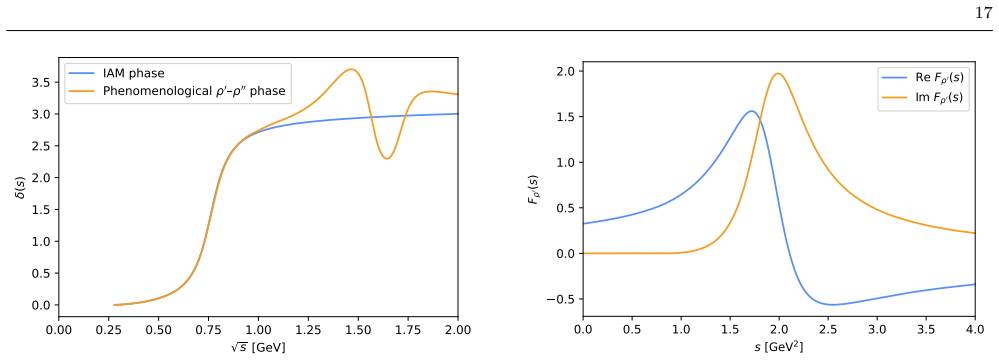
- domain assumption The ππ P-wave phase shift and amplitude are given by the modified inverse-amplitude method with NNLO terms, with phase tending to π at high energies.
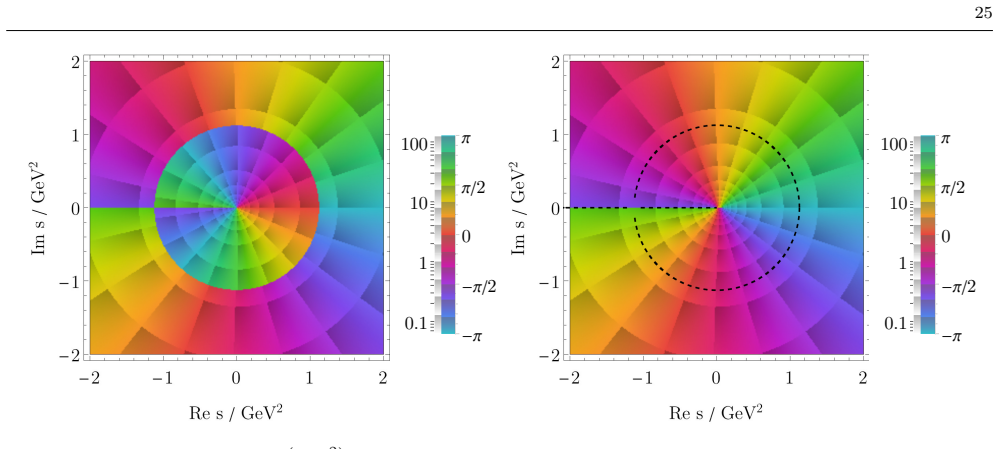
- ad hoc to paper The D* is treated as a stable external particle with M_V^2 -> M_V^2 + iδ; finite-width smearing of the anomalous threshold is not implemented.
- standard math Standard dispersion-theory results: BTT decompositions, Omnes solution, Watson theorem, and Landau equations.
read the original abstract
We analyze the isovector vector form factors of $D$, $D^*$, $B$, and $B^*$ mesons at low energies. We employ all constraints due to chiral and heavy-quark symmetry, and include the physics of resonant pion-pion rescattering in a model-independent way, using dispersion theory. Special attention is paid to the analytic properties of these form factors, which include anomalous thresholds due to triangle diagrams that are located on the physical Riemann sheets in some of the form factors. We extract the couplings of the $\rho(770)$ resonance to all these heavy mesons by determining the appropriate pole residues.
Figures




Reference graph
Works this paper leans on
-
[1]
Weinberg, Physica A 96, 327 (1979)
S. Weinberg, Physica A 96, 327 (1979)
1979
-
[2]
Gasser and H
J. Gasser and H. Leutwyler, Annals Phys. 158, 142 (1984)
1984
-
[3]
M. B. Wise, Phys. Rev. D 45, R2188 (1992)
1992
-
[4]
Yan, H.-Y
T.-M. Yan, H.-Y. Cheng, C.-Y. Cheung, G.-L. Lin, Y. C. Lin, and H.-L. Yu, Phys. Rev. D 46, 1148 (1992), [Erratum: Phys. Rev. D 55, 5851 (1997)]
1992
-
[5]
Burdman and J
G. Burdman and J. F. Donoghue, Phys. Lett. B 280, 287 (1992)
1992
-
[6]
R. Casalbuoni, A. Deandrea, N. Di Bartolomeo, R. Gatto, F. Feruglio, and G. Nardulli, Phys. Rept.281, 145 (1997) [arXiv:hep-ph/9605342]
Pith/arXiv arXiv 1997
-
[7]
Isgur and M
N. Isgur and M. B. Wise, Phys. Lett. B 232, 113 (1989)
1989
-
[8]
Isgur and M
N. Isgur and M. B. Wise, Phys. Lett. B 237, 527 (1990)
1990
-
[9]
Grinstein, Nucl
B. Grinstein, Nucl. Phys. B 339, 253 (1990)
1990
-
[10]
Eichten and B
E. Eichten and B. R. Hill, Phys. Lett. B 234, 511 (1990)
1990
-
[11]
Georgi, Phys
H. Georgi, Phys. Lett. B 240, 447 (1990)
1990
-
[12]
A. V. Manohar and M. B. Wise, Heavy quark physics, Cambridge University Press, 2000
2000
-
[13]
J. J. Sakurai, Annals Phys. 11, 1 (1960)
1960
-
[14]
J. J. Sakurai, Currents and Mesons , University of Chicago Press, 1969
1969
-
[15]
L. G. Landsberg, Phys. Rept. 128, 301 (1985)
1985
-
[16]
Meißner, Phys
U.-G. Meißner, Phys. Rept. 161, 213 (1988)
1988
-
[17]
F. Klingl, N. Kaiser, and W. Weise, Z. Phys. A 356, 193 (1996) [arXiv:hep-ph/9607431]
Pith/arXiv arXiv 1996
-
[18]
S.-s. Fang, B. Kubis, and A. Kup´ s´ c, Prog. Part. Nucl. Phys. 120, 103884 (2021) [arXiv:2102.05922 [hep-ph]]
Pith/arXiv arXiv 2021
-
[19]
B. Ananthanarayan, G. Colangelo, J. Gasser, and H. Leutwyler, Phys. Rept. 353, 207 (2001) [arXiv:hep- ph/0005297]
arXiv 2001
-
[20]
R. Garc ´ ıa-Mart ´ ın, R. Kami´ nski, J. R. Pel´ aez, J. Ruiz de Elvira, and F. J. Yndur´ ain, Phys. Rev. D 83, 074004 (2011) [arXiv:1102.2183 [hep-ph]]
Pith/arXiv arXiv 2011
-
[21]
G. Colangelo, M. Hoferichter, and P. Stoffer, JHEP 02, 006 (2019) [arXiv:1810.00007 [hep-ph]]
Pith/arXiv arXiv 2019
-
[22]
X.-W. Kang, B. Kubis, C. Hanhart, and U.-G. Meißner, Phys. Rev. D 89, 053015 (2014) [arXiv:1312.1193 [hep- ph]]
Pith/arXiv arXiv 2014
-
[23]
C. Granados, S. Leupold, and E. Perotti, Eur. Phys. J. A 53, 117 (2017) [arXiv:1701.09130 [hep-ph]]
Pith/arXiv arXiv 2017
-
[24]
J. Alarc´ on, A. Hiller Blin, M. J. Vicente Va- cas, and C. Weiss, Nucl. Phys. A 964, 18 (2017) [arXiv:1703.04534 [hep-ph]]
Pith/arXiv arXiv 2017
-
[25]
S. Leupold, Eur. Phys. J. A 54, 1 (2018) [arXiv:1707.09210 [hep-ph]]
Pith/arXiv arXiv 2018
-
[26]
O. Junker, S. Leupold, E. Perotti, and T. Vitos, Phys. Rev. C 101, 015206 (2020) [arXiv:1910.07396 [hep-ph]]
Pith/arXiv arXiv 2020
-
[27]
Y.-H. Lin, H.-W. Hammer, and U.-G. Meißner, Eur. Phys. J. A 59, 54 (2023) [arXiv:2205.00850 [hep-ph]]
Pith/arXiv arXiv 2023
-
[28]
F. Alvarado, D. An, L. Alvarez-Ruso, and S. Leupold, Phys. Rev. D 108, 114021 (2023) [arXiv:2310.07796 [hep-ph]]
Pith/arXiv arXiv 2023
-
[29]
M. M. Aung, S. Leupold, E. Perotti, and Y. Yan, Phys. Rev. D 111, 114021 (2025) [arXiv:2401.17756 [hep-ph]]
Pith/arXiv arXiv 2025
- [30]
-
[31]
S. L. Olsen, T. Skwarnicki, and D. Zieminska, Rev. Mod. Phys. 90, 015003 (2018) [arXiv:1708.04012 [hep-ph]]
Pith/arXiv arXiv 2018
-
[32]
N. Brambilla, S. Eidelman, C. Hanhart, A. Nefediev, C.-P. Shen, C. E. Thomas, A. Vairo, and C.-Z. Yuan, Phys. Rept. 873, 1 (2020) [arXiv:1907.07583 [hep-ex]]
Pith/arXiv arXiv 2020
-
[33]
F.-K. Guo, C. Hanhart, U.-G. Meißner, Q. Wang, Q. Zhao, and B.-S. Zou, Rev. Mod. Phys. 90, 015004 (2018) [arXiv:1705.00141 [hep-ph]], [Erratum: Rev. Mod. Phys. 94, 029901 (2022)]
Pith/arXiv arXiv 2018
-
[34]
Y.-R. Liu, H.-X. Chen, W. Chen, X. Liu, and S.- L. Zhu, Prog. Part. Nucl. Phys. 107, 237 (2019) [arXiv:1903.11976 [hep-ph]]
Pith/arXiv arXiv 2019
-
[35]
H.-X. Chen, W. Chen, X. Liu, Y.-R. Liu, and S.-L. Zhu, Rept. Prog. Phys. 86, 026201 (2023) [arXiv:2204.02649 [hep-ph]]
Pith/arXiv arXiv 2023
-
[36]
L. Meng, B. Wang, G.-J. Wang, and S.-L. Zhu, Phys. Rept. 1019, 1 (2023) [arXiv:2204.08716 [hep-ph]]
Pith/arXiv arXiv 2023
-
[37]
J. T. Chacko, V. Baru, C. Hanhart, and S. L. Krug, Phys. Rev. D 111, 034042 (2025) [arXiv:2411.13303 [hep-ph]]
Pith/arXiv arXiv 2025
-
[38]
M. B. Voloshin and L. B. Okun, JETP Lett. 23, 333 (1976)
1976
-
[39]
Navas et al.[Particle Data Group], Phys
S. Navas et al.[Particle Data Group], Phys. Rev. D 110, 030001 (2024). 27
2024
-
[40]
W. A. Bardeen and W. K. Tung, Phys. Rev. 173, 1423 (1968), [Erratum: Phys. Rev. D 4, 3229 (1971)]
1968
-
[41]
Tarrach, Nuovo Cim
R. Tarrach, Nuovo Cim. A 28, 409 (1975)
1975
-
[42]
K. J. Kim and Y.-S. Tsai, Phys. Rev. D 7, 3710 (1973)
1973
-
[43]
R. G. Arnold, C. E. Carlson, and F. Gross, Phys. Rev. C 21, 1426 (1980)
1980
-
[44]
R. G. Arnold, C. E. Carlson, and F. Gross, Phys. Rev. C 23, 363 (1981)
1981
-
[45]
S. J. Brodsky and J. R. Hiller, Phys. Rev. D 46, 2141 (1992)
1992
-
[46]
Jacob and G
M. Jacob and G. C. Wick, Annals Phys. 7, 404 (1959)
1959
-
[47]
T. Becher and H. Leutwyler, Eur. Phys. J. 9, 643 (1999) [arXiv:hep-ph/9901384]
Pith/arXiv arXiv 1999
-
[48]
B. Kubis and U.-G. Meißner, Nucl. Phys. A 679, 698 (2001) [arXiv:hep-ph/0007056]
Pith/arXiv arXiv 2001
-
[49]
Weinberg, Phys
S. Weinberg, Phys. Rev. Lett. 17, 616 (1966)
1966
-
[50]
Tomozawa, Nuovo Cim
Y. Tomozawa, Nuovo Cim. A 46, 707 (1966)
1966
-
[51]
N. Fettes, U.-G. Meißner, and S. Steininger, Nucl. Phys. A 640, 199 (1998) [arXiv:hep-ph/9803266]
Pith/arXiv arXiv 1998
-
[52]
M. Holmberg and S. Leupold, Eur. Phys. J. A 54, 103 (2018) [arXiv:1802.05168 [hep-ph]]
Pith/arXiv arXiv 2018
-
[53]
S.-Z. Jiang, Y.-R. Liu, and Q.-H. Yang, Phys. Rev. D 99, 074018 (2019) [arXiv:1901.09479 [hep-ph]]
Pith/arXiv arXiv 2019
-
[54]
F.-K. Guo, C. Hanhart, and U.-G. Meißner, Eur. Phys. J. A 40, 171 (2009) [arXiv:0901.1597 [hep-ph]]
Pith/arXiv arXiv 2009
-
[55]
M. F. M. Lutz, X.-Y. Guo, Y. Heo, and C. L. Korpa, Phys. Rev. D 106, 114038 (2022) [arXiv:2209.10601 [hep-ph]]
Pith/arXiv arXiv 2022
-
[56]
K. M. Watson, Phys. Rev. 95, 228 (1954)
1954
-
[57]
N. I. Muskhelishvili, Singular Integral Equations , Wolters-Noordhoff Publishing, 1953. [Dover Publica- tions, 2nd edition, 2008]
1953
-
[58]
Omn` es, Nuovo Cim.8, 316 (1958)
R. Omn` es, Nuovo Cim.8, 316 (1958)
1958
-
[59]
S. Mutke, M. Hoferichter, and B. Kubis, JHEP 07, 276 (2024) [arXiv:2406.14608 [hep-ph]]
Pith/arXiv arXiv 2024
-
[60]
W. Lucha, D. Melikhov, and S. Simula, Phys. Rev. D75, 016001 (2007) [arXiv:hep-ph/0610330], [Erratum: Phys. Rev. D 92, 019901 (2015)]
Pith/arXiv arXiv 2007
-
[61]
M. Hoferichter, G. Colangelo, M. Procura, and P. Stof- fer, Int. J. Mod. Phys. Conf. Ser. 35, 1460400 (2014) [arXiv:1309.6877 [hep-ph]]
Pith/arXiv arXiv 2014
-
[62]
G. Colangelo, M. Hoferichter, M. Procura, and P. Stof- fer, JHEP 09, 074 (2015) [arXiv:1506.01386 [hep-ph]]
Pith/arXiv arXiv 2015
-
[63]
M. Hoferichter and P. Stoffer, JHEP 07, 073 (2019) [arXiv:1905.13198 [hep-ph]]
Pith/arXiv arXiv 2019
-
[64]
L. D. Landau, Nucl. Phys. 13, 181 (1959), [Sov. Phys. JETP 10 (1960) 45; Zh. Eksp. Teor. Fiz. 37 (1959) 62]
1959
-
[65]
V. N. Gribov, V. V. Anisovich, and A. A. Anselm, Sov. Phys. JETP 15, 159 (1962)
1962
-
[66]
J. B. Bronzan and C. Kacser, Phys. Rev. 132, 2703 (1963)
1963
-
[67]
M. Niehus, M. Hoferichter, and B. Kubis, JHEP 12, 038 (2021) [arXiv:2110.11372 [hep-ph]]
Pith/arXiv arXiv 2021
-
[68]
W. R. Frazer and J. R. Fulco, Phys. Rev. 117, 1603 (1960)
1960
-
[69]
H¨ ohler and E
G. H¨ ohler and E. Pietarinen, Phys. Lett. B 53, 471 (1975)
1975
-
[70]
V. Bernard, N. Kaiser, and U.-G. Meißner, Nucl. Phys. A 611, 429 (1996) [arXiv:hep-ph/9607428]
Pith/arXiv arXiv 1996
-
[71]
M. Dax, T. Isken, and B. Kubis, Eur. Phys. J. C 78, 859 (2018) [arXiv:1808.08957 [hep-ph]]
Pith/arXiv arXiv 2018
-
[72]
M. Niehus, M. Hoferichter, B. Kubis, and J. Ruiz de Elvira, Phys. Rev. Lett. 126, 102002 (2021) [arXiv:2009.04479 [hep-ph]]
Pith/arXiv arXiv 2021
-
[73]
Dobado, M
A. Dobado, M. J. Herrero, and T. N. Truong, Phys. Lett. B 235, 134 (1990)
1990
-
[74]
A. Dobado and J. R. Pel´ aez, Phys. Rev. D 56, 3057 (1997) [arXiv:hep-ph/9604416]
Pith/arXiv arXiv 1997
-
[75]
S. Holz, J. Plenter, C.-W. Xiao, T. Dato, C. Hanhart, B. Kubis, U.-G. Meißner, and A. Wirzba, Eur. Phys. J. C 81, 1002 (2021) [arXiv:1509.02194 [hep-ph]]
Pith/arXiv arXiv 2021
-
[76]
S. Holz, M. Hoferichter, B.-L. Hoid, and B. Kubis, JHEP 04, 147 (2025) [arXiv:2412.16281 [hep-ph]]
Pith/arXiv arXiv 2025
-
[77]
Y. Aoki et al. [Flavour Lattice Averaging Group (FLAG) Collaboration], Eur. Phys. J. C 82, 869 (2022) [arXiv:2111.09849 [hep-lat]]
Pith/arXiv arXiv 2022
-
[78]
A. Bazavov et al. [MILC Collaboration], PoS LA T- TICE2010, 074 (2010) [arXiv:1012.0868 [hep-lat]]
Pith/arXiv arXiv 2010
-
[79]
S. Bors´ anyi, S. D¨ urr, Z. Fodor, S. Krieg, A. Sch¨ afer, E. E. Scholz, and K. K. Szab´ o, Phys. Rev. D88, 014513 (2013) [arXiv:1205.0788 [hep-lat]]
Pith/arXiv arXiv 2013
-
[80]
S. D¨ urret al. [BMW Collaboration], Phys. Rev. D 90, 114504 (2014) [arXiv:1310.3626 [hep-lat]]
Pith/arXiv arXiv 2014
discussion (0)
Sign in with ORCID, Apple, or X to comment. Anyone can read and Pith papers without signing in.