REVIEW 3 major objections 4 minor 4 cited by
Reflective Gaussian Splatting
T0 review · 3 major / 4 minor · reviewed 2026-08-11 · deepseek-v4-flash
Pith's one-line read This paper presents Ref-Gaussian, a real-time Gaussian-splatting renderer for reflective surfaces that models inter-reflection by combining split-sum deferred shading with ray-traced binary visibility.
desk verdict Solid engineering with credible NVS results; the inter-reflection claim is overclaimed and needs revalidation. read the letter →
The pith
A machine-rendered reading of the paper's core claim, the machinery that carries it, and where it could break.
The reading
What carries the argument
The core is a split-sum approximation of the rendering equation evaluated after $\alpha$-blending, so that material properties (albedo, metallic, roughness, normal) are aggregated per-pixel; the specular integral is factorized into a precomputed BRDF term and an environment-map convolution. The inter-reflection extension (Eqs. 9–10) adds an indirect term $L_{\mathrm{ind}}$: each Gaussian carries spherical-harmonic coefficients, evaluated in the reflected direction $R = 2(\omega_o \cdot N)N - \omega_o$, and the aggregate is multiplied by $(1 - V)$ where $V$ is a per-pixel binary visibility from ray tracing against a TSDF mesh. Geometry support comes from 2D Gaussian disks, a per-Gaussian shading initialization stage, and a material-aware normal propagation that enlarges high-metallic, low-roughness Gaussians.
What would settle it
Render a scene with two parallel mirrors facing each other and compare against a path-traced reference; because Ref-Gaussian uses only single-bounce binary visibility and an SH-based indirect term evaluated in the reflected direction, it cannot represent the series of bounces that such a scene produces, so the multiply-reflected pattern should be missing or blurred.
Extended reading notes
Core claim
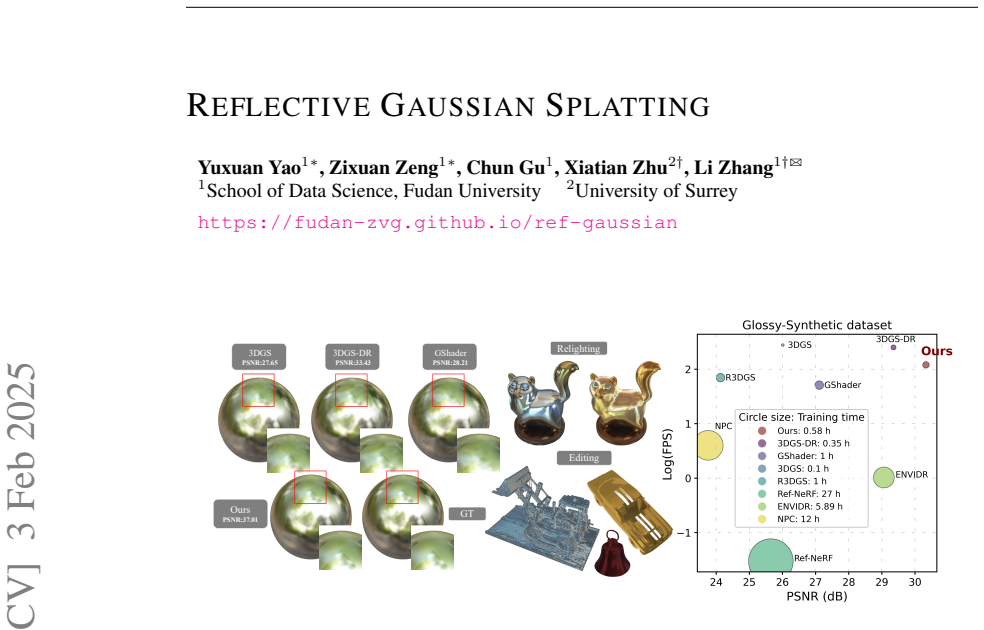
The paper's central claim is that inter-reflection can be incorporated into Gaussian splatting without leaving the real-time regime. The method separates the specular term into a direct part from a pre-integrated environment map and an indirect part computed from per-Gaussian spherical-harmonic colors evaluated along the reflected direction; the indirect part is gated by a binary visibility flag obtained by tracing one ray per pixel against a mesh that is periodically extracted during training. With 2D Gaussian primitives, a per-Gaussian shading pre-stage, and material-aware normal propagation, Ref-Gaussian reports higher PSNR and SSIM and lower LPIPS than prior reflective-object methods on the Shiny Blender, Glossy Synthetic, and Ref-Real datasets, at 122 FPS and roughly 0.58 hours of training per scene.
Load-bearing premise
The inter-reflection model rests on a single binary ray test along the exact mirror direction deciding whether a surface is occluded from its environment.
Editorial extensions
If this is right
- Real-time rendering of reflective objects becomes feasible on a single A6000 GPU (122 FPS), making interactive relighting and editing possible.
- The method works as a unified solution for both glossy and matte scenes, so users do not need to switch representations by surface type.
- The split-sum approximation avoids Monte Carlo noise, keeping training fast (about 0.58 hours) while still modeling inter-reflection.
- Downstream applications such as relighting and editing follow directly from the decomposed materials and environment map.
Reading between the lines
- Editorial inference: the single-ray binary visibility restricts $L_{\mathrm{ind}}$ to a single mirror bounce; scenes with two facing mirrors or strong multi-bounce reflections are a stress test the paper does not run.
- Editorial inference: because $L_{\mathrm{ind}}$ is a per-Gaussian spherical-harmonic color in the reflected direction, it can also absorb view-dependent residuals that are not true inter-reflection; an evaluation that isolates a known inter-reflection component would separate the two.
- Editorial inference: the material-aware normal propagation (growing Gaussians with high metallic and low roughness) suggests a cheap regularizer for other deferred-shading radiance fields, independent of the inter-reflection machinery.
- Editorial inference: substituting a learned or precomputed multi-ray visibility for the binary flag could extend the same framework to global illumination without giving up the real-time property.
Signed reviews
Editorial analysis
A structured set of objections, weighed in public.
Referee Report
Summary. The paper proposes Ref-Gaussian, a 2D Gaussian Splatting framework for inverse rendering of reflective scenes. It combines pixel-level deferred shading with a simplified Disney BRDF and split-sum environment lighting, and adds an inter-reflection term Lind modeled as per-Gaussian spherical harmonics evaluated in the reflected direction, gated by a binary visibility computed by ray tracing on a TSDF-extracted mesh. Geometry optimization is supported by 2D Gaussian primitives, an initial per-Gaussian shading stage, and material-aware normal propagation. The authors report strong novel-view-synthesis results on Shiny Blender, Glossy Synthetic, and Ref-Real datasets, with training times and frame rates competitive with or better than NeRF-based and several Gaussian-based baselines, and they demonstrate relighting and editing applications.
Significance. If the inter-reflection claim is established, the paper would be a meaningful contribution: it would be the first Gaussian-splatting formulation to explicitly model indirect specular inter-reflection while retaining real-time rendering, and the material/lighting decomposition enables downstream relighting and editing. The strengths of the paper are its extensive external benchmarks (Table 1 and appendix Tables 5-8), a thorough ablation suite (Tables 3-4), and concrete, reproducible efficiency numbers. The main risk is that the physical interpretation of Lind is not independently validated: the ablation effect is small and could be explained by added view-dependent fitting capacity rather than true indirect illumination.
major comments (3)
- [Section 3.2, Eq. (9)-(10), Appendix A.1, Table 4] The central novelty claim that Lind 'realizes the inter-reflection function' is not supported by the evidence presented. Eq. (10) defines Lind as per-Gaussian spherical harmonics evaluated in the reflected direction and alpha-blended, which is the same functional form as the ordinary 3DGS view-dependent color in Eq. (2); the only physical coupling is the binary visibility V in Eq. (9), computed from a single ray along the mirror direction. Appendix A.1 explicitly concedes that this ignores the rest of the specular lobe. Since Lind is fitted from the same RGB reconstruction loss as all other parameters, it can absorb residual view-dependent signal in pixels flagged as occluded, regardless of physical origin. The ablation in Table 4 measures only 0.19 dB PSNR, 0.001 SSIM, and 0.001 LPIPS when removing inter-reflection, with no statistical significance, and there is no comparison against path-traced indirect illumination on the Glossy Synthetic dataset where ground truth is available. I request a quantitative validation of Lind against reference indirect radiance (e.g., rendered with Blender Cycles) and/or an isolation experiment where only indirect light is rendered and compared to ground truth, preferably with a capacity-matched baseline that has the same SH residual but without visibility gating.
- [Abstract, Conclusion, Table 2] The abstract and conclusion state that Ref-Gaussian 'surpasses existing approaches' in compute efficiency, but Table 2 shows that 3DGS-DR trains in 0.35h versus 0.58h for Ref-Gaussian and renders at 251 FPS versus 122 FPS. The efficiency claim is defensible only against NeRF-based and slower Gaussian baselines. Please qualify the claim or provide an efficiency-equitable comparison, for example quality-versus-time curves and repeated runs with error bars.
- [Appendix A.3, Table 8] A.3 states that Ref-Gaussian 'excels over both alternatives' on the NeRF-Synthetic dataset, but Table 8 shows that Ref-Gaussian is not uniformly superior to 3DGS: chair PSNR is 34.71 versus 35.03, lego PSNR is 33.46 versus 33.71, and ship SSIM/LPIPS are 0.898/0.125 versus 0.906/0.111. The unified-solution claim should be supported by averages and appropriate significance testing, or softened to reflect the mixed per-scene results.
minor comments (4)
- [Section 4, Implementation Details] The sentence 'retaining only the the geometry of Gaussians' contains a duplicated article; Appendix A.3 also contains the typo 'soluton'.
- [Table 2] Training time and FPS are reported as single scalars with no indication of whether these are single-run measurements or averages across scenes; please state the measurement protocol and, if possible, report variance.
- [Figure 9 caption] The caption 'w/w/o' is ambiguous; please spell out 'with/without' for readability.
- [Section 3.1, Eq. (8)] The split-sum approximation as written could be clarified by stating explicitly how the GGX distribution is normalized in the pre-integrated environment map lookups, to avoid ambiguity about energy conservation.
Circularity Check
Inter-reflection novelty reduces to a relabeled per-Gaussian SH color: Eq. 10 is the standard 3DGS alpha-blending formula fit to training views, not a physically validated indirect-light prediction.
-
renaming known result
[Section 3.2, Eqs. (9)-(10); compare Eq. (2) in Section 3 and Table 4]
"We represent the indirect light from occluded part as Lind: L′s(ωo) ≈ ( Z Ω fs(ωi, ωo)(ωi · N )dωi) · [Ldir · V + Lind · (1 − V )]. (9) ... For the indirect lighting component, each Gaussian is assigned an additional view-dependent color lind, modeled by spherical harmonics. During the rendering process,lind is evaluated in the reflected direction at the Gaussian level, and alpha blending is applied to aggregate the indirect lighting map as follows: Lind = NX i=1 lindαi i−1Y j=1 (1 − αj). (10)"
Equation (10) is the same alpha-blending formula as the standard 3DGS view-dependent color in Eq. (2), with the per-Gaussian SH color renamed lind and evaluated at the reflected direction; the only physical coupling is the binary mask (1−V) from a single mirror ray. Since lind is optimized solely by the RGB reconstruction loss against the training views and is never supervised by ground-truth or path-traced indirect radiance, the 'indirect light' term is, by construction, whatever residual color minimizes the masked-pixel reconstruction error. Calling this 'Gaussian-grounded inter-reflection' is therefore a relabeling of ordinary SH view-dependent fitting capacity.
full rationale
The paper's central novel-view-synthesis claim is benchmarked against external datasets (Shiny Blender, Glossy Synthetic, Ref-Real) and does not depend on a self-citation chain, so most of the method is not circular. The load-bearing concern is the Gaussian-grounded inter-reflection component: Eq. (10) defines Lind as alpha-blended per-Gaussian spherical-harmonic colors, which is the same functional form as the standard 3DGS view-dependent color in Eq. (2), with only the evaluation direction changed to the reflected direction and a binary visibility mask applied. Because lind is fitted purely through the reconstruction loss and is never compared with measured or simulated indirect radiance, the quantity called 'indirect light' is defined as whatever residual fits the masked pixels. The claim of realizing the inter-reflection function for the first time is therefore partly a renaming of standard SH view-dependent fitting capacity rather than a physically derived and independently verified prediction. The small ablation difference in Table 4 further supports the view that the term adds fitting capacity. This is a partial circularity affecting the physical-interpretation novelty, but the quantitative rendering comparisons and the PBR deferred-shading pipeline retain independent content, so the score is 4 rather than 6.
Assumptions & free parameters
free parameters (4)
- Loss balancing weights (lambda=0.2, lambda_n=0.05, lambda_smooth=1.0) =
0.2 / 0.05 / 1.0
- Material-aware normal propagation thresholds =
metallic >= 0.02, roughness <= 0.1
- Training stage lengths =
18,000 per-Gaussian steps; about 40,000 deferred steps
- Initial roughness and mesh extraction interval =
roughness 0.1; mesh every 3,000 steps
assumptions (5)
- domain assumption Split-sum approximation of the specular rendering equation is accurate enough for material and lighting decomposition.
- domain assumption Disney BRDF with albedo, metallic, and roughness is an adequate material model for these scenes.
- domain assumption TSDF-fused mesh extracted from 2D Gaussians is an accurate proxy for visibility ray tracing.
- ad hoc to paper A per-Gaussian spherical harmonic directivity can represent true indirect inter-reflection.
- domain assumption 2D Gaussian primitives are a valid surface representation for reflective object reconstruction.
Cite this review
Pith. "Pith review of Reflective Gaussian Splatting." pith.science (2026). https://pith.science/paper/HBWHFMHY
@misc{pith2026241219282,
  author       = {Pith},
  title        = {Pith review of: Reflective Gaussian Splatting},
  year         = {2026},
  howpublished = {\url{https://pith.science/paper/HBWHFMHY}},
  note         = {Machine review of arXiv:2412.19282}
}
read the original abstract
Novel view synthesis has experienced significant advancements owing to increasingly capable NeRF- and 3DGS-based methods. However, reflective object reconstruction remains challenging, lacking a proper solution to achieve real-time, high-quality rendering while accommodating inter-reflection. To fill this gap, we introduce a Reflective Gaussian splatting (Ref-Gaussian) framework characterized with two components: (I) Physically based deferred rendering that empowers the rendering equation with pixel-level material properties via formulating split-sum approximation; (II) Gaussian-grounded inter-reflection that realizes the desired inter-reflection function within a Gaussian splatting paradigm for the first time. To enhance geometry modeling, we further introduce material-aware normal propagation and an initial per-Gaussian shading stage, along with 2D Gaussian primitives. Extensive experiments on standard datasets demonstrate that Ref-Gaussian surpasses existing approaches in terms of quantitative metrics, visual quality, and compute efficiency. Further, we show that our method serves as a unified solution for both reflective and non-reflective scenes, going beyond the previous alternatives focusing on only reflective scenes. Also, we illustrate that Ref-Gaussian supports more applications such as relighting and editing.
Figures


Figures from the paper (9 more)


Forward citations
Cited by 4 Pith papers
-
Beyond a Single Light: A Large-Scale Aerial Dataset for Urban Scene Reconstruction Under Varying Illumination
SkyLume contributes 10 real-world UAV urban regions captured at morning, noon, and afternoon with LiDAR-based ground truth, plus the Temporal Consistency Coefficient metric for cross-time albedo stability.
-
AG$^2$aussian: Anchor-Graph Structured Gaussian Splatting for Instance-Level 3D Scene Understanding and Editing
An anchor-graph structured 3D Gaussians representation, with graph-based feature propagation and region growing, achieves cleaner instance-level object selection and better editing/simulation results than free-Gaussia...
-
CTRL-GS: Cascaded Temporal Residue Learning for 4D Gaussian Splatting
CTRL-GS represents dynamic Gaussian scenes as cascaded video-segment-frame residuals, improving reconstruction quality over 4D-GS on several dynamic-view benchmarks.
-
GOGS: High-Fidelity Geometry and Relighting for Glossy Objects via Gaussian Surfels
GOGS rebuilds geometry of shiny objects using split-sum shading and monocular depth/normal priors, then decomposes materials with Monte Carlo sampling of the full rendering equation and a learnable specular compensation term.
Reference graph
Works this paper leans on
-
[1]
write newline
" write newline "" before.all 'output.state := FUNCTION n.dashify 't := "" t empty not t #1 #1 substring "-" = t #1 #2 substring "--" = not "--" * t #2 global.max substring 't := t #1 #1 substring "-" = "-" * t #2 global.max substring 't := while if t #1 #1 substring * t #2 global.max substring 't := if while FUNCTION format.date year duplicate empty "emp...
-
[2]
J. T. Barron, B. Mildenhall, M. Tancik, P. Hedman, R. Martin-Brualla, and P. P. Srinivasan. Mip-nerf: A multiscale representation for anti-aliasing neural radiance fields. In ICCV, 2021
work page 2021
-
[3]
J. T. Barron, B. Mildenhall, D. Verbin, P. P. Srinivasan, and P. Hedman. Mip-nerf 360: Unbounded anti-aliased neural radiance fields. In CVPR, 2022
work page 2022
-
[4]
J. T. Barron, B. Mildenhall, D. Verbin, P. P. Srinivasan, and P. Hedman. Zip-nerf: Anti-aliased grid-based neural radiance fields. In ICCV, 2023
work page 2023
-
[5]
M. Boss, R. Braun, V. Jampani, J. T. Barron, C. Liu, and H. Lensch. Nerd: Neural reflectance decomposition from image collections. In ICCV, 2021 a
work page 2021
-
[6]
M. Boss, V. Jampani, R. Braun, C. Liu, J. Barron, and H. Lensch. Neural-pil: Neural pre-integrated lighting for reflectance decomposition. NeurIPS, 2021 b
work page 2021
-
[7]
M. Boss, A. Engelhardt, A. Kar, Y. Li, D. Sun, J. Barron, H. Lensch, and V. Jampani. Samurai: Shape and material from unconstrained real-world arbitrary image collections. NeurIPS, 2022
work page 2022
-
[8]
B. Burley and W. D. A. Studios. Physically-based shading at disney. In SIGGRAPH, 2012
work page 2012
Show all 38 references
-
[9]
A. Chen, Z. Xu, A. Geiger, J. Yu, and H. Su. Tensorf: Tensorial radiance fields. In ECCV, 2022
2022
-
[10]
Fridovich-Keil, A
S. Fridovich-Keil, A. Yu, M. Tancik, Q. Chen, B. Recht, and A. Kanazawa. Plenoxels: Radiance fields without neural networks. In CVPR, 2022
2022
-
[11]
J. Gao, C. Gu, Y. Lin, H. Zhu, X. Cao, L. Zhang, and Y. Yao. Relightable 3d gaussian: Real-time point cloud relighting with brdf decomposition and ray tracing. arXiv preprint, 2023
2023
-
[12]
Huang, Z
B. Huang, Z. Yu, A. Chen, A. Geiger, and S. Gao. 2d gaussian splatting for geometrically accurate radiance fields. In SIGGRAPH, 2024
2024
-
[13]
Jiang, J
Y. Jiang, J. Tu, Y. Liu, X. Gao, X. Long, W. Wang, and Y. Ma. Gaussianshader: 3d gaussian splatting with shading functions for reflective surfaces. In CVPR, 2024
2024
-
[14]
H. Jin, I. Liu, P. Xu, X. Zhang, S. Han, S. Bi, X. Zhou, Z. Xu, and H. Su. Tensoir: Tensorial inverse rendering. In CVPR, 2023
2023
-
[15]
Kerbl, G
B. Kerbl, G. Kopanas, T. Leimk \"u hler, and G. Drettakis. 3d gaussian splatting for real-time radiance field rendering. ACM Trans. Graph., 2023
2023
-
[16]
Liang, H
R. Liang, H. Chen, C. Li, F. Chen, S. Panneer, and N. Vijaykumar. Envidr: Implicit differentiable renderer with neural environment lighting. In ICCV, 2023
2023
-
[17]
Liang, Q
Z. Liang, Q. Zhang, Y. Feng, Y. Shan, and K. Jia. Gs-ir: 3d gaussian splatting for inverse rendering. In CVPR, 2024
2024
-
[18]
Y. Liu, P. Wang, C. Lin, X. Long, J. Wang, L. Liu, T. Komura, and W. Wang. Nero: Neural geometry and brdf reconstruction of reflective objects from multiview images. ACM Trans. Graph., 2023
2023
-
[19]
Mildenhall, P
B. Mildenhall, P. P. Srinivasan, M. Tancik, J. T. Barron, R. Ramamoorthi, and R. Ng. Nerf: Representing scenes as neural radiance fields for view synthesis. In ECCV, 2020
2020
-
[20]
Mildenhall, P
B. Mildenhall, P. P. Srinivasan, M. Tancik, J. T. Barron, R. Ramamoorthi, and R. Ng. Nerf: Representing scenes as neural radiance fields for view synthesis. Commun. ACM, 2021
2021
-
[21]
M \"u ller, A
T. M \"u ller, A. Evans, C. Schied, and A. Keller. Instant neural graphics primitives with a multiresolution hash encoding. TOG, 2022
2022
-
[22]
Munkberg, J
J. Munkberg, J. Hasselgren, T. Shen, J. Gao, W. Chen, A. Evans, T. M \"u ller, and S. Fidler. Extracting triangular 3d models, materials, and lighting from images. In CVPR, 2022
2022
-
[23]
Y. Shi, Y. Wu, C. Wu, X. Liu, C. Zhao, H. Feng, J. Liu, L. Zhang, J. Zhang, B. Zhou, et al. Gir: 3d gaussian inverse rendering for relightable scene factorization. arXiv preprint, 2023
2023
-
[24]
P. P. Srinivasan, B. Deng, X. Zhang, M. Tancik, B. Mildenhall, and J. T. Barron. Nerv: Neural reflectance and visibility fields for relighting and view synthesis. In CVPR, 2021
2021
-
[25]
C. Sun, M. Sun, and H. Chen. Direct voxel grid optimization: Super-fast convergence for radiance fields reconstruction. In CVPR, 2022
2022
-
[26]
Verbin, P
D. Verbin, P. Hedman, B. Mildenhall, T. Zickler, J. T. Barron, and P. P. Srinivasan. Ref-nerf: Structured view-dependent appearance for neural radiance fields. In CVPR, 2022
2022
-
[27]
P. Wang, L. Liu, Y. Liu, C. Theobalt, T. Komura, and W. Wang. Neus: Learning neural implicit surfaces by volume rendering for multi-view reconstruction. arXiv preprint, 2021
2021
-
[28]
Z. Wang, A. C. Bovik, H. R. Sheikh, and E. P. Simoncelli. Image quality assessment: from error visibility to structural similarity. IEEE Trans. Image Process., 2004
2004
-
[29]
L. Wu, S. Bi, Z. Xu, F. Luan, K. Zhang, I. Georgiev, K. Sunkavalli, and R. Ramamoorthi. Neural directional encoding for efficient and accurate view-dependent appearance modeling. In CVPR, 2024
2024
-
[30]
Y. Yao, J. Zhang, J. Liu, Y. Qu, T. Fang, D. McKinnon, Y. Tsin, and L. Quan. Neilf: Neural incident light field for physically-based material estimation. In ECCV, 2022
2022
-
[31]
K. Ye, Q. Hou, and K. Zhou. 3d gaussian splatting with deferred reflection. In SIGGRAPH, 2024
2024
-
[32]
Z. Yu, T. Sattler, and A. Geiger. Gaussian opacity fields: Efficient and compact surface reconstruction in unbounded scenes. arXiv preprint, 2024
2024
-
[33]
Zhang, Y
J. Zhang, Y. Yao, S. Li, J. Liu, T. Fang, D. McKinnon, Y. Tsin, and L. Quan. Neilf++: Inter-reflectable light fields for geometry and material estimation. In ICCV, 2023
2023
-
[34]
Zhang, P
R. Zhang, P. Isola, A. A. Efros, E. Shechtman, and O. Wang. The unreasonable effectiveness of deep features as a perceptual metric. In CVPR, 2018
2018
-
[35]
Zhang, P
X. Zhang, P. P. Srinivasan, B. Deng, P. Debevec, W. T. Freeman, and J. T. Barron. Nerfactor: Neural factorization of shape and reflectance under an unknown illumination. ACM Trans. Graph., 2021
2021
-
[36]
@esa (Ref
\@ifxundefined[1] #1\@undefined \@firstoftwo \@secondoftwo \@ifnum[1] #1 \@firstoftwo \@secondoftwo \@ifx[1] #1 \@firstoftwo \@secondoftwo [2] @ #1 \@temptokena #2 #1 @ \@temptokena \@ifclassloaded agu2001 natbib The agu2001 class already includes natbib coding, so you should ...
-
[37]
\@lbibitem[] @bibitem@first@sw\@secondoftwo \@lbibitem[#1]#2 \@extra@b@citeb \@ifundefined br@#2\@extra@b@citeb \@namedef br@#2 \@nameuse br@#2\@extra@b@citeb \@ifundefined b@#2\@extra@b@citeb @num @parse #2 @tmp #1 NAT@b@open@#2 NAT@b@shut@#2 \@ifnum @merge>\@ne @bibitem@firs...
-
[38]
However, reflective object reconstruction remains challenging, lacking a proper solution to achieve real-time, high-quality rendering while accommodating inter-reflection
@open @close @open @close and [1] URL: #1 \@ifundefined chapter * \@mkboth \@ifxundefined @sectionbib * \@mkboth * \@mkboth\@gobbletwo \@ifclassloaded amsart * \@ifclassloaded amsbook * \@ifxundefined @heading @heading NAT@ctr thebibliography [1] @ \@biblabel @NAT@ctr \@bibset...
Reviewed August 11, 2026 · model on record in the stance chip above.
Discussion (0). Continue with ORCID to comment.