REVIEW 4 major objections 4 minor 2 cited by
Dynamics of $E_6$ Chiral Gauge Theories
T0 review · 4 major / 4 minor · reviewed 2026-08-15 · deepseek-v4-flash
Pith's one-line read For $E_6$ with three $\mathbf{27}$s, anomaly-mediated supersymmetry breaking predicts an unbroken SU(3) vacuum with massless composite fermions, contradicting the tumbling hypothesis.
desk verdict E6 AMSB paper: clean NF=1,2, but NF=3 exactness rests on an unsearched 11D space; still, the SU(3) vacuum with massless 10s is a real result that deserves review. read the letter →
The pith
A machine-rendered reading of the paper's core claim, the machinery that carries it, and where it could break.
The reading
What carries the argument
The engine is anomaly-mediated supersymmetry breaking: a Weyl compensator $\Phi = 1 + \theta^2 m$ adds the tree-level potential $m(\phi^i \, \partial W / \partial \phi^i - 3W)$ on top of the supersymmetric D-flat potential. The nonperturbative superpotential comes from gaugino condensation in the unbroken subgroup and is expressed through the gauge invariants $S_{(ijk)} = d_{\mu\nu\lambda}\psi^\mu_i \psi^\nu_j \psi^\lambda_k$ and the rank-six invariant $T_{ijk;lmn}$ built from the $E_6$ cubic tensor $d_{\mu\nu\lambda}$. For $N_F = 3$ the superpotential takes the form $W = [\Lambda^{27}/(aT^3 + bTS^4 + cS^6)]^{1/3}$, whose singularities along enhanced-symmetry loci corresponding to SO(8) and $G_2$ split the scalar potential into separate regions; anomaly mediation produces at most one minimum in each region. Minimizing this potential along flat directions and checking 't Hooft anomaly matching, the Witten anomaly, and the supertrace rule selects the three vacua.
What would settle it
Numerically minimize the $N_F = 3$ scalar potential over the full 11-dimensional flat-direction moduli space, or over the 10-dimensional parameterization with the eleventh direction switched on, and look for a vacuum deeper than the reported $-10.15167\,(m^7\Lambda^9)^{1/4}$; any such minimum would falsify the three-vacuum claim. A lattice computation showing a phase transition at $m \sim \Lambda$ would instead sever the extrapolation to the non-supersymmetric limit.
Extended reading notes
Core claim
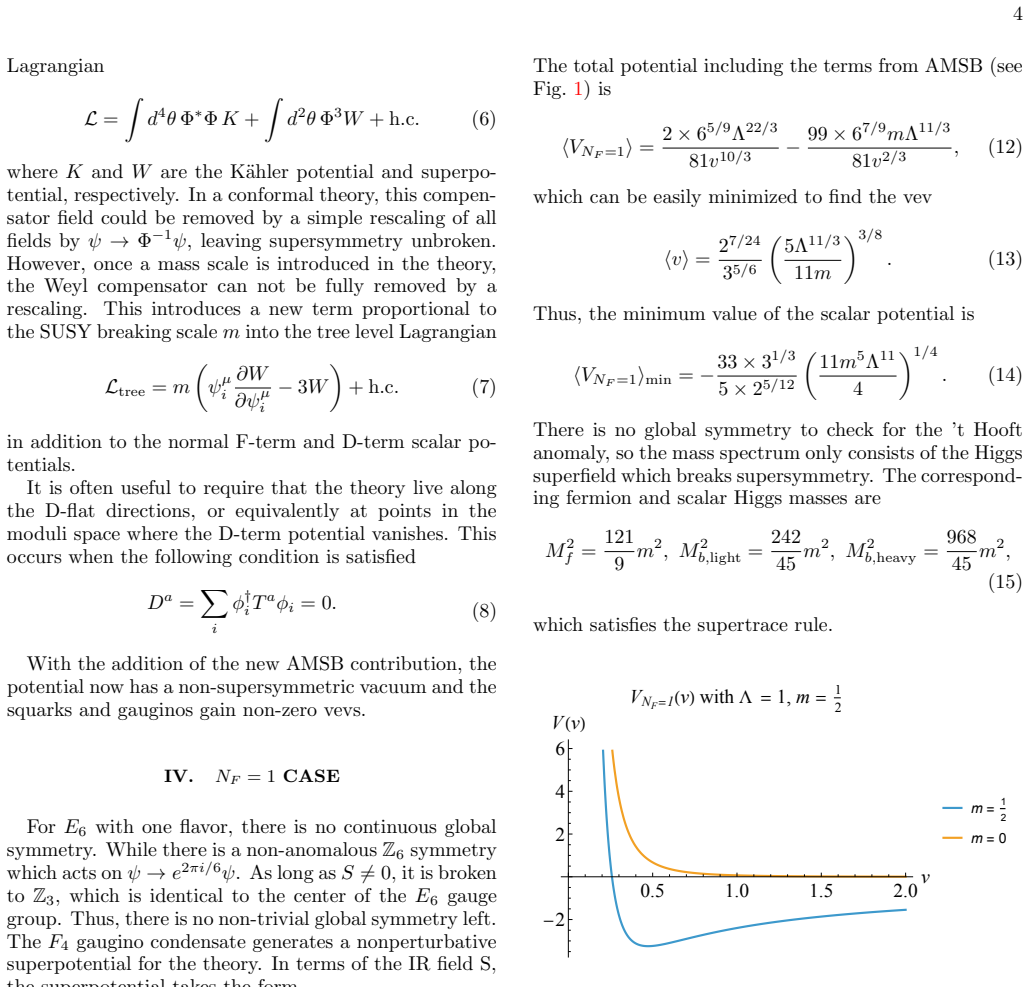
The paper claims that the near-supersymmetric $E_6$ theories with $N_F = 1, 2, 3$ flavors of $\mathbf{27}$ can be solved exactly when slightly perturbed by anomaly-mediated supersymmetry breaking, and that their vacuum structure differs sharply from the sequential symmetry-breaking pattern predicted by tumbling. For $N_F = 1$ there is no surviving continuous global symmetry; for $N_F = 2$ the global SU(2) is fully broken and there are no massless fermions. For $N_F = 3$ there are three local minima: one preserving the global SU(3)$_F$ with massless composite fermions in the $\mathbf{10}$ of SU(3), one preserving a U(1)$\times$U(1) subgroup with a massless fermion spectrum that matches all UV anomalies, and one fully breaking the global symmetry, which has the lowest tree-level vacuum energy. The SU(3)-preserving minimum is the unanticipated result, since tumbling predicts no massless fermions and an SO(3)-type breaking; the paper presents it as a valid low-energy phase in the near-SUSY regime that could persist to the non-supersymmetric limit.
Load-bearing premise
For $N_F = 3$ the search for minima runs only over a 3-dimensional submanifold of the 11-dimensional family of flat directions, so a vacuum located outside that slice would be missed and the three-vacuum list would be incomplete.
Editorial extensions
If this is right
- Tumbling predictions for $E_6$ with $\mathbf{27}$s, namely SU($N_F$) breaking to SO($N_F$) with no massless fermions, are replaced by different exact symmetry patterns for $N_F = 1, 2, 3$.
- The $N_F = 3$ SU(3)$_F$-preserving vacuum with massless composite $\mathbf{10}$ fermions becomes a concrete candidate low-energy phase for the non-supersymmetric theory whenever the continuous crossover from $m \ll \Lambda$ to $m \gg \Lambda$ holds.
- The reported vacuum energies and mass spectra, including the numerical fully broken vacuum with energy $-10.15167\,(m^7\Lambda^9)^{1/4}$, give quantitative benchmarks for future lattice or other nonperturbative checks.
- Within the near-SUSY regime, the exact solutions are usable for beyond-Standard-Model model building: composite axions, composite dark matter, composite inflation, and nonperturbative baryogenesis are listed by the authors as applications.
- The numerical procedure developed here, treating the superpotential as a functional of global invariants and differentiating implicitly, extends to other high-dimensional chiral gauge theories.
Reading between the lines
- Because the $N_F = 3$ search is restricted to a 3-dimensional submanifold of the 11 flat directions, I would not treat the three-vacuum list as closed until a lower minimum is excluded on the full moduli space.
- If the SU(3)-preserving vacuum survives in the non-supersymmetric limit, it gives a working example where massless composite fermions in a higher representation saturate the UV anomaly, which could be useful in composite-model building.
- The whole bridge to the non-supersymmetric limit assumes no phase transition at $m \sim \Lambda$; a strong-coupling transition there would leave these as exact statements only for the near-SUSY theory.
Signed reviews
Editorial analysis
A structured set of objections, weighed in public.
Referee Report
Summary. The paper studies N=1 supersymmetric E6 gauge theory with NF=1,2,3 chiral superfields in the 27-dimensional fundamental representation, perturbed by small anomaly-mediated supersymmetry breaking (AMSB) with m << Lambda. The authors write effective superpotentials generated by gaugino condensates in terms of the gauge invariants S and T, add the AMSB scalar potential, and minimize. For NF=1 and NF=2 they present analytic minima, spectra, and supertrace checks; for NF=3 they report three distinct minima, including one with unbroken SU(3)_F global symmetry and ten massless composite fermions in the 10 of SU(3), and a deepest fully-broken vacuum. The paper compares these results with tumbling-hypothesis predictions and claims exact nonperturbative solutions for the near-SUSY regime.
Significance. If established, these results would extend the exact-solution program for chiral gauge theories to an exceptional group and provide a sharp counterexample to tumbling, especially the NF=3 SU(3)-symmetric vacuum with massless 10's. The NF=1 and NF=2 calculations are analytic, the anomaly and supertrace checks are nontrivial, and the numerical work is carried out at very high precision with the code and an animation made available. However, the NF=3 load-bearing claims rest on an unproven reduction of the 11-dimensional D-flat moduli space to a 3-parameter slice and on superpotential coefficients fixed by singularity requirements rather than by a condensate computation. These issues must be resolved before the exact-ground-state claims for NF=3 can be accepted.
major comments (4)
- [Section VI and Section VII, Eq. (25)] The three-parameter ansatz in Eq. (25) is an unproven slice of the full eleven-dimensional D-flat moduli space. Appendix B explicitly provides only a ten-dimensional parameterization and states that adding the eleventh direction 'greatly increases the number of orthogonality conditions.' The claim in Section VII that 'there are indeed only three distinct minima' is based on BFGS minimization over this slice. A fourth vacuum lying off the slice would invalidate the enumeration and the exact ground state summarized in Table I. Please either prove that all stationary points (or at least the global minima) are contained in the family Eq. (25), or perform and report a systematic search over the full 11-dimensional D-flat space.
- [Appendix A, Eqs. (A1)-(A4)] The coefficients a, b, c entering the NF=3 superpotential Eq. (24) are fixed by imposing that the denominator vanishes at the G2 and SO(8) enhanced-symmetry configurations, not by a calculation of the gaugino condensate. The text itself states that 'This exact value can be determined through an exact gaugino condensate calculation' but does not perform it. A polynomial chosen to vanish at two points is not the same as the exact denominator; the three vacuum energies, their ordering, and the resulting spectra are all sensitive to these coefficients. The authors should derive the coefficients from the condensate or provide an independent argument (for example, symmetries plus a uniqueness theorem for the denominator) that the superpotential is exactly Eq. (24).
- [Section V] There is a direct internal contradiction in the location of the NF=2 minimum: the first paragraph states 'We find a unique minimum where ⟨θ⟩=π/3 and ⟨ϕ⟩=2π/3', while the next paragraph states 'There is then a unique minimum at θ=π/2 and 2π/3'. Since the vev, the mass spectrum in Table III, and the supertrace check all depend on the minimum location, this contradiction must be resolved and the correct value stated explicitly.
- [Abstract and Section VII] The phrase 'exact ground state' for the NF=3 case is too strong. The numerical minimization is performed with the BFGS algorithm on the restricted ansatz Eq. (25), and while 512-bit precision verifies local stationarity and the supertrace on that slice, it does not establish exactness or global minimality over the full moduli space. The claims in the abstract and Table I should be qualified as numerical results on the chosen submanifold until the completeness question is settled.
minor comments (4)
- [Section I] The sentence 'we can learn a lot about the strong coupling limit (BEC) by studying the weak coupling limit (BEC)' contains a typo: the second '(BEC)' should be '(BCS)'.
- [Table I] The entries in Table I for the NF=3 row are garbled, with line breaks and missing representations making the comparison between the SUSY+AMSB and tumbling columns difficult to read; please reformat the table.
- [Section V, Eq. (20)] The statement 'These scalars fit into the fundamental E6 fields' would benefit from a more explicit definition of the embedding matrix used to place the X± and Y scalars into the 27, to make the D-flat configuration reproducible.
- [Section VI.A] For the unbroken SU(3) vacuum, the text says 'We can achieve a vanishing S invariant from Eq. (25) by setting ⟨θ⟩=π/4 and ⟨ϕ⟩=π/2', but it is not shown explicitly how this choice makes S4 and S6 vanish; a short check would improve clarity.
Circularity Check
No significant circularity: the E6 vacuum analysis is computed from imported SUSY/AMSB inputs and standard singularity constraints, not from the final minima.
full rationale
The derivation chain is not circular. For NF=1 and NF=2, the nonperturbative superpotentials W=(Lambda^33/S^2)^{1/9} and W=(Lambda^30/S^4)^{1/6} are taken from standard supersymmetric gaugino-condensation results, and the AMSB potentials are minimized analytically; the final vevs, masses, and supertrace checks are computed consequences, not inputs. For NF=3, the superpotential coefficients in Eq. (24) are fixed in Appendix A by demanding that W diverge on the enhanced-symmetry loci G2 and SO(8), a standard consistency condition for an effective superpotential, and not by fitting the three vacuum energies or spectra; the minima are then obtained by minimizing the resulting potential and are checked by anomaly matching and supertrace relations. Citations to the authors' prior work [15-20] supply the AMSB/exact-SUSY framework, but those results are formulated for different gauge groups and are externally checkable, so they are independent support rather than a self-referential loop. The paper's own admission that the exact b,c values could in principle come from a gaugino-condensate calculation, though not needed, is an indication of a derivation gap, not of circularity. The main weakness is a completeness risk: the NF=3 search is restricted to the 3-parameter ansatz Eq. (25) while the full D-flat space is 11-dimensional, so the claim that the three found minima are the only ground states is an extrapolation; this is a correctness concern, not a circular-reasoning defect.
Assumptions & free parameters
free parameters (1)
- a, b, c coefficients in the NF=3 superpotential =
a=1, b=6 sqrt(3), c=-28 sqrt(3)/5
assumptions (6)
- domain assumption AMSB is UV insensitive, so the IR theory is determined by the Weyl compensator coupling m.
- domain assumption The supersymmetric E6 theory with NF fundamentals has a nonperturbative superpotential generated by gaugino condensation.
- standard math D-flat directions for E6 with NF 27s can be described by vevs in the (3,3bar,1) block after gauge rotation.
- ad hoc to paper For NF=3, it is sufficient to search the 3-parameter family in Eq. (25) for all possible ground states.
- domain assumption The small-SUSY-breaking vacuum with m<<Lambda connects continuously to the non-SUSY limit m>>Lambda with no phase transition at m~Lambda.
- ad hoc to paper The superpotential denominator must vanish whenever the gauge symmetry does not fully break to SU(3).
Cite this review
Pith. "Pith review of Dynamics of $E_6$ Chiral Gauge Theories." pith.science (2026). https://pith.science/paper/HBYBHWH2
@misc{pith2026250507931,
  author       = {Pith},
  title        = {Pith review of: Dynamics of $E_6$ Chiral Gauge Theories},
  year         = {2026},
  howpublished = {\url{https://pith.science/paper/HBYBHWH2}},
  note         = {Machine review of arXiv:2505.07931}
}
abstract
We present exact non-perturbative solutions to chiral gauge theories based on the $E_6$ gauge group and several matter fermions in the fundamental $\bf{27}$-dimensional representation. They are obtained when supersymmetric versions are perturbed by small supersymmetry breaking by anomaly mediation. The universality classes obtained are very different from what can be conjectured by the tumbling hypothesis. In particular, the case with three $\bf{27}$s may have an unbroken $\text{SU}(3)$ symmetry with massless composite fermions in $\bf{10}$ of $\text{SU}(3)$. For this case, we employed numerical techniques to obtain the exact ground state.
Figures


Figures from the paper (1 more)

Forward citations
Cited by 2 Pith papers
-
Novel Phases of a Baryon-Dense QCD-like Theory
Adding a baryon chemical potential to AMSB-deformed s-confining SQCD produces novel finite-density vacua with baryon-number and parity breaking, with both first- and second-order transitions.
-
Truly Confining Supersymmetric Gauge Theories
The authors propose a complete list of seven truly confining supersymmetric gauge theories and show that each exhibits magnetic operator condensation and discrete symmetry breaking, including two new models.
Reference graph
Works this paper leans on
- [1]
-
[2]
Infinitely many regulator fields for chiral fermions,
R. Narayanan and H. Neuberger, “Infinitely many regulator fields for chiral fermions,”Phys. Lett. B302 (1993) 62–69,arXiv:hep-lat/9212019
arXiv 1993
-
[3]
A Remnant of Chiral Symmetry on the Lattice,
P. H. Ginsparg and K. G. Wilson, “A Remnant of Chiral Symmetry on the Lattice,”Phys. Rev. D25 (1982) 2649
work page 1982
-
[4]
A Method for simulating chiral fermions on the lattice,
D. B. Kaplan, “A Method for simulating chiral fermions on the lattice,”Phys. Lett. B288(1992) 342–347, arXiv:hep-lat/9206013
arXiv 1992
-
[5]
Chiral fermions from lattice boundaries,
Y. Shamir, “Chiral fermions from lattice boundaries,” Nucl. Phys. B406(1993) 90–106, arXiv:hep-lat/9303005
arXiv 1993
-
[6]
A Construction of lattice chiral gauge theories,
R. Narayanan and H. Neuberger, “A Construction of lattice chiral gauge theories,”Nucl. Phys. B443(1995) 305–385,arXiv:hep-th/9411108
arXiv 1995
-
[7]
Exact chiral symmetry on the lattice and the Ginsparg-Wilson relation,
M. L¨ uscher, “Exact chiral symmetry on the lattice and the Ginsparg-Wilson relation,”Phys. Lett. B428 (1998) 342–345,arXiv:hep-lat/9802011
arXiv 1998
-
[8]
Lattice chiral gauge theories,
M. Golterman, “Lattice chiral gauge theories,”Nucl. Phys. B Proc. Suppl.94(2001) 189–203, arXiv:hep-lat/0011027
arXiv 2001
Show all 30 references
-
[9]
SU(N) chiral gauge theories on the lattice,
M. Golterman and Y. Shamir, “SU(N) chiral gauge theories on the lattice,”Phys. Rev. D70(2004) 094506, arXiv:hep-lat/0404011
2004 arXiv
-
[10]
Nonperturbative Regulator for Chiral Gauge Theories?,
D. M. Grabowska and D. B. Kaplan, “Nonperturbative Regulator for Chiral Gauge Theories?,”Phys. Rev. Lett. 116(2016) no. 21, 211602,arXiv:1511.03649 [hep-lat]
2016 arXiv
-
[11]
Chiral solution to the Ginsparg-Wilson equation,
D. M. Grabowska and D. B. Kaplan, “Chiral solution to the Ginsparg-Wilson equation,”Phys. Rev. D94(2016) no. 11, 114504,arXiv:1610.02151 [hep-lat]
2016 arXiv
-
[12]
Chiral gauge theories revisited,
M. L¨ uscher, “Chiral gauge theories revisited,”Subnucl. Ser.38(2002) 41–89,arXiv:hep-th/0102028
2002 arXiv
-
[13]
Tumbling Gauge Theories,
S. Raby, S. Dimopoulos, and L. Susskind, “Tumbling Gauge Theories,”Nucl. Phys. B169(1980) 373–383
1980
-
[14]
Impossibility of Spontaneously Breaking Local Symmetries,
S. Elitzur, “Impossibility of Spontaneously Breaking Local Symmetries,”Phys. Rev. D12(1975) 3978–3982
1975
-
[15]
Some exact results in chiral gauge theories,
C. Cs´ aki, H. Murayama, and O. Telem, “Some exact results in chiral gauge theories,”Phys. Rev. D104 (2021) no. 6, 065018,arXiv:2104.10171 [hep-th]
2021 arXiv
-
[16]
Out of this world supersymmetry breaking,
L. Randall and R. Sundrum, “Out of this world supersymmetry breaking,”Nuclear Physics B557 (Sept., 1999) 79–118. http://dx.doi.org/10.1016/S0550-3213(99)00359-4
1999 doi
-
[17]
Gaugino mass without singlets,
G. F. Giudice, M. A. Luty, H. Murayama, and R. Rattazzi, “Gaugino mass without singlets,”JHEP 12(1998) 027,arXiv:hep-ph/9810442
1998 arXiv
-
[18]
More exact results on chiral gauge theories: The case of the symmetric tensor,
C. Cs´ aki, H. Murayama, and O. Telem, “More exact results on chiral gauge theories: The case of the symmetric tensor,”Phys. Rev. D105(2022) no. 4, 045007,arXiv:2105.03444 [hep-th]
2022 arXiv
-
[19]
Dynamics of Simplest Chiral Gauge Theories
D. Kondo, H. Murayama, and C. Sylber, “Dynamics of Simplest Chiral Gauge Theories.” 9, 2022
2022
-
[20]
Exact Results in Chiral Gauge Theories with Flavor
J. M. Leedom, H. Murayama, G. Singh, B. Suter, and J. Wong, “Exact Results in Chiral Gauge Theories with Flavor.” 3, 2025
2025
-
[21]
Exact results on the space of vacua of four-dimensional SUSY gauge theories,
N. Seiberg, “Exact results on the space of vacua of four-dimensional SUSY gauge theories,”Phys. Rev. D 49(1994) 6857–6863,arXiv:hep-th/9402044
1994 arXiv
-
[22]
Electric - magnetic duality in supersymmetric nonAbelian gauge theories,
N. Seiberg, “Electric - magnetic duality in supersymmetric nonAbelian gauge theories,”Nucl. Phys. B435(1995) 129–146,arXiv:hep-th/9411149
1995 arXiv
-
[23]
Some exact results in qcd-like theories,
H. Murayama, “Some exact results in qcd-like theories,”Physical Review Letters126(June, 2021) . http: //dx.doi.org/10.1103/PhysRevLett.126.251601
2021 doi
-
[24]
Broken conformal window,
D. Kondo, H. Murayama, B. Noether, and D. R. Varier, “Broken conformal window,”JHEP04(2025) 152, arXiv:2111.09690 [hep-th]
2025 arXiv
-
[25]
Guide to anomaly-mediated supersymmetry-breaking QCD,
C. Cs´ aki, A. Gomes, H. Murayama, B. Noether, D. R. Varier, and O. Telem, “Guide to anomaly-mediated supersymmetry-breaking QCD,”Phys. Rev. D107 (2023) no. 5, 054015,arXiv:2212.03260 [hep-th]
2023 arXiv
-
[26]
M. M. Parish,The BCS–BEC Crossover, p. 179–197. IMPERIAL COLLEGE PRESS, Sept., 2014. http://dx.doi.org/10.1142/9781783264766_0009
2014 doi
-
[27]
BCS-BEC Crossover and the Unitary Fermi Gas,
M. Randeria and E. Taylor, “BCS-BEC Crossover and the Unitary Fermi Gas,”Ann. Rev. Condensed Matter Phys.5(2014) 209–232,arXiv:1306.5785 [cond-mat.quant-gas]
2014 arXiv
-
[28]
E6Tensors: A Mathematica Package for E6 Tensors,
T. Deppisch, “E6Tensors: A Mathematica Package for E6 Tensors,”Comput. Phys. Commun.213(2017) 130–135,arXiv:1605.05920 [hep-ph]
2017 arXiv
-
[29]
E6 N F = 3 AMSB Potential
A. Goh, H. Murayama, G. Singh, B. Suter, and J. Wong, “E6 N F = 3 AMSB Potential.” https://doi.org/10.5281/zenodo.15258774
-
[30]
Near-SUSY to Non-SUSY Crossover
D. Kondo, H. Murayama, and B. Noether, “Near-SUSY to Non-SUSY Crossover.” in preparation, 2025
2025
Reviewed August 15, 2026 · model on record in the stance chip above.
Discussion (0). Continue with ORCID to comment.