REVIEW 5 major objections 6 minor 1 cited by
Comparative Analysis of QNN Architectures for Wind Power Prediction: Feature Maps and Ansatz Configurations
T0 review · 5 major / 6 minor · reviewed 2026-08-07 · deepseek-v4-flash
Pith's one-line read Quantum neural networks using the Z feature map reach an R² of about 0.93 in wind-power prediction, matching or beating classical regressors on this dataset.
desk verdict Honest benchmark, overclaimed headline: the paper's own MAE table shows QNNs do not beat classical baselines, and the unspecified time-series split likely inflates the R^2. read the letter →
The pith
A machine-rendered reading of the paper's core claim, the machinery that carries it, and where it could break.
The reading
What carries the argument
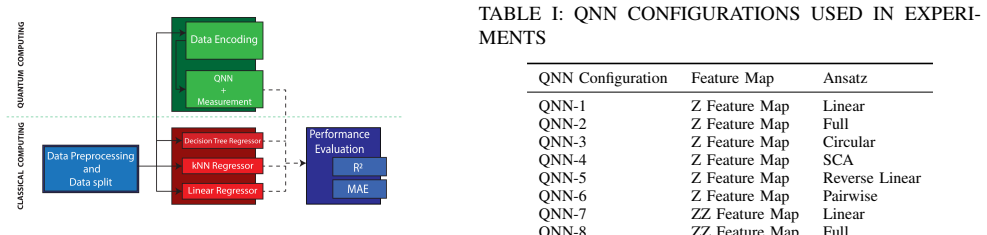
The load-bearing object is the data-encoding feature map rather than the trainable ansatz. The $Z$ feature map encodes each of the four input features into single-qubit rotation phases using Hadamard and phase gates, with no entangling gates in the encoding layer; the $ZZ$ feature map instead uses two-qubit $ZZ$ interactions via CNOT gates. These two encoders are combined with six parameterized ansatz circuits (linear, circular, full, reverse linear, pairwise, and SCA entanglement) whose parameters are optimized by L-BFGS-B over 25 iterations, with all qubits measured in the Pauli $Z$ basis and the expectation values concatenated as the regression output. The argument runs on the observed optimization contrast: $Z$-map circuits minimize the loss quickly with few oscillations, whereas $ZZ$-map circuits converge poorly, and this contrast mirrors the final $R^2$ gap.
What would settle it
Retrain all twelve QNNs plus the three classical baselines on the same data with a temporal split (first 80% of the ordered 10-minute timestamps for training, last 20% for test) and report $R^2$ and MAE; if the $Z$-feature-map QNNs no longer beat or match decision tree and k-nearest neighbors, the comparative claim fails. A second check is to rerun the best configuration with three different feature scalings (for example min–max, z-score, and a fixed physical range) to see whether the $Z$-map advantage depends on the undisclosed scaling.
Extended reading notes
Core claim
The paper's discovery, on its own terms, is that the $Z$ feature map—a circuit built from Hadamard and phase gates that rotates each classical input into single-qubit phases—produces QNN regressors with $R^2 \approx 0.92$–$0.93$ on wind power prediction, regardless of which of the six ansatz entanglement strategies is used. The $ZZ$ feature map, which adds CNOT gates that entangle feature pairs, fails uniformly ($R^2 \approx 0.29$–$0.35$) and shows worse optimization dynamics: the objective function decreases more slowly and oscillates more under the L-BFGS-B optimizer. The best configuration, $Z$ feature map with reverse linear entanglement, reaches $R^2 = 0.93$ with MAE $= 119.71$ kW. Against classical baselines on the same dataset, these $Z$-map QNNs exceed decision tree ($R^2 = 0.91$) and linear regression ($R^2 = 0.88$) in $R^2$ and match k-nearest neighbors ($R^2 = 0.92$), though decision tree keeps the lowest mean absolute error ($66.38$ kW).
Load-bearing premise
The reported accuracies assume that the 80/20 split of this 10-minute-interval time series keeps temporally adjacent readings out of both training and test sets, and that the undisclosed scaling of features into rotation angles is appropriate; if either fails, the high $R^2$ values may be inflated.
Editorial extensions
If this is right
- If the results are correct, practitioners can build a competitive wind-power forecaster from a $Z$-feature-map QNN with only four meteorological inputs, trained in under an hour on a classical simulator.
- Feature-map choice would matter more than ansatz design: the six entanglement strategies produce nearly identical $R^2$ with the $Z$ map, while all $ZZ$ variants fail, so research effort should go into encoding rather than circuit depth.
- On this dataset QNNs would not simply replace classical methods: they beat decision trees and linear regression on $R^2$ but not on MAE, so the practical win is in capturing global trends, not absolute point accuracy.
- The successful $Z$-map configurations converge within 25 L-BFGS-B iterations, making single-run simulator-based QNN training a viable baseline for small regression tasks.
Reading between the lines
- A reader should treat the unstated scaling of wind speed, direction, pressure, and temperature into rotation angles as a hidden parameter; different scalings could plausibly move all QNN results, and comparing scaling rules would reveal whether the $Z$-versus-$ZZ$ gap is about encoding capacity or simply about angle ranges.
- Because the paper does not describe the 80/20 split as temporal, a decisive follow-up is to repeat the benchmark with a purely chronological split; if the $Z$-map advantage persists the comparison is much stronger, and if it shrinks, leakage was the likely driver.
- The single-run design means the 0.92–0.93 spread across ansatz types may sit within optimizer noise; repeated runs with different initializations would sharpen the ranking of ansatz strategies.
- Extending the same two-feature-map comparison to higher-dimensional inputs or to real noisy hardware would test whether the $Z$-map dominance is a general NISQ phenomenon or an artifact of this four-feature simulator setting.
Editorial analysis
A structured set of objections, weighed in public.
Referee Report
Summary. This manuscript experimentally compares twelve QNN configurations for wind power prediction, combining two feature maps (Z and ZZ) with six ansatz entanglement strategies, and compares them with three classical regressors on a dataset of 4,464 observations at 10-minute intervals. The authors report R^2 and MAE for each configuration and claim that Z-feature-map QNNs achieve R^2 values of 0.92-0.93 and outperform classical methods. The central quantitative claim is undermined by the paper's own Table II, which shows classical decision tree and kNN MAEs well below the best QNN MAE, and by the unspecified train/test split, undocumented feature scaling, lack of error bars, and an internal inconsistency in the reported best configuration.
Significance. If properly validated, a systematic comparison of feature maps and ansatz strategies for QNN-based regression would be useful for practitioners in energy forecasting and QML applications. The manuscript has a clear experimental pipeline and examines a reasonable space of circuit architectures. It also honestly acknowledges NISQ-era limitations, the single-run nature of the experiments, and the need for future work on computational cost and data size. However, as presented, the headline claim that QNNs outperform classical methods is not supported by the reported metrics, and the methodological omissions concerning the data split and feature encoding prevent the reader from trusting the reported R^2 values. The paper's value is therefore only realized after substantial additional experimentation and re-analysis.
major comments (5)
- [Section III-A] The dataset description states only that the data were "divided into 80% training data and 20% test data," without indicating whether the split is chronological or random. Because the data are a 10-minute-interval time series with strong autocorrelation, a random split would place temporally adjacent samples in both training and test sets, making the regression task substantially easier and likely inflating all reported R^2 values, including the headline 0.92-0.93. The authors must specify the split type; if the split was random, the experiments need to be redone with a temporal split and the results re-reported.
- [Table II and Section IV] The abstract claims that "QNNs outperform classical methods in predictive tasks," but Table II shows the classical decision tree has MAE 66.38 and kNN has MAE 103.30, both far below the best QNN MAE of 119.05 (QNN-5). The R^2 values are comparable (0.92 for the best QNNs vs. 0.91 for the decision tree and 0.92 for kNN), which at best supports a claim of competitiveness, not superiority. Section IV itself concedes that the decision tree has lower MAE, so the conclusion should be revised to remove the unsupported "outperform" claim.
- [Section IV, paragraph 2] The text states that "The reverse linear ansatz combined with the Z feature map emerges as the optimal configuration, achieving the highest R2 (0.93) and lowest error metric (MAE=119.71)." This is internally inconsistent: Table I assigns the reverse linear ansatz to QNN-5, and Table II gives QNN-5 MAE=119.05, not 119.71. The value 119.71 belongs to QNN-3 (circular ansatz). This error affects the claimed ranking of ansatz configurations and must be corrected.
- [Section III-C and Fig. 3] The feature encoding procedure is underspecified. Fig. 3a shows a single-qubit Z feature map and Fig. 3b a two-qubit ZZ feature map, yet the prediction task uses four input parameters. The number of qubits, the mapping of each input feature to rotation angles, any data normalization or scaling, and the number of encoding repetitions are not stated. The performance of angle encoding depends entirely on the chosen scaling, so the reported superiority of the Z feature map over the ZZ feature map cannot be reproduced or interpreted without this information.
- [Section III-D and Table II] All QNN results are based on a single run per circuit, with no random seeds, no repeated trials, and no error bars. The paper explicitly states that each circuit was run once. Given the well-known sensitivity of variational quantum circuit training to initialization and optimizer randomness, the differences among QNN-1 through QNN-6 (R^2 0.92-0.93, MAE range 119.05-136.50) may be within run-to-run variation. Multiple runs with fixed seeds and reported standard deviations are necessary to support any ranking of ansatz types or feature maps.
minor comments (6)
- [Abstract] The phrase "93% prediction accuracy" should be replaced with a precise metric statement, e.g., "R^2 = 0.93," since R^2 is not classification accuracy.
- [Section III-D] The sentence "we used the Limited-memory Broyden-Fletcher-Goldfarb-Shanno Bound (L-BFGS-B) optimizer with 25 iterations, and Ɛ(error) of 1e−8" should clarify whether 25 is the maximum number of iterations and should report the optimizer's stopping behavior, since convergence is relevant to the learning curves in Fig. 2.
- [Table II] Several table entries lack proper spacing (e.g., "QNN-20.93123.81"), which appears to be a LaTeX formatting issue; the table should be checked for readability.
- [Fig. 2 and Fig. 5] The learning curves and prediction scatter plots do not include axis labels or units, which makes it difficult to interpret the loss values and the scale of prediction errors.
- [Section III-D] The classical baselines are taken from the authors' prior work [17]; the text should state whether those classical models were trained and evaluated under the same train/test split and preprocessing steps as the QNNs, so that the comparison is controlled.
- [Section V] The conclusion that QNNs are "even surpassing them in some cases" is not supported by Table II; either specific cases should be cited or the claim should be softened to "competitive" in line with the R^2 results.
Circularity Check
No significant circularity: the paper is an empirical benchmark comparison, not a derivation, and its self-cited classical baselines are independent external results.
full rationale
This paper does not present an analytic derivation chain in which a predicted quantity is equivalent to an input by construction. The workflow is explicitly experimental: data are encoded with feature maps, ansatz circuits are trained with L-BFGS-B, and test-set R^2 and MAE values are reported. There is no fitted parameter being renamed as a prediction, no target quantity defined in terms of the claimed result, and no uniqueness theorem invoked to force a chosen ansatz. The only self-citation is the choice of classical baselines from the authors' earlier work [17], but that prior work is a separate empirical study on the same public dataset, so it constitutes independent external evidence rather than a circular justification. Concerns about the unspecified chronological/random split, undocumented angle scaling, single-run execution, and the discrepancy between the abstract's 'outperform classical methods' claim and Table II's MAE values are substantive reproducibility and correctness issues, but they are not circularity under the definitions used here. Therefore, no circular step can be exhibited with a specific reduction, and the appropriate score is 0.
Assumptions & free parameters
free parameters (4)
- Ansatz initial parameters and random seed =
not reported
- Data scaling for angle encoding =
not reported
- Ansatz depth (number of variational layers) =
not reported
- L-BFGS-B iteration count =
25
assumptions (3)
- domain assumption Qiskit statevector simulation faithfully represents the QNN circuits without noise or sampling error.
- domain assumption The 80/20 split of the 10-minute interval time series does not allow information leakage between training and test sets.
- domain assumption Classical baseline models are representative and were evaluated under a comparable effort.
Cite this review
Pith. "Pith review of Comparative Analysis of QNN Architectures for Wind Power Prediction: Feature Maps and Ansatz Configurations." pith.science (2026). https://pith.science/paper/HCCV3I45
@misc{pith2026250614795,
  author       = {Pith},
  title        = {Pith review of: Comparative Analysis of QNN Architectures for Wind Power Prediction: Feature Maps and Ansatz Configurations},
  year         = {2026},
  howpublished = {\url{https://pith.science/paper/HCCV3I45}},
  note         = {Machine review of arXiv:2506.14795}
}
read the original abstract
Quantum Machine Learning (QML) is an emerging field at the intersection of quantum computing and machine learning, aiming to enhance classical machine learning methods by leveraging quantum mechanics principles such as entanglement and superposition. However, skepticism persists regarding the practical advantages of QML, mainly due to the current limitations of noisy intermediate-scale quantum (NISQ) devices. This study addresses these concerns by extensively assessing Quantum Neural Networks (QNNs)-quantum-inspired counterparts of Artificial Neural Networks (ANNs), demonstrating their effectiveness compared to classical methods. We systematically construct and evaluate twelve distinct QNN configurations, utilizing two unique quantum feature maps combined with six different entanglement strategies for ansatz design. Experiments conducted on a wind energy dataset reveal that QNNs employing the Z feature map achieve up to 93% prediction accuracy when forecasting wind power output using only four input parameters. Our findings show that QNNs outperform classical methods in predictive tasks, underscoring the potential of QML in real-world applications.
Figures


Figures from the paper (2 more)


Forward citations
Cited by 1 Pith paper
-
Quantum Neural Networks for Wind Energy Forecasting: A Comparative Study of Performance and Scalability with Classical Models
On one wind turbine dataset, simulated 4-qubit quantum neural networks with a Z feature map reach R2 around 0.94 and RMSE slightly below k-nearest neighbors, with training time scaling roughly linearly with dataset size.
Reference graph
Works this paper leans on
-
[1]
Unsupervised quantum machine learning for fraud detection,
O. Kyriienko and E. B. Magnusson, “Unsupervised quantum machine learning for fraud detection,”arXiv preprint arXiv:2208.01203, 2022
arXiv 2022
-
[2]
Quantum machine learning for anomaly detection in consumer electronics,
S. Bhowmik and H. Thapliyal, “Quantum machine learning for anomaly detection in consumer electronics,” in2024 IEEE Computer Society Annual Symposium on VLSI (ISVLSI), 2024, pp. 544–550
work page 2024
-
[3]
T. Cultice, M. S. Hassan Onim, A. Giani, and H. Thapliyal, “Anomaly detection for real-world cyber-physical security using quantum hybrid support vector machines,” in2024 IEEE Computer Society Annual Symposium on VLSI (ISVLSI), 2024, pp. 619–624
work page 2024
-
[4]
A robust hybrid classical and quantum model for short-term wind speed forecasting,
Y .-Y . Hong, C. J. E. Arce, and T.-W. Huang, “A robust hybrid classical and quantum model for short-term wind speed forecasting,”IEEE Access, vol. 11, pp. 90 811–90 824, 2023
2023
-
[5]
S. K. Satpathy, V . Vibhu, B. K. Behera, S. Al-Kuwari, S. Mumtaz, and A. Farouk, “Analysis of quantum machine learning algorithms in noisy channels for classification tasks in the iot extreme environment,”IEEE Internet of Things Journal, vol. 11, no. 3, pp. 3840–3852, 2024
work page 2024
-
[6]
S. Z. Khan, N. Muzammil, S. Ghafoor, H. Khan, S. M. H. Zaidi, A. J. Aljohani, and I. Aziz, “Quantum long short-term memory (qlstm) vs. classical lstm in time series forecasting: a comparative study in solar power forecasting,”Frontiers in Physics, vol. 12, 2024
work page 2024
-
[7]
Extended abstract: Quantum-accelerated transient stability assessment for power systems,
J. Chen and Y . Li, “Extended abstract: Quantum-accelerated transient stability assessment for power systems,” in2024 IEEE Computer Society Annual Symposium on VLSI (ISVLSI), 2024, pp. 593–594
work page 2024
-
[8]
Quantum computing based hybrid deep learning for fault diagnosis in electrical power systems,
A. Ajagekar and F. You, “Quantum computing based hybrid deep learning for fault diagnosis in electrical power systems,”Applied Energy, vol. 303, p. 117628, 2021
2021
Show all 19 references
-
[9]
Quantum computing for energy systems optimization: Challenges and opportunities,
——, “Quantum computing for energy systems optimization: Challenges and opportunities,”Energy, vol. 179, pp. 76–89, 2019
2019
-
[10]
Neuroquman: quantum neural network-based consumer reaction time demand response predictive management,
A. Safari and M. A. Badamchizadeh, “Neuroquman: quantum neural network-based consumer reaction time demand response predictive management,”Neural Computing and Applications, vol. 36, no. 30, pp. 19 121–19 138, 2024
2024
-
[11]
Prediction of solar irradiance one hour ahead based on quantum long short-term memory network,
Y . Yu, G. Hu, C. Liu, J. Xiong, and Z. Wu, “Prediction of solar irradiance one hour ahead based on quantum long short-term memory network,” IEEE Transactions on Quantum Engineering, vol. 4, pp. 1–15, 2023
2023
-
[12]
Noise-resilient quantum machine learning for stability assessment of power systems,
Y . Zhou and P. Zhang, “Noise-resilient quantum machine learning for stability assessment of power systems,”IEEE Transactions on Power Systems, vol. 38, no. 1, pp. 475–487, 2022
2022
-
[13]
Quantum renewable scenario genera- tion,
Z. Tang, P. Zhang, and Y . Zhou, “Quantum renewable scenario genera- tion,” in2022 IEEE Power & Energy Society General Meeting (PESGM). IEEE, 2022, pp. 1–5
2022
-
[14]
Quantum computing approach to smart grid stability forecasting,
B. Hangun, O. Eyecioglu, and O. Altun, “Quantum computing approach to smart grid stability forecasting,” in2024 12th International Confer- ence on Smart Grid (icSmartGrid), 2024, pp. 840–843
2024
-
[15]
A hybrid quantum-classical machine learning approach to offshore wind farm power forecasting,
B. Hangun, E. Akpinar, M. Oduncuoglu, O. Altun, and O. Eyecioglu, “A hybrid quantum-classical machine learning approach to offshore wind farm power forecasting,” in2024 13th International Conference on Renewable Energy Research and Applications (ICRERA), 2024, pp. 1105–1110
2024
-
[16]
Database on wind character- istics,
T. U. of Denmark and R. N. Laboratory, “Database on wind character- istics,” http://www.winddata.com, [Online]
-
[17]
Performance comparison of different machine learning algorithms on the prediction of wind turbine power generation,
O. Eyecioglu, B. Hangun, K. Kayisli, and M. Yesilbudak, “Performance comparison of different machine learning algorithms on the prediction of wind turbine power generation,” in2019 8th International Conference on Renewable Energy Research and Applications (ICRERA), 2019, pp. 922–926
2019
-
[18]
Quantum computing with Qiskit,
A. Javadi-Abhari, M. Treinish, K. Krsulich, C. J. Wood, J. Lishman, J. Gacon, S. Martiel, P. D. Nation, L. S. Bishop, A. W. Cross, B. R. Johnson, and J. M. Gambetta, “Quantum computing with Qiskit,” 2024
2024
-
[19]
Qiskit machine learning: an open-source library for quantum machine learning tasks at scale on quantum hardware and classical simulators,
M. E. Sahin, E. Altamura, O. Wallis, S. P. Wood, A. Dekusar, D. A. Millar, T. Imamichi, A. Matsuo, and S. Mensa, “Qiskit machine learning: an open-source library for quantum machine learning tasks at scale on quantum hardware and classical simulators,” 2025. [Online]. Availabl...
2025 arXiv
Reviewed August 7, 2026 · model on record in the stance chip above.
Discussion (0). Sign in to comment.