REVIEW 2 major objections 6 minor 1 cited by
At 64 GBaud, a coherent transceiver's ~25 dB back-to-back ceiling makes 1024-QAM infeasible on standard and hollow-core fiber alike.
Reviewed by Pith at T0; open to challenge. T0 means a machine referee read the full paper against a public rubric. the ladder, T0–T4 →
T0 review · deepseek-v4-flash
2026-08-02 10:24 UTC pith:HESOSBA3
load-bearing objection Useful integrated budget for HCF system design, but the '1024-QAM infeasible at 64 GBaud' headline rests on a hand-calibrated transceiver curve; the qualitative bottleneck shift is robust, the exact boundary is not. the 2 major comments →
System-Level Limits of Higher-Order QAM in Hollow-Core Fiber Systems
The pith
A machine-rendered reading of the paper's core claim, the machinery that carries it, and where it could break.
Core claim
The central discovery is that a real coherent transceiver has a finite, symbol-rate-dependent back-to-back SNR ceiling—set by converter ENOB at the operating rate, analog bandwidth, and Tx/Rx nonlinearity—and that at 64 GBaud this ceiling (~25.3 dB for the high-performance class) sits below the 29.6 dB Es/N0 requirement for 1024-QAM. Because the total SNR combines the link SNR and the transceiver ceiling in parallel (reciprocally), no fiber improvement can lift the delivered SNR above the ceiling. The paper concludes that hollow-core fiber's near-vacuum Kerr nonlinearity does not enable ultra-high QAM at deployable baud rates; it enables longer reach and higher baud at a given modulation ord
What carries the argument
The key object is the effective-SNR budget: 1/SNR_total = 1/SNR_link + 1/SNR_TRx(Rs) + sum_i 1/SNR_i, where SNR_link collects true optical noise powers (ASE, Kerr NLI, inter-modal interference, pigtail NLI), SNR_TRx is a parametrized transceiver back-to-back ceiling from ENOB-at-rate, analog bandwidth, and Tx/Rx nonlinearity, and the remaining impairments (phase noise, equalization-enhanced phase noise, timing jitter, PDL, line-system penalties, CO2 gas-notch ISI) enter as equivalent SNR floors. The reciprocal form is what makes the ceiling binding: the achievable SNR can never exceed the transceiver ceiling no matter how clean the link is.
Load-bearing premise
The load-bearing premise is that the parameterized back-to-back transceiver SNR ceiling—ENOB0 of 5.5 at 32 GBaud, a 0.6 bit/octave roll-off, a 38 dB analog floor, and a 42 dB nonlinearity floor—accurately represents real 64-GBaud coherent transceivers; it is calibrated to published trends rather than measured, and its absolute level shifts the exact baud at which 1024-QAM becomes infeasible.
What would settle it
Measure the back-to-back SNR of a state-of-the-art 64-GBaud coherent transceiver into an ideal link. If it exceeds about 29.6 dB (the 1024-QAM requirement with shaping credit and margin), the 64-GBaud infeasibility claim collapses on hollow-core fiber, since the corresponding link SNR there is about 35 dB. Alternatively, an end-to-end 64-GBaud 1024-QAM transmission over a few kilometers of hollow-core fiber with standard external-cavity lasers would directly refute the ceiling claim if successful.
If this is right
- Ultra-high QAM (1024-QAM and above) is feasible only at low baud rates, roughly below 24 GBaud, even with a high-performance transceiver; at 64 GBaud the maximum feasible order is 256-QAM on either fiber.
- Hollow-core fiber's practical value is reach and baud at a given order rather than raw modulation order: about 3.8x more reach for 256-QAM and 5.5x more for 64-QAM at the baseline IMI coefficient.
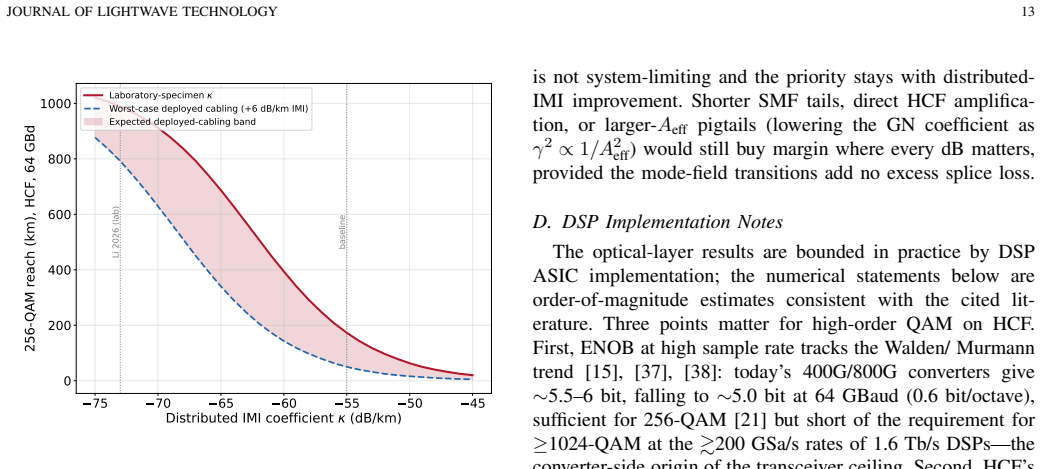
- Improving the distributed inter-modal interference coefficient is the highest-leverage fiber-side lever: moving from -55 to -73 dB/km extends 256-QAM reach from about 170 km to about 975 km, though the paper flags this as a laboratory bound.
- CO2 absorption forces spectral planning: line-avoiding C-band channels follow the gas-free baseline, while L-band channels on strong lines lose one to two QAM orders unless the core is sealed or mitigation is used.
- Any future move beyond 256-QAM at deployable baud rates requires transceiver improvements—higher ENOB at rate, wider analog bandwidth, and lower Tx/Rx nonlinearity—rather than fiber improvements.
Where Pith is reading between the lines
- If the parameterized transceiver ceiling is optimistic—for example, if a real 64-GBaud transceiver delivers more than about 30 dB back-to-back SNR—1024-QAM could become feasible on hollow-core fiber at 64 GBaud, so the exact crossover baud is uncertain even though the transceiver-limited picture likely survives.
- The same reciprocal budget could be reused for future converter generations or other fiber types by swapping in a different ENOB-at-rate curve; the framework predicts a baud-versus-order design rule in which higher baud forces moderate order.
- The CO2 notch-ISI result suggests a testable mitigation prediction: spectral pre-emphasis or digital-subcarrier avoidance should recover most of the C-band worst-channel reach penalty at modest spectral cost, while L-band avoidance remains spectrally expensive because the strong lines are denser than the channel bandwidth.
- The IMI-reach prediction could be tested directly by measuring the cabled inter-modal interference coefficient on deployed hollow-core fiber; the paper itself identifies cabled-IMI characterization as the key open measurement for this class of result.
Editorial analysis
A structured set of objections, weighed in public.
Referee Report
Summary. This paper develops a per-channel effective-SNR budget for coherent WDM transmission over hollow-core fiber (HCF) and standard SMF, combining ASE, Kerr NLI, inter-modal interference (IMI), pigtail NLI, CO2 gas absorption, a parameterized transceiver back-to-back (B2B) SNR ceiling, and SNR-equivalent penalties for phase noise, EEPN, jitter, PDL, and line-system effects. The central quantitative claim is that at 64 GBaud with 75 GHz spacing, the modeled transceiver B2B ceiling (~25.3 dB for the 'high-performance' class) falls below the net requirement for 1024-QAM (~29.0 dB), making 1024-QAM and higher infeasible on either fiber regardless of fiber quality. HCF's advantage is consequently stated to be reach and baud at a given modulation order (e.g., 256-QAM reach ~170 km vs ~45 km at κ=-55 dB/km), with additional analysis of CO2 absorption, launch power, and IMI sensitivity. The model is a synthesis of published formulas and parametrized/calibrated components, with explicit caveats about unmeasured quantities.
Significance. If the transceiver B2B ceiling were anchored to direct measurement, this would be an important reframing of the HCF roadmap: it would show that HCF's near-vacuum nonlinearity does not automatically translate into ultra-high QAM at deployment baud rates, and that converter ENOB and analog bandwidth are the system bottleneck. The paper's transparency about its parameters and its external consistency checks (20 GBaud PS-1024-QAM and 60 GBaud PS-256-QAM demonstrations) are strengths, and the qualitative conclusion that the transceiver becomes the limiting factor at high baud is plausible. However, the absolute '1024-QAM infeasible at 64 GBaud' boundary is not yet anchored to a measured B2B curve; a ~1-bit ENOB shift at 64 GBaud would change the feasibility conclusion. The framework is valuable, but the headline quantitative claim needs additional support.
major comments (2)
- [Section III-B, Eq. (8), Table II; Section IV-A; Abstract] The central '1024-QAM infeasible at 64 GBaud' claim rests on the unmeasured, hand-calibrated transceiver B2B ceiling. The model uses ENOB0=5.5 at 32 GBaud, 0.6 bit/octave roll-off, S_afe=38 dB, and S_nl=42 dB. At 64 GBaud this gives ENOB≈4.9 and SNR_TRx≈25.3 dB, while the net 1024-QAM requirement from Eq. (3) is 29.57-1.53+1.0≈29.0 dB—a gap of about 3.7 dB. A ~1-bit increase in ENOB at 64 GBaud (ENOB≈6.0 instead of 4.9) raises the quantization floor by about 6 dB and, even with the parallel floors, brings the ceiling near or above 29 dB, making 1024-QAM feasible on HCF at short reach. The external anchors (Fan 20 GBaud, Wang 60 GBaud) exercise lower orders or lower baud rates, and the Varughese anchor near 100 GBaud is itself model-based; none pins the 64-GBaud high-order crossover to ±1 bit. Since the abstract presents the boundary as a physical result, the paper should either include a
- [Section III-F, Eq. (19)] The closed form for the all-pairs splice-MPI sum appears incorrect as printed. For N_s=2, Eq. (18) gives S(2,ζ)=ζ, but the numerator shown in Eq. (19), if read as ζ^{N_s-1}-N_sζ+ζ^{N_s}, gives (ζ-2ζ+ζ^2)/(1-ζ)^2=(ζ^2-ζ)/(1-ζ)^2<0 for 0<ζ<1. The correct closed form should be [(N_s-1)ζ - N_sζ^2 + ζ^{N_s+1}]/(1-ζ)^2. If this is a typographical error, it should be corrected; if not, the numerical discrete-MPI results in Section IV-D and the conclusion that splice MPI is below the distributed-IMI floor are unreliable. This is a load-bearing point for the paper's 'distributed κ dominates; discrete splice MPI is small' message.
minor comments (6)
- [Section III-D] The text says EEPN 'enters the transceiver ceiling of Eq. (8),' but Eq. (8) is the pure B2B ceiling and Section II-A explicitly excludes EEPN from that ceiling. EEPN should enter Eq. (2) as a separate SNR-equivalent penalty.
- [Section III-B] The analog-bandwidth floor S_afe(R_s) depends on an unspecified R_bw. 'Calibrated so the bandwidth penalty approaches ~10 dB near 100 GBaud' is not sufficient to reproduce Table II; please state R_bw or the explicit calibration formula.
- [Section III-F] The symbol κ is used both for the distributed IMI coefficient (dB/km) and for the linear splice coupling coefficients κ_in, κ_out. This is confusing; use different symbols (e.g., η for coupling).
- [Section IV-A] The text says the ceiling 'crosses the 1024-QAM requirement near 24 GBaud.' Using the stated parameters and the net requirement of Eq. (3) (~29.0 dB), the crossover appears to be closer to 27–29 GBaud. Please clarify whether the comparison uses the raw threshold 29.57 dB or the net requirement, and derive the crossover from the formulas.
- [Figure 1 and Eq. (3)] The 'required-SNR lines' in Fig. 1 should state explicitly whether they include G_PCS and the 1.0 dB margin; the text uses both 'threshold' and 'net requirement' at different points.
- [Eq. (9)] The phase-noise penalty δ_PN=(ΔνT_s/τ_1dB)^2 is not derived. The small-signal BPS variance analysis cited from Pfau scales linearly in ΔνT_s for the phase-error variance; a quadratic scaling should be justified or replaced with a linear form calibrated at the same 1 dB point.
Circularity Check
Low-baud 'external check' is a calibration loop: Fan/Wang demonstrations are used to inform the transceiver ceiling and then returned as confirmation; the 64 GBaud central claim still rests on independent converter/ENOB anchors.
specific steps
-
fitted input called prediction
[Section I (Introduction); Section III-B (Transceiver Back-to-Back SNR Ceiling); Section IV-A; Section V-E]
"The resulting estimates are consistent with, and informed by, the PDM-PS-256-QAM NANF demonstration of Wang et al. [27] and the PDM-PS-1024-QAM DNANF demonstration of Fan et al. [28]. ... remains consistent with the back-to-back SNRs realized in published high-order-QAM experiments ... Extending the same model to low baud provides an external check on its calibration: ... indeed returns 1024-QAM as the maximum feasible order at 20 GBaud over 5 km—matching the DNANF demonstration of Fan et al. [28]."
The Fan/Wang demonstrations are first used to inform or calibrate the transceiver ceiling: the unmeasured calibration constants S_afe and S_nl in Eq. (8) were set so the ceiling 'remains consistent with the back-to-back SNRs realized in published high-order-QAM experiments,' and the Introduction says the resulting estimates are 'informed by' Wang [27] and Fan [28]. The same Fan 20 GBaud PS-1024-QAM point is then re-used as an 'external check' and reported as 'matching' the model's returned maximum feasible order. Because the Fan operating point is inside the calibration set used to choose the parameters, its agreement with the model is enforced by construction rather than independently confirmed. This is a fitted-input-called-prediction loop in the validation argument; it does not by itsel
full rationale
The core SNR budget (Eqs. (1)-(8)) is a forward model assembled from independent literature anchors: BER thresholds from standard QAM formulas, Kerr NLI from the eGN model, IMI/MPI from Poggiolini-Poletti and Mlejnek/Downie, EEPN from Shieh-Ho, and ENOB trends from Walden/Murmann. The 64 GBaud headliner (SNR_TRx ~25.3 dB, making 1024-QAM infeasible) is not fitted to that conclusion; the paper explicitly states the ceiling is a parametrized, unmeasured model and that its absolute calibration shifts the crossover baud. Thus the central transceiver-limited claim is not circular by construction. However, the low-baud 'external check' is circular: the Fan [28] and Wang [27] demonstrations are described as informing/calibrating the same ceiling and then returned as confirming 'boundaries' and a 'matching' 20 GBaud result. That agreement is a calibration-consistency loop, not independent prediction. The self-citations in the reference list are contextual and not load-bearing. Overall this is partial validation circularity, not a definitional collapse of the main derivation, so a score of 4 is appropriate.
Axiom & Free-Parameter Ledger
free parameters (11)
- ENOB0 reference at 32 GBaud =
5.5 (high-performance); deployable ~2.5–3 dB lower
- ENOB roll-off slope sb =
0.6 bit/octave
- Analog front-end floor Saf =
38 dB
- Tx/Rx nonlinearity floor Snl =
42 dB
- PCS shaping credit GPCS(M) =
0.4 (16Q), 0.8 (64Q), 1.20 (256Q), 1.53 (≥1024Q) dB
- BPS 1-dB tolerance for 1024-QAM =
1.5e-6
- Gmod scaling coefficient =
0.88 in Eq. (10)
- Grcm scaling coefficient =
7.6 in Eq. (11)
- Gas-notch ISI saturation constants =
δmax≈5.5 dB, A0≈6 dB
- MFA taper NLI coefficient =
estimated, sub-dB at operating launch
- Baseline distributed IMI coefficient κ =
−55 dB/km
axioms (10)
- domain assumption GN/eGN model gives Kerr NLI power ∝ γ²·L_eff per span (Eq. 14)
- standard math Independent additive noise powers add reciprocally in SNR (Eq. 2)
- standard math Gray-coded square M-QAM BER at pre-FEC 2e-2 sets SNR_th(M) (Eq. 4)
- domain assumption Phase noise equivalent linewidth is Δν_TX+Δν_LO and residual penalty is quadratic in Δν·T_s (Eq. 9)
- standard math SQNR = 6.02·ENOB + 1.76 dB with PAPR back-off (Eq. 7)
- domain assumption EEPN variance per Shieh-Ho with Rs→Rs/Nsc for DSCM (Eq. 13)
- domain assumption IMI is an additive noise power linear in P_ch and L (Eq. 16)
- ad hoc to paper Transceiver B2B ceiling = parallel combination of quantization, analog-bandwidth, nonlinearity floors (Eq. 8)
- ad hoc to paper Gas-notch ISI penalty saturates per Eq. (22) with δmax≈5.5 dB, A0≈6 dB
- domain assumption CO2 line comb: Lorentzian P/R branches, spacing ~23 GHz, FWHM ~1.5 GHz, anchored to 0.5 dB/km line-center loss
read the original abstract
Hollow-core fiber (HCF) is widely expected to enable higher-order quadrature amplitude modulation (QAM) because of its near-vacuum Kerr nonlinearity and higher launch power. We develop a per-channel effective signal-to-noise ratio (SNR) budget that combines, in reciprocal form, optical-link impairments including amplified spontaneous emission, Kerr nonlinear interference (NLI), inter-modal interference (IMI), pigtail NLI, and CO2 gas absorption; a parameterized, symbol-rate-dependent transceiver back-to-back SNR ceiling determined by effective-number-of-bits at rate, analog bandwidth, and Tx/Rx nonlinearity; and the remaining transceiver and line impairments, including laser phase noise, equalization-enhanced phase noise, timing jitter, polarization-dependent loss, and amplifier gain ripple with filter narrowing, each expressed as an equivalent SNR floor. The central result, at a representative 64GBaud system with 75GHz channel spacing over 6THz, is that once HCF removes the fiber limits, the transceiver ceiling rather than the fiber sets the achievable modulation order: a roughly 25dB ceiling at 64GBaud makes 1024-QAM and above infeasible on either fiber, confining ultra-high-order QAM to low baud rates. HCF therefore provides its main advantage in reach and achievable baud rate at a given modulation order: at an IMI coefficient of kappa=-55dB/km, 256-QAM reach increases from about 45km to about 170km and 64-QAM reach from about 415km to about 2275km when moving from single-mode fiber to HCF. In the C-band, CO2 absorption lines are weak and sparse, so channels placed away from the lines follow the gas-free baseline, while only worst-case placements lose reach at long distances. In the L-band, the stronger absorption bands are denser than the channel bandwidth, making line avoidance spectrally costly, and a channel placed on a line loses one to two QAM orders.
Figures


Forward citations
Cited by 1 Pith paper
-
Beyond Silica Assumptions: Optical Network Design in the Hollow-Core Era
Hollow-core fiber's distinguishing properties (ultra-low loss, negligible nonlinearity, 30% lower latency, broad low-loss window) warrant a cross-layer co-design of optical networks rather than drop-in replacement of ...
Reference graph
Works this paper leans on
-
[1]
Nested antiresonant nodeless hollow core fiber,
F. Poletti, “Nested antiresonant nodeless hollow core fiber,”Optics Express, vol. 22, no. 20, pp. 23 807–23 828, 2014
2014
-
[2]
0.174 dB/km hollow core double nested antiresonant node- less fiber (DNANF),
G. T. Jasion, H. Sakr, J. R. Hayes, S. R. Sandoghchi, L. Hooper, E. Numkam Fokoua, A. Saljoghei, H. C. H. Mulvad, M. Alonso, A. Taranta, T. D. Bradley, I. A. Davidson, Y . Chen, D. J. Richardson, and F. Poletti, “0.174 dB/km hollow core double nested antiresonant node- less fiber (DNANF),” inProceedings of Optical Fiber Communication Conference (OFC), 202...
2022
-
[3]
M. G. Saber and Z. Jiang, “Hollow-core fiber in direct-detection optical networks: Technology readiness, deployment drivers, and adoption outlook,” 2026. [Online]. Available: https://arxiv.org/abs/2606.23511
Pith/arXiv arXiv 2026
-
[4]
Broadband optical fibre with an attenuation lower than 0.1 decibel per kilometre,
M. Petrovich, E. Numkam Fokoua, Y . Chen, H. Sakr, A. I. Adamu, R. Hassan, D. Wu, R. Fatobene Ando, A. Papadimopoulos, S. R. Sandoghchi, G. Jasion, and F. Poletti, “Broadband optical fibre with an attenuation lower than 0.1 decibel per kilometre,”Nature Photonics, vol. 19, pp. 1203–1208, 2025
2025
-
[5]
Hollow-core and standard single-mode fiber hybrid optical networks: A multi-topology investigation of protection switching,
M. G. Saber and Z. Jiang, “Hollow-core and standard single-mode fiber hybrid optical networks: A multi-topology investigation of protection switching,” inThe 52nd European Conference on Optical Communica- tion (ECOC 2026), Malaga, Spain, September 2026
2026
-
[6]
Loss in hollow-core optical fibers: Mechanisms, scaling rules, and limits,
E. Numkam Fokoua, S. Abokhamis Mousavi, G. T. Jasion, D. J. Richard- son, and F. Poletti, “Loss in hollow-core optical fibers: Mechanisms, scaling rules, and limits,”Advances in Optics and Photonics, vol. 15, no. 1, pp. 1–85, 2023
2023
-
[7]
Beyond silica assumptions: Optical network design in the hollow-core era,
M. G. Saber and Z. Jiang, “Beyond silica assumptions: Optical network design in the hollow-core era,”submitted to Photonics, 2026
2026
-
[8]
Hardware-efficient coherent digital receiver concept with feedforward carrier recovery forM-QAM constel- lations,
T. Pfau, S. Hoffmann, and R. No ´e, “Hardware-efficient coherent digital receiver concept with feedforward carrier recovery forM-QAM constel- lations,”Journal of Lightwave Technology, vol. 27, no. 8, pp. 989–999, 2009
2009
-
[9]
Digital filters for coherent optical receivers,
S. J. Savory, “Digital filters for coherent optical receivers,”Optics Express, vol. 16, no. 2, pp. 804–817, 2008
2008
-
[10]
Laser phase noise tolerance of uniform and probabilistically shaped QAM signals for high spectral efficiency systems,
T. Sasai, A. Matsushita, M. Nakamura, S. Okamoto, F. Hamaoka, and Y . Kisaka, “Laser phase noise tolerance of uniform and probabilistically shaped QAM signals for high spectral efficiency systems,”Journal of Lightwave Technology, vol. 38, no. 2, pp. 439–446, 2020
2020
-
[11]
Overhead-optimization of pilot-based digital signal processing for flexible high spectral efficiency transmission,
M. Mazur, J. Schr ¨oder, A. Lorences-Riesgo, T. Yoshida, M. Karlsson, and P. A. Andrekson, “Overhead-optimization of pilot-based digital signal processing for flexible high spectral efficiency transmission,” Optics Express, vol. 27, no. 17, pp. 24 654–24 669, 2019
2019
-
[12]
Optimized pilot structure for PS-PDM ultrahigh-order QAM coherent optical transmission,
X. Shi, M. Gao, X. Huang, J. Fan, X. Han, X. You, and G. Shen, “Optimized pilot structure for PS-PDM ultrahigh-order QAM coherent optical transmission,”Optics Letters, vol. 49, no. 6, pp. 1579–1582, 2024
2024
-
[13]
Equalization-enhanced phase noise for coherent-detection systems using electronic digital signal processing,
W. Shieh and K.-P. Ho, “Equalization-enhanced phase noise for coherent-detection systems using electronic digital signal processing,” Optics Express, vol. 16, no. 20, pp. 15 718–15 727, 2008
2008
-
[14]
Local oscillator phase noise induced penalties in optical coherent detection systems using electronic chromatic dispersion com- pensation,
C. Xie, “Local oscillator phase noise induced penalties in optical coherent detection systems using electronic chromatic dispersion com- pensation,” inProceedings of Optical Fiber Communication Conference (OFC), 2009, p. OMT4
2009
-
[15]
Analog-to-digital converter survey and analysis,
R. H. Walden, “Analog-to-digital converter survey and analysis,”IEEE Journal on Selected Areas in Communications, vol. 17, no. 4, pp. 539– 550, 1999
1999
-
[16]
The GN model of non-linear propagation in uncom- pensated coherent optical systems,
P. Poggiolini, “The GN model of non-linear propagation in uncom- pensated coherent optical systems,”Journal of Lightwave Technology, vol. 30, no. 24, pp. 3857–3879, 2012
2012
-
[17]
A simple and effective closed-form GN model correction formula accounting for signal non-gaussian distribution,
P. Poggiolini, G. Bosco, A. Carena, V . Curri, Y . Jiang, and F. Forghieri, “A simple and effective closed-form GN model correction formula accounting for signal non-gaussian distribution,”Journal of Lightwave Technology, vol. 33, no. 2, pp. 459–473, 2015
2015
-
[18]
Opportunities and challenges for long- distance transmission in hollow-core fibres,
P. Poggiolini and F. Poletti, “Opportunities and challenges for long- distance transmission in hollow-core fibres,”Journal of Lightwave Technology, vol. 40, no. 6, pp. 1605–1616, 2022
2022
-
[19]
Transmission of 61 C-band channels over record distance of hollow-core-fiber with L-band interferers,
A. Nespola, S. Straullu, T. D. Bradley, K. Harrington, H. Sakr, G. T. Jasion, E. Numkam Fokoua, Y . Jung, Y . Chen, J. R. Hayes, F. Forghieri, D. J. Richardson, F. Poletti, G. Bosco, and P. Poggiolini, “Transmission of 61 C-band channels over record distance of hollow-core-fiber with L-band interferers,”Journal of Lightwave Technology, vol. 39, no. 3, pp....
2021
-
[20]
M. G. Saber and Z. Jiang, “Protection switching in hybrid hollow-core and single-mode fiber networks: Challenges, analysis, and mitigation strategies,” 2026. [Online]. Available: https://arxiv.org/abs/2606.23554
Pith/arXiv arXiv 2026
-
[21]
Frequency dependent ENoB requirements forM-QAM optical links: An analysis using an improved digital to analog converter model,
S. Varughese, J. Langston, V . A. Thomas, S. Tibuleac, and S. E. Ralph, “Frequency dependent ENoB requirements forM-QAM optical links: An analysis using an improved digital to analog converter model,” Journal of Lightwave Technology, vol. 36, no. 18, pp. 4082–4089, 2018. JOURNAL OF LIGHTW A VE TECHNOLOGY 15
2018
-
[22]
Hollow-core fiber capacities with receiver noise limitations,
W. Klaus and P. J. Winzer, “Hollow-core fiber capacities with receiver noise limitations,” inOptical Fiber Communication Conference (OFC), no. M2C.4. Optica Publishing Group, 2022
2022
-
[23]
1024 QAM (60 Gbit/s) single-carrier coherent optical transmission over 150 km,
Y . Koizumi, K. Toyoda, M. Yoshida, and M. Nakazawa, “1024 QAM (60 Gbit/s) single-carrier coherent optical transmission over 150 km,” Optics Express, vol. 20, no. 11, pp. 12 508–12 514, 2012
2012
-
[24]
2048 QAM (66 Gbit/s) single-carrier coherent optical transmission over 150 km with a potential SE of 15.3 bit/s/hz,
S. Beppu, K. Kasai, M. Yoshida, and M. Nakazawa, “2048 QAM (66 Gbit/s) single-carrier coherent optical transmission over 150 km with a potential SE of 15.3 bit/s/hz,”Optics Express, vol. 23, no. 4, pp. 4960–4969, 2015
2048
-
[25]
Probabilistically shaped PDM 4096-QAM transmission over up to 200 km of fiber using standard intradyne detection,
S. L. I. Olsson, J. Cho, S. Chandrasekhar, X. Chen, P. J. Winzer, and S. Makovejs, “Probabilistically shaped PDM 4096-QAM transmission over up to 200 km of fiber using standard intradyne detection,”Optics Express, vol. 26, no. 4, pp. 4522–4530, 2018
2018
-
[26]
16384-QAM trans- mission at 10 GBd over 25-km SSMF using polarization-multiplexed probabilistic constellation shaping,
X. Chen, J. Cho, A. Adamiecki, and P. J. Winzer, “16384-QAM trans- mission at 10 GBd over 25-km SSMF using polarization-multiplexed probabilistic constellation shaping,” inProceedings of the 45th European Conference on Optical Communication (ECOC), 2019, pp. 1–4
2019
-
[27]
High-order QAM NANF transmission utilizing MIMO equalizer integrated with low-complexity decision-directed carrier phase estimation,
C. Wang, K. Wang, J. Long, W. Zhou, F. Zhao, L. Shen, P. Li, and J. Yu, “High-order QAM NANF transmission utilizing MIMO equalizer integrated with low-complexity decision-directed carrier phase estimation,”Optics Letters, vol. 49, no. 9, pp. 2293–2296, 2024
2024
-
[28]
Hierarchical MIMO equalizer for PDM PS-1024-QAM coherent optical transmission over DNANF,
J. Fan, Y . Qin, T. Fu, J. Zhu, Y . Shen, L. Xiao, and M. Gao, “Hierarchical MIMO equalizer for PDM PS-1024-QAM coherent optical transmission over DNANF,”Optics Communications, vol. 607, p. 132941, 2026
2026
-
[29]
1- Tb/s/λTransmission over Record 10,714-km AR-HCF,
D. Ge, S. Liu, Q. Qiu, P. Li, Q. Guo, Y . Li, D. Wang, B. Yan, M. Zuo, L. Zhang, D. Zhang, H. Shi, J. Luo, H. Li, and Z. Chen, “1- Tb/s/λTransmission over Record 10,714-km AR-HCF,” inProceedings of the European Conference on Optical Communication (ECOC 2025), Copenhagen, Denmark, September 2025
2025
-
[30]
Demonstration of beyond terabit/s/λnonlinearity-free transmission over the hollow-core fibre,
Y . Hong, S. Almonacil, H. Mardoyan, C. Castineiras-Carrero, S. Osuna, J. R. Gomez, D. R. Knight, and J. Renaudier, “Demonstration of beyond terabit/s/λnonlinearity-free transmission over the hollow-core fibre,” inProceedings of the 50th European Conference on Optical Communication (ECOC), 2024
2024
-
[31]
Low intermodal interference and low loss hollow core fibers,
P. Li, G. Chen, A. Jia, H. Li, J. Chu, Y . Liu, L. Zhang, L. Zhang, and J. Luo, “Low intermodal interference and low loss hollow core fibers,” in Proceedings of Optical Fiber Communication Conference (OFC), 2026, p. M2J.1
2026
-
[32]
OIF-400ZR-02.0 – implementation agreement for 400ZR,
Optical Internetworking Forum, “OIF-400ZR-02.0 – implementation agreement for 400ZR,” 2022, [Online]. Available: https://www.oiforum. com/wp-content/uploads/OIF-400ZR-02.0.pdf
2022
-
[33]
OIF-800ZR-01.0 – implementation agreement for 800ZR,
——, “OIF-800ZR-01.0 – implementation agreement for 800ZR,” 2024, [Online]. Available: https://www.oiforum.com/wp-content/ uploads/OIF-800ZR-01.0.pdf
2024
-
[34]
Sensitivity gains by mismatched probabilistic shaping for optical communication systems,
T. Fehenberger, D. Lavery, R. Maher, A. Alvarado, P. Bayvel, and N. Hanik, “Sensitivity gains by mismatched probabilistic shaping for optical communication systems,”IEEE Photonics Technology Letters, vol. 28, no. 7, pp. 786–789, 2016
2016
-
[35]
Probabilistic constellation shaping for optical fiber communications,
J. Cho and P. J. Winzer, “Probabilistic constellation shaping for optical fiber communications,”Journal of Lightwave Technology, vol. 37, no. 6, pp. 1590–1607, 2019
2019
-
[36]
Design of low-margin optical networks,
Y . Pointurier, “Design of low-margin optical networks,”Journal of Optical Communications and Networking, vol. 9, no. 1, pp. A9–A17, 2017
2017
-
[37]
Advances in high-speed DACs, ADCs, and DSP for optical coherent transceivers,
C. Laperle and M. O’Sullivan, “Advances in high-speed DACs, ADCs, and DSP for optical coherent transceivers,”Journal of Lightwave Tech- nology, vol. 32, no. 4, pp. 629–643, 2014
2014
-
[38]
ADC performance survey 1997–2026,
B. Murmann, “ADC performance survey 1997–2026,” [Online]. Avail- able: https://github.com/bmurmann/ADC-survey, 2026
1997
-
[39]
X. Wang, Z. Li, L. Feng, P. Li, K. Lv, X. Sheng, Y . Liu, R. Gao, X. Xin, L. Zhang, J. Luo, A. Zhang, X. Huo, T. Ma, and Z. Wang, “Simulation investigation of CO 2 absorption-induced performance degradation in hollow-core fiber transmission systems and spectrum-optimized digi- tal sub-carrier multiplexing design for circumvention,”Optics Letters, vol. 50,...
2025
-
[40]
CO2-limited hollow-core fiber links: A capacity-map guide to pre-emphasis and spectral avoidance,
M. G. Saber and Z. Jiang, “CO2-limited hollow-core fiber links: A capacity-map guide to pre-emphasis and spectral avoidance,”Photonics, vol. 13, no. 6, 2026. [Online]. Available: https://www.mdpi.com/ 2304-6732/13/6/559
2026
-
[41]
Beyond terabit/s/λ nonlinearity-free transmission over the hollow-core fiber,
Y . Hong, S. Almonacil, H. Mardoyan, C. Castineiras Carrero, S. Osuna, J. R. Gomez, D. R. Knight, and J. Renaudier, “Beyond terabit/s/λ nonlinearity-free transmission over the hollow-core fiber,”Journal of Lightwave Technology, vol. 43, no. 13, pp. 6306–6312, 2025
2025
-
[42]
On the optimum energy-per-bit launch power in coherent hollow-core fibre transmission systems,
R. Sohanpal, E. Sillekens, M. Jarmolovicius, R. I. Killey, and P. Bayvel, “On the optimum energy-per-bit launch power in coherent hollow-core fibre transmission systems,” arXiv:2606.17942, 2026, arXiv preprint arXiv:2606.17942
Pith/arXiv arXiv 2026
-
[43]
Fusion splic- ing performance evaluation of hollow-core fiber to hollow-core fiber with different structural parameters,
C. Zhang, Y . Zhen, X. Wu, J. Li, Y . Qin, and S. Fu, “Fusion splic- ing performance evaluation of hollow-core fiber to hollow-core fiber with different structural parameters,”Journal of Lightwave Technology, vol. 44, no. 2, pp. 659–664, 2026
2026
-
[44]
Low loss and high performance interconnection between standard single-mode fiber and antiresonant hollow-core fiber,
D. Suslov, M. Komanec, E. R. Numkam Fokoua, D. Dousek, A. Zhong, S. Zv ´anovec, T. D. Bradley, F. Poletti, D. J. Richardson, and R. Slav ´ık, “Low loss and high performance interconnection between standard single-mode fiber and antiresonant hollow-core fiber,”Scientific Reports, vol. 11, p. 8799, 2021
2021
-
[45]
J. G. Proakis and M. Salehi,Digital Communications, 5th ed. New York, NY , USA: McGraw-Hill, 2008
2008
-
[46]
Bit error probability of M-ary quadrature amplitude modulation,
D. Yoon, K. Cho, and J. Lee, “Bit error probability of M-ary quadrature amplitude modulation,” inIEEE Vehicular Technology Conference (VTC 2000-Fall), vol. 5, 2000, pp. 2422–2427
2000
-
[47]
On the limits of digital back- propagation in the presence of transceiver noise,
L. Galdino, D. Semrau, D. Lavery, G. Saavedra, C. B. Czegledi, E. Agrell, R. I. Killey, and P. Bayvel, “On the limits of digital back- propagation in the presence of transceiver noise,”Optics Express, vol. 25, no. 4, pp. 4564–4578, 2017
2017
-
[48]
4096 QAM (72 Gbit/s) single-carrier coherent optical transmission with a potential SE of 15.8 b/s/hz in all-raman amplified 160 km fiber link,
M. Terayama, S. Okamoto, K. Kasai, M. Yoshida, and M. Nakazawa, “4096 QAM (72 Gbit/s) single-carrier coherent optical transmission with a potential SE of 15.8 b/s/hz in all-raman amplified 160 km fiber link,” in Proceedings of Optical Fiber Communication Conference (OFC), 2018, p. Th1F.2
2018
-
[49]
Transmission of 30-GBd polarization-multiplexed probabilistically shaped 4096-QAM over 50.9-km SSMF,
X. Chen, S. Chandrasekhar, J. Cho, and P. J. Winzer, “Transmission of 30-GBd polarization-multiplexed probabilistically shaped 4096-QAM over 50.9-km SSMF,”Optics Express, vol. 27, no. 21, pp. 29 916–29 923, 2019
2019
-
[50]
Over- coming laser phase noise for low-cost coherent optical communication,
X. Fang, Y . Zhu, X. Cai, W. Hu, Z. He, S. Yu, and F. Zhang, “Over- coming laser phase noise for low-cost coherent optical communication,” Nature Communications, vol. 15, p. 6339, 2024
2024
-
[51]
800G DSP ASIC design using probabilistic shaping and digital sub-carrier multiplexing,
H. Sun, M. Torbatian, M. Karimi, R. Maher, S. Thomsonet al., “800G DSP ASIC design using probabilistic shaping and digital sub-carrier multiplexing,”Journal of Lightwave Technology, vol. 38, no. 17, pp. 4744–4756, 2020
2020
-
[52]
Coupled-mode theory of multipath interference in quasi-single-mode fibers,
M. Mlejnek, I. Roudas, J. D. Downie, N. Kaliteevskiy, and K. Koreshkov, “Coupled-mode theory of multipath interference in quasi-single-mode fibers,”IEEE Photonics Journal, vol. 7, no. 1, p. 7100116, 2015
2015
-
[53]
Measurements and modeling of multipath interference at wavelengths below cable cut-off in a G.654 optical fiber span,
J. D. Downie, J. Hurley, H. de Pedro, S. Garner, J. Blaker, A. B. Zakharian, S. Ten, and G. Mills, “Measurements and modeling of multipath interference at wavelengths below cable cut-off in a G.654 optical fiber span,”Optics Express, vol. 25, no. 8, pp. 9305–9311, 2017
2017
-
[54]
Low loss and broadband low back-reflection interconnection between a hollow-core and standard single-mode fiber,
D. Suslov, E. Numkam Fokoua, D. Dousek, A. Zhong, S. Zv ´anovec, T. D. Bradley, F. Poletti, D. J. Richardson, M. Komanec, and R. Slav ´ık, “Low loss and broadband low back-reflection interconnection between a hollow-core and standard single-mode fiber,”Optics Express, vol. 30, no. 20, pp. 37 006–37 014, 2022
2022
-
[55]
Splicing hollow-core fiber with standard glass-core fiber with ultralow back-reflection and low coupling loss,
B. Shi, C. Zhang, T. Kelly, X. Wei, M. Ding, M. Huang, S. Fu, F. Poletti, and R. Slav´ık, “Splicing hollow-core fiber with standard glass-core fiber with ultralow back-reflection and low coupling loss,”ACS Photonics, vol. 11, no. 8, pp. 3288–3295, 2024
2024
-
[56]
Gas line absorption mitigation in hollow- core fibre using spectral pre-equalisation,
E. Sillekens and R. Sohanpal, “Gas line absorption mitigation in hollow- core fibre using spectral pre-equalisation,” inProceedings of Optical Fiber Communication Conference (OFC), 2026, p. Th2A.50
2026
-
[57]
Toward 1.6T low-power coherent DSP: Challenges, and lessons learned from preceding generations,
S. H. Fan, R. L. Nguyen, J. L. C. Lust, H. Chien, and S. Wang, “Toward 1.6T low-power coherent DSP: Challenges, and lessons learned from preceding generations,” inProceedings of Optical Fiber Communication Conference (OFC), 2024, p. M2H.1
2024
-
[58]
Field- deployed hollow-core fibre cable with 0.11 db/km loss,
Y . Xiong, D. Zhang, S. Gao, D. Ge, Y . Sun, R. Zhao, Y . Xiao, Z. Yang, D. Wang, H. Li, X. Duan, W. Ding, and Y . Wang, “Field- deployed hollow-core fibre cable with 0.11 db/km loss,” inProceedings of European Conference on Optical Communications (ECOC), 2024, p. Th3B.8
2024
-
[59]
End-to-end energy modeling and anal- ysis of long-haul coherent transmission systems,
B. S. G. Pillai, B. Sedighi, K. Guan, N. P. Anthapadmanabhan, W. Shieh, K. J. Hinton, and R. S. Tucker, “End-to-end energy modeling and anal- ysis of long-haul coherent transmission systems,”Journal of Lightwave Technology, vol. 32, no. 18, pp. 3093–3111, 2014
2014
-
[60]
ASIC design exploration for DSP and FEC of 400-Gbit/s coherent data-center interconnect receivers,
C. Fougstedt, O. Gustafsson, C. Bae, E. B ¨orjeson, and P. Larsson- Edefors, “ASIC design exploration for DSP and FEC of 400-Gbit/s coherent data-center interconnect receivers,” inProceedings of Optical Fiber Communication Conference (OFC), 2020, p. Th2A.38
2020
discussion (0)
Sign in with ORCID, Apple, or X to comment. Anyone can read and Pith papers without signing in.