REVIEW 4 major objections 4 minor 2 cited by
CARE: Enhancing Safety of Visual Navigation through Collision Avoidance via Repulsive Estimation
T0 review · 4 major / 4 minor · reviewed 2026-08-07 · deepseek-v4-flash
Pith's one-line read A bolt-on safety module reduces robot navigation collisions by up to 100% in unfamiliar scenes, without retraining or extra sensors.
desk verdict Solid real-robot safety layer for RGB navigation, but the abstract overstates the time cost; still deserves peer review. read the letter →
The pith
A machine-rendered reading of the paper's core claim, the machinery that carries it, and where it could break.
The reading
What carries the argument
The load-bearing mechanism is the combination of a depth-derived obstacle set O and a repulsive-force heading adjustment. The obstacle set is built by filtering the UniDepthV2 point cloud to points with Z in (0, tau_z] and Y >= -epsilon (excluding ceilings), discretizing the x-axis into M bins, and keeping the nearest point per bin. The repulsive force at each waypoint p_k follows the artificial potential field law F_rep(p_k, O) = sum_m -(p_k - o_m)/(||p_k - o_m||^4) (written with a split denominator in the paper), and CARE selects the waypoint with the largest repulsive magnitude, converts that vector to an angle theta_rep = atan2(F_rep,y, F_rep,x), clips it to +/-theta_clip, and rotates the entire trajectory by that angle. The second mechanism is the Safe-FOV gating rule (v, omega) = (0, omega_rot) when |theta_des| > theta_thres, which forces an in-place turn instead of forward motion when the adjusted heading is large; this is what compensates for obstacles entering the view from outside the camera's field of view during turns.
What would settle it
Run the goal-conditioned navigation experiment on a LoCoBot with the paper's reported parameters (tau_z = 1.0 m, theta_clip = pi/4, theta_thres = pi/6) and place a single transparent acrylic sheet across the corridor in 10 trials. If the depth model sees through the sheet, CARE should collide as often as the base policy, contradicting the collision-reduction claim; if it reports a phantom obstacle, CARE should rotate or stop at a measurable heading deviation where the base policy continues straight. Either reproducible outcome would show that CARE's safety is bounded by the monocular-depth assumption rather than by the repulsive mechanism.
Extended reading notes
Core claim
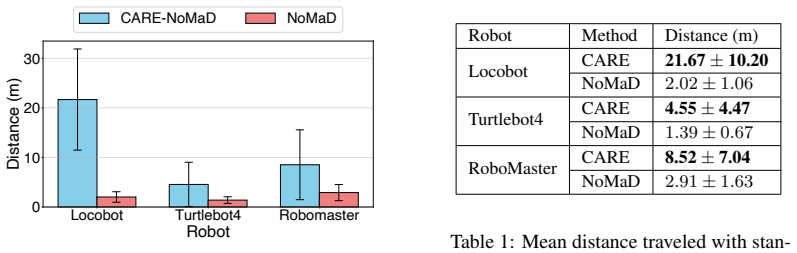
CARE's central discovery is that the trajectory a pretrained RGB navigation policy emits can be made substantially safer by a geometry-only correction computed from the same image: estimate metric depth with a pretrained monocular model (UniDepthV2), project it into a top-down local obstacle set O by keeping the nearest valid point in each lateral bin within sensing range tau_z, then apply the repulsive-force law F_rep(p_k, O) = sum_m -(p_k - o_m)/||p_k - o_m||^4 (as written in the paper) to decide how much to rotate the whole trajectory. The rotation angle theta_rep is the direction of the repulsive force at the most-threatened waypoint, clipped to theta_clip = pi/4 to keep the deviation small, and the Safe-FOV threshold theta_thres = pi/6 suppresses forward motion when the corrected heading demands a sharp turn. On real robots, this reduces collisions in goal-conditioned navigation by up to 100% (LoCoBot with both NoMaD and ViNT) and increases collision-free exploration distance by 2.9x-10.7x across platforms, while arrival rates improve and path length stays within ~4% of baseline.
Load-bearing premise
CARE's obstacle set comes entirely from monocular depth predictions, and the paper concedes (Section 6) that reflective or transparent surfaces and low-texture floors make those predictions unreliable, so in such environments the repulsive rotation can either steer around an obstacle that isn't there or fail to move an unsafe trajectory.
Editorial extensions
If this is right
- CARE should reduce collisions for any RGB-based navigation policy that outputs waypoints or a local trajectory; the paper demonstrates this for NoMaD and ViNT across three platforms with different cameras (170, 89.5, and 120 degree fields of view).
- Navigation performance is preserved within a small margin: path length increases by up to 4.27% and completion time by up to 23.89%, while goal arrival rates improve sharply (e.g., NoMaD on LoCoBot from 50% to 90%, ViNT on TurtleBot4 from 70% to 100%).
- In dynamic scenarios where a person appears from outside the field of view, CARE-integrated policies completed all 10 trials per scenario without collision, while the base models collided in 7-10 of 10 trials.
- CARE's benefit is bounded by the base policy: the paper explicitly notes that CARE adjusts rather than generates trajectories, so in densely cluttered or highly dynamic settings a poor underlying trajectory may not be fully corrected even with strong repulsive forces.
- The safety layer is lightweight enough for real-time control: the depth model runs with about 100 MB of GPU memory, so the collision-avoidance module does not impose a noticeable control-frequency penalty.
Reading between the lines
- A direct testable extension is to feed CARE a per-pixel depth uncertainty from the monocular model and gate the rotation angle by it; the paper's own limitation section (Section 6) implies that reflective, transparent, and low-texture surfaces are exactly where the un-gated version would either miss obstacles or create phantom ones.
- The repulsive force's magnitude decays as 1/d^4 with obstacle distance, so even with a specified sensing range tau_z near 1 m, CARE's effective correction is concentrated within a fraction of a meter; this suggests the empirically tuned tau_z values (0.6-1.2 m across platforms) are already compensating for the law's short effective horizon, and a sensitivity analysis of tau_z would quantify how mu
- Because CARE only uses a top-down obstacle set and scalar parameters, the same module could be applied to other RGB trajectory generators beyond navigation—for example waypoint proposals for manipulation or shared-autonomy teleoperation—wherever a reactive geometric filter is acceptable.
- The Safe-FOV threshold theta_thres interacts with the robot's maximum angular velocity; if heading error contracts monotonically under RotateInPlace, CARE could be paired with a control-barrier-function argument to give a formal safety certificate for the corrected trajectory, something the paper does not claim but its mechanism suggests.
Editorial analysis
A structured set of objections, weighed in public.
Referee Report
Summary. The paper proposes CARE, an attachable safety module for RGB-only visual navigation policies. CARE uses a pretrained monocular depth model (UniDepthV2) to construct a top-down obstacle map, computes an artificial potential field (APF) repulsive force on the policy's predicted waypoints, and rotates or stops the robot accordingly, including a Safe-FOV mechanism that triggers in-place rotation for large heading changes. The module is evaluated on three real robot platforms (LoCoBot, TurtleBot4, RoboMaster S1) with two navigation policies (NoMaD and ViNT) in undirected exploration and image-goal-conditioned navigation tasks, plus a set of dynamic-obstacle experiments. The reported results show collision reductions, improvements in arrival rate and collision-free travel distance, and increases in completion time and path length. A seen-environment sanity check reports 100% success for both baseline policies.
Significance. If the results hold, CARE is a simple and practical contribution: it wraps existing RGB navigation policies without retraining or extra range sensors, and the real-robot evidence spans multiple platforms and camera configurations. The paper is strong in that it includes genuine hardware experiments, a sanity check validating the baseline implementations, and a candid limitations section that acknowledges depth-estimation errors, sensing-range limits, and dependence on the base policy. The central idea is plausible and the module could be useful to practitioners. However, the paper's headline claim that safety is improved 'without compromising navigation performance' is contradicted by its own completion-time data, and the APF formulation as written contains a sign error that would make the force attractive rather than repulsive. These issues, together with the per-platform empirical tuning of safety-critical parameters, need to be resolved before the claims can be accepted as stated.
major comments (4)
- [Abstract; §4.2, Table 2] The abstract's claim that CARE "significantly reduces collisions (up to 100%) without compromising navigation performance in goal-conditioned navigation" is not supported by the paper's own data. Section 4 explicitly defines completion time as a navigation performance metric, and Table 2 shows mean completion time increases of up to 23.89% (RoboMaster+ViNT: 125.60±2.28 s to 155.60±11.35 s) and 17.2% (TurtleBot4+NoMaD: 127.28±0.55 s to 149.13±9.03 s). With n=10 per condition, these increases are likely statistically significant given the small reported standard deviations. Calling these "slightly longer" in §4.2 does not reconcile the contradiction. Please replace the "without compromising navigation performance" claim with a quantified safety–time tradeoff, or restrict the claim to arrival rate and path length.
- [§3.2, Eq. (1)] The repulsive force in Eq. (1) has a sign error as written. Since (p_k − o_m) points from the obstacle o_m to the waypoint p_k, the negative leading factor makes F_rep point from the waypoint toward the obstacle, i.e., an attractive force rather than a repulsive one. If the implementation matches the equation, the trajectory rotation in Section 3.2 would steer the robot into obstacles, contradicting the reported collision reductions. If this is a typographical error in the paper, please correct the sign and state the direction convention used in the code; if the negative sign is intentional, explain why the resulting vector is still repulsive. This is a central derivation issue that must be clarified for reproducibility.
- [§4; Appendix B.2; §6] The paper claims zero-shot deployment without fine-tuning, but CARE itself requires platform-specific empirical tuning. Section 4 states "We optimize CARE parameters experimentally for each platform," and Appendix B.2 reports different empirical values for τ_z (1.0, 1.2, 1.0 m) and Depth Offset (0.05, 0.2, −0.1 m) across the three robots, with θ_clip and θ_thres also experimentally chosen. This is not the same as retraining the navigation policy, but it is a per-platform calibration step that should be disclosed in the abstract and conclusion. The paper's own Limitations section (§6) mentions sensitivity to depth errors and sensing range, but it does not mention this parameter-tuning dependence. Please state the need for per-platform tuning explicitly and, ideally, report the sensitivity of the collision results to these parameters.
- [Table 2; §4.2] The collision-reduction claim is based on small counts reported without confidence intervals or statistical tests. For example, TurtleBot4+ViNT shows a mean collision count of 0.2 vs. 0.1, which is a difference of one collision in 10 trials per condition, yet the abstract uses the word "significantly" to describe the reductions. Since collision count is the central safety metric, please report per-condition collision counts, confidence intervals, or a paired significance test (e.g., a permutation test) for each comparison, or qualify the strength of the evidence accordingly.
minor comments (4)
- [§3.1 vs. Table 6] The filter Y ≥ −ε with ε = −0.05 m retains points with Y ≥ 0.05 m, which excludes floor points, not ceiling points as the text states in Section 3.1 ("vertical margin to exclude ceiling points"). Please clarify the coordinate convention or correct the sign/description.
- [Table 2] Please clarify whether the "# Collision" column reports the mean number of collisions per trial over the 10 runs, and add the total collision counts or a footnote so that readers can judge the magnitude of the differences.
- [§4.2] The sentence "slightly longer paths (up to 4.27% increase) and completion times (up to 23.89% increase)" groups two different magnitudes under one adverb; consider reporting path length and completion time separately so that the 23.89% increase is not downplayed.
- [Appendix A.2] The seen-environment sanity check is performed only on the LoCoBot platform; a brief justification for why this single platform suffices to validate the baseline implementations would be helpful.
Circularity Check
No circularity: CARE's safety gains are measured against external collision outcomes; the only self-citation (APF force law) is standard and not load-bearing.
full rationale
The paper's central claims are empirical, not derived from a fitted model: CARE attaches a monocular-depth obstacle estimator and a repulsive-rotation module to pretrained navigation policies, and the reported collisions, path lengths, completion times, arrival rates, and distances-before-first-collision are measured in real-world experiments against external baselines. None of these metrics is defined in terms of CARE's own outputs. The only self-citation is Eq. (1), the repulsive-force law attributed to the authors' prior work [26]; however, the same formula is standard artificial potential field (Khatib [14]) and is not a fitted parameter, a uniqueness theorem, or a premise that by construction determines the measured collision outcomes. Section 6 further concedes that monocular depth errors produce both missed and phantom obstacles, so the collision-reduction results are not tautologically forced: the system can fail. The abstract's 'without compromising navigation performance' is internally inconsistent with Table 2's completion-time increases (up to 23.89%), but that is a correctness/consistency issue, not circularity. The derivation chain is therefore self-contained with respect to the evaluation evidence.
Assumptions & free parameters
free parameters (5)
- tau_z max depth range =
LoCoBot 1.0 m, TurtleBot4 1.2 m, RoboMaster 1.0 m
- Depth offset =
0.05 m (LoCoBot), 0.2 m (TurtleBot4), -0.1 m (RoboMaster)
- theta_clip =
pi/4 rad
- theta_thres =
pi/6 rad
- epsilon vertical offset =
-0.05 m
assumptions (4)
- domain assumption Monocular depth predictions from UniDepthV2 are metrically accurate enough for top-down obstacle mapping in test environments.
- domain assumption The robot can be treated as a point with the body radius absorbed by the hand-tuned depth offset.
- domain assumption Rotating the entire predicted trajectory by theta_rep, clipped to theta_clip, preserves goal-directed progress.
- standard math The APF force law Eq. (1) from reference [26] extends to this setting without modification.
Cite this review
Pith. "Pith review of CARE: Enhancing Safety of Visual Navigation through Collision Avoidance via Repulsive Estimation." pith.science (2026). https://pith.science/paper/HEYRHD67
@misc{pith2026250603834,
  author       = {Pith},
  title        = {Pith review of: CARE: Enhancing Safety of Visual Navigation through Collision Avoidance via Repulsive Estimation},
  year         = {2026},
  howpublished = {\url{https://pith.science/paper/HEYRHD67}},
  note         = {Machine review of arXiv:2506.03834}
}
read the original abstract
We propose CARE (Collision Avoidance via Repulsive Estimation) to improve the robustness of learning-based visual navigation methods. Recently, visual navigation models, particularly foundation models, have demonstrated promising performance by generating viable trajectories using only RGB images. However, these policies can generalize poorly to environments containing out-of-distribution (OOD) scenes characterized by unseen objects or different camera setups (e.g., variations in field of view, camera pose, or focal length). Without fine-tuning, such models could produce trajectories that lead to collisions, necessitating substantial efforts in data collection and additional training. To address this limitation, we introduce CARE, an attachable module that enhances the safety of visual navigation without requiring additional range sensors or fine-tuning of pretrained models. CARE can be integrated seamlessly into any RGB-based navigation model that generates local robot trajectories. It dynamically adjusts trajectories produced by a pretrained model using repulsive force vectors computed from depth images estimated directly from RGB inputs. We evaluate CARE by integrating it with state-of-the-art visual navigation models across diverse robot platforms. Real-world experiments show that CARE significantly reduces collisions (up to 100%) without compromising navigation performance in goal-conditioned navigation, and further improves collision-free travel distance (up to 10.7x) in exploration tasks. Project page: https://airlab-sogang.github.io/CARE/
Figures


Figures from the paper (4 more)



Forward citations
Cited by 2 Pith papers
-
Rule-VLN: Bridging Perception and Compliance via Semantic Reasoning and Geometric Rectification
Rule-VLN is the first large-scale benchmark injecting 177 regulatory categories into an urban environment, and the proposed SNRM module equips pre-trained VLN agents with zero-shot semantic reasoning and detour planni...
-
MM-Nav: Multi-View VLA Model for Robust Visual Navigation via Multi-Expert Learning
A four-camera VLA navigation model trained by distilling multiple RL experts achieves strong simulation performance and qualitative real-world transfer.
Reference graph
Works this paper leans on
- [1]
-
[2]
C. H. Song, J. Wu, C. Washington, B. M. Sadler, W.-L. Chao, and Y . Su. Llm-planner: Few- shot grounded planning for embodied agents with large language models. In Proc. of the IEEE/CVF International Conference on Computer Vision (ICCV), pages 2998–3009, 2023
work page 2023
-
[3]
G. Zhou, Y . Hong, and Q. Wu. Navgpt: Explicit reasoning in vision-and-language navigation with large language models. In Proc. of the AAAI Conference on Artificial Intelligence (AAAI), volume 38, pages 7641–7649, 2024
work page 2024
- [4]
-
[5]
D. Shah, B. Osi ´nski, B. Ichter, and S. Levine. Lm-nav: Robotic navigation with large pre- trained models of language, vision, and action. In Proc. of the Conference on Robot Learning (CoRL), pages 492–504. PMLR, 2023
work page 2023
-
[6]
D. Shah, B. Eysenbach, G. Kahn, N. Rhinehart, and S. Levine. Ving: Learning open-world navigation with visual goals. In Proc. of the IEEE International Conference on Robotics and Automation (ICRA), pages 13215–13222. IEEE, 2021
work page 2021
-
[7]
D. Shah, A. Sridhar, A. Bhorkar, N. Hirose, and S. Levine. Gnm: A general navigation model to drive any robot. In Proc. of the IEEE International Conference on Robotics and Automation (ICRA), pages 7226–7233. IEEE, 2023
work page 2023
-
[8]
D. Shah, A. Sridhar, N. Dashora, K. Stachowicz, K. Black, N. Hirose, and S. Levine. Vint: A foundation model for visual navigation. InProc. of the Conference on Robot Learning (CoRL), pages 711–733. PMLR, 2023
work page 2023
Show all 32 references
-
[9]
Shah and S
D. Shah and S. Levine. ViKiNG: Vision-Based Kilometer-Scale Navigation with Geographic Hints. In Proc. of the Robotics: Science and Systems (RSS), 2022
2022
-
[10]
Sridhar, D
A. Sridhar, D. Shah, C. Glossop, and S. Levine. Nomad: Goal masked diffusion policies for navigation and exploration. In Proc. of the IEEE International Conference on Robotics and Automation (ICRA), pages 63–70. IEEE, 2024
2024
-
[11]
Simon and A
N. Simon and A. Majumdar. Mononav: Mav navigation via monocular depth estimation and reconstruction. In Proc. of the International Symposium on Experimental Robotics (ISER) , pages 415–426. Springer, 2023
2023
-
[12]
Firoozi, J
R. Firoozi, J. Tucker, S. Tian, A. Majumdar, J. Sun, W. Liu, Y . Zhu, S. Song, A. Kapoor, K. Hausman, B. Ichter, D. Driess, J. Wu1, C. Lu, and M. Schwager. Foundation models in robotics: Applications, challenges, and the future. The International Journal of Robotics Research (...
2023
-
[13]
Piccinelli, C
L. Piccinelli, C. Sakaridis, Y .-H. Yang, M. Segu, S. Li, W. Abbeloos, and L. Van Gool. Unidepthv2: Universal monocular metric depth estimation made simpler. arXiv preprint arXiv:2502.20110, 2025
2025 arXiv
-
[14]
O. Khatib. Real-time obstacle avoidance for manipulators and mobile robots.The International Journal of Robotics Research (IJRR), 5(1):90–98, 1986
1986
-
[15]
D. Shah, M. R. Equi, B. Osi ´nski, F. Xia, B. Ichter, and S. Levine. Navigation with large language models: Semantic guesswork as a heuristic for planning. In Proc. of the Conference on Robot Learning (CoRL), pages 2683–2699. PMLR, 2023
2023
-
[16]
H. Lu, J. Wu, X. Wang, T. Darrell, and C. Chen. Navigating beyond instructions: Evaluating and enhancing vln agents under realistic environment changes. In Proc. of ACM International Conference on Multimedia (ACM MM), 2024
2024
-
[17]
F. Gao, J. Tang, J. Wang, S. Li, and J. Yu. Enhancing scene understanding for vision-and- language navigation by knowledge awareness. IEEE Robotics and Automation Letters (RA-L), 9(12):10874–10878, 2024
2024
-
[18]
Vaswani, N
A. Vaswani, N. Shazeer, N. Parmar, J. Uszkoreit, L. Jones, A. N. Gomez, Ł. Kaiser, and I. Polo- sukhin. Attention is all you need. Advances in neural information processing systems , 30, 2017
2017
-
[19]
A. Bar, G. Zhou, D. Tran, T. Darrell, and Y . LeCun. Navigation world models. arXiv preprint arXiv:2412.03572, 2025. 10
2025 arXiv
-
[20]
L. Yue, D. Zhou, L. Xie, F. Zhang, Y . Yan, and E. Yin. Safe-vln: Collision avoidance for vision-and-language navigation of autonomous robots operating in continuous environments. IEEE Robotics and Automation Letters (RA-L), 2024
2024
-
[21]
Farid, D
A. Farid, D. Snyder, A. Z. Ren, and A. Majumdar. Failure prediction with statistical guarantees for vision-based robot control. In Proc. of the Robotics: Science and Systems (RSS). MIT Press Journals, 2022
2022
-
[22]
Dixit, Z
A. Dixit, Z. Mei, M. Booker, M. Storey-Matsutani, A. Z. Ren, and A. Majumdar. Perceive with confidence: Statistical safety assurances for navigation with learning-based perception. In Proc. of the Conference on Robot Learning (CoRL), 2024
2024
-
[23]
Santos, Z
L. Santos, Z. Li, L. Peters, S. Bansal, and A. Bajcsy. Updating robot safety representations online from natural language feedback. arXiv preprint arXiv:2409.14580, 2024
2024 arXiv
-
[24]
Sanyal and K
S. Sanyal and K. Roy. Asma: An adaptive safety margin algorithm for vision-language drone navigation via scene-aware control barrier functions. arXiv preprint arXiv:2409.10283, 2024
2024 arXiv
-
[25]
Z. Xu, X. Han, H. Shen, H. Jin, and K. Shimada. Navrl: Learning safe flight in dynamic environments. IEEE Robotics and Automation Letters (RA-L), 2025
2025
-
[26]
J. Kim, S. Park, W. Lee, W. Kim, N. Doh, and C. Nam. Escaping local minima: Hybrid artifi- cial potential field with wall-follower for decentralized multi-robot navigation. arXiv preprint arXiv:2409.10332, 2024
2024 arXiv
-
[27]
Bektas ¸ and H
K. Bektas ¸ and H. I. Bozma. Apf-rl: Safe mapless navigation in unknown environments. In Proc. of the IEEE International Conference on Robotics and Automation (ICRA), pages 7299– 7305, 2022
2022
-
[28]
Zhang, X
D. Zhang, X. Zhang, Z. Zhang, B. Zhu, and Q. Zhang. Reinforced potential field for multi- robot motion planning in cluttered environments. In Proc. of the IEEE/RSJ International Con- ference on Intelligent Robots and Systems (IROS), pages 699–704, 2023
2023
-
[29]
Zhang, D
Z. Zhang, D. Zhang, Q. Zhang, W. Pan, and T. Hu. Dacoop-a: Decentralized adaptive cooper- ative pursuit via attention. IEEE Robotics and Automation Letters (RA-L), 9(6), 2024
2024
-
[30]
Weng and K
X. Weng and K. Kitani. Monocular 3d object detection with pseudo-lidar point cloud. InProcc of the IEEE/CVF International Conference on Computer Vision (ICCV) Workshops, 2019
2019
-
[31]
Piccinelli, Y .-H
L. Piccinelli, Y .-H. Yang, C. Sakaridis, M. Segu, S. Li, L. Van Gool, and F. Yu. Unidepth: Uni- versal monocular metric depth estimation. In Proc. of the IEEE/CVF Conference on Computer Vision and Pattern Recognition (CVPR), pages 10106–10116, 2024
2024
-
[32]
Elazab, T
G. Elazab, T. Gr¨aber, M. Unterreiner, and O. Hellwich. MonoPP: Metric-scaled self-supervised monocular depth estimation by planar-parallax geometry in automotive applications. In Proc. of the IEEE/CVF Winter Conference on Applications of Computer Vision (WACV), pages 2777– 27...
2025
Reviewed August 7, 2026 · model on record in the stance chip above.
Discussion (0). Sign in to comment.