Ray tracing ultracompact boson stars: visibility modulations and incomplete photon rings
Pith reviewed 2026-07-01 02:08 UTC · model grok-4.3
The pith
Clear visibility modulations from extra photon rings occur only in spherical ultracompact boson stars at limited inclinations, not generically for black-hole mimickers.
A machine-rendered reading of the paper's core claim, the machinery that carries it, and where it could break.
Core claim
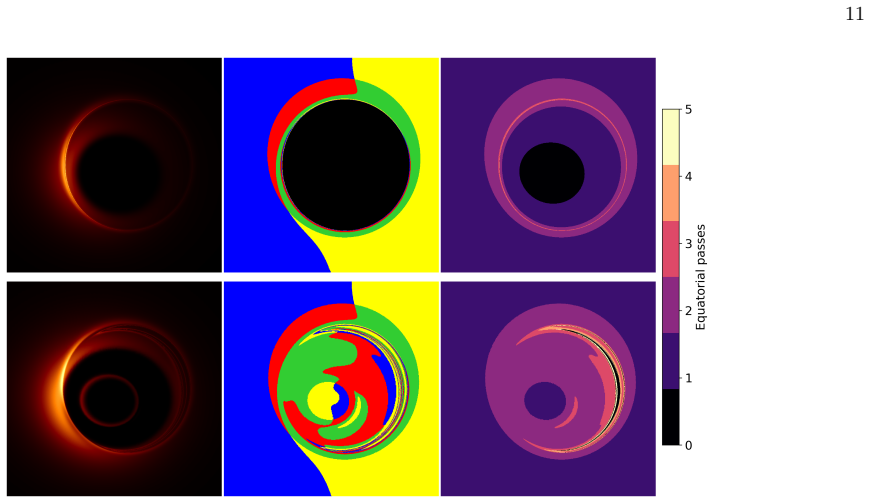
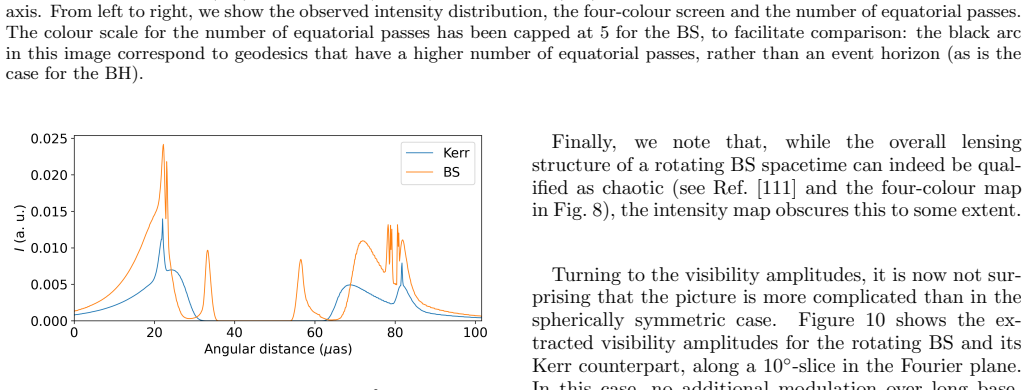
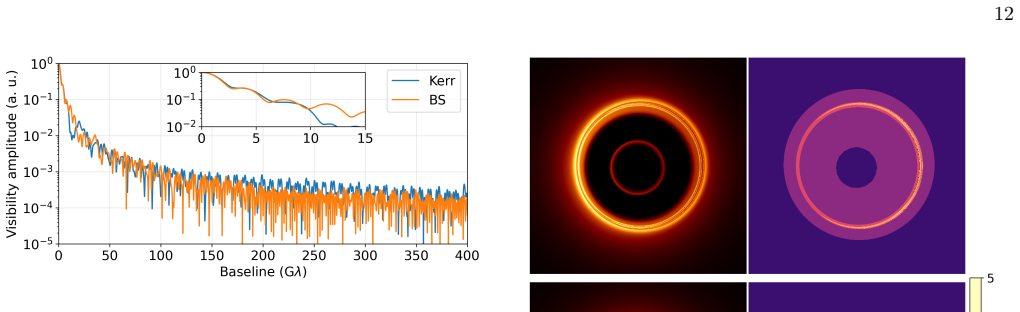
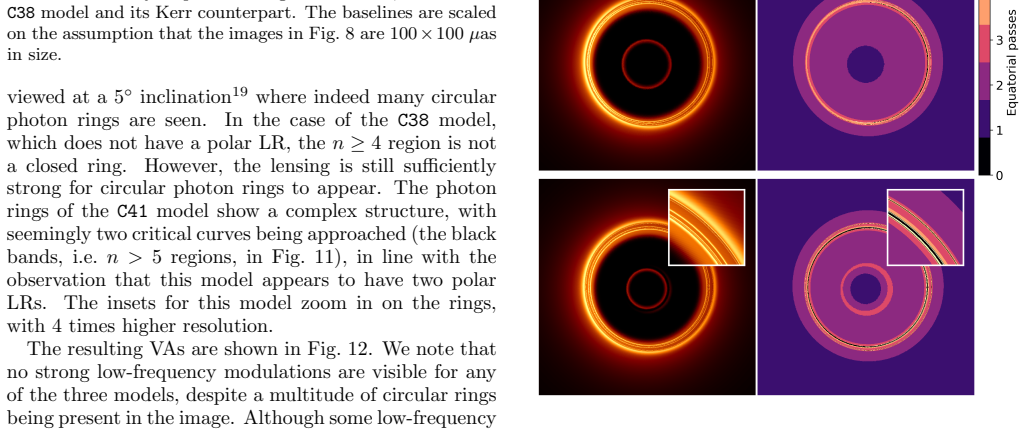
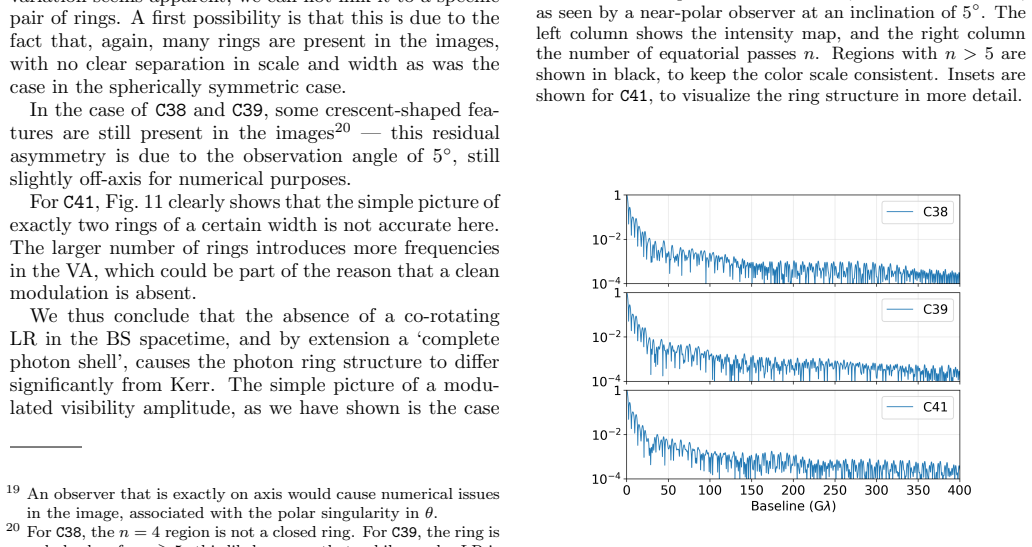
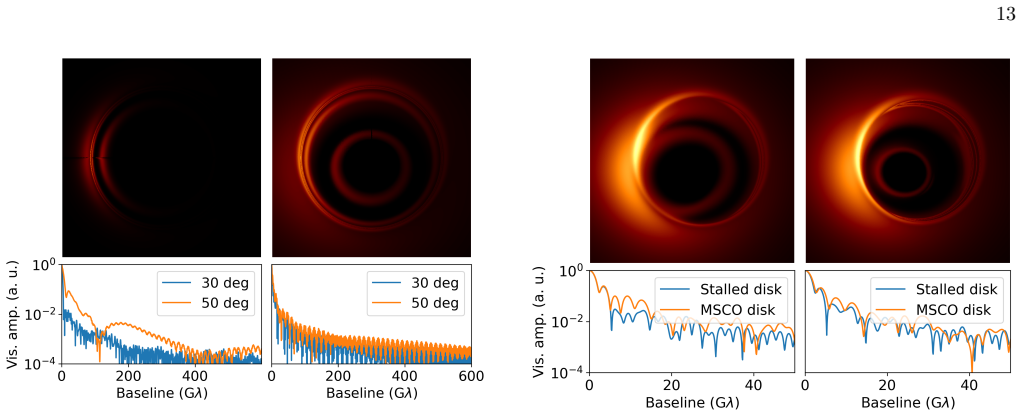
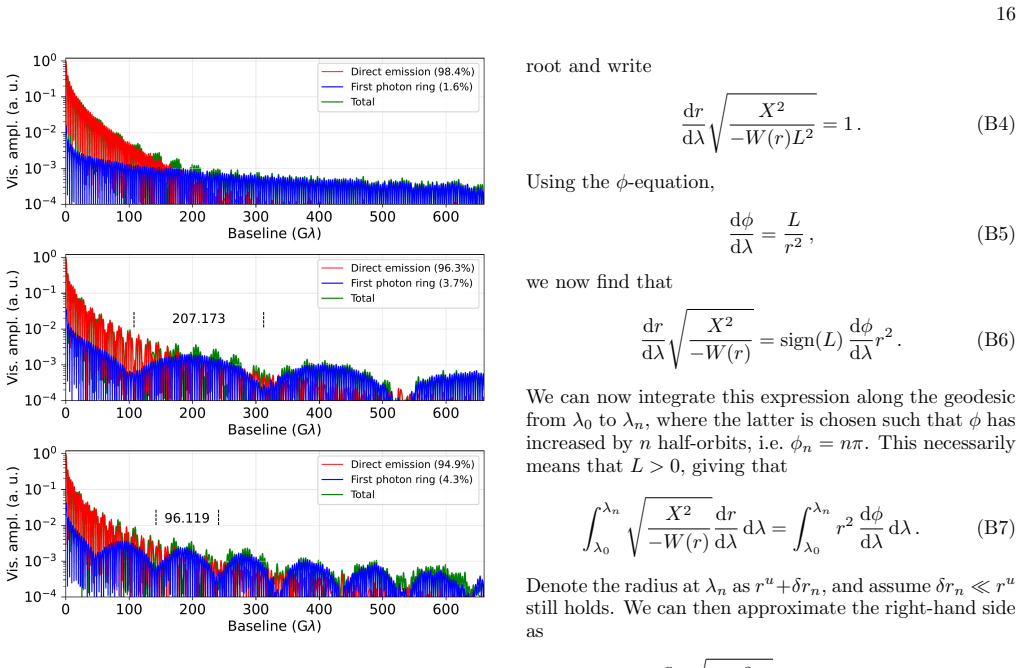
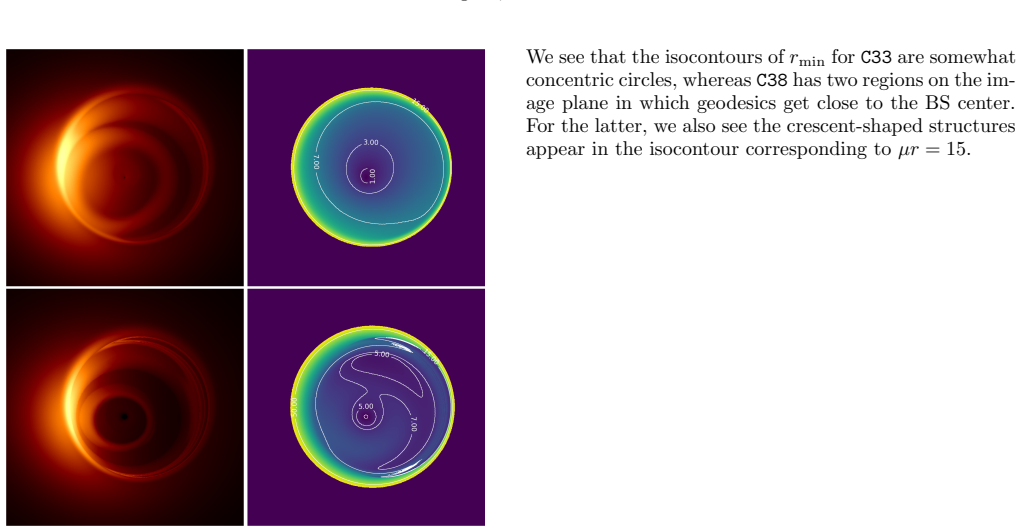
Ray-traced images of stable and unstable ultracompact solitonic boson stars show that clear modulations in the associated visibility amplitude are only present in spherical symmetry, for a restricted range of observer inclinations. This suggests that such modulations cannot be a generic expectation of ultracompact black-hole mimickers. For rotating boson stars the photon rings are incomplete, and an unstable prograde light ring may be needed to remedy this.
What carries the argument
Visibility amplitude extracted from ray-traced images of boson star spacetimes, examined for low-frequency modulations that would signal extra photon rings.
If this is right
- Additional photon rings in rotating ultracompact objects will not generically imprint low-frequency modulations on visibility data.
- Rotating boson-star photon rings remain incomplete unless an unstable prograde light ring is present.
- Absence of visibility modulations in observations cannot be used to exclude most rotating black-hole mimickers.
- Image features from axisymmetric mimickers may require separate analysis from spherical ones.
Where Pith is reading between the lines
- Applying the same visibility analysis to other mimicker spacetimes such as gravastars or wormholes would test whether the spherical-only result holds more broadly.
- Incomplete rings in rotating cases may affect how image-reconstruction pipelines interpret partial ring signals.
- Inclination dependence implies that orientation biases could affect the detectability of any mimicker signatures in surveys.
Load-bearing premise
The specific stable and unstable ultracompact solitonic boson star models examined are representative of the broader class of ultracompact black-hole mimickers capable of producing additional photon rings.
What would settle it
Clear low-frequency modulations appearing in the visibility amplitude of a rotating ultracompact boson star across a wide range of inclinations would falsify the claim that such modulations are not generic.
Figures
read the original abstract
Modified black holes and black hole mimickers can give rise to additional photon rings in ray-traced images. With the photon ring structure of Kerr well understood, the question arises how well future versions of the Event Horizon Telescope images would be able to constrain the presence of non-Kerr photon rings. In this work, we investigate how likely additional photon rings are to present themselves through low-frequency modulations of the visibility amplitude, i.e. in Fourier space where the data live. To this end, we generate ray-traced images of stable and unstable ultracompact, solitonic boson stars, both in spherical symmetry and with rotation. We find that clear modulations in the associated visibility amplitude are only present in spherical symmetry, for a restricted range of observer inclinations, hence suggesting that these modulations can not be a generic expectation of ultracompact black-hole mimickers. Additionally, we discuss how the photon rings are incomplete for the rotating boson stars considered, and how an unstable prograde light ring may be needed to remedy this.
Editorial analysis
A structured set of objections, weighed in public.
Referee Report
Summary. The manuscript uses numerical ray tracing to generate images of stable and unstable ultracompact solitonic boson stars, both spherically symmetric and rotating. It reports that clear low-frequency modulations in visibility amplitude (indicative of additional photon rings) appear only in the spherical cases and only for a restricted range of observer inclinations. The work concludes that such modulations cannot be viewed as a generic signature of ultracompact black-hole mimickers. It further observes that photon rings remain incomplete in the rotating models and suggests that an unstable prograde light ring may be required to produce complete rings.
Significance. If the numerical findings hold, the result indicates that visibility modulations are unlikely to serve as a robust, model-independent probe of extra photon rings in EHT data, thereby limiting one proposed avenue for constraining non-Kerr ultracompact objects. The paper supplies direct ray-traced images and visibility curves for both stable and unstable boson-star solutions, together with an explicit discussion of photon-ring incompleteness in the rotating sector; these concrete examples constitute a useful addition to the literature on mimicker phenomenology.
major comments (2)
- [Abstract] Abstract: the statement that modulations 'can not be a generic expectation of ultracompact black-hole mimickers' is drawn exclusively from the absence of clear modulations in the rotating solitonic boson-star models examined. No cross-comparison with other mimicker families (e.g., gravastars, wormholes, or different scalar potentials) is presented, so the generality claim rests on the untested assumption that the light-ring structure of these specific solutions is representative.
- [Discussion] Discussion section on rotating models: the suggestion that 'an unstable prograde light ring may be needed to remedy' photon-ring incompleteness is offered without a quantitative demonstration that adding such a ring in the examined spacetimes would in fact restore completeness; the claim therefore functions as a conjecture rather than a result directly supported by the ray-tracing data.
minor comments (1)
- [Abstract / Introduction] The abstract and introduction should state the specific compactness values, scalar-field potential parameters, and rotation rates of the boson-star models so that the numerical results can be reproduced or extended by other groups.
Simulated Author's Rebuttal
We thank the referee for the careful reading of our manuscript and the constructive comments. We address each major comment below, indicating where revisions will be made to the text.
read point-by-point responses
-
Referee: [Abstract] Abstract: the statement that modulations 'can not be a generic expectation of ultracompact black-hole mimickers' is drawn exclusively from the absence of clear modulations in the rotating solitonic boson-star models examined. No cross-comparison with other mimicker families (e.g., gravastars, wormholes, or different scalar potentials) is presented, so the generality claim rests on the untested assumption that the light-ring structure of these specific solutions is representative.
Authors: We agree that the original wording in the abstract is too broad. Our conclusions are drawn from the specific class of ultracompact solitonic boson stars (both spherical and rotating) that we have ray-traced. While these solutions are standard examples of black-hole mimickers possessing multiple light rings, we have not examined other families. We will revise the abstract to qualify the statement as applying to the boson-star models considered in this work. revision: yes
-
Referee: [Discussion] Discussion section on rotating models: the suggestion that 'an unstable prograde light ring may be needed to remedy' photon-ring incompleteness is offered without a quantitative demonstration that adding such a ring in the examined spacetimes would in fact restore completeness; the claim therefore functions as a conjecture rather than a result directly supported by the ray-tracing data.
Authors: The referee correctly identifies that this is a conjecture motivated by the light-ring structure observed in our models and by comparison with the spherical cases and Kerr, rather than a direct numerical test of modifying the spacetime. We will revise the discussion section to present the statement explicitly as a conjecture and will adjust the language to avoid implying a demonstrated result. revision: partial
Circularity Check
No significant circularity detected
full rationale
The paper's central results are obtained via direct numerical ray-tracing of specific stable/unstable solitonic boson star solutions to the Einstein-Klein-Gordon system. The claim that visibility modulations are not generic follows from the absence of such modulations in the examined rotating cases, without any self-referential definitions, fitted parameters renamed as predictions, or load-bearing self-citations. No equations reduce to their inputs by construction, and the derivation chain consists of independent numerical outputs rather than tautological mappings. The representativeness concern is a scope limitation, not a circularity violation under the enumerated patterns.
Axiom & Free-Parameter Ledger
free parameters (1)
- boson star model parameters (compactness, scalar field potential, rotation rate)
axioms (2)
- standard math Spacetime around the boson stars is governed by general relativity
- domain assumption Ultracompact solitonic boson stars can exist in both stable and unstable configurations
Reference graph
Works this paper leans on
-
[1]
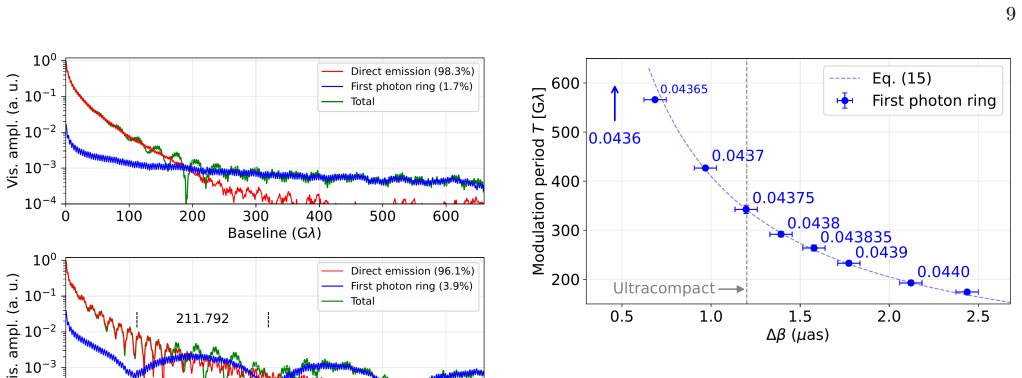
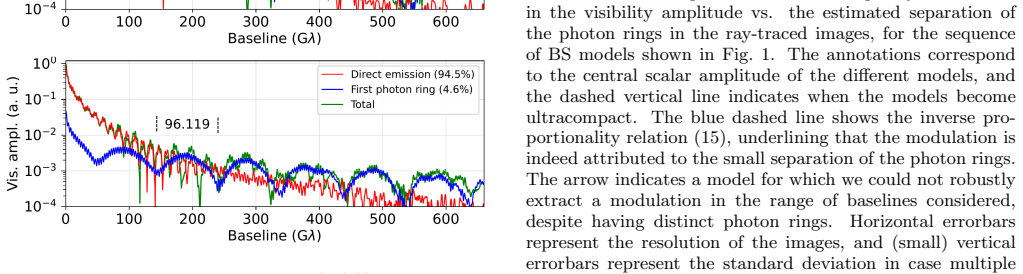
The visibility amplitudes for near-equatorial ob- servers can display a notable low-frequency mod- ulation on long baselines
-
[2]
This low-frequency modulation is present, despite the asymmetry in the image as a result of the fluid velocity
-
[3]
This could be due to the larger separation between the photon ring pairs, and the stronger decay of the signal towards longer base- lines
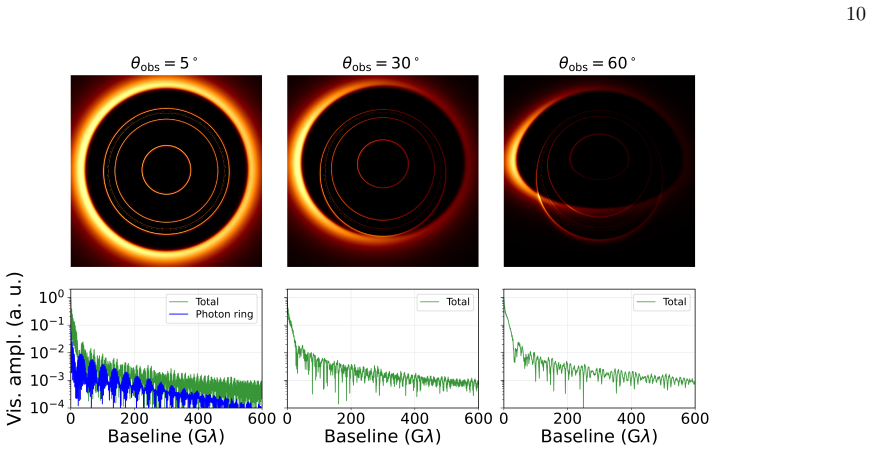
Observers close to the symmetry axis (perpendicu- lar to the accretion plane) still see highly circular photon rings, but no strong modulations in the to- tal VA are apparent. This could be due to the larger separation between the photon ring pairs, and the stronger decay of the signal towards longer base- lines
-
[4]
This appears to violate the simple picture used to derive the mod- ulations
Observers at intermediate angles are less likely to see modulations, as the photon rings are less circu- lar and have varying separation. This appears to violate the simple picture used to derive the mod- ulations
-
[5]
We reiterate that we have focussed on the first-order photon ring(s), i.e
Despite not having LRs, some BSs just outside of the ultracompact regime can still source modula- tions as they are still sufficiently compact to gen- erate a finite number of photon rings. We reiterate that we have focussed on the first-order photon ring(s), i.e. those sourced by geodesics that pass through the accretion disc twice. The above conclusions...
-
[6]
In this context, nearly bound means that the conserved quantitiesE=−p t, L=p ϕ of the geodesic are approximately those associated with the LR, which we denote asE u, Lu
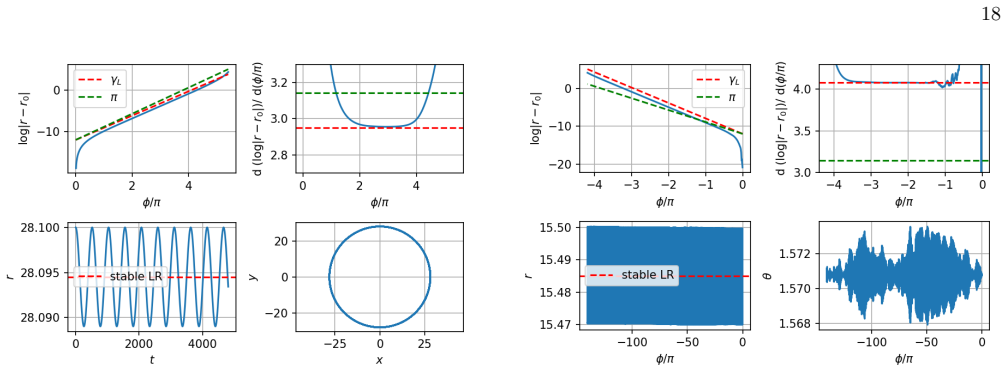
Spherical symmetry Consider a nearly-bound null geodesic in the equato- rial plane, starting close to the unstable LR at radial coordinater 0 =r u +δr 0 withδr 0 ≪r u LR (and WLOG we can assumeϕ 0 = 0). In this context, nearly bound means that the conserved quantitiesE=−p t, L=p ϕ of the geodesic are approximately those associated with the LR, which we de...
-
[7]
Due to the reflection symmetry with 17 respect to the equatorial plane, a nearly-bound geodesic that has an initial velocity in the equatorial plane will remain there22
Rotating BS We follow a similar approach to calculate the Lyapunov exponent associated with the unstable LR in the rotat- ing BS spacetimes. Due to the reflection symmetry with 17 respect to the equatorial plane, a nearly-bound geodesic that has an initial velocity in the equatorial plane will remain there22. Calculating the Lyapunov exponent as- sociated...
-
[8]
(bottom) We plot the absolute differences between the simulations at different resolution, i.e
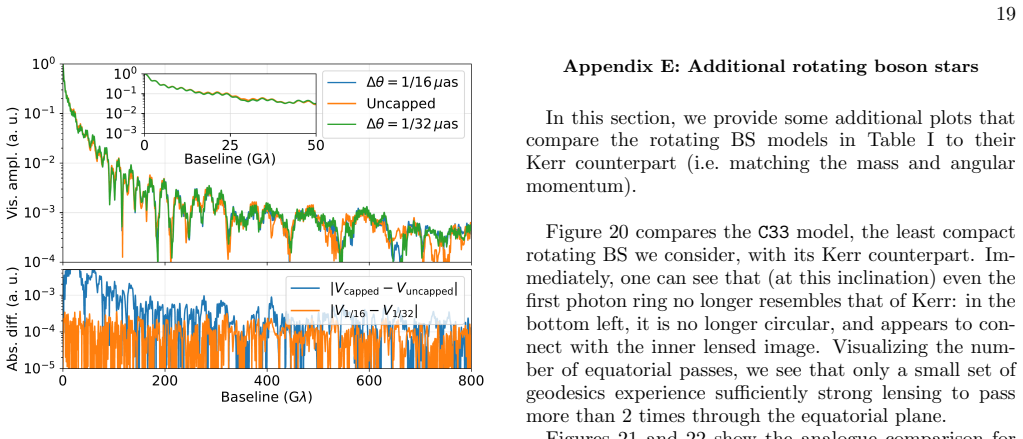
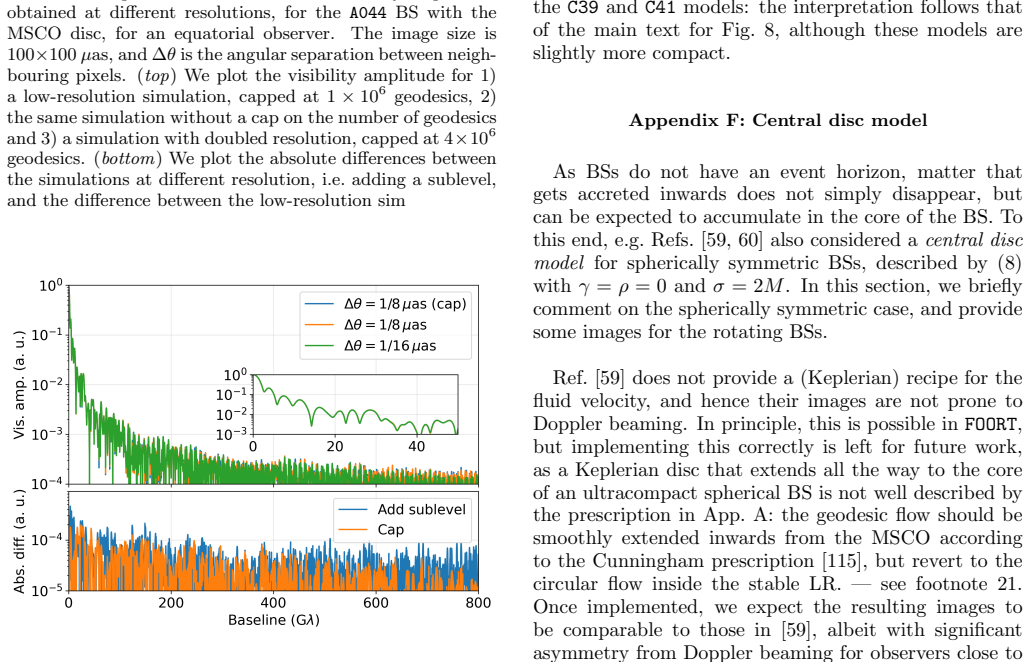
a low-resolution simulation, capped at 5×10 5 geodesics, 2) the same simulation without a cap on the number of geodesics and 3) a simulation with doubled resolution, capped at 2×10⁶ geodesics. (bottom) We plot the absolute differences between the simulations at different resolution, i.e. adding a sublevel, and the difference between the low-resolution sim...
-
[9]
Black hole mimickers: from theory to observation
Cosimo Bambi et al. Black hole mimickers: from theory to observation. 5 2025
2025
-
[10]
Testing the nature of dark compact objects: a status report.Living Rev
Vitor Cardoso and Paolo Pani. Testing the nature of dark compact objects: a status report.Living Rev. Rel., 22(1):4, 2019. doi:10.1007/s41114-019-0020-4
-
[11]
Springer Nature Singapore, Singa- pore, 2025
Miguel Bezares and Nicolas Sanchis-Gual.Exotic Com- 22 pact Objects: A Recent Numerical-Relativity Perspec- tive, pages 619–661. Springer Nature Singapore, Singa- pore, 2025. doi:10.1007/978-981-97-8522-3˙18
-
[12]
David J. Kaup. Klein-Gordon Geon.Phys. Rev., 172: 1331–1342, 1968. doi:10.1103/PhysRev.172.1331
-
[13]
Systems of self- gravitating particles in general relativity and the con- cept of an equation of state.Phys
Remo Ruffini and Silvano Bonazzola. Systems of self- gravitating particles in general relativity and the con- cept of an equation of state.Phys. Rev., 187:1767–1783,
-
[14]
doi:10.1103/PhysRev.187.1767
-
[15]
R. Friedberg, T. D. Lee, and Y. Pang. Scalar Soliton Stars and Black Holes.Phys. Rev. D, 35:3658, 1987. doi:10.1103/PhysRevD.35.3658
-
[16]
Rotat- ing boson stars and Q-balls.Phys
Burkhard Kleihaus, Jutta Kunz, and Meike List. Rotat- ing boson stars and Q-balls.Phys. Rev. D, 72:064002,
-
[17]
doi:10.1103/PhysRevD.72.064002
-
[18]
Liebling and Carlos Palenzuela
Steven L. Liebling and Carlos Palenzuela. Dynami- cal boson stars.Living Rev. Rel., 26(1):1, 2023. doi: 10.1007/s41114-023-00043-4
-
[19]
Boson stars and oscillatons: A re- view.Int
Luca Visinelli. Boson stars and oscillatons: A re- view.Int. J. Mod. Phys. D, 30(15):2130006, 2021. doi: 10.1142/S0218271821300068
-
[20]
T. D. Lee and Yang Pang. Stability of Mini - Boson Stars.Nucl. Phys. B, 315:477, 1989. doi:10.1016/0550- 3213(89)90365-9
-
[21]
Gravitational Stability of Scalar Matter.Nucl
Marcelo Gleiser and Richard Watkins. Gravitational Stability of Scalar Matter.Nucl. Phys. B, 319:733–746,
-
[22]
doi:10.1016/0550-3213(89)90627-5
-
[23]
Fabrizio Di Giovanni, Nicolas Sanchis-Gual, Pablo Cerd´ a-Dur´ an, Miguel Zilh˜ ao, Carlos Herdeiro, Jos´ e A. Font, and Eugen Radu. Dynamical bar-mode instabil- ity in spinning bosonic stars.Phys. Rev. D, 102(12): 124009, 2020. doi:10.1103/PhysRevD.102.124009
-
[24]
Nils Siemonsen and William E. East. Stability of rotating scalar boson stars with nonlinear interac- tions.Phys. Rev. D, 103(4):044022, 2021. doi: 10.1103/PhysRevD.103.044022
-
[25]
Sanchis-Gual, F
N. Sanchis-Gual, F. Di Giovanni, M. Zilh˜ ao, C. Herdeiro, P. Cerd´ a-Dur´ an, J. A. Font, and E. Radu. Nonlinear Dynamics of Spinning Bosonic Stars: For- mation and Stability.Phys. Rev. Lett., 123(22):221101,
-
[26]
doi:10.1103/PhysRevLett.123.221101
-
[27]
Self-interactions can stabilize excited boson stars.Class
Nicolas Sanchis-Gual, Carlos Herdeiro, and Eugen Radu. Self-interactions can stabilize excited boson stars.Class. Quant. Grav., 39(6):064001, 2022. doi: 10.1088/1361-6382/ac4b9b
-
[28]
Stability and col- lisions of excited spherical boson stars: Glimpses of chains and rings.Phys
Marco Brito, Carlos Herdeiro, Eugen Radu, Nicolas Sanchis-Gual, and Miguel Zilh˜ ao. Stability and col- lisions of excited spherical boson stars: Glimpses of chains and rings.Phys. Rev. D, 113(2):024008, 2026. doi:10.1103/8bwz-wqhp
-
[29]
Perturbations of Solitonic Bo- son Stars: Nonlinear Radial Stability and Binding En- ergy.J
Gareth Arturo Marks. Perturbations of Solitonic Bo- son Stars: Nonlinear Radial Stability and Binding En- ergy.J. Phys. Conf. Ser., 3177(1):012047, 2026. doi: 10.1088/1742-6596/3177/1/012047
-
[30]
Boson stars inD≥4 dimensions: stability, oscillation frequencies, and dynamical evolutions.Class
Gareth Arturo Marks and Abdullah Al Zaif. Boson stars inD≥4 dimensions: stability, oscillation frequencies, and dynamical evolutions.Class. Quant. Grav., 43(8): 085014, 2026. doi:10.1088/1361-6382/ae60bc
-
[31]
C. Palenzuela, I. Olabarrieta, L. Lehner, and Steven L. Liebling. Head-on collisions of boson stars.Phys. Rev. D, 75:064005, 2007. doi:10.1103/PhysRevD.75.064005
-
[32]
Gravita- tional Wave Signatures of Highly Compact Boson Star Binaries.Phys
Carlos Palenzuela, Paolo Pani, Miguel Bezares, Vitor Cardoso, Luis Lehner, and Steven Liebling. Gravita- tional Wave Signatures of Highly Compact Boson Star Binaries.Phys. Rev. D, 96(10):104058, 2017. doi: 10.1103/PhysRevD.96.104058
-
[33]
Final fate of compact boson star mergers.Phys
Miguel Bezares, Carlos Palenzuela, and Carles Bona. Final fate of compact boson star mergers.Phys. Rev. D, 95(12):124005, 2017. doi:10.1103/PhysRevD.95.124005
-
[35]
Grav- itational waves and kicks from the merger of unequal mass, highly compact boson stars.Phys
Miguel Bezares, Mateja Boˇ skovi´ c, Steven Liebling, Car- los Palenzuela, Paolo Pani, and Enrico Barausse. Grav- itational waves and kicks from the merger of unequal mass, highly compact boson stars.Phys. Rev. D, 105 (6):064067, 2022. doi:10.1103/PhysRevD.105.064067
-
[36]
Thomas Helfer, Ulrich Sperhake, Robin Croft, Miren Radia, Bo-Xuan Ge, and Eugene A. Lim. Malaise and remedy of binary boson-star initial data.Class. Quant. Grav., 39(7):074001, 2022. doi:10.1088/1361- 6382/ac53b7
-
[37]
Nicolas Sanchis-Gual, Juan Calder´ on Bustillo, Carlos Herdeiro, Eugen Radu, Jos´ e A. Font, Samson H. W. Leong, and Alejandro Torres-Forn´ e. Impact of the wave- like nature of Proca stars on their gravitational-wave emission.Phys. Rev. D, 106(12):124011, 2022. doi: 10.1103/PhysRevD.106.124011
-
[38]
Nils Siemonsen and William E. East. Generic initial data for binary boson stars.Phys. Rev. D, 108(12): 124015, 2023. doi:10.1103/PhysRevD.108.124015
-
[39]
Nils Siemonsen and William E. East. Binary boson stars: Merger dynamics and formation of rotating rem- nant stars.Phys. Rev. D, 107(12):124018, 2023. doi: 10.1103/PhysRevD.107.124018
-
[40]
Tamara Evstafyeva, Ulrich Sperhake, Thomas Helfer, Robin Croft, Miren Radia, Bo-Xuan Ge, and Eugene A. Lim. Unequal-mass boson-star binaries: initial data and merger dynamics.Class. Quant. Grav., 40(8):085009,
-
[41]
doi:10.1088/1361-6382/acc2a8
-
[42]
Romero-Shaw, and Michalis Agathos
Tamara Evstafyeva, Ulrich Sperhake, Isobel M. Romero-Shaw, and Michalis Agathos. Gravitational- Wave Data Analysis with High-Precision Numer- ical Relativity Simulations of Boson Star Merg- ers.Phys. Rev. Lett., 133(13):131401, 2024. doi: 10.1103/PhysRevLett.133.131401
-
[43]
Lim, Ulrich Sperhake, Tamara Evstafyeva, Daniela Cors, Eloy de Jong, Robin Croft, and Thomas Helfer
Bo-Xuan Ge, Eugene A. Lim, Ulrich Sperhake, Tamara Evstafyeva, Daniela Cors, Eloy de Jong, Robin Croft, and Thomas Helfer. Dynamics and gravitational radi- ation of stable and unstable boson-star mergers.Phys. Rev. D, 112(12):124080, 2025. doi:10.1103/2dhs-phl4
-
[44]
Moore, and Tamanna Jain
Tamara Evstafyeva, Antonia Seifert, Ulrich Sperhake, Christopher J. Moore, and Tamanna Jain. Lessons from binary dynamics of inspiralling equal-mass boson-star mergers. 4 2026
2026
-
[45]
Niemeyer
Katy Clough, Tim Dietrich, and Jens C. Niemeyer. Ax- ion star collisions with black holes and neutron stars in full 3D numerical relativity.Phys. Rev. D, 98(8):083020,
-
[46]
doi:10.1103/PhysRevD.98.083020
-
[47]
Piercing of a boson star by a black hole.Phys
Vitor Cardoso, Taishi Ikeda, Zhen Zhong, and Miguel Zilh˜ ao. Piercing of a boson star by a black hole.Phys. Rev. D, 106(4):044030, 2022. doi: 10.1103/PhysRevD.106.044030
-
[48]
Piercing of a solitonic boson star by a black hole.Phys
Zhen Zhong, Vitor Cardoso, Taishi Ikeda, and Miguel Zilh˜ ao. Piercing of a solitonic boson star by a black hole.Phys. Rev. D, 108(8):084051, 2023. doi: 10.1103/PhysRevD.108.084051. 23
-
[49]
Staelens, and Ulrich Sperhake
Gareth Arturo Marks, Seppe J. Staelens, and Ulrich Sperhake. Black Hole-Boson Star Binaries: Gravita- tional Wave Signals and Tidal Disruption. 4 2026
2026
-
[50]
Boson star-black hole binaries: initial data and head-on collisions
Zhuan Ning. Boson star-black hole binaries: initial data and head-on collisions. 4 2026
2026
-
[51]
S. Yoshida, Y. Eriguchi, and T. Futamase. Quasinormal modes of boson stars.Phys. Rev. D, 50:6235–6246, 1994. doi:10.1103/PhysRevD.50.6235
-
[52]
Caio F. B. Macedo, Paolo Pani, Vitor Cardoso, and Lu´ ıs C. B. Crispino. Astrophysical signatures of boson stars: quasinormal modes and inspiral reso- nances.Phys. Rev. D, 88(6):064046, 2013. doi: 10.1103/PhysRevD.88.064046
-
[53]
Nonlinear Treatment of a Black Hole Mimicker Ringdown.Phys
Nils Siemonsen. Nonlinear Treatment of a Black Hole Mimicker Ringdown.Phys. Rev. Lett., 133(3):031401,
-
[54]
doi:10.1103/PhysRevLett.133.031401
-
[55]
Gravitational scattering of solitonic boson stars: Ana- lytics vs Numerics
Thibault Damour, Tamanna Jain, and Ulrich Sperhake. Gravitational scattering of solitonic boson stars: Ana- lytics vs Numerics. 11 2025
2025
-
[56]
Diego F. Torres, S. Capozziello, and G. Lambiase. A Su- permassive scalar star at the galactic center?Phys. Rev. D, 62:104012, 2000. doi:10.1103/PhysRevD.62.104012
-
[57]
F. Siddhartha Guzman. Accretion disc onto boson stars: A Way to supplant black holes candidates.Phys. Rev. D, 73:021501, 2006. doi:10.1103/PhysRevD.73.021501
-
[58]
Constraining scalar fields with stellar kinematics and collisional dark matter.JCAP, 11:002,
Pau Amaro-Seoane, Juan Barranco, Argelia Bernal, and Luciano Rezzolla. Constraining scalar fields with stellar kinematics and collisional dark matter.JCAP, 11:002,
-
[59]
doi:10.1088/1475-7516/2010/11/002
-
[60]
Pedro V. P. Cunha, Emanuele Berti, and Carlos A. R. Herdeiro. Light-Ring Stability for Ultracompact Ob- jects.Phys. Rev. Lett., 119(25):251102, 2017. doi: 10.1103/PhysRevLett.119.251102
-
[61]
Pedro V. P. Cunha, Carlos Herdeiro, Eugen Radu, and Nicolas Sanchis-Gual. Exotic Compact Objects and the Fate of the Light-Ring Instability.Phys. Rev. Lett., 130 (6):061401, 2023. doi:10.1103/PhysRevLett.130.061401
-
[62]
Staelens, Tamara Evstafyeva, and Ulrich Sperhake
Gareth Arturo Marks, Seppe J. Staelens, Tamara Evstafyeva, and Ulrich Sperhake. Long-Term Stable Nonlinear Evolutions of Ultracompact Black-Hole Mim- ickers.Phys. Rev. Lett., 135(13):131402, 2025. doi: 10.1103/lk48-7r2f
-
[63]
When do neural networks outperform kernel methods?*
Seppe J. Staelens. Search for growing angular modes in ultracompact boson star evolutions.J. Phys. Conf. Ser., 3177(1):012046, 2026. doi:10.1088/1742- 6596/3177/1/012046
-
[64]
Tamara Evstafyeva, Nils Siemonsen, and William E. East. Assessing the stability of ultracompact spinning boson stars with nonlinear evolutions.Phys. Rev. D, 113(4):044024, 2026. doi:10.1103/2vz3-s39r
-
[65]
John L. Friedman. Ergosphere instability.Com- mun. Math. Phys., 63(3):243–255, 1978. doi: 10.1007/BF01196933
-
[66]
Parton Fragmen- tation and String Dynamics,
A. Vilenkin. Exponential Amplification of Waves in the Gravitational Field of Ultrarelativistic Rotating Body. Phys. Lett. B, 78:301–303, 1978. doi:10.1016/0370- 2693(78)90027-8
-
[67]
A Proof of Friedman’s Ergosphere Instability for Scalar Waves.Commun
Georgios Moschidis. A Proof of Friedman’s Ergosphere Instability for Scalar Waves.Commun. Math. Phys., 358(2):437–520, 2018. doi:10.1007/s00220-017-3010-y
-
[68]
Weakly Turbulent Saturation of the Nonlinear Scalar Ergoregion Instability.Phys
Nils Siemonsen. Weakly Turbulent Saturation of the Nonlinear Scalar Ergoregion Instability.Phys. Rev. Lett., 136(17):171401, 2026. doi:10.1103/ytqg-v1j8
-
[69]
Nils Siemonsen. Ergoregion instability in bosonic stars: Scalar mode structure, universality, and weakly nonlin- ear effects.Phys. Rev. D, 112(12):124031, 2025. doi: 10.1103/sbtt-jnjg
-
[70]
Nils Siemonsen and William E. East. Nonlinear evolu- tion of the ergoregion instability: Turbulence, bursts of radiation, and black hole formation. 12 2025
2025
-
[71]
Kazunori Akiyama et al. First M87 Event Horizon Telescope Results. I. The Shadow of the Supermassive Black Hole.Astrophys. J. Lett., 875:L1, 2019. doi: 10.3847/2041-8213/ab0ec7
-
[72]
Kazunori Akiyama et al. First Sagittarius A* Event Horizon Telescope Results. I. The Shadow of the Su- permassive Black Hole in the Center of the Milky Way. Astrophys. J. Lett., 930(2):L12, 2022. doi:10.3847/2041- 8213/ac6674
-
[73]
Vincent, and Vitor Cardoso
Jo˜ ao Lu´ ıs Rosa, Paulo Garcia, Fr´ ed´ eric H. Vincent, and Vitor Cardoso. Observational signatures of hot spots or- biting horizonless objects.Phys. Rev. D, 106(4):044031,
-
[74]
doi:10.1103/PhysRevD.106.044031
-
[75]
Polarimetry imprints of exotic compact objects: Soli- tonic boson stars.Phys
Jo˜ ao Lu´ ıs Rosa, Nicolas Aimar, and Hanna Liis Tamm. Polarimetry imprints of exotic compact objects: Soli- tonic boson stars.Phys. Rev. D, 111(12):124036, 2025. doi:10.1103/h8ln-psjr
-
[76]
Jo˜ ao Lu´ ıs Rosa, Caio F. B. Macedo, and Diego Rubiera- Garcia. Imaging compact boson stars with hot spots and thin accretion disks.Phys. Rev. D, 108(4):044021, 2023. doi:10.1103/PhysRevD.108.044021
-
[77]
Observational features of massive boson stars with thin disk accretion.Phys
Guo-Ping Li, Meng-Qi Wu, Ke-Jian He, and Qing-Quan Jiang. Observational features of massive boson stars with thin disk accretion.Phys. Rev. D, 113(4):043009,
-
[78]
doi:10.1103/yq27-3z22
-
[79]
Optical images of massive boson stars with nonlinear electrodynamics.Eur
Xiao-Xiong Zeng, Huan Ye, Ke-Jian He, and Hao Yu. Optical images of massive boson stars with nonlinear electrodynamics.Eur. Phys. J. C, 85(10):1211, 2025. doi:10.1140/epjc/s10052-025-14983-4
-
[80]
Polarization images of solitonic boson stars.Eur
Xiao-Xiong Zeng, Chen-Yu Yang, Hao Yu, and Ke-Jian He. Polarization images of solitonic boson stars.Eur. Phys. J. C, 86(2):169, 2026. doi:10.1140/epjc/s10052- 026-15373-0
-
[81]
Broadened Lensing Rings of Compact Bo- son Stars: Enhanced Imprint of Accretion Flow in Im- ages and Visibilities
Xiangyu Wang, Xinyu Wang, Minyong Guo, and Hai- Qing Zhang. Broadened Lensing Rings of Compact Bo- son Stars: Enhanced Imprint of Accretion Flow in Im- ages and Visibilities. 6 2026
2026
discussion (0)
Sign in with ORCID, Apple, or X to comment. Anyone can read and Pith papers without signing in.