Dense, multi-phase accretion disk atmosphere in the low-luminosity state of black hole transientV4641 Sgr
Pith reviewed 2026-07-02 17:19 UTC · model grok-4.3
The pith
V4641 Sgr shows a radially extended multiphase dense disk atmosphere in its low-luminosity state.
A machine-rendered reading of the paper's core claim, the machinery that carries it, and where it could break.
Core claim
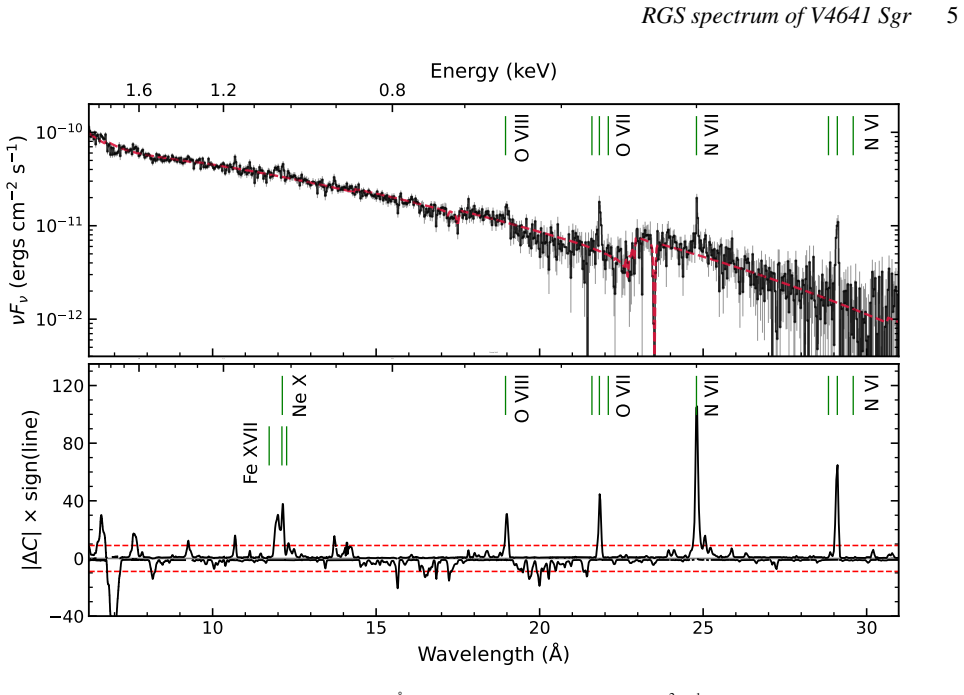
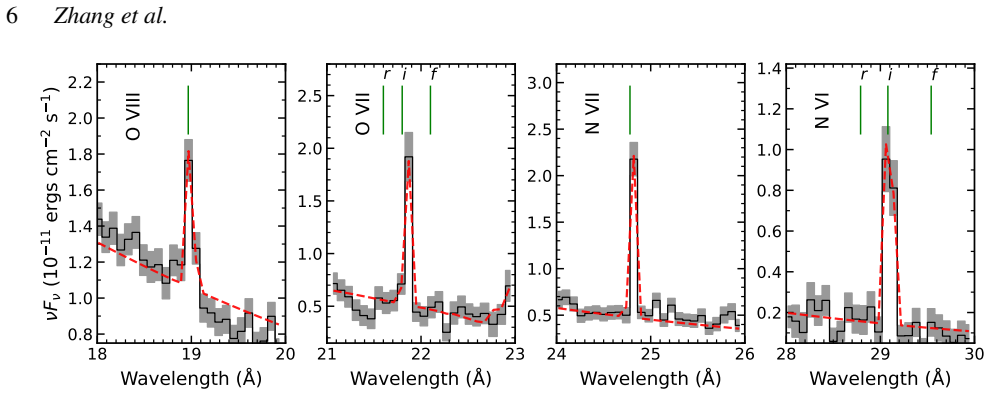
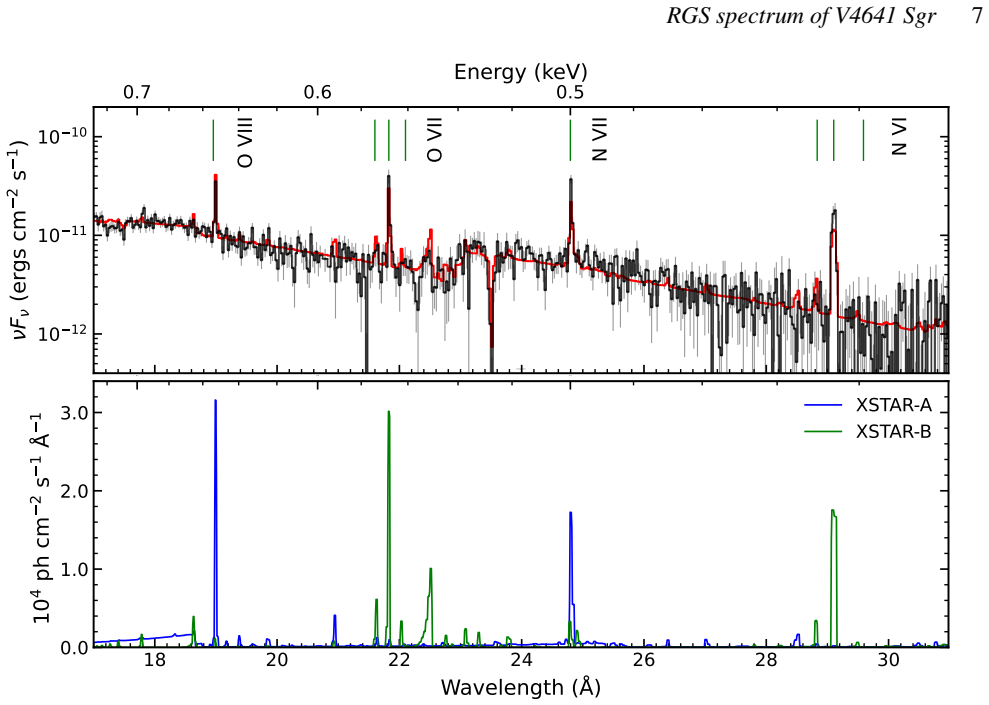
The RGS spectrum shows narrow emission features from N VI-VII and O VII-VIII that require two xstar photoionization components with log ξ ≃ 3.1 and log ξ ≃ 0.36, together with high G and low R ratios in the He-like triplets, establishing the presence of a dense, radially extended, multiphase disk atmosphere.
What carries the argument
Two xstar photoionization components fitted to the narrow N and O emission lines, with supporting He-like triplet diagnostics, that capture the ionization states and densities of the plasma.
If this is right
- The atmosphere contains gas at both intermediate (log ξ ≃ 3.1) and low (log ξ ≃ 0.36) ionization states simultaneously.
- Velocities of 540–720 km s^{-1} indicate quasi-static or slowly outflowing material after accounting for systematics.
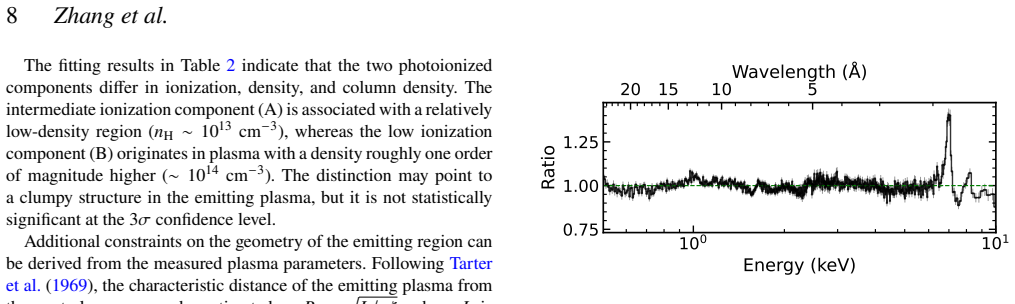
- An additional highly ionized component is suggested by Fe emission structures in the EPIC-pn spectrum.
- The source shares high inclination with other binaries but is set apart by the presence of low-ionization emission lines.
Where Pith is reading between the lines
- Similar low-luminosity states in other black-hole binaries may contain undetected multiphase atmospheres if observed at comparable sensitivity.
- The radial extent could be tested by searching for changes in line properties with luminosity or inclination in monitoring campaigns.
- The distinction from other sources suggests that factors beyond inclination influence the visibility of low-ionization lines.
Load-bearing premise
The observed narrow lines arise from a photoionized disk atmosphere whose properties are captured by the two xstar components rather than from other locations or different physical processes.
What would settle it
If the narrow lines cannot be reproduced by the two xstar components or show velocities and ionization parameters inconsistent with the reported fits when observed at higher signal-to-noise, the disk atmosphere interpretation would be ruled out.
Figures
read the original abstract
We present soft X-ray spectroscopy of the black-hole X-ray binary V4641~Sgr with the \textit{XMM-Newton} Reflection Grating Spectrometer (RGS). The RGS spectrum shows narrow emission features from N\,\textsc{vi--vii} and O\,\textsc{vii--viii} superimposed on a partially covered disk blackbody continuum. A blind Gaussian search confirms the presence of significant lines at the expected rest wavelengths. He-like triplet ratios (high $G$, low $R$) and full photoionization modelling both indicate a dense, photoionized plasma. Small redshifted velocities of $\sim 540$--$720\ \mathrm{km\ s^{-1}}$ are suggested, which are consistent with quasi-static or slowly flowing gas away from the observer after accounting for systematics. Photoionization modelling requires two \textsc{xstar} components with an intermediate ionization parameter ($\log\xi \simeq 3.1$) and a low ionization parameter ($\log\xi \simeq 0.36$), respectively. The simultaneous EPIC-pn spectrum suggests highly ionized Fe emission structures, hinting at an additional, more highly ionized component. These results imply the existence of a radially extended, multiphase, and dense disk atmosphere in the source. We compare the source with other X-ray binaries showing similar emission lines. V4641~Sgr shares a similarly high inclination with other sources; however, the presence of low ionization emission lines distinguishes it from the rest.
Editorial analysis
A structured set of objections, weighed in public.
Referee Report
Summary. The manuscript presents soft X-ray spectroscopy of the black-hole X-ray binary V4641 Sgr using XMM-Newton RGS data in the low-luminosity state. Narrow emission lines from N VI-VII and O VII-VIII are identified via blind Gaussian search on a partially covered disk blackbody continuum. He-like triplet ratios and two-component xstar photoionization modeling (log ξ ≈ 3.1 and 0.36) indicate dense photoionized plasma, with small redshifted velocities (540–720 km s⁻¹) interpreted as consistent with quasi-static gas. The results are taken to imply a radially extended, multiphase, dense disk atmosphere, with comparison to other high-inclination X-ray binaries.
Significance. If the two xstar components correctly capture the plasma properties and the lines are shown to originate from a radially extended disk atmosphere (rather than alternative sites), the work would add to the evidence for complex atmospheric structures in black-hole transients, highlighting the role of low-ionization lines in distinguishing sources at similar inclinations.
major comments (2)
- [Abstract] Abstract: the reported velocities of 540–720 km s⁻¹ lack error bars, and the text provides no explicit tests of alternative models (e.g., single-component xstar or wind emission) nor discussion of line blending or continuum choices that could affect the ionization parameters and the radial-extension inference.
- [Photoionization modelling] Photoionization modelling: the central claim of a radially extended multiphase atmosphere rests on mapping the two xstar components (log ξ ≃ 3.1 and 0.36) via the ξ ∝ 1/(n r²) scaling without quantitative exclusion of alternative emission sites or velocity systematics; no falsification tests against single-component models or partial-covering effects are described.
minor comments (2)
- The simultaneous EPIC-pn spectrum is invoked to suggest highly ionized Fe structures but no quantitative details or fit parameters are supplied.
- The comparison paragraph with other X-ray binaries notes shared high inclination but does not quantify how the low-ionization lines distinguish V4641 Sgr beyond a qualitative statement.
Simulated Author's Rebuttal
We thank the referee for their thorough review and constructive feedback on our manuscript. We address each major comment below and will revise the paper accordingly to strengthen the presentation of our results.
read point-by-point responses
-
Referee: [Abstract] Abstract: the reported velocities of 540–720 km s⁻¹ lack error bars, and the text provides no explicit tests of alternative models (e.g., single-component xstar or wind emission) nor discussion of line blending or continuum choices that could affect the ionization parameters and the radial-extension inference.
Authors: We agree that the velocities reported in the abstract lack error bars. In the revised manuscript we will quote the 1σ uncertainties derived from the Gaussian line centroid fits. We will also add explicit model comparison tests (including single-component xstar fits and a simple wind-emission scenario) together with a short discussion of possible line blending and the sensitivity of the derived log ξ values to continuum parameterization. These additions will be placed in a new subsection of the modeling section and referenced from the abstract. revision: yes
-
Referee: [Photoionization modelling] Photoionization modelling: the central claim of a radially extended multiphase atmosphere rests on mapping the two xstar components (log ξ ≃ 3.1 and 0.36) via the ξ ∝ 1/(n r²) scaling without quantitative exclusion of alternative emission sites or velocity systematics; no falsification tests against single-component models or partial-covering effects are described.
Authors: The manuscript already states that two xstar components are required to reproduce both the high- and low-ionization lines. In revision we will add quantitative falsification tests: (i) Δχ² and BIC values comparing the single- versus two-component models on the RGS data, and (ii) a brief exploration of how partial-covering fractions and velocity shifts affect the best-fit log ξ. We will also discuss why a radially extended disk atmosphere is favored over a compact wind given the small observed velocities and the source inclination. While a complete exclusion of every conceivable emission site is limited by the existing data quality, the added tests will make the supporting evidence for the multiphase atmosphere explicit. revision: yes
Circularity Check
No significant circularity; derivation is data-driven spectral fitting
full rationale
The paper derives its central claim (radially extended multiphase disk atmosphere) directly from fitting two xstar photoionization components plus a disk blackbody to the observed RGS emission lines in public XMM-Newton data. Ionization parameters (log ξ ≈ 3.1 and 0.36), densities from triplet ratios, and velocities are outputs of the fit rather than inputs; the radial-extension inference follows from the requirement for multiple ξ values under the standard ξ ∝ 1/(n r²) scaling. No self-citation chain, uniqueness theorem, or ansatz is invoked to justify the model choice, and no fitted parameter is relabeled as a prediction. The analysis remains self-contained against the spectrum itself.
Axiom & Free-Parameter Ledger
free parameters (2)
- log ξ (high)
- log ξ (low)
axioms (2)
- domain assumption The narrow lines are produced by photoionized plasma whose emission can be modeled by the xstar code under the assumed density and illuminating spectrum.
- domain assumption The continuum is a partially covered disk blackbody whose parameters can be jointly fit with the line components.
Reference graph
Works this paper leans on
-
[1]
A highly ionised outflow in the X-ray binary 4U 1624─49 detected with XRISM. , keywords =. doi:10.1051/0004-6361/202558352 , archivePrefix =. 2601.19480 , primaryClass =
-
[2]
, year = 1969, month = jun, volume =
The Interaction of X-Ray Sources with Optically Thin Environments. , year = 1969, month = jun, volume =. doi:10.1086/150026 , adsurl =
-
[3]
Accretion Power in Astrophysics: Third Edition
-
[4]
The Impact of Accretion Disk Winds on the Optical Spectra of Cataclysmic Variables
The impact of accretion disc winds on the optical spectra of cataclysmic variables. , keywords =. doi:10.1093/mnras/stv867 , archivePrefix =. 1504.05590 , primaryClass =
work page internal anchor Pith review Pith/arXiv arXiv doi:10.1093/mnras/stv867
-
[5]
Thermal Winds in Stellar Mass Black Hole and Neutron Star Binary Systems
Thermal winds in stellar mass black hole and neutron star binary systems. , keywords =. doi:10.1093/mnras/stx2400 , archivePrefix =. 1612.09377 , primaryClass =
work page internal anchor Pith review Pith/arXiv arXiv doi:10.1093/mnras/stx2400
-
[6]
X-Ray--heated Coronae and Winds from Accretion Disks: Time-dependent Two-dimensional Hydrodynamics with Adaptive Mesh Refinement. , keywords =. doi:10.1086/177101 , adsurl =
-
[7]
Simultaneous X-Ray and Optical Observations of GX 339-4 in an X-Ray High State. , keywords =. doi:10.1086/164534 , adsurl =
-
[8]
Broad-band -ray and X-ray spectra of NGC 4151 and their implications for physical processes and geometry. , keywords =. doi:10.1093/mnras/283.1.193 , archivePrefix =. astro-ph/9607015 , primaryClass =
work page internal anchor Pith review Pith/arXiv arXiv doi:10.1093/mnras/283.1.193
-
[9]
Evidence for a Black Hole in the X-Ray Transient GRS 1009-45. , keywords =. doi:10.1093/pasj/50.6.667 , adsurl =
-
[10]
The low-luminosity accretion disc wind of the black hole transient V4641 Sagittarii
The low-luminosity accretion disc wind of the black hole transient V4641 Sagittarii. , keywords =. doi:10.1093/mnras/sty1711 , archivePrefix =. 1806.10881 , primaryClass =
work page internal anchor Pith review Pith/arXiv arXiv doi:10.1093/mnras/sty1711
-
[11]
The MAXI Mission on the ISS: Science and Instruments for Monitoring All Sky X-Ray Images
The MAXI Mission on the ISS: Science and Instruments for Monitoring All-Sky X-Ray Images. , keywords =. doi:10.1093/pasj/61.5.999 , archivePrefix =. 0906.0631 , primaryClass =
work page internal anchor Pith review Pith/arXiv arXiv doi:10.1093/pasj/61.5.999
-
[12]
Probing the near-horizon region of Cygnus X-1 with S u z a k u and N u S T A R. , keywords =. doi:10.1103/PhysRevD.103.024055 , archivePrefix =. 2012.01112 , primaryClass =
-
[13]
Accretion disc winds in X-ray binaries
Accretion disc winds in X-ray binaries. arXiv e-prints , keywords =. doi:10.48550/arXiv.2601.05319 , archivePrefix =. 2601.05319 , primaryClass =
work page internal anchor Pith review Pith/arXiv arXiv doi:10.48550/arxiv.2601.05319
-
[14]
XRISM Spectroscopy of the Stellar-mass Black Hole 4U 1630-472 in Outburst. , keywords =. doi:10.3847/2041-8213/ade25c , archivePrefix =. 2506.07319 , primaryClass =
-
[15]
First look at Vela X-1 with XRISM: A simultaneous campaign with XMM-Newton and NuSTAR. , keywords =. doi:10.1051/0004-6361/202556244 , archivePrefix =. 2509.07258 , primaryClass =
-
[16]
The Disk Wind in GRS 1915+105 as Seen by Insight-Hard X-Ray Modulation Telescope. , keywords =. doi:10.3847/1538-4357/ac74b1 , archivePrefix =. 2203.02659 , primaryClass =
-
[17]
Testing the Kerr Black Hole Hypothesis with GRS 1716-249 by Combining the Continuum Fitting and the Iron-line Methods. , keywords =. doi:10.3847/1538-4357/ac350e , archivePrefix =. 2106.03086 , primaryClass =
-
[18]
Variable Ionized Disk Winds in MAXI J1803 - 298 Revealed by NICER. , keywords =. doi:10.3847/1538-4357/ad7b29 , archivePrefix =. 2402.10315 , primaryClass =
-
[19]
Large-scale radio bubbles around the black hole transient V4641 Sgr. , keywords =. doi:10.1051/0004-6361/202557124 , archivePrefix =. 2601.03140 , primaryClass =
-
[20]
Nature Astronomy , year = 2026, month = feb, volume =
Evidence of mutually exclusive outflow forms from a black hole X-ray binary. Nature Astronomy , year = 2026, month = feb, volume =. doi:10.1038/s41550-025-02753-x , adsurl =
-
[21]
Modelling the behaviour of accretion flows in X-ray binaries
Modelling the behaviour of accretion flows in X-ray binaries. Everything you always wanted to know about accretion but were afraid to ask. , keywords =. doi:10.1007/s00159-007-0006-1 , archivePrefix =. 0708.0148 , primaryClass =
work page internal anchor Pith review Pith/arXiv arXiv doi:10.1007/s00159-007-0006-1
-
[22]
doi:10.1111/j.1365-2966.2006.11074.x , keywords =
Accretion states and radio loudness in active galactic nuclei: analogies with X-ray binaries. , keywords =. doi:10.1111/j.1365-2966.2006.10954.x , archivePrefix =. astro-ph/0608628 , primaryClass =
-
[23]
X-Ray Properties of Black-Hole Binaries. , keywords =. doi:10.1146/annurev.astro.44.051905.092532 , archivePrefix =. astro-ph/0606352 , primaryClass =
work page internal anchor Pith review Pith/arXiv arXiv doi:10.1146/annurev.astro.44.051905.092532
-
[24]
Hard X-ray spectrum of CYG X-1. , keywords =. doi:10.1038/279506a0 , adsurl =
-
[25]
Black Holes (Les Astres Occlus) , year = 1973, editor =
Astrophysics of black holes. Black Holes (Les Astres Occlus) , year = 1973, editor =
1973
-
[26]
Observational appearance
Black holes in binary systems. Observational appearance. , year = 1973, month = jan, volume =
1973
-
[27]
The Structure and X-Ray Recombination Emission of a Centrally Illuminated Accretion Disk Atmosphere and Corona. , keywords =. doi:10.1086/344364 , archivePrefix =. astro-ph/0208488 , primaryClass =
work page internal anchor Pith review Pith/arXiv arXiv doi:10.1086/344364
-
[28]
On the Spectral Hardening Factor of the X-Ray Emission from Accretion Disks in Black Hole Candidates. , keywords =. doi:10.1086/175740 , adsurl =
-
[29]
Vertical Structure of Gas Pressure-dominated Accretion Disks with Local Dissipation of Turbulence and Radiative Transport. , keywords =. doi:10.1086/499153 , archivePrefix =. astro-ph/0510741 , primaryClass =
work page internal anchor Pith review Pith/arXiv arXiv doi:10.1086/499153
-
[30]
, archivePrefix = "arXiv", eprint =
Ubiquitous equatorial accretion disc winds in black hole soft states. , keywords =. doi:10.1111/j.1745-3933.2012.01224.x , archivePrefix =. 1201.4172 , primaryClass =
-
[31]
Lecture Notes in Physics, Berlin Springer Verlag , year = 2016, editor =
The Balance of Power: Accretion and Feedback in Stellar Mass Black Holes. Lecture Notes in Physics, Berlin Springer Verlag , year = 2016, editor =. doi:10.1007/978-3-319-19416-5_3 , adsurl =
-
[32]
Compton heated winds and coronae above accretion disks. I. Dynamics. , keywords =. doi:10.1086/161178 , adsurl =
-
[33]
The Chandra HETGS and RXTE view of GRS 1915+105
High-Resolution Chandra HETGS and Rossi X-Ray Timing Explorer Observations of GRS 1915+105: A Hot Disk Atmosphere and Cold Gas Enriched in Iron and Silicon. , keywords =. doi:10.1086/338588 , archivePrefix =. astro-ph/0208187 , primaryClass =
work page internal anchor Pith review Pith/arXiv arXiv doi:10.1086/338588 1915
-
[34]
The Accretion Disk Wind in the Black Hole GRS 1915+105
The Accretion Disk Wind in the Black Hole GRS 1915+105. , keywords =. doi:10.3847/2041-8205/821/1/L9 , archivePrefix =. 1603.01474 , primaryClass =
work page internal anchor Pith review Pith/arXiv arXiv doi:10.3847/2041-8205/821/1/l9 1915
-
[35]
GRS 1915+105 in "Soft State": Nature of Accretion Disk Wind and Origin of X-Ray Emission
GRS 1915+105 in ``Soft State'': Nature of Accretion Disk Wind and Origin of X-ray Emission. , keywords =. doi:10.1088/0004-637X/695/2/888 , archivePrefix =. 0901.1982 , primaryClass =
work page internal anchor Pith review Pith/arXiv arXiv doi:10.1088/0004-637x/695/2/888 1915
-
[36]
Accretion disc atmospheres and winds in low-mass X-ray binaries
Accretion disc atmospheres and winds in low-mass X-ray binaries. Astronomische Nachrichten , keywords =. doi:10.1002/asna.201612315 , archivePrefix =. 1510.03576 , primaryClass =
work page internal anchor Pith review Pith/arXiv arXiv doi:10.1002/asna.201612315
-
[37]
Modelling the disk atmosphere of the low mass X-ray binary EXO 0748-676
Modelling the disc atmosphere of the low mass X-ray binary EXO 0748-676. , keywords =. doi:10.1051/0004-6361/201834000 , archivePrefix =. 1809.06864 , primaryClass =
work page internal anchor Pith review Pith/arXiv arXiv doi:10.1051/0004-6361/201834000
-
[38]
Soft X-ray emission lines in the X-ray binary Swift J1858.6-0814 observed with XMM-Newton Reflection Grating Spectrometer: disc atmosphere or wind?. , keywords =. doi:10.1093/mnras/staa2258 , archivePrefix =. 2007.14407 , primaryClass =
-
[39]
A Redshifted Inner Disk Atmosphere and Transient Absorbers in the Ultracompact Neutron Star X-Ray Binary 4U 1916-053. , keywords =. doi:10.3847/2041-8213/aba9de , archivePrefix =. 2008.01083 , primaryClass =
-
[40]
Evolution of the disc atmosphere in the X-ray binary MXB 1659-298, during its 2015-2017 outburst
Evolution of the disc atmosphere in the X-ray binary MXB 1659-298, during its 2015-17 outburst. , keywords =. doi:10.1093/mnras/stz1245 , archivePrefix =. 1905.01308 , primaryClass =
work page internal anchor Pith review Pith/arXiv arXiv doi:10.1093/mnras/stz1245 2015
-
[41]
High Resolution Chandra HETG spectroscopy of V404 Cygni in Outburst
High-resolution Chandra HETG Spectroscopy of V404 Cygni in Outburst. , keywords =. doi:10.1088/2041-8205/813/2/L37 , archivePrefix =. 1508.01181 , primaryClass =
work page internal anchor Pith review Pith/arXiv arXiv doi:10.1088/2041-8205/813/2/l37 2041
-
[42]
Spectrum Synthesis Modeling of the X-ray Spectrum of GRO J1655-40 Taken During the 2005 Outburst
Spectrum Synthesis Modeling of the X-Ray Spectrum of GRO J1655-40 Taken During the 2005 Outburst. , keywords =. doi:10.1088/0004-637X/701/2/865 , archivePrefix =. 0905.4206 , primaryClass =
work page internal anchor Pith review Pith/arXiv arXiv doi:10.1088/0004-637x/701/2/865 2005
-
[43]
A Black Hole in the Superluminal source SAX J1819.3-2525 (V4641 Sgr)
A Black Hole in the Superluminal Source SAX J1819.3-2525 (V4641 Sgr). , keywords =. doi:10.1086/321442 , archivePrefix =. astro-ph/0103045 , primaryClass =
work page internal anchor Pith review Pith/arXiv arXiv doi:10.1086/321442
-
[44]
The Black Hole Binary V4641 Sagitarii: Activity in Quiescence & Improved Mass Determinations
The Black Hole Binary V4641 Sagitarii: Activity in Quiescence and Improved Mass Determinations. , keywords =. doi:10.1088/0004-637X/784/1/2 , archivePrefix =. 1401.4190 , primaryClass =
work page internal anchor Pith review Pith/arXiv arXiv doi:10.1088/0004-637x/784/1/2
-
[45]
Super-Eddington outburst of V4641 Sgr
Super-Eddington outburst of V4641 Sgr. , keywords =. doi:10.1051/0004-6361:20020865 , archivePrefix =. astro-ph/0204132 , primaryClass =
work page internal anchor Pith review Pith/arXiv arXiv doi:10.1051/0004-6361:20020865
-
[46]
Light Curves and Radio Structure of the 1999 September Transient Event in V4641 Sagittarii (=XTE J1819-254=SAX J1819.3-2525). , keywords =. doi:10.1086/317255 , adsurl =
-
[47]
The Astronomer's Telegram , keywords =
Swift/XRT suggests a faint soft state in the 2015 outburst of V4641 Sgr. The Astronomer's Telegram , keywords =
2015
-
[48]
High resolution X-ray spectroscopy of V4641 Sgr during its 2020 outburst. , keywords =. doi:10.1093/mnras/stac2213 , archivePrefix =. 2208.01732 , primaryClass =
-
[49]
XRISM reveals a variable, multi-phase outflow-inflow structure during the X-ray obscured 2024 outburst of the black hole transient V4641 Sgr. arXiv e-prints , keywords =. doi:10.48550/arXiv.2508.17541 , archivePrefix =. 2508.17541 , primaryClass =
work page internal anchor Pith review Pith/arXiv arXiv doi:10.48550/arxiv.2508.17541 2024
-
[50]
High ionisation absorption in low mass X-ray binaries
High ionisation absorption in low mass X-ray binaries. Astronomische Nachrichten , keywords =. doi:10.1002/asna.201612339 , archivePrefix =. 1510.08902 , primaryClass =
work page internal anchor Pith review Pith/arXiv arXiv doi:10.1002/asna.201612339
-
[51]
The Astronomer's Telegram , keywords =
MAXI/GSC detection of renewed activity of the black hole X-ray binary V4641 Sgr. The Astronomer's Telegram , keywords =
-
[52]
The Reflection Grating Spectrometer on board XMM-Newton. , keywords =. doi:10.1051/0004-6361:20000058 , adsurl =
-
[53]
Astronomical Data Analysis Software and Systems V , year = 1996, editor =
XSPEC: The First Ten Years. Astronomical Data Analysis Software and Systems V , year = 1996, editor =
1996
-
[54]
On the Absorption of X-rays in the Interstellar Medium
On the Absorption of X-Rays in the Interstellar Medium. , keywords =. doi:10.1086/317016 , archivePrefix =. astro-ph/0008425 , primaryClass =
work page internal anchor Pith review Pith/arXiv arXiv doi:10.1086/317016
-
[55]
Atomic Data for Astrophysics. II. New Analytic Fits for Photoionization Cross Sections of Atoms and Ions. , keywords =. doi:10.1086/177435 , archivePrefix =. astro-ph/9601009 , primaryClass =
work page internal anchor Pith review Pith/arXiv arXiv doi:10.1086/177435
-
[56]
Parameter estimation in astronomy through application of the likelihood ratio. , keywords =. doi:10.1086/156922 , adsurl =
-
[57]
, keywords =
Energy spectra of low-mass binary X-ray sources observed from Tenma. , keywords =
-
[58]
Photoionization and High-Density Gas. , keywords =. doi:10.1086/319184 , adsurl =
-
[59]
Updated Atomic Data and Calculations for X-ray Spectroscopy
Updated Atomic Data and Calculations for X-Ray Spectroscopy. , keywords =. doi:10.1088/0004-637X/756/2/128 , archivePrefix =. 1207.0576 , primaryClass =
work page internal anchor Pith review Pith/arXiv arXiv doi:10.1088/0004-637x/756/2/128
-
[60]
Statistics: Handle with Care, Detecting Multiple Model Components with the Likelihood Ratio Test
Statistics, Handle with Care: Detecting Multiple Model Components with the Likelihood Ratio Test. , keywords =. doi:10.1086/339856 , archivePrefix =. astro-ph/0201547 , primaryClass =
work page internal anchor Pith review Pith/arXiv arXiv doi:10.1086/339856
-
[61]
X-ray photoionized plasma diagnostics with helium-like ions. Application to warm absorber-emitter in active galactic nuclei. , keywords =. doi:10.1051/aas:2000192 , archivePrefix =. astro-ph/0002319 , primaryClass =
work page internal anchor Pith review Pith/arXiv arXiv doi:10.1051/aas:2000192
-
[62]
X-Ray Spectroscopy in Astrophysics , year = 1999, editor =
The X-Ray Spectral Properties of Photoionized Plasma and Transient Plasmas. X-Ray Spectroscopy in Astrophysics , year = 1999, editor =. doi:10.1007/978-3-540-49199-6_3 , adsurl =
-
[63]
Helium-like ion line intensities. I. Stationary plasmas. , keywords =
-
[64]
X-ray spectroscopy of astrophysical plasmas. Philosophical Transactions of the Royal Society of London Series A , year = 2002, month = sep, volume =. doi:10.1098/rsta.2002.1043 , adsurl =
-
[65]
, archivePrefix = "arXiv", eprint =
Improving the full spectrum fitting method: accurate convolution with Gauss-Hermite functions. , keywords =. doi:10.1093/mnras/stw3020 , archivePrefix =. 1607.08538 , primaryClass =
work page internal anchor Pith review Pith/arXiv arXiv doi:10.1093/mnras/stw3020
-
[66]
Reprocessing from Highly Ionized Gas in the Soft Spectral State of V4641 Sgr with NuSTAR. , keywords =. doi:10.3847/1538-4357/adbbdb , archivePrefix =. 2503.07835 , primaryClass =
-
[67]
He-like Ions as Practical Astrophysical Plasma Diagnostics: From Stellar Coronae to Active Galactic Nuclei. , keywords =. doi:10.1007/s11214-010-9731-2 , archivePrefix =. 1101.3184 , primaryClass =
work page internal anchor Pith review Pith/arXiv arXiv doi:10.1007/s11214-010-9731-2
-
[68]
Detection of Extended X-Ray Emission around the PeVatron Microquasar V4641 Sgr with XRISM. , keywords =. doi:10.3847/2041-8213/ad9d11 , archivePrefix =. 2412.08089 , primaryClass =
-
[69]
Ultra-high-energy gamma-ray bubble around microquasar V4641 Sgr. , keywords =. doi:10.1038/s41586-024-07995-9 , archivePrefix =. 2410.16117 , primaryClass =
-
[70]
Ultrahigh-Energy Gamma-ray Emission Associated with Black Hole-Jet Systems. arXiv e-prints , keywords =. doi:10.48550/arXiv.2410.08988 , archivePrefix =. 2410.08988 , primaryClass =
-
[71]
Photoionization Modeling and the K Lines of Iron
Photoionization Modeling and the K Lines of Iron. , keywords =. doi:10.1086/424039 , archivePrefix =. astro-ph/0405210 , primaryClass =
work page internal anchor Pith review Pith/arXiv arXiv doi:10.1086/424039
-
[72]
Constraining Distance and Inclination Angle of V4641 Sgr Using Swift and NuSTAR Observations during Low Soft Spectral State. , keywords =. doi:10.1088/0004-637X/814/2/158 , archivePrefix =. 1510.07837 , primaryClass =
work page internal anchor Pith review Pith/arXiv arXiv doi:10.1088/0004-637x/814/2/158
-
[73]
Dips and eclipses in the X-ray binary Swift J1858.6-0814 observed with NICER. , keywords =. doi:10.1093/mnras/stab863 , archivePrefix =. 2103.12787 , primaryClass =
-
[74]
The Discovery of 3.8 Hour Periodic Intensity Dips and Eclipses from the Transient Low-Mass X-Ray Binary EXO 0748-676. , keywords =. doi:10.1086/164490 , adsurl =
-
[75]
Eclipse Timings of the Transient Low-Mass X-ray Binary EXO 0748-676. IV. The Rossi X-ray Timing Explorer Eclipses. , keywords =. doi:10.1088/0067-0049/183/1/156 , archivePrefix =. 0812.1034 , primaryClass =
work page internal anchor Pith review Pith/arXiv arXiv doi:10.1088/0067-0049/183/1/156
-
[76]
Discovery of a 50 MN binary period and a likely 22 magnitude optical counterpart for the X-ray burster 4U 1915-05. , keywords =. doi:10.1086/183738 , adsurl =
-
[77]
A possible solution of the puzzling variation of the orbital period of MXB 1659-298
A possible solution of the puzzling variation of the orbital period of MXB 1659-298. , keywords =. doi:10.1093/mnras/stx2529 , archivePrefix =. 1703.05294 , primaryClass =
work page internal anchor Pith review Pith/arXiv arXiv doi:10.1093/mnras/stx2529
-
[78]
The accretion of brown dwarfs and planets by giant stars -
MERLIN observations of relativistic ejections from GRS 1915+105. , keywords =. doi:10.1046/j.1365-8711.1999.02364.x , archivePrefix =. astro-ph/9812150 , primaryClass =
-
[79]
A Parallax Distance to the Microquasar GRS 1915+105 and a Revised Estimate of its Black Hole Mass
A Parallax Distance to the Microquasar GRS 1915+105 and a Revised Estimate of its Black Hole Mass. , keywords =. doi:10.1088/0004-637X/796/1/2 , archivePrefix =. 1409.2453 , primaryClass =
work page internal anchor Pith review Pith/arXiv arXiv doi:10.1088/0004-637x/796/1/2 1915
-
[80]
Optical studies of V404 Cyg, the X-ray transient GS 2023+338. IV. The rotation speed of the companion star. , keywords =. doi:10.1093/mnras/271.1.L5 , adsurl =
discussion (0)
Sign in with ORCID, Apple, or X to comment. Anyone can read and Pith papers without signing in.