REVIEW 3 major objections 4 minor 25 references
Diffusion drafters keep speculative decoding fast only if they adapt online and truncate drafts dynamically.
Reviewed by Pith at T0; open to challenge. T0 means a machine referee read the full paper against a public rubric. the ladder, T0–T4 →
T0 review · deepseek-v4-flash
2026-08-01 13:01 UTC pith:HIECSTTR
load-bearing objection Solid OPD idea for diffusion drafters, but the adaptive length head's training signal is unobservable as written — the main high-concurrency claim needs fixing before I'd trust it. the 3 major comments →
AdaFlash: Adaptive Speculative Decoding via On-Policy Distilled Diffusion Drafters
The pith
A machine-rendered reading of the paper's core claim, the machinery that carries it, and where it could break.
Core claim
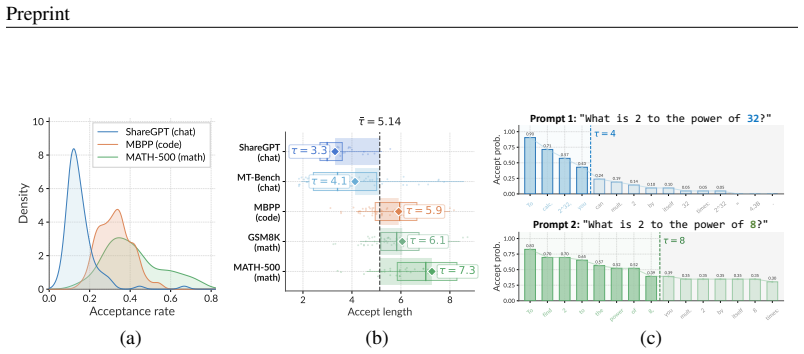
Central claim: bidirectional attention lets a diffusion drafter generate a whole draft block in one pass, but it also makes draft quality vary strongly across domains and across token positions. A static drafter with fixed candidate length therefore wastes verification work and degrades out of distribution. AdaFlash counteracts domain-level variance with on-policy distillation—updating the drafter on sequences it actually generates, using a mixture of hard-label cross-entropy and reverse-KL with entry-wise clipping—and counteracts token-level variance with an adaptive length head that predicts the block's acceptance rate and sends only the viable prefix for verification. Both mechanisms trai
What carries the argument
The load-bearing object is the one-step diffusion drafter with bidirectional attention, which masks a block of future positions and reconstructs all draft tokens in a single forward pass. Around it AdaFlash builds two adaptive mechanisms: an on-policy distillation loss—a convex mixture of hard-label cross-entropy and reverse-KL divergence with entry-wise clipping, which lets the drafter track the target model's high-probability modes rather than spread probability mass—and an adaptive length head, a small network on the drafter's hidden states that predicts the draft block's overall acceptance rate and maps it to a verification length. A serving loop with asynchronous training and variable-l
Load-bearing premise
The adaptive length head is trained on the acceptance rate of the full k-token draft block, but at serving time only the truncated prefix is sent to the target model, so tokens beyond the cutoff are never verified; the head learns from a proxy unless extra target-model passes are added.
What would settle it
Run AdaFlash with a variant that performs full-target verification of all k draft tokens, recording the true acceptance status of every position, and compare the length head's predicted b_k with the optimal truncation point. If predicted lengths are far from optimal, or if switching the head's training signal to the true full-block acceptance rate does not improve the reported high-concurrency speedup, then the claimed verification-cost savings rest on a biased training signal rather than on adaptive control.
If this is right
- At concurrency 1, AdaFlash reports up to 5.3x speedup over autoregressive decoding and higher average accepted length than static diffusion drafters on math, code, and chat benchmarks.
- At high concurrency (C=128), methods with fixed candidate length drop to or below 1x speedup, while AdaFlash stays above baseline and achieves up to 66% higher throughput than previous state-of-the-art speculative decoding.
- On-policy distillation with reverse-KL and clipping lifts per-position acceptance probabilities across the draft, most at late positions, narrowing the gap between early and late tokens.
- The adaptive length head is trained on the verification outcome itself, costs no extra target-model calls, and ablations show it is required for the high-concurrency gains.
- ADAFLASH can also train a diffusion drafter from scratch, not just adapt an existing one, and in that regime it outperforms a standard autoregressive drafter with the same draft budget.
Where Pith is reading between the lines
- Editorial inference: the same two-part recipe—live on-policy distillation from verification feedback plus a learned truncation policy—is likely to transfer to autoregressive and tree-based drafters, which also show token-level acceptance variance but currently use static draft lengths.
- Editorial inference: if the length head's acceptance-rate prediction is reliable, it could double as a system-level admission-control signal, letting a serving engine decide how many concurrent requests to admit, not just how many tokens to verify per request.
- Editorial inference: entry-wise divergence clipping is not specific to speculative decoding; the same idea could stabilise other reverse-KL distillation pipelines where a few vocabulary entries dominate the gradient.
Editorial analysis
A structured set of objections, weighed in public.
Referee Report
Summary. The paper proposes AdaFlash, an online adaptive speculative decoding framework for diffusion drafters. It argues that bidirectional attention in one-step diffusion drafters causes high domain-level and token-level variance in acceptance rates, and addresses this with two components: (i) on-policy distillation (OPD) with a mixture of reverse-KL and hard-label cross-entropy plus entry-wise divergence clipping, and (ii) an adaptive length head that predicts the acceptance rate of a draft block and truncates the verification length accordingly. A serving-engine implementation with asynchronous training/inference and variable-length verification scheduling is also described. Experiments across six standard benchmarks, two long-sequence reasoning benchmarks, three target models, and multiple concurrency levels report consistent speedup improvements, up to 5.3× over autoregressive decoding and up to about 66% higher throughput than prior state-of-the-art at high concurrency.
Significance. If the claims hold, the paper makes a useful contribution to speculative decoding for diffusion drafters. The core motivation—that diffusion drafters exhibit larger acceptance-rate variance than AR drafters, and that online adaptation plus dynamic truncation can mitigate this—is well grounded in the presented measurements. The OPD formulation with reverse-KL is appropriate for the speculative-decoding objective, and the entry-wise clipping is a sensible stabilization mechanism. The evaluation is unusually broad: multiple target model families, high-concurrency serving, long-sequence reasoning, cross-domain offline evaluation, and a different hardware backend. The paper also ships clear engineering innovations (asynchronous training–inference pipeline, variable-length verification batching). However, the training signal for the adaptive length head and the OPD supervision beyond the truncated verification length are under-specified; these points are load-bearing for the claimed no-additional-cost online adaptation and for the high-concurrency gains.
major comments (3)
- [§3.2, Online Update of the Length Head] The MSE target a*_t is called the 'ground-truth acceptance rate (i.e., the fraction of accepted tokens)', but under the paper's own pipeline only the first bkt tokens are sent to the target model for verification. Therefore the acceptance status of tokens at positions i > bkt is never observed, so a*_t cannot be the full-k acceptance rate. If a*_t is instead computed as accepted_length / bkt, the label is endogenous to the head's own truncation policy: a short draft that would have failed at a later position receives a high label. The paper must specify the exact denominator and provenance of a*_t. If full-k labels require additional target forward passes, the statement that supervision 'incurs no additional cost' is false and the reported speedup numbers must be re-derived with that cost accounted for.
- [§3.1, OPD loss] The OPD loss is defined as a sum over all positions i ∈ {1,...,k} of the target distributions p_v(·|x_{<t+i}). With the adaptive length head, verification returns target distributions only for i ≤ bkt; positions beyond bkt are never sent to the target. The paper does not state whether OPD gradients use positions beyond bkt. If they do, additional target forward passes are required and the 'no additional cost' claim in §3.2 is invalid. If they do not, the loss definition in §3.1 and the description in §3.3 ('the target model returns its distributions at each position i∈{1,...,k}') are inaccurate. Please clarify and, if extra target computations are used, include them in the throughput/speedup accounting.
- [§4.3 / §B.1, Hyperparameter selection] The main hyperparameters α, δ, and γ are tuned on GSM8K (Table 3) and then fixed for all experiments, yet GSM8K is also a test benchmark in the main comparison (Table 1). This selection bias can inflate the reported gain on GSM8K and, because the same configuration is used elsewhere, makes it difficult to know how much of the improvement is due to tuning. Please either choose hyperparameters on a validation split disjoint from all evaluation benchmarks, or report the sensitivity of the main conclusions to these choices across all datasets.
minor comments (4)
- [§2.1, Eq. (1)] The speedup formula η = E[τ]/(ρk+1) with E[τ] = (1−Acc^{k+1})/(1−Acc) assumes independent and identically distributed acceptance events. For a diffusion drafter, which generates the whole block jointly, acceptance decisions are correlated. As a background formula this is acceptable, but it should be labeled as an idealized approximation, since the paper's own data show strong positional dependence in acceptance probability.
- [§3.2, Design of the Adaptive Length Head] The scalar predicted acceptance rate bhat_t is used to set bkt = clamp(⌊bhat_t·k⌋,1,k). Given the paper's emphasis on token-level variance and the non-monotonic/heterogeneous per-position acceptance shown in Figure 2(c), a brief justification for reducing the acceptance pattern to a single scalar would help; otherwise the head may be learning a proxy that does not capture where truncation should occur.
- [Abstract and §4.2] The abstract claims 'up to approximately 66% higher throughput than previous SOTA'. From Table 1 this appears to correspond to Q3-30B at C=128 when comparing AdaFlash to DFlash or OSD, but the paper does not state the comparison point. Please specify the setting to avoid ambiguity.
- [§B.1] The implementation details mention 'reverse-KL temperature = 1.0', but temperature is not defined in the loss expressions in §3.1. Please define how temperature enters the reverse-KL term, or remove the mention.
Circularity Check
No significant circularity; the derivation is empirical and externally benchmarked, with only minor non-load-bearing self-citations.
full rationale
The paper's central claims are empirical and validated against external target models and baselines: speedups are measured wall-clock (Section 4, Tables 1, 4-9), and the drafter and length head are updated online from verification outcomes produced by the target model, not from constants fitted to the reported metrics. No equation turns a fitted parameter into a predicted result: the OPD loss (ℓOPD) and length-head MSE (ℓlen) are training objectives, and the reported speedups are independent measurements of the resulting serving system. The self-citations (Qian et al. 2026a,b) appear only in related-work context and as one citation among external works (Liu et al. 2024) for the 'draft–feedback–adapt' loop; they are not used to justify the central results. The one substantive concern is in §3.2: the paper states that 'only the first bkt tokens of the draft sequence are sent to the target model for verification' yet then says 'we obtain the ground-truth acceptance rate a⋆t ∈ [0,1] (i.e., the fraction of accepted tokens)'. This leaves the denominator of a⋆t unspecified and makes full-k acceptance unobservable under truncation; if a⋆t is computed over the truncated prefix, the label is endogenous to the head's own policy. This is a genuine correctness/identifiability risk and should be clarified, but it is not a circular reduction: the measured speedups do not reduce to the head's predictions, and the adversarial fixed-point behavior the concern describes is not asserted in the paper as a derivation. Thus, no circular step is established, and the minor self-citations are not load-bearing.
Axiom & Free-Parameter Ledger
free parameters (8)
- mixing coefficient alpha =
0.8
- divergence clipping threshold delta =
0.01
- adaptive length scale factor gamma =
1.0
- reverse-KL temperature =
1.0
- drafter learning rate =
3e-4
- length head learning rate =
2e-4
- online training buffer size / epochs / batch =
128 / 2 epochs / batch size 2
- EMA scheduling coefficient beta =
not specified
axioms (5)
- standard math Standard speculative decoding acceptance formula (E[tau] = (1-A^{k+1})/(1-A))
- domain assumption Target model output distributions are available at all draft positions during verification
- domain assumption Diffusion drafters exhibit higher domain- and token-level variance than AR drafters
- ad hoc to paper Scalar predicted acceptance rate is a sufficient statistic for optimal truncation length
- ad hoc to paper Ground-truth acceptance rate a_t^* is observable from truncated verification
read the original abstract
Speculative decoding, in which a lightweight draft model first generates a draft sequence that is then verified in parallel by the target model, has become a prevalent paradigm for accelerating large language model inference. Recent work such as DFlash further boosts drafting efficiency by leveraging diffusion drafters, whose parallel denoising mechanism enables draft generation in a single forward pass. In this work, we uncover a central pitfall of diffusion drafters: bidirectional attention is a double-edged sword. On one hand, it endows the model with parallel generation and global contextual modeling capabilities; on the other hand, this inherent global dependency introduces high variance at both the domain-level and the token-level: acceptance rates fluctuate substantially across different domains, and draft token quality also varies heterogeneously at different token positions. To tackle this issue, we propose AdaFlash framework, comprising two components: (i) an on-policy distillation (OPD) algorithm with reverse-KL divergence tailored for diffusion drafters, bringing stable convergence and effectively reducing domain-level variance; and (ii) an adaptive length head that dynamically adjusts the candidate sequence length on the fly, substantially lowering the verification cost of the target model and handling token-level variance. Experiments demonstrate that AdaFlash consistently improves speedup rate during deployment, with especially significant gains in high-concurrency scenarios, achieving up to approximately 66% higher throughput than previous state-of-the-art methods.
Figures


Reference graph
Works this paper leans on
-
[4]
Tom B. Brown, Benjamin Mann, Nick Ryder, Melanie Subbiah, Jared Kaplan, Prafulla Dhariwal, Arvind Neelakantan, Pranav Shyam, Girish Sastry, Amanda Askell, Sandhini Agarwal, Ariel Herbert-V oss, Gretchen Krueger, Tom Henighan, et al. Language models are few-shot learners. In Advances in Neural Information Processing Systems 33 (NeurIPS), pp. 1877–1901,
1901
-
[5]
MATHCODE MathQA GSM8K OpenCodeInstruct CodeAlpacaAvg
Method Conc. MATHCODE MathQA GSM8K OpenCodeInstruct CodeAlpacaAvg. SpeedupτSpeedupτSpeedupτSpeedupτSpeedupτ DFlash 1 3.43×7.10 3.01×6.28 3.43×6.69 2.63×5.63 3.13×6.43 32 1.77×7.09 1.41×6.28 1.48×6.67 1.43×5.68 1.52×6.43 64 1.42×7.09 1.17×6.26 1.33×6.70 1.10×5.64 1.26×6.42 128 1.24×7.12 1.02×6.27 1.14×6.69 1.03×5.65 1.11×6.43 ADAFLASH (cross-domain) 1 4.23...
2026
-
[7]
Self speculative decoding for diffusion large language models.ArXiv preprint, arXiv:2510.04147,
Yifeng Gao, Ziang Ji, Yuxuan Wang, Biqing Qi, Hanlin Xu, and Linfeng Zhang. Self speculative decoding for diffusion large language models.ArXiv preprint, arXiv:2510.04147,
-
[8]
Distilling the knowledge in a neural network.ArXiv preprint, arXiv:1503.02531,
Geoffrey Hinton, Oriol Vinyals, and Jeff Dean. Distilling the knowledge in a neural network.ArXiv preprint, arXiv:1503.02531,
-
[9]
Fast and accurate causal parallel decoding using jacobi forcing.ArXiv preprint, arXiv:2512.14681,
Lanxiang Hu, Siqi Kou, Yichao Fu, Samyam Rajbhandari, Tajana Rosing, Yuxiong He, Zhijie Deng, and Hao Zhang. Fast and accurate causal parallel decoding using jacobi forcing.ArXiv preprint, arXiv:2512.14681,
-
[10]
Jia-Nan Li, Jian Guan, Wei Wu, and Chongxuan Li. Refusion: A diffusion large language model with parallel autoregressive decoding.ArXiv preprint, arXiv:2512.13586, 2025a. Yuhui Li, Fangyun Wei, Chao Zhang, and Hongyang Zhang. EAGLE-2: faster inference of language models with dynamic draft trees. InProceedings of the 2024 Conference on Empirical Methods in...
arXiv 2024
-
[11]
11 Preprint Hongyi Liu, Jiaji Huang, Zhen Jia, Youngsuk Park, and Yu-Xiang Wang. Not-a-bandit: Provably no-regret drafter selection in speculative decoding for LLMs.ArXiv preprint, arXiv:2510.20064,
-
[12]
https://thinkingmachines.ai/blog/on-policy-distillation
doi: 10.64434/tml.20251026. https://thinkingmachines.ai/blog/on-policy-distillation. Xinyin Ma, Runpeng Yu, Gongfan Fang, and Xinchao Wang. dkv-cache: The cache for diffusion language models. InAdvances in Neural Information Processing Systems 38 (NeurIPS), pp. to appear,
-
[13]
Hunyuan AI Infra Team. Angelslim: A more accessible, comprehensive, and efficient toolkit for large model compression.ArXiv preprint, arXiv:2602.21233,
-
[14]
Yu-Yang Qian, Junda Su, Lanxiang Hu, Peiyuan Zhang, Zhijie Deng, Peng Zhao, and Hao Zhang. d3llm: Ultra-fast diffusion llm using pseudo-trajectory distillation.ArXiv preprint, arXiv:2601.07568, 2026a. Yu-Yang Qian, Hao-Cong Wu, Yichao Fu, Hao Zhang, and Peng Zhao. When drafts evolve: Speculative decoding meets online learning. InProceedings of the 43rd In...
-
[15]
12 Preprint Junxiong Wang, Fengxiang Bie, Jisen Li, Zhongzhu Zhou, Zelei Shao, Yubo Wang, Yinghui Liu, Qingyang Wu, Avner May, Sri Yanamandra, Yineng Zhang, Ce Zhang, Tri Dao, Percy Liang, Ben Athiwaratkun, Shuaiwen Leon Song, Chenfeng Xu, and Xiaoxia Wu. When RL meets adaptive speculative training: A unified training-serving system.ArXiv preprint, arXiv:...
-
[16]
Yinjie Wang, Ling Yang, Bowen Li, Ye Tian, Ke Shen, and Mengdi Wang. Revolutionizing reinforce- ment learning framework for diffusion large language models.ArXiv preprint, arXiv:2509.06949,
-
[18]
URL https://openreview.net/ forum?id=EgJhwYR2tB. An Yang, Anfeng Li, Baosong Yang, Beichen Zhang, Binyuan Hui, Bo Zheng, Bowen Yu, Chang Gao, Chengen Huang, Chenxu Lv, Chujie Zheng, Dayiheng Liu, Fan Zhou, Fei Huang, Feng Hu, et al. Qwen3 technical report.ArXiv preprint, arXiv:2505.09388, 2025a. Jingyi Yang, Guanxu Chen, Xuhao Hu, and Jing Shao. Taming ma...
-
[19]
Dream 7b: Diffusion large language models.ArXiv preprint, arXiv:2508.15487,
Jiacheng Ye, Zhihui Xie, Lin Zheng, Jiahui Gao, Zirui Wu, Xin Jiang, Zhenguo Li, and Lingpeng Kong. Dream 7b: Diffusion large language models.ArXiv preprint, arXiv:2508.15487,
-
[21]
d3LLM (Qian et al., 2026a) improves the efficiency of dLLMs by leveraging distillation
proposes a delayed KV-cache strategy tailored for the non-autoregressive setting (Gao et al., 2025; Yang et al., 2025b). d3LLM (Qian et al., 2026a) improves the efficiency of dLLMs by leveraging distillation. On the other hand, MMaDA (Yang et al., 2025c) applies policy-gradient reinforcement learning to enhance dLLM performance across modalities; ReFusion...
2025
-
[22]
further introduced the firstone-stepdLLM drafter, generating all draft tokens in a single forward pass and achieving both lower drafting cost and higher acceptance rates than AR drafters. Our work uncovers a previously overlooked pitfall of diffusion drafters: bidirectional attention, while enabling one-pass parallel generation, also introduceshigh varian...
2024
-
[23]
trains a student model on sequences sampled from its own policy rather than from a fixed dataset or the teacher, thereby eliminating the train–inference distribution mismatch (exposure bias) that arises when a model is only supervised on offline data. Since the supervision signals are derived from the student’s on-policy generations, the student directly ...
2004
-
[2004]
Specifically, we first introduce the speculative decoding framework and then the diffusion language models
13 Preprint A RELATEDWORK In this section, we discuss the related topics. Specifically, we first introduce the speculative decoding framework and then the diffusion language models. Finally, we introduce the on-policy distillation. Speculative Decoding.Speculative decoding (Leviathan et al., 2023; Chen et al.,
2023
-
[2015]
In contrast, by operating on student-sampled sequences, on- 14 Preprint Jan et 's ducks lay ** 1 6 eggs per day **
similarly matches the teacher’s soft logits under a forward KL. In contrast, by operating on student-sampled sequences, on- 14 Preprint Jan et 's ducks lay ** 1 6 eggs per day ** . She uses : - ** 3 eggs ** for breakfast - ** 4 eggs ** for muff ins So , she uses ** 3 + 4 = 7 eggs ** . That leaves ** 1 6 - 7 = 9 eggs ** to sell . She sells each egg for ** ...
2023
-
[2019]
Llada2.0: Scaling up diffusion language models to 100b
Tiwei Bie, Maosong Cao, Kun Chen, Lun Du, Mingliang Gong, Zhuochen Gong, Yanmei Gu, Jiaqi Hu, Zenan Huang, Zhenzhong Lan, et al. Llada2.0: Scaling up diffusion language models to 100b. ArXiv preprint, arXiv:2512.15745,
-
[2022]
Chengyue Wu, Hao Zhang, Shuchen Xue, Zhijian Liu, Shizhe Diao, Ligeng Zhu, Ping Luo, Song Han, and Enze Xie. Fast-dllm: Training-free acceleration of diffusion LLM by enabling KV cache and parallel decoding.ArXiv preprint, arXiv:2505.22618,
-
[2023]
Charlie Chen, Sebastian Borgeaud, Geoffrey Irving, Jean-Baptiste Lespiau, Laurent Sifre, and John Jumper. Accelerating large language model decoding with speculative sampling.ArXiv preprint, arXiv:2302.01318,
-
[2024]
Wasi Uddin Ahmad, Aleksander Ficek, Mehrzad Samadi, Jocelyn Huang, Vahid Noroozi, Somshubra Majumdar, and Boris Ginsburg. Opencodeinstruct: A large-scale instruction tuning dataset for code llms.ArXiv preprint, arXiv:2504.04030,
-
[2025]
Mathqa: Towards interpretable math word problem solving with operation-based formalisms
Aida Amini, Saadia Gabriel, Shanchuan Lin, Rik Koncel-Kedziorski, Yejin Choi, and Hannaneh Hajishirzi. Mathqa: Towards interpretable math word problem solving with operation-based formalisms. InProceedings of the 2019 Conference of the North American Chapter of the Association for Computational Linguistics (NAACL), pp. 2357–2367,
2019
-
[2026]
https://github. com/deepseek-ai/DeepSpec. Karl Cobbe, Vineet Kosaraju, Mohammad Bavarian, Mark Chen, Heewoo Jun, Lukasz Kaiser, Matthias Plappert, Jerry Tworek, Jacob Hilton, Reiichiro Nakano, et al. Training verifiers to solve math word problems.ArXiv preprint, arXiv:2110.14168,
discussion (0)
Sign in with ORCID, Apple, or X to comment. Anyone can read and Pith papers without signing in.