REVIEW 2 major objections 5 minor 6 cited by
Conservation of superhorizon curvature perturbations at one loop: Backreaction in the in-in formalism and Renormalization
T0 review · 2 major / 5 minor · reviewed 2026-08-07 · deepseek-v4-flash
Pith's one-line read This paper proves that superhorizon curvature perturbations remain conserved at one loop in single-field inflation with a transient non-slow-roll period, so enhanced small-scale modes do not alter the large-scale power spectrum.
desk verdict A careful, honest in-in derivation of one-loop conservation that is weaker than its abstract: the strict result depends on dropping an IR cutoff term the paper admits it cannot rigorously justify. read the letter →
The pith
A machine-rendered reading of the paper's core claim, the machinery that carries it, and where it could break.
The reading
What carries the argument
The load-bearing object is the ratio identity $\lim_{q\to 0} (P_{\delta\phi}(q,\eta)-P_{\delta\phi,\mathrm{tr}}(q,\eta))/P_{\delta\phi,\mathrm{tr}}(q,\eta) = 2\left(\langle \delta\dot\phi(\eta)\rangle - \langle \delta\dot\phi\rangle_{\mathrm{IR}}\right)/\dot{\bar\phi}(\eta)$, which ties every one-loop contribution to the renormalized backreaction in the inflaton velocity. The in-in formalism supplies the time integrals for the one-vertex, two-vertex, and tadpole diagrams, and the retarded Green function of the linear perturbation equation converts the background-velocity backreaction into the same integrals. The counterterm $V_{c,(1)}$ fixes $V_{c,(2)}$ and cancels the quadratic and logarithmic UV divergences, while the logarithmic divergence in the two-vertex contribution cancels against the one-vertex counterterm contribution.
What would settle it
For a fixed SR-non-SR-SR model with finite $k_{\mathrm{IR}}$, keep the $\langle \delta\dot\phi\rangle_{\mathrm{IR}}$ term in Eq. (66) instead of dropping it and compute $\lim_{q\to 0} P_{\zeta,1\text{-loop}}(q)$; if the result is nonzero, the conservation claim fails. A direct alternative is to implement the field-dependent IR cutoff of Appendix C and check whether Eq. (C4) exactly cancels the IR term as claimed.
Extended reading notes
Core claim
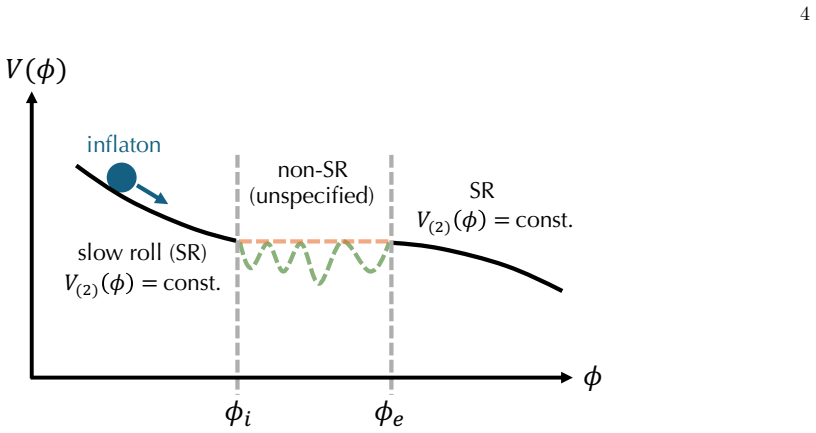
The central discovery is that the superhorizon limit of the one-loop curvature power spectrum is conserved: $\lim_{q\to 0} \langle \zeta_q \zeta_{q'} \rangle = (2\pi)^3 \delta(q+q') (2\pi^2/q^3) P_{\zeta,\mathrm{tr}}(q)$ for $\eta<\eta_i$ and $\eta>\eta_e$. In the spatially flat gauge, $\zeta = -H\,\delta\phi/\langle \dot\phi\rangle$, so conservation requires that the one-loop correction to $\langle \delta\phi_q \delta\phi_{q'}\rangle$ be exactly matched by the one-loop backreaction to $\langle \dot\phi\rangle$. The paper derives this matching for the one-vertex, two-vertex, and tadpole contributions, after setting aside the homogeneous infrared-cutoff contribution $\langle \delta\dot\phi\rangle_{\mathrm{IR}}$, and shows that the same counterterm structure removes the UV divergences from both the fluctuation power spectrum and the background velocity.
Load-bearing premise
The proof drops the homogeneous infrared-cutoff contribution $\langle \delta\dot\phi\rangle_{\mathrm{IR}}$ after Eq. (66), and Appendix C concedes that the inhomogeneous, field-dependent cutoff that would fully cancel it cannot yet be justified.
Editorial extensions
If this is right
- Small-scale enhancements from a transient non-slow-roll phase do not generate scale-invariant one-loop corrections to the large-scale curvature power spectrum, leaving CMB and LSS scales untouched at this order.
- Primordial-black-hole single-field models are not constrained by one-loop backreaction on CMB scales, so higher-loop and non-perturbative small-scale effects remain the only open worries at this level.
- Ignoring backreaction in the spatially flat gauge would break conservation unless counterterms are tuned; the explicit $V_{c,(1)}$ counterterm absorbs the UV divergences in both the power spectrum and the background velocity.
- The conservation holds for $\eta<\eta_i$ and $\eta>\eta_e$, and the separate-universe argument extends it through the non-SR phase up to corrections suppressed by the choice of $k_{\mathrm{IR}}$.
Reading between the lines
- The paper leaves open whether a physical regulator makes the homogeneous IR-cutoff contribution nonzero; if it does, conservation could fail at one loop.
- The strict proof lives in the de Sitter limit $\epsilon\to 0$; a finite-$\epsilon$ extension could produce $\mathcal{O}(\epsilon)$ one-loop corrections not covered here.
- The separate-universe picture is restored only by an inhomogeneous, field-dependent smoothing scale, suggesting that homogeneous cutoffs may spuriously break conservation in other gauge choices as well.
- A natural next step is a two-loop version of the same backreaction-matching argument, where the cancellation pattern may or may not persist.
Editorial analysis
A structured set of objections, weighed in public.
Referee Report
Summary. The paper aims to prove that superhorizon-limit curvature perturbations are conserved at one-loop order in single-field inflation models with a transient non-slow-roll period, working in the spatially-flat gauge and using the in-in formalism. The author computes the one-loop power spectrum of δφ, including one-vertex, two-vertex, and tadpole contributions, and separately computes the one-loop backreaction of the perturbations on the background inflaton velocity ⟨δφ̇⟩. The central step is the matching in Eqs. (61)-(65), where the superhorizon limit of the one-loop power spectrum is shown to equal 2⟨δφ̇⟩/φ̇ plus an IR-cutoff term ⟨δφ̇⟩_IR. Eq. (66) then gives the ratio ⟨δφδφ⟩/⟨φ̇⟩^2 as the tree-level curvature power spectrum times [1 − 2⟨δφ̇⟩_IR/φ̇]; neglecting this IR term yields the conservation statement in Eq. (68). The paper also presents a UV renormalization procedure with counter terms, showing that the quadratic and logarithmic UV divergences in the one-vertex and two-vertex contributions cancel via the counter term in Eq. (76).
Significance. If the result holds, it is significant because it would refute claims that enhanced small-scale perturbations during a transient non-slow-roll period generate scale-invariant one-loop corrections to CMB/LSS-scale curvature perturbations, thereby supporting the separate-universe picture and relaxing constraints on PBH scenarios. The paper's strengths include a self-contained derivation of the loop-backreaction matching in the in-in formalism, an explicit and detailed treatment of UV renormalization with counter terms, and a clear comparison with earlier work. The derivation is internally consistent and the cancellation between the one-loop power spectrum and backreaction terms is demonstrated by explicit formulas. However, the conservation statement in Eq. (68) depends on dropping the IR cutoff term ⟨δφ̇⟩_IR, and the manuscript itself (Appendix C) states that the only known way to remove this term involves a field-dependent cutoff that cannot be justified. This gap currently leaves the central claim conditional rather than proven.
major comments (2)
- [§V, Eq. (66)] The step from Eq. (66) to Eq. (68) drops the IR cutoff contribution ⟨δφ̇⟩_IR without a quantitative estimate. This term, defined in Eq. (57), is proportional to H V(3) P_{δφ,tr}(k_IR, η′) integrated with a^4 Im[u0 u0*]. For a scale-invariant tree-level spectrum, P_{δφ,tr}(k_IR) is of the same order as P_{δφ,tr}(q), and the paper provides no argument that the time integral suppresses this term relative to the kept one-loop contributions. Since Eq. (68) is the paper's central claim, the neglect of this term is load-bearing and needs to be justified by an explicit estimate or by reformulating the theorem to state the condition under which the term is negligible.
- [Appendix C] The manuscript acknowledges that the only known way to cancel the IR cutoff contribution is to adopt an inhomogeneous, field-dependent IR cutoff of the form k_IR[1 − Hδφ/φ̇], and then states in Appendix C that this choice "cannot be justified." This concession directly undermines the unconditional form of the conservation result stated in the abstract and in Eq. (68). The strict conservation theorem is therefore not proven for the homogeneous-cutoff calculation presented; it holds only if a particular local-smoothing prescription is imposed. The abstract and conclusion should be qualified accordingly, or the paper should provide a physical justification for the field-dependent cutoff within its framework.
minor comments (5)
- [§V, after Eq. (66)] The sentence "If we neglect the IR cutoff contribution..." introduces an unstated assumption into the derivation; the paper should clearly label this as an assumption in the statement of the theorem, so that readers can distinguish the proven result from the conditional result.
- [§V, paragraph after Eq. (68)] The claim that contributions of O(X P_{ζ,tr}(k1) P_{ζ,tr}(k2)) from smoothed modes are negligible "unless X is extremely large" is not quantified. The paper should either define a threshold or state explicitly that this condition is an assumption of the argument.
- [Eq. (58)] The notation ⟨δφ̇(η)⟩ in the denominator of Eq. (58) omits the spatial argument; since the backreaction is defined as a spatially homogeneous quantity in the main text, the notation should be made consistent, perhaps by writing ⟨δφ̇(x,η)⟩ or stating that the x-dependence drops out.
- [Figure 2] The Feynman diagram labels "Tadpole", "One vertex", and "Two vertices" are clear, but the one-vertex diagram includes both V(4) and Vc,(2) insertions; a sentence in the caption clarifying which vertex corresponds to which term would improve readability.
- [Appendix D, Eq. (D4)] The notation a1 in Eq. (D4) is used before it is defined in Eq. (D2), and the definition appears only in the surrounding text; consider defining a1 explicitly at first use.
Circularity Check
No circularity: the one-loop conservation result is derived in-in from the vertices and counter terms; the only notable caveat is the acknowledged IR-cutoff term, which is a rigor gap rather than a circular reduction.
full rationale
The central derivation is self-contained. The one-loop power spectrum is computed with the in-in formalism from the cubic and quartic vertices and the counter terms, and the key cancellation in Eq. (65) follows algebraically from Eqs. (61), (63), and (64) without assuming the final conservation. The proof uses standard external inputs (Bunch-Davies mode functions, Wronskian identities, the separate-universe/δN relation) and contains no fitted parameters or quantities that are renamed as predictions. The author cites his own previous work [58] for motivation, comparison, and some notation, and Appendix A explicitly reconciles the two formalisms, but the load-bearing steps are re-derived here rather than imported; the self-citations are not circular. The one substantive caveat is the IR-cutoff contribution: Eq. (66) contains the factor [1 - 2⟨δφdot⟩_IR/φdot], and Eq. (68) is obtained only after neglecting it. Appendix C concedes that the inhomogeneous, field-dependent cutoff that would fully remove this term 'cannot be justified.' This is an acknowledged limitation of the proof, not a circular step, because the dropped term is not an input that is later repackaged as the output. The result is therefore not equivalent to its assumptions by construction. Score 1 reflects minor self-citation and the flagged caveat, not circular reasoning.
Assumptions & free parameters
free parameters (1)
- IR comoving cutoff k_IR =
chosen such that q << k_IR and k_IR lies above the enhanced small-scale band
assumptions (7)
- domain assumption The bare potential is smooth and split as V_b = V + V_c with V_c of one-loop order or higher.
- domain assumption The de Sitter limit epsilon -> 0 is taken, with all metric perturbations neglected.
- domain assumption V^(n>=3) is zero or exponentially suppressed outside the non-SR window, so interactions act only for eta_i < eta < eta_e.
- domain assumption The initial state is the Bunch-Davies vacuum at eta_i and the i-epsilon prescription is unnecessary.
- ad hoc to paper The IR cutoff contribution <delta dot-phi>_IR can be neglected by choosing k_IR much larger than the enhanced small-scale modes.
- domain assumption The separate universe / delta-N formula (Eq. 67) applies during the SR phases, with corrections suppressed by m^2/H^2.
- ad hoc to paper During the non-SR phase, contributions of O(X P_zeta,tr(k1) P_zeta,tr(k2)) from smoothed modes are negligible unless X is very large.
Cite this review
Pith. "Pith review of Conservation of superhorizon curvature perturbations at one loop: Backreaction in the in-in formalism and Renormalization." pith.science (2026). https://pith.science/paper/HJVHVM5K
@misc{pith2026250208707,
  author       = {Pith},
  title        = {Pith review of: Conservation of superhorizon curvature perturbations at one loop: Backreaction in the in-in formalism and Renormalization},
  year         = {2026},
  howpublished = {\url{https://pith.science/paper/HJVHVM5K}},
  note         = {Machine review of arXiv:2502.08707}
}
read the original abstract
We show that the superhorizon-limit curvature perturbations are conserved at one-loop level in single-field inflation models with a transient non-slow-roll period. We take the spatially-flat gauge, where the backreaction plays a crucial role for the conservation of superhorizon curvature perturbations unless the counter terms are tuned. We calculate the backreaction with the in-in formalism. In addition, we explicitly show the renormalization of the UV divergences with the counter terms.
Figures

Forward citations
Cited by 6 Pith papers
-
Scale-Dependent Loop Corrections to the Inflationary Power Spectrum
One-loop gravitational corrections in inflationary models with scale-dependent features are renormalizable and vanish on large and small scales, preserving perturbativity of CMB-fit feature models.
-
How Dilatation Invariance Suppresses Loop Corrections to Curvature Perturbations on CMB Scales
Dilatation invariance forces the non-linear curvature perturbation on super-Hubble scales to depend only on the decaying/growing mode, suppressing loop corrections to the CMB power spectrum even with sharp transitions.
-
Efficient training of photonic quantum generative models
Photonic quantum generative models can be trained classically via maximum mean discrepancy, with deployment corresponding to boson sampling.
-
Evolution of Linear Perturbations under Time-Dependent Hubble Friction I: SR-USR-SR Inflation
Analytic asymptotics show the dip in the SR-USR-SR curvature power spectrum comes from cancellation between two growing modes, not a constant-versus-growing cancellation.
-
One-loop corrections to infrared GWs is forbidden by symmetries
In non-attractor single-field inflation, one-loop corrections to superhorizon gravitational waves cancel, and a Ward identity explains why.
-
Incorporating Backreaction in One-Loop Corrections in Ultra-Slow-Roll Inflation
Including the backreaction of quantum fluctuations on the background inflaton cancels the one-loop superhorizon corrections to the curvature power spectrum in ultra-slow-roll inflation.
Reference graph
Works this paper leans on
-
[58]
K. Inomata, Phys. Rev. Lett. 133, 141001 (2024), arXiv:2403.04682 [astro-ph.CO]
arXiv 2024
-
[1]
J. M. Bardeen, Phys. Rev. D 22, 1882 (1980)
1980
-
[2]
Kodama and M
H. Kodama and M. Sasaki, Prog. Theor. Phys. Suppl. 78, 1 (1984)
1984
-
[3]
L. Senatore and M. Zaldarriaga, JHEP 12, 008 (2010), arXiv:0912.2734 [hep-th]
arXiv 2010
-
[4]
L. Senatore and M. Zaldarriaga, JHEP 01, 109 (2013), arXiv:1203.6354 [hep-th]
arXiv 2013
-
[5]
G. L. Pimentel, L. Senatore, and M. Zaldarriaga, JHEP 07, 166 (2012), arXiv:1203.6651 [hep-th]
arXiv 2012
-
[6]
D. H. Lyth, K. A. Malik, and M. Sasaki, JCAP 05, 004 (2005), arXiv:astro-ph/0411220
arXiv 2005
-
[7]
G. F. Chapline, Nature 253, 251 (1975)
1975
Show all 76 references
-
[8]
Ivanov, P
P. Ivanov, P. Naselsky, and I. Novikov, Phys. Rev. D 50, 7173 (1994)
1994
- [9]
-
[10]
Garcia-Bellido, A
J. Garcia-Bellido, A. D. Linde, and D. Wands, Phys. Rev. D54, 6040 (1996), arXiv:astro-ph/9605094 [astro-ph]
1996 arXiv
-
[11]
Afshordi, P
N. Afshordi, P. McDonald, and D. N. Spergel, Astrophys. J. Lett. 594, L71 (2003), arXiv:astro-ph/0302035
2003 arXiv
-
[12]
P. H. Frampton, M. Kawasaki, F. Takahashi, and T. T. Yanagida, JCAP 1004, 023 (2010), arXiv:1001.2308 [hep-ph]
2010 arXiv
-
[13]
K. M. Belotsky, A. D. Dmitriev, E. A. Esipova, V. A. Gani, A. V. Grobov, M. Y. Khlopov, A. A. Kirillov, S. G. Rubin, and I. V. Svadkovsky, Mod. Phys. Lett. A 29, 1440005 (2014), arXiv:1410.0203 [astro-ph.CO]
2014 arXiv
-
[14]
B. Carr, F. Kuhnel, and M. Sandstad, Phys. Rev. D94, 083504 (2016), arXiv:1607.06077 [astro-ph.CO]
2016 arXiv
-
[15]
Inomata, M
K. Inomata, M. Kawasaki, K. Mukaida, Y. Tada, and T. T. Yanagida, Phys. Rev. D96, 043504 (2017), arXiv:1701.02544 [astro-ph.CO]
2017 arXiv
-
[16]
J. R. Espinosa, D. Racco, and A. Riotto, Phys. Rev. Lett. 120, 121301 (2018), arXiv:1710.11196 [hep-ph]
2018 arXiv
-
[17]
S. Bird, I. Cholis, J. B. Mu˜ noz, Y. Ali-Ha ¨ ımoud, M. Kamionkowski, E. D. Kovetz, A. Raccanelli, and A. G. Riess, Phys. Rev. Lett. 116, 201301 (2016), arXiv:1603.00464 [astro-ph.CO]
2016 arXiv
-
[18]
Clesse and J
S. Clesse and J. Garc ´ ıa-Bellido, Phys. Dark Univ.10, 002 (2016), arXiv:1603.05234 [astro-ph.CO]
2016 arXiv
-
[19]
Sasaki, T
M. Sasaki, T. Suyama, T. Tanaka, and S. Yokoyama, Phys. Rev. Lett.117, 061101 (2016), arXiv:1603.08338 [astro-ph.CO]
2016 arXiv
-
[20]
Y. N. Eroshenko, J. Phys. Conf. Ser. 1051, 012010 (2018), arXiv:1604.04932 [astro-ph.CO]
2018 arXiv
-
[21]
Sasaki, T
M. Sasaki, T. Suyama, T. Tanaka, and S. Yokoyama, Class. Quant. Grav. 35, 063001 (2018), arXiv:1801.05235 [astro- ph.CO]
2018 arXiv
-
[22]
B. Carr, K. Kohri, Y. Sendouda, and J. Yokoyama, Rept. Prog. Phys. 84, 116902 (2021), arXiv:2002.12778 [astro-ph.CO]
2021 arXiv
-
[23]
A. M. Green and B. J. Kavanagh, J. Phys. G 48, 043001 (2021), arXiv:2007.10722 [astro-ph.CO]
2021 arXiv
-
[24]
Escriv` a, F
A. Escriv` a, F. Kuhnel, and Y. Tada, (2022), 10.1016/B978-0-32-395636-9.00012-8, arXiv:2211.05767 [astro-ph.CO]
2022 arXiv
-
[25]
Kristiano and J
J. Kristiano and J. Yokoyama, Phys. Rev. Lett. 132, 221003 (2024), arXiv:2211.03395 [hep-th]
2024 arXiv
-
[26]
Cheng, D.-S
S.-L. Cheng, D.-S. Lee, and K.-W. Ng, Phys. Lett. B 827, 136956 (2022), arXiv:2106.09275 [astro-ph.CO]
2022 arXiv
-
[27]
W. H. Kinney, Phys. Rev. D 56, 2002 (1997), arXiv:hep-ph/9702427
1997 arXiv
- [28]
-
[29]
W. H. Kinney, Phys. Rev. D 72, 023515 (2005), arXiv:gr-qc/0503017
2005 arXiv
-
[30]
Martin, H
J. Martin, H. Motohashi, and T. Suyama, Phys. Rev. D 87, 023514 (2013), arXiv:1211.0083 [astro-ph.CO]
2013 arXiv
-
[31]
Riotto, (2023), arXiv:2301.00599 [astro-ph.CO]
A. Riotto, (2023), arXiv:2301.00599 [astro-ph.CO]
2023 arXiv
-
[32]
Choudhury, M
S. Choudhury, M. R. Gangopadhyay, and M. Sami, Eur. Phys. J. C 84, 884 (2024), arXiv:2301.10000 [astro-ph.CO]
2024 arXiv
-
[33]
Kristiano and J
J. Kristiano and J. Yokoyama, Phys. Rev. D 109, 103541 (2024), arXiv:2303.00341 [hep-th]
2024 arXiv
-
[34]
Riotto, (2023), arXiv:2303.01727 [astro-ph.CO]
A. Riotto, (2023), arXiv:2303.01727 [astro-ph.CO]
2023 arXiv
-
[35]
Firouzjahi, JCAP 10, 006 (2023), arXiv:2303.12025 [astro-ph.CO]
H. Firouzjahi, JCAP 10, 006 (2023), arXiv:2303.12025 [astro-ph.CO]
2023 arXiv
-
[36]
Motohashi and Y
H. Motohashi and Y. Tada, JCAP 08, 069 (2023), arXiv:2303.16035 [astro-ph.CO]
2023 arXiv
-
[37]
Firouzjahi and A
H. Firouzjahi and A. Riotto, JCAP 02, 021 (2024), arXiv:2304.07801 [astro-ph.CO]
2024 arXiv
-
[38]
Franciolini, A
G. Franciolini, A. Iovino, Junior., M. Taoso, and A. Urbano, Phys. Rev. D 109, 123550 (2024), arXiv:2305.03491 [astro- ph.CO]
2024 arXiv
- [39]
-
[40]
Cheng, D.-S
S.-L. Cheng, D.-S. Lee, and K.-W. Ng, JCAP 03, 008 (2024), arXiv:2305.16810 [astro-ph.CO]
2024
-
[41]
Fumagalli, (2023), arXiv:2305.19263 [astro-ph.CO]
J. Fumagalli, (2023), arXiv:2305.19263 [astro-ph.CO]
2023 arXiv
-
[42]
Maity, H
S. Maity, H. V. Ragavendra, S. K. Sethi, and L. Sriramkumar, JCAP 05, 046 (2024), arXiv:2307.13636 [astro-ph.CO]
2024 arXiv
-
[43]
Y. Tada, T. Terada, and J. Tokuda, JHEP 01, 105 (2024), arXiv:2308.04732 [hep-th]
2024 arXiv
-
[44]
Firouzjahi, Phys
H. Firouzjahi, Phys. Rev. D 109, 043514 (2024), arXiv:2311.04080 [astro-ph.CO]
2024 arXiv
-
[45]
M. W. Davies, L. Iacconi, and D. J. Mulryne, JCAP 04, 050 (2024), arXiv:2312.05694 [astro-ph.CO]
2024 arXiv
-
[46]
Iacconi, D
L. Iacconi, D. Mulryne, and D. Seery, JCAP 06, 062 (2024), arXiv:2312.12424 [astro-ph.CO]
2024 arXiv
-
[47]
Saburov and S
S. Saburov and S. V. Ketov, Universe 10, 354 (2024), arXiv:2402.02934 [gr-qc]. 25
2024 arXiv
-
[48]
Ballesteros and J
G. Ballesteros and J. G. Egea, JCAP 07, 052 (2024), arXiv:2404.07196 [astro-ph.CO]
2024 arXiv
-
[49]
Kristiano and J
J. Kristiano and J. Yokoyama, JCAP 10, 036 (2024), arXiv:2405.12145 [astro-ph.CO]
2024 arXiv
- [50]
-
[51]
Kawaguchi, S
R. Kawaguchi, S. Tsujikawa, and Y. Yamada, JHEP 12, 095 (2024), arXiv:2407.19742 [hep-th]
2024 arXiv
-
[52]
Fumagalli, JHEP 01, 108 (2025), arXiv:2408.08296 [astro-ph.CO]
J. Fumagalli, JHEP 01, 108 (2025), arXiv:2408.08296 [astro-ph.CO]
2025 arXiv
-
[53]
Sheikhahmadi and A
H. Sheikhahmadi and A. Nassiri-Rad, (2024), arXiv:2411.18525 [astro-ph.CO]
2024 arXiv
- [54]
-
[55]
Sasaki and T
M. Sasaki and T. Tanaka, Prog. Theor. Phys. 99, 763 (1998), arXiv:gr-qc/9801017
1998 arXiv
-
[56]
Wands, K
D. Wands, K. A. Malik, D. H. Lyth, and A. R. Liddle, Phys. Rev. D 62, 043527 (2000), arXiv:astro-ph/0003278
2000 arXiv
-
[57]
D. H. Lyth and D. Wands, Phys. Rev. D 68, 103515 (2003), arXiv:astro-ph/0306498
2003 arXiv
- [59]
-
[60]
Pajer, G
E. Pajer, G. L. Pimentel, and J. V. S. Van Wijck, JCAP 06, 009 (2017), arXiv:1609.06993 [hep-th]
2017 arXiv
-
[61]
Inomata, M
K. Inomata, M. Braglia, X. Chen, and S. Renaux-Petel, JCAP 04, 011 (2023), [Erratum: JCAP 09, E01 (2023)], arXiv:2211.02586 [astro-ph.CO]
2023 arXiv
- [62]
- [63]
-
[64]
Kawaguchi, S
R. Kawaguchi, S. Tsujikawa, and Y. Yamada, Phys. Lett. B 856, 138962 (2024), arXiv:2403.16022 [hep-th]
2024 arXiv
-
[65]
S. B. Giddings and M. S. Sloth, JCAP 01, 023 (2011), arXiv:1005.1056 [hep-th]
2011 arXiv
-
[66]
C. T. Byrnes, M. Gerstenlauer, A. Hebecker, S. Nurmi, and G. Tasinato, JCAP 08, 006 (2010), arXiv:1005.3307 [hep-th]
2010 arXiv
-
[67]
Inomata, E
K. Inomata, E. McDonough, and W. Hu, Phys. Rev. D 104, 123553 (2021), arXiv:2104.03972 [astro-ph.CO]
2021 arXiv
-
[68]
Inomata, E
K. Inomata, E. McDonough, and W. Hu, JCAP 02, 031 (2022), arXiv:2110.14641 [astro-ph.CO]
2022 arXiv
-
[69]
Iacconi and D
L. Iacconi and D. J. Mulryne, JCAP 09, 033 (2023), arXiv:2304.14260 [astro-ph.CO]
2023 arXiv
-
[70]
Fumagalli, S
J. Fumagalli, S. Bhattacharya, M. Peloso, S. Renaux-Petel, and L. T. Witkowski, JCAP 04, 029 (2024), arXiv:2307.08358 [astro-ph.CO]
2024 arXiv
-
[71]
Caravano, K
A. Caravano, K. Inomata, and S. Renaux-Petel, Phys. Rev. Lett. 133, 151001 (2024), arXiv:2403.12811 [astro-ph.CO]
2024 arXiv
-
[72]
Caravano, G
A. Caravano, G. Franciolini, and S. Renaux-Petel, (2024), arXiv:2410.23942 [astro-ph.CO]
2024 arXiv
-
[73]
Tanaka and Y
T. Tanaka and Y. Urakawa, Class. Quant. Grav. 30, 233001 (2013), arXiv:1306.4461 [hep-th]
2013 arXiv
-
[74]
J. M. Maldacena, JHEP 05, 013 (2003), arXiv:astro-ph/0210603
2003 arXiv
-
[75]
Hinterbichler, L
K. Hinterbichler, L. Hui, and J. Khoury, JCAP 08, 017 (2012), arXiv:1203.6351 [hep-th]
2012 arXiv
-
[76]
M. E. Peskin and D. V. Schroeder, An Introduction to quantum field theory (Addison-Wesley, Reading, USA, 1995)
1995
Reviewed August 7, 2026 · model on record in the stance chip above.
Discussion (0). Continue with ORCID to comment.