REVIEW 4 major objections 5 minor 2 cited by
DG-SLAM: Robust Dynamic Gaussian Splatting SLAM with Hybrid Pose Optimization
T0 review · 4 major / 5 minor · reviewed 2026-08-12 · deepseek-v4-flash
Pith's one-line read DG-SLAM claims to be the first robust dynamic visual SLAM system grounded in 3D Gaussians, using fused depth-warp and semantic motion masks plus coarse-to-fine hybrid pose optimization to keep moving objects from corrupting the static map.
desk verdict A solid dynamic 3DGS SLAM system with real benchmark gains, but the motion mask's dependence on DROID-VO pose error is never stress-tested. read the letter →
The pith
A machine-rendered reading of the paper's core claim, the machinery that carries it, and where it could break.
The reading
What carries the argument
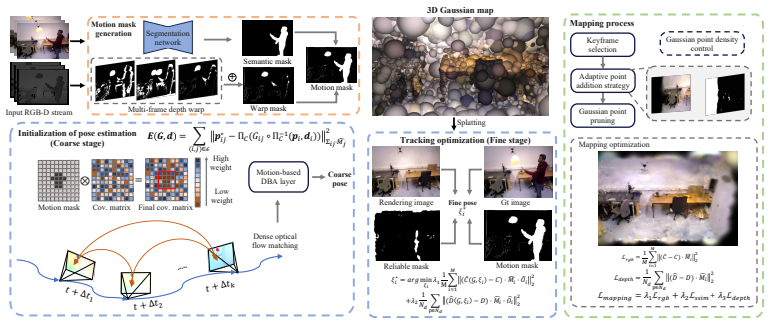
The load-bearing mechanism is the motion mask plus a coarse-to-fine pose optimizer. The motion mask is built from depth-warp residuals (Eq. 6) and their fusion (Eq. 7): multiple observation masks within a sliding window are intersected for spatial consistency, then the semantic mask is unioned in, so the final mask is precise at edges and still catches non-semantic movers. The hybrid tracking uses [19] as the coarse pose through masked dense bundle adjustment (Eq. 8), then Gaussian-splatting fine alignment (Eq. 10) with a reliability mask derived from accumulated opacity, which prevents dynamic pixels and under-optimized Gaussians from steering the pose. Adaptive Gaussian point addition and pruning keeps the map geometry clean and prevents floaters in the rendered images.
What would settle it
Take a sequence with a large, slow-moving object covering most of the frame, or induce coarse-pose drift through fast camera motion, and compare the generated motion mask's precision and recall against ground-truth dynamic annotations; if the depth-warp mask mislabels large static regions as dynamic or misses the moving object when the coarse pose is off by a few centimeters, the claimed robustness fails in exactly the regime the paper targets.
Extended reading notes
Core claim
DG-SLAM's central claim is that a 3D-Gaussian SLAM system can be made robust in dynamic scenes by explicitly separating moving objects from the static map. The core object is a fused motion mask: per-pixel depth-warp residuals between keyframes in a sliding window are intersected over time to remove noise at edges, then unioned with a semantic dynamic-object mask, so that objects a semantic network misses (balloons, boxes) are still caught. This mask suppresses dynamic pixels in the masked dense bundle adjustment of the coarse stage and in the photometric and depth losses of the fine Gaussian-splatting stage. With this separation, the Gaussian map is optimized on static pixels only, and pose estimates are refined against a clean rendering. The paper reports that this yields lower ATE than optical-flow-plus-semantic dynamic SLAM baselines on TUM and BONN, and lower reconstruction error than neural-implicit or other Gaussian SLAM baselines on dynamic BONN sequences, while preserving real-time rendering ability.
Load-bearing premise
The whole pipeline depends on the coarse pose from the learned odometry and the depth values being accurate enough that the depth-warp residual cleanly separates moving from static pixels; if the initial pose drifts badly in scenes with large moving regions, the mask itself becomes wrong and the masked optimization will reinforce the error instead of fixing it.
Editorial extensions
If this is right
- Dynamic objects no longer corrupt the Gaussian map: map optimization uses only pixels outside the motion mask, so the reconstructed static background is clean even when people carry balloons or boxes.
- Pose estimation becomes robust in dynamic scenes: masking dynamic pixels in both the dense bundle adjustment and the fine Gaussian alignment removes a major source of photometric and geometric inconsistency.
- The system retains real-time rendering ability while achieving the paper's reported ATE and reconstruction improvements over prior Gaussian and neural-implicit SLAM baselines on dynamic sequences.
- Semantic segmentation errors can be compensated by the depth-warp masks, and depth-warp edge noise is reduced by spatio-temporal consistency, so the fused mask is more precise than either cue alone.
- The masked Gaussian map supports novel-view synthesis of the static scene, extending the utility of the map beyond tracking to rendering and editing.
Reading between the lines
- If this approach holds, the same motion-mask fusion could be dropped into other Gaussian or neural-implicit SLAM backends as a front-end filter, not only for SLAM but for static-map reconstruction from handheld RGB-D video in busy scenes.
- The paper's reliance on a learned dense optical-flow odometry for the coarse pose suggests a failure mode when that odometry itself drifts; testing with degraded coarse poses would show how much of the claimed robustness comes from the mask versus the oracle pose.
- The 163 ms semantic segmentation step could be swapped for a faster lightweight segmenter or self-supervised motion cues to push the system closer to true real-time operation without changing the fusion strategy.
- Because the motion mask only removes pixels labeled dynamic through the sliding-window intersection, an object that is static at first but starts moving later (or vice versa) may need a forgetting mechanism for stale warp-mask labels.
Signed reviews
Editorial analysis
A structured set of objections, weighed in public.
Referee Report
Summary. The manuscript proposes DG-SLAM, a dynamic RGB-D SLAM system built on 3D Gaussian Splatting. The pipeline uses a motion mask computed from multi-frame depth-warp residuals and semantic segmentation to avoid optimizing over dynamic pixels, a coarse-to-fine tracking stage that starts from DROID-VO poses and then refines them against the Gaussian map, and adaptive Gaussian point addition/pruning for map quality. The system is evaluated on TUM RGB-D, BONN RGB-D Dynamic, and ScanNet, with tables reporting ATE, reconstruction accuracy/completion/completion ratio, and runtime. The paper claims state-of-the-art pose estimation, reconstruction, and novel-view synthesis in dynamic scenes while retaining real-time rendering.
Significance. If the results hold, DG-SLAM is a useful step toward making 3D Gaussian Splatting SLAM work in scenes with moving objects, an area where existing Gaussian SLAM systems are weak. The design is sensible: masking dynamic pixels before bundle adjustment and fine tracking, and using coarse-to-fine pose optimization, are technically reasonable. The paper is accompanied by a public code link, evaluates on standard benchmarks, and includes ablations that support the contribution of each component. However, the strength of the claim depends on sensitivity to the coarse pose source and on statistical reliability, neither of which is demonstrated beyond single-run point estimates.
major comments (4)
- [Sec. 3.2-3.3, Eqs. (6)-(10)] The central robustness claim rests on the depth-warp motion mask, but the paper does not quantify how the system behaves when the DROID-VO coarse pose is inaccurate. Eq. (6) warps pixels using the coarse pose; the resulting mask is applied in the DBA objective (Eq. 8) and in both terms of the fine tracking loss (Eq. 10). Section 3.3 itself acknowledges that an inaccurate initial pose degrades the depth-warp mask, yet no experiment perturbs the coarse pose or analyzes a sequence where DROID-VO drifts. Since DROID-VO alone achieves 3.3 cm average ATE on TUM (Table 2) and 15.4 cm on BONN (Table 3), the improvement to 2.2 cm and 5.5 cm could, in some regimes, be due to the mask-and-refine loop recovering from good coarse poses rather than to genuine robustness. A controlled pose-noise ablation (e.g., adding known translation/rotation perturbations to the DROID-VO output and measuring final ATE and mask accuracy) would settle whether the system degrades gracefully or fails exactly where it claims robustness.
- [Sec. 4, Tables 2-4 and 6] All quantitative results are single-run point estimates. Tables 2, 3, 4, and 6 report no error bars, no standard deviations across multiple runs, and no significance tests. The implementation section lists hand-set hyperparameters (loss weights lambda1=0.9, lambda2=0.2, lambda3=0.1; tracking/mapping iterations 20/40; pruning thresholds tau_alpha=0.005, tau_S1=0.4, tau_S2=36; depth threshold 0.6; window size 4), but no sensitivity analysis is given. This matters because several ablations in Table 6 differ by only about 1 cm (e.g., w/o Add 6.63 vs. 5.51, w/o Prune 6.89 vs. 5.51), and the 'state-of-the-art' claim is based on margins that may be within run-to-run noise. At minimum, the authors should provide repeated runs or a hyperparameter sweep to show that the reported margins are stable.
- [Eq. (6)] The depth-warp mask definition in Eq. (6) is ambiguous and is not fully consistent with the surrounding text. The equation states a condition D_j(p_{i->j}) - D_i(p) < e_th, while Section 3.2 then says 'we only mask the foreground pixels where the depth residual is positive.' A one-sided inequality with a positive threshold already excludes negative residuals, so the additional sentence is confusing; if a signed residual is intended, the equation should state it explicitly. The notation with the tensor product and I_{m x n} is nonstandard and should be replaced by an explicit elementwise predicate so that the mask can be reproduced unambiguously.
- [Sec. 3.4, Eq. (13)] The point-pruning criterion in Eq. (13) uses max(S) and min(S), but the scale vector S_i is never defined in the Gaussian representation of Eq. (1), which instead introduces the covariance matrix Sigma_i. This makes the pruning rule and the initialization description in Section 3.4 ('the scale vector S_i is initialized...') formally incomplete. The authors should either define the scale-rotation decomposition of Sigma_i explicitly or rewrite Eq. (13) in terms of Sigma_i's eigenvalues.
minor comments (5)
- [Various headings] There are typos and grammatical issues, e.g., 'Adapative Gaussian point adding strategy' and 'we reduce the gradient-based dynamic radius to half so that can add more Gaussian points.' These do not affect the technical content but should be corrected.
- [Eq. (2) vs. Eq. (5)] The transformation notation is inconsistent: Eq. (2) uses T^c_w while Eq. (5) uses T_ji for the relative pose. Please unify the notation.
- [References] References [14] and [29] are the same paper (Mildenhall et al., NeRF); one duplicate should be removed and the citation indices updated.
- [Table 5] Table 5 lists only iteration counts, but Section 4.3 says these results 'take TUM as an example' without specifying which sequences or whether the reported values are averaged; please clarify.
- [Section 4.5] The runtime comparison in Table 7 excludes semantic segmentation time, which is later reported as 163 ms per frame. The abstract's 'real-time rendering ability' claim should be reconciled with this extra cost, perhaps by reporting end-to-end runtime including segmentation.
Circularity Check
No circularity found; pose and reconstruction claims are measured against external benchmarks, and the coarse-to-fine mask/pose loop is iterative refinement, not derivation-by-construction.
full rationale
The paper's central claims—camera pose accuracy, reconstruction quality, and novel-view synthesis—are evaluated on external datasets (TUM, BONN, ScanNet) against ground-truth trajectories and point clouds, so they are not manufactured from the method's own fitted parameters. The coarse-to-fine pipeline is a feedback loop rather than a circular definition: DROID-VO supplies a coarse pose, Eqs. (5)-(7) build a motion mask from depth warping and semantics, Eq. (8) performs masked bundle adjustment, and Eq. (10) refines the pose by minimizing photometric and depth residuals against rendered Gaussians. The final pose is the minimizer of an independent objective, not an algebraic consequence of the mask; the mask itself is an intermediate estimate that can be wrong, as the paper acknowledges. The self-citation of Rodyn-SLAM [33] is used as a comparison baseline and as related work, and it is not load-bearing for any of DG-SLAM's derivations. The paper's stated limitations—large-scale tracking and sensitivity to semantic segmentation precision—are robustness concerns, not evidence of circular reasoning. No fitted constant is relabeled as a prediction, and no result is forced by a self-citation chain.
Assumptions & free parameters
free parameters (7)
- Loss weights lambda1, lambda2, lambda3 =
0.9, 0.2, 0.1
- Depth warp threshold e_th =
0.6
- Depth warp window size N =
4
- Gaussian pruning thresholds tau_alpha, tau_S1, tau_S2 =
0.005, 0.4, 36
- Reliable mask opacity threshold tau_track =
unspecified
- Opacity-based point addition threshold o_th =
unspecified
- Tracking and mapping iteration counts =
20 and 40
assumptions (5)
- domain assumption The 3D Gaussian Splatting alpha-blending model (Eqs. 2-3) faithfully represents the scene for rendering and pose optimization.
- ad hoc to paper Dynamic objects can be recognized by depth-warp residual thresholding combined with semantic segmentation (Eqs. 6-7).
- ad hoc to paper Accumulated opacity O_hat (Eq. 4) is a reliable indicator of Gaussian map optimization quality.
- domain assumption DROID-VO provides a sufficiently accurate coarse pose in dynamic scenes for the warp mask and fine tracking.
- domain assumption The semantic segmentation network OneFormer produces priors accurate enough to support the motion mask.
Cite this review
Pith. "Pith review of DG-SLAM: Robust Dynamic Gaussian Splatting SLAM with Hybrid Pose Optimization." pith.science (2026). https://pith.science/paper/HJX2UDG6
@misc{pith2026241108373,
  author       = {Pith},
  title        = {Pith review of: DG-SLAM: Robust Dynamic Gaussian Splatting SLAM with Hybrid Pose Optimization},
  year         = {2026},
  howpublished = {\url{https://pith.science/paper/HJX2UDG6}},
  note         = {Machine review of arXiv:2411.08373}
}
read the original abstract
Achieving robust and precise pose estimation in dynamic scenes is a significant research challenge in Visual Simultaneous Localization and Mapping (SLAM). Recent advancements integrating Gaussian Splatting into SLAM systems have proven effective in creating high-quality renderings using explicit 3D Gaussian models, significantly improving environmental reconstruction fidelity. However, these approaches depend on a static environment assumption and face challenges in dynamic environments due to inconsistent observations of geometry and photometry. To address this problem, we propose DG-SLAM, the first robust dynamic visual SLAM system grounded in 3D Gaussians, which provides precise camera pose estimation alongside high-fidelity reconstructions. Specifically, we propose effective strategies, including motion mask generation, adaptive Gaussian point management, and a hybrid camera tracking algorithm to improve the accuracy and robustness of pose estimation. Extensive experiments demonstrate that DG-SLAM delivers state-of-the-art performance in camera pose estimation, map reconstruction, and novel-view synthesis in dynamic scenes, outperforming existing methods meanwhile preserving real-time rendering ability.
Figures


Forward citations
Cited by 2 Pith papers
-
ContraGS: Codebook-Condensed and Trainable Gaussian Splatting for Fast, Memory-Efficient Reconstruction
ContraGS trains 3D Gaussian Splatting directly on codebook-compressed representations, cutting peak model memory ~3.5x with small quality loss.
-
DyPho-SLAM : Real-time Photorealistic SLAM in Dynamic Environments
DyPho-SLAM uses prior-image masks and adaptive feature selection to keep camera tracking accurate while building a photorealistic static 3D map in real time.
Reference graph
Works this paper leans on
-
[1]
Simultaneous map building and localization for an autonomous mobile robot
John J Leonard and Hugh F Durrant-Whyte. Simultaneous map building and localization for an autonomous mobile robot. In IROS, 1991. 1
work page 1991
-
[2]
Orb-slam2: An open-source slam system for monocular, stereo, and rgb-d cameras
Raul Mur-Artal and Juan D Tardós. Orb-slam2: An open-source slam system for monocular, stereo, and rgb-d cameras. IEEE TRO, 2017. 1, 2 10
work page 2017
-
[3]
Orb-slam3: An accurate open-source library for visual, visual–inertial, and multimap slam
Carlos Campos, Richard Elvira, Juan J Gómez Rodríguez, José MM Montiel, and Juan D Tardós. Orb-slam3: An accurate open-source library for visual, visual–inertial, and multimap slam. IEEE TRO, 2021. 1, 2, 8, 9
work page 2021
-
[4]
Haochen Jiang, Rui Qian, Liang Du, Jian Pu, and Jianfeng Feng. Ul-slam: A universal monocular line-based slam via unifying structural and non-structural constraints. IEEE TASE,
-
[5]
Refusion: 3d reconstruction in dynamic environments for rgb-d cameras exploiting residuals
Emanuele Palazzolo, Jens Behley, Philipp Lottes, Philippe Giguere, and Cyrill Stachniss. Refusion: 3d reconstruction in dynamic environments for rgb-d cameras exploiting residuals. In IROS, 2019. 1, 2, 4, 6, 8, 9
work page 2019
-
[6]
iMAP: Implicit mapping and positioning in real-time
Edgar Sucar, Shikun Liu, Joseph Ortiz, and Andrew Davison. iMAP: Implicit mapping and positioning in real-time. In ICCV, 2021. 1, 3, 8, 9
work page 2021
-
[7]
Zihan Zhu, Songyou Peng, Viktor Larsson, Weiwei Xu, Hujun Bao, Zhaopeng Cui, Martin R. Oswald, and Marc Pollefeys. Nice-slam: Neural implicit scalable encoding for slam. In CVPR,
-
[8]
Co-slam: Joint coordinate and sparse parametric encodings for neural real-time slam
Hengyi Wang, Jingwen Wang, and Lourdes Agapito. Co-slam: Joint coordinate and sparse parametric encodings for neural real-time slam. In CVPR, 2023. 1, 3, 7, 8, 9, 10
work page 2023
Show all 44 references
-
[9]
Eslam: Efficient dense slam system based on hybrid representation of signed distance fields
Mohammad Mahdi Johari, Camilla Carta, and François Fleuret. Eslam: Efficient dense slam system based on hybrid representation of signed distance fields. In CVPR, 2023. 1, 3, 7, 8, 9, 10
2023
-
[10]
V ox- fusion: Dense tracking and mapping with voxel-based neural implicit representation
Xingrui Yang, Hai Li, Hongjia Zhai, Yuhang Ming, Yuqian Liu, and Guofeng Zhang. V ox- fusion: Dense tracking and mapping with voxel-based neural implicit representation. In ISMAR,
-
[11]
Kinectfusion: Real-time dense surface mapping and tracking
Richard A Newcombe, Shahram Izadi, Otmar Hilliges, David Molyneaux, David Kim, Andrew J Davison, Pushmeet Kohi, Jamie Shotton, Steve Hodges, and Andrew Fitzgibbon. Kinectfusion: Real-time dense surface mapping and tracking. In ISMAR, 2011. 1
2011
-
[12]
Surfelmeshing: Online surfel-based mesh reconstruction
Thomas Schöps, Torsten Sattler, and Marc Pollefeys. Surfelmeshing: Online surfel-based mesh reconstruction. IEEE TPAMI, 2019. 1
2019
-
[13]
Bad slam: Bundle adjusted direct rgb-d slam
Thomas Schops, Torsten Sattler, and Marc Pollefeys. Bad slam: Bundle adjusted direct rgb-d slam. In CVPR, 2019. 1
2019
-
[14]
Nerf: Representing scenes as neural radiance fields for view synthesis
Ben Mildenhall, Pratul P Srinivasan, Matthew Tancik, Jonathan T Barron, Ravi Ramamoorthi, and Ren Ng. Nerf: Representing scenes as neural radiance fields for view synthesis. Commun Acm, 2021. 1
2021
-
[15]
Gs-slam: Dense visual slam with 3d gaussian splatting
Chi Yan, Delin Qu, Dong Wang, Dan Xu, Zhigang Wang, Bin Zhao, and Xuelong Li. Gs-slam: Dense visual slam with 3d gaussian splatting. In CVPR, 2024. 2, 3
2024
-
[16]
Splatam: Splat, track & map 3d gaussians for dense rgb-d slam
Nikhil Keetha, Jay Karhade, Krishna Murthy Jatavallabhula, Gengshan Yang, Sebastian Scherer, Deva Ramanan, and Jonathon Luiten. Splatam: Splat, track & map 3d gaussians for dense rgb-d slam. In CVPR, 2024. 2, 3, 7, 8, 9
2024
-
[17]
Hidenobu Matsuki, Riku Murai, Paul H. J. Kelly, and Andrew J. Davison. Gaussian Splatting SLAM. In CVPR, 2024. 2, 3, 7, 8, 9
2024
-
[18]
3d gaussian splatting for real-time radiance field rendering
Bernhard Kerbl, Georgios Kopanas, Thomas Leimkühler, and George Drettakis. 3d gaussian splatting for real-time radiance field rendering. ACM TOG, 2023. 2, 3, 4
2023
-
[19]
DROID-SLAM: Deep Visual SLAM for Monocular, Stereo, and RGB-D Cameras
Zachary Teed and Jia Deng. DROID-SLAM: Deep Visual SLAM for Monocular, Stereo, and RGB-D Cameras. In NeurIPS, 2021. 2, 5, 7, 8
2021
-
[20]
Ds-slam: A semantic visual slam towards dynamic environments
Chao Yu, Zuxin Liu, Xin-Jun Liu, Fugui Xie, Yi Yang, Qi Wei, and Qiao Fei. Ds-slam: A semantic visual slam towards dynamic environments. In IROS, 2018. 2
2018
-
[21]
Dynaslam: Tracking, mapping, and inpainting in dynamic scenes
Berta Bescos, José M Fácil, Javier Civera, and José Neira. Dynaslam: Tracking, mapping, and inpainting in dynamic scenes. IEEE RAL, 2018. 2 11
2018
-
[22]
Dynamic-slam: Semantic monocular visual localization and mapping based on deep learning in dynamic environment
Linhui Xiao, Jinge Wang, Xiaosong Qiu, Zheng Rong, and Xudong Zou. Dynamic-slam: Semantic monocular visual localization and mapping based on deep learning in dynamic environment. IEEE RAS, 2019. 2
2019
-
[23]
Dynaslam ii: Tightly-coupled multi-object tracking and slam
Berta Bescos, Carlos Campos, Juan D Tardós, and José Neira. Dynaslam ii: Tightly-coupled multi-object tracking and slam. IEEE RAL, 2021. 2
2021
-
[24]
Vdo-slam: a visual dynamic object-aware slam system
Jun Zhang, Mina Henein, Robert Mahony, and Viorela Ila. Vdo-slam: a visual dynamic object-aware slam system. arXiv preprint, 2020. 2
2020
-
[25]
Crowd-slam: visual slam towards crowded environments using object detection
João Carlos Virgolino Soares, Marcelo Gattass, and Marco Antonio Meggiolaro. Crowd-slam: visual slam towards crowded environments using object detection. Journal of Intelligent & Robotic Systems, 2021. 2
2021
-
[26]
Ddn-slam: Real-time dense dynamic neural implicit slam with joint semantic encoding
Mingrui Li, Jiaming He, Guangan Jiang, and Hongyu Wang. Ddn-slam: Real-time dense dynamic neural implicit slam with joint semantic encoding. arXiv preprin, 2024. 2
2024
-
[27]
Dytanvo: Joint refinement of visual odometry and motion segmentation in dynamic environments
Shihao Shen, Yilin Cai, Wenshan Wang, and Sebastian Scherer. Dytanvo: Joint refinement of visual odometry and motion segmentation in dynamic environments. In ICRA, 2023. 2
2023
-
[28]
Deflowslam: Self-supervised scene motion decomposition for dynamic dense slam
Weicai Ye, Xingyuan Yu, Xinyue Lan, Yuhang Ming, Jinyu Li, Hujun Bao, Zhaopeng Cui, and Guofeng Zhang. Deflowslam: Self-supervised scene motion decomposition for dynamic dense slam. arXiv preprint, 2022. 2
2022
-
[29]
Nerf: Representing scenes as neural radiance fields for view synthesis
Ben Mildenhall, Pratul P Srinivasan, Matthew Tancik, Jonathan T Barron, Ravi Ramamoorthi, and Ren Ng. Nerf: Representing scenes as neural radiance fields for view synthesis. Commun ACM, 2021. 3
2021
-
[30]
Di-fusion: Online implicit 3d reconstruction with deep priors
Jiahui Huang, Shi-Sheng Huang, Haoxuan Song, and Shi-Min Hu. Di-fusion: Online implicit 3d reconstruction with deep priors. In CVPR, 2021. 3
2021
-
[31]
Erik Sandström, Yue Li, Luc Van Gool, and Martin R. Oswald. Point-slam: Dense neural point cloud-based slam. In ICCV, 2023. 3, 6, 9, 10
2023
-
[32]
Point-nerf: Point-based neural radiance fields
Qiangeng Xu, Zexiang Xu, Julien Philip, Sai Bi, Zhixin Shu, Kalyan Sunkavalli, and Ulrich Neumann. Point-nerf: Point-based neural radiance fields. In CVPR, 2022. 3
2022
-
[33]
Rodyn-slam: Robust dynamic dense rgb-d slam with neural radiance fields
Haochen Jiang, Yueming Xu, Kejie Li, Jianfeng Feng, and Li Zhang. Rodyn-slam: Robust dynamic dense rgb-d slam with neural radiance fields. RAL, 2024. 3, 8, 9
2024
-
[34]
Gaussian-slam: Photo-realistic dense slam with gaussian splatting
Vladimir Yugay, Yue Li, Theo Gevers, and Martin R Oswald. Gaussian-slam: Photo-realistic dense slam with gaussian splatting. arXiv preprint, 2023. 3
2023
-
[35]
Compact 3d gaussian splatting for dense visual slam
Tianchen Deng, Yaohui Chen, Leyan Zhang, Jianfei Yang, Shenghai Yuan, Danwei Wang, and Weidong Chen. Compact 3d gaussian splatting for dense visual slam. arXiv preprint, 2024. 3
2024
-
[36]
Parallel tracking and mapping for small ar workspaces
Georg Klein and David Murray. Parallel tracking and mapping for small ar workspaces. In ISMAR, 2007. 3
2007
-
[37]
Newcombe, Steven J
Richard A. Newcombe, Steven J. Lovegrove, and Andrew J. Davison. Dtam: Dense tracking and mapping in real-time. In ICCV, 2011. 3
2011
-
[38]
A benchmark for the evaluation of rgb-d slam systems
Jürgen Sturm, Nikolas Engelhard, Felix Endres, Wolfram Burgard, and Daniel Cremers. A benchmark for the evaluation of rgb-d slam systems. In IROS, 2012. 6, 7
2012
-
[39]
Chang, Manolis Savva, Maciej Halber, Thomas Funkhouser, and Matthias Nießner
Angela Dai, Angel X. Chang, Manolis Savva, Maciej Halber, Thomas Funkhouser, and Matthias Nießner. Scannet: Richly-annotated 3d reconstructions of indoor scenes. In CVPR, 2017. 6, 9
2017
-
[40]
Closed-form solution of absolute orientation using unit quaternions
Berthold KP Horn. Closed-form solution of absolute orientation using unit quaternions. Josa a,
-
[41]
One- Former: One Transformer to Rule Universal Image Segmentation
Jitesh Jain, Jiachen Li, MangTik Chiu, Ali Hassani, Nikita Orlov, and Humphrey Shi. One- Former: One Transformer to Rule Universal Image Segmentation. In CVPR, 2023. 7 12
2023
-
[42]
Co-fusion: Real-time segmentation, tracking and fusion of multiple objects
Martin Rünz and Lourdes Agapito. Co-fusion: Real-time segmentation, tracking and fusion of multiple objects. In ICRA, 2017. 8
2017
-
[43]
Mid-fusion: Octree-based object-level multi-instance dynamic slam
Binbin Xu, Wenbin Li, Dimos Tzoumanikas, Michael Bloesch, Andrew Davison, and Stefan Leutenegger. Mid-fusion: Octree-based object-level multi-instance dynamic slam. In ICRA,
-
[44]
Em-fusion: Dynamic object-level slam with probabilistic data association
Michael Strecke and Jorg Stuckler. Em-fusion: Dynamic object-level slam with probabilistic data association. In ICCV, 2019. 8, 9 13
2019
Reviewed August 12, 2026 · model on record in the stance chip above.
Discussion (0). Continue with ORCID to comment.