REVIEW 4 minor 89 references
SPEAR: A Simulator for Photorealistic Embodied AI Research
T0 review · 0 major / 4 minor · reviewed 2026-07-10 · grok-4.5
Pith's one-line read SPEAR turns any Unreal Engine application into a programmable photorealistic simulator by exposing over 14,000 engine functions to Python and delivering 1920×1080 images into NumPy at 73 frames per second.
desk verdict Practical systems win: SPEAR really does give order-of-magnitude more UE surface and faster NumPy delivery than AirSim/CARLA/UnrealCV+, with public code and clean tables. read the letter →
The pith
A machine-rendered reading of the paper's core claim, the machinery that carries it, and where it could break.
The reading
What carries the argument
The transaction-based programming model: begin_frame / end_frame contexts that specify arbitrary dependency graphs of Unreal work, executed deterministically on the game thread inside a single frame, together with asynchronous futures, SpFunctions for zero-copy NumPy interchange, and interprocess shared memory.
What would settle it
An independent benchmark on the same Unreal sample projects that either matches SPEAR’s 73 FPS end-to-end NumPy path with a prior plugin under identical conditions, or demonstrates that a substantial fraction of common embodied-AI tasks require reflection-invisible engine APIs that SPEAR cannot reach without additional custom C++.
Extended reading notes
Core claim
By exposing Unreal Engine’s reflection system through a thin set of 193 hand-crafted server entry points and a client that treats reflected functions and properties as native Python objects, SPEAR delivers an order-of-magnitude increase in programmable functionality (14,485 UE functions, 53,537 variables) while rendering 1920×1080 photorealistic beauty images directly into a user’s NumPy array at 73 FPS—roughly 10–20 imes faster than prior UE plugins—and supplies ground-truth modalities unavailable in any earlier UE-based simulator.
Load-bearing premise
The whole approach assumes that Unreal’s existing reflection system plus a modest set of 193 hand-crafted entry points already surface essentially every function an embodied-AI researcher needs, so no further per-project C++ wrappers are required.
Editorial extensions
If this is right
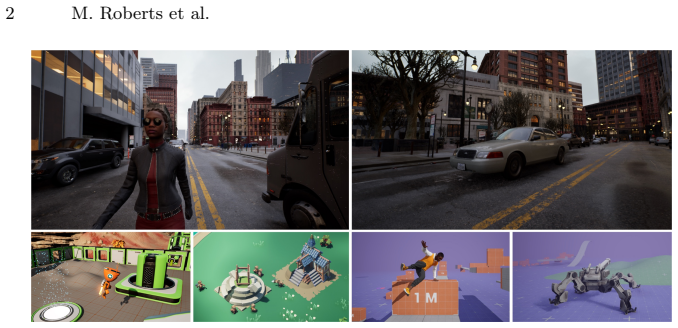
- Researchers can control multiple agents with distinct action spaces (humans, cars, robots) inside unmodified commercial Unreal sample projects without forking the engine.
- City-scale photorealistic environments and Unreal’s procedural content generation systems become fully scriptable from Python.
- Synchronized multi-view capture of detailed human characters and interactive co-simulation with external physics engines become practical at interactive rates.
- The same Python interface works for standalone packaged applications, live editor sessions, and the path tracer.
- Natural-language scene editing becomes feasible by letting an AI coding assistant emit SPEAR transaction programs.
Reading between the lines
- Because new BlueprintCallable engine features automatically appear through reflection, SPEAR’s surface area can grow with Unreal itself without library updates, lowering long-term maintenance for research groups.
- The combination of speed and dense ground-truth modalities positions the system as a candidate data engine for large vision-language and world models that need photorealistic multi-view supervision at scale.
- The ability to keep the Unreal application fully interactive while paused between transactions may change how researchers debug long-horizon embodied policies.
- If the thin reflection-bridge pattern proves portable, similar lightweight clients could be built for other engines that expose comparable runtime metadata.
Editorial analysis
A structured set of objections, weighed in public.
Referee Report
Summary. SPEAR is a modular Python library and UE plugin suite that programmatically controls any Unreal Engine application by exposing UE’s runtime reflection system. It claims an order-of-magnitude increase in programmable surface (over 14K unique UE functions and 53K properties via only 193 hand-crafted server entry points), photorealistic 1920×1080 beauty-image delivery into NumPy arrays at up to 73 FPS with shared memory and asynchronous transactions, and ground-truth modalities (non-diffuse intrinsic decomposition, material IDs, PBR parameters) unavailable in prior UE simulators. A transaction model (begin_frame / end_frame contexts) lets users specify arbitrary dependency graphs of UE work that execute deterministically inside a single game-thread frame. Utility is shown through multi-agent control across Epic sample projects, PCG manipulation, MetaHuman multi-view rendering, MuJoCo co-simulation, and LLM-driven scene editing.
Significance. If the measured gains hold, SPEAR removes two long-standing bottlenecks for photorealistic embodied-AI research: the need for large custom UE forks and the high communication overhead of existing plugins. The reflection-based design, modest code footprint (Table 1), public repository, and controlled head-to-head FPS numbers (Tables 2–3) make the contribution immediately usable and falsifiable. The transaction model and SpFunction/shared-memory path are concrete engineering advances that other simulators can adopt. The work therefore has clear potential as infrastructure for training agents, generating synthetic data, and bridging vision-language models to high-fidelity virtual worlds.
minor comments (4)
- [Table 1] Table 1 caption and surrounding text should state the exact UE version and the precise reflection-query method used to obtain the 14 485 / 53 537 counts so that later readers can reproduce the enumeration.
- [§6] In §5 the phrase “over 150 megapixels per second” appears only in the conclusions; a short calculation linking the 73 FPS 1920×1080 figure to that claim would improve clarity.
- [Fig. 5] Figure 5’s timeline diagram would benefit from an explicit legend distinguishing “queue work”, “execute work”, and “blocked” states; the current shading is dense.
- [§4] A brief note on whether the same shared-memory path works under Linux / macOS (or any platform-specific caveats) would help multi-platform users.
Circularity Check
No circularity: engineering systems paper whose claims are empirical measurements and implementation facts, not derived predictions.
full rationale
SPEAR is a systems contribution whose central claims (14K+ reflection-visible UE functions exposed via 193 hand-crafted entry points, 73 FPS 1920 imes1080 NumPy delivery with shared memory/async transactions, novel ground-truth modalities, and a transaction programming model) are established by direct implementation, runtime enumeration of UE’s reflection system, and controlled end-to-end timing against external baselines (Tables 1–3). There are no fitted parameters re-labeled as predictions, no self-definitional equations, no uniqueness theorems imported from the authors’ prior work, and no ansatz smuggled via citation. The example applications simply exercise the exposed surface; they do not close a logical loop. The paper is therefore self-contained against external benchmarks and exhibits zero circularity of the kinds enumerated.
Assumptions & free parameters
assumptions (3)
- domain assumption Unreal Engine’s runtime reflection system (UFUNCTION/UPROPERTY) correctly enumerates and invokes essentially all engine functionality that embodied-AI users require.
- domain assumption A single TCP/IP client–server pair plus inter-process shared memory can transfer high-resolution images without becoming the dominant bottleneck on contemporary hardware.
- ad hoc to paper Deterministic execution of arbitrary Python-specified work graphs inside one UE frame is achievable by queuing tasks on the game thread at begin/end frame boundaries.
invented entities (2)
-
begin_frame / end_frame transaction model
-
SpFunction dispatch with shared-memory NumPy arrays
Cite this review
Pith. "Pith review of SPEAR: A Simulator for Photorealistic Embodied AI Research." pith.science (2026). https://pith.science/paper/HKXYZXXM
@misc{pith2026260706701,
  author       = {Pith},
  title        = {Pith review of: SPEAR: A Simulator for Photorealistic Embodied AI Research},
  year         = {2026},
  howpublished = {\url{https://pith.science/paper/HKXYZXXM}},
  note         = {Machine review of arXiv:2607.06701}
}
read the original abstract
Interactive simulators have become powerful tools for training embodied agents and generating synthetic visual data, but existing photorealistic simulators suffer from limited generality, programmability, and rendering speed. We address these limitations by introducing SPEAR: A Simulator for Photorealistic Embodied AI Research. At its core, SPEAR is a Python library that can connect to, and programmatically control, any Unreal Engine (UE) application via a modular plugin architecture. SPEAR exposes over 14K unique UE functions to Python, representing an order-of-magnitude increase in programmable functionality over existing UE-based simulators. Additionally, a single SPEAR instance can render 1920x1080 photorealistic beauty images directly into a user's NumPy array at 73 frames per second - an order of magnitude faster than existing UE plugins - while also providing ground truth image modalities that are not available in any existing UE-based simulator (e.g., a non-diffuse intrinsic image decomposition, material IDs, and physically based shading parameters). Finally, SPEAR introduces an expressive high-level programming model that enables users to specify complex graphs of UE work with arbitrary data dependencies among work items, and to execute these graphs deterministically within a single UE frame. We demonstrate the utility of SPEAR through a diverse collection of example applications: controlling multiple embodied agents with distinct action spaces (e.g., humans, cars, and robots) across several in-the-wild UE projects; rendering photorealistic city-scale environments; manipulating UE's procedural content generation systems; rendering synchronized multi-view images of detailed human faces; coordinating an interactive co-simulation with the MuJoCo physics simulator; and editing scenes with natural language via an AI coding assistant.
Figures


Figures from the paper (6 more)


Reference graph
Works this paper leans on
-
[1]
Epic Games Developer Documentation 5
Blueprints visual scripting. Epic Games Developer Documentation 5
-
[2]
Epic Games Developer Documentation 13
Console variables and commands. Epic Games Developer Documentation 13
-
[3]
NVIDIA Isaac Sim.https://developer.nvidia.com/isaac/sim2
-
[4]
Epic Games Developer Documentation 11
An overview of components. Epic Games Developer Documentation 11
-
[5]
Panda3D.https://www.panda3d.org2
-
[6]
Epic Games Developer Documentation 5
Scripting the Unreal Editor using Python. Epic Games Developer Documentation 5
-
[7]
Unity.https://unity.com2
-
[8]
Unreal Engine.https://www.unrealengine.com2
Show all 89 references
-
[9]
Epic Games Developer Documentation 3, 11
Unreal Engine reflection system. Epic Games Developer Documentation 3, 11
-
[10]
Game World Observer (2025) 2
Black Myth: Wukong tops 25 million copies sold as its merchandise sales skyrocket in China. Game World Observer (2025) 2
2025
-
[11]
Epic Games Store News (2025) 2
Clair Obscur takes home 9 Game Awards including Game of the Year. Epic Games Store News (2025) 2
2025
-
[12]
In: NeurIPS 2024 2
Bachmann, R., Kar, O.F., Mizrahi, D., Garjani, A., Gao, M., Griffiths, D., Hu, J., Dehghan, A., Zamir, A.: 4M-21: An any-to-any vision model for tens of tasks and modalities. In: NeurIPS 2024 2
2024
-
[13]
In: ICCV 2025 2
Bai, J., Xia, M., Fu, X., Wang, X., Mu, L., Cao, J., Liu, Z., Hu, H., Bai, X., Wan, P., Zhang, D.: ReCamMaster: Camera-controlled generative rendering from a single video. In: ICCV 2025 2
2025
-
[14]
arXiv 2016 4
Beattie, C., Leibo, J.Z., Teplyashin, D., Ward, T., Wainwright, M., Küttler, H., Lefrancq, A., Green, S., Valdés, V., Sadik, A., Schrittwieser, J., Anderson, K., York, S., Cant, M., Cain, A., Bolton, A., Gaffney, S., King, H., Hassabis, D., Legg, S., Petersen, S.: DeepMind Lab...
2016
-
[15]
Journal of Artificial Intelligence Research47(1) (2013) 4
Bellemare, M.G., Naddaf, Y., Veness, J., Bowling, M.: The arcade learning environ- ment: An evaluation platform for general agents. Journal of Artificial Intelligence Research47(1) (2013) 4
2013
-
[16]
In: NeurIPS 2023 2, 9
Bordes, F., Shekhar, S., Ibrahim, M., Bouchacourt, D., Vincent, P., Morcos, A.S.: PUG:Photorealisticandsemanticallycontrollablesyntheticdataforrepresentation learning. In: NeurIPS 2023 2, 9
2023
-
[17]
arXiv 2016 5
Brockman, G., Cheung, V., Pettersson, L., Schneider, J., Schulman, J., Tang, J., Zaremba, W.: OpenAI Gym. arXiv 2016 5
2016
-
[18]
In: CoRL 2017 1, 2, 5, 7, 9, 12, 14
Dosovitskiy, A., Ros, G., Codevilla, F., Lopez, A., Koltun, V.: CARLA: An open urban driving simulator. In: CoRL 2017 1, 2, 5, 7, 9, 12, 14
2017
-
[19]
In: NeurIPS 2022 Datasets and Benchmarks Track 4
Fan, L., Wang, G., Jiang, Y., Mandlekar, A., Yang, Y., Zhu, H., Tang, A., Huang, D.A., Zhu, Y., Anandkumar, A.: MineDojo: Building open-ended embodied agents with internet-scale knowledge. In: NeurIPS 2022 Datasets and Benchmarks Track 4
2022
-
[20]
arXiv 2026 2
Gabeur, V., Long, S., Peng, S., Voigtlaender, P., Sun, S., Bao, Y., Truong, K., Wang, Z., Zhou, W., Barron, J.T., Genova, K., Kannen, N., Ben, S., Li, Y., Guo, M., Yogin, S., Gu, Y., Chen, H., Wang, O., Xie, S., Zhou, H., He, K., Funkhouser, T., Alayrac, J.B., Soricut, R.: Ima...
2026
-
[21]
In: NeurIPS 2021 Datasets and Benchmarks Track 2, 9 SPEAR: A Simulator for Photorealistic Embodied AI Research 17
Gan, C., Schwartz, J., Alter, S., Mrowca, D., Schrimpf, M., Traer, J., Freitas, J.D., Kubilius, J., Bhandwaldar, A., Haber, N., Sano, M., Kim, K., Wang, E., Lingel- bach, M., Curtis, A., Feigelis, K., Bear, D.M., Gutfreund, D., Cox, D., Torralba, A., DiCarlo, J.J., Tenenbaum, ...
2021
-
[22]
In: CVPR 2024 2
Ge, Y., Tang, Y., Xu, J., Gokmen, C., Li, C., Ai, W., Martinez, B.J., Aydin, A., Anvari, M., Chakravarthy, A.K., Yu, H.X., Wong, J., Srivastava, S., Lee, S., Zha, S., Itti, L., Li, Y., Martin-Martin, R., Liu, M., Zhang, P., Zhang, R., Fei-Fei, L., Wu, J.: BEHAVIOR vision suite...
2024
-
[23]
In: ICCV 2023 2
Gong, R., Huang, J., Zhao, Y., Geng, H., Gao, X., Wu, Q., Ai, W., Zhou, Z., Terzopoulos, D., Zhu, S.C., Jia, B., Huang, S.: Arnold: A benchmark for language- grounded task learning with continuous states in realistic 3D scenes. In: ICCV 2023 2
2023
-
[24]
Science Robotics 4(26) (2019) 2
Hwangbo,J.,Lee,J.,Dosovitskiy,A.,Bellicoso,D.,Tsounis,V.,Koltun,V.,Hutter, M.: Learning agile and dynamic motor skills for legged robots. Science Robotics 4(26) (2019) 2
2019
-
[25]
Science364(6443) (2019) 4
Jaderberg, M., Czarnecki, W.M., Dunning, I., Marris, L., Lever, G., Castañeda, A.G., Beattie, C., Rabinowitz, N.C., Morcos, A.S., Ruderman, A., Sonnerat, N., Green, T., Deason, L., Leibo, J.Z., Silver, D., Hassabis, D., Kavukcuoglu, K., Grae- pel, T.: Human-level performance i...
2019
-
[26]
com/wjakob/nanobind9
Jakob, W.: nanobind: tiny and efficient C++/Python bindings.https://github. com/wjakob/nanobind9
-
[27]
In: IJCAI 2016 4
Johnson, M., Hofmann, K., Hutton, T., Bignell, D.: The Malmo platform for arti- ficial intelligence experimentation. In: IJCAI 2016 4
2016
-
[28]
arXiv 2018 2, 9
Juliani, A., Berges, V.P., Teng, E., Cohen, A., Harper, J., Elion, C., Goy, C., Gao, Y., Henry, H., Mattar, M., Lange, D.: Unity: A general platform for intelligent agents. arXiv 2018 2, 9
2018
-
[29]
In: SIGGRAPH 2021 Course on Advances in Real-Time Rendering and Games 2
Karis, B., Stubbe, R., Wihlidal, G.: A deep dive into Nanite virtualized geometry. In: SIGGRAPH 2021 Course on Advances in Real-Time Rendering and Games 2
2021
-
[30]
Nature 620(7976) (2023) 1
Kaufmann, E., Bauersfeld, L., Loquercio, A., Müller, M., Koltun, V., Scara- muzza, D.: Champion-level drone racing using deep reinforcement learning. Nature 620(7976) (2023) 1
2023
-
[31]
In: CoRL 2018 1
Kaufmann, E., Loquercio, A., Ranftl, R., Dosovitskiy, A., Koltun, V., Scaramuzza, D.: Deep drone racing: Learning agile flight in dynamic environments. In: CoRL 2018 1
2018
-
[32]
In: RSS 2020 1
Kaufmann, E., Loquercio, A., Ranftl, R., Müller, M., Koltun, V., Scaramuzza, D.: Deep drone acrobatics. In: RSS 2020 1
2020
-
[33]
In: CVPR 2024 2
Ke, B., Obukhov, A., Huang, S., Metzger, N., Daudt, R.C., Schindler, K.: Re- purposing diffusion-based image generators for monocular depth estimation. In: CVPR 2024 2
2024
-
[34]
In: Computa- tional Intelligence and Games 2016 4
Kempka, M., Wydmuch, M., Runc, G., Toczek, J., Jaśkowski, W.: ViZDoom: A Doom-based AI research platform for visual reinforcement learning. In: Computa- tional Intelligence and Games 2016 4
2016
-
[35]
In: ICCV 2023 2
Kirillov, A., Mintun, E., Ravi, N., Mao, H., Rolland, C., Gustafson, L., Xiao, T., Whitehead, S., Berg, A.C., Lo, W.Y., Dollár, P., Girshick, R.: Segment anything. In: ICCV 2023 2
2023
-
[36]
arXiv 2017 2, 9
Kolve, E., Mottaghi, R., Han, W., VanderBilt, E., Weihs, L., Herrasti, A., Gordon, D., Zhu, Y., Gupta, A., Farhadi, A.: AI2-THOR: An interactive 3D environment for visual AI. arXiv 2017 2, 9
2017
-
[37]
In: CVPR 2018 4
Krähenbühl, P.: Free supervision from video games. In: CVPR 2018 4
2018
-
[38]
In: Game Developers Con- ference 2023 2 18 M
Langmead, A.: Procedural content generation in UE5. In: Game Developers Con- ference 2023 2 18 M. Roberts et al
2023
-
[39]
Science Robotics5(47) (2020) 2
Lee, J., Hwangbo, J., Wellhausen, L., Koltun, V., Hutter, M.: Learning quadrupedal locomotion over challenging terrain. Science Robotics5(47) (2020) 2
2020
-
[40]
In: ICML 2016 2
Lerer, A., Gross, S., Fergus, R.: Learning physical intuition of block towers by example. In: ICML 2016 2
2016
-
[41]
In: CoRL 2021 4
Li, C., Xia, F., Martín-Martín, R., Lingelbach, M., Srivastava, S., Shen, B., Vainio, K.E., Gokmen, C., Dharan, G., Jain, T., Kurenkov, A., Liu, C.K., Gweon, H., Wu, J.,Fei-Fei,L.,Savarese,S.:iGibson2.0:Object-centricsimulationforrobotlearning of everyday household tasks. In: ...
2021
-
[42]
In: CoRL 2022 2
Li, C., Zhang, R., Wong, J., Gokmen, C., Srivastava, S., Martín-Martín, R., Wang, C.,Levine,G.,Ai,W.,Martinez,B.,Yin,H.,Lingelbach,M.,Hwang,M.,Hiranaka, A., Garlanka, S., Aydin, A., Lee, S., Sun, J., Anvari, M., Sharma, M., Bansal, D., Hunter, S., Kim, K.Y., Lou, A., Matthews,...
2022
-
[43]
Transactions on Robotics36(1) (2020) 1
Loquercio, A., Kaufmann, E., Ranftl, R., Dosovitskiy, A., Koltun, V., Scaramuzza, D.: Deep drone racing: From simulation to reality with domain randomization. Transactions on Robotics36(1) (2020) 1
2020
-
[44]
Science Robotics6(59) (2021) 1
Loquercio, A., Kaufmann, E., Ranftl, R., Müller, M., Koltun, V., Scaramuzza, D.: Learning high-speed flight in the wild. Science Robotics6(59) (2021) 1
2021
-
[45]
In: OOPSLA 1987 3
Maes, P.: Concepts and experiments in computational reflection. In: OOPSLA 1987 3
1987
-
[46]
arXiv 2026 4
Magne, L., Awadalla, A., Wang, G., Xu, Y., Belofsky, J., Hu, F., Kim, J., Schmidt, L., Gkioxari, G., Kautz, J., Yue, Y., Choi, Y., Zhu, Y., Fan, L.J.: NitroGen: An open foundation model for generalist gaming agents. arXiv 2026 4
2026
-
[47]
In: IJCNN 2021 2, 9
Martinez-Gonzalez, P., Oprea, S., Castro-Vargas, J.A., Garcia-Garcia, A., Orts- Escolano, S., Garcia-Rodriguez, J., Vincze, M.: UnrealROX+: An improved tool for acquiring synthetic data from virtual 3D environments. In: IJCNN 2021 2, 9
2021
-
[48]
Virtual Reality24(2019) 2, 9
Martinez-Gonzalez, P., Oprea, S., Garcia-Garcia, A., Jover-Alvarez, A., Orts- Escolano, S., Garcia-Rodriguez, J.: UnrealROX: An extremely photorealistic vir- tual reality environment for robotics simulations and synthetic data generation. Virtual Reality24(2019) 2, 9
2019
-
[49]
In: CVPR 2024 2
Mazur, K., Bae, G., Davison, A.J.: SuperPrimitive: Scene reconstruction at a prim- itive level. In: CVPR 2024 2
2024
-
[50]
Science Robotics 7(62) (2022) 2
Miki, T., Lee, J., Hwangbo, J., Wellhausen, L., Koltun, V., Hutter, M.: Learning robust perceptive locomotion for quadrupedal robots in the wild. Science Robotics 7(62) (2022) 2
2022
-
[51]
In: NeurIPS 2023 2
Mizrahi, D., Bachmann, R., Kar, O.F., Yeo, T., Gao, M., Dehghan, A., Zamir, A.: 4M: Massively multimodal masked modeling. In: NeurIPS 2023 2
2023
-
[52]
Nature518(7540) (2015) 4
Mnih, V., Kavukcuoglu, K., Silver, D., Rusu, A.A., Veness, J., Bellemare, M.G., Graves,A.,Riedmiller,M.,Fidjeland,A.K.,Ostrovski,G.,Petersen,S.,Beattie,C., Sadik, A., Antonoglou, I., King, H., Kumaran, D., Wierstra, D., Legg, S., Hassabis, D.: Human-level control through deep ...
2015
-
[53]
In: CoRL 2018 1
Müller, M., Dosovitskiy, A., Ghanem, B., Koltun, V.: Driving policy transfer via modularity and abstraction. In: CoRL 2018 1
2018
-
[54]
Narkowicz, K., Costa, T.: MegaLights: Stochastic direct lighting in Unreal Engine
-
[55]
In: SIGGRAPH 2025 Advances in Real-Time Rendering in Games 2 SPEAR: A Simulator for Photorealistic Embodied AI Research 19
2025
-
[56]
arXiv 2019 2
OpenAI, Akkaya, I., Andrychowicz, M., Chociej, M., Litwin, M., McGrew, B., Petron, A., Paino, A., Plappert, M., Powell, G., Ribas, R., Schneider, J., Tezak, N., Tworek, J., Welinder, P., Weng, L., Yuan, Q., Zaremba, W., Zhang, L.: Solving Rubik’s Cube with a robot hand. arXiv 2019 2
2019
-
[57]
OpenAI, Berner, C., Brockman, G., Chan, B., Cheung, V., Dębiak, P., Dennison, C., Farhi, D., Fischer, Q., Hashme, S., Hesse, C., Józefowicz, R., Gray, S., Olsson, C., Pachocki, J., Petrov, M., d. O. Pinto, H.P., Raiman, J., Salimans, T., Schlatter, J., Schneider, J., Sidor, S....
2019
-
[58]
In: ICLR 2024 4
Puig, X., Undersander, E., Szot, A., Cote, M.D., Yang, T.Y., Partsey, R., Desai, R., Clegg, A.W., Hlavac, M., Min, S.Y., Vondruš, V., Gervet, T., Berges, V.P., Turner, J.M., Maksymets, O., Kira, Z., Kalakrishnan, M., Malik, J., Chaplot, D.S., Jain, U., Batra, D., Rai, A., Mott...
2024
-
[59]
In: Multimedia 2017 2, 5, 9, 10, 11, 12, 13, 14
Qiu, W., Zhong, F., Zhang, Y., Qiao, S., Xiao, Z., Kim, T.S., Wang, Y.: UnrealCV: Virtual worlds for computer vision. In: Multimedia 2017 2, 5, 9, 10, 11, 12, 13, 14
2017
-
[60]
In: ICLR 2025 2
Ravi, N., Gabeur, V., Hu, Y.T., Hu, R., Ryali, C., Ma, T., Khedr, H., Rädle, R., Rolland, C., Gustafson, L., Mintun, E., Pan, J., Alwala, K.V., Carion, N., Wu, C.Y., Girshick, R., Dollár, P., Feichtenhofer, C.: SAM 2: Segment anything in images and videos. In: ICLR 2025 2
2025
-
[61]
In: ECCV 2016 1, 4
Richter, S., Vineet, V., Roth, S., Koltun, V.: Playing for data: Ground truth from computer games. In: ECCV 2016 1, 4
2016
-
[62]
In: ICCV 2017 1, 4
Richter, S.R., Hayder, Z., Koltun, V.: Playing for benchmarks. In: ICCV 2017 1, 4
2017
-
[63]
In: ICCV 2021 2, 3
Roberts, M., Ramapuram, J., Ranjan, A., Kumar, A., Bautista, M.A., Paczan, N., Webb, R., Susskind, J.M.: Hypersim: A photorealistic synthetic dataset for holistic indoor scene understanding. In: ICCV 2021 2, 3
2021
-
[64]
Python Enhance- ment Proposals 10
van Rossum, G., Coghlan, A.: PEP 343: The “with” statement. Python Enhance- ment Proposals 10
-
[65]
arXiv 2017 4
Savva, M., Chang, A.X., Dosovitskiy, A., Funkhouser, T., Koltun, V.: MINOS: Multimodal indoor simulator for navigation in complex environments. arXiv 2017 4
2017
-
[66]
In: ICCV 2019 4
Savva, M., Kadian, A., Maksymets, O., Zhao, Y., Wijmans, E., Jain, B., Straub, J., Liu, J., Koltun, V., Malik, J., Parikh, D., Batra, D.: Habitat: A platform for embodied AI research. In: ICCV 2019 4
2019
-
[67]
XML Press (2011) 12
Schäling, B.: The Boost C++ Libraries. XML Press (2011) 12
2011
-
[68]
In: Field and Service Robotics 2017 2, 5, 9, 12, 14
Shah, S., Dey, D., Lovett, C., Kapoor, A.: AirSim: High-fidelity visual and physical simulation for autonomous vehicles. In: Field and Service Robotics 2017 2, 5, 9, 12, 14
2017
-
[69]
In: IROS 2021 4
Shen, B., Xia, F., Li, C., Martín-Martín, R., Fan, L., Wang, G., Pérez-D’Arpino, C., Buch, S., Srivastava, S., Tchapmi, L.P., Tchapmi, M.E., Vainio, K., Wong, J., Fei-Fei, L., Savarese, S.: iGibson 1.0: A simulation environment for interactive tasks in large realistic scenes. ...
2021
-
[70]
arXiv 2025 2
Siméoni, O., Vo, H.V., Seitzer, M., Baldassarre, F., Oquab, M., Jose, C., Khalidov, V., Szafraniec, M., Yi, S., Ramamonjisoa, M., Massa, F., Haziza, D., Wehrstedt, L., Wang, J., Darcet, T., Moutakanni, T., Sentana, L., Roberts, C., Vedaldi, A., Tolan, J., Brandt, J., Couprie, ...
2025
-
[71]
Szelei, T.: rpclib: Modern msgpack-rpc for C++.http://rpclib.net9
-
[72]
Roberts et al
Szot, A., Clegg, A., Undersander, E., Wijmans, E., Zhao, Y., Turner, J., Maestre, N.,Mukadam,M.,Chaplot,D.,Maksymets,O.,Gokaslan,A.,Vondrus,V.,Dharur, 20 M. Roberts et al. S., Meier, F., Galuba, W., Chang, A., Kira, Z., Koltun, V., Malik, J., Savva, M., Batra, D.: Habitat 2.0:...
2021
-
[73]
In: IROS 2012 3, 5, 8
Todorov, E., Erez, T., Tassa, Y.: MuJoCo: A physics engine for model-based con- trol. In: IROS 2012 3, 5, 8
2012
-
[74]
In: NeurIPS 2024 2
Tong, S., Brown, E., Wu, P., Woo, S., Middepogu, M., Akula, S.C., Yang, J., Yang, S., Iyer, A., Pan, X., Wang, Z., Fergus, R., LeCun, Y., Xie, S.: Cambrian-1: A fully open, vision-centric exploration of multimodal LLMs. In: NeurIPS 2024 2
2024
-
[75]
Addison-Wesley Professional, 2 edn
Vandevoorde, D., Josuttis, N.M., Gregor, D.: C++ Templates: The Complete Guide. Addison-Wesley Professional, 2 edn. (2017) 10
2017
-
[76]
Nature575(2019) 1, 4
Vinyals, O., Babuschkin, I., Czarnecki, W.M., Mathieu, M., Dudzik, A., Chung, J., Choi, D.H., Powell, R., Ewalds, T., Georgiev, P., Oh, J., Horgan, D., Kroiss, M., Danihelka, I., Huang, A., Sifre, L., Cai, T., Agapiou, J.P., Jaderberg, M., Vezhn- evets, A.S., Leblond, R., Pohl...
2019
-
[77]
arXiv 2017 1, 4
Vinyals, O., Ewalds, T., Bartunov, S., Georgiev, P., Vezhnevets, A.S., Yeo, M., Makhzani, A., Küttler, H., Agapiou, J., Schrittwieser, J., Quan, J., Gaffney, S., Petersen, S., Simonyan, K., Schaul, T., van Hasselt, H., Silver, D., Lillicrap, T., Calderone, K., Keet, P., Brunas...
2017
-
[78]
In: CVPR 2025 2
Wang, J., Chen, M., Karaev, N., Vedaldi, A., Rupprecht, C., Novotny, D.: VGGT: Visual geometry grounded transformer. In: CVPR 2025 2
2025
-
[79]
In: CVPR 2026 2
Wang, J., Chen, M., Zhang, S., Karaev, N., Schönberger, J., Labatut, P., Bo- janowski, P., Novotny, D., Vedaldi, A., Rupprecht, C.: VGGT-Ω. In: CVPR 2026 2
2026
-
[80]
In: SIGGRAPH 2022 Advances in Real-Time Rendering in Games 2
Wright, D., Narkowicz, K., Kelly, P.: Lumen: Real-time global illumination in Un- real Engine 5. In: SIGGRAPH 2022 Advances in Real-Time Rendering in Games 2
2022
-
[81]
In: ICLR 2025 2
Wu, W., He, H., He, J., Wang, Y., Duan, C., Liu, Z., Li, Q., Zhou, B.: MetaUrban: An embodied AI simulation platform for urban micromobility. In: ICLR 2025 2
2025
-
[82]
In: CVPR 2025 2
Wu, W., He, H., Zhang, C., He, J., Zhao, S.Z., Gong, R., Li, Q., Zhou, B.: Towards autonomous micromobility through scalable urban simulation. In: CVPR 2025 2
2025
-
[83]
Nature602(2022) 1, 4
Wurman, P.R., Barrett, S., Kawamoto, K., MacGlashan, J., Subramanian, K., Walsh, T.J., Capobianco, R., Devlic, A., Eckert, F., Fuchs, F., Gilpin, L., Khan- delwal, P., Kompella, V., Lin, H., MacAlpine, P., Oller, D., Seno, T., Sherstan, C., Thomure, M.D., Aghabozorgi, H., Barr...
2022
-
[84]
In: CVPR 2018 4
Xia, F., Zamir, A.R., He, Z.Y., Sax, A., Malik, J., Savarese, S.: Gibson Env: Real- world perception for embodied agents. In: CVPR 2018 4
2018
-
[85]
In: CVPR 2020 4
Xiang, F., Qin, Y., Mo, K., Xia, Y., Zhu, H., Liu, F., Liu, M., Jiang, H., Yuan, Y., Wang, H., Yi, L., Chang, A.X., Guibas, L.J., Su, H.: SAPIEN: A simulated part-based interactive environment. In: CVPR 2020 4
2020
-
[86]
arXiv 2025 2 SPEAR: A Simulator for Photorealistic Embodied AI Research 21
Yang, S., Yang, J., Huang, P., Brown, E., Yang, Z., Yu, Y., Tong, S., Zheng, Z., Xu, Y., Wang, M., Lu, D., Fergus, R., LeCun, Y., Fei-Fei, L., Xie, S.: Cambrian-S: Towards spatial supersensing in video. arXiv 2025 2 SPEAR: A Simulator for Photorealistic Embodied AI Research 21
2025
-
[87]
In: NeurIPS 2025 2
Ye, X., Ren, J., Zhuang, Y., He, X., Liang, Y., Yang, Y., Zhong, X., Dogra, M., Liu, E., Benavente, K., Nagaraju, R.M., Sharma, D.V., Ma, Z., Shu, T., Hu, Z., Qin, L.: SimWorld: An open-ended simulator for agents in physical and social worlds. In: NeurIPS 2025 2
2025
-
[88]
In: ICCV 2025 2, 5, 9, 10, 11, 12, 13, 14
Zhong, F., Wu, K., Wang, C., Chen, H., Ci, H., Li, Z., Wang, Y.: UnrealZoo: Enriching photo-realistic virtual worlds for embodied AI. In: ICCV 2025 2, 5, 9, 10, 11, 12, 13, 14
2025
-
[89]
Zhou, B., Krähenbühl, P., Koltun, V.: Does computer vision matter for action? Science Robotics4(30) (2018) 1, 4
2018
Reviewed July 10, 2026 · model on record in the stance chip above.
Discussion (0). Continue with ORCID to comment.