REVIEW 3 major objections 5 minor 117 references
Semiclassical Dispersion Corrections efficiently improve Multi-Configurational Theory with Short-Range Density-Functional Dynamic Correlation
T0 review · 3 major / 5 minor · reviewed 2026-08-14 · deepseek-v4-flash
Pith's one-line read Adding the D3 dispersion correction to a multiconfigurational wave function combined with short-range DFT reproduces the CCSD(T) benzene-dimer stacking curve to within 0.2 kcal/mol at negligible extra cost.
desk verdict A useful, honestly scoped proof-of-concept for adding D3 to MC-srDFT, but it does not test the method in the multireference regime it targets. read the letter →
The pith
A machine-rendered reading of the paper's core claim, the machinery that carries it, and where it could break.
The reading
What carries the argument
The load-bearing object is the composite energy expression $E_{\text{CASSCF}} + E_{\text{srPBE}} + E_{\text{D3(BJ)}}$, where $E_{\text{D3(BJ)}}$ is the semiclassical atom-pair dispersion sum with Becke-Johnson damping, Eq. (1): for atom pairs $I,J$ it adds terms $s_n C_{n,IJ}/(R_{IJ}^n + (a_1\sqrt{C_{8,IJ}/C_{6,IJ}} + a_2)^n)$ for $n=6,8$. Range-separated two-electron integrals (split at $\mu = 0.4\,a_0^{-1}$) feed the short-range PBE functional, the compact active space supplies only static correlation, and the D3 term supplies the long-range dynamical correlation that neither part contains. The paper adopts the PBE-D3 values for the functional-dependent parameters $s_8$, $a_1$, $a_2$ without refitting them to the new composite.
What would settle it
Replace the PBE-D3 damping parameters in Eq. (1) with the parameter set of another GGA functional and recompute the five Table 1 dimers, or refit the three parameters to the srPBE component; if the interaction energies shift by more than about 0.2 kcal/mol at the minima, the claimed accuracy is an error compensation of the transferred damping rather than a clean separation of correlation contributions.
Extended reading notes
Core claim
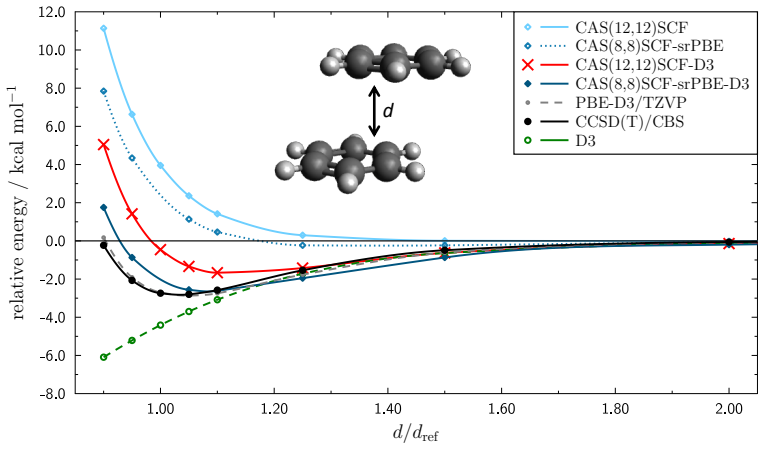
On the paper's own terms, the discovery is that semiclassical D3 dispersion corrections, borrowed unmodified from DFT, can be grafted onto an MC-srDFT composite without reparameterisation and without apparent double counting. For the stacked benzene dimer, CASSCF-srPBE-D3 gives a minimum 0.2 kcal/mol from the CCSD(T)/CBS value, whereas CASSCF alone is purely repulsive and CASSCF with short-range PBE still has no minimum; adding D3 to bare CASSCF gives a minimum only half as deep. Across five benzene/pyridine dimers in π-stacked and T-shaped geometries, deviations from CCSD(T)/CBS lie between 0.08 and 0.90 kcal/mol at reference geometries, and between 0.08 and 0.38 kcal/mol at the composite's own interpolated minima. The paper also finds that the short-range DFT part regularizes the active space so that a CAS(12,12) can be reduced to CAS(8,8), and it argues that the model contains no dispersion double counting because the compact active space and the short-range functional are both dispersion-free, leaving the long-range dispersion to D3 alone.
Load-bearing premise
The whole accuracy claim rests on the untested transfer of the PBE-D3 damping parameters to the CASSCF-srPBE composite, i.e. on the assumption that the damping smoothly switches off the empirical dispersion term exactly where the short-range functional and active-space correlation already cover it.
Editorial extensions
If this is right
- For dispersion-bound systems with strong static correlation, the composite offers an accuracy comparable to second-order multireference perturbation theory at a small fraction of its cost, because the expensive higher-order reduced density matrices are never needed.
- Because the short-range DFT regularizes the wave function, smaller active spaces than a CASSCF-only treatment requires may be sufficient, as illustrated by the reduction from CAS(12,12) to CAS(8,8) for the π dimers.
- The method is compatible with large-active-space reference methods such as DMRG or FCIQMC, so it could extend quantitative dynamic correlation to active spaces beyond the roughly 30 orbitals that limit CASPT2/NEVPT2.
- Reparameterizing the dispersion correction and designing short-range functionals specifically for this composite could push the deviations below the current 0.08–0.90 kcal/mol range.
Reading between the lines
- The PBE-D3 damping transfer is the part most likely to fail outside the tested dimers; a dedicated srPBE damping parameterisation would show whether the current agreement is robust or partly error compensation.
- Since D3 is a pairwise, additive model that assumes well-separated fragments, the composite should be stress-tested on π-stacked systems with charge transfer or on strongly delocalized active spaces, where dispersion determinants are no longer cleanly assigned to one fragment.
- Because the composite adds essentially no cost once the CAS-type reference exists, the same D3 correction could be applied post hoc to existing CASSCF-srDFT or DMRG-srDFT calculations, turning them into quantitative tools for dispersion-bound systems without re-running the expensive part.
Signed reviews
Editorial analysis
A structured set of objections, weighed in public.
Referee Report
Summary. The manuscript proposes a composite electronic-structure method, CASSCF-srPBE-D3, in which a multiconfigurational wave function treats static correlation, a short-range density functional (srPBE) supplies short-range dynamical correlation through range separation, and Grimme's D3(BJ) semiclassical correction adds long-range dispersion. The authors argue that a compact active space contains essentially no dispersion and that range separation avoids double counting, so adding D3 is both safe and inexpensive. They test the method on the stacked benzene dimer and on five benzene/pyridine dimers from the S22/S66 benchmark sets, comparing interaction energies with CCSD(T)/CBS. The uncorrected CASSCF-srPBE curves are repulsive, while adding D3 produces minima; reported errors range from 0.08 to 0.90 kcal/mol depending on system and geometry. The paper concludes that the approach has very good reliability at negligible cost and great potential for genuinely multiconfigurational systems.
Significance. If the central claim held, the method would be a valuable low-cost route to non-covalent interactions in multiconfigurational systems, avoiding both the dispersion overestimation of second-order multireference perturbation theory and the high cost of high-order reduced density matrices. The paper has clear strengths: a conceptually clean separation of static, short-range dynamic, and long-range dispersion correlation; a plausible double-counting argument based on compact active spaces and range separation; and direct numerical comparison with CCSD(T)/CBS benchmarks. However, all numerical evidence is obtained on closed-shell, essentially single-reference dimers with near-double occupation numbers, and the D3 parameters are inherited from PBE fits to benchmark sets that overlap the test set. The significance of the work therefore rests on an extrapolation to the multiconfigurational regime rather than on demonstrated performance there; the current results support the narrower statement that D3 can be grafted onto CASSCF-srPBE for dispersion-dominated closed-shell dimers.
major comments (3)
- [Secs. 4-5, Table 1] The test systems have essentially no multiconfigurational character, so the central claim is not tested in the regime the method is designed for. Section 1 explicitly states that the chosen systems "does not feature any MC character at all," and Sec. 4 reports natural occupation numbers of 1.998/0.002 at the benzene-dimer equilibrium, which is numerically a single-determinant wave function. The CASSCF part is therefore inert in these calculations, and the quantitative evidence in Fig. 2 and Table 1 cannot support the paper's conclusion that the approach is a reliable efficient multiconfigurational model. The authors should add at least one dispersion-bound system with genuine static correlation (for example, a diradicaloid, an open-shell transition-metal complex, or a stretched bond system) and compare it against a suitable multireference benchmark before drawing the conclusions in Sec. 6.
- [Eq. (1), Secs. 3-4] The D3(BJ) damping parameters s8, a1, and a2 in Eq. (1) are taken from a PBE fit, as stated in Sec. 3, and the benchmark dimers are drawn from S22/S66, which are standard D3 calibration sets; the paper itself notes that the benzene dimer was part of the set for which the D3 parameters were optimized. The reported agreement is therefore partly a consequence of fitted parameters rather than an independent test of the composite method. The claim of "very good reliability" requires an out-of-sample test or a leave-one-out analysis. In addition, the transferability of PBE-D3 damping to CASSCF-srPBE is assumed without numerical checks; because the damping function was optimized for PBE, the absence of double counting between the empirical dispersion term and the srPBE/CAS correlation at intermediate distances should be explicitly verified or the parameters should be reoptimized.
- [Table 1, Sec. 5] The minima labeled "CASSCF-srPBE-D3 structure" were located by fitting only three computed energies at d = 1.05, 1.10, and 1.25 deq to a Lennard-Jones function. This is too sparse to determine a minimum reliably: the fitted well position and depth depend on the assumed functional form, and the interpolated distance shifts are large (up to 0.28 Å for the π-stacked pyridine dimer). The reported errors at the interpolated minima (0.08-0.38 kcal/mol) are therefore not robust evidence of accuracy. The authors should provide the fitted curves, an estimate of the interpolation uncertainty, or additional sampled distances around the minimum.
minor comments (5)
- [Sec. 1] The sentence "we choose to study seystems which does not feature any MC character at all" contains a typo ("seystems") and a subject-verb disagreement; it should read "systems that do not feature."
- [Fig. 2] The legend entry "D3" is unclear: it should specify whether this is the bare D3 correction energy, a D3-only interaction curve, or something else. The horizontal axis label "d/dref" should also be explained in the caption.
- [Table 1] The column header "ECASSCF−D3 diss ∆" is misformatted; the label "diss" appears to be a subscript or abbreviation and should be defined in the caption or table footnote.
- [Sec. 3] The paper does not state whether a basis-set superposition error correction was applied to the interaction energies; if none was applied, this should be stated explicitly because ANO-RCC-VTZ is not a large basis.
- [Eq. (1)] Equation (1) is typeset with an awkward line break; the denominator of the Becke-Johnson damping term should be displayed clearly so that the algebraic form is unambiguous.
Circularity Check
Reported accuracy is partly in-sample for the fitted D3 dispersion term, because the S22/S66 validation complexes overlap the benchmark sets used to optimize the PBE-D3 parameters; the CASSCF-srPBE core otherwise provides independent content.
-
fitted input called prediction
[Section 4, discussion of Fig. 2 and Eq. (1); Table 1 validation dimers from S22/S66 described in Section 3]
"Certainly, the agreement of D3 corrected PBE is even better (gray dashed line) but it must be emphasized that this molecule was part of the benchmark set for which the D3 parameters were optimized and there is also little MC character that could break the standard PBE model."
The only functional-dependent parameters in Eq. (1), s8, a1, and a2, were optimized for PBE on benchmark sets, and the paper adopts them unchanged for CASSCF-srPBE-D3. The molecules used to demonstrate the composite's reliability are S22/S66 dimers, which are among the standard benchmark sets used for D3 calibration, and the paper explicitly admits that the benzene dimer is part of the D3 parameterization benchmark. Consequently, the agreement of CASSCF-srPBE-D3 with CCSD(T)/CBS in Fig. 2 and Table 1 partly reflects the in-sample fit of the D3 term rather than an independent prediction of the new composite.
full rationale
The paper's new combination CASSCF-srPBE-D3 is a genuine composition of a multiconfigurational wave function, a short-range DFT correlation functional, and an existing empirical D3 dispersion term. The arguments that CASSCF contains essentially no dispersion, that srPBE supplies short-range dynamic correlation, and that range separation avoids double counting are self-contained and not circular. The main circularity concern is empirical rather than logical: Eq. (1) is evaluated with PBE-fitted D3 parameters, and the validation complexes (S22/S66 dimers) overlap the benchmark sets on which those parameters were optimized. The paper openly states that the benzene dimer was part of the D3 parameterization benchmark, so the agreement in Fig. 2 and Table 1 is partly an in-sample check of the fitted D3 term rather than an independent test of the new composite. Because CASSCF-srPBE is not fitted and changes the curve qualitatively, the circularity is partial, leading to a moderate score of 4. The paper's additional admissions, such as the absence of multiconfigurational character in the test systems, are limitations on external validity rather than circularity, and the self-citations to autoCAS and related method papers are contextual and do not carry the derivation. The central derivation is otherwise self-contained, which is why the score is not higher.
Assumptions & free parameters
free parameters (2)
- D3(BJ) functional-dependent parameters s8, a1, a2 =
PBE D3(BJ) values from Ref. [80], not listed numerically in the paper
- Range-separation parameter mu =
0.4 a0^-1
assumptions (5)
- domain assumption Range separation by an error function with srDFT eliminates double counting between short-range DFT and long-range wave function correlation.
- ad hoc to paper A compact CAS active space contains essentially zero intermolecular dispersion contribution.
- ad hoc to paper PBE-D3 damping parameters are transferable from PBE-only calculations to the CASSCF-srPBE composite.
- domain assumption CCSD(T)/CBS benchmark values from S22 and S66 are accurate references for these dimers.
- ad hoc to paper Three computed points fit to a Lennard-Jones function reliably locate the composite minimum.
Cite this review
Pith. "Pith review of Semiclassical Dispersion Corrections efficiently improve Multi-Configurational Theory with Short-Range Density-Functional Dynamic Correlation." pith.science (2026). https://pith.science/paper/HM2CTHEM
@misc{pith2026190808604,
  author       = {Pith},
  title        = {Pith review of: Semiclassical Dispersion Corrections efficiently improve Multi-Configurational Theory with Short-Range Density-Functional Dynamic Correlation},
  year         = {2026},
  howpublished = {\url{https://pith.science/paper/HM2CTHEM}},
  note         = {Machine review of arXiv:1908.08604}
}
read the original abstract
Multi-configurational wave functions are known to describe electronic structure across a Born-Oppenheimer surface qualitatively correct. However, for quantitative reaction energies, dynamical correlation originating from the many configurations involving excitations out of the restricted orbital space, the active space, must be considered. Standard procedures involve approximations that eventually limit the ultimate accuracy achievable (most prominently, multi-reference perturbation theory). At the same time, the computational cost increase dramatically due to the necessity to obtain higher-order reduced density matrices. It is this disproportion that leads us here to propose a MC-srDFT-D hybrid approach of semiclassical dispersion (D) corrections to cover long-range dynamical correlation in a multi-configurational (MC) wave function theory which includes short-range (sr) dynamical correlation by density functional theory (DFT) without double counting. We demonstrate that the reliability of this approach is very good (at negligible cost), especially when considering that standard second-order multi-reference perturbation theory usually overestimates dispersion interactions.
Figures

Reference graph
Works this paper leans on
-
[1]
P.; Rancurel, P
Huron, B.; Malrieu, J. P.; Rancurel, P. Iterative perturbation calculations of ground and excited state energies from multiconfigurational zeroth-order wavefunctions. J. Chem. Phys. 1973, 58, 5745–5759
1973
-
[2]
Recent advances in multireference second order perturbation CI: The CIPSI method revisited
Cimiraglia, R.; Persico, M. Recent advances in multireference second order perturbation CI: The CIPSI method revisited. J. Comput. Chem. 1987, 8, 39–47
1987
-
[3]
Specific CI calculation of energy differences: Transition energies and bond energies
Miralles, J.; Castell, O.; Caballol, R.; Malrieu, J.-P. Specific CI calculation of energy differences: Transition energies and bond energies. Chem. Phys. 1993, 172, 33 – 43
1993
-
[4]
A spectroscopy oriented configuration interaction procedure
Neese, F. A spectroscopy oriented configuration interaction procedure. J. Chem. Phys. 2003, 119, 9428–9443. 10
2003
-
[5]
M.; Lee, J.; Takeshita, T
Tubman, N. M.; Lee, J.; Takeshita, T. Y.; Head-Gordon, M.; Whaley, K. B. A deterministic alternative to the full configuration interaction quantum Monte Carlo method. J. Chem. Phys. 2016, 145, 044112
2016
-
[6]
A.; Tubman, N
Holmes, A. A.; Tubman, N. M.; Umrigar, C. J. Heat-Bath Configuration Interaction: An Efficient Selected Configuration Interaction Algorithm In- spired by Heat-Bath Sampling. J. Chem. Theory Comp. 2016, 12, 3674– 3680
2016
-
[7]
A.; Jeanmairet, G.; Alavi, A.; Umrigar, C
Sharma, S.; Holmes, A. A.; Jeanmairet, G.; Alavi, A.; Umrigar, C. J. Semis- tochastic Heat-Bath Configuration Interaction Method: Selected Configura- tion Interaction with Semistochastic Perturbation Theory. J. Chem. Theory Comput. 2017, 13, 1595–1604
2017
-
[8]
H.; Thom, A
Booth, G. H.; Thom, A. J. W.; Alavi, A. Fermion Monte Carlo Without Fixed Nodes: A Game of Life, Death, and Annihilation in Slater Determi- nant Space. J. Chem. Phys. 2009, 131, 054106
2009
Show all 117 references
-
[9]
H.; Alavi, A
Booth, G. H.; Alavi, A. Approaching Chemical Accuracy Using Full Configuration-Interaction Quantum Monte Carlo: A Study of Ionization Potentials. J. Chem. Phys. 2010, 132, 174104
2010
-
[10]
J.; Booth, G
Shepherd, J. J.; Booth, G. H.; Alavi, A. Investigation of the Full Configura- tion Interaction Quantum Monte Carlo Method Using Homogeneous Elec- tron Gas Models. J. Chem. Phys. 2012, 136, 244101
2012
-
[11]
White, S. R. Density Matrix Formulation for Quantum Renormalization Groups. Phys. Rev. Lett. 1992, 69, 2863–2866
1992
-
[12]
White, S. R. Density-Matrix Algorithms for Quantum Renormalization Groups. Phys. Rev. B 1993, 48, 10345–10356
1993
-
[13]
Applications of Quantum In- formation in the Density-Matrix Renormalization Group
Legeza, ¨O.; Noack, R.; S´ olyom, J.; Tincani, L. Applications of Quantum In- formation in the Density-Matrix Renormalization Group. Lect. Notes Phys. 2008, 739, 653–664
2008
-
[14]
K.-L.; Dorando, J
Chan, G. K.-L.; Dorando, J. J.; Ghosh, D.; Hachmann, J.; Neuscamman, E.; Wang, H.; Yanai, T. An Introduction to the Density Matrix Renormalization Group Ansatz in Quantum Chemistry. Prog. Theor. Chem. Phys. 2008, 18, 49–65
2008
-
[15]
K.-L.; Zgid, D
Chan, G. K.-L.; Zgid, D. The Density Matrix Renormalization Group in Quantum Chemistry. 2009, 5, 149–162
2009
-
[16]
H.; Reiher, M
Marti, K. H.; Reiher, M. The Density Matrix Renormalization Group Algo- rithm in Quantum Chemistry. Z. Phys. Chem. 2010, 224, 583–599
2010
-
[17]
H.; Reiher, M
Marti, K. H.; Reiher, M. New Electron Correlation Theories for Transition Metal Chemistry. Phys. Chem. Chem. Phys. 2011, 13, 6750–6759
2011
-
[18]
K.-L.; Sharma, S
Chan, G. K.-L.; Sharma, S. The Density Matrix Renormalization Group in Chemistry. Ann. Rev. Phys. Chem. 2011, 62, 465. 11
2011
-
[19]
The Density-Matrix Renormalization Group in the Age of Matrix Product States
Schollw¨ ock, U. The Density-Matrix Renormalization Group in the Age of Matrix Product States. Annals of Physics 2011, 326, 96–192
2011
-
[20]
Multireference Electron Correlation Methods With Density Matrix Renormalisation Group Reference Functions
Kurashige, Y. Multireference Electron Correlation Methods With Density Matrix Renormalisation Group Reference Functions. Mol. Phys. 2014, 112, 1485–1494
2014
-
[21]
The Density Matrix Renormalization Group for ab initio Quantum Chemistry
Wouters, S.; Van Neck, D. The Density Matrix Renormalization Group for ab initio Quantum Chemistry. Eur. Phys. J. D 2014, 68, 272
2014
-
[22]
N.; Saitow, M
Yanai, T.; Kurashige, Y.; Mizukami, W.; Chalupsk´ y, J.; Lan, T. N.; Saitow, M. Density Matrix Renormalization Group for ab initio Calcula- tions and Associated Dynamic Correlation Methods: A Review of Theory and Applications. Int. J. Quantum Chem. 2015, 115, 283–299
2015
-
[23]
Tensor Product Methods and Entanglement Optimization for ab initio Quantum Chemistry
Szalay, S.; Pfeffer, M.; Murg, V.; Barcza, G.; Verstraete, F.; Schneider, R.; Legeza, ¨O. Tensor Product Methods and Entanglement Optimization for ab initio Quantum Chemistry. Int. J. Quantum Chem. 2015, 115, 1342–1391
2015
-
[24]
D.; Keller, S.; Kovyrshin, A.; Ma, Y.; Muolo, A.; Stein, C
Knecht, S.; Hedeg˚ ard, E. D.; Keller, S.; Kovyrshin, A.; Ma, Y.; Muolo, A.; Stein, C. J.; Reiher, M. New Approaches for ab initio Calculations of Molecules with Strong Electron Correlation. Chimia 2016, 70, 244–251
2016
-
[25]
K.-L.; Keselman, A.; Nakatani, N.; Li, Z.; White, S
Chan, G. K.-L.; Keselman, A.; Nakatani, N.; Li, Z.; White, S. R. Matrix Product Operators, Matrix Product States, and ab initio Density Matrix Renormalization Group Algorithms. J. Chem. Phys. 2016, 145, 014102
2016
-
[26]
O.; Taylor, P
Roos, B. O.; Taylor, P. R.; Siegbahn, P. E. A Complete Active Space SCF Method (CASSCF) Using a Density Matrix Formulated Super-CI Approach. Chem. Phys. 1980, 48, 157–173
1980
-
[27]
W.; Gilbert, M
Ruedenberg, K.; Schmidt, M. W.; Gilbert, M. M.; Elbert, S. Are Atoms In- trinsic to Molecular Electronic Wavefunctions? I. The FORS Model. Chem. Phys. 1982, 71, 41–49
1982
-
[28]
W.; Gilbert, M
Ruedenberg, K.; Schmidt, M. W.; Gilbert, M. M. Are Atoms Intrinsic to Molecular Electronic Wavefunctions? II. Analysis of FORS Orbitals. Chem. Phys. 1982, 71, 51 – 64
1982
-
[29]
W.; Gilbert, M
Ruedenberg, K.; Schmidt, M. W.; Gilbert, M. M.; Elbert, S. Are Atoms Intrinsic to Molecular Electronic Wavefunctions? III. Analysis of FORS Configurations. Chem. Phys. 1982, 71, 65 – 78
1982
-
[30]
Werner, H.-J.; Knowles, P. J. A Second Order Multiconfiguration SCF Pro- cedure With Optimum Convergence. J. Chem. Phys. 1985, 82, 5053–5063
1985
-
[31]
Roos, B. O. The Complete Active Space Self-Consistent Field Method and its Applications in Electronic Structure Calculations. Adv. Chem. Phys. 1987, 69, 399–445
1987
-
[32]
The Multiconfiguration Self-Consistent Field Method
Shepard, R. The Multiconfiguration Self-Consistent Field Method. Adv. Chem. Phys. 1987, 69, 63–200. 12
1987
-
[33]
˚A.; Roos, B
Andersson, K.; Malmqvist, P. ˚A.; Roos, B. O.; Sadlej, A. J.; Wolinski, K. Second-order Perturbation Theory With a CASSCF Reference Function. J. Phys. Chem. 1990, 94, 5483–5488
1990
-
[34]
˚A.; Roos, B
Andersson, K.; Malmqvist, P. ˚A.; Roos, B. O. Second-order Perturbation Theory With a Complete Active Space Self-Consistent Field Reference Func- tion. J. Chem. Phys. 1992, 96, 1218–1226
1992
-
[35]
Intro- duction ofn-Electron Valence States for Multireference Perturbation Theory
Angeli, C.; Cimiraglia, R.; Evangelisti, S.; Leininger, T.; Malrieu, J.-P. Intro- duction ofn-Electron Valence States for Multireference Perturbation Theory. J. Chem. Phys. 2001, 114, 10252–10264
2001
-
[36]
n-electron Valence State Pertur- bation Theory: a Fast Implementation of the Strongly Contracted Variant
Angeli, C.; Cimiraglia, R.; Malrieu, J.-P. n-electron Valence State Pertur- bation Theory: a Fast Implementation of the Strongly Contracted Variant. Chem. Phys. Lett. 2001, 350, 297–305
2001
-
[37]
n-Electron Valence State Pertur- bation Theory: A Spinless Formulation and an Efficient Implementation of the Strongly Contracted and of the Partially Contracted Variants
Angeli, C.; Cimiraglia, R.; Malrieu, J.-P. n-Electron Valence State Pertur- bation Theory: A Spinless Formulation and an Efficient Implementation of the Strongly Contracted and of the Partially Contracted Variants. J. Chem. Phys. 2002, 117, 9138–9153
2002
-
[38]
Jeziorski, B.; Monkhorst, H. J. Coupled-cluster method for multidetermi- nantal reference states. Phys. Rev. A 1981, 24, 1668–1681
1981
-
[39]
S.; Datta, B.; Mukherjee, D
Mahapatra, U. S.; Datta, B.; Mukherjee, D. A state-specific multi-reference coupled cluster formalism with molecular applications. Mol. Phys. 1998, 94, 157–171
1998
-
[40]
Single-root multireference Brillouin-Wigner coupled-cluster theory: Applicability to the F2 molecule
M´ aˇ sik, J.; Hubaˇ c, I.; Mach, P. Single-root multireference Brillouin-Wigner coupled-cluster theory: Applicability to the F2 molecule. J. Chem. Phys. 1998, 108, 6571–6579
1998
-
[41]
A.; Gauss, J
Evangelista, F. A.; Gauss, J. An orbital-invariant internally contracted mul- tireference coupled cluster approach. J. Chem. Phys. 2011, 134, 114102
2011
-
[42]
Pilot applications of internally contracted multirefer- ence coupled cluster theory, and how to choose the cluster operator properly
Hanauer, M.; K¨ ohn, A. Pilot applications of internally contracted multirefer- ence coupled cluster theory, and how to choose the cluster operator properly. J. Chem. Phys. 2011, 134, 204111
2011
-
[43]
Evangelista, F. A. A driven similarity renormalization group approach to quantum many-body problems. J. Chem. Phys. 2014, 141, 054109
2014
-
[44]
Evangelista, F. A. Perspective: Multireference coupled cluster theories of dynamical electron correlation. J. Chem. Phys. 2018, 149, 030901
2018
-
[45]
Cou- pled Cluster Method with Single and Double Excitations Tailored by Matrix Product State Wave Functions
Veis, L.; Antal´ ık, A.; Brabec, J.; Neese, F.; Legeza, ¨O.; Pittner, J. Cou- pled Cluster Method with Single and Double Excitations Tailored by Matrix Product State Wave Functions. J. Chem. Phys. Lett. 2016, 7, 4072–4078
2016
-
[46]
The Intricate Case of Tetramethyleneethane: A Full Configuration Interaction Quantum Monte Carlo Benchmark and Multireference Coupled Cluster Studies
Veis, L.; Antal´ ık, A.; Legeza,¨O.; Alavi, A.; Pittner, J. The Intricate Case of Tetramethyleneethane: A Full Configuration Interaction Quantum Monte Carlo Benchmark and Multireference Coupled Cluster Studies. J. Chem. Theory Comput. 2018, 14, 2439–2445. 13
2018
-
[47]
M.; M´ at´ e, M.; Laestadius, A.; Csirik, M
Faulstich, F. M.; M´ at´ e, M.; Laestadius, A.; Csirik, M. A.; Veis, L.; Anta- lik, A.; Brabec, J.; Schneider, R.; Pittner, J.; Kvaal, S.; Legeza, ¨O. Numeri- cal and Theoretical Aspects of the DMRG-TCC Method Exemplified by the Nitrogen Dimer. J. Chem. Theory Comput. 2019, 15,...
2019
-
[48]
Low-Order Scaling Local Electron Correlation Methods
Sch¨ utz, M.; Werner, H.-J. Low-Order Scaling Local Electron Correlation Methods. IV. Linear Scaling Local Coupled-Cluster (LCCSD). J. Chem. Phys. 2001, 114, 661–681
2001
-
[49]
Explicitly correlated second order perturbation theory: Intro- duction of a rational generator and numerical quadratures
Ten-no, S. Explicitly correlated second order perturbation theory: Intro- duction of a rational generator and numerical quadratures. J. Chem. Phys. 2004, 121, 117–129
2004
-
[50]
E.; Sodt, A.; Head-Gordon, M
Subotnik, J. E.; Sodt, A.; Head-Gordon, M. A Near Linear-Scaling Smooth Local Coupled Cluster Algorithm for Electronic Structure. J. Chem. Phys. 2006, 125, 074116
2006
-
[51]
Linear scaling cou- pled cluster method with correlation energy based error control
Zi´ o lkowski, M.; Jans´ ık, B.; Kjærgaard, T.; Jørgensen, P. Linear scaling cou- pled cluster method with correlation energy based error control. J. Chem. Phys. 2010, 133, 014107
2010
-
[52]
An efficient linear-scaling CCSD(T) method based on local natural orbitals
Rolik, Z.; Szegedy, L.; Ladj´ anszki, I.; Ladczki, B.; K´ allay, M. An efficient linear-scaling CCSD(T) method based on local natural orbitals. J. Chem. Phys. 2013, 139, 094105
2013
-
[53]
An Efficient and Near Linear Scaling Pair Natural Orbital Based Local Coupled Cluster Method
Riplinger, C.; Neese, F. An Efficient and Near Linear Scaling Pair Natural Orbital Based Local Coupled Cluster Method. J. Chem. Phys. 2013, 138, 034106
2013
-
[54]
J.; Baudin, P.; Ettenhuber, P.; Kristensen, K.; Kjærgaard, T.; Jørgensen, P
Eriksen, J. J.; Baudin, P.; Ettenhuber, P.; Kristensen, K.; Kjærgaard, T.; Jørgensen, P. Linear-Scaling Coupled Cluster with Perturbative Triple Exci- tations: The Divide-Expand-Consolidate CCSD(T) Model. J. Chem. Theory Comput. 2015, 11, 2984–2993
2015
-
[55]
Explicitly correlated local coupled-cluster methods using pair natural orbitals
Ma, Q.; Werner, H.-J. Explicitly correlated local coupled-cluster methods using pair natural orbitals. Wiley Interdiscip. Rev. Comput. Mol. Sci. 2018, 8, e1371
2018
-
[56]
O.; Valeev, E
Sinnokrot, M. O.; Valeev, E. F.; Sherrill, C. D. Estimates of the Ab Initio Limit forπ−π Interactions: The Benzene Dimer. J. Am. Chem. Soc. 2002, 124, 10887–10893
2002
-
[57]
M.; Lytle, M
Cybulski, S. M.; Lytle, M. L. The Origin of Deficiency of the Supermolecule Second-Order Møller-Plesset Approach for Evaluating Interaction Energies. J. Chem. Phys. 2007, 127, 141102
2007
-
[58]
E.; Platts, J
Riley, K. E.; Platts, J. A.; ˇRez´ aˇ c, J.; Hobza, P.; Hill, J. G. Assessment of the Performance of MP2 and MP2 Variants for the Treatment of Noncovalent Interactions. J. Phys. Chem. A 2012, 116, 4159–4169
2012
-
[59]
Accu- racy of Quantum Chemical Methods for Large Noncovalent Complexes
Sedlak, R.; Janowski, T.; Pitoˇ n´ ak, M.;ˇRez´ aˇ c, J.; Pulay, P.; Hobza, P. Accu- racy of Quantum Chemical Methods for Large Noncovalent Complexes. J. Chem. Theory Comput. 2013, 9, 3364–3374. 14
2013
-
[60]
Density Functional Methods in Physics ; Plenum: New York, 1985; p 177
Stoll, H.; Savin, A. Density Functional Methods in Physics ; Plenum: New York, 1985; p 177
1985
-
[61]
Density functionals for the Yukawa electron-electron interaction
Savin, A.; Flad, H.-J. Density functionals for the Yukawa electron-electron interaction. Int. J. Quantum Chem. 1995, 56, 327–332
1995
-
[62]
Combining Long-Range Configuration Interaction With Short-Range Density Functionals
Leininger, T.; Stoll, H.; Werner, H.-J.; Savin, A. Combining Long-Range Configuration Interaction With Short-Range Density Functionals. Chem. Phys. Lett. 1997, 275, 151–160
1997
-
[63]
Combining Multideterminantal Wave Functions With Density Functionals to Handle Near-Degeneracy in Atoms and Molecules
Pollet, R.; Savin, A.; Leininger, T.; Stoll, H. Combining Multideterminantal Wave Functions With Density Functionals to Handle Near-Degeneracy in Atoms and Molecules. J. Chem. Phys. 2002, 116, 1250–1258
2002
-
[64]
Long-range–short-range separation of the electron-electron interaction in density-functional theory
Toulouse, J.; Colonna, F.; Savin, A. Long-range–short-range separation of the electron-electron interaction in density-functional theory. Phys. Rev. A 2004, 70, 062505
2004
-
[65]
G.; Gerber, I
´Angy´ an, J. G.; Gerber, I. C.; Savin, A.; Toulouse, J. Van-der-Waals Forces in Density Functional Theory: Perturbational Long-Range Electron- Interaction Corrections. Phys. Rev. A 2005, 72, 012510
2005
-
[66]
A Short-Range Gradient-Corrected Den- sity Functional in Long-Range Coupled-Cluster Calculations for Rare Gas Dimers
Goll, E.; Werner, H.-J.; Stoll, H. A Short-Range Gradient-Corrected Den- sity Functional in Long-Range Coupled-Cluster Calculations for Rare Gas Dimers. Phys. Chem. Chem. Phys. 2005, 7, 3917–3923
2005
-
[67]
A short-range gradient-corrected spin density functional in combination with long-range coupled-cluster methods: Application to alkali-metal rare-gas dimers
Goll, E.; Werner, H.-J.; Stoll, H.; Leininger, T.; Gori-Giorgi, P.; Savin, A. A short-range gradient-corrected spin density functional in combination with long-range coupled-cluster methods: Application to alkali-metal rare-gas dimers. Chem. Phys. 2006, 329, 276–282
2006
-
[68]
Fromager, E.; Toulouse, J.; Jensen, H. J. A. On the Universality of the Long-/Short-Range Separation in Multiconfigurational Density-Functional Theory. J. Chem. Phys. 2007, 126, 074111
2007
-
[69]
D.; Knecht, S.; Kielberg, J
Hedeg˚ ard, E. D.; Knecht, S.; Kielberg, J. S.; Jensen, H. J. A.; Reiher, M. Density Matrix Renormalization Group With Efficient Dynamical Electron Correlation Through Range Separation. J. Chem. Phys. 2015, 142, 224108
2015
-
[70]
D.; Jensen, H
Hubert, M.; Hedeg˚ ard, E. D.; Jensen, H. J. A. Investigation of Multiconfigu- rational Short-Range Density Functional Theory for Electronic Excitations in Organic Molecules. J. Chem. Theory Comput. 2016, 12, 2203–2213
2016
-
[71]
D.; Toulouse, J.; Jensen, H
Hedeg˚ ard, E. D.; Toulouse, J.; Jensen, H. J. A. Multiconfigurational short- range density-functional theory for open-shell systems.J. Chem. Phys. 2018, 148, 214103
2018
-
[72]
Range-separated multideterminant density- functional theory with a short-range correlation functional of the on-top pair density
Fert´ e, A.; Giner, E.; Toulouse, J. Range-separated multideterminant density- functional theory with a short-range correlation functional of the on-top pair density. J. Chem. Phys. 2019, 150, 084103. 15
2019
-
[73]
K.; Luo, S.; Ma, D.; Olsen, J.; Truhlar, D
Li Manni, G.; Carlson, R. K.; Luo, S.; Ma, D.; Olsen, J.; Truhlar, D. G.; Gagliardi, L. Multiconfiguration Pair-Density Functional Theory. J. Chem. Theory Comput. 2014, 10, 3669–3680
2014
-
[74]
G.; Li Manni, G.; Carlson, R
Gagliardi, L.; Truhlar, D. G.; Li Manni, G.; Carlson, R. K.; Hoyer, C. E.; Bao, J. L. Multiconfiguration Pair-Density Functional Theory: A New Way To Treat Strongly Correlated Systems. Acc. Chem. Res. 2017, 50, 66–73
2017
-
[75]
J.; Gagliardi, L.; Truhlar, D
Bao, J. J.; Gagliardi, L.; Truhlar, D. G. Weak Interactions in Alkaline Earth Metal Dimers by Pair-Density Functional Theory. J. Phys. Chem. Lett. 2019, 10, 799–805
2019
-
[76]
R.; Becke, A
Johnson, E. R.; Becke, A. D. A post-Hartree–Fock model of intermolecular interactions. J. Chem. Phys. 2005, 123, 024101
2005
-
[77]
Accurate description of van der Waals complexes by density functional theory including empirical corrections
Grimme, S. Accurate description of van der Waals complexes by density functional theory including empirical corrections. J. Comput. Chem. 2004, 25, 1463–1473
2004
-
[78]
Semiempirical GGA-type density functional constructed with a long-range dispersion correction
Grimme, S. Semiempirical GGA-type density functional constructed with a long-range dispersion correction. J. Comput. Chem. 2006, 27, 1787–1799
2006
-
[79]
A consistent and accurate ab initio parametrization of density functional dispersion correction (DFT-D) for the 94 elements H-Pu
Grimme, S.; Antony, J.; Ehrlich, S.; Krieg, H. A consistent and accurate ab initio parametrization of density functional dispersion correction (DFT-D) for the 94 elements H-Pu. J. Chem. Phys. 2010, 132, 154104
2010
-
[80]
Effect of the damping function in dis- persion corrected density functional theory
Grimme, S.; Ehrlich, S.; Goerigk, L. Effect of the damping function in dis- persion corrected density functional theory. J. Comput. Chem. 2011, 32, 1456–1465
2011
-
[81]
Extension of the D3 dispersion coefficient model
Caldeweyher, E.; Bannwarth, C.; Grimme, S. Extension of the D3 dispersion coefficient model. J. Chem. Phys. 2017, 147, 034112
2017
-
[82]
A generally applicable atomic-charge dependent London dispersion correction
Caldeweyher, E.; Ehlert, S.; Hansen, A.; Neugebauer, H.; Spicher, S.; Ban- nwarth, C.; Grimme, S. A generally applicable atomic-charge dependent London dispersion correction. J. Chem. Phys. 2019, 150, 154122
2019
-
[83]
Density functional method including weak interactions: Dispersion coefficients based on the local response approximation
Sato, T.; Nakai, H. Density functional method including weak interactions: Dispersion coefficients based on the local response approximation. J. Chem. Phys. 2009, 131, 224104
2009
-
[84]
Local response dispersion method
Sato, T.; Nakai, H. Local response dispersion method. II. Generalized mul- ticenter interactions. J. Chem. Phys. 2010, 133, 194101
2010
-
[85]
Accurate Molecular Van Der Waals Interac- tions from Ground-State Electron Density and Free-Atom Reference Data
Tkatchenko, A.; Scheffler, M. Accurate Molecular Van Der Waals Interac- tions from Ground-State Electron Density and Free-Atom Reference Data. Phys. Rev. Lett. 2009, 102, 073005
2009
-
[86]
A.; Car, R.; Scheffler, M
Tkatchenko, A.; DiStasio, R. A.; Car, R.; Scheffler, M. Accurate and Efficient Method for Many-Body van der Waals Interactions. Phys. Rev. Lett. 2012, 108, 236402. 16
2012
-
[87]
N.; Corminboeuf, C
Steinmann, S. N.; Corminboeuf, C. A System-Dependent Density-Based Dis- persion Correction. J. Chem. Theory Comput. 2010, 6, 1990–2001
2010
-
[88]
N.; Corminboeuf, C
Steinmann, S. N.; Corminboeuf, C. A generalized-gradient approximation exchange hole model for dispersion coefficients. J. Chem. Phys. 2011, 134, 044117
2011
-
[89]
Andersson, K.; Roos, B. O. Excitation Energies in the Nickel Atom Studied With the Complete Active Space SCF Method and Second-Order Perturba- tion Theory. Chem. Phys. Lett. 1992, 191, 507–514
1992
-
[90]
In Computational Organometallic Chemistry ; Cundari, T
Pierloot, K. In Computational Organometallic Chemistry ; Cundari, T. R., Ed.; Marcel Dekker, Inc., 2001; Chapter Nondynamic Correlation Effects in Transition Metal Coordination Compounds, pp 123–158
2001
-
[91]
J.; Reiher, M
Stein, C. J.; Reiher, M. autoCAS: A Program for Fully Automated Multi- configurational Calculations. J. Comput. Chem 2019, 40, 2216–2226
2019
-
[92]
F.; Head-Gordon, M
Gonthier, J. F.; Head-Gordon, M. Compressed representation of dispersion interactions and long-range electronic correlations. J. Chem. Phys. 2017, 147, 144110
2017
-
[93]
Pipek, J.; Mezey, P. G. A Fast Intrinsic Localization Procedure Applicable for ab initio and Semiempirical Linear Combination of Atomic Orbital Wave Functions. J. Chem. Phys. 1989, 90, 4916–4926
1989
-
[94]
An Energy Decomposition Analysis for Second-Order Møller–Plesset Perturbation Theory Based on Absolutely Lo- calized Molecular Orbitals
Thirman, J.; Head-Gordon, M. An Energy Decomposition Analysis for Second-Order Møller–Plesset Perturbation Theory Based on Absolutely Lo- calized Molecular Orbitals. J. Chem. Phys. 2015, 143, 084124
2015
-
[95]
B.; Bistoni, G.; Sparta, M.; Saitow, M.; Riplinger, C.; Auer, A
Schneider, W. B.; Bistoni, G.; Sparta, M.; Saitow, M.; Riplinger, C.; Auer, A. A.; Neese, F. Decomposition of Intermolecular Interaction Ener- gies within the Local Pair Natural Orbital Coupled Cluster Framework. J. Chem. Theory Comput. 2016, 12, 4778–4792
2016
-
[96]
Decomposition of Density Matrix Renormalization Group States Into a Slater Determinant Basis
Moritz, G.; Reiher, M. Decomposition of Density Matrix Renormalization Group States Into a Slater Determinant Basis. J. Chem. Phys. 2007, 126, 244109
2007
-
[97]
H.; Reiher, M
Boguslawski, K.; Marti, K. H.; Reiher, M. Construction of CASCI-Type Wave Functions for Very Large Active Spaces. J. Chem. Phys. 2011, 134, 224101
2011
-
[98]
G.; Bannwarth, C
Grimme, S.; Hansen, A.; Brandenburg, J. G.; Bannwarth, C. Dispersion- Corrected Mean-Field Electronic Structure Methods. Chem. Rev. 2016, 116, 5105–5154
2016
-
[99]
Aidas, K. et al. The Dalton quantum chemistry program system. WIREs Comput. Mol. Sci. 2014, 4, 269–284
2014
-
[100]
O.; Lindh, R.; Malmqvist, P.- ˚A.; Veryazov, V.; Widmark, P.-O
Roos, B. O.; Lindh, R.; Malmqvist, P.- ˚A.; Veryazov, V.; Widmark, P.-O. Main Group Atoms and Dimers Studied with a New Relativistic ANO Basis Set. J. Phys. Chem. A 2004, 108, 2851–2858. 17
2004
-
[101]
Widmark, P.-O.; Malmqvist, P.- ˚A.; Roos, B. O. Density Matrix Averaged Atomic Natural Orbital (ANO) Basis Sets for Correlated Molecular Wave Functions. Theor. Chim. Acta 1990, 77, 291–306
1990
-
[102]
P.; Burke, K.; Ernzerhof, M
Perdew, J. P.; Burke, K.; Ernzerhof, M. Generalized Gradient Approxima- tion Made Simple. Phys. Rev. Lett. 1996, 77, 3865–3868
1996
-
[103]
https://www.chemie.uni-bonn.de/pctc/ mulliken-center/software/dft-d3/dft-d3 , Accessed: 2020-01-15
DFT-D3 program. https://www.chemie.uni-bonn.de/pctc/ mulliken-center/software/dft-d3/dft-d3 , Accessed: 2020-01-15
2020
-
[104]
Benchmark database of accurate (MP2 and CCSD(T) complete basis set limit) interaction energies of small model complexes, DNA base pairs, and amino acid pairs.Phys
Jureˇ cka, P.;ˇSponer, J.; ˇCern´ y, J.; Hobza, P. Benchmark database of accurate (MP2 and CCSD(T) complete basis set limit) interaction energies of small model complexes, DNA base pairs, and amino acid pairs.Phys. Chem. Chem. Phys. 2006, 8, 1985–1993
2006
-
[105]
E.; Hobza, P
ˇRez´ aˇ c, J.; Riley, K. E.; Hobza, P. S66: A Well-balanced Database of Bench- mark Interaction Energies Relevant to Biomolecular Structures. J. Chem. Theory Comput. 2011, 7, 2427–2438
2011
-
[106]
Møller, C.; Plesset, M. S. Note on an Approximation Treatment for Many- Electron Systems. Phys. Rev. 1934, 46, 618–622
1934
-
[107]
A.; Binkley, J
Pople, J. A.; Binkley, J. S.; Seeger, R. Theoretical models incorporating electron correlation. Int. J. Quantum Chem. 1976, 10, 1–19
1976
-
[108]
Dunning, T. H. Gaussian Basis Sets for Use in Correlated Molecular Calcu- lations. I. The Atoms Boron Through Neon and Hydrogen. J. Chem. Phys. 1989, 90, 1007–1023
1989
-
[109]
A.; Dunning, T
Kendall, R. A.; Dunning, T. H.; Harrison, R. J. Electron Affinities of the First-Row Atoms Revisited. Systematic Basis Sets and Wave Functions. J. Chem. Phys. 1992, 96, 6796–6806
1992
-
[110]
Optimizing the Density-Matrix Renormalization Group Method Using Quantum Information Entropy
Legeza, ¨O.; S´ olyom, J. Optimizing the Density-Matrix Renormalization Group Method Using Quantum Information Entropy. Phys. Rev. B 2003, 68, 195116
2003
-
[111]
Measuring orbital interaction using quantum information theory. Chem. Phys. 2006, 323, 519 – 531
2006
-
[112]
Entanglement Measures for Single- and Multireference Correlation Effects
Boguslawski, K.; Tecmer, P.; Legeza, .; Reiher, M. Entanglement Measures for Single- and Multireference Correlation Effects. J. Chem. Phys. Lett. 2012, 3, 3129–3135
2012
-
[113]
J.; Reiher, M
Stein, C. J.; Reiher, M. Automated Selection of Active Orbital Spaces. J. Chem. Theory Comput. 2016, 12, 1760–1771
2016
-
[114]
Statistical Analysis of Semiclassical Dispersion Corrections
Weymuth, T.; Proppe, J.; Reiher, M. Statistical Analysis of Semiclassical Dispersion Corrections. J. Chem. Theory Comput. 2018, 14, 2480–2494
2018
-
[115]
Gaussian Process-Based Refinement of Dispersion Corrections
Proppe, J.; Gugler, S.; Reiher, M. Gaussian Process-Based Refinement of Dispersion Corrections. J. Chem. Theory Comput. 2019, 15, 6046–6060. 18
2019
-
[116]
J.; von Burg, V.; Reiher, M
Stein, C. J.; von Burg, V.; Reiher, M. The Delicate Balance of Static and Dynamic Electron Correlation. J. Chem. Theory Comput. 2016, 12, 3764– 3773
2016
-
[117]
J.; Reiher, M
Stein, C. J.; Reiher, M. Automated Identification of Relevant Frontier Or- bitals for Chemical Compounds and Processes. Chimia 2017, 71, 170–176. 19
2017
Reviewed August 14, 2026 · model on record in the stance chip above.
Discussion (0). Continue with ORCID to comment.