REVIEW 4 major objections 6 minor 2 cited by
Edge AI-based Radio Frequency Fingerprinting for IoT Networks
T0 review · 4 major / 6 minor · reviewed 2026-08-11 · deepseek-v4-flash
Pith's one-line read The paper claims that a 73KB quantized Transformer-Encoder identifies 28 WiFi transmitters with accuracy above 0.95 and ROC-AUC above 0.90 on a Raspberry Pi, and—unlike a CNN—keeps its accuracy when IQ sample order is randomized.
desk verdict The Transformer's claimed edge over the CNN rests almost entirely on a permutation-invariance artifact from omitting positional encoding, so the paper's main comparative claim does not hold; the deployment numbers are still useful. read the letter →
The pith
A machine-rendered reading of the paper's core claim, the machinery that carries it, and where it could break.
The reading
What carries the argument
The carrying object is the Transformer-Encoder block: a single multi-head self-attention layer (2 heads, key dimension 64) with layer normalization, a 64-unit feed-forward network, and dropout 0.1, operating on IQ samples reshaped to (256, 2, 1) and embedded to dimension 64, followed by global pooling, a 64-unit dense layer, and a softmax classifier over 28 classes. The self-attention mechanism is what lets the model weight every part of the IQ sequence against every other part, which the paper argues is why its predictions do not change when the sequence order is randomized. The companion machinery is post-training quantization via TensorFlow Lite, which reduces the transformer from 645.68 KB to 73.27 KB and its Raspberry Pi 4 inference time from 11.43 ms to 0.55 ms.
What would settle it
Present the quantized Transformer with IQ samples from a transmitter not among the 28 training classes (or the same transmitters recorded on a different day) and inspect its output: if it assigns the unseen device to one of the known classes with high confidence, the paper's authentication claim—which requires rejecting unauthorized devices—fails, since the model has no way to say 'unknown'.
Extended reading notes
Core claim
On the paper's own terms, the discovery is that a one-block Transformer encoder with two attention heads performs closed-set identification of 28 known transmitters from raw IQ samples at 0.98 accuracy, and that this accuracy survives both TFLite conversion and post-training quantization to a 73.27 KB model, while the CNN it compares against drops from 0.99 to 0.04 when the IQ sequence is randomized. The paper interprets this as the Transformer's multi-head self-attention capturing transmitter-specific features that are invariant to the ordering of the input samples, whereas the CNN's convolutional features depend on sequence order. The authors present this as the first edge-deployable Transformer-based RFF model that does not rely on transfer learning.
Load-bearing premise
The claim rests on a closed-set, same-day evaluation: every test transmitter is one of the 28 transmitters seen in training, and validation data comes from the same one-day WiSig session, so the model is never asked to handle a device it has not seen.
Editorial extensions
If this is right
- A 73KB quantized Transformer can run RFF inference on a Raspberry Pi 4 in about 0.55 ms per sample, making real-time PHY-layer identification feasible without cloud offload.
- Because the Transformer keeps 0.98 accuracy under IQ sequence randomization while the CNN collapses to 0.04, the transformer's fingerprint is based on local or permutation-invariant signal statistics, not on sequence position.
- Both models retain their accuracy after TFLite conversion and 8-bit quantization, so the compression step does not trade away classification performance.
- The system model describes rejecting unauthorized devices, but the softmax classifier only chooses among the 28 trained classes, so the evaluation claims stop at identification, not rejection.
Reading between the lines
- If the Transformer's order-invariance generalizes beyond the WiSig SingleDay recording, it could make the method more robust to channel variation than CNNs, since it does not rely on temporal ordering of the IQ stream.
- A practical extension the paper leaves implicit is a rejection rule for unknown devices—e.g., a softmax confidence threshold or a distance in the embedding space—which would turn closed-set identification into the open-set authentication the system model describes.
- The comparison may be dataset-specific: on protocols with longer or burstier packets, such as LoRa or Bluetooth, the relative ranking of CNN and Transformer could change, so the 0.98 vs. 0.04 gap should be tested on other corpora before it is taken as a general law.
Signed reviews
Editorial analysis
A structured set of objections, weighed in public.
Referee Report
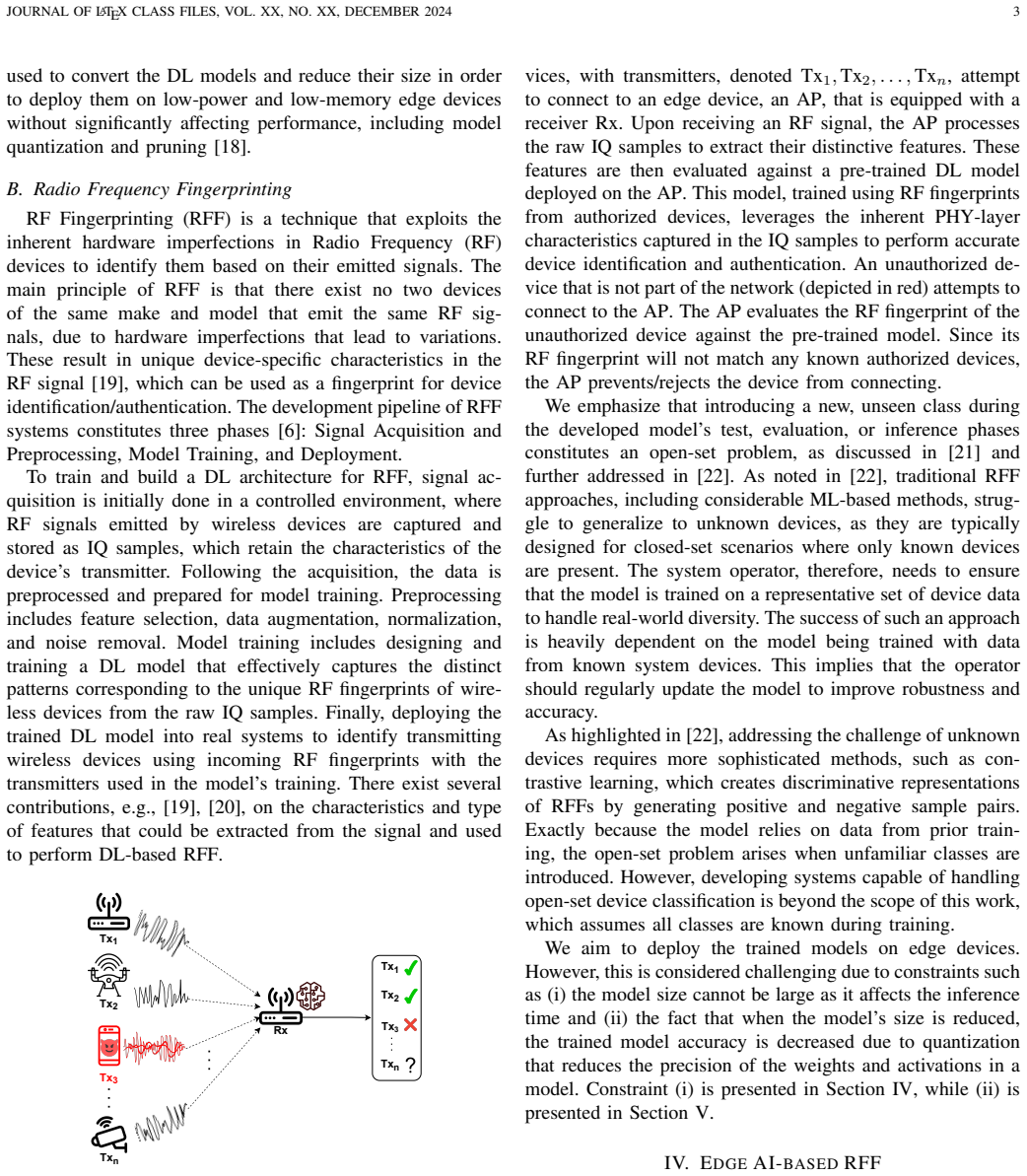
Summary. The paper proposes two lightweight deep-learning models for radio-frequency fingerprinting (RFF) on edge devices: a CNN and a Transformer encoder, both trained on the public WiSig SingleDay dataset with 28 WiFi transmitters. The models are converted to TensorFlow Lite and quantized, and their sizes and inference times are measured on a Raspberry Pi 4. The central claim is that the Transformer encoder outperforms the CNN, achieving accuracy above 0.95 and ROC-AUC above 0.90 while remaining compact (73 KB quantized), and that unlike the CNN, the Transformer maintains its accuracy when the IQ sample sequence is randomized. The paper includes model architecture details, training curves, confusion matrices, accuracy tables, ROC curves for the Transformer, and edge-deployment measurements.
Significance. If the central claim were established, the paper would provide a useful empirical data point: a quantized Transformer encoder of 73 KB that preserves classification accuracy after quantization would be a practical candidate for closed-set RFF on Raspberry-Pi-class hardware. The paper has several strengths: it uses a public dataset, reports model sizes and parameter counts, measures actual inference times on a Raspberry Pi, and honestly reports that the CNN collapses to near-chance accuracy under sequence randomization. However, the comparative claim that the Transformer 'outperforms' the CNN rests almost entirely on the randomization experiment, and that experiment is likely explained by the Transformer's built-in permutation invariance rather than by learned robustness. The identical confusion matrices in Fig. 7 and the absence of CNN ROC-AUC curves further weaken the evidence. These issues are fixable, but they currently leave the paper's headline conclusion not fully supported.
major comments (4)
- [Section V.A, Table VI; Abstract] The claim that the Transformer 'outperforms' the CNN is supported only by the sequence-randomization experiment. On the unperturbed test set the CNN achieves accuracy 0.99 and the Transformer 0.98 (Table VI), so the randomized-sequence result (0.98 vs. 0.04) is the sole quantitative basis for superiority. As described in Section IV.B and Fig. 3, the Transformer has no positional encoding and uses global average pooling, making it mathematically invariant to the permutation of input tokens. The constant accuracy under full sequence shuffling is therefore an architectural identity, not evidence of learned robustness to temporal changes. I recommend the authors add a control with positional encoding, or replace the randomization test with an order-preserving perturbation (e.g., additive noise, time shift, or partial sequence corruption), to substantiate the claimed robustness advantage.
- [Fig. 7(a) and Fig. 7(b)] The two confusion matrices shown for the Transformer encoder are identical, including the exact off-diagonal counts and percentage labels. Since the text states that the Transformer's performance 'remains constant even when randomizing the IQ sequences,' the reader expects a matrix for the randomized condition that differs in detail from the non-randomized one, even if the overall accuracy is the same. As printed, this appears to be a duplicated panel, which undermines the visual evidence for the invariance claim. Please provide the actual confusion matrix for the randomized-sequence condition.
- [Section V.A, Fig. 8; Section VIII] ROC-AUC curves are reported only for the Transformer encoder (Fig. 8a and 8b), while the abstract and the conclusion claim that 'both models' achieve ROC-AUC scores above 0.90. Without CNN ROC-AUC curves or at least a numeric AUC for the CNN, the reader cannot verify the comparative or absolute AUC claim for the CNN. Please report the CNN's ROC-AUC values as well, or explicitly restrict the ROC-AUC claim to the Transformer.
- [Section III; Section V.A] The system model in Section III describes an access point that 'prevents/rejects' an unauthorized device, but the deployed model is a 28-class softmax classifier with no unknown-class mechanism or rejection threshold, and the paper explicitly states that open-set device classification is beyond its scope. Consequently, the authentication/rejection claim is unsupported for any device outside the 28 training classes. The paper should either add an explicit rejection rule (e.g., a score threshold) or clearly rephrase the system model so that it describes identification among known devices only, with open-set rejection left as future work.
minor comments (6)
- [Section IV.C, Table III] There are typos in the text: 'Tabel III' should be 'Table III', and the code fragments 'arget spec.supported ops' and 'tf.lite.O -psSet.SELE CT_TF_OPS' contain obvious transcription errors that should be corrected.
- [Section V.A, Table VI caption] The caption reads 'Predication accuracy' and should be 'Prediction accuracy'.
- [Section VII, first paragraph] The discussion states that the Transformer 'outperforms CNN in terms of accuracy and robustness,' but Table VI shows equal accuracy (0.99 vs. 0.98, with the CNN slightly higher) on the unperturbed test set. The wording should be adjusted to reflect that the only reported accuracy difference appears in the randomization test.
- [Section VIII] The conclusion states that the Transformer sustains accuracy 'even when tested with samples that were not introduced during training.' This is misleading: the randomization test shuffles the IQ sequence of test samples from the same 28 known transmitters, not unseen transmitters or unseen classes. Please rephrase to describe the actual experiment.
- [Section V.A, Data Validation] The validation split is described as a random 20% of the data, and the paper uses the SingleDay subset of WiSig. It would strengthen the paper to state explicitly that this is a same-day, same-receiver evaluation and to discuss any implications for cross-day or cross-channel generalization, which the related work on RFF generally emphasizes.
- [Figures 6 and 7] The confusion matrices are extremely dense and the numerical labels are difficult to read at the printed size. Consider larger fonts, a zoomed view for representative classes, or a numeric table of per-class accuracy.
Circularity Check
No significant circularity: the paper is an empirical benchmark with independent external evaluation; all self-citations are background-only.
full rationale
The paper does not present a derivation chain that could feed back into its inputs. Its central claims are measured quantities: classification accuracy on the public WiSig SingleDay dataset, model sizes after TFLite conversion and quantization, and Raspberry Pi inference times. No parameter is fitted to the test set and then re-labeled as a prediction; the sequence-randomization experiment is a separate evaluation protocol applied after training and was not used to adjust either model. The self-citations in the paper (references [2], [6], and [27]) are used only as background illustrations, such as backscatter authentication, challenges of deep-learning-based radio frequency fingerprinting, and an edge-AI jamming detection example; none of them is load-bearing for the paper's quantitative results. The Transformer's behavior under sequence randomization could be debated because the architecture lacks positional encoding and therefore is permutation invariant by construction, but that is an evaluation-interpretation concern rather than a circularity: the reported accuracies are externally reproducible against the public dataset and do not reduce to a fitted parameter or to a self-citation. For these reasons, no circular step is identified.
Assumptions & free parameters
free parameters (4)
- Learning rate =
0.001 (Adam default)
- Batch size =
32
- Number of epochs =
100
- Architecture hyperparameters (embedding dim 64, 2 heads, CNN filters 8/16/32/16, dense units, dropout, L2) =
Tables I and II
assumptions (5)
- domain assumption RF fingerprints are unique and stable per transmitter due to hardware imperfections.
- domain assumption All classes are known during training and testing (closed-set).
- domain assumption WiSig SingleDay is representative enough for a same-day random 80/20 split.
- domain assumption 8-bit post-training quantization preserves model accuracy.
- standard math TensorFlow, Keras, and TFLite implement training, attention, and quantization faithfully.
Cite this review
Pith. "Pith review of Edge AI-based Radio Frequency Fingerprinting for IoT Networks." pith.science (2026). https://pith.science/paper/HP54K5ZB
@misc{pith2026241210553,
  author       = {Pith},
  title        = {Pith review of: Edge AI-based Radio Frequency Fingerprinting for IoT Networks},
  year         = {2026},
  howpublished = {\url{https://pith.science/paper/HP54K5ZB}},
  note         = {Machine review of arXiv:2412.10553}
}
read the original abstract
The deployment of the Internet of Things (IoT) in smart cities and critical infrastructure has enhanced connectivity and real-time data exchange but introduced significant security challenges. While effective, cryptography can often be resource-intensive for small-footprint resource-constrained (i.e., IoT) devices. Radio Frequency Fingerprinting (RFF) offers a promising authentication alternative by using unique RF signal characteristics for device identification at the Physical (PHY)-layer, without resorting to cryptographic solutions. The challenge is two-fold: how to deploy such RFF in a large scale and for resource-constrained environments. Edge computing, processing data closer to its source, i.e., the wireless device, enables faster decision-making, reducing reliance on centralized cloud servers. Considering a modest edge device, we introduce two truly lightweight Edge AI-based RFF schemes tailored for resource-constrained devices. We implement two Deep Learning models, namely a Convolution Neural Network and a Transformer-Encoder, to extract complex features from the IQ samples, forming device-specific RF fingerprints. We convert the models to TensorFlow Lite and evaluate them on a Raspberry Pi, demonstrating the practicality of Edge deployment. Evaluations demonstrate the Transformer-Encoder outperforms the CNN in identifying unique transmitter features, achieving high accuracy (> 0.95) and ROC-AUC scores (> 0.90) while maintaining a compact model size of 73KB, appropriate for resource-constrained devices.
Figures


Figures from the paper (5 more)


Forward citations
Cited by 2 Pith papers
-
Attention in Motion: Secure Platooning via Transformer-based Misbehavior Detection
A transformer with global positional offsets and a false-positive-penalizing loss detects kinematic falsification attacks in simulated platoons at 0.13-0.8 ms inference.
-
AttentionGuard: Transformer-based Misbehavior Detection for Secure Vehicular Platoons
A transformer-encoder classifier detects simulated position, speed, and acceleration falsification attacks in vehicle platoons with reported F1 up to 0.95.
Reference graph
Works this paper leans on
-
[40]
Radio frequency fingerprint identification for security in low-cost iot devices,
G. Shen, J. Zhang, A. Marshall, M. Valkama, and J. Cavallaro, “Radio frequency fingerprint identification for security in low-cost iot devices,” in 2021 55th Asilomar conference on signals, systems, and computers . IEEE, 2021, pp. 309–313
work page 2021
-
[1]
A. Al-Fuqaha, M. Guizani, M. Mohammadi, M. Aledhari, and M. Ayyash, “Internet of things: A survey on enabling technologies, JOURNAL OF LATEX CLASS FILES, VOL. XX, NO. XX, DECEMBER 2024 10 protocols, and applications,” IEEE communications surveys & tutorials , vol. 17, no. 4, pp. 2347–2376, 2015
work page 2024
-
[2]
HarvestPrint: Securing Battery-Free Backscatter Tags through Fingerprinting,
R. Narayanan, A. Varshney, and P. Papadimitratos, “HarvestPrint: Securing Battery-Free Backscatter Tags through Fingerprinting,” in ACM Workshop on Hot Topics in Networks (ACM HotNets) , ser. HotNets ’21. New York, NY , USA: Association for Computing Machinery, November 2021, pp. 178 – 184. [Online]. Available: https://doi.org/10.1145/3484266.3487388
arXiv 2021
-
[3]
Security in energy harvesting networks: A survey of current solutions and research chal- lenges,
P. Tedeschi, S. Sciancalepore, and R. Di Pietro, “Security in energy harvesting networks: A survey of current solutions and research chal- lenges,” IEEE Communications Surveys & Tutorials , vol. 22, no. 4, pp. 2658–2693, 2020
work page 2020
-
[4]
A review of radio frequency fingerprinting techniques,
N. Soltanieh, Y . Norouzi, Y . Yang, and N. C. Karmakar, “A review of radio frequency fingerprinting techniques,” IEEE Journal of Radio Frequency Identification, vol. 4, no. 3, pp. 222–233, 2020
2020
-
[5]
A secure and private authentication based on radio frequency fingerprinting,
C. Zhu, K. Li, J. Hong, C. Hua, and F. Zou, “A secure and private authentication based on radio frequency fingerprinting,” in ICC 2024- IEEE International Conference on Communications . IEEE, 2024, pp. 2210–2215
work page 2024
-
[6]
Radio frequency fingerprinting via deep learning: Challenges and opportunities,
S. Al-Hazbi, A. Hussain, S. Sciancalepore, G. Oligeri, and P. Papadim- itratos, “Radio frequency fingerprinting via deep learning: Challenges and opportunities,” in 2024 International Wireless Communications and Mobile Computing (IWCMC) , 2024, pp. 0824–0829
2024
-
[7]
Radio frequency fingerprinting on the edge,
T. Jian, Y . Gong, Z. Zhan, R. Shi, N. Soltani, Z. Wang, J. Dy, K. Chowd- hury, Y . Wang, and S. Ioannidis, “Radio frequency fingerprinting on the edge,” IEEE Transactions on Mobile Computing , vol. 21, no. 11, pp. 4078–4093, 2021
work page 2021
Show all 45 references
-
[8]
Radio-frequency fingerprinting for distributed iot networks: Authentication and qos optimization,
W. Wu, S. Hu, D. Lin, and T. Yang, “Radio-frequency fingerprinting for distributed iot networks: Authentication and qos optimization,” IEEE Systems Journal, vol. 17, no. 3, pp. 4440–4451, 2023
2023
-
[9]
Deep residual learning for image recognition,
K. He, X. Zhang, S. Ren, and J. Sun, “Deep residual learning for image recognition,” in Proceedings of the IEEE conference on computer vision and pattern recognition , 2016, pp. 770–778
2016
-
[10]
Wisig: A large-scale wifi signal dataset for receiver and channel agnostic rf fingerprinting,
S. Hanna, S. Karunaratne, and D. Cabric, “Wisig: A large-scale wifi signal dataset for receiver and channel agnostic rf fingerprinting,” IEEE Access, vol. 10, p. 22808–22818, 2022
2022
-
[11]
Review of deep learning: concepts, cnn architectures, challenges, applications, future directions,
L. Alzubaidi, J. Zhang, A. J. Humaidi, A. Al-Dujaili, Y . Duan, O. Al- Shamma, J. Santamar ´ıa, M. A. Fadhel, M. Al-Amidie, and L. Farhan, “Review of deep learning: concepts, cnn architectures, challenges, applications, future directions,” Journal of big Data , vol. 8, pp. 1–74, 2021
2021
-
[12]
An introduction to convolutional neural networks,
K. O’shea and R. Nash, “An introduction to convolutional neural networks,” arXiv preprint arXiv:1511.08458 , 2015
2015 arXiv
-
[13]
Attention is all you need,
A. Vaswani, N. Shazeer, N. Parmar, J. Uszkoreit, L. Jones, A. N. Gomez, Ł. Kaiser, and I. Polosukhin, “Attention is all you need,” Advances in neural information processing systems , vol. 30, 2017
2017
-
[14]
Edge in- telligence for empowering iot-based healthcare systems,
V . Hayyolalam, M. Aloqaily, ¨O. ¨Ozkasap, and M. Guizani, “Edge in- telligence for empowering iot-based healthcare systems,” IEEE Wireless Communications, vol. 28, no. 3, pp. 6–14, 2021
2021
-
[15]
Survey on recent smart gateways for smart home: Systems, technologies, and chal- lenges,
W. Yan, Z. Wang, H. Wang, W. Wang, J. Li, and X. Gui, “Survey on recent smart gateways for smart home: Systems, technologies, and chal- lenges,” Transactions on Emerging Telecommunications Technologies , vol. 33, no. 6, p. e4067, 2022
2022
-
[16]
Enabling technologies for urban smart mobility: Recent trends, opportunities and challenges,
S. Paiva, M. A. Ahad, G. Tripathi, N. Feroz, and G. Casalino, “Enabling technologies for urban smart mobility: Recent trends, opportunities and challenges,” Sensors, vol. 21, no. 6, p. 2143, 2021
2021
-
[17]
Edge ai: a survey,
R. Singh and S. S. Gill, “Edge ai: a survey,” Internet of Things and Cyber-Physical Systems, vol. 3, pp. 71–92, 2023
2023
-
[18]
Pruning and quantization for deep neural network acceleration: A survey,
T. Liang, J. Glossner, L. Wang, S. Shi, and X. Zhang, “Pruning and quantization for deep neural network acceleration: A survey,” Neuro- computing, vol. 461, pp. 370–403, 2021
2021
-
[19]
Distinguishable iq feature represen- tation for domain-adaptation learning of wifi device fingerprints,
A. Elmaghbub and B. Hamdaoui, “Distinguishable iq feature represen- tation for domain-adaptation learning of wifi device fingerprints,” IEEE Transactions on Machine Learning in Communications and Networking, pp. 1404–1423, August 2024
2024
-
[20]
A needle in a haystack: Distinguishable deep neural network features for domain-agnostic device fingerprinting,
——, “A needle in a haystack: Distinguishable deep neural network features for domain-agnostic device fingerprinting,” in 2023 IEEE Con- ference on Communications and Network Security (CNS), 2023, pp. 1–9
2023
-
[21]
Recent advances in open set recognition: A survey,
C. Geng, S.-J. Huang, and S. Chen, “Recent advances in open set recognition: A survey,” IEEE Transactions on Pattern Analysis and Machine Intelligence, vol. 43, no. 10, pp. 3614–3631, 2021
2021
-
[22]
Radio frequency fingerprint authentication based on feature fusion and contrastive learning,
X. Wang, Q. Wang, L. Fang, M. Hua, Y . Jiang, and Y . Hu, “Radio frequency fingerprint authentication based on feature fusion and contrastive learning,” Expert Systems with Applications , vol. 255, p. 124537, 2024. [Online]. Available: https://www.sciencedirect.com/ science/ar...
2024
-
[23]
(2024) TensorFlow
Google. (2024) TensorFlow. Accessed: Jun 2024. [Online]. Available: https://www.tensorflow.org
2024
-
[24]
(2024) Keras
Franc ¸ois Chollet. (2024) Keras. Accessed: Jun 2024. [Online]. Available: https://keras.io/
2024
-
[25]
Adam: A method for stochastic optimization,
D. P. Kingma and J. Ba, “Adam: A method for stochastic optimization,” arXiv preprint arXiv:1412.6980 , 2014
2014 arXiv
-
[26]
(2024) Adam Optimizer
Keras. (2024) Adam Optimizer. Accessed: Jun 2024. [Online]. Available: https://keras.io/api/optimizers/adam/
2024
-
[27]
Jamming detection in iot wireless networks: An edge-ai based approach,
A. Hussain, N. Abughanam, J. Qadir, and A. Mohamed, “Jamming detection in iot wireless networks: An edge-ai based approach,” in Proceedings of the 12th International Conference on the Internet of Things , ser. IoT ’22. New York, NY , USA: Association for Computing Machinery, 2...
2023
-
[28]
(2024) TFLite Optimize
Google. (2024) TFLite Optimize. Accessed: Jun 2024. [Online]. Available: https://www.tensorflow.org/api docs/python/tf/lite/Optimize
2024
-
[29]
Artificial intelligence- powered mobile edge computing-based anomaly detection in cellular networks,
B. Hussain, Q. Du, A. Imran, and M. A. Imran, “Artificial intelligence- powered mobile edge computing-based anomaly detection in cellular networks,” IEEE Transactions on Industrial Informatics , vol. 16, no. 8, pp. 4986–4996, 2020
2020
-
[30]
Fogai: An ai-supported fog controller for next generation iot,
˙I. K ¨ok, F. Y . Okay, and S. ¨Ozdemir, “Fogai: An ai-supported fog controller for next generation iot,” Internet of Things, vol. 19, p. 100572, 2022
2022
-
[31]
Security threats and artificial intelligence based countermeasures for internet of things networks: A comprehensive survey,
S. Zaman, K. Alhazmi, M. A. Aseeri, M. R. Ahmed, R. T. Khan, M. S. Kaiser, and M. Mahmud, “Security threats and artificial intelligence based countermeasures for internet of things networks: A comprehensive survey,” IEEE Access, vol. 9, pp. 94 668–94 690, 2021
2021
-
[32]
A review on tinyml: State-of-the-art and prospects,
P. P. Ray, “A review on tinyml: State-of-the-art and prospects,” Journal of King Saud University-Computer and Information Sciences , vol. 34, no. 4, pp. 1595–1623, 2022
2022
-
[33]
A transformer-based multi- feature extraction neural network for bluetooth devices identification,
C. Sun, X. Chen, W. Wang, and H. Yin, “A transformer-based multi- feature extraction neural network for bluetooth devices identification,” in 2023 9th International Conference on Computer and Communications (ICCC). IEEE, 2023, pp. 1469–1473
2023
-
[34]
Lightweight cnn-based rf fingerprint recognition method,
J. Feng, X. Tang, B. Zhang, and Y . Ren, “Lightweight cnn-based rf fingerprint recognition method,” in 2023 8th International Conference on Computer and Communication Systems (ICCCS) . IEEE, 2023, pp. 1031–1035
2023
-
[35]
Optimized coherent integration-based radio frequency fingerprinting in internet of things,
F. Xie, H. Wen, Y . Li, S. Chen, L. Hu, Y . Chen, and H. Song, “Optimized coherent integration-based radio frequency fingerprinting in internet of things,” IEEE Internet of Things Journal , vol. 5, no. 5, pp. 3967–3977, 2018
2018
-
[36]
A convolutional neural network-based rf fingerprinting identification scheme for mobile phones,
S. Wang, L. Peng, H. Fu, A. Hu, and X. Zhou, “A convolutional neural network-based rf fingerprinting identification scheme for mobile phones,” in IEEE INFOCOM 2020-IEEE Conference on Computer Communications Workshops (INFOCOM WKSHPS) . IEEE, 2020, pp. 115–120
2020
-
[37]
Radio fre- quency fingerprint authentication based on feature fusion and contrastive learning,
X. Wang, Q. Wang, L. Fang, M. Hua, Y . Jiang, and Y . Hu, “Radio fre- quency fingerprint authentication based on feature fusion and contrastive learning,” Expert Systems with Applications , vol. 255, p. 124537, 2024
2024
-
[38]
Radio frequency fingerprint identification for lora using deep learning,
G. Shen, J. Zhang, A. Marshall, L. Peng, and X. Wang, “Radio frequency fingerprint identification for lora using deep learning,” IEEE Journal on Selected Areas in Communications, vol. 39, no. 8, pp. 2604–2616, 2021
2021
-
[39]
Radio frequency fingerprint identification based on deep complex residual network,
S. Wang, H. Jiang, X. Fang, Y . Ying, J. Li, and B. Zhang, “Radio frequency fingerprint identification based on deep complex residual network,” IEEE access, vol. 8, pp. 204 417–204 424, 2020
2020
-
[41]
Towards scalable and channel-robust radio frequency fingerprint identification for lora,
G. Shen, J. Zhang, A. Marshall, and J. R. Cavallaro, “Towards scalable and channel-robust radio frequency fingerprint identification for lora,” IEEE Transactions on Information Forensics and Security , vol. 17, pp. 774–787, 2022
2022
-
[42]
Raspberry Pi 4 Model B
Raspberry Pi. Raspberry Pi 4 Model B. Accessed April
-
[43]
Espressif ESP32 DevKitC
Espressif. Espressif ESP32 DevKitC. Accessed: Jun 2024. [Online]. Available: https://www.espressif.com/en/products/devkits/esp32-devkitc/ overview
2024
-
[44]
(2024) Coral
Coral. (2024) Coral. Accessed: Jun 2024. [Online]. Available: https://coral.ai/ JOURNAL OF LATEX CLASS FILES, VOL. XX, NO. XX, DECEMBER 2024 11 Ahmed Mohamed Hussain is currently a Predoctoral Researcher working with the Networked Systems Security (NSS) Group at KTH Royal Inst...
2024
-
[2023]
Available: https://www.raspberrypi.com/products/ raspberry-pi-4-model-b/
[Online]. Available: https://www.raspberrypi.com/products/ raspberry-pi-4-model-b/
Reviewed August 11, 2026 · model on record in the stance chip above.
Discussion (0). Continue with ORCID to comment.