REVIEW 5 major objections 6 minor 18 references
Multi-View Reconstruction with Global Context for 3D Anomaly Detection
T0 review · 5 major / 6 minor · reviewed 2026-08-06 · deepseek-v4-flash
Pith's one-line read The central claim is that converting a point cloud into 27 depth views and reconstructing them with a pre-trained vision transformer yields the strongest anomaly-detection scores on the Real3D-AD benchmark.
desk verdict A plausible and well-ablated combination that likely sets a new SOTA on Real3D-AD, but the reported numbers are compromised by test-set hyperparameter selection and some unclear evaluation details. read the letter →
The pith
A machine-rendered reading of the paper's core claim, the machinery that carries it, and where it could break.
The reading
What carries the argument
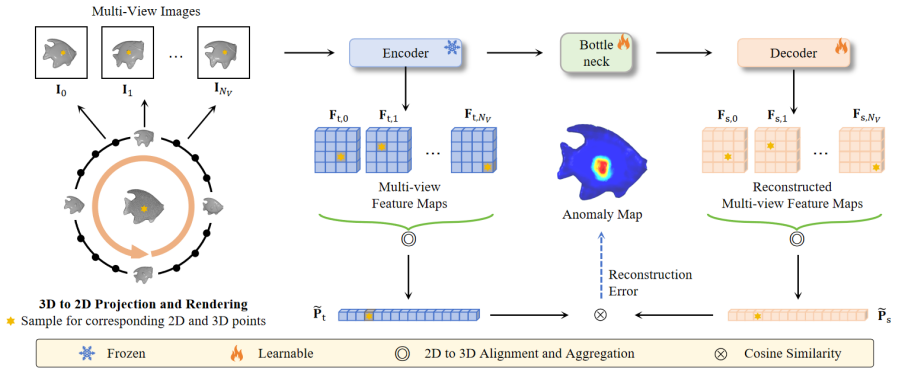
The load-bearing object is the multi-view projection-and-reconstruction pipeline built on a teacher–student transformer framework in the style of Dinomaly. Depth images rendered at 672×672 pixels and downsampled to 224×224 are encoded by a pre-trained ViT-Large/14 backbone, and the student network must reconstruct the encoder's middle-layer features from a latent bottleneck; a hard-mining global cosine loss concentrates training on the hardest-restored points. Point features from all views are mapped back to 3D through the inverse projection function Pos_k and averaged, so the 2D reconstruction error becomes a point-wise 3D anomaly map. The mechanism's work is to force the model to understand whole-object structure rather than match local patches.
What would settle it
Take a set of sparse point clouds with small inserted defects and run MVR at rendering resolutions of 224, 672, and 1568 pixels per view. The paper's ablation predicts that the sparse classes lose accuracy at 1568 because downsampling interpolates across voids; if point-wise AU-ROC stays flat or improves there, the void-degradation mechanism is wrong, and if defects missed at 224 remain missed at 672, the claim that the rendering is lossless for detection is also wrong.
Extended reading notes
Core claim
MVR's central claim is that a high-resolution multi-view rendering of a point cloud preserves the structure needed for defect detection, and that a pre-trained teacher–student reconstruction pair can exploit global context in those views. The teacher extracts features from each depth image, the student tries to reconstruct those features through a bottleneck, and the cosine difference between them scores every point. Because features from several views are back-projected to the same 3D points and averaged, a defect is flagged only if it is consistently anomalous across viewpoints. On Real3D-AD this recipe achieves 89.6% object-wise AU-ROC and 95.7% point-wise AU-ROC, with its largest reported gains over memory-bank baselines such as CPMF and PointCore.
Load-bearing premise
The method's performance rests on the assumption that rendering a point cloud into 27 depth images at 672×672 pixels and then downsampling to 224×224 preserves the fine geometric details that separate defects from normal surfaces.
Editorial extensions
If this is right
- The paper reports 89.6% object-wise and 95.7% point-wise AU-ROC on Real3D-AD, with category-level gains in most of the twelve classes.
- The rendering ablation shows that generating views at 672×672 pixels and then downsampling to 224×224 beats direct 224×224 rendering by roughly 3.6 points in object-wise AU-ROC.
- Detection performance improves steadily with more rendered views, peaking around 15 views for object-wise scores and around 21 for point-wise scores, and three views are already competitive.
- Larger vision transformers improve both metrics, with ViT-Large beating ViT-Base and ViT-Small in the reported backbone comparison.
Reading between the lines
- If global context is the active ingredient, then a 3D transformer operating directly on raw point clouds, or a rendering whose interpolation respects object geometry, could match these numbers without 27 separate views; the paper does not run that comparison.
- The render-at-672 then downsample-to-224 step functions as an anti-aliasing filter, so the same two-step rendering could help other point-cloud tasks such as segmentation or surface reconstruction when scans are noisy or sparse.
- Because high-resolution rendering creates data voids on sparse classes like diamond and gemstone, an adaptive rendering resolution chosen from local point density is a natural next test; the paper's own ablation predicts it would recover the lost points.
Editorial analysis
A structured set of objections, weighed in public.
Referee Report
Summary. The paper proposes MVR, a 3D anomaly detection method that renders a point cloud into multiple depth images from different viewpoints, feeds these images through a pre-trained DINOv2-based teacher-student reconstruction network (following the Dinomaly paradigm), and fuses the resulting point-wise features back into 3D space via inverse projection. Anomaly scores are obtained from cosine distances between teacher and student features. The method is evaluated on the Real3D-AD benchmark, where it reports 89.6% object-wise AU-ROC and 95.7% point-wise AU-ROC, claiming state-of-the-art performance. The paper also includes ablations on rendering resolution, number of views, and backbone size.
Significance. If the reported results hold, MVR would be a strong and practical baseline for high-resolution 3D anomaly detection, showing that 2D pre-trained transformer features can be transferred effectively to point-cloud data through multi-view rendering. The manuscript has several strengths: it evaluates on an external public benchmark (Real3D-AD), it releases code, and it provides ablations that give some insight into rendering resolution and view-count choices. The methodological combination of high-resolution rendering followed by downsampling is a reasonable and potentially useful design. However, the empirical claim of state-of-the-art performance is weakened by the hyperparameter selection protocol, the lack of standardized preprocessing across baselines, and the absence of error bars or multiple runs. These issues are load-bearing because the central claim rests entirely on the comparison table.
major comments (5)
- [§III-C (Ablation Studies) and §III-A (Implementation Details)] The headline configuration is not selected under a validation protocol. In §III-C.1 the rendering resolution is chosen by comparing O-ROC/P-ROC on the Real3D-AD test set, and in §III-C.2 the number of views is discussed as 'O-ROC peaks at around 15 views, while P-ROC reaches its highest value at approximately 21 views,' yet the final method uses 27 depth images (§III-A.1), a value not present in the ablation grid. Because the reported 89.6/95.7 figures appear to come from a configuration chosen after observing test labels, the claimed margins over PointCore and GLFM may be optimistically biased. Please report a held-out validation split, a pre-defined selection rule, or a sensitivity analysis that justifies the final Nv=27.
- [§III-A.1 and Table 1] The preprocessing is not standardized across methods. The paper states that 'background points are filtered out in the Real3D-AD dataset' for the proposed method, but it does not say whether the baselines in Table 1 were re-run with the same background filtering or whether their scores were copied from the original papers. If background filtering is part of MVR's pipeline but not applied to baselines, the comparison is unfair. Please re-run all baselines with identical preprocessing or report both settings.
- [Table 1 and §III-C] No estimate of variability is provided. The tables report single runs without error bars, multiple seeds, or statistical tests, so it is unclear whether the reported improvements (e.g., 89.6 vs 82.9 O-ROC, 95.7 vs 89.8 P-ROC) exceed run-to-run variation. Please report mean and standard deviation over at least three seeds, and/or a paired test for per-class scores.
- [Abstract, §I (Contributions), and §III-C.1] The term 'losslessly' is contradicted by the paper's own analysis. The ablation section states that high-resolution rendering of sparse point clouds produces 'regional data voids' that introduce 'anomalous noise artifacts' after downsampling and degrade performance; this is a form of information loss. Please remove or qualify 'losslessly' in the abstract and contribution list, or provide a formal sense in which the conversion is lossless.
- [§III-C.1 and Fig. 5] There is a numerical inconsistency between the ablation text and Table 1: §III-C.1 reports O-ROC 89.3% at 672^2 resolution, while Table 1 reports 89.6% for the final MVR config. Please clarify which setting produces the headline number and whether the difference arises from the view count or another factor.
minor comments (6)
- [§II-D, Eqs. (4)-(6)] The notation is inconsistent: F(k)_t is defined as a single feature map in Eq. (4) but as a set of j feature maps in the following sentence; please use a distinct symbol or subscript for the set.
- [§III-A.2] The model is trained for 300 iterations; please state the batch size and the number of epochs or effective passes over the training set so that readers can interpret the training budget.
- [§III-C.1] There is a typo: 'dimond' should be 'diamond' in the phrase '(e.g., dimond, gemstone)'.
- [§IV (Conclusions)] The conclusion describes the framework as 'highly efficient,' but Table 2 reports 413.5 G MACs for ViT-Large and no runtime comparison against baselines is provided; please qualify or support this statement.
- [§III-C.2] The statement 'Performance at Nv=15 shows substantial improvement compared to Nv=1' would be more informative with explicit numbers, and the claim that the framework 'achieves superior detection performance with only three depth views' needs a precise comparator.
- [Eq. (13)] The notation 'sg(Ps∗(i))0.1' is not defined in the text; please clarify that it means stopping gradients and scaling them to one-tenth of the original magnitude.
Circularity Check
Headline benchmark result is partly a test-set-selected optimum; no derivation-level circularity.
-
fitted input called prediction
[Section III-C.1 (Fig. 5) and Section III-A.2; evaluated in Section III-B Table 1]
"Through systematic experiments with rendering resolutions ( 2242 − 15682), Fig. 5 reveals: O-ROC increases notably by 3.6% as the resolution rises from 2242 to 6722, reaching its peak(89.3%) at 6722, then decaying to 86.4% at 15682. ... the rendered images are fixed with a spatial resolution of 672 × 672 by default."
The default rendering resolution is selected after observing that O-ROC peaks at 672² on the Real3D-AD test set, and the same test set then supplies the headline 89.6/95.7 scores in Table 1. No held-out validation split is described, so the reported 'prediction' is the result of choosing a hyperparameter from the target metric itself, not an independent evaluation. The view-count discussion in §III-C.2 similarly reads O-ROC/P-ROC peaks off the benchmark. This is a test-set-fitted configuration renamed as a predictive result: the SOTA margin is statistically forced to be optimistic.
full rationale
The method's derivation chain is not circular at the equation level: Eqs. (1)-(3) define standard projection and inverse mapping, Eqs. (4)-(14) define a teacher-student reconstruction trained with a hard-mining cosine loss on normal samples, and Eqs. (15)-(17) define the anomaly score as cosine distance. None of these definitions encodes the Real3D-AD labels or the reported AUROC values, so the model's anomaly predictions are not equivalent to its inputs by construction. The self-citations in the paper (e.g., CPMF [3], GLFM [7], Refs. [1], [4], [9]) are used as prior work, baselines, or incidental references; they do not supply a load-bearing uniqueness theorem or an ansatz that forces the MVR design. The main circularity concern is empirical: §III-C.1 selects the default rendering resolution after observing that O-ROC peaks at 672² on the Real3D-AD test set, and Table 1 then reports 89.6/95.7 on that same test set as the method's performance. With no validation-based selection protocol or error bars, the headline SOTA claim is partly a test-set-selected optimum rather than an unbiased prediction. This is a partial circularity in the evaluation claim, not in the method's construction; the architecture and external DINOv2 backbone remain independent content.
Assumptions & free parameters
free parameters (4)
- number of rendering views Nv =
27
- rendering resolution =
672x672
- number of intermediate layers j =
8
- hard-mining ratio k% =
not reported
assumptions (4)
- standard math Pinhole camera projection model (Eqs. 1-2) maps point clouds to depth images.
- domain assumption Pre-trained ViT features from DINOv2-R generalize to depth images.
- domain assumption Reconstruction error between teacher and student networks indicates anomalies when trained only on normal samples.
- domain assumption Filtering background points from Real3D-AD is necessary and does not bias the comparison.
Cite this review
Pith. "Pith review of Multi-View Reconstruction with Global Context for 3D Anomaly Detection." pith.science (2026). https://pith.science/paper/HPR7PL4J
@misc{pith2026250721555,
  author       = {Pith},
  title        = {Pith review of: Multi-View Reconstruction with Global Context for 3D Anomaly Detection},
  year         = {2026},
  howpublished = {\url{https://pith.science/paper/HPR7PL4J}},
  note         = {Machine review of arXiv:2507.21555}
}
read the original abstract
3D anomaly detection is critical in industrial quality inspection. While existing methods achieve notable progress, their performance degrades in high-precision 3D anomaly detection due to insufficient global information. To address this, we propose Multi-View Reconstruction (MVR), a method that losslessly converts high-resolution point clouds into multi-view images and employs a reconstruction-based anomaly detection framework to enhance global information learning. Extensive experiments demonstrate the effectiveness of MVR, achieving 89.6\% object-wise AU-ROC and 95.7\% point-wise AU-ROC on the Real3D-AD benchmark.
Figures


Figures from the paper (2 more)


Reference graph
Works this paper leans on
-
[1]
Y . Cheng, Y . Cao, H. Yao, W. Luo, C. Jiang, H. Zhang, and W. Shen, “A comprehensive survey for real-world industrial defect detection: Challenges, approaches, and prospects,” arXiv preprint arXiv:2507.13378, 2025
work page Pith review arXiv 2025
-
[2]
Y . Cheng, W. Li, C. Jiang, D. Wang, H. Xing, and W. Xu, “MVGR: Mean-variance minimization global registration method for multi-view point cloud in robot inspection,” IEEE Transactions on Instrumenta- tion and Measurement , pp. 1–1, 2024
work page 2024
-
[3]
Complementary pseudo multimodal feature for point cloud anomaly detection,
Y . Cao, X. Xu, and W. Shen, “Complementary pseudo multimodal feature for point cloud anomaly detection,” Pattern Recognition , vol. 156, p. 110761, 2024
work page 2024
-
[4]
Y . Cheng, Y . Sun, H. Zhang, W. Shen, and Y . Cao, “To- wards high-resolution 3d anomaly detection: A scalable dataset and real-time framework for subtle industrial defects,” arXiv preprint arXiv:2507.07435, 2025
work page Pith review arXiv 2025
-
[5]
Real3d-ad: A dataset of point cloud anomaly detection,
J. Liu, G. Xie, X. Li, J. Wang, Y . Liu, C. Wang, F. Zheng, et al. , “Real3d-ad: A dataset of point cloud anomaly detection,” in Neural Information Processing Systems Datasets and Benchmarks Track , vol. 36, 2024
work page 2024
-
[6]
Towards high-resolution 3d anomaly detection via group-level feature contrastive learning,
H. Zhu, G. Xie, C. Hou, T. Dai, C. Gao, J. Wang, and L. Shen, “Towards high-resolution 3d anomaly detection via group-level feature contrastive learning,” ACM Multimedia (ACM MM) , p. 4680–4689, 2024
work page 2024
-
[7]
Y . Cheng, Y . Cao, D. Wang, W. Shen, and W. Li, “Boosting global- local feature matching via anomaly synthesis for multi-class point cloud anomaly detection,” IEEE Transactions on Automation Science and Engineering, vol. 22, pp. 12560–12571, 2025
work page 2025
-
[8]
Dinomaly: The less is more philosophy in multi-class unsupervised anomaly detection,
J. Guo, S. Lu, W. Zhang, F. Chen, H. Liao, and H. Li, “Dinomaly: The less is more philosophy in multi-class unsupervised anomaly detection,” arXiv preprint arXiv:2405.14325 , 2024
arXiv 2024
Show all 18 references
-
[9]
Exploring intrinsic normal prototypes within a single image for universal anomaly detection,
W. Luo, Y . Cao, H. Yao, X. Zhang, J. Lou, Y . Cheng, W. Shen, and W. Yu, “Exploring intrinsic normal prototypes within a single image for universal anomaly detection,” ArXiv, vol. abs/2503.02424, 2025
2025 arXiv
-
[10]
Recontrast: Domain- specific anomaly detection via contrastive reconstruction,
J. Guo, S. Lu, L. Jia, W. Zhang, and H. Li, “Recontrast: Domain- specific anomaly detection via contrastive reconstruction,” ArXiv, vol. abs/2306.02602, 2023
2023 arXiv
-
[11]
Multimodal industrial anomaly detection via hybrid fusion,
Y . Wang, J. Peng, J. Zhang, R. Yi, Y . Wang, and C. Wang, “Multimodal industrial anomaly detection via hybrid fusion,” in Proceedings of the IEEE/CVF Conference on Computer Vision and Pattern Recognition , pp. 8032–8041, 2023
2023
-
[12]
R3d-ad: Reconstruction via diffusion for 3d anomaly detection,
Z. Zhou, L. Wang, N. Fang, Z. Wang, L. Qiu, and S. Zhang, “R3d-ad: Reconstruction via diffusion for 3d anomaly detection,” in European Conference on Computer Vision (ECCV) , pp. 91–107, 2024
2024
-
[13]
Towards scalable 3d anomaly detection and localization: A benchmark via 3d anomaly synthesis and a self-supervised learning network,
W. Li, X. Xu, Y . Gu, B. Zheng, S. Gao, and Y . Wu, “Towards scalable 3d anomaly detection and localization: A benchmark via 3d anomaly synthesis and a self-supervised learning network,” 2024 IEEE/CVF Conference on Computer Vision and Pattern Recognition (CVPR) , pp. 22207–222...
2024
-
[14]
Pointcore: Efficient unsupervised point cloud anomaly detector using local-global features,
B. Zhao, Q. Xiong, X. Zhang, J. Guo, Q. Liu, X. Xing, and X. Xu, “Pointcore: Efficient unsupervised point cloud anomaly detector using local-global features,” arXiv preprint arXiv:2403.01804 , 2024
2024 arXiv
-
[15]
Open3d: A modern library for 3d data processing,
Q.-Y . Zhou, J. Park, and V . Koltun, “Open3d: A modern library for 3d data processing,” ArXiv, vol. abs/1801.09847, 2018
2018 arXiv
-
[16]
Vision transform- ers need registers,
T. Darcet, M. Oquab, J. Mairal, and P. Bojanowski, “Vision transform- ers need registers,” ArXiv, vol. abs/2309.16588, 2023
2023 arXiv
-
[17]
Stable and low-precision training for large-scale vision-language models,
M. Wortsman, T. Dettmers, L. Zettlemoyer, A. S. Morcos, A. Farhadi, and L. Schmidt, “Stable and low-precision training for large-scale vision-language models,” ArXiv, vol. abs/2304.13013, 2023
2023 arXiv
-
[18]
On the convergence of adam and beyond,
S. J. Reddi, S. Kale, and S. Kumar, “On the convergence of adam and beyond,” ArXiv, vol. abs/1904.09237, 2018
1904 arXiv
Reviewed August 6, 2026 · model on record in the stance chip above.
Discussion (0). Sign in to comment.