REVIEW 5 major objections 6 minor 3 cited by
Adversarial Attack Against Images Classification based on Generative Adversarial Networks
T0 review · 5 major / 6 minor · reviewed 2026-08-11 · deepseek-v4-flash
Pith's one-line read The paper proposes a GAN-based adversarial attack that generates small, natural-looking perturbations to fool image classifiers, and claims it beats FGSM and BIM in success and cost on MNIST.
desk verdict The central claim is unsupported: the paper's own update rule is standard BIM, with no GAN component in the algorithm or experiments. read the letter →
The pith
A machine-rendered reading of the paper's core claim, the machinery that carries it, and where it could break.
The reading
What carries the argument
The load-bearing object is the iterative update $x^{(t+1)} = \mathrm{Clip}_{x,\epsilon}(x^{(t)} + \alpha \cdot \mathrm{sign}(\nabla_x J(\theta, x^{(t)}, y)))$ (Eq. 3): repeated clipped sign-gradient steps that maximize the classifier's loss under a perturbation threshold. The paper wraps this update in a GAN formulation (Eq. 1) with a generator and a discriminator, and states that the generator and the classifier are trained adversarially. Two auxiliary mechanisms are added: total-variation regularization (Eq. 4) to suppress noise-like artifacts, and a time-dependent weight function $w(t)$ (Eq. 5) that adaptively adjusts the influence of adversarial samples during training. The same update equation is the one used by the BIM baseline, so it is the mechanism that must distinguish the proposed attack from a standard gradient attack.
What would settle it
Inspect the training loop and generated samples: if no generator or discriminator is trained, and the reported adversarial samples come from the 10-iteration clipped signed-gradient update of Eq. 3, the GAN-based claim is falsified. A direct check is to run Algorithm 1 with all GAN components removed and see whether the attack success and the 0.15-second cost are unchanged.
Extended reading notes
Core claim
The paper's central claim is that generative adversarial networks can generate adversarial samples that are both effective and natural: small perturbations that change a classifier's decision while remaining visually unnoticeable. The authors state that by adversarially training the generator against the classifier, the attack learns where the classifier is fragile, and they report that on MNIST it outperforms FGSM and BIM in attack success ratio and computational cost. They also claim that the adversarial samples stay close to normal samples in feature space, which they take as evidence of concealment. The paper's stated goal is to reveal weaknesses in image classification systems and to motivate stronger defenses.
Load-bearing premise
The load-bearing premise is that the method is genuinely a GAN-based attack and not just the standard iterative gradient attack it compares against; if the GAN components are never actually trained, the claimed novelty and the adversarial-learning mechanism collapse.
Editorial extensions
If this is right
- A trained GAN-based attacker could generate adversarial samples without per-image gradient search, lowering the cost per attack.
- The same samples could be used to harden classifiers through adversarial training, since the attack exposes the model's fragile regions.
- The recipe could be turned into an image-protection tool: applying such perturbations before publishing a photo would make deepfake-style edits fail while the photo still looks normal.
- The reported 0.15-second generation time makes the attack fast enough for real-time or large-batch deployment, if the result holds.
Reading between the lines
- Inference: Because Eq. 3 and Algorithm 1 match the BIM baseline, removing the GAN framing and rerunning the experiment is the decisive test of whether the proposed mechanism is doing the work.
- Inference: The claimed naturalness could be quantified on MNIST by measuring distance to the nearest real-sample neighborhood or by a human-perception study; the paper's PCA and t-SNE plots are suggestive, not a metric.
- Inference: If a real generator were trained, the attack might transfer to harder datasets and architectures, which would test the abstract's promise of deceiving a variety of advanced classifiers beyond the one three-layer CNN evaluated.
Signed reviews
Editorial analysis
A structured set of objections, weighed in public.
Referee Report
Summary. The paper proposes an adversarial attack method against image classifiers, claiming to use generative adversarial networks (GANs) to generate imperceptible perturbations through adversarial learning of a generator and a classifier. The method is compared with FGSM and BIM on the MNIST dataset with a simple three-layer CNN, reporting accuracy drop, attack success rate, computational cost, robustness heatmaps, and feature-space visualizations. The central claim is that the proposed GAN-based attack outperforms FGSM and BIM in success rate and efficiency while preserving image naturalness (Abstract, Section V).
Significance. If the central claim were supported, a GAN-based attack that improves on FGSM and BIM would be a useful contribution to adversarial machine learning, with potential application to robustness evaluation. The paper gives a clear account of the FGSM and BIM baselines and provides a readable description of the GAN background. However, the claimed novelty rests entirely on the assertion that the attack is GAN-based, and the manuscript does not provide a training loop, a generator/discriminator objective tied to the attack, or any experimental evidence that a GAN is actually used. The experimental evaluation is limited to a single simple CNN on MNIST, so the abstract's claim of deceiving 'a variety of advanced classifiers' is unsubstantiated. The paper provides no code, no architectural details, no error bars, and no ablation of the regularizers introduced in Equations (4) and (5). On the evidence in the manuscript, the method reduces to BIM, so the claimed significance does not hold as written.
major comments (5)
- [Section III-C, Eq. (3)] The proposed update rule in Equation (3) is exactly the BIM update from reference [12], and Algorithm 1 describes only a standard iterative gradient-sign attack: forward pass, cross-entropy loss, backpropagation, sign of gradient, update, clipping. No line of Algorithm 1 uses the generator G, the discriminator D, the minimax objective in Equation (1), or any adversarial training loop tying G, D, and the classifier together. Thus the paper's central claim that the attack is GAN-based and generated through adversarial learning of generator and classifier is unsupported by the method as written.
- [Section IV and abstract/conclusion] The abstract and conclusion claim that the method 'successfully deceives a variety of advanced classifiers' and the introduction promises evaluations on 'multiple real-world datasets as well as a synthesized dataset' with transferability across scenarios. The experiments in Section IV use only MNIST and one three-layer CNN, with no transferability experiments, no synthesized dataset, and no advanced classifiers. The claimed contributions in the introduction, including the projection operation for transferability, do not appear in the methodology or experiments. This is a load-bearing mismatch between the claims and the actual evaluation.
- [Section III-C, Eqs. (4) and (5)] The total-variation regularization term in Equation (4) and the dynamic weight function in Equation (5) are introduced as part of the method, but neither appears in Algorithm 1, in the experimental setup, or in the reported results. There is no ablation or any other evidence that these terms affect the attack's performance or the naturalness of the perturbations. Consequently, the statement that the method maintains naturalness through these mechanisms is not supported.
- [Section IV-B, Table 2] Table 2 reports that generating one adversarial sample takes 0.15 seconds for 'Ours' versus 0.47 seconds for BIM, without any description of what distinguishes 'Ours' from BIM computationally. Since the algorithm is the same iterative gradient-sign procedure with the same iteration count and identical operations, this speedup is unexplained and implausible; no hardware, software, or implementation details are given. The absence of error bars or repeated runs makes it impossible to assess whether the reported differences are meaningful.
- [Section IV-B, Figures 4-6] The comparison is difficult to interpret because 'Ours' is never defined independently from the baselines; the same hyperparameters (perturbation size 0.1, step size 0.01, 10 iterations) are used, and the method is described only as 'the proposed method' with no distinguishing algorithmic content. The text states that 'the performance of other three methods are extremely unacceptable' when only FGSM and BIM are compared, and no quantitative values for accuracy or attack success rate are given in the text, so the reader cannot verify the claimed superiority from Figures 4 and 5.
minor comments (6)
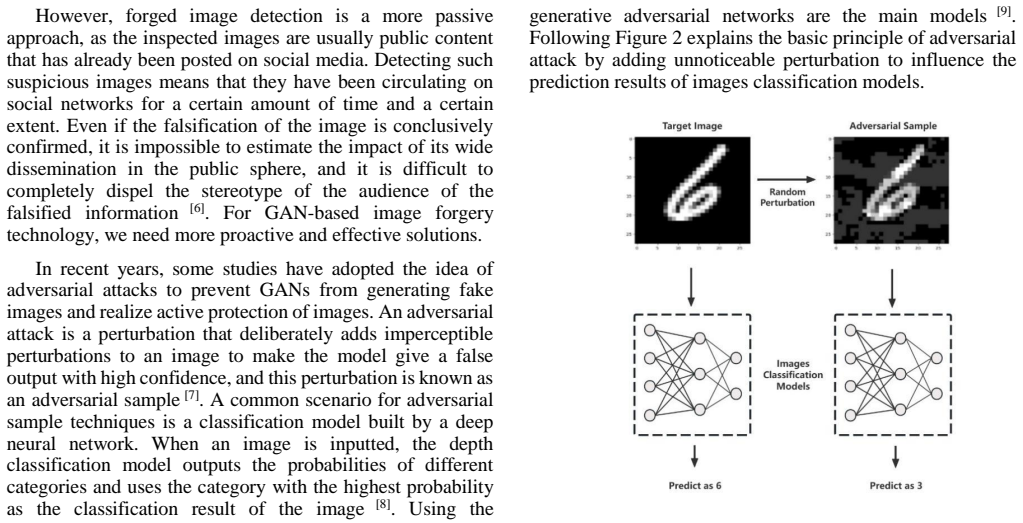
- [Figure 2 caption] The caption for Figure 2 reads 'Illustration of generative images by using generative adversarial networks,' which appears to be a copy-paste error from Figure 1; the figure is meant to illustrate the principle of adversarial attacks, not generative images.
- [Section IV-B] The text says 'we compared two different adversarial attack methods: Fast Gradient Sign Method (FGSM) and Basic Iterative Method (BIM)' but then refers to 'these three methods' and 'other three methods'; the wording should consistently identify 'Ours' as the third method, and 'other two methods' when comparing to the baselines.
- [Figure 7 caption and text] The caption for Figure 7 says 'Feature Space Visualization using t-SNE,' but the surrounding text describes principal component analysis (PCA) for dimensionality reduction; the caption and text should agree on the actual technique used.
- [Section IV-A] The evaluation metrics are enumerated as 'A. Attack Accuracy' and 'B. Adversarial Success Rate' immediately after a sentence about 'the following items,' which is confusing because the letters A and B are also used for other purposes in the paper; using a numbered list would improve clarity.
- [Table 1] The table heading says 'NOTIONS' and the column says 'Notion symbols'; the intended word is 'Notations.' Also, the table lists parameters such as alpha and beta that are later reused with different meanings in Equations (3) and (5), which is notationally confusing.
- [Section IV-A] The abstract states that 'extensive experiment analysis' was performed, but only one dataset and one classifier are used; the wording should be adjusted to match the actual experimental scope.
Circularity Check
The method's defining update in Eq. (3) is verbatim the BIM update, so the GAN-based novelty and the Ours-vs-BIM comparison collapse by construction.
-
renaming known result
[Section III-C, Equation (3) and Algorithm 1]
"Specifically, the proposed method updates the adversarial perturbations of images by the following equation 3. x(t+1) = Clip_{x,epsilon}(x(t)+alpha * sign(nabla_x J(theta,x(t),y))), (3) ... Algorithm 1 describes the attack iteration process with a threshold."
Equation (3) is exactly the BIM update described in Section II-A and attributed to reference [12]. Algorithm 1 implements only forward pass, cross-entropy loss, backpropagation, sign-gradient update, clipping, and repetition; no line references the generator G, the discriminator D, the minimax objective in Eq. (1), or any adversarial training loop connecting G, D, and the classifier. Thus the 'Ours' method is, by the paper's own equations, BIM under a new name, and the claimed GAN-based attack plus the Ours-vs-BIM comparison reduce to a single algorithm.
full rationale
There are no self-citations, no fitted parameters, and no imported uniqueness theorem, so the usual circularity modes (self-definition, fitted-input-as-prediction, self-citation chains) are absent. The concrete reduction that remains is the method definition itself: the paper's 'proposed method' in Eq. (3) and Algorithm 1 is the standard BIM update from reference [12], restated without any connection to the GAN objective in Eq. (1) or to the generator and discriminator variables introduced in the threat model. Because 'Ours' is identical by construction to the BIM baseline it is compared against in Figures 4-6 and Table 2, the central novelty claim and the comparative results are vacuous as stated. This is most accurately classified as renaming a known result rather than a fitted or self-cited derivation, and it warrants a partial-circularity score of 6.
Assumptions & free parameters
free parameters (5)
- perturbation threshold epsilon =
0.1
- step size alpha =
0.01
- number of iterations =
10
- total variation weight lambda (Eq 4) =
not reported
- dynamic weight parameters alpha and beta (Eq 5) =
not reported
assumptions (3)
- domain assumption The standard GAN min-max objective (Eq 1) is the correct model for adversarial sample generation.
- domain assumption The classifier is differentiable and the attacker has white-box gradient access to it.
- ad hoc to paper Adversarial training of generator and classifier converges to a generator that produces imperceptible, effective perturbations.
Cite this review
Pith. "Pith review of Adversarial Attack Against Images Classification based on Generative Adversarial Networks." pith.science (2026). https://pith.science/paper/HQ2KNFP2
@misc{pith2026241216662,
  author       = {Pith},
  title        = {Pith review of: Adversarial Attack Against Images Classification based on Generative Adversarial Networks},
  year         = {2026},
  howpublished = {\url{https://pith.science/paper/HQ2KNFP2}},
  note         = {Machine review of arXiv:2412.16662}
}
read the original abstract
Adversarial attacks on image classification systems have always been an important problem in the field of machine learning, and generative adversarial networks (GANs), as popular models in the field of image generation, have been widely used in various novel scenarios due to their powerful generative capabilities. However, with the popularity of generative adversarial networks, the misuse of fake image technology has raised a series of security problems, such as malicious tampering with other people's photos and videos, and invasion of personal privacy. Inspired by the generative adversarial networks, this work proposes a novel adversarial attack method, aiming to gain insight into the weaknesses of the image classification system and improve its anti-attack ability. Specifically, the generative adversarial networks are used to generate adversarial samples with small perturbations but enough to affect the decision-making of the classifier, and the adversarial samples are generated through the adversarial learning of the training generator and the classifier. From extensive experiment analysis, we evaluate the effectiveness of the method on a classical image classification dataset, and the results show that our model successfully deceives a variety of advanced classifiers while maintaining the naturalness of adversarial samples.
Figures


Figures from the paper (4 more)


Forward citations
Cited by 3 Pith papers
-
Unmasking Synthetic Realities in Generative AI: A Comprehensive Review of Adversarially Robust Deepfake Detection Systems
A systematic review of deepfake detection finds a pervasive lack of adversarial robustness evaluation across all modalities and calls for resilient, modality-agnostic detectors.
-
A Deep Learning Approach to Interface Color Quality Assessment in HCI
The authors train a CNN on website screenshots to predict user ratings of color quality and report high agreement, but provide no architecture, dataset size, or held-out validation.
-
Multi-Scale Transformer Architecture for Accurate Medical Image Classification
A Transformer with a loosely defined multi-scale attention weighting is reported to achieve 89.5% accuracy on ISIC 2017 skin lesion classification.
Reference graph
Works this paper leans on
-
[12]
Adversarial examples in the physical world
Kurakin, Alexey, Ian J. Goodfellow, and Samy Bengio. "Adversarial examples in the physical world." Artificial intelligence safety and security. Chapman and Hall/CRC, (2018). 99-112
work page 2018
-
[1]
A survey on generative adversarial net -works: Variants, applications, and training
Jabbar, Abdul, Xi Li, and Bourahla Omar. "A survey on generative adversarial net -works: Variants, applications, and training." ACM Computing Surveys (CSUR) 54.8 (2021): 1-49
work page 2021
-
[2]
Gener ative adversarial networks
Goodfellow, Ian, et al. "Gener ative adversarial networks." Communications of the ACM 63.11 (2020): 139-144
work page 2020
-
[3]
Training generative adversarial networks with limited data
Karras, Tero, et al. "Training generative adversarial networks with limited data." Ad-vances in neural information processing systems 33 (2020): 12104-12114
work page 2020
-
[4]
Generative adversarial networks for image and video synthesis: Algorithms and applications
Liu, Ming-Yu, et al. "Generative adversarial networks for image and video synthesis: Algorithms and applications." Proceedings of the IEEE 109.5 (2021): 839-862
work page 2021
-
[5]
Generative adversarial networks in computer vision: A survey and taxon omy
Wang, Zhengwei, Qi She, and Tomas E. Ward. "Generative adversarial networks in computer vision: A survey and taxon omy." ACM Computing Surveys (CSUR) 54.2 (2021): 1-38
work page 2021
-
[6]
Alias -free generative adversarial networks
Karras, Tero, et al. "Alias -free generative adversarial networks." Advances in neural in -formation processing systems 34 (2021): 852 - 863
work page 2021
-
[7]
A u -net based discriminator for generative adversarial networks
Schonfeld, Edgar, Bernt Schiele, and Anna Khoreva. "A u -net based discriminator for generative adversarial networks." Proceedings of the IEEE/CVF conference on comput -er vision and pattern recognition. (2020)
work page 2020
Show all 18 references
-
[8]
Regularizing generative adversarial networks under limited da -ta
Tseng, Hung-Yu, et al. "Regularizing generative adversarial networks under limited da -ta." Proceedings of the IEEE/CVF conference on computer vision and pattern recogni-tion. (2021)
2021
-
[9]
Gradient normalization for generative adversarial networks
Wu, Yi-Lun, et al. "Gradient normalization for generative adversarial networks." Pro-ceedings of the IEEE/CVF international conference on computer vision. (2021)
2021
-
[10]
Ccgan: Continuous conditional generative adversarial networks for image generation
Ding, Xin, et al. "Ccgan: Continuous conditional generative adversarial networks for image generation." International conference on learning representations. (2021)
2021
-
[11]
Explaining and harness -ing adversarial examples
Goodfellow, Ian J., Jonathon Shlens, and Christian Szegedy. "Explaining and harness -ing adversarial examples." arXiv preprint arXiv:1412.6572 (2014)
2014 arXiv
-
[13]
Adversarial perturbations fool deepfake detectors
Gandhi, Apurva, and Shomik Jain. " Adversarial perturbations fool deepfake detectors." 2020 International joint conference on neural networks (IJCNN). IEEE, (2020)
2020
-
[14]
Adversarial out-domain examples for generative models
Pasquini, Dario, Marco Mingione, and Massimo Bernaschi. "Adversarial out-domain examples for generative models." 2019 IEEE European Symposium on Security and Privacy Workshops (EuroS&PW). IEEE, (2019)
2019
-
[15]
Trojan attack on deep generative models in autonomous driving
Ding, Shaohua, et al. "Trojan attack on deep generative models in autonomous driving." Security and Privacy in Communication Networks: 15th EAI International Conference, SecureComm 2019, Orlando, FL, USA, October 23 -25, 2019, Proceedings, Part I 15. Springer International Pub...
2019
-
[16]
Hiding faces in plain sight: Disrupting ai face synthesis with adver -sarial perturbations
Li, Yuezun, et al. "Hiding faces in plain sight: Disrupting ai face synthesis with adver -sarial perturbations." arXiv preprint arXiv:1906.09288 (2019)
2019 arXiv
-
[17]
Fawkes: Protecting privacy against unauthorized deep learning models
Shan, Shawn, et al. "Fawkes: Protecting privacy against unauthorized deep learning models." 29th USENIX security symposium (USENIX Security 20). (2020)
2020
-
[18]
Disrupting image -translation-based deepfake algorithms with adversaria l attacks
Yeh, Chin-Yuan, et al. "Disrupting image -translation-based deepfake algorithms with adversaria l attacks." Proceedings of the IEEE/CVF Winter Conference on Applications of Computer Vision Workshops. (2020)
2020
Reviewed August 11, 2026 · model on record in the stance chip above.
Discussion (0). Continue with ORCID to comment.