REVIEW 6 major objections 10 minor 15 references
Re-ranking Reasoning Context with Tree Search Makes Large Vision-Language Models Stronger
T0 review · 6 major / 10 minor · reviewed 2026-08-07 · deepseek-v4-flash
Pith's one-line read Automatic reasoning contexts plus tree-search re-ranking of retrieved examples significantly improve VQA accuracy in large vision-language models without fine-tuning.
desk verdict A solid, incremental multimodal RAG paper with a plausible mechanism; the main soft spot is that the reward function's correlation with accuracy is asserted rather than demonstrated, and the reliability check is circular. read the letter →
The pith
A machine-rendered reading of the paper's core claim, the machinery that carries it, and where it could break.
The reading
What carries the argument
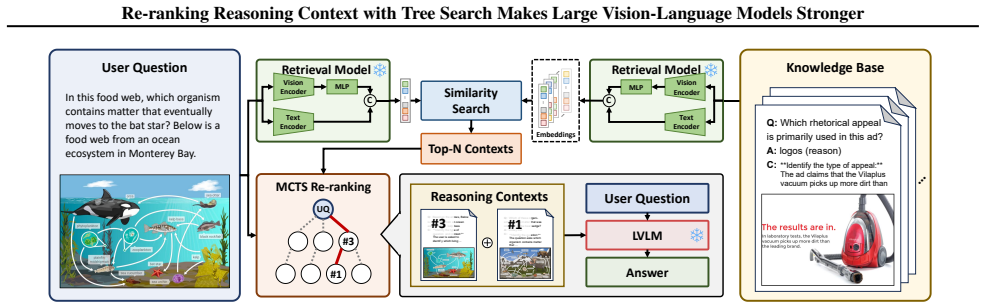
The load-bearing object is the MCTS-HR re-ranker: it treats each retrieved example as an action, builds prompt branches of depth K (here K=3) from a pool of the top N=20 retrieved examples, scores each completed branch with a weighted heuristic reward $Q_i = \alpha Q_{S,i} + (1-\alpha) Q_{M,i}$ combining self-consistency and mutual answer-prediction rewards, and backpropagates through the tree using a parent-update rule that averages the child value with the best child. The reasoning-context generator is the second mechanism: candidate contexts are produced by the LVLM and only the one that best re-predicts the ground-truth answer is stored, so the knowledge base contains verified reasoning chains instead of bare Q-A pairs.
What would settle it
Run RCTS on a VQA benchmark where the retrieval pool has been adversarially populated with high-similarity question-answer pairs whose reasoning contexts are plausible but wrong; if the MCTS-HR branch rewards still favor those examples and the final accuracy drops relative to random re-ranking, the reward heuristic fails to track helpfulness.
Extended reading notes
Core claim
On its own terms, the paper establishes that the quality of a few-shot prompt built from retrieved multimodal examples depends on two under-appreciated factors: whether each example carries a reasoning context that was verified to reproduce its answer, and whether the set and order of examples are selected jointly rather than greedily by retrieval score. The proposed framework, RCTS, first enriches each knowledge-base entry with a generated reasoning context selected by a self-consistency check (generate candidates, use each to re-predict the known answer, keep the best). It then retrieves a candidate pool using hybrid text+image embeddings and runs MCTS-HR, a Monte Carlo tree search whose branch rewards combine a self-consistency score (does the prompted answer reproduce itself under resampling?) and a mutual score (does the prompted context help answer other held-out questions?). The authors show the full combination outperforms each component alone and beats the baselines across model sizes and datasets.
Load-bearing premise
The load-bearing premise is that the self-consistency and mutual-answer rewards of Eqs. 7-9 reliably indicate whether a set of retrieved examples improves the model's answer to the user's question, and that such a helpful set exists in the top retrieval pool.
Editorial extensions
If this is right
- RCTS improves Qwen2-VL 2B on ScienceQA from 71.94% with Vanilla-RAG to 78.99%, and Qwen2-VL 7B from 86.68% to 91.44%, without any fine-tuning.
- The framework transfers to non-reasoning VQA: +1.61% on VizWiz and +3.05% on VSR-MC over Vanilla-RAG, using retrieval and re-ranking alone.
- Hybrid heuristic rewards are the best reward design: on all three reasoning datasets, self-reward alone or mutual-reward alone underperforms the weighted combination.
- The reasoning contexts alone, without MCTS, already lift accuracy (e.g., +2.3% on MathV), and MCTS alone also helps, so the two mechanisms are complementary.
- Rollouts are a compute/accuracy dial: accuracy improves from 4 to 10 rollouts and then plateaus, providing a tunable trade-off.
Reading between the lines
- The self-consistency and mutual rewards are a fixed, model-internal proxy for 'helpfulness'; one could test whether a single learned reranker trained on these rewards would reach similar accuracy at a fraction of the inference cost, since the tree search currently spends many LVLM calls per query.
- The paper's own limitation that results depend on helpful samples existing in the knowledge base suggests that RCTS's gains should shrink as retrieval pool coverage degrades; a controlled study with progressively shrunk or polluted knowledge bases would bound when re-ranking stops paying.
- Because the reward signals never use the ground-truth answer of the user's query, the same pipeline should be adaptable to open-ended generation tasks where answers cannot be rule-scored, provided a self-consistent scoring function exists.
- The framework is LVLM-agnostic and training-free, so gains may stack with stronger base models; the reported margins might narrow as zero-shot reasoning improves, but the re-ranking principle should persist.
Editorial analysis
A structured set of objections, weighed in public.
Referee Report
Summary. This paper proposes RCTS, a training-free multimodal RAG framework for VQA that augments the knowledge base with automatically generated reasoning contexts and re-ranks retrieved examples using a Monte Carlo Tree Search with heuristic rewards (MCTS-HR). The reasoning contexts are generated by prompting an LVLM with a knowledge-base question-answer pair, selecting the candidate that best predicts the known answer (Sec. 3.2). Retrieval uses hybrid text-image embeddings from PreFLMR (Sec. 3.3). Re-ranking treats the top-N retrieved question-answer pairs as actions; each branch of the tree builds a K-shot prompt and receives a reward that combines a self-consistency score and a mutual-answer-prediction score (Eqs. 7-9). Experiments on ScienceQA, MMMU-Dev, MathV, VizWiz, and VSR-MC report consistent improvements over zero-shot, random ICL, and Vanilla-RAG across Qwen2-VL 2B/7B and InternVL-2 8B, with ablations of the two framework components, reward variants, the mixing weight alpha, and the number of rollouts. The stated limitations acknowledge dependence on the knowledge base containing helpful samples and increased computational overhead.
Significance. If the reported gains are robust, the paper makes a useful engineering contribution to training-free multimodal RAG: it shows a concrete way to enrich a VQA knowledge base with generated reasoning chains and to treat example selection as a small combinatorial search problem, departing from the standard top-k retrieval baseline. The framework is model-agnostic and the released code supports reproducibility, which are strengths. The central claim is empirical, not theoretical, so the appropriate bar is whether the experiments convincingly isolate the proposed mechanisms from confounds. The current evidence supports the qualitative claim that adding reasoning contexts and search-based re-ranking helps on these benchmarks, but the experiments do not yet establish that the specific MCTS-HR reward is the driver, and several evaluation details (single-run results, small MMMU dev set, circular reliability check) limit the strength of the claim.
major comments (6)
- [Sec. 3.4 / Eqs. 7-9] The reward function that guides MCTS-HR is never validated against the quantity it is supposed to proxy, namely whether a branch's context improves the final answer to the user's question. Both terms are computed with the same LVLM that produces the final answer: self-consistency measures agreement among repeated generations conditioned on the branch, and the mutual reward measures accuracy on unrelated knowledge-base questions when the branch is prepended. A branch that makes the model confidently repeat a wrong answer, or that helps on KB questions while hurting the user's question, receives a high reward. The ablations in Tab. 4 and Fig. 5(a) show that hybrid reward outperforms the alternatives in aggregate, but they do not distinguish reward-guided selection from the possibility that any re-ranking within the top-N pool, or simply the greater number of candidate prompts evaluated by the search, drives the gains. The missing control is a random re-ranking baseline that uses the same retrieved pool, the same reasoning contexts, and the same number of prompt evaluations but selects branches without the heuristic reward. Please report such a control, or provide a correlation analysis between Q_i and final-answer correctness on a development set.
- [Sec. 4.3 / Table 2] All main numbers are reported as single point estimates with no variance, and the MMMU evaluation uses only the 150-question dev set. For a method whose key component is stochastic (MCTS rollouts and LVLM sampling), a single run does not rule out that the reported gains, e.g., 44.00 vs. 42.67 on MMMU-Dev or 24.01 vs. 18.42 on MathV, are within run-to-run noise. Please provide multiple seeds or repeated evaluations (at least for the MCTS-HR component, whose rollouts and sampling are randomized), and state the number of runs used for all tables. If computational cost makes repeated evaluation infeasible, please say so explicitly and provide at least one error-bar experiment on a subset, e.g., ScienceQA with Qwen2-VL 2B.
- [Sec. 4.5 / Table 6] The reliability check in Tab. 6 is circular by construction. The reasoning context is scored by feeding the same (Q, C) pair back to the same LVLM that generated C, and the context was selected precisely because it predicts the known answer A_kb under this same procedure. High percentages therefore confirm that the selection criterion was applied, not that the reasoning context helps new user queries. The paper's actual evidence for usefulness is the end-task accuracy in Tab. 2 and Tab. 4, which does not need Tab. 6; please either remove Tab. 6 or replace it with a non-circular check, for example measuring how often the generated reasoning context, when shown to the final LVLM in the K-shot prompt, is consistent with the retrieved example's answer and with the correct answer on a held-out subset.
- [Sec. 4.3 / Tables 2-3] The comparison with the RAG baseline is incomplete in a way that affects the central claim. Vanilla-RAG is evaluated with the original question-answer pairs only (Sec. 3.4 implies the baseline uses the same prompt format), so it is unclear whether the gains come from the reasoning context enrichment, from the MCTS re-ranking, or from an interaction of the two. Tab. 4 partially addresses this by ablating each component, but it does so using MCTS with the full reward. A cleaner decomposition would compare (i) Vanilla-RAG + reasoning contexts without re-ranking and (ii) RCTS without reasoning contexts but with MCTS on raw question-answer pairs. The current 'Rea. Con. only' row (88.33 on ScienceQA) uses random or retrieval-based ordering; please specify exactly how the context-only baseline orders its K examples, since that determines whether it is a fair comparison for isolating the re-ranking benefit.
- [Sec. 3.2 / Fig. 3] The reasoning context generation requires access to the ground-truth answer A_kb of each knowledge-base question, and the final answer generation also uses A_kb inside the reasoning context. This is legitimate for a training-free KB-side construction, but the paper should be clearer about the cost: generating Nc=10 candidate contexts per KB sample and running Np=10 verifications per candidate, for KBs of 17k-20k samples, is a substantial offline computation whose wall-clock and API costs are not reported. The limitations section mentions 'more computational overhead' but does not quantify it, even though the usefulness of the framework depends on this trade-off. Please add a concrete estimate of the KB construction cost (number of LVLM calls and approximate GPU-hours per dataset) and of the per-query MCTS cost, so that the claimed training-free advantage is meaningful.
- [Sec. 4.2] Several hyperparameters are fixed without sensitivity analysis: the tree width (3), the number of sampled actions per node (implied by the maximum width), and the early-stopping criterion are not ablated, while Tab. 5 and Fig. 5(b) only study alpha and rollouts. Since the method's computational cost scales with the number of reward evaluations (P x Ns x Nm calls per query), it is important to know whether the default width of 3 and the early-stopping rule are critical or whether a simpler search, e.g., beam search over the same reward, would achieve comparable accuracy. Please add an ablation of the tree width and a comparison with a non-MCTS re-ranking baseline that uses the same reward (e.g., greedy or beam selection), which would clarify the contribution of the tree-search mechanism itself.
minor comments (10)
- [Sec. 3.4 / Eq. 10] The backpropagation formula in Eq. 10 is unusual: the parent value is a convex combination of its previous average and the changed child's value, plus an explicit max over all children. The text says the formula accounts for 'the reliability of the answers of all child nodes' but the average term uses only the changed child Q(c), not all children's values. Please clarify the notation and the exact update rule, and make sure the implementation matches the formula (the released code would be the source of truth).
- [Sec. 3.4 / Eq. 6] The action sampling probability in Eq. 6 uses normalized similarity scores s_i, but the paper does not state how the similarity scores are normalized across the top-N retrieved samples or whether the scores come from the same hybrid embedding used in Eq. 4. Please define s_i explicitly.
- [Sec. 4.5 / Tab. 6] The reported accuracy values for the reasoning context (e.g., 100.0 for Qwen2-VL 7B on ScienceQA) are suspiciously high for a generation-quality metric, which further indicates that the metric measures memorization of the known answer rather than reasoning quality. A qualitative assessment or a human evaluation of the generated reasoning contexts would be more informative.
- [Sec. 4.4 / Tab. 5] The alpha sweep in Tab. 5 shows non-monotonic behavior: alpha=0.8 gives 54.00 on MMMU while alpha=0.2 gives 53.33, and the differences are within a couple of points on a 150-question set. Please indicate whether any of these differences are statistically significant, or present the numbers with confidence intervals.
- [Sec. 2 / Related Work] The related work section cites RATP as using MCTS with RAG, but the contrast with the proposed method could be sharpened: RATP applies MCTS to the reasoning chain in the answer, whereas RCTS applies MCTS to select retrieved examples. Please add one sentence making this distinction to help position the contribution.
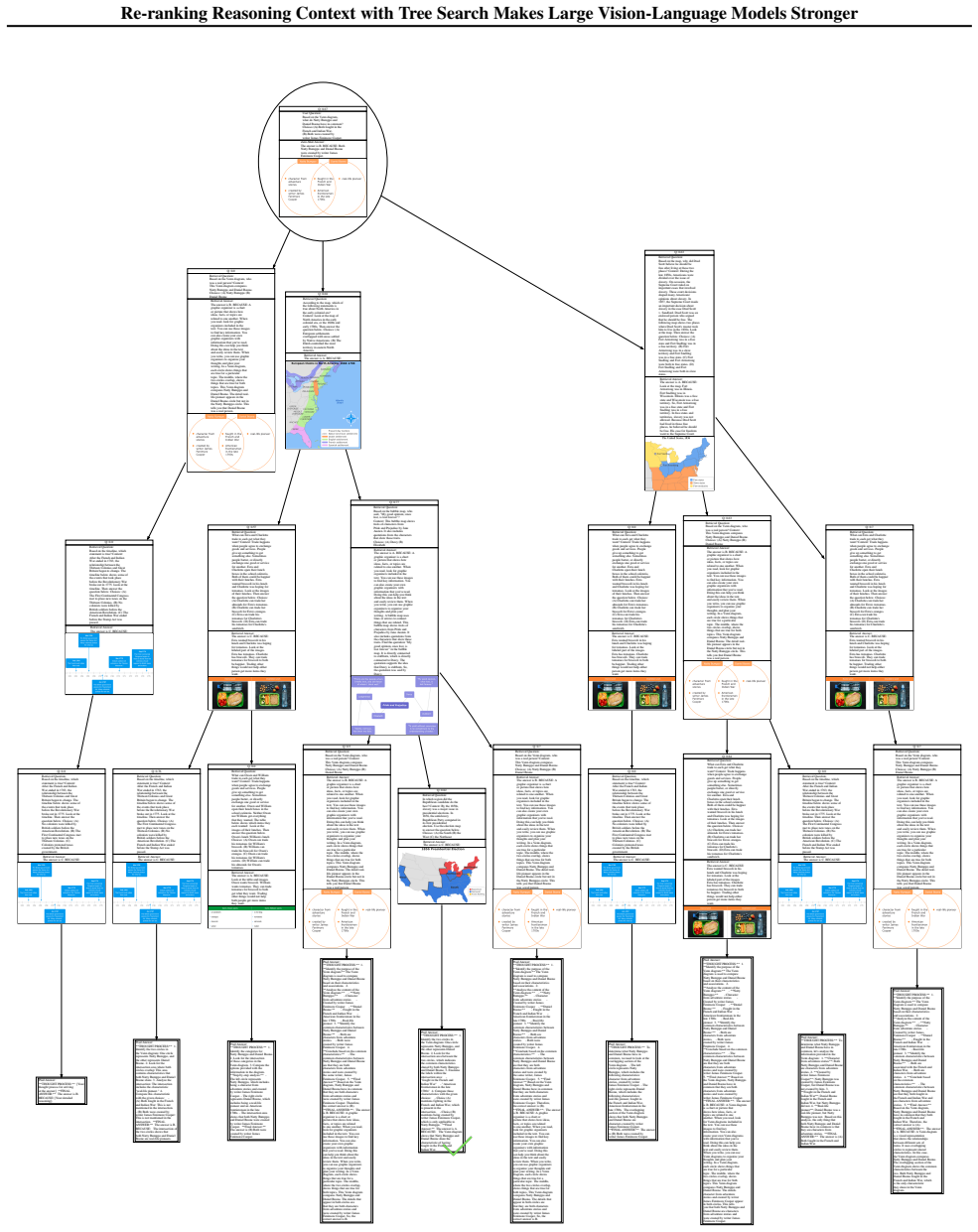
- [Appendix D] The qualitative figures (Figs. 11-16) are extremely large and in the submitted PDF they are hard to read; the captions are also partially cut off (e.g., Fig. 15 ends mid-sentence). Please compress the figures, ensure all panel labels are legible, and complete the truncated caption.
- [Sec. 4.3 / Tab. 3] For VizWiz and VSR-MC, the paper reports only Qwen2-VL 7B and says reasoning context is excluded because answers are brief. It would be useful to state the exact prompt format used for these baselines, since VSR-MC is an artificial multiple-choice construction introduced by the authors.
- [Sec. 4.2] The paper states that LVLMs over 7B are run in 4-bit AWQ quantization. As quantization can affect the reliability of self-consistency and mutual rewards, please state whether the same quantized model is used for both reward computation and final answer, and whether any checks were done against the unquantized model on a small subset.
- [Sec. 4.1 / Tab. 1] For MathV, the knowledge base uses the deduplicated test set while the evaluation set is test-mini, which is a standard practice but worth making explicit, since using test-set examples in the KB can be seen as a form of ground-truth leakage if the test-mini is a subset of the test set. Please confirm that test-mini samples are excluded from the KB.
- [Sec. 3.2] The method is called 'self-consistent evaluation mechanism' but Sec. 3.2 uses only a single-generation candidate selection: Nc candidate contexts are generated and scored by Np predicted answers. The self-consistency terminology usually refers to majority voting over multiple samples; please clarify whether any sampling/repetition is used in the candidate generation and scoring, or rename the mechanism.
Circularity Check
Circularity is confined to the self-referential reasoning-context reliability check; the central held-out accuracy comparison is not circular.
-
self definitional
[Section 3.2, Reasoning Context with Self-Consistent Evaluation (Fig. 3b)]
"These predicted answers are evaluated with the ground truth answer Akb to obtain a set of prediction scores {Score_i}_{i=1}^{Nc}. Finally, the candidate reasoning context with the highest score is selected as the associated reasoning context."
The reasoning context is selected precisely because, when spliced with the question, it makes the LVLM reproduce the known ground-truth answer. The selection objective is therefore defined in terms of answer reproducibility, so any later claim that the context is 'accurate' because it reproduces that answer is restating the construction criterion rather than providing independent evidence. This does not invalidate the downstream retrieval/re-ranking experiments, since those are evaluated on held-out test answers.
-
fitted input called prediction
[Section 4.5 Discussion, Table 6]
"Table 6 demonstrates the reliability and accuracy of the reasoning context generated by our self-consistency evaluation strategy. Specifically, we evaluate the accuracy of the ground-truth answer with the predicted answer, which is generated by splicing the question and the reasoning context into a prompt that yields the corresponding answer."
This 'reliability/accuracy' metric is exactly the same score used as the selection criterion in Section 3.2: a context is kept only if Q + C produces the known answer, and Table 6 then reports that Q + C produces the known answer. The 90-100% numbers are an artefact of the construction, not a prediction of whether the context helps answer new user questions. The central RCTS accuracy gains on ScienceQA, MMMU, MathV, VizWiz, and VSR-MC are still measured on disjoint evaluation sets and are therefore independent of this circular reliability check.
full rationale
The main claim—that RCTS with reasoning contexts and MCTS-HR re-ranking improves accuracy on multiple VQA benchmarks—is an empirical result on held-out test splits, with the knowledge base constructed from training/validation splits, so the core comparison is not circular. The only concrete circularity is the Section 4.5 reliability evidence: the reasoning contexts are generated and selected to reproduce known answers, and Table 6 re-reports that same reproduction accuracy as evidence of reliability. That is a fitted-input-called-prediction/self-definitional step. The heuristic nature of the MCTS rewards (Eqs. 7-9) and the absence of a correlation analysis with final answer correctness are validity concerns rather than circularity, because the final test metrics do not reduce to those rewards by construction. No load-bearing self-citations or imported uniqueness arguments are present. I therefore score 4: one self-referential validation item, while the central claim retains independent empirical content.
Assumptions & free parameters
free parameters (6)
- reward weight alpha =
0.2
- reasoning context candidates Nc and predicted answers Np =
10 each
- self-consistency samples Ns and mutual samples Nm =
5 each
- few-shot depth K =
3
- retrieval pool size N =
20
- rollouts P =
10
assumptions (4)
- domain assumption The rule-based evaluator R correctly judges answer equivalence.
- domain assumption Helpful examples exist in the knowledge base for each test question.
- ad hoc to paper In-context consistency is a reliable proxy for answer correctness.
- domain assumption Multiple stochastic generations from the LVLM provide valid samples for self-consistency.
Cite this review
Pith. "Pith review of Re-ranking Reasoning Context with Tree Search Makes Large Vision-Language Models Stronger." pith.science (2026). https://pith.science/paper/HQQLQIWH
@misc{pith2026250607785,
  author       = {Pith},
  title        = {Pith review of: Re-ranking Reasoning Context with Tree Search Makes Large Vision-Language Models Stronger},
  year         = {2026},
  howpublished = {\url{https://pith.science/paper/HQQLQIWH}},
  note         = {Machine review of arXiv:2506.07785}
}
read the original abstract
Recent advancements in Large Vision Language Models (LVLMs) have significantly improved performance in Visual Question Answering (VQA) tasks through multimodal Retrieval-Augmented Generation (RAG). However, existing methods still face challenges, such as the scarcity of knowledge with reasoning examples and erratic responses from retrieved knowledge. To address these issues, in this study, we propose a multimodal RAG framework, termed RCTS, which enhances LVLMs by constructing a Reasoning Context-enriched knowledge base and a Tree Search re-ranking method. Specifically, we introduce a self-consistent evaluation mechanism to enrich the knowledge base with intrinsic reasoning patterns. We further propose a Monte Carlo Tree Search with Heuristic Rewards (MCTS-HR) to prioritize the most relevant examples. This ensures that LVLMs can leverage high-quality contextual reasoning for better and more consistent responses. Extensive experiments demonstrate that our framework achieves state-of-the-art performance on multiple VQA datasets, significantly outperforming In-Context Learning (ICL) and Vanilla-RAG methods. It highlights the effectiveness of our knowledge base and re-ranking method in improving LVLMs. Our code is available at https://github.com/yannqi/RCTS-RAG.
Figures


Figures from the paper (13 more)






Reference graph
Works this paper leans on
-
[2]
Therefore, the correct constellation is B
The sum of the numbers on the stars in constellation B is 8 + 5 + 7 = 20, which matches the given condition. Therefore, the correct constellation is B. Pred Answer: The answer is \boxed{A}. BECAUSE: The sum of the numbers on the stars in constellation A is 20, and all the numbers are greater than
-
[3]
Therefore, the correct constellation is A. Q: 0.45 Retrieval Question: Hint: Please answer the question and provide the correct option letter, e.g., A, B, C, D, at the end. Question: The star shown in the picture is made by fitting together 12 congruent equilateral triangles. The perimeter of the star is $36 \mathrm{~cm}$. What is the perimeter of the gre...
-
[4]
**Current Position of Kangaroos:** - Let's count the kangaroos in each row and column to check if they meet the requirement of exactly 2 kangaroos in each row and column. 3. **Analyzing Each Row and Column:** - **Row Analysis:** - Row 1: 1 kangaroo - Row 2: 2 kangaroos - Row 3: 1 kangaroo - Row 4: 2 kangaroos - Row 5: 1 kangaroo - **Column Analysis:** - C...
-
[5]
- For example, the first row and the first column both have exactly 2 kangaroos
**Analysis:** - In the current configuration, some rows and columns already have exactly 2 kangaroos. - For example, the first row and the first column both have exactly 2 kangaroos. 4. **Required Changes:** - To achieve the goal, we need to adjust the distribution of kangaroos in the remaining rows and columns. - Specifically, we need to move kangaroos f...
-
[6]
We already have two kangaroos in the third column
Finally, look at the fourth row. We already have two kangaroos in the third column. To satisfy the condition, we need to place a kangaroo in the sixth column. By placing the kangaroos in these specific columns, we ensure that each row and each column have exactly two kangaroos. Therefore, the minimum number of kangaroos that must jump is 1. Pred Answer: T...
-
[7]
the surroundings . . . each bottle,
In the third row, we need to move 1 kangaroo from the third column to the fourth column. 4. In the first column, we need to move 1 kangaroo from the second row to the third row. 5. In the second column, we need to move 1 kangaroo from the first row to the second row. 6. In the third column, we need to move 1 kangaroo from the third row to the fourth row. ...
-
[8]
**Understand the relationship between temperature and thermal energy:** A change in temperature indicates a change in thermal energy. An increase in temperature means thermal energy has increased, while a decrease in temperature means thermal energy has decreased
-
[9]
the surroundings . . . each bottle
**Analyze the temperature changes:** - The brown bottle initially at 19°C increases to 25°C. - The clear bottle initially at 19°C decreases to 22°C. 4. **Determine the direction of thermal energy transfer:** Since the temperature of the brown bottle increased, it means thermal energy was transferred into the brown bottle from its surroundings. Conversely,...
Show all 15 references
-
[10]
Understand the concept of thermal energy transfer: - An increase in temperature indicates that thermal energy was transferred into the object
Determine if the temperature increased or decreased for each bottle: - Brown bottle: Temperature increased by 6°C - Clear bottle: Temperature increased by 3°C 3. Understand the concept of thermal energy transfer: - An increase in temperature indicates that thermal energy was t...
-
[11]
the surroundings . . . each bottle
**Match the direction of energy transfer with the options provided:** - Option A: "the surroundings . . . each bottle" suggests energy transfer from the surroundings to the bottles, which matches the observed temperature increases. - Option B: "each bottle . . . the surroundin...
-
[12]
- For the clear bottle, the temperature increased from 19°C to 22°C, also indicating that thermal energy was transferred into the bottle from the surroundings
**Determine the direction of thermal energy transfer:** - For the brown bottle, the temperature increased from 19°C to 25°C, indicating that thermal energy was transferred into the bottle from the surroundings. - For the clear bottle, the temperature increased from 19°C to 22°...
-
[13]
the surroundings . . . each bottle
**Match the direction of energy transfer with the options provided:** - Option A: "the surroundings . . . each bottle" suggests energy transfer from the surroundings to the bottles, which matches the observed temperature increases. - Option B: "each bottle . . . the surroundin...
-
[14]
fought in the French and Indian War
Look for the intersection of these categories in the Venn diagram. 3. Compare the options provided with the information in the diagram. **Step-by-step analysis:** - The left circle represents Natty Bumppo, which includes being a character from adventure stories and created by ...
-
[15]
fruit intake
**Final Answer:** Based on the Venn diagram, Natty Bumppo and Daniel Boone have in common that they are both characters from adventure stories and were created by writer James Fenimore Cooper. **FINAL ANSWER:**: The answer is B. BECAUSE: A Venn diagram is a chart or picture th...
2004
-
[20]
The sum of the numbers on the stars in constellation B is 8 + 5 + 7 = 20, which matches the given condition
Therefore, constellation A cannot be the Kangaroo constellation. The sum of the numbers on the stars in constellation B is 8 + 5 + 7 = 20, which matches the given condition. Therefore, constellation B is the Kangaroo constellation. Q: 0.48 Retrieval Question: Hint: Please answ...
Reviewed August 7, 2026 · model on record in the stance chip above.
Discussion (0). Sign in to comment.