REVIEW 2 major objections 4 minor 187 references
Warm-started multigrid can replace distributed FFTs for fixed-mesh gravity and is the solver that makes differentiable moving-mesh PM practical.
Reviewed by Pith at T0; open to challenge. T0 means a machine referee read the full paper against a public rubric. the ladder, T0–T4 →
T0 review · grok-4.5
2026-07-14 07:51 UTC pith:HQWAY546
load-bearing objection Solid JAX methods paper: multigrid as the real enabler for differentiable moving-mesh PM, with fixed-mesh FFT competition that is real but hardware-tied. the 2 major comments →
Fast(er)PM and Moving Mesh: JAX-native Geometric Multigrid Methods
The pith
A machine-rendered reading of the paper's core claim, the machinery that carries it, and where it could break.
Core claim
Geometric multigrid for particle–mesh gravity plays two complementary roles: on fixed meshes, warm-started Chebyshev multigrid is a competitive, communication-avoiding alternative to distributed FFTs, and on moving meshes it becomes the enabling solver for a differentiable variable-coefficient curvilinear Poisson problem that FFT diagonalization cannot handle.
What carries the argument
Warm-started Chebyshev multigrid as defect correction: the previous time-step potential (optionally growth-scaled) is used as the initial guess so that one or two V-cycles correct only the residual; the same hierarchy, with geometry coefficients restricted level-by-level, solves the curvilinear Laplace–Beltrami operator on the deformed mesh.
Load-bearing premise
That the measured wall-clock and GPU-time gains over distributed FFTs on the tested GPU cluster will hold broadly enough to make multigrid a practical alternative, even though the paper itself notes that those gains depend on interconnect and library performance.
What would settle it
On a production-scale fixed mesh (for example 1024^3 or 2048^3), run matched FFT and warm one- or two-cycle multigrid force evaluations on the same allocation; if multigrid is systematically slower in wall-clock and higher in total GPU-seconds, or if two-cycle field-level correlation with the FFT reference collapses, the competitive-fixed-mesh claim fails. Separately, if the moving-mesh reconstruction cannot recover small-scale transfer above the static mesh at the same cell count once the geometry is strongly deformed, the adaptive claim fails.
Editorial analysis
A structured set of objections, weighed in public.
Referee Report
Summary. The paper presents a JAX-native geometric multigrid Poisson framework for particle–mesh cosmology and argues that multigrid plays two complementary roles: on fixed meshes, warm-started Chebyshev multigrid is a competitive, communication-avoiding alternative to distributed FFTs; on moving meshes, it is the enabling solver for a variable-coefficient curvilinear Poisson problem that ordinary FFT diagonalization cannot handle. For static FastPM, temporal coherence is exploited via recycled/growth-scaled predictors so that one or two warm V-cycles reach field-level accuracy relative to a matched discrete FFT operator, with reported wall-clock and GPU-time gains and a lower memory floor on Perlmutter A100 nodes. The same multigrid hierarchy is then used for a potential-flow moving-mesh PM scheme (after Pen), with a conservative finite-volume Laplace–Beltrami operator, mesh-motion and gravity solves, limiters, and an implicit adjoint that supports end-to-end differentiable reconstruction. Accuracy is tested against FFT references and CAMELS/AREPO CV0, and a reconstruction stress test shows recovery of small-scale amplitude at fixed nominal resolution.
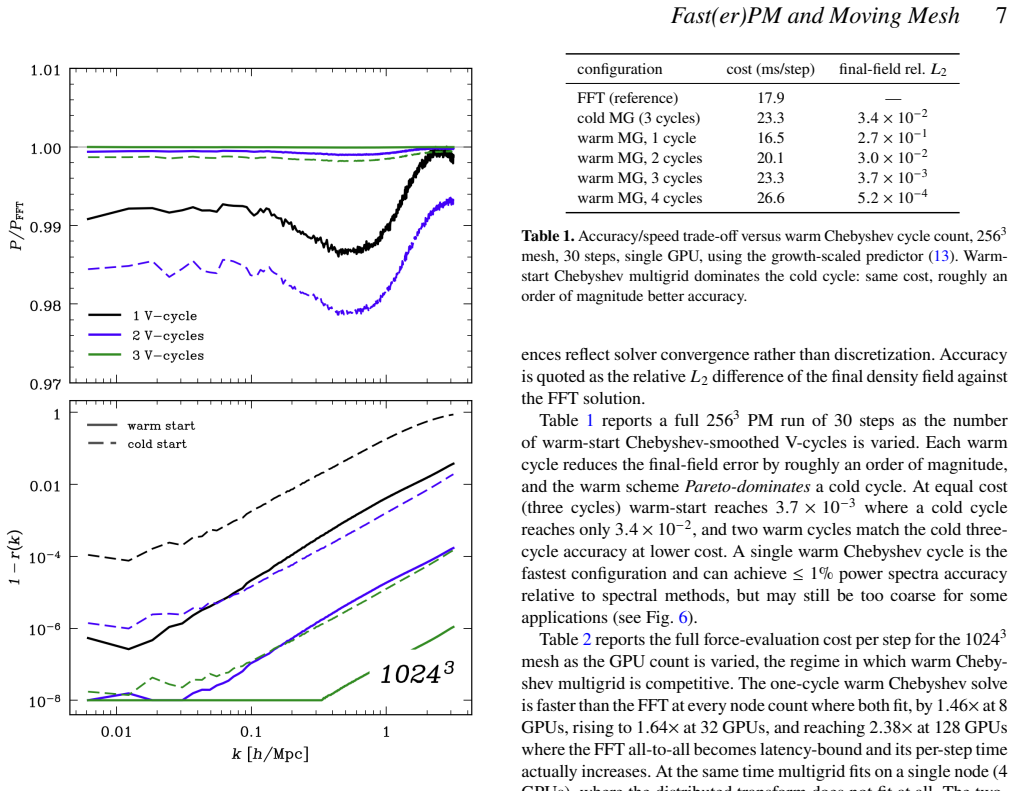
Significance. If the dual-role claim holds, the work is a useful methods contribution for GPU-native, autodiff-compatible cosmological PM solvers. The enabling half is particularly valuable: a regular-array, JAX-compilable moving-mesh gravity path with shared multigrid infrastructure and a carefully constructed adjoint fills a gap between fixed-grid FastPM-style codes and adaptive force methods that are hard to differentiate. Strengths include matched discrete-operator comparisons, residual and field-level diagnostics (transfer/stochasticity), Appendix A error-accumulation tests, strong-scaling and memory-floor measurements, and a finite-difference check of the curvilinear adjoint under strong compression. Development code links are provided. The fixed-mesh performance half is more provisional because the measured speedups are machine- and interconnect-dependent, but the structural communication and memory arguments remain of practical interest even if wall-clock ratios do not fully generalize.
major comments (2)
- [§3.3–3.5, Tables 2–3] §3.3–3.5 and Tables 2–3: the abstract and introduction frame warm Chebyshev multigrid as a competitive alternative with up to ~2× lower total GPU time. The measured 1.5–2.4× wall-clock and ~2× GPU-time gains are on Perlmutter A100 + Slingshot, which the text itself flags as likely suboptimal for all-to-all and machine-dependent. The structural advantages (halo vs all-to-all, real vs complex scratch, lower memory floor) are well supported, but the dual-role claim’s fixed-mesh half currently over-weights fabric-specific timings. Please rebalance the abstract/conclusions to lead with communication pattern and memory floor, present wall-clock ratios as platform-specific evidence, and (if feasible) add a brief comparison or discussion against a stronger distributed FFT baseline (e.g. jaxdecomp/cuDecomp on a fabric more favorable to collectives).
- [§4.7–4.8, Figs. 10–14] §4.7–4.8 and Figs. 10–14: the moving-mesh accuracy and reconstruction claims rest on a single small-box CAMELS CV0 setup (25 h^{-1} Mpc, 256^3 particles) and a deliberately minimal reconstruction experiment. That is acceptable for a methods demonstration, but the paper’s bridge claim toward “differentiable adaptive-force cosmological simulations” needs clearer scope limits: state that the tests do not yet establish cosmology- or redshift-general accuracy, quantify sensitivity to free limiter/κ parameters (Appendix C), and note that production field-level inference would require likelihood, priors, and bias validation beyond the MSE reconstruction shown.
minor comments (4)
- [§4.3] §4.3: note that Jacobi outperforms Chebyshev for the variable-coefficient Laplace–Beltrami problem, opposite to the static-mesh default. A short remark on why (spectrum of the preconditioned operator, anisotropy) would help readers choose smoothers.
- [Table 1, Figs. 4–6] Table 1 vs Figs. 4–6: cycle-count accuracy is shown at 256^3 while production scaling is at 1024^3/2048^3. A brief statement that the 1–2 warm-cycle operating point remains adequate at the larger sizes (or a small residual/transfer check) would tighten the accuracy–performance link.
- [§4.8.1–4.8.2] Eqs. (35)–(38): the straight-through limiter treatment and √g-conjugated adjoint are important; a one-sentence pointer in the main text to the finite-difference agreement under √g_min≈0.15 would make the reverse-mode claim easier to verify without hunting the prose.
- Minor presentation: a few missing spaces in compound words in the compiled text (e.g. “particle–mesh”, “all-to-all”); ensure figure captions for Figs. 2–3 and 8 fully define symbols used in the panels.
Circularity Check
Methods paper with external FFT/N-body benchmarks; warm-start is residual defect correction, not a tautological prediction, and self-citations supply infrastructure rather than the performance claims.
specific steps
-
self citation load bearing
[§2.3 Geometric multigrid; §3.4 Implementation (DiffHydro baseline)]
"Following the notation of the diffhydro self-gravity solver, the flat-mesh PM Poisson problem is written as A_h φ_h = F_h ... The first three are the additions that give the present solver its speed over the originally published version in DiffHydro, and all are exposed as flags with the original Jacobi path preserved as a fallback."
The flat multigrid hierarchy and Jacobi smoother are imported from the author's DiffHydro paper. This is infrastructure reuse, not a uniqueness or uniqueness-of-result claim: the present work's performance and accuracy conclusions rest on new Chebyshev fusion, warm-start timings vs FFT, and moving-mesh tests against external references, so the self-citation is not load-bearing for the dual-role claim.
full rationale
The paper is a numerical methods contribution whose central claims are (i) warm-started Chebyshev multigrid can match or beat distributed FFTs on fixed meshes under stated hardware conditions and (ii) the same multigrid hierarchy enables a differentiable moving-mesh PM solve of a variable-coefficient curvilinear Poisson equation that FFT diagonalization cannot handle. Both claims are checked against external references: the spectral FFT with the same discrete operator (Tables 1–3, Figs. 4–6, Appendix A) and the CAMELS CV0 AREPO N-body field (Figs. 10–14). Warm starting is standard defect correction of a residual (Eqs. 11–12, §3.1–3.2); the residual is not forced to zero by construction, and accuracy is measured against the FFT reference rather than redefined as success. Self-citations (DiffHydro, JaxPM, jaxdecomp) provide the prior Jacobi baseline, array framework, and distributed primitives; the production Chebyshev fusion, timings, moving-mesh limiters, and adjoint finite-difference checks are new content evaluated in this work. No uniqueness theorem, fitted parameter renamed as prediction, or self-definitional loop carries the dual-role claim. Minor self-citation of infrastructure is normal and non-load-bearing for the conclusions, so the circularity score is 1.
Axiom & Free-Parameter Ledger
free parameters (5)
- Chebyshev spectral interval parameter α
- Warm V-cycle budget (1–2 production cycles)
- Mesh-response gain κ
- Limiter parameters c_max, s_max, source smoothing, repulsive strength η
- Weighted-Jacobi ω=2/3 and pre/post sweep counts (ν1=ν2=2 moving mesh)
axioms (4)
- domain assumption Discrete periodic Poisson with seven-point Laplacian (static) or conservative finite-volume Laplace–Beltrami (moving) is an adequate gravity model for the PM applications considered.
- standard math Geometric multigrid V-cycles with local smoothers converge with mesh-independent factor for the model/variable-coefficient problems used.
- domain assumption Potential-flow mesh map x=ξ+∇ψ with limiters remains a useful quasi-Lagrangian adaptive force model without destroying large-scale phases.
- ad hoc to paper Straight-through treatment of non-smooth limiters in reverse mode yields usable gradients for reconstruction.
read the original abstract
Efficient, differentiable Poisson solvers are a key component of modern particle--mesh simulations and field-level inference pipelines. FFT-based solvers are extremely effective on fixed Cartesian meshes, but they impose global all-to-all communication and rely on symmetries that are lost in adaptive or non-Cartesian coordinates. In this work, we present a JAX-native geometric multigrid framework for particle--mesh gravity and argue that multigrid plays two complementary roles: on fixed meshes it can be a competitive, communication-avoiding alternative to FFTs, while on moving meshes it becomes the enabling solver. For static FastPM evolution, warm-started Chebyshev multigrid acts as a defect-correction method, exploiting temporal coherence between time steps to reduce the number of V-cycles required for field-level accuracy. At large mesh sizes this reduces memory pressure and yields comparable or faster wall-clock performance than distributed FFTs, with up to a factor of two reduction in total GPU time at fixed final mesh size. We then embed the same solver in a differentiable moving-mesh particle--mesh method, where adaptive coordinate deformation produces a variable-coefficient curvilinear Poisson equation that cannot be solved by ordinary FFT diagonalization. The resulting method concentrates force resolution in nonlinear structures while retaining a regular, JAX-compilable, automatically differentiable array workflow. These results suggest geometric multigrid can be a practical bridge between fast fixed-grid PM methods and differentiable adaptive-force cosmological simulations.
Figures




Reference graph
Works this paper leans on
-
[1]
Nonlinear Reconstruction of the Velocity Field
Nonlinear Reconstruction of the Velocity Field. , keywords =. doi:10.3847/1538-4357/ab5580 , archivePrefix =. 1908.08217 , primaryClass =
work page internal anchor Pith review Pith/arXiv arXiv doi:10.3847/1538-4357/ab5580 1908
-
[2]
Hydrodynamic methods and sub-resolution models for cosmological simulations
Hydrodynamic methods and sub-resolution models for cosmological simulations. arXiv e-prints , keywords =. doi:10.48550/arXiv.2502.06954 , archivePrefix =. 2502.06954 , primaryClass =
work page internal anchor Pith review Pith/arXiv arXiv doi:10.48550/arxiv.2502.06954
-
[3]
The Santa Barbara Cluster Comparison Project: A Comparison of Cosmological Hydrodynamics Solutions. , keywords =. doi:10.1086/307908 , archivePrefix =. astro-ph/9906160 , primaryClass =
-
[4]
The Sunyaev-Zel'dovich angular power spectrum as a probe of cosmological parameters. , keywords =. doi:10.1046/j.1365-8711.2002.05889.x , archivePrefix =. astro-ph/0205468 , primaryClass =
-
[5]
Differentiable Stochastic Halo Occupation Distribution
Differentiable stochastic halo occupation distribution. , keywords =. doi:10.1093/mnras/stae350 , archivePrefix =. 2211.03852 , primaryClass =
work page internal anchor Pith review Pith/arXiv arXiv doi:10.1093/mnras/stae350
-
[6]
Halo Nonlinear Reconstruction. , keywords =. doi:10.3847/1538-4357/aa89e7 , archivePrefix =. 1703.08301 , primaryClass =
work page internal anchor Pith review Pith/arXiv arXiv doi:10.3847/1538-4357/aa89e7
-
[7]
Nonlinear reconstruction of redshift space distortions
Nonlinear reconstruction of redshift space distortions. , keywords =. doi:10.1103/PhysRevD.97.043502 , archivePrefix =. 1711.03218 , primaryClass =
work page internal anchor Pith review Pith/arXiv arXiv doi:10.1103/physrevd.97.043502
-
[8]
Journal of Computational Physics , volume=
Shaping the force law in two-dimensional particle-mesh models , author=. Journal of Computational Physics , volume=. 1974 , publisher=
1974
-
[9]
Computer Simulation Using Particles
-
[10]
Numerical techniques for large cosmological N-body simulations. , keywords =. doi:10.1086/191003 , adsurl =
-
[11]
Particle-Mesh code for cosmological simulations. arXiv e-prints , keywords =. doi:10.48550/arXiv.astro-ph/9712217 , archivePrefix =. astro-ph/9712217 , primaryClass =
-
[12]
The Athena++ Adaptive Mesh Refinement Framework: Design and Magnetohydrodynamic Solvers. , keywords =. doi:10.3847/1538-4365/ab929b , archivePrefix =. 2005.06651 , primaryClass =
-
[13]
Towards optimal parallel PM N-body codes: PMFAST
Towards optimal parallel PM N-body codes: PMFAST. , keywords =. doi:10.1016/j.newast.2005.02.001 , archivePrefix =. astro-ph/0402443 , primaryClass =
work page internal anchor Pith review Pith/arXiv arXiv doi:10.1016/j.newast.2005.02.001 2005
-
[14]
Mathematics of computation , volume=
Multi-level adaptive solutions to boundary-value problems , author=. Mathematics of computation , volume=
-
[15]
USSR Computational Mathematics and Mathematical Physics , volume=
A relaxation method for solving elliptic difference equations , author=. USSR Computational Mathematics and Mathematical Physics , volume=. 1962 , publisher=
1962
-
[16]
Adaptive Refinement Tree: A New High-Resolution N-Body Code for Cosmological Simulations. , keywords =. doi:10.1086/313015 , archivePrefix =. astro-ph/9701195 , primaryClass =
-
[17]
A Linear Moving Adaptive Particle-Mesh N-Body Algorithm. , keywords =. doi:10.1086/192219 , adsurl =
-
[18]
Proceedings of the 1998 IEEE International Conference on Acoustics , year = 1998, volume =
FFTW: an adaptive software architecture for the FFT. Proceedings of the 1998 IEEE International Conference on Acoustics , year = 1998, volume =. doi:10.1109/ICASSP.1998.681704 , adsurl =
-
[19]
The Design and Implementation of FFTW3. IEEE Proceedings , keywords =. doi:10.1109/JPROC.2004.840301 , adsurl =
-
[20]
, year = 2026, month = jun, doi =
jFoF: GPU Friends-of-Friends Halo Finding with Gradient Propagation. , year = 2026, month = jun, doi =
2026
-
[21]
Differentiable cosmological hydrodynamics for field level inference and high dimensional parameter constraints. , keywords =. doi:10.1093/mnras/staf1785 , archivePrefix =. 2502.02294 , primaryClass =
-
[22]
Differentiable fuzzy cosmic web for field-level inference. , keywords =. doi:10.1051/0004-6361/202555817 , archivePrefix =. 2506.03969 , primaryClass =
-
[23]
Field-Level Inference with Microcanonical Langevin Monte Carlo. arXiv e-prints , keywords =. doi:10.48550/arXiv.2307.09504 , archivePrefix =. 2307.09504 , primaryClass =
-
[24]
Benchmarking field-level cosmological inference from galaxy redshift surveys. , keywords =. doi:10.1088/1475-7516/2025/12/039 , archivePrefix =. 2504.20130 , primaryClass =
-
[25]
Mujic : Reconstructing Initial Conditions from Incomplete Redshift Surveys with Projected Optimization. arXiv e-prints , keywords =. doi:10.48550/arXiv.2604.26823 , archivePrefix =. 2604.26823 , primaryClass =
work page internal anchor Pith review Pith/arXiv arXiv doi:10.48550/arxiv.2604.26823
-
[26]
The Manticore Project I: a digital twin of our cosmic neighbourhood from Bayesian field-level analysis. , keywords =. doi:10.1093/mnras/staf767 , archivePrefix =. 2505.10682 , primaryClass =
-
[27]
Journal of Parallel and Distributed Computing , volume=
FFT, FMM, and multigrid on the road to exascale: Performance challenges and opportunities , author=. Journal of Parallel and Distributed Computing , volume=. 2020 , publisher=
2020
-
[28]
diffhydro: Inverse Multiphysics Modeling and Embedded Machine Learning in Astrophysical Flows. arXiv e-prints , keywords =. doi:10.48550/arXiv.2512.13403 , archivePrefix =. 2512.13403 , primaryClass =
-
[29]
Journal of Open Source Software , volume=
jaxDecomp: JAX Library for 3D Domain Decomposition and Parallel FFTs , author=. Journal of Open Source Software , volume=
-
[30]
Proceedings of the Platform for Advanced Scientific Computing Conference , pages=
Distributed-memory simulations of turbulent flows on modern GPU systems using an adaptive pencil decomposition library , author=. Proceedings of the Platform for Advanced Scientific Computing Conference , pages=
-
[31]
Differentiable Cosmological Simulation with the Adjoint Method. , keywords =. doi:10.3847/1538-4365/ad0ce7 , archivePrefix =. 2211.09815 , primaryClass =
-
[32]
Journal of Imaging , volume=
Python non-uniform fast Fourier transform (PyNUFFT): An accelerated non-Cartesian MRI package on a heterogeneous platform (CPU/GPU) , author=. Journal of Imaging , volume=. 2018 , publisher=
2018
-
[33]
Poisson, Sim. M. 1826 , publisher=
-
[34]
Increasing Fisher Information by Moving-Mesh Reconstruction
Increasing Fisher information by Potential Isobaric Reconstruction. , keywords =. doi:10.1093/mnras/stx774 , archivePrefix =. 1611.10013 , primaryClass =
work page internal anchor Pith review Pith/arXiv arXiv doi:10.1093/mnras/stx774
-
[35]
Isobaric Reconstruction of the Baryonic Acoustic Oscillation
Isobaric Reconstruction of the Baryonic Acoustic Oscillation. , keywords =. doi:10.3847/2041-8213/aa738c , archivePrefix =. 1703.09742 , primaryClass =
work page internal anchor Pith review Pith/arXiv arXiv doi:10.3847/2041-8213/aa738c 2041
-
[36]
A High-resolution Adaptive Moving Mesh Hydrodynamic Algorithm
A High-Resolution Adaptive Moving Mesh Hydrodynamic Algorithm. , keywords =. doi:10.1086/313074 , archivePrefix =. astro-ph/9704258 , primaryClass =
work page internal anchor Pith review Pith/arXiv arXiv doi:10.1086/313074
-
[37]
Iterative Poisson Solvers for Self-gravity with the GPU Code Astaroth
Iterative Poisson Solvers for Self-gravity with the GPU Code Astaroth. arXiv e-prints , keywords =. doi:10.48550/arXiv.2605.03563 , archivePrefix =. 2605.03563 , primaryClass =
work page internal anchor Pith review Pith/arXiv arXiv doi:10.48550/arxiv.2605.03563
-
[38]
A simple and efficient solver for self-gravity in the DISPATCH astrophysical simulation framework
A simple and efficient solver for self-gravity in the DISPATCH astrophysical simulation framework. Journal of Physics Conference Series , year = 2018, series =. doi:10.1088/1742-6596/1031/1/012021 , archivePrefix =. 1806.10098 , primaryClass =
work page internal anchor Pith review Pith/arXiv arXiv doi:10.1088/1742-6596/1031/1/012021 2018
-
[39]
A Performance-Portable, Massively Parallel Distributed Nonuniform FFT
A Performance-Portable, Massively Parallel Distributed Nonuniform FFT. arXiv e-prints , keywords =. doi:10.48550/arXiv.2605.10678 , archivePrefix =. 2605.10678 , primaryClass =
work page internal anchor Pith review Pith/arXiv arXiv doi:10.48550/arxiv.2605.10678
-
[40]
Towards optimal extraction of cosmological information from nonlinear data. , keywords =. doi:10.1088/1475-7516/2017/12/009 , archivePrefix =. 1706.06645 , primaryClass =
-
[41]
Astronomy and Computing , keywords =
FlowPM: Distributed TensorFlow implementation of the FastPM cosmological N-body solver. Astronomy and Computing , keywords =. doi:10.1016/j.ascom.2021.100505 , archivePrefix =. 2010.11847 , primaryClass =
-
[42]
Solving large scale structure in ten easy steps with COLA. , keywords =. doi:10.1088/1475-7516/2013/06/036 , archivePrefix =. 1301.0322 , primaryClass =
-
[43]
Second Data Release of the COSMOS Ly Mapping and Tomography Observations: The First 3D Maps of the Detailed Cosmic Web at 2.05 < z < 2.55. , keywords =. doi:10.3847/1538-4365/ac982d , archivePrefix =. 2109.09660 , primaryClass =
work page internal anchor Pith review Pith/arXiv arXiv doi:10.3847/1538-4365/ac982d
-
[44]
Planting a Lyman alpha forest on ABACUSSUMMIT. , keywords =. doi:10.1093/mnras/stad1920 , archivePrefix =. 2305.08899 , primaryClass =
-
[45]
Radiative Transfer in a Clumpy Universe. IV. New Synthesis Models of the Cosmic UV/X-Ray Background. , archivePrefix = "arXiv", eprint =. doi:10.1088/0004-637X/746/2/125 , adsurl =
-
[46]
arXiv e-prints , keywords =
Strong bound on canonical ultra-light axion dark matter from the Lyman-alpha forest. arXiv e-prints , keywords =
-
[47]
Revealing Reionization with the Thermal History of the Intergalactic Medium: New Constraints from the Ly Flux Power Spectrum. , keywords =. doi:10.3847/1538-4357/aafee4 , archivePrefix =. 1809.06980 , primaryClass =
-
[48]
Hints, neutrino bounds, and WDM constraints from SDSS DR14 Lyman- and Planck full-survey data. , keywords =. doi:10.1088/1475-7516/2020/04/038 , archivePrefix =
-
[49]
The Cosmic Baryon Budget. , keywords =. doi:10.1086/306025 , archivePrefix =. astro-ph/9712020 , primaryClass =
-
[50]
Simulating intergalactic gas for DESI-like small scale Lyman forest observations. , keywords =. doi:10.1088/1475-7516/2021/04/059 , archivePrefix =. 2012.04008 , primaryClass =
-
[51]
New Constraints on IGM Thermal Evolution from the Ly Forest Power Spectrum. , keywords =. doi:10.3847/1538-4357/aafad1 , archivePrefix =. 1808.04367 , primaryClass =
-
[52]
arXiv e-prints , keywords =
Standard Big-Bang Nucleosynthesis after Planck. arXiv e-prints , keywords =
-
[54]
Annual Review of Astronomy and Astrophysics , volume =
McQuinn, Matthew , title =. Annual Review of Astronomy and Astrophysics , volume =. 2016 , doi =
2016
-
[55]
Astronomy and Computing , keywords =
TensorFlow Hydrodynamics Analysis for Ly- Simulations. Astronomy and Computing , keywords =. doi:10.1016/j.ascom.2024.100858 , archivePrefix =. 2407.16009 , primaryClass =
-
[56]
New synthesis models of the cosmic UV/X-ray background
Radiative transfer in a clumpy universe: IV. New synthesis models of the cosmic UV/X-ray background. arXiv e-prints , keywords =. doi:10.48550/arXiv.1105.2039 , archivePrefix =. 1105.2039 , primaryClass =
-
[57]
Planck 2018 results. VI. Cosmological parameters. , keywords =. doi:10.1051/0004-6361/201833910 , archivePrefix =. 1807.06209 , primaryClass =
-
[58]
, year = 1965, month = nov, volume =
On the Density of Neutral Hydrogen in Intergalactic Space. , year = 1965, month = nov, volume =. doi:10.1086/148444 , adsurl =
doi:10.1086/148444 1965
-
[59]
Formation and Evolution of X-Ray Clusters: A Hydrodynamic Simulation of the Intracluster Medium. , keywords =. doi:10.1086/169350 , adsurl =
-
[60]
A Hydrodynamic Approach to Cosmology: Methodology. , keywords =. doi:10.1086/191630 , adsurl =
-
[61]
Cosmological Simulations with TreeSPH. , keywords =. doi:10.1086/192305 , archivePrefix =. astro-ph/9509107 , primaryClass =
-
[62]
The one-dimensional power spectrum from the SDSS DR14 Ly forests. , keywords =. doi:10.1088/1475-7516/2019/07/017 , archivePrefix =. 1812.03554 , primaryClass =
-
[63]
doi:10.1093/mnras/stt449 , Eprint =
, Keywords =. doi:10.1093/mnras/stt449 , Eprint =
-
[64]
The cosmological simulation code GADGET-2. , keywords =. doi:10.1111/j.1365-2966.2005.09655.x , archivePrefix =. astro-ph/0505010 , primaryClass =
-
[65]
2019 4th International Conference on Pattern Recognition and Image Analysis (IPRIA) , pages=
Deep Generative Models: Deterministic Prediction with an Application in Inverse Rendering , author=. 2019 4th International Conference on Pattern Recognition and Image Analysis (IPRIA) , pages=. 2019 , organization=
2019
-
[66]
2016 international joint conference on neural networks (IJCNN) , pages=
Training deep neural networks on imbalanced data sets , author=. 2016 international joint conference on neural networks (IJCNN) , pages=. 2016 , organization=
2016
-
[67]
Sixth International Conference on Machine Learning and Applications (ICMLA 2007) , pages=
Learning with limited minority class data , author=. Sixth International Conference on Machine Learning and Applications (ICMLA 2007) , pages=. 2007 , organization=
2007
-
[68]
arXiv e-prints , keywords =
Data Augmentation Using GANs. arXiv e-prints , keywords =
-
[69]
arXiv e-prints , keywords =
Adversarial Training of Variational Auto-encoders for High Fidelity Image Generation. arXiv e-prints , keywords =
-
[70]
arXiv e-prints , keywords =
Deep Generative Models for Galaxy Image Simulations. arXiv e-prints , keywords =
-
[71]
Deep Neural Network Classifier for Variable Stars with Novelty Detection Capability
Deep Neural Network Classifier for Variable Stars with Novelty Detection Capability. , keywords =. doi:10.3847/2041-8213/ab212c , archivePrefix =. 1905.05767 , primaryClass =
work page internal anchor Pith review Pith/arXiv arXiv doi:10.3847/2041-8213/ab212c 2041
-
[72]
arXiv e-prints , keywords =
HInet: Generating neutral hydrogen from dark matter with neural networks. arXiv e-prints , keywords =
-
[73]
Proceedings of the IEEE Conference on Computer Vision and Pattern Recognition , pages=
A variational u-net for conditional appearance and shape generation , author=. Proceedings of the IEEE Conference on Computer Vision and Pattern Recognition , pages=
-
[74]
Pattern Recognition , volume=
Recent advances in convolutional neural networks , author=. Pattern Recognition , volume=. 2018 , publisher=
2018
-
[75]
Advances in neural information processing systems , volume=
Learning structured output representation using deep conditional generative models , author=. Advances in neural information processing systems , volume=
-
[76]
Proceedings of the IEEE conference on computer vision and pattern recognition , pages=
Image-to-image translation with conditional adversarial networks , author=. Proceedings of the IEEE conference on computer vision and pattern recognition , pages=
-
[77]
European conference on computer vision , pages=
Perceptual losses for real-time style transfer and super-resolution , author=. European conference on computer vision , pages=. 2016 , organization=
2016
-
[78]
, archivePrefix = "arXiv", eprint =
Painting with baryons: augmenting N-body simulations with gas using deep generative models. , archivePrefix = "arXiv", eprint =. doi:10.1093/mnrasl/slz075 , adsurl =
-
[79]
On the evolution of the H I column density distribution in cosmological simulations. , keywords =. doi:10.1093/mnras/stt066 , archivePrefix =. 1210.7808 , primaryClass =
-
[80]
Equation of state of the photoionized intergalactic medium. , keywords =. doi:10.1093/mnras/292.1.27 , archivePrefix =. astro-ph/9612232 , primaryClass =
-
[81]
Effect of the Metallicity on the X-ray Emission from the Warm-Hot Intergalactic Medium
Effect of Metallicity on X-ray Emission from the Warm-hot Intergalactic Medium. , keywords =. doi:10.1088/0004-637X/721/1/46 , archivePrefix =. 1007.3274 , primaryClass =
work page internal anchor Pith review Pith/arXiv arXiv doi:10.1088/0004-637x/721/1/46
discussion (0)
Sign in with ORCID, Apple, or X to comment. Anyone can read and Pith papers without signing in.