Compressed minimum-purity time evolution for late-time quantum dynamics
Pith reviewed 2026-06-27 11:11 UTC · model grok-4.3
The pith
The minimum-purity principle closes equations for reduced local density matrices to describe late-time quantum many-body dynamics accurately.
A machine-rendered reading of the paper's core claim, the machinery that carries it, and where it could break.
Core claim
Compressed minimum-purity time evolution keeps track of consistent reduced local density matrices by closing the hierarchical equations of motion with a minimum-purity principle, enabling accurate description of late-time dynamics in quantum many-body systems.
What carries the argument
The minimum-purity principle that supplies the closure for the hierarchical equations of motion obeyed by the reduced local density matrices.
If this is right
- Accurate description of energy diffusion in the one-dimensional mixed-field Ising model.
- Applicability to genuinely out-of-equilibrium Floquet dynamics starting from a pure state.
- Identification of limitations of the local reduced density matrix approximation in the XXZ chain at Δ=1 due to non-local integrals of motion.
- Enhanced computational efficiency compared to the local-information time evolution algorithm.
Where Pith is reading between the lines
- Extending the method to higher spatial dimensions could enable simulations of more complex systems where entanglement growth is even more prohibitive.
- The minimum-purity closure might connect to hydrodynamic descriptions at late times by discarding irrelevant correlations.
- Testing on other models with different conservation laws could clarify when the local approximation breaks down.
Load-bearing premise
The minimum-purity principle supplies a consistent and sufficiently accurate closure for the hierarchical equations of motion obeyed by the reduced local density matrices.
What would settle it
A direct comparison showing that the CoMPuTE predictions deviate significantly from exact results or other reliable methods at late times in the mixed-field Ising model would falsify the claim of accuracy.
Figures


read the original abstract
Unitary time evolution of initially simple quantum many-body states rapidly generates entanglement and complex correlations, which limits direct numerical simulations. The late-time dynamics of physical observables, however, typically exhibits an effective simplicity in the form of hydrodynamics or kinetic theory. This leads to the question whether microscopic equations of motion can remain accurate and tractable up to long time scales by discarding irrelevant information in a controlled manner. Here, we introduce compressed minimum-purity time evolution (CoMPuTE) as an approach to keep track of a consistent set of reduced local density matrices, closing the hierarchical equations of motion using a minimum-purity principle. In benchmark applications we demonstrate (i) accurate description of energy diffusion in the one-dimensional mixed-field Ising model, (ii) the applicability to genuinely out-of-equilibrium Floquet dynamics starting from a pure state, and (iii) the limitations of the local reduced density matrix approximation when describing transport in the XXZ chain at $\Delta=1$ that is governed by increasingly non-local integrals of motion. The CoMPuTE method enhances computational efficiency in comparison to the closely related local-information time evolution algorithm, opening a possible route towards an extension to systems in higher spatial dimensions.
Editorial analysis
A structured set of objections, weighed in public.
Referee Report
Summary. The manuscript introduces Compressed Minimum-Purity Time Evolution (CoMPuTE) for late-time quantum many-body dynamics. It tracks a consistent set of reduced local density matrices and closes the resulting hierarchy of equations of motion via a minimum-purity principle. Benchmark claims include accurate energy diffusion in the 1D mixed-field Ising model, applicability to out-of-equilibrium Floquet evolution from a pure state, and identification of limitations of the local RDM approximation for transport in the XXZ chain at Δ=1; the method is stated to be more efficient than the related local-information time evolution algorithm.
Significance. A controlled, parameter-free closure that remains accurate into the hydrodynamic regime would be a useful addition to the toolbox for late-time quantum dynamics, especially if it extends beyond one dimension. The claimed benchmarks on both integrable and non-integrable models, together with the explicit comparison to an existing method, would constitute a concrete advance if supported by quantitative error metrics and explicit closure equations.
major comments (2)
- [Abstract] Abstract: the claim of an 'accurate description' of energy diffusion is unsupported by any quantitative error measure, baseline comparison, or definition of accuracy; this prevents evaluation of whether the minimum-purity closure actually reproduces the expected diffusive scaling.
- [Method] Method description (paragraph introducing the closure): the minimum-purity principle is presented as an independent axiom rather than derived from the hierarchical equations of motion; without the explicit functional form of the closure or a demonstration that it is free of adjustable parameters, the central consistency claim cannot be verified.
minor comments (2)
- The abstract states that benchmarks were performed but supplies no system sizes, time scales, or error norms; these details belong in the main text or a dedicated results table.
- Notation for the reduced density matrices and the purity functional should be defined once at first use and used consistently thereafter.
Simulated Author's Rebuttal
We thank the referee for the careful reading and constructive feedback. We address the two major comments below, agreeing that both points identify areas where the manuscript can be strengthened with additional detail and quantitative support.
read point-by-point responses
-
Referee: [Abstract] Abstract: the claim of an 'accurate description' of energy diffusion is unsupported by any quantitative error measure, baseline comparison, or definition of accuracy; this prevents evaluation of whether the minimum-purity closure actually reproduces the expected diffusive scaling.
Authors: We agree that the abstract's phrasing would benefit from a clearer definition of accuracy and supporting quantitative metrics. The manuscript presents visual comparisons to exact results for the mixed-field Ising model that are consistent with diffusive scaling, but these are not accompanied by explicit error measures such as relative deviations or fitted diffusion constants. We will revise the abstract to qualify the claim and add quantitative error analysis in the results section of the revised manuscript. revision: yes
-
Referee: [Method] Method description (paragraph introducing the closure): the minimum-purity principle is presented as an independent axiom rather than derived from the hierarchical equations of motion; without the explicit functional form of the closure or a demonstration that it is free of adjustable parameters, the central consistency claim cannot be verified.
Authors: The minimum-purity closure is constructed by minimizing the global purity subject to the fixed local RDM constraints, which is parameter-free by design and yields a definite functional form for the higher-order terms. However, the current manuscript introduces the principle without an explicit derivation or formula in the method paragraph. We will expand that section in the revision to include the explicit closure equations and their derivation from the minimum-purity condition, allowing direct verification of consistency with the hierarchy. revision: yes
Circularity Check
No significant circularity identified
full rationale
The paper introduces CoMPuTE by positing a minimum-purity principle as the closure for the hierarchy of reduced local density matrices. This principle is presented as an external assumption rather than derived from the equations of motion or prior results within the paper. No equations are shown reducing a prediction to a fitted parameter by construction, no self-citation chain bears the central claim, and no uniqueness theorem or ansatz is smuggled in. The benchmarks are applications of the method, not internal validations that force the result. The derivation is therefore self-contained against its stated inputs.
Axiom & Free-Parameter Ledger
axioms (1)
- ad hoc to paper The minimum-purity principle supplies a consistent closure for the hierarchy of reduced local density matrices.
Reference graph
Works this paper leans on
-
[1]
(10) into an exact hierarchical (BBGKY-like) equation of mo- tion for theρ ℓ n defined in Eq
Hierarchical equation of motion for local density matrices Tracing out the complement ofC ℓ n transforms Eq. (10) into an exact hierarchical (BBGKY-like) equation of mo- tion for theρ ℓ n defined in Eq. (2) of the form ∂tρℓ n =−i[H ℓ n, ρℓ n]−iTr L [H ℓ+1 n− 1 2 −H ℓ n, ρ ℓ+1 n− 1 2 ] −iTr R [H ℓ+1 n+ 1 2 −H ℓ n, ρ ℓ+1 n+ 1 2 ] ,(11) whereH ℓ n denotes an...
-
[2]
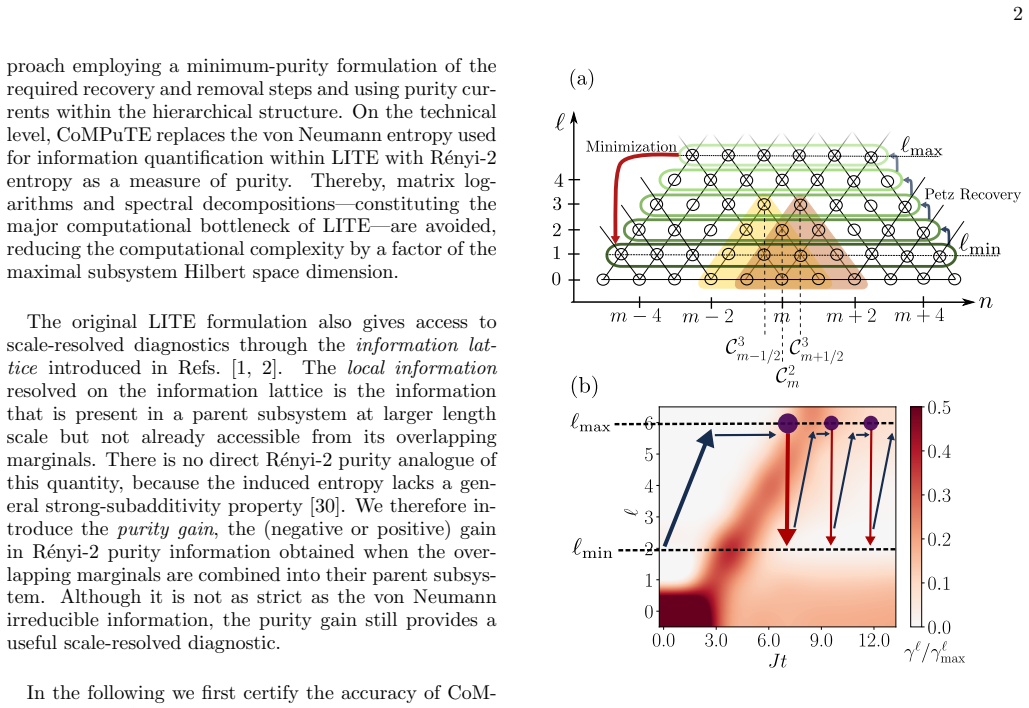
Truncating the hierarchy In practice, the evolution starts at the minimal re- tained levelℓ min and proceeds at a working levelℓ∗ within the scale windowℓ min ≤ℓ ∗ ≤ℓ max shown in Fig. 1 (a). Thusℓ min + 1 is the smallest subsystem size kept explic- itly, whileℓ max + 1 is the largest subsystem size allowed before truncation. The equation of motion Eq. (1...
-
[3]
A sim- ple class of allowed initial states is given by finite product states, ρinit = NO m=1 ρm,(18) whereρ m can be pureρ m =|ψ m⟩⟨ψm|or mixedP(ρ m)< 1 within CoMPuTE
Initial conditions and simulations in the thermodynamic limit The compression scheme employed by LITE limits the correlations and structure of usable initial states. A sim- ple class of allowed initial states is given by finite product states, ρinit = NO m=1 ρm,(18) whereρ m can be pureρ m =|ψ m⟩⟨ψm|or mixedP(ρ m)< 1 within CoMPuTE. For such states every ...
-
[4]
zeroth order
With the R´ enyi-2 choice, the update can be posed as χℓmin n = arg min χ ρℓmin n +χ − I dℓmin 2 2 (25) such thatB IR(χ) = 0. Instead of solving Eq. (25) di- rectly, we approximate the solution to zeroth order. That is, we use the unconstrained minimizer ˜χ=I/dℓmin −ρℓmin n and enforce the constraints by orthogonal projection onto the feasible linear subs...
-
[5]
For a subsystem Hilbert space dimensiond ℓ = 2 ℓ+1, following the original LITE conventions, LITE requires a 8 4 5 6 7 8 9 10 11 ℓmax 345678910 ℓmin 1.25 1.43 DE FIG
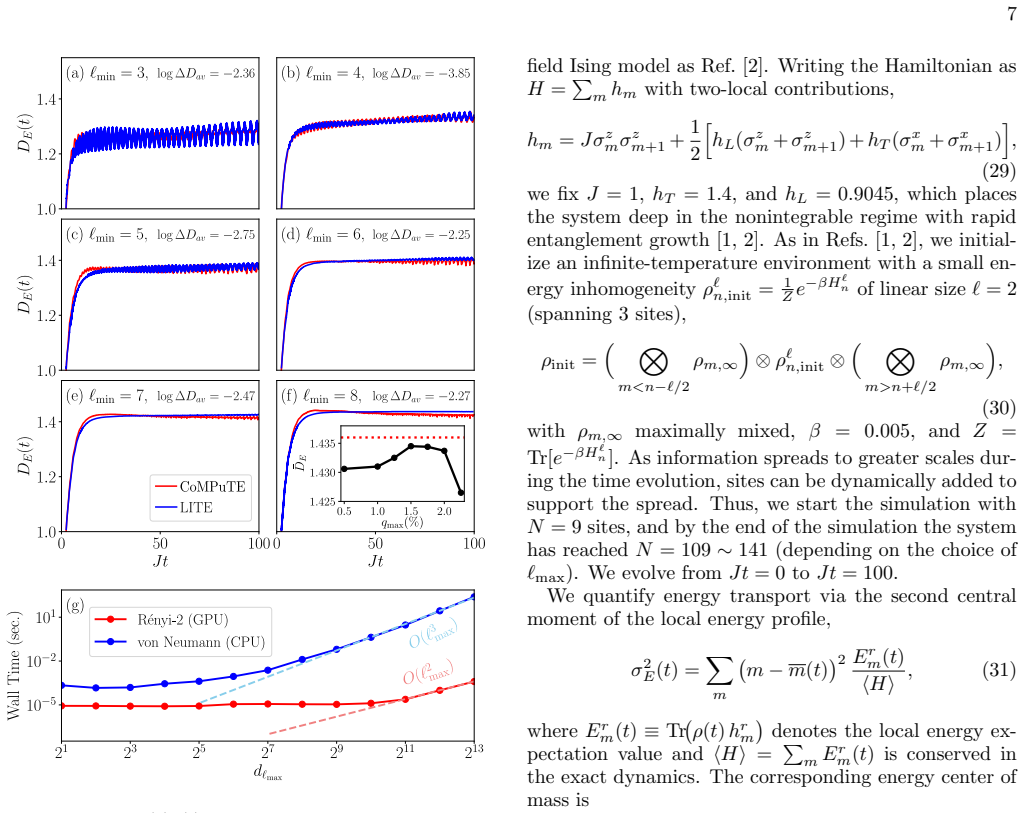
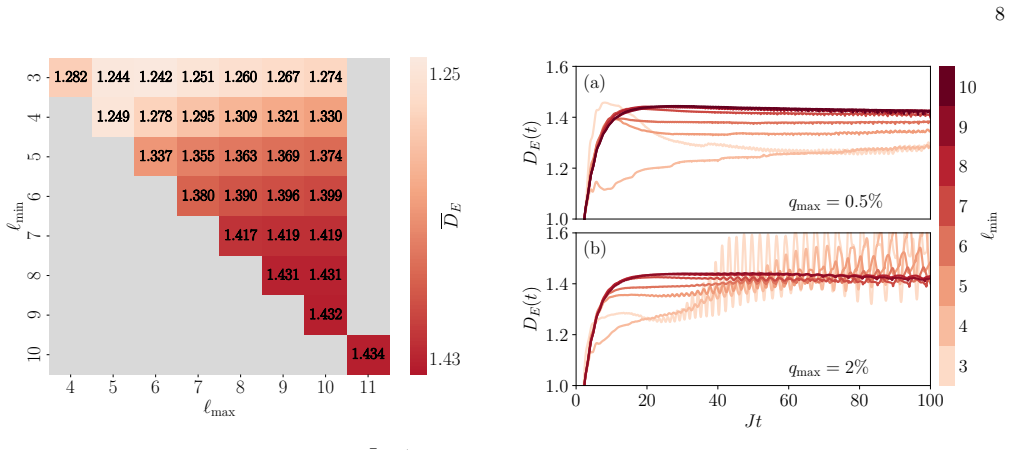
Accuracy benchmark: LITE vs CoMPuTE. For a subsystem Hilbert space dimensiond ℓ = 2 ℓ+1, following the original LITE conventions, LITE requires a 8 4 5 6 7 8 9 10 11 ℓmax 345678910 ℓmin 1.25 1.43 DE FIG. 3. Time-averaged diffusion coefficient ¯DE (averaged overt∈[20,100]) as a function of truncation parameters (ℓmin, ℓmax) forq max = 0.5%. The diffusion c...
-
[6]
information minimization
Largerℓ max and improved extrapolation of late-time transport. The main practical consequence of the reduced run time is that CoMPuTE gives access to larger truncation scalesℓ max than standard LITE. This is essential because 9 the two LITE cutoffs play different roles. The upper scale ℓmax determines how far information can propagate up the hierarchy bef...
-
[7]
Klein Kvorning, L
T. Klein Kvorning, L. Herviou, and J. H. Bardarson, Time-evolution of local information: Thermalization dy- namics of local observables, SciPost Physics13, 080 (2022)
2022
-
[8]
Artiaco, C
C. Artiaco, C. Fleckenstein, D. Aceituno Ch´ avez, T. K. Kvorning, and J. H. Bardarson, Efficient Large-Scale Many-Body Quantum Dynamics via Local-Information Time Evolution, PRX Quantum5, 020352 (2024)
2024
-
[9]
L. J. P. Ament, M. Van Veenendaal, T. P. Devereaux, J. P. Hill, and J. Van Den Brink, Resonant inelastic x- ray scattering studies of elementary excitations, Reviews of Modern Physics83, 705 (2011)
2011
-
[10]
T.-H. Han, J. S. Helton, S. Chu, D. G. Nocera, J. A. Rodriguez-Rivera, C. Broholm, and Y. S. Lee, Fraction- alized excitations in the spin-liquid state of a kagome- lattice antiferromagnet, Nature492, 406 (2012)
2012
-
[11]
Gegenwart, Q
P. Gegenwart, Q. Si, and F. Steglich, Quantum criticality in heavy-fermion metals, Nature Physics4, 186 (2008)
2008
-
[12]
Kjaergaard, F
M. Kjaergaard, F. Nichele, H. J. Suominen, M. P. Nowak, M. Wimmer, A. R. Akhmerov, J. A. Folk, K. Flens- berg, J. Shabani, C. J. Palmstrøm, and C. M. Marcus, Quantized conductance doubling and hard gap in a two- dimensional semiconductor–superconductor heterostruc- ture, Nature Communications7, 12841 (2016)
2016
-
[13]
Polkovnikov, K
A. Polkovnikov, K. Sengupta, A. Silva, and M. Vengalat- tore,Colloquium: Nonequilibrium dynamics of closed in- teracting quantum systems, Reviews of Modern Physics 83, 863 (2011)
2011
-
[14]
From Quantum Chaos and Eigenstate Thermalization to Statistical Mechanics and Thermodynamics
L. D’Alessio, Y. Kafri, A. Polkovnikov, and M. Rigol, From Quantum Chaos and Eigenstate Thermalization to Statistical Mechanics and Thermodynamics, Advances in Physics65, 239 (2016), arXiv:1509.06411 [cond-mat]
work page internal anchor Pith review Pith/arXiv arXiv 2016
-
[15]
Mitra, Quantum Quench Dynamics, Annual Review of Condensed Matter Physics9, 245 (2018)
A. Mitra, Quantum Quench Dynamics, Annual Review of Condensed Matter Physics9, 245 (2018)
2018
-
[16]
Rigol, V
M. Rigol, V. Dunjko, and M. Olshanii, Thermalization and its mechanism for generic isolated quantum systems, Nature452, 854 (2008)
2008
-
[17]
J. M. Deutsch, Eigenstate thermalization hypothesis, Re- ports on Progress in Physics81, 082001 (2018)
2018
-
[18]
Scheie, N
A. Scheie, N. E. Sherman, M. Dupont, S. E. Nagler, M. B. Stone, G. E. Granroth, J. E. Moore, and D. A. Tennant, Detection of Kardar–Parisi–Zhang hydrodynamics in a quantum Heisenberg spin-1/2 chain, Nature Physics17, 726 (2021)
2021
-
[19]
J. F. Wienand, S. Karch, A. Impertro, C. Schweizer, E. McCulloch, R. Vasseur, S. Gopalakrishnan, M. Aidels- burger, and I. Bloch, Emergence of fluctuating hydrody- namics in chaotic quantum systems, Nature Physics20, 1732 (2024)
2024
-
[20]
J. Lux, J. M¨ uller, A. Mitra, and A. Rosch, Hydrodynamic long-time tails after a quantum quench, Physical Review A89, 053608 (2014)
2014
-
[21]
Gopalakrishnan and R
S. Gopalakrishnan and R. Vasseur, Kinetic Theory of Spin Diffusion and Superdiffusion in X X Z Spin Chains, Physical Review Letters122, 127202 (2019)
2019
-
[22]
J. Dubail, Entanglement scaling of operators: a confor- mal field theory approach, with a glimpse of simulability of long-time dynamics in 1 + 1d, Journal of Physics A: Mathematical and Theoretical50, 234001 (2017)
2017
-
[23]
Wang and T
H. Wang and T. Zhou, Barrier from chaos: operator entanglement dynamics of the reduced density matrix, Journal of High Energy Physics2019, 20 (2019)
2019
-
[24]
K. Noh, L. Jiang, and B. Fefferman, Efficient classical simulation of noisy random quantum circuits in one di- mension, Quantum4, 318 (2020)
2020
-
[25]
Schmitt and Z
M. Schmitt and Z. Lenarˇ ciˇ c, From observations to com- plexity of quantum states via unsupervised learning, Physical Review B106, L041110 (2022)
2022
-
[26]
Reid and B
I. Reid and B. Bertini, Entanglement barriers in dual- unitary circuits, Physical Review B104, 014301 (2021)
2021
-
[27]
C. W. von Keyserlingk, F. Pollmann, and T. Rakovszky, Operator backflow and the classical simulation of quan- tum transport, Physical Review B105, 245101 (2022)
2022
-
[28]
Bogoliubov and K
N. Bogoliubov and K. Gurov, Kinetic equations in quan- tum mechanics, J. Exp. Theor. Phys17, 614 (1947)
1947
-
[29]
J. G. Kirkwood, The statistical mechanical theory of transport processes I. General the- ory, The Journal of Chemical Physics14, 180 (1946), https://pubs.aip.org/aip/jcp/article- pdf/14/3/180/18793903/180 1 online.pdf
1946
-
[30]
Rakovszky, C
T. Rakovszky, C. W. Von Keyserlingk, and F. Pollmann, Dissipation-assisted operator evolution method for cap- turing hydrodynamic transport, Physical Review B105, 075131 (2022)
2022
-
[31]
C. D. White, M. Zaletel, R. S. K. Mong, and G. Re- fael, Quantum dynamics of thermalizing systems, Physi- cal Review B97, 035127 (2018)
2018
-
[32]
Fr´ ıas-P´ erez, L
M. Fr´ ıas-P´ erez, L. Tagliacozzo, and M. C. Ba˜ nuls, Con- verting Long-Range Entanglement into Mixture: Tensor- Network Approach to Local Equilibration, Physical Re- view Letters132, 100402 (2024)
2024
-
[33]
D. E. Parker, X. Cao, A. Avdoshkin, T. Scaffidi, and E. Altman, A Universal Operator Growth Hypothesis, Physical Review X9, 041017 (2019)
2019
- [34]
-
[35]
Harkins, C
K. Harkins, C. Fleckenstein, N. D’Souza, P. M. Schindler, D. Marchiori, C. Artiaco, Q. Reynard-Feytis, U. Ba- sumallick, W. Beatrez, A. Pillai, M. Hagn, A. Nayak, S. Breuer, X. Lv, M. McAllister, P. Reshetikhin, E. Druga, M. Bukov, and A. Ajoy, Nanoscale engineering and dynamic stabilization of mesoscopic spin textures, Science Advances11, eadn9021 (2025)
2025
-
[36]
Linden, M
N. Linden, M. Mosonyi, and A. Winter, The structure of r´ enyi entropic inequalities, Proceedings of the Royal Soci- ety A: Mathematical, Physical and Engineering Sciences 469, 20120737 (2013)
2013
- [37]
-
[38]
Petz, Sufficient subalgebras and the relative entropy of states of a von Neumann algebra, Communications in Mathematical Physics105, 123 (1986)
D. Petz, Sufficient subalgebras and the relative entropy of states of a von Neumann algebra, Communications in Mathematical Physics105, 123 (1986)
1986
- [39]
discussion (0)
Sign in with ORCID, Apple, or X to comment. Anyone can read and Pith papers without signing in.