REVIEW 4 major objections 4 minor 83 references
Traversable Wormholes with Spontaneous Symmetry Breaking
T0 review · 4 major / 4 minor · reviewed 2026-08-12 · deepseek-v4-flash
Pith's one-line read A scalar field whose symmetry breaks at the throat can support a traversable wormhole in general relativity.
desk verdict The paper's central exact solution fails the printed field equations for generic C1; the SSB interpretation is reverse-engineered, but the underlying idea is worth a corrected second look. read the letter →
The pith
A machine-rendered reading of the paper's core claim, the machinery that carries it, and where it could break.
The reading
What carries the argument
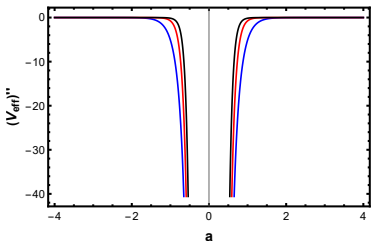
The load-bearing object is the regularized wormhole ansatz $S^2=e^{-2\sigma}=r^2+a^2$, where $a$ is a non-zero parameter, combined with the self-interaction potential $V=V_0+M(\varphi)\varphi^2+\lambda\varphi^4$. The paper treats $M(\varphi)$ not as a fixed coupling but as a function determined by the field equations, and its sign switch near $r=0$ is the marker of spontaneous symmetry breaking. The coordinate change $r^2+a^2=l^2$ turns the radial metric component into the throat form $\left(1-a^2/l^2\right)^{-1}G_1(l)^{-1}$, and the embedding conditions $d\rho/dz\to 0$ with $d^2\rho/dz^2>0$ at $l\to a$ identify $a$ as the throat radius. The same ansatz is then recast as a generalized quintessence metric by promoting a constant coefficient to a function $f(r)$, and the photon-sphere, shadow, Lyapunov, and ISCO formulas all follow from the effective potential $V_\epsilon(r)=G(r)(-\epsilon + L^2/(r^2+a^2))$.
What would settle it
Substitute $G(r)$ from Eq. (15) and $\sigma(r)$ from Eq. (14) directly into Eq. (13) and evaluate the residual; if it is nonzero for any $C_1\neq 0$, the exact-solution claim is false and the photon-sphere, shadow, Lyapunov, and ISCO formulas need to be re-derived from the correct field equations.
Extended reading notes
Core claim
The central claim is that the metric $ds^2 = -G(r)dt^2 + dr^2/G(r) + (r^2+a^2)d\Omega^2$, with $G(r)=1+C_1+\frac{C_2}{2a^3}(ar+(a^2+r^2)\tan^{-1}(r/a))$ and $\varphi(r)=C_3\pm 2\tan^{-1}(r/a)$, is an exact solution of the Einstein-scalar system with $V=V_0+M(\varphi)\varphi^2+\lambda\varphi^4$. The paper solves $M(\varphi)$ from the field equations and finds that it switches from negative to positive values in a neighbourhood of $r=0$; this switch is presented as spontaneous breaking of the scalar's $\mathbb{Z}_2$ symmetry in precisely the region where the wormhole throat forms. For the generalized quintessence metric, a parameter regime with no symmetry breaking also exists. The radial null geodesics show that the same family of solutions can behave as a two-way traversable wormhole for most parameter choices, with one-way wormhole or regular-black-hole behaviour in selected ranges, and the paper derives explicit formulas for the photon sphere, shadow radius, Lyapunov exponent, and innermost stable circular orbit for both geometries.
Load-bearing premise
The load-bearing premise is that the displayed metric with $C_1$ a free parameter really solves all three field equations; substituting the printed $G(r)$ into the third equation leaves a residual equal to $-2C_1$, so that equation as written holds only when $C_1=0$.
Editorial extensions
If this is right
- If the exact solutions stand, the scalar no-hair obstruction is bypassed: the paper shows $\varphi\,dV/d\varphi$ can be negative, so a non-trivial scalar deformation of the vacuum Schwarzschild metric can exist without a horizon.
- The quadratic approximation to the radial null-geodesic equation gives the horizon condition $C_2^2 \geq 4a^4 C_1(1+C_1a^2)$; when it fails, the metric represents a two-way traversable wormhole.
- For the phantom wormhole the unstable photon orbit sits at $r_{\rm ph}=C_2/2$, and for the generalized quintessence wormhole at $r_{\rm ph}=-a^3 C_2 p$, which requires $C_2$ or $p$ to be negative for a physical orbit.
- All curvature scalars remain finite for every $r$ when $a\neq 0$, so the throat configuration is regular and can represent a one-way wormhole or a regular black hole rather than a singular spacetime.
- The sign switch of $M(\varphi)$ occurs only in the throat region, which is the basis for the paper's proposal that spontaneous symmetry breaking is the threshold condition for wormhole throat formation.
Reading between the lines
- Beyond the paper: the same regularity-and-solve-for-$M(\varphi)$ recipe could be applied to other static spherically symmetric metrics, turning the construction into a general method for attaching spontaneous symmetry breaking to spacetime geometry.
- Beyond the paper: the shadow-radius formulas give a concrete observational discriminator, since a wormhole shadow with a given $a$, $C_1$, $C_2$ differs from the Schwarzschild value; horizon-scale imaging could in principle distinguish these solutions from black holes if the mass scale is known.
- Beyond the paper: because $M(\varphi)$ is solved backwards from the metric, one could invert the question and search systematically over $V_0$, $\lambda$, and the integration constants to test whether the sign-switch behaviour is generic or an artifact of the chosen ansatz.
Editorial analysis
A structured set of objections, weighed in public.
Referee Report
Summary. The paper proposes two static, spherically symmetric wormhole metrics, the "phantom" solution (14)-(16) and a generalized Kiselev metric (33), and claims that they are exact solutions of Einstein gravity minimally coupled to a self-interacting scalar field with Higgs-type potential V = V0 + M(phi) phi^2 + lambda phi^4. The authors examine curvature regularity, the null energy condition, radial null geodesics, and traversability, then reconstruct M(phi) from the field equations and interpret its sign change as spontaneous symmetry breaking near the throat. The paper also computes the photon-sphere radius, Lyapunov exponent, shadow radius, and innermost stable circular orbits for both geometries.
Significance. If correct, the paper would provide explicit scalar-field-supported traversable wormholes with a symmetry-breaking mechanism and a set of observational signatures such as shadow radii and Lyapunov exponents. The manuscript is clearly organized and contains useful explicit checks, including the regularity of curvature scalars and the behavior of the null energy condition. However, the central exactness claim is not supported as written: the displayed solution does not satisfy the printed field equation (13) for generic C1, and several derived quantities, including the photon-sphere radius and the horizon condition near r = 0, are based on incorrect algebra. The significance of the paper is therefore limited until these load-bearing issues are resolved.
major comments (4)
- [Section 2, Eqs. (13)-(15)] Substituting sigma(r) = -(1/2) ln(r^2 + a^2) into Eq. (13) reduces the equation to (r^2 + a^2) G'' - 2G + 2 = 0. Direct differentiation of the G(r) in Eq. (15) gives (r^2 + a^2) G'' - 2G + 2 = -2 C1, so the stated field equation is satisfied only for C1 = 0. The paper treats C1 as a free parameter throughout, for example in Fig. 2, Fig. 6, and the photon-sphere analysis of Section 4, so the claimed exact solution (14)-(16) is not a solution of the printed field equations as written.
- [Section 4, Eq. (40)] The photon-sphere condition for the phantom metric is 2rG = (r^2 + a^2) G'. Using Eq. (15), this condition evaluates to 2r(1 + C1) - C2 = 0, so the correct radius is r_ph = C2 / [2(1 + C1)], not C2/2. The omission of the factor (1 + C1) propagates into the shadow radius in Eq. (46), the Lyapunov exponent in Eq. (45), and the ISCO expression in Eq. (49); even if C1 is fixed to zero on the basis of the previous comment, all parameter scans and conclusions involving these quantities must be redone.
- [Section 2, Eqs. (23)-(24)] The claimed small-r approximation of Eq. (22) is not correct. Expanding the G(r) from Eq. (15) gives G = 1 + C1 + (C2/a^2) r + O(r^3), so the horizon condition dr/dt = 0 is linear in r, not the quadratic equation displayed in Eq. (23). The displayed equation C1 r_h^2 + (C2/a^2) r_h + (1 + C1 a^2) = 0 also mixes terms of different dimension, since C1 is dimensionless in Eq. (15). Consequently the horizon discriminant and the one-way/two-way traversability thresholds derived from Eq. (24) are not supported by the metric.
- [Section 2, Eq. (19) and Section 5] The scalar potential is not specified independently: M(phi) is solved from the metric after the ansatz is imposed, as Eq. (19) makes explicit. The sign change in M(r) is therefore a property of the chosen geometry, and the abstract's and Section 5's claim that spontaneous symmetry breaking may act as a threshold for wormhole throat formation is a post-hoc interpretation rather than a derived prediction. To support the causal claim, one would need to fix V(phi) and show that throat formation is tied to the symmetry-breaking transition as parameters are varied; the reconstruction performed here does not establish that.
minor comments (4)
- [Section 1 and Section 2] The potential is written as V = V0 + M phi^2 + lambda phi^4 in Eq. (4), but the text following Eq. (8) writes V = V0 + (1/2) M phi^2 + (lambda/4) phi^4, and Eq. (19) uses the latter convention; please harmonize these definitions.
- [Section 1, Eq. (10)] The azimuthal coordinate is denoted by phi in Eq. (10) while the scalar field is also denoted by phi (or varphi) throughout the paper; this is confusing and should be changed, for example by using psi for the scalar field or a different symbol for the azimuth.
- [Section 4] There are several typographical errors, including "Phanton" instead of "Phantom" before Eq. (41) and "diferent" instead of "different" in the captions of Figs. 11 and 13.
- [Section 3, Eqs. (31)-(33)] The generalized Kiselev metric is presented with an extremely complicated f(r) and p(r), but no derivation or verification is shown that Eq. (33) satisfies the field equations (11)-(13), and the claimed reduction to the phantom metric is not demonstrated; please provide the algebra or a clear reference to a supplementary calculation.
Circularity Check
The central SSB claim is a reconstruction: M(φ) is solved from the metric ansatz via Eq. (19), so the sign change near r=0 and the 'SSB as throat threshold' statement are properties of the defining equation, not independent predictions.
-
self definitional
[Section 2, Eq. (19), Figs. 4-5; Abstract and Conclusion]
"Finally, the solution for M (ϕ) is written straightaway from the field equations as M = 2 { G′′ + 2G′r/(r2 + a2) − V0 − λ/4 ϕ4 } ... There is always a switch from negative into positive values of M (ϕ) within a small neighbourhood of r = 0 ... spontaneous symmetry breaking may act as a threshold for wormhole throat formation."
M is not an independently specified potential coefficient; it is solved from the field equations after the metric functions σ(r), G(r), and the scalar profile ϕ(r) = C3 ± 2 tan−1(r/a) are fixed by ansatz. The claimed 'switch from negative into positive' in M near r=0 is therefore a read-off of the defining equation, not a consequence derived from a first-principles potential. Moreover, a is an input parameter of the ansatz, so the causal statement that SSB 'may act as a threshold for wormhole throat formation' reverses the actual construction order: a and G are fixed first, and M is then engineered to satisfy Eq. (12). The headline SSB-threshold claim is thus equivalent by construction to the chosen ansatz rather than a prediction.
full rationale
The paper's central novelty is the association between spontaneous symmetry breaking and wormhole throat formation. That association is reverse-engineered: with σ and ϕ chosen as (14) and (16), and G chosen as (15), Eq. (19) defines M so that Eq. (12) is satisfied. The paper itself repeatedly notes that 'the solution we have found is consistent if and only if M(ϕ) is a function,' which is another way of saying M is a constructed quantity rather than an independently motivated potential. The sign change of M and the Z2-breaking interpretation are therefore consequences of the ansatz, not independent evidence for a threshold phenomenon. The geodesic, photon-sphere, shadow, and ISCO calculations are self-contained consequences of the chosen metric and are not circular. The self-citations in the paper (e.g., [22], [38], [58]) are contextual and not load-bearing. Separately, though not a circularity, the printed field equations are not satisfied as claimed: substituting (14)–(15) into (13) gives −2C1 = 0, while the paper scans C1 as a free nonzero parameter; this is a consistency flaw that further undermines the exact-solution claim. Weighing the definitional character of the SSB-threshold claim against the independent geodesic content gives a score of 7.
Assumptions & free parameters
free parameters (9)
- a =
varied in plots, e.g., 0.5
- C1 =
varied in plots, e.g., 1
- C2 =
varied in plots, e.g., 1
- C3 =
varied, e.g., 1
- V0
- λ
- p =
used in Kiselev section, varied in plots
- w
- m =
used in Kiselev section, varied in plots
assumptions (5)
- standard math Einstein field equations hold for a minimally coupled scalar field with action S = ∫√-g (R + ½(∂φ)² + V(φ)).
- ad hoc to paper The scalar self-interaction potential has the Higgs-like form V = V₀ + M(φ)φ² + λφ⁴.
- domain assumption The metric is static, spherically symmetric, and takes the regularized form with S² = r² + a² (Simpson-Visser style).
- domain assumption The scalar field tends to a constant at spatial infinity and the potential has a local extremum at the asymptotic value.
- ad hoc to paper A sign change in M(r) is interpreted as evidence of spontaneous symmetry breaking in the effective potential.
Cite this review
Pith. "Pith review of Traversable Wormholes with Spontaneous Symmetry Breaking." pith.science (2026). https://pith.science/paper/HT5QE2AH
@misc{pith2026241109236,
  author       = {Pith},
  title        = {Pith review of: Traversable Wormholes with Spontaneous Symmetry Breaking},
  year         = {2026},
  howpublished = {\url{https://pith.science/paper/HT5QE2AH}},
  note         = {Machine review of arXiv:2411.09236}
}
read the original abstract
We argue that a spherically symmetric traversable wormhole solution of the Einstein field equations can be supported by minimally coupled self-interacting scalar field which allows a spontaneous symmetry breaking of the field around the wormhole throat. We study two cases : (i) the phantom wormhole solution of Bronnikov and (ii) a generalized Kiselev wormhole. We study the property of radial null geodesics and show that the metric can describe either a two-way or a one-way traversable wormhole depending on certain parameter ranges. The scalar field exhibits spontaneous symmetry breaking within the coordinate range where a wormhole throat forms and helps one suggest that spontaneous symmetry breaking may act as a threshold for wormhole throat formation. We also compute the radius of the photon sphere, the Lyapunov exponent, the shadow radius, and the innermost stable circular orbits for the geometries.
Figures


Figures from the paper (16 more)




Reference graph
Works this paper leans on
-
[1]
K. Schwarzschild, Sitzungsber. Preuss. Akad. Wiss. Phys. Math. Kl., , physics/9905030 (1916), arXiv:physics/9905030 [physics.hist-ph]
arXiv 1916
-
[2]
Hilbert, Nachr
D. Hilbert, Nachr. Ges. Wiss. Math. Phys. Kl. (G ¨ottingen) , 53 (1917)
1917
-
[3]
Weyl, Ann
H. Weyl, Ann. d. Phys. 54, 117 (1917). 22
1917
-
[4]
J. T. Jebsen, Ark. Mat. Ast. Fys. (Stockholm) 15, 18 (1921)
1921
-
[5]
G. D. Birkhoff, Relativity and Modern Physics, Harvard University Press 253, 18 (1923)
work page 1923
-
[6]
Sato, Journal of Astrophysics and Astronomy Supplement 16, 37 (1995)
K. Sato, Journal of Astrophysics and Astronomy Supplement 16, 37 (1995)
work page 1995
-
[7]
O. Bechmann and O. Lechtenfeld, Class. Quant. Grav. 12, 1473 (1995), arXiv:gr-qc/9502011
arXiv 1995
-
[8]
J. D. Bekenstein, in 2nd International Sakharov Conference on Physics (1996) pp. 216–219, arXiv:gr- qc/9605059
arXiv 1996
Show all 83 references
-
[9]
C. A. R. Herdeiro and E. Radu, International Journal of Modern Physics D 24, 1542014 (2015)
2015
-
[10]
Barcel´ o, R
C. Barcel´ o, R. Carballo-Rubio, and S. Liberati, Classical and Quantum Gravity 36, 13LT01 (2019)
2019
-
[11]
Perlmutter et al
S. Perlmutter et al. (Supernova Cosmology Project), Bull. Am. Astron. Soc. 29, 1351 (1997), arXiv:astro-ph/9812473
1997 arXiv
-
[12]
A. G. Riess, A. V. Filippenko, P. Challis, A. Clocchiatti, A. Diercks, P. M. Garnavich, R. L. Gilliland, C. J. Hogan, S. Jha, R. P. Kirshner, B. Leibundgut, M. M. Phillips, D. Reiss, B. P. Schmidt, R. A. Schommer, R. C. Smith, J. Spyromilio, C. Stubbs, N. B. Suntzeff, and J. T...
1998
-
[13]
Melchiorri, P
A. Melchiorri, P. A. R. Ade, P. de Bernardis, J. J. Bock, J. Borrill, A. Boscaleri, B. P. Crill, G. D. Troia, P. Farese, P. G. Ferreira, K. Ganga, G. de Gasperis, M. Giacometti, V. V. Hristov, A. H. Jaffe, A. E. Lange, S. Masi, P. D. Mauskopf, L. Miglio, C. B. Netterfield, E. ...
2000
-
[14]
A. E. Lange, P. A. R. Ade, J. J. Bock, J. R. Bond, J. Borrill, A. Boscaleri, K. Coble, B. P. Crill, P. de Bernardis, P. Farese, P. Ferreira, K. Ganga, M. Giacometti, E. Hivon, V. V. Hristov, A. Iacoan- geli, A. H. Jaffe, L. Martinis, S. Masi, P. D. Mauskopf, A. Melchiorri, T. ...
2001
-
[15]
Padmanabhan and T
T. Padmanabhan and T. R. Choudhury, Monthly Notices of the Royal Astronomical Society 344, 823 (2003), https://academic.oup.com/mnras/article-pdf/344/3/823/3304941/344-3-823.pdf
2003
-
[16]
Zlatev, L
I. Zlatev, L. Wang, and P. J. Steinhardt, Phys. Rev. Lett. 82, 896 (1999)
1999
-
[17]
Sahni and A
V. Sahni and A. Starobinsky, International Journal of Modern Physics D 09, 373 (2000)
2000
-
[18]
E. G. Adelberger, B. R. Heckel, and A. E. Nelson, Ann. Rev. Nucl. Part. Sci. 53, 77 (2003), arXiv:hep- ph/0307284
2003
-
[19]
J. A. Frieman, C. T. Hill, A. Stebbins, and I. Waga, Phys. Rev. Lett. 75, 2077 (1995)
1995
-
[20]
Khoury and A
J. Khoury and A. Weltman, Phys. Rev. Lett. 93, 171104 (2004)
2004
-
[21]
Hinterbichler and J
K. Hinterbichler and J. Khoury, Phys. Rev. Lett. 104, 231301 (2010)
2010
-
[22]
Chakrabarti, K
S. Chakrabarti, K. Dutta, and J. L. Said, Monthly Notices of the Royal Astronomical Society 514, 427 (2022), https://academic.oup.com/mnras/article-pdf/514/1/427/43946981/stac1321.pdf . 23
2022
-
[23]
P. A. M. Dirac, Nature 139, 323 (1937)
1937
-
[24]
Jordan, Naturwissenschaften 25, 513 (1937)
P. Jordan, Naturwissenschaften 25, 513 (1937)
1937
-
[25]
Fierz, Helvetica Physica Acta 29, 128 (1956)
M. Fierz, Helvetica Physica Acta 29, 128 (1956)
1956
-
[26]
Brans and R
C. Brans and R. H. Dicke, Phys. Rev. 124, 925 (1961)
1961
-
[27]
Gamow, Phys
G. Gamow, Phys. Rev. Lett. 19, 759 (1967)
1967
-
[28]
J. D. Bekenstein, Phys. Rev. D 25, 1527 (1982)
1982
-
[29]
Uzan, Rev
J.-P. Uzan, Rev. Mod. Phys. 75, 403 (2003)
2003
-
[30]
Chiba, Progress of Theoretical Physics 126, 993 (2011), arXiv:1111.0092 [gr-qc]
T. Chiba, Progress of Theoretical Physics 126, 993 (2011), arXiv:1111.0092 [gr-qc]
2011 arXiv
-
[31]
Gasser and H
J. Gasser and H. Leutwyler, Physics Reports 87, 77 (1982)
1982
-
[32]
Ji, Phys
X. Ji, Phys. Rev. Lett. 74, 1071 (1995)
1995
-
[33]
Calmet and H
X. Calmet and H. Fritzsch, Phys. Lett. B 540, 173 (2002), arXiv:hep-ph/0204258
2002 arXiv
-
[34]
Fritzsch, Nuclear Physics B - Proceedings Supplements 186, 221 (2009), proceedings of the QCD 08, 14th High-Energy Physics International Conference On Quantum ChromoDynamics
H. Fritzsch, Nuclear Physics B - Proceedings Supplements 186, 221 (2009), proceedings of the QCD 08, 14th High-Energy Physics International Conference On Quantum ChromoDynamics
2009
-
[35]
Bagdonaite, E
J. Bagdonaite, E. J. Salumbides, S. P. Preval, M. A. Barstow, J. D. Barrow, M. T. Murphy, and W. Ubachs, Phys. Rev. Lett. 113, 123002 (2014)
2014
-
[36]
Huntemann, B
N. Huntemann, B. Lipphardt, C. Tamm, V. Gerginov, S. Weyers, and E. Peik, Phys. Rev. Lett. 113, 210802 (2014)
2014
-
[37]
J. Sola, E. Karimkhani, and A. Khodam-Mohammadi, Class. Quant. Grav. 34, 025006 (2017), arXiv:1609.00350 [gr-qc]
2017 arXiv
-
[38]
Chakrabarti, Monthly Notices of the Royal Astronomical Society 506, 2518 (2021), https://academic.oup.com/mnras/article-pdf/506/2/2518/39136152/stab1910.pdf
S. Chakrabarti, Monthly Notices of the Royal Astronomical Society 506, 2518 (2021), https://academic.oup.com/mnras/article-pdf/506/2/2518/39136152/stab1910.pdf
2021
-
[39]
K. A. Bronnikov and J. C. Fabris, Physical Review Letters 96 (2006), 10.1103/physrevlett.96.251101
2006 doi
-
[40]
V. V. Kiselev, Classical and Quantum Gravity 20, 1187–1197 (2003)
2003
-
[41]
Visser, Classical and Quantum Gravity 37, 045001 (2020)
M. Visser, Classical and Quantum Gravity 37, 045001 (2020)
2020
-
[42]
Battista, S
E. Battista, S. Capozziello, and A. Errehymy, (2024), arXiv:2409.09750 [gr-qc]
2024 arXiv
-
[43]
Di Grezia, E
E. Di Grezia, E. Battista, M. Manfredonia, and G. Miele, Eur. Phys. J. Plus 132, 537 (2017), arXiv:1707.01508 [gr-qc]
2017 arXiv
-
[44]
De Falco, E
V. De Falco, E. Battista, S. Capozziello, and M. De Laurentis, Phys. Rev. D 101, 104037 (2020), arXiv:2004.14849 [gr-qc]
2020 arXiv
-
[45]
De Falco, E
V. De Falco, E. Battista, S. Capozziello, and M. De Laurentis, Phys. Rev. D 103, 044007 (2021), arXiv:2101.04960 [gr-qc] . 24
2021 arXiv
-
[46]
De Falco, E
V. De Falco, E. Battista, S. Capozziello, and M. De Laurentis, Eur. Phys. J. C 81, 157 (2021), arXiv:2102.01123 [gr-qc]
2021 arXiv
-
[47]
X. Y. Chew and D.-h. Yeom, Phys. Rev. D 110, 044036 (2024), arXiv:2401.09039 [gr-qc]
2024 arXiv
-
[48]
X. Y. Chew, D.-h. Yeom, and J. L. Bl´ azquez-Salcedo, Phys. Rev. D 108, 044020 (2023), arXiv:2210.01313 [gr-qc]
2023 arXiv
-
[49]
X. Y. Chew and K.-G. Lim, Phys. Rev. D 109, 064039 (2024), arXiv:2307.13972 [gr-qc]
2024 arXiv
-
[50]
X. Y. Chew and K.-G. Lim, Universe 10, 212 (2024), arXiv:2405.06407 [gr-qc]
2024 arXiv
-
[51]
X. Y. Chew and Y. S. Myung, Phys. Rev. D 110, 044011 (2024), arXiv:2405.04921 [gr-qc]
2024 arXiv
-
[52]
Dzhunushaliev, V
V. Dzhunushaliev, V. Folomeev, R. Myrzakulov, and D. Singleton, JHEP 07, 094 (2008), arXiv:0805.3211 [gr-qc]
2008 arXiv
-
[53]
C. F. S. Pereira, D. C. Rodrigues, J. C. Fabris, and M. E. Rodrigues, Phys. Rev. D 109, 044011 (2024)
2024
-
[54]
C. F. S. Pereira, E. L. Martins, D. C. Rodrigues, J. C. Fabris, and M. E. Rodrigues, (2024), arXiv:2405.07455 [gr-qc]
2024 arXiv
-
[55]
C. F. S. Pereira, D. C. Rodrigues, M. V. d. S. Silva, J. C. Fabris, M. E. Rodrigues, and H. Belich, (2024), arXiv:2409.09182 [gr-qc]
2024 arXiv
-
[56]
K. A. Bronnikov, R. A. Konoplya, and T. D. Pappas, Phys. Rev. D 103, 124062 (2021), arXiv:2102.10679 [gr-qc]
2021 arXiv
-
[57]
Simpson and M
A. Simpson and M. Visser, Journal of Cosmology and Astroparticle Physics 2019, 042 (2019)
2019
-
[58]
Chakrabarti and S
S. Chakrabarti and S. Kar, Phys. Rev. D 104, 024071 (2021)
2021
-
[59]
Visser, Lorentzian wormholes: From Einstein to Hawking (1995)
M. Visser, Lorentzian wormholes: From Einstein to Hawking (1995)
1995
-
[60]
Einstein and N
A. Einstein and N. Rosen, Phys. Rev. 48, 73 (1935)
1935
-
[61]
C. W. Misner and J. A. Wheeler, Annals of Physics 2, 525 (1957)
1957
-
[62]
C. A. Kolassis, N. O. Santos, and D. Tsoubelis, Classical and Quantum Gravity 5, 1329 (1988)
1988
-
[63]
H. G. Ellis, Journal of Mathematical Physics 14, 104 (1973), https://pubs.aip.org/aip/jmp/article- pdf/14/1/104/19133700/104 1 online.pdf
1973
-
[64]
P. Brax, C. van de Bruck, D. F. Mota, N. J. Nunes, and H. A. Winther, Phys. Rev. D 82, 083503 (2010)
2010
-
[65]
Hinterbichler, J
K. Hinterbichler, J. Khoury, A. Levy, and A. Matas, Phys. Rev. D 84, 103521 (2011)
2011
-
[66]
K. S. Virbhadra and G. F. R. Ellis, Phys. Rev. D 62, 084003 (2000), arXiv:astro-ph/9904193
2000 arXiv
-
[67]
K. S. Virbhadra and G. F. R. Ellis, Phys. Rev. D 65, 103004 (2002). 25
2002
-
[68]
K. S. Virbhadra and C. R. Keeton, Phys. Rev. D 77, 124014 (2008)
2008
-
[69]
Claudel, K
C.-M. Claudel, K. S. Virbhadra, and G. F. R. Ellis, Journal of Mathematical Physics 42, 818 (2001), https://pubs.aip.org/aip/jmp/article-pdf/42/2/818/19220437/818 1 online.pdf
2001
-
[70]
K. S. Virbhadra, Phys. Rev. D 79, 083004 (2009)
2009
-
[71]
R. M. Wald, General Relativity (Chicago Univ. Pr., Chicago, USA, 1984)
1984
-
[72]
Chakraborty, Galaxies 9, 96 (2021), arXiv:2111.04912 [gr-qc]
S. Chakraborty, Galaxies 9, 96 (2021), arXiv:2111.04912 [gr-qc]
2021 arXiv
-
[73]
A. K. Mishra, S. Chakraborty, and S. Sarkar, Phys. Rev. D 99, 104080 (2019), arXiv:1903.06376 [gr-qc]
2019 arXiv
-
[74]
Berry, A
T. Berry, A. Simpson, and M. Visser, Universe 7, 2 (2020), arXiv:2008.13308 [gr-qc]
2020 arXiv
-
[75]
Z.-Y. Tang, Y. C. Ong, and B. Wang, Class. Quant. Grav. 34, 245006 (2017), arXiv:1705.09633 [gr-qc]
2017 arXiv
-
[76]
A. K. Mishra and S. Chakraborty, Phys. Rev. D 101, 064041 (2020), arXiv:1911.09855 [gr-qc]
2020 arXiv
-
[77]
Rahman, S
M. Rahman, S. Chakraborty, S. SenGupta, and A. A. Sen, JHEP 03, 178 (2019), arXiv:1811.08538 [gr-qc]
2019 arXiv
-
[78]
Cardoso, J
V. Cardoso, J. a. L. Costa, K. Destounis, P. Hintz, and A. Jansen, Phys. Rev. Lett. 120, 031103 (2018), arXiv:1711.10502 [gr-qc]
2018 arXiv
-
[79]
Cardoso, A
V. Cardoso, A. S. Miranda, E. Berti, H. Witek, and V. T. Zanchin, Phys. Rev. D 79, 064016 (2009), arXiv:0812.1806 [hep-th]
2009 arXiv
-
[80]
Chandrasekhar, The Mathematical Theory of Black Holes , The International Series of Monographs on Physics (Oxford University Press, 1983)
S. Chandrasekhar, The Mathematical Theory of Black Holes , The International Series of Monographs on Physics (Oxford University Press, 1983)
1983
-
[81]
Visser, Phys
M. Visser, Phys. Rev. D 46, 2445 (1992)
1992
-
[82]
Visser, Phys
M. Visser, Phys. Rev. D 48, 583 (1993)
1993
-
[83]
Boonserm, T
P. Boonserm, T. Ngampitipan, and M. Visser, Phys. Rev. D 88, 041502 (2013). 26
2013
Reviewed August 12, 2026 · model on record in the stance chip above.
Discussion (0). Continue with ORCID to comment.