REVIEW 5 major objections 6 minor 1 cited by
Learning Robust Grasping Strategy Through Tactile Sensing and Adaption Skill
T0 review · 5 major / 6 minor · reviewed 2026-08-12 · deepseek-v4-flash
Pith's one-line read The paper claims a demonstration-learned, tactile-only adaptive grasping policy can keep a two-finger gripper stable under pulling, vibration, and added weight, and that it raises the maximum holdable weight on all seven novel objects…
desk verdict A plausible tactile-grasp adaptation pipeline, but the key generalization claim is undercut by missing experimental controls and training/test overlap ambiguity. read the letter →
The pith
A machine-rendered reading of the paper's core claim, the machinery that carries it, and where it could break.
The reading
What carries the argument
The central machinery is a tactile grasp state $X^*=(S^*,\theta^*,P^*)$, where $S^*\in\mathbb{R}^{32}$ is the pair of 16-channel fingertip readings, $\theta^*$ is the gripper angle, and $P^*\in\mathbb{R}^7$ is the end-effector pose. A Gaussian mixture model over this state acts as a binary stability classifier: when the likelihood $p(X^*|\Omega)$ falls below a threshold chosen from the ROC curve, the grasp is treated as unstable. A self-attention network—a mechanism that weights past time steps by relevance to the current output—then maps the sequence of tactile changes $(\Delta S_i,\Delta\theta_i)$ to a corrective gripper-angle change $\Delta\theta$, updating $\theta'\mapsto\theta+\Delta\theta$. Because the action space is just the gripper angle, the same learned policy can run iteratively on a parallel gripper until stability is restored.
What would settle it
A decisive test would be to increase an object's weight remotely, for example by pumping liquid into a rigid container through a tube, so that mass changes while the tactile contact pattern and gripper angle stay unchanged; if the estimator reports stable and the policy issues no correction even though the grasp eventually slips, the premise that 32 tactile values plus gripper angle capture grasp stability is refuted.
Extended reading notes
Core claim
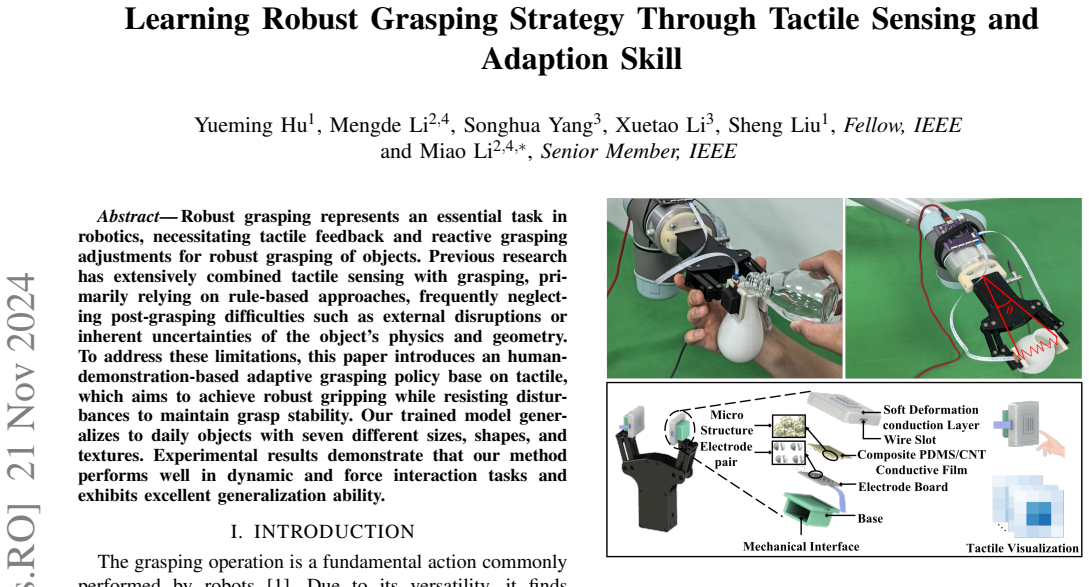
The paper's central claim is that continuous grasp adaptation can be learned entirely from human demonstrations and carried by tactile feedback: a two-finger gripper can detect an unstable grasp from the current tactile state and restore stability by adjusting only its finger angle. The trained policy, called he-AGPT, consists of a behavior-cloned initial grasp generator, a Gaussian-mixture stability estimator, and a self-attention adaptation network that outputs $\Delta\theta$. On seven novel objects—pillbox, tea can, mouthwash, milk bottle, wine bottle, perfume, and ink—the reported maximum holdable weight rises with adaptation in every case, for example from 34 g to 55 g for the pillbox and from 72 g to 129 g for the ink bottle. Live tests include a person pulling a milk bottle downward and water being poured into a wine bottle, with the fingers adjusting their angle during the disturbance.
Load-bearing premise
The load-bearing premise is that the 32 tactile readings and the gripper angle contain enough information to detect instability and to infer the corrective angle, so that no vision or object model is required.
Editorial extensions
If this is right
- For the seven tested objects, enabling the adaptation increases the maximum supported weight, with the largest relative gain on the ink bottle (72 g to 129 g).
- The policy generalizes to novel objects of different sizes, shapes, and textures without retraining, using only tactile input and gripper angle.
- Repeated corrective angle adjustments, rather than a single regrasp action, let the gripper ride out continuous disturbances such as pouring and pulling.
- Because the adaptation loop needs no vision or object model, it can run on simple parallel grippers in settings where cameras are unavailable or occluded.
Reading between the lines
- A testable extension is to run the same demonstration pipeline on other two-finger grippers with different tactile layouts; if the angle-only action space transfers, the cost of deploying the policy on new hardware drops sharply.
- The reported largest percentage gains on small rigid objects (pillbox and ink bottle) suggest that the value of angle correction may depend on object compliance; comparing correction magnitude against object stiffness would test that.
- Because the policy uses no vision, it could be paired with a vision-based initial grasp planner while keeping tactile-only corrections, a combination that may address the abrupt-shape-change failures the paper itself notes.
- An implicit implication is that human demonstrators encode a useful disturbance-response prior that could be mined for other tactile tasks such as in-hand manipulation, though the paper does not claim this.
Signed reviews
Editorial analysis
A structured set of objections, weighed in public.
Referee Report
Summary. The paper proposes a tactile-driven adaptive grasping framework, called he-AGPT, consisting of three components: an initial grasp generator trained by behavior cloning, a Gaussian Mixture Model (GMM) stability estimator, and a self-attention-based grasp adaptation policy that outputs corrective gripper-angle changes. The system is evaluated on a real electric parallel gripper with custom 32-channel tactile sensors. The experimental section reports, for seven everyday objects, the maximum graspable weight with and without the adaptation strategy, and the authors claim that the learned policy generalizes to novel objects and resists disturbances such as human pulling, vibration, and added mass. The central claim is that tactile-only feedback plus gripper angle suffices to detect instability and generate corrective actions without vision or object models.
Significance. If the claims are established, the paper would provide a useful demonstration that a purely tactile, learned policy can maintain grasp stability on a parallel gripper under external disturbances. The use of real hardware with 1200 human demonstrations and a custom tactile sensor is a concrete strength, as is the clear division of the system into an initial grasp generator, a stability estimator, and an adaptation policy. However, the current evidence does not yet support the generalization claim: Table I reports no trial counts, variance, or statistical comparison; the training and test object sets are not shown to be disjoint; and the adaptation policy is not compared against a simple grip-tightening baseline. These are experimental-reporting gaps that could be addressed with additional experiments and clarifications, rather than fundamental flaws in the core idea.
major comments (5)
- [Sec. III-B and III-D, Table I] The central generalization claim is not supported by the reported data. Section III-B states that 1200 experiments were performed on 12 objects for demonstration and training, but it never identifies those 12 objects, and Section III-D calls the objects in Fig. 5 'novel' without stating that they are disjoint from the training set. If any of the seven test objects (pillbox, tea can, mouthwash, milk bottle, wine bottle, perfume, ink) were among the 12 training objects, Table I could reflect object-specific memorized adjustments rather than a generalizable tactile policy. The authors should list the 12 training objects, state explicitly the overlap with the test set, and clarify how the 30,000 data points (10,000+6,000+14,000) are allocated among the three modules.
- [Table I and Sec. III-D] The quantitative evidence does not rule out a trivial grip-tightening reflex. Because the only adaptation action is alpha = Delta_theta (Eq. (7)), closing the gripper by a fixed amount whenever instability is detected would increase grip force and could plausibly reproduce the 'with adaptation' column in Table I. Table I reports no trial counts, no error bars, no confidence intervals, and no comparison with such a non-learned baseline. The claim that the learned policy, rather than the action space itself, is responsible for the observed improvements is therefore unsubstantiated. The authors should report repeated trials with variance and include a baseline that simply applies a fixed positive Delta_theta on instability detection.
- [Sec. II-B, Eq. (6)] The stability-threshold definition is mathematically malformed. Eq. (6) defines Lik_{2sigma}(i) as (2*pi)^{-d/2} |Sigma_i|^{-1/2} e^{-2}, which is not the Gaussian likelihood at two standard deviations; the exponent is an unexplained constant, the dimension d is not defined, and the relationship to 'two standard deviations' is unclear. Since a and b are then used to select the discrimination threshold t_e, and this threshold controls when adaptation is triggered, the formula must be corrected. The authors should also specify which dataset (training or validation) is used for ROC-based threshold selection.
- [Sec. II-A, Eqs. (1)-(3), and Sec. III-C] The training objective is internally inconsistent. Eq. (1) defines the policy as pi_w(s), Eq. (2) updates parameters theta with pi_theta(s_i) without defining theta in this context, and Eq. (3) defines a mean-squared-error loss, whereas Section III-C states that the initial grasp generator uses cross-entropy loss with SGD. This makes it impossible to verify the training procedure. The authors need to align the notation across equations and state the actual loss function used for each network.
- [Sec. II-B and II-C] The state definition is inconsistent with the policy input. The stability estimator defines the current grasp as X* = (S*, theta*, P*) with P in R^7 representing the end-effector location, and Eqs. (4)-(5) include P components in the GMM. However, the adaptation dataset in Eq. (9) contains only Delta_S, S, theta, and Delta_theta, with no P, and the self-attention input in Eq. (10) is Xi = (Delta_S_i, Delta_theta_i). If the end-effector pose is not observed by the adaptation policy, the definition in Eq. (4)-(5) is misleading; if it is observed, the policy input must be specified accordingly. This matters for the tactile-only claim, since the system must be shown to rely only on the information actually fed to the learned components.
minor comments (6)
- [Abstract] The abstract contains grammatical errors: 'an human-demonstration-based adaptive grasping policy base on tactile' should be 'a human-demonstration-based adaptive grasping policy based on tactile sensing'.
- [Sec. IV] The conclusion's admitted limitation, that the gripper shows limited adaptability for targets with abrupt shape changes, should be reconciled with the abstract's claim of 'excellent generalization ability'.
- [Fig. 4 and Fig. 7 captions] The Fig. 4 caption contains 'with with adding water', and the Fig. 7 caption repeats 'A snapshot for the experiment on wine bottle' twice.
- [Sec. II-C] The sentence 'Once the stability proposed in III-B inform us the current grasp is unstable' should refer to Section II-B and should read 'informs us'.
- [Eq. (2)] The update rule uses the index i both for the dataset elements and for the gradient-step counter; use separate indices to avoid confusion.
- [Sec. III-C] For the GMM stability estimator, the text says 'the number of classes set to 2', which is ambiguous: it should clarify whether this is the number of mixture components m or the number of stability labels.
Circularity Check
No circularity: the paper is an empirical tactile grasping system with real-robot evaluation; its generalization concerns are validity issues, not definitional reductions.
full rationale
This paper is an empirical learning system rather than a derivation chain, so the circularity patterns do not apply. The initial grasp generator is trained by behavior cloning on demonstrated state-action pairs (Eqs. 1-3); the stability estimator is a GMM binary classifier with a ROC-selected threshold (Eqs. 4-6); and the adaptation policy is a self-attention network trained with MSE on human demonstrations of corrective angle changes (Eqs. 9-10). No equation defines its output in terms of the target result: the predicted delta-theta in Eq. 8 is supervised from demonstrations and then evaluated on real objects. The only self-citations, refs [20] and [21], support the tactile sensor hardware with independent characterizations (force error and contact precision), and they do not carry the central generalization claim. The reviewer concerns about unlisted training objects, possible overlap with the seven test objects, and the absence of a trivial grip-tightening baseline in Table I are legitimate empirical validity and control questions, but they do not exhibit the required reduction of a prediction to its inputs by construction. Under the hard rule requiring a quoted Eq. X = Eq. Y equivalence or a fitted parameter renamed as prediction, no circular step exists here.
Assumptions & free parameters
free parameters (5)
- Stability threshold t_e =
selected from ROC curve within [a, b]
- GMM component count m =
2
- GMM parameters (pi_i, mu_i, Sigma_i) =
estimated via EM with K-means initialization
- Adaptation network weights =
trained with Adam, exact values not reported
- Initial grasp generator weights =
trained with SGD, exact values not reported
assumptions (4)
- domain assumption Tactile readings and gripper angle are sufficient to determine grasp stability and to generate corrective actions.
- domain assumption Only the gripper angle theta needs to be adjusted; other degrees of freedom are treated as fixed.
- domain assumption Human demonstrations provide optimal or near-optimal adaptation actions.
- domain assumption GMM likelihood thresholding is a valid model of grasp stability.
Cite this review
Pith. "Pith review of Learning Robust Grasping Strategy Through Tactile Sensing and Adaption Skill." pith.science (2026). https://pith.science/paper/HVPQ44YM
@misc{pith2026241108499,
  author       = {Pith},
  title        = {Pith review of: Learning Robust Grasping Strategy Through Tactile Sensing and Adaption Skill},
  year         = {2026},
  howpublished = {\url{https://pith.science/paper/HVPQ44YM}},
  note         = {Machine review of arXiv:2411.08499}
}
read the original abstract
Robust grasping represents an essential task in robotics, necessitating tactile feedback and reactive grasping adjustments for robust grasping of objects. Previous research has extensively combined tactile sensing with grasping, primarily relying on rule-based approaches, frequently neglecting post-grasping difficulties such as external disruptions or inherent uncertainties of the object's physics and geometry. To address these limitations, this paper introduces an human-demonstration-based adaptive grasping policy base on tactile, which aims to achieve robust gripping while resisting disturbances to maintain grasp stability. Our trained model generalizes to daily objects with seven different sizes, shapes, and textures. Experimental results demonstrate that our method performs well in dynamic and force interaction tasks and exhibits excellent generalization ability.
Figures


Figures from the paper (4 more)


Forward citations
Cited by 1 Pith paper
-
Surformer v1: Transformer-Based Surface Classification Using Tactile and Vision Features
Surformer v1 is a cross-modal transformer for tactile-visual surface classification that claims 99.4% accuracy at 0.77 ms inference, but the submitted full text belongs to an unrelated statistics paper.
Reference graph
Works this paper leans on
-
[1]
Probabilistic robotics,
S. Thrun, “Probabilistic robotics,” Communications of the ACM , vol. 45, no. 3, pp. 52–57, 2002
2002
-
[2]
C. Ren, H. Ji, X. Liu, J. Teng, and H. Xu, “Visual sorting of express packages based on the multi-dimensional fusion method under complex logistics sorting,” Entropy, vol. 25, no. 2, p. 298, 2023
work page 2023
-
[3]
Generation of a tactile-based pouring motion using fingertip force sensors,
T. Kiyokawa, M. Ding, G. A. G. Ricardez, J. Takamatsu, and T. Oga- sawara, “Generation of a tactile-based pouring motion using fingertip force sensors,” in 2019 IEEE/SICE International Symposium on System Integration (SII). IEEE, 2019, pp. 669–674
2019
-
[4]
M. Hatano, “Estimation of center of gravity for withdrawal works of unknown indefinite shape rubbles for rescue robots,” in 2017 IEEE International Conference on Mechatronics and Automation (ICMA) . IEEE, 2017, pp. 1970–1975
work page 2017
-
[5]
R. Xu, J. Luo, and M. Wang, “Optimal grasping pose for dual-arm space robot cooperative manipulation based on global manipulability,” Acta Astronautica, vol. 183, pp. 300–309, 2021
work page 2021
-
[6]
A. Pettersson, S. Davis, J. O. Gray, T. J. Dodd, and T. Ohlsson, “Design of a magnetorheological robot gripper for handling of delicate food products with varying shapes,” Journal of F ood Engineering, vol. 98, no. 3, pp. 332–338, 2010
work page 2010
-
[7]
T. Li, Y . Yan, J. An, G. Chen, and Y . Wang, “Ptfd-net: A sliding detection algorithm combining point cloud sequences and tactile sequences information,” IEEE Sensors Journal , 2023
work page 2023
-
[8]
Self-adaptive grasp process and equilibrium configuration analysis of a 3-dof uact robotic finger,
S. Qiao, H. Guo, R. Liu, and Z. Deng, “Self-adaptive grasp process and equilibrium configuration analysis of a 3-dof uact robotic finger,” Mechanism and Machine Theory , vol. 133, pp. 250–266, 2019
work page 2019
Show all 21 references
-
[9]
Adagrasp: Learning an adaptive gripper-aware grasping policy,
Z. Xu, B. Qi, S. Agrawal, and S. Song, “Adagrasp: Learning an adaptive gripper-aware grasping policy,” in 2021 IEEE International Conference on Robotics and Automation (ICRA) . IEEE, 2021, pp. 4620–4626
2021
-
[10]
High-performance pixel-level grasp detection based on adaptive grasping and grasp-aware network,
W. Dexin, “High-performance pixel-level grasp detection based on adaptive grasping and grasp-aware network,” Authorea Preprints , 2023
2023
-
[11]
Sliding touch-based exploration for modeling unknown object shape with multi-fingered hands,
Y . Chen, A. E. Tekden, M. P. Deisenroth, and Y . Bekiroglu, “Sliding touch-based exploration for modeling unknown object shape with multi-fingered hands,” in 2023 IEEE/RSJ International Conference on Intelligent Robots and Systems (IROS) . IEEE, 2023, pp. 8943–8950
2023
-
[12]
An adaptive compliant multi-finger approach- to-grasp strategy for objects with position uncertainties,
Z. Chen, T. Wimb ¨ock, M. A. Roa, B. Pleintinger, M. Neves, C. Ott, C. Borst, and N. Y . Lii, “An adaptive compliant multi-finger approach- to-grasp strategy for objects with position uncertainties,” in 2015 IEEE International Conference on Robotics and Automation (ICRA) . IEE...
2015
-
[13]
Adaptive fingers coordination for robust grasp and in-hand manipulation under disturbances and unknown dynamics,
F. Khadivar and A. Billard, “Adaptive fingers coordination for robust grasp and in-hand manipulation under disturbances and unknown dynamics,” IEEE Transactions on Robotics , vol. 39, no. 5, pp. 3350– 3367, 2023
2023
-
[14]
Learning of grasp adaptation through experience and tactile sensing. in 2014 ieee,
M. Li, Y . Bekiroglu, D. Kragic, and A. Billard, “Learning of grasp adaptation through experience and tactile sensing. in 2014 ieee,” inRSJ International Conference on Intelligent Robots and Systems . IEEE, 2014, pp. 3339–3346
2014
-
[15]
Estimating tactile data for adap- tive grasping of novel objects,
E. Hyttinen, D. Kragic, and R. Detry, “Estimating tactile data for adap- tive grasping of novel objects,” in 2017 IEEE-RAS 17th International Conference on Humanoid Robotics (Humanoids) . IEEE, 2017, pp. 643–648
2017
-
[16]
Improving grasp stability with rotation measurement from tactile sensing,
R. Kolamuri, Z. Si, Y . Zhang, A. Agarwal, and W. Yuan, “Improving grasp stability with rotation measurement from tactile sensing,” in 2021 IEEE/RSJ International Conference on Intelligent Robots and Systems (IROS). IEEE, 2021, pp. 6809–6816
2021
-
[17]
Tactile event based grasping algorithm using memorized triggers and mechanoreceptive sensors,
W. D. Kim and J. Kim, “Tactile event based grasping algorithm using memorized triggers and mechanoreceptive sensors,” in 2020 IEEE/RSJ International Conference on Intelligent Robots and Systems (IROS) . IEEE, 2020, pp. 10 438–10 443
2020
-
[18]
Learning a dictionary of prototypical grasp-predicting parts from grasping experience,
R. Detry, C. H. Ek, M. Madry, and D. Kragic, “Learning a dictionary of prototypical grasp-predicting parts from grasping experience,” in 2013 IEEE International Conference on Robotics and Automation . IEEE, 2013, pp. 601–608
2013
-
[19]
Attention is all you need,
A. Vaswani, “Attention is all you need,” Advances in Neural Informa- tion Processing Systems , 2017
2017
-
[20]
A novel tactile palm for robotic object manipulation,
F. Zhao, B. Huang, M. Li, M. Li, Z. Fu, Z. Lei, and M. Li, “A novel tactile palm for robotic object manipulation,” in International Conference on Intelligent Robotics and Applications . Springer, 2023, pp. 81–92
2023
-
[21]
A biomimetic tactile palm for robotic object manipulation,
Z. Lei, X. Deng, Y . Wang, Z. Li, X. Xiao, D. Han, F. Chen, and M. Li, “A biomimetic tactile palm for robotic object manipulation,” IEEE Robotics and Automation Letters , vol. 7, no. 4, pp. 11 500–11 507, 2022
2022
Reviewed August 12, 2026 · model on record in the stance chip above.
Discussion (0). Continue with ORCID to comment.