REVIEW 4 major objections 4 minor 35 references
DejAIvu: Identifying and Explaining AI Art on the Web in Real-Time with Saliency Maps
T0 review · 4 major / 4 minor · reviewed 2026-08-07 · deepseek-v4-flash
Pith's one-line read DejAIvu detects AI-generated images in the browser in about 95 ms and explains each verdict with a saliency heatmap.
desk verdict Competent integration of known components into a browser extension, but the 97.1% accuracy is in-distribution only and the saliency explainability is unvalidated, so the practical claim hangs on an untested transfer assumption. read the letter →
The pith
A machine-rendered reading of the paper's core claim, the machinery that carries it, and where it could break.
The reading
What carries the argument
The load-bearing mechanism is a ResNet-50 convolutional neural network, converted to ONNX and executed in-browser by ONNX.js, with a log-ratio bias term used to initialize the final layer because the training set is skewed toward AI-made images. Image inputs are resized to 256×256, normalized to [0,1], and passed through the network; if the output crosses the detection threshold, a Vanilla Gradient saliency map is computed by backpropagating the class score to the input pixels. That map is blended over the original image as a heatmap. The architecture comparison in the paper exists to justify the ResNet-50 choice as the best accuracy-latency trade-off.
What would settle it
Take the released extension (or its exported ONNX model) and run it over a diverse set of real-world web images—photographs, screenshots, compressed thumbnails, and outputs of generators not in the training data—with known ground truth. If accuracy on that collection falls well below the reported 97.1%, or varies sharply across websites or generators, the real-time deployment claim is not supported.
Extended reading notes
Core claim
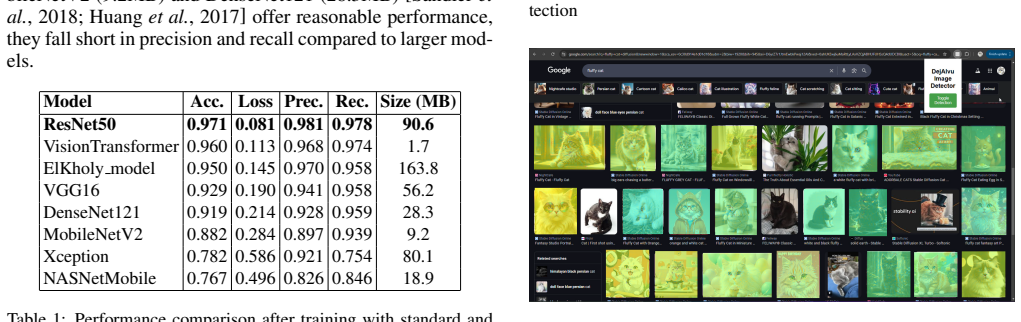
On its own terms, the paper's central claim is that a binary classifier separating AI-generated artwork from human-made artwork can be packaged as a browser extension without sacrificing accuracy or speed. Trained on 271,993 images from public art and generation datasets, a ResNet-50 backbone reaches 97.1% test accuracy with 0.981 precision and 0.978 recall, and converting it to ONNX and running it with ONNX.js lowers average per-image latency to 95 ms, about 35 ms faster than the same model under TensorFlow.js. The paper further claims that Vanilla Gradient saliency maps, computed only when an image is flagged, highlight the artifacts the model relies on, so the extension explains rather than merely asserts its verdicts.
Load-bearing premise
The load-bearing assumption is that a model tested on a held-out slice of its own training artwork collections will perform about as well on the arbitrary images people actually encounter while browsing the web.
Editorial extensions
If this is right
- Every image on a page can be screened client-side in about a tenth of a second, so the tool can operate continuously while browsing rather than as a manual upload service.
- Because inference is local, users do not have to send their images to a server, which keeps the detection process private.
- The comparison with TensorFlow.js indicates that the same ResNet-50 model runs about 35 ms faster per image under ONNX.js, which is the difference between usable and sluggish real-time feedback.
- A 90.6 MB model is small enough to ship inside a browser extension, so the accuracy of a large CNN does not by itself rule out client-side deployment.
Reading between the lines
- The paper leaves implicit that the 97.1% test accuracy is measured on the same curated artwork domain as training; a live deployment benchmark on unrelated web imagery would be a direct test of the extension's real-world claim.
- The saliency heatmaps are explanations of the classifier, not evidence of a human-visible artifact; an experiment that crops heatmap hotspots and checks whether users independently recognize them as AI artifacts would connect the explanation to perception.
- The two headline numbers measure different slices—accuracy on curated art, latency on isolated inference—so an end-to-end browser measurement that includes image interception and heatmap rendering would be needed to verify the 'real-time while browsing' claim.
- A natural extension is to make the detector generator-aware, since training data from diffusion and GAN sources must ultimately generalize to newer models; a per-generator accuracy breakdown would show where the current model starts to fail.
Editorial analysis
A structured set of objections, weighed in public.
Referee Report
Summary. DejAIvu is a Chrome extension that runs a ResNet-50 classifier converted to ONNX.js directly in the browser, labels images as AI-generated, and overlays Vanilla Gradient saliency maps on detected images. The paper trains the model on a curated dataset of AI-generated and human artworks (DiffusionDB, ArtBench, WikiArt), compares several architectures after retraining, reports 97.1% accuracy and 95 ms average latency for ResNet-50 in ONNX.js, and demonstrates the extension on Google Images screenshots. The central claim is that DejAIvu is a practical, deployable, and explainable tool for detecting AI-generated images on the web in real time.
Significance. If the reported numbers held under deployment conditions, DejAIvu would be a useful open-source contribution to practical AI-image detection and browser-based explainability. The paper's strengths include public code, a head-to-head architecture comparison under a fixed training protocol, and a class-prior bias initialization (Eq. 1) that is legitimately derived from the training distribution rather than from test results; I see no circularity in the training/evaluation procedure. However, the evidence currently supports an in-distribution classification claim with limited reproducibility details, not the broader real-world 'practical and deployable tool' claim, and the saliency explanation component is entirely unvalidated. The distribution-shift gap between a curated artwork corpus and arbitrary web images is the decisive risk, and the manuscript itself acknowledges in Section 5 that dataset coverage needs expansion.
major comments (4)
- [§3, Table 1 (Model Performance Comparison)] The headline 97.1% accuracy comes from a single stratified 20% holdout of the same curated AI-art/WikiArt corpus used for training; the paper reports no confidence intervals, no multiple-seed runs, and no out-of-distribution evaluation. The deployed setting is arbitrary web images, including photographs rather than artworks, thumbnails and re-encoded JPEGs, and generators such as Midjourney, FLUX, or DALL·E 3 that are absent from the training set. The conclusion (Section 5) itself lists 'expanding dataset coverage to improve generalization' as future work, which underlines this gap. The central 'practical and deployable tool' claim therefore rests on an untested transfer assumption; please add an out-of-distribution benchmark or explicitly restrict the claims to in-distribution art-style images.
- [§4, Demonstration] The Google Images demonstration is qualitative only: Figures 2 and 3 show 'fluffy cat' search results before and after toggling detection, with no ground-truth labels, no quantitative agreement, and no false-positive count. Because the human class was built only from WikiArt paintings, false positives on natural photographs are not constrained by the reported precision. This demonstration does not provide evidence that the in-distribution accuracy transfers to real web images.
- [§3, Table 2 (Latency Comparisons)] The latency measurement is under-specified: no hardware, browser, image resolution, number of repetitions, or variance is reported, and the 'approximate 35ms reduction' versus TF.js has no statistical detail. The table heading says 'Performance Benchmarks' but only reports latency; the paper also does not verify that ONNX conversion preserves the original model's accuracy. Real-time claims need a reproducible measurement protocol, including accuracy-after-conversion checks.
- [§1 and §4.1 (Saliency Explanation)] The title and abstract present saliency-based explainability as a core contribution, but the manuscript contains no evaluation of the saliency maps: no sanity checks, no localization or faithfulness metrics, no perturbation tests, and no comparison to other explanation methods. The only evidence is the overlay shown in the Google Images screenshots. At minimum, a perturbation-based sanity check (e.g., model output sensitivity to removed highlighted regions) or a small user study is needed before the paper can claim that DejAIvu 'explains' its detections.
minor comments (4)
- [§2.2, Table 1 and §3, Table 1] Table numbering is duplicated: the dataset table in §2.2 and the model performance table in §3 are both labeled 'Table 1', and the text in §2.2 refers to 'Table ??' instead of a proper cross-reference. Please renumber and fix the reference.
- [§2.2, Eq. (1)] The text calls the dataset 'highly imbalanced,' but 190,549 AI-generated versus 81,457 human-made samples is a 2.34:1 ratio, which is only moderately imbalanced; please either soften the wording or report a standard imbalance measure.
- [§2.2, Preprocessing Pipeline] The preprocessing description says pixel values are scaled to [0,1], but it is unclear whether the model was trained from scratch or fine-tuned from pretrained weights; if pretrained ImageNet weights were used, standard per-channel normalization would be needed, and this should be stated explicitly.
- [References] Several references are incomplete or inconsistently formatted, for example '[aio, 2025]' lacks an author name and the WikiArt entry is cited as '[wik, 2025]' without full bibliographic details.
Circularity Check
No circularity: the reported accuracy comes from a held-out split of externally sourced benchmark datasets, and the latency result is a separate system measurement.
full rationale
DejAIvu's central claims are the 97.1% classification accuracy and the 95ms in-browser latency. Neither claim reduces to the paper's own inputs by construction. The model is trained on 271,993 images assembled from externally published datasets (DiffusionDB, AI-ArtBench, WikiArt) and evaluated on a stratified 60-20-20 split, so the test accuracy is a genuine holdout evaluation rather than a fitted value relabeled as a prediction. The bias initialization constant in Eq. (1) is computed from the training class prior before training and does not encode held-out test labels. The latency comparison between ONNX.js and TensorFlow.js is an independent engineering measurement. The paper compares against an El Kholy model and dataset, but El Kholy is not an author of this paper, so there is no load-bearing self-citation chain that forces the conclusion. The main weaknesses are distribution shift from curated artworks to arbitrary web images and the lack of quantitative validation of the saliency overlays; these are correctness and generalization risks, not circularity. The derivation and evaluation are self-contained against external benchmarks, so no significant circularity is present.
Assumptions & free parameters
free parameters (1)
- Class-prior log-bias b =
log(190,549 / 81,457) ≈ 0.849
assumptions (4)
- domain assumption Labels in the curated dataset are correct and consistent across DiffusionDB, AI-ArtBench, and WikiArt.
- domain assumption The curated artwork distribution is representative of AI-generated and human images on the web.
- domain assumption Vanilla Gradient saliency maps localize features that caused the AI classification.
- domain assumption Stratified 60/20/20 splitting prevents data leakage and gives an unbiased accuracy estimate.
Cite this review
Pith. "Pith review of DejAIvu: Identifying and Explaining AI Art on the Web in Real-Time with Saliency Maps." pith.science (2026). https://pith.science/paper/I23RKD2B
@misc{pith2026250208821,
  author       = {Pith},
  title        = {Pith review of: DejAIvu: Identifying and Explaining AI Art on the Web in Real-Time with Saliency Maps},
  year         = {2026},
  howpublished = {\url{https://pith.science/paper/I23RKD2B}},
  note         = {Machine review of arXiv:2502.08821}
}
read the original abstract
The recent surge in advanced generative models, such as diffusion models and generative adversarial networks (GANs), has led to an alarming rise in AI-generated images across various domains on the web. While such technologies offer benefits such as democratizing artistic creation, they also pose challenges in misinformation, digital forgery, and authenticity verification. Additionally, the uncredited use of AI-generated images in media and marketing has sparked significant backlash from online communities. In response to this, we introduce DejAIvu, a Chrome Web extension that combines real-time AI-generated image detection with saliency-based explainability while users browse the web. Using an ONNX-optimized deep learning model, DejAIvu automatically analyzes images on websites such as Google Images, identifies AI-generated content using model inference, and overlays a saliency heatmap to highlight AI-related artifacts. Our approach integrates efficient in-browser inference, gradient-based saliency analysis, and a seamless user experience, ensuring that AI detection is both transparent and interpretable. We also evaluate DejAIvu across multiple pretrained architectures and benchmark datasets, demonstrating high accuracy and low latency, making it a practical and deployable tool for enhancing AI image accountability. The code for this system can be found at https://github.com/Noodulz/dejAIvu.
Figures


Reference graph
Works this paper leans on
- [1]
-
[7]
Mapping the ethics of generative ai: A comprehensive scoping review
[Hagendorff, 2024] Thilo Hagendorff. Mapping the ethics of generative ai: A comprehensive scoping review. Minds and Machines, 34(4), September
work page 2024
-
[8]
Learn- ing from class-imbalanced data: Review of methods and applications
[Haixiang et al., 2017] Gao Haixiang, Liu Yijing, Jinjun Shang, Ma Mingyun, Yang Hong, and Wang Bing. Learn- ing from class-imbalanced data: Review of methods and applications. Expert Systems with Applications , 73:220– 239,
work page 2017
-
[10]
DistML.js: Installation-free Distributed Deep Learning Framework for Web Browsers
[Hidaka et al., 2024] Masatoshi Hidaka, Tomohiro Hashimoto, Yuto Nishizawa, and Tatsuya Harada. Distml.js: Installation-free distributed deep learn- ing framework for web browsers. arXiv preprint arXiv:2407.01023,
work page Pith review arXiv 2024
-
[11]
Densely con- nected convolutional networks
[Huang et al., 2017] Gao Huang, Zhuang Liu, Laurens van der Maaten, and Kilian Q Weinberger. Densely con- nected convolutional networks. In Proceedings of the IEEE Conference on Computer Vision and Pattern Recog- nition, pages 4700–4708,
work page 2017
-
[12]
Gradient-based Explanations for Deep Learning Survival Models
[Jarrett et al., 2025] Daniel M. Jarrett, Aengus M. O’Marcaigh, Georg M. Goerg, Fiona M. Fennessy, Nicholas R. Keat, and Ben Glocker. Gradient-based explanations for deep learning survival models. arXiv preprint arXiv:2502.04970,
work page Pith review arXiv 2025
-
[13]
[Jia et al., 2018] Xianyan Jia, Shutao Song, Wei He, Yangz- ihao Wang, Haidong Rong, Feihu Zhou, Liqiang Xie, Zhenyu Guo, Yuanzhou Yang, Liwei Yu, Tiegang Chen, Guangxiao Hu, Shaohuai Shi, and Xiaowen Chu. Highly scalable deep learning training system with mixed- precision: Training imagenet in four minutes,
work page 2018
-
[15]
A recipe for training neural networks,
[Karpathy, 2019] Andrej Karpathy. A recipe for training neural networks,
work page 2019
Show all 35 references
-
[17]
[Li et al., 2024] Yuying Li, Zeyan Liu, Junyi Zhao, Liangqin Ren, Fengjun Li, Jiebo Luo, and Bo Luo
GitHub repository. [Li et al., 2024] Yuying Li, Zeyan Liu, Junyi Zhao, Liangqin Ren, Fengjun Li, Jiebo Luo, and Bo Luo. The adversarial ai-art: Understanding, generation, detection, and bench- marking,
2024
-
[18]
The artbench dataset: Benchmark- ing generative models with artworks
[Liao et al., 2022] Peiyuan Liao, Xiuyu Li, Xihui Liu, and Kurt Keutzer. The artbench dataset: Benchmark- ing generative models with artworks. arXiv preprint arXiv:2206.14257,
2022 arXiv
-
[20]
Mobilenetv2: Inverted residuals and linear bottlenecks
[Sandler et al., 2018] Mark Sandler, Andrew Howard, Men- glong Zhu, Andrey Zhmoginov, and Liang-Chieh Chen. Mobilenetv2: Inverted residuals and linear bottlenecks. In Proceedings of the IEEE Conference on Computer Vision and Pattern Recognition, pages 4510–4520,
2018
-
[21]
Selvaraju, Michael Cogswell, Abhishek Das, Ramakrishna Vedantam, Devi Parikh, and Dhruv Batra
[Selvaraju et al., 2017] Ramprasaath R. Selvaraju, Michael Cogswell, Abhishek Das, Ramakrishna Vedantam, Devi Parikh, and Dhruv Batra. Grad-cam: Visual explana- tions from deep networks via gradient-based localization. In Proceedings of the IEEE International Conference on Com...
2017
-
[22]
The rise of creative machines: Exploring the im- pact of generative ai,
[Shaikh et al., 2023] Saad Shaikh, Rajat bendre, and Sakshi Mhaske. The rise of creative machines: Exploring the im- pact of generative ai,
2023
-
[24]
Deep inside convolutional networks: Visualising image classification models and saliency maps,
[Simonyan et al., 2014] Karen Simonyan, Andrea Vedaldi, and Andrew Zisserman. Deep inside convolutional networks: Visualising image classification models and saliency maps,
2014
-
[25]
Smooth- grad: removing noise by adding noise
[Smilkov et al., 2017] Daniel Smilkov, Nikhil Thorat, Been Kim, Fernanda Vi´egas, and Martin Wattenberg. Smooth- grad: removing noise by adding noise. In arXiv preprint arXiv:1706.03825,
2017 arXiv
-
[26]
Deep unsupervised learning using nonequilibrium thermody- namics
[Sohl-Dickstein et al., 2015] Jascha Sohl-Dickstein, Eric A Weiss, Niru Maheswaranathan, and Surya Ganguli. Deep unsupervised learning using nonequilibrium thermody- namics. In Proceedings of the 32nd International Con- ference on Machine Learning , pages 2256–2265. PMLR,
2015
-
[27]
Evaluating the social impact of generative ai systems in systems and society,
[Solaiman et al., 2024] Irene Solaiman, Zeerak Talat, William Agnew, Lama Ahmad, Dylan Baker, Su Lin Blodgett, Canyu Chen, Hal Daum ´e III, Jesse Dodge, Isabella Duan, Ellie Evans, Felix Friedrich, Avijit Ghosh, Usman Gohar, Sara Hooker, Yacine Jernite, Ria Kalluri, Alberto Lu...
2024
-
[28]
Axiomatic attribution for deep net- works
[Sundararajan et al., 2017] Mukund Sundararajan, Ankur Taly, and Qiqi Yan. Axiomatic attribution for deep net- works. In Proceedings of the 34th International Con- ference on Machine Learning (ICML) , pages 3319–3328,
2017
-
[29]
Wang, Evan Montoya, David Munechika, Haoyang Yang, Benjamin Hoover, and Duen Horng Chau
[Wang et al., 2022] Zijie J. Wang, Evan Montoya, David Munechika, Haoyang Yang, Benjamin Hoover, and Duen Horng Chau. Diffusiondb: A large-scale prompt gallery dataset for text-to-image generative models. arXiv preprint arXiv:2210.14896,
2022 arXiv
-
[30]
Anatomizing deep learning inference in web browsers
[Wang et al., 2024] Qipeng Wang, Shiqi Jiang, Zhenpeng Chen, Xu Cao, Yuanchun Li, Aoyu Li, Yun Ma, Ting Cao, and Xuanzhe Liu. Anatomizing deep learning inference in web browsers. arXiv preprint arXiv:2402.05981,
2024 arXiv
-
[31]
https://www.wikiart.org/,
[wik, 2025] Wikiart. https://www.wikiart.org/,
2025
-
[32]
A comprehensive survey of image augmentation techniques for deep learning.Pattern Recog- nition, 137:109347, May
[Xu et al., 2023] Mingle Xu, Sook Yoon, Alvaro Fuentes, and Dong Sun Park. A comprehensive survey of image augmentation techniques for deep learning.Pattern Recog- nition, 137:109347, May
2023
-
[33]
A sanity check for ai-generated image detection, 06
[Yan et al., 2024] Shilin Yan, Ouxiang Li, Jiayin Cai, Yanbin Hao, Xiaolong Jiang, Yao Hu, and Weidi Xie. A sanity check for ai-generated image detection, 06
2024
-
[34]
On attribution of deepfakes
[Zhang et al., 2020] Baiwu Zhang, Jin Peng Zhou, Ilia Shu- mailov, and Nicolas Papernot. On attribution of deepfakes. arXiv preprint arXiv:2008.09194,
2020 arXiv
-
[35]
Patchcraft: Explor- ing texture patch for efficient ai-generated image detec- tion, 2024
[Zhong et al., 2024] Nan Zhong, Yiran Xu, Sheng Li, Zhenxing Qian, and Xinpeng Zhang. Patchcraft: Explor- ing texture patch for efficient ai-generated image detec- tion, 2024
2024
-
[2014]
Ai-generated image detection: Passive or water- mark?,
[Guo et al., 2025] Moyang Guo, Yuepeng Hu, Zhengyuan Jiang, Zeyu Li, Amir Sadovnik, Arka Daw, and Neil Gong. Ai-generated image detection: Passive or water- mark?,
2025
-
[2015]
An image is worth 16x16 words: Transformers for image recognition at scale
[Dosovitskiy et al., 2020] Alexey Dosovitskiy, Lucas Beyer, Alexander Kolesnikov, Dirk Weissenborn, Xiaohua Zhai, Thomas Unterthiner, Mostafa Dehghani, Matthias Min- derer, Georg Heigold, Sylvain Gelly, et al. An image is worth 16x16 words: Transformers for image recognition a...
2020 arXiv
-
[2017]
Deep residual learning for image recog- nition
[He et al., 2015] Kaiming He, Xiangyu Zhang, Shaoqing Ren, and Jian Sun. Deep residual learning for image recog- nition. arXiv preprint arXiv:1512.03385,
2015 arXiv
-
[2018]
Compiling onnx neural net- work models using mlir.arXiv preprint arXiv:2008.08272,
[Jin et al., 2020] Tian Jin, Gheorghe-Teodor Bercea, Tung D Le, Tong Chen, Gong Su, Haruki Imai, Yasushi Negishi, Anh Leu, Kevin O’Brien, Kiyokuni Kawachiya, and Alexandre E Eichenberger. Compiling onnx neural net- work models using mlir.arXiv preprint arXiv:2008.08272,
2020 arXiv
-
[2019]
[Kholy, 2024a] Adam El Kholy
Accessed: 2025-02-11. [Kholy, 2024a] Adam El Kholy. Ai-artwork dataset: Human and ai-generated artworks,
2025
-
[2020]
Improving interpretability and robustness for the detection of ai-generated images,
[Gaintseva et al., 2024] Tatiana Gaintseva, Laida Kushnareva, German Magai, Irina Piontkovskaya, Sergey Nikolenko, Martin Benning, Serguei Barannikov, and Gregory Slabaugh. Improving interpretability and robustness for the detection of ai-generated images,
2024
-
[2022]
Mixed precision training,
[Micikevicius et al., 2018] Paulius Micikevicius, Sharan Narang, Jonah Alben, Gregory Diamos, Erich Elsen, David Garcia, Boris Ginsburg, Michael Houston, Oleksii Kuchaiev, Ganesh Venkatesh, and Hao Wu. Mixed precision training,
2018
-
[2023]
Shorten and T.M
[Shorten and Khoshgoftaar, 2019] C. Shorten and T.M. Khoshgoftaar. A survey on image data augmentation for deep learning. Journal of Big Data , 6:60,
2019
-
[2024]
Goodfellow, Jean Pouget- Abadie, Mehdi Mirza, Bing Xu, David Warde-Farley, Sherjil Ozair, Aaron Courville, and Yoshua Bengio
[Goodfellow et al., 2014] Ian J. Goodfellow, Jean Pouget- Abadie, Mehdi Mirza, Bing Xu, David Warde-Farley, Sherjil Ozair, Aaron Courville, and Yoshua Bengio. Gen- erative adversarial nets. arXiv preprint arXiv:1406.2661 ,
2014 arXiv
-
[2025]
[Bach et al., 2015] Sebastian Bach, Alexander Binder, Gr´egoire Montavon, Frederick Klauschen, Klaus-Robert M¨uller, and Wojciech Samek
Ac- cessed: 2025-02-11. [Bach et al., 2015] Sebastian Bach, Alexander Binder, Gr´egoire Montavon, Frederick Klauschen, Klaus-Robert M¨uller, and Wojciech Samek. On pixel-wise explanations for non-linear classifier decisions by layer-wise relevance propagation. PLOS ONE, 10(7):...
2025
Reviewed August 7, 2026 · model on record in the stance chip above.
Discussion (0). Continue with ORCID to comment.