REVIEW 2 major objections 5 minor 33 references
Chemical filters for ultra-high-throughput materials screening and generation
T0 review · 2 major / 5 minor · reviewed 2026-08-01 · deepseek-v4-flash
Pith's one-line read A tunable oxidation-state filter can screen and guide AI-generated materials, preserving low-energy crystals while rejecting chemically implausible ones.
desk verdict Useful, well-scoped methods paper with a real soft spot in the MLIP-based stability validation; the tunable filter itself is solid and worth refereeing. read the letter →
The pith
A machine-rendered reading of the paper's core claim, the machinery that carries it, and where it could break.
The reading
What carries the argument
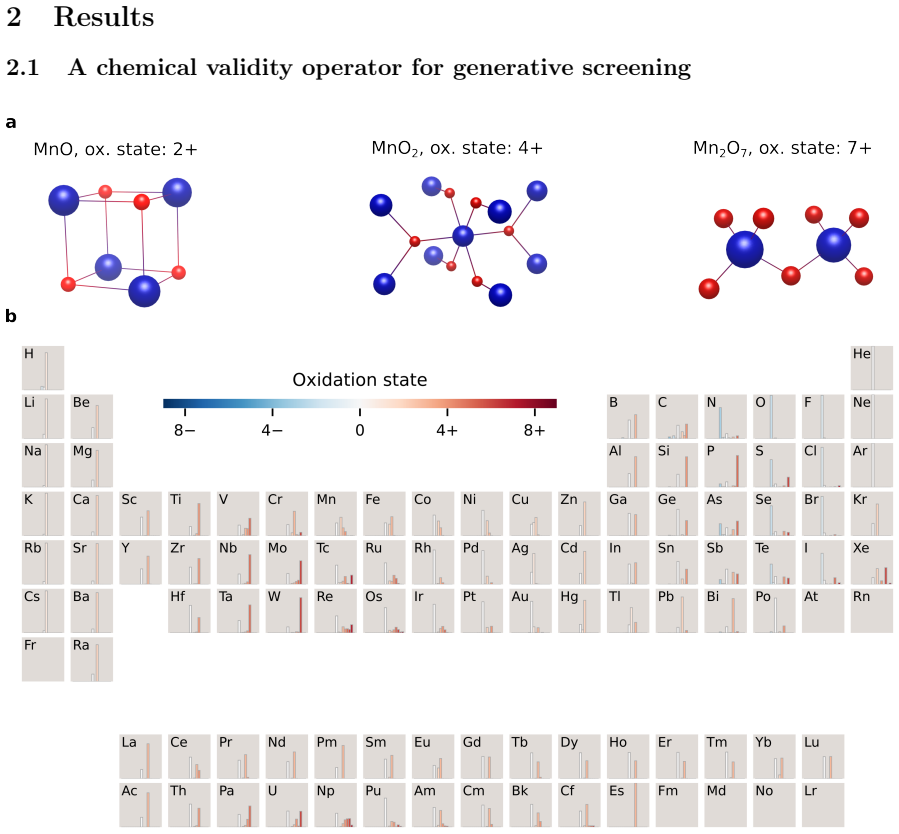
The load-bearing component is a composition-level chemical validity operator built from empirical oxidation-state statistics. For each element, a filtered set of allowed oxidation states is constructed by keeping states that appear at least C times in a large experimental crystal-structure database (consensus) and that account for at least a fraction θ of that element's recorded occurrences (commonality). A composition is declared valid if some product assignment from these per-element sets is charge neutral and satisfies the Pauling electronegativity rule. For the continuous reward, the same machinery is turned into a score: the geometric mean, over the elements in a composition, of the obs
What would settle it
Compile a list of experimentally confirmed inorganic compounds that rely on oxidation states with fewer than three database occurrences or with low relative frequency (for example, certain high-valence oxides or stabilized low-valence species). If the strict filter (C=3, θ=0.5) rejects a large share of these confirmed compounds, that is direct evidence that the database prior is too conservative; conversely, if it retains them, the prior tracks synthesizability closely.
Extended reading notes
Core claim
The central claim is that oxidation-state frequencies observed in experimental crystal structures provide a model-agnostic chemical prior that can both evaluate and guide generative models. The paper formalizes this as a validity operator that accepts only compositions for which some assignment of element oxidation states is charge neutral and obeys the electronegativity rule, where the allowed states are those that survive two adjustable thresholds: consensus C (a minimum absolute number of database occurrences) and commonality θ (a minimum share of an element's occurrences). Benchmarks on six generative models show that while 93–97% of generated compositions pass charge neutrality, strict
Load-bearing premise
The entire screening and reward signal is only as good as the oxidation-state frequencies in the experimental crystal-structure database, so if that database systematically under-records rare but synthesizable oxidation states, the filter will discard legitimate chemistry.
Editorial extensions
If this is right
- Generative models that score well on standard validity checks can still be far from the empirical oxidation-state distribution; the stricter commonality filter exposes this gap, with retention dropping to 42–55% at θ=0.5.
- Charge neutrality and electronegativity consistency are not enough to predict stability; empirical oxidation-state commonality adds a chemical signal that correlates with low energy above the convex hull.
- Stricter filtering preferentially removes high-Ehull compounds, so the operator acts as a cheap first-pass stability prior before expensive structure relaxation.
- The same operator can be used as an in-training reward without retraining the generative architecture, since it is model-agnostic.
- Oxidation-state-aware rewards can trade novelty and diversity for metastability; the continuous reward raised metastability while lowering uniqueness and novelty.
Reading between the lines
- Because the operator is tunable, it could be adapted to synthesis-specific goals: loosening θ to propose compounds that require unusual stabilisation, or tightening it near the end of a pipeline to favor well-trodden chemistry.
- The correlation between validity and Ehull may reflect that common oxidation states are often those with accessible synthesis routes; if so, the filter indirectly encodes kinetic or thermodynamic accessibility beyond what the convex-hull calculation captures. This connection is not tested in the paper.
- A testable extension: use the continuous reward in a multi-objective setup with an exploration bonus, which could recover some of the lost novelty while retaining the metastability gain.
- As the underlying database grows and updates, the same operator can be re-derived without changing the method; quantifying how much rare-but-real chemistry is discarded at each threshold remains an open empirical question.
Editorial analysis
A structured set of objections, weighed in public.
Referee Report
Summary. The paper introduces a tunable chemical validity operator built on the SMACT oxidation-state model, with a consensus threshold C and a commonality threshold θ that control the strictness of empirical oxidation-state prior. The authors benchmark six generative models (ADiT, CDVAE, Chemeleon-DNG, DiffCSP, DiffCSP++, MatterGen) on 10,000 generated compositions each, showing that charge neutrality and the electronegativity rule are usually satisfied, while agreement with empirical oxidation-state commonality varies substantially across models. They further analyze energy above the convex hull (Ehull) using MACE-MPA-0 relaxations, reporting that stricter validity filtering correlates with lower Ehull. Finally, they demonstrate the operator as a binary or continuous RL reward for fine-tuning the Chemeleon2 latent diffusion model, claiming the continuous reward improves metastability and mSUN at the cost of uniqueness and novelty.
Significance. If the claims hold, this work provides a simple, interpretable, and model-agnostic chemical filter that can serve both as a post-hoc diagnostic and as an in-training reward for generative models. The threshold formulation is a pragmatic extension of SMACT, and the open-source code and benchmark data are valuable resources. The benchmarking across six state-of-the-art models is a useful contribution. However, the central Ehull-based evidence rests on MLIP energies with potentially systematic bias, and the RL results are unreplicated, so the quantitative claims require strengthening before the significance can be fully assessed.
major comments (2)
- [§4.4 / Fig. 2] The claim that stricter filtering preserves low-energy compounds is based on the Ehull comparison in Fig. 2, computed with MACE-MPA-0, which the paper states has errors of 'a few tens of meV/atom' (§4.4). At C=3, θ=0.5 the median valid–invalid gap is 0.089 eV/atom (89 meV/atom), the same order of magnitude as the reported MLIP error. Since MACE-MPA-0 is trained on Materials Project structures dominated by common oxidation states, energies for compounds with rare oxidation states may be systematically biased, inflating the observed separation. The paper does not test for systematic bias with respect to the validity grouping variable. I recommend a DFT cross-check on a stratified sample (e.g., 50–100 valid and invalid compounds balanced across oxidation-state commonality) or, at minimum, an analysis of residual errors against oxidation-state frequency. Without this, the 'preserves low-ener
- [§2.4 / Fig. 6] The reinforcement-learning results are presented from single training runs. Figure 6 shows one reward trajectory and one set of final metrics per reward, with no error bars or multiple seeds. The observed changes (e.g., mSUN 0.0764→0.0908, metastability 0.3279→0.4310) could be within run-to-run variance, especially with only 400 update steps and stochastic generation. The claims that the continuous SMACT reward improves metastability and mSUN, and that the binary reward does not, require reproducibility evidence. Please report means and standard deviations over at least 3–5 independent seeds, or otherwise justify the stability of the results.
minor comments (5)
- [§2.2 / Table 1] The sentence 'reducing the fraction of retained compositions by a further 3–7%' is inconsistent with Table 1: from q+χ to C=3 the decreases are 1.7%, 4.2%, 3.7%, 4.0%, 3.8%, 3.9% for ADiT, CDVAE, Chemeleon-DNG, DiffCSP, DiffCSP++, and MatterGen. Similarly, the '42–55%' range for θ=0.5 omits CDVAE's 41.8% (or should be rounded consistently). Please correct the text.
- [§2.4 / Fig. 6] The term 'mSUN' is used in the Results but only defined in the Methods. Please define it at first use in the Results. Also, specify the number of independent runs/seeds in the figure caption.
- [§4.1 / Eq. (2)] Clarify how include_zero=False interacts with the commonality calculation: is the denominator in Eq. (2) computed over the zero-inclusive or zero-excluded oxidation-state set? This could affect the filtered Ω set and the resulting retention rates.
- [§4.4 / Fig. 2] The exclusion of Yb-containing compositions (2.5%) is stated only in the Methods. Please mention this important data exclusion in the Results text for Fig. 2, as it may affect the comparability of the Ehull distributions.
- [§2.3 / Fig. 3] The caption of Fig. 3 should state explicitly which oxidation-state list and which consensus setting (C=1 vs C=3) are used for the 'permissive' and 'strictest' panels. The current text leaves some ambiguity about the default parameters.
Circularity Check
No significant circularity: validity labels and stability/energy metrics are constructed independently, and the load-bearing claims are empirical correlations rather than definitional reductions.
full rationale
The derivation chain is self-contained on inspection. The oxidation-state prior is explicitly constructed from ICSD frequencies in Eqs. (1)-(3), and the validity operator in Eqs. (4)-(7) is a stated composition-level rule (charge neutrality, electronegativity ordering, membership in the filtered state set); nothing in this construction is fitted to or defined by the downstream quantities it is used to evaluate. The central quantitative claim, that stricter filtering retains low-Ehull compounds while invalid compositions concentrate in the high-Ehull tail (Figure 2), compares these validity labels against energies above the convex hull computed with MACE-MPA-0 (Methods 4.4), an independent surrogate for DFT stability that does not appear in the validity definition. The RL reward in Eq. (8) uses the same ICSD oxidation-state proportions, but the reported gains in mSUN/metastability are evaluated with external Ehull and diversity metrics; the paper even shows a metric-targeted reward outperforms on aligned metrics, indicating the authors are not conflating reward and evaluation. Retention curves in Figures 3-5 are descriptive consequences of the threshold definitions, not predictions, and are presented as tunability demonstrations. Self-citations to SMACT and Chemeleon identify codebases/models whose relevant equations and settings are stated in the manuscript; no load-bearing argument reduces to an unverified self-citation. Limitations on ICSD coverage bias and MLIP energy error are acknowledged in the Discussion and Methods 4.4; they are accuracy concerns, not evidence of circularity.
Assumptions & free parameters
free parameters (2)
- Consensus threshold C =
C=3 (default); also C=1 and C=0 used
- Commonality threshold θ =
θ=0.05, 0.10, 0.50
assumptions (4)
- domain assumption ICSD oxidation-state frequencies are a reliable empirical prior for chemical plausibility.
- domain assumption The Pauling electronegativity rule is a valid necessary condition for charge assignment.
- domain assumption MACE-MPA-0 foundation potential predicts energies accurately enough for distributional comparisons of Ehull.
- domain assumption The 0.1 eV/atom threshold defines metastability.
Cite this review
Pith. "Pith review of Chemical filters for ultra-high-throughput materials screening and generation." pith.science (2026). https://pith.science/paper/I4TAADXY
@misc{pith2026260717910,
  author       = {Pith},
  title        = {Pith review of: Chemical filters for ultra-high-throughput materials screening and generation},
  year         = {2026},
  howpublished = {\url{https://pith.science/paper/I4TAADXY}},
  note         = {Machine review of arXiv:2607.17910}
}
read the original abstract
Generative artificial intelligence is rapidly transforming materials design by enabling de novo exploration of immense chemical spaces. Yet a large proportion of AI-generated compositions remain implausible, violating established chemical principles, which limits the reliability and interpretability of generative materials design. Here, we introduce a chemical validity operator that recasts heuristic chemical rules as a configurable algorithmic prior for evaluating and guiding generative materials discovery. Built on the open-source SMACT package, a data-informed oxidation-state model exposes tunable thresholds, allowing users to interpolate continuously between permissive and conservative chemical constraints, while supporting both exploratory and conservative materials-design workflows. Benchmarking six state-of-the-art generative models for inorganic crystals shows that most reproduce stoichiometry but under-represent realistic oxidation-state combinations, and that filtering removes compositions reliant on rarely observed oxidation states while preserving low-energy compounds near the convex hull. Beyond screening, the same operator can also serve as a reinforcement-learning reward, steering a latent diffusion model towards chemically grounded compositions. By encoding chemical heuristics and observations, this work establishes a foundation for oxidation-state-aware generative models.
Figures


Figures from the paper (3 more)


Reference graph
Works this paper leans on
-
[1]
Zeni, C.et al.A generative model for inorganic materials design.Nature639, 624–632 (2025)
2025
-
[2]
Handoko, A. D. & Made, R. I. Artificial intelligence and generative models for materials discovery – a review. Preprint athttps://arxiv.org/abs/2508.03278(2025)
arXiv 2025
-
[3]
Merchant, A.et al.Scaling deep learning for materials discovery.Nature624, 80–85 (2023)
2023
-
[4]
Preprint athttps://arxiv.org/abs/2512.04562(2025)
Betala, S.et al.LeMat-GenBench: a unified evaluation framework for crystal generative models. Preprint athttps://arxiv.org/abs/2512.04562(2025). 15
arXiv 2025
-
[5]
Achary, S. N. & Tyagi, A. K. Synthesis of materials with unusual oxidation state. in Handbook on Synthesis Strategies for Advanced Materials: Volume-III: Materials Specific Synthesis Strategies(eds Tyagi, A. K. & Ningthoujam, R. S.) 137–158 (Springer, 2021)
2021
-
[6]
npj Comput
Deng, B.et al.Systematic softening in universal machine learning interatomic potentials. npj Comput. Mater.11, 9 (2025)
2025
-
[7]
Sanocki, M. & Zavadlav, J. Generalization of long-range machine learning potentials in complex chemical spaces. Preprint athttps://arxiv.org/abs/2512.10989(2025)
arXiv 2025
-
[8]
Goldschmidt, V. M. Die Gesetze der Krystallochemie.Naturwissenschaften14, 477–485 (1926)
1926
Show all 33 references
-
[9]
Pettifor, D. G. A chemical scale for crystal-structure maps.Solid State Commun.51, 31–34 (1984)
1984
-
[10]
Pamplin, B. R. A systematic method of deriving new semiconducting compounds by struc- tural analogy.J. Phys. Chem. Solids25, 675–684 (1964)
1964
-
[11]
Preprint athttps://arxiv.org/abs/2507.19799(2025)
Cheng, M.et al.Enhancing materials discovery with valence constrained design in genera- tive modeling. Preprint athttps://arxiv.org/abs/2507.19799(2025)
2025 arXiv
-
[12]
Mater.9, 38 (2023)
Zhao, Y.et al.Physics guided deep learning for generative design of crystal materials with symmetry constraints.npj Comput. Mater.9, 38 (2023)
2023
-
[13]
W.et al.Computational screening of all stoichiometric inorganic materials
Davies, D. W.et al.Computational screening of all stoichiometric inorganic materials. Chem1, 617–627 (2016)
2016
-
[14]
W., Butler, K
Davies, D. W., Butler, K. T., Isayev, O. & Walsh, A. Materials discovery by chemical analogy: role of oxidation states in structure prediction.Faraday Discuss.211, 553–568 (2018)
2018
-
[15]
W.et al.SMACT: semiconducting materials by analogy and chemical theory
Davies, D. W.et al.SMACT: semiconducting materials by analogy and chemical theory. J. Open Source Softw.4, 1361 (2019)
2019
-
[16]
& Jaakkola, T
Xie, T., Fu, X., Ganea, O.-E., Barzilay, R. & Jaakkola, T. S. Crystal diffusion variational autoencoder for periodic material generation. inInternational Conference on Learning Representations(2022)
2022
-
[17]
& Walsh, A
Park, H. & Walsh, A. Guiding generative models to uncover diverse and novel crystals via reinforcement learning. Preprint athttps://arxiv.org/abs/2511.07158(2025)
2025
-
[18]
Mater.11, 184 (2025)
Qiu, Z.et al.Massive discovery of crystal structures across dimensionalities by leveraging vector quantization.npj Comput. Mater.11, 184 (2025)
2025
-
[19]
S., Hanisch, M
Yan, L., Kang, B. S., Hanisch, M. D., Ma, J. & Anandkumar, A. MGB: the material gen- eration benchmark. Preprint athttps://openreview.net/forum?id=K15Dqxm0ge(2025)
2025
-
[20]
Sci.11, 2304305 (2024)
Wei, L.et al.Crystal composition transformer: self-learning neural language model for generative and tinkering design of materials.Adv. Sci.11, 2304305 (2024)
2024
-
[21]
K.et al.All-atom diffusion transformers: unified generative modelling of molecules and materials
Joshi, C. K.et al.All-atom diffusion transformers: unified generative modelling of molecules and materials. inInternational Conference on Machine Learning(2025)
2025
-
[22]
& Walsh, A
Park, H., Onwuli, A. & Walsh, A. Exploration of crystal chemical space using text-guided generative artificial intelligence.Nat. Commun.16, 4379 (2025). 16
2025
-
[23]
inAdvances in Neural Information Processing Systems, vol
Jiao, R.et al.Crystal structure prediction by joint equivariant diffusion. inAdvances in Neural Information Processing Systems, vol. 36, 17464–17497 (2023)
2023
-
[24]
Spacegroupconstrainedcrystalgeneration
Jiao, R., Huang, W., Liu, Y., Zhao, D.&Liu, Y. Spacegroupconstrainedcrystalgeneration. inInternational Conference on Learning Representations(2024)
2024
-
[25]
& Rehme, S
Zagorac, D., Müller, H., Ruehl, S., Zagorac, J. & Rehme, S. Recent developments in the Inorganic Crystal Structure Database: theoretical crystal structure data and related features.J. Appl. Crystallogr.52, 918–925 (2019)
2019
-
[26]
Jain, A.et al.Commentary: The Materials Project: a materials genome approach to accelerating materials innovation.APL Mater.1, 011002 (2013)
2013
-
[27]
Adv.2, e1600225 (2016)
Sun, W.et al.The thermodynamic scale of inorganic crystalline metastability.Sci. Adv.2, e1600225 (2016)
2016
-
[28]
Batatia, I.et al.A foundation model for atomistic materials chemistry.J. Chem. Phys. 163, 184110 (2025)
2025
-
[29]
Cohen, O.et al.TorchSim: an efficient atomistic simulation engine in PyTorch.AI Sci.1, 025003 (2025)
2025
-
[30]
Riebesell, J.et al.A framework to evaluate machine learning crystal stability predictions. Nat. Mach. Intell.7, 836–847 (2025)
2025
-
[31]
Preprint athttps://arxiv.org/abs/2402.03300(2024)
Shao, Z.et al.DeepSeekMath: pushing the limits of mathematical reasoning in open language models. Preprint athttps://arxiv.org/abs/2402.03300(2024)
2024 arXiv
-
[32]
& Ermon, S
Song, J., Meng, C. & Ermon, S. Denoising diffusion implicit models. inInternational Conference on Learning Representations(2021)
2021
-
[33]
& Hutter, F
Loshchilov, I. & Hutter, F. Decoupled weight decay regularization. inInternational Con- ference on Learning Representations(2019). 17 Supplementary Information Figure S1: Number of oxidation states listed per element in each of the five built-in oxidation- state lists. Each li...
2019
Reviewed August 1, 2026 · model on record in the stance chip above.
Discussion (0). Sign in to comment.