REVIEW 3 major objections 3 minor 6 references
This paper contends that the Painlevé paradox, as formulated in Génot and Brogliato's analysis, is not invariant under Galilean boosts: the existence and uniqueness of a smooth evolution depend on the inertial observer.
Reviewed by Pith at T0; open to challenge. T0 means a machine referee read the full paper against a public rubric. the ladder, T0–T4 →
T0 review · deepseek-v4-flash
2026-08-01 02:28 UTC pith:I52ARFWQ
load-bearing objection Correct algebra and a useful phase-plane remark, but the central observer-dependence claim collapses once sliding velocity is defined relativistically. the 3 major comments →
Notes on a paper by F. G\'enot and B. Brogliato on the Painlev\'e paradox
The pith
A machine-rendered reading of the paper's core claim, the machinery that carries it, and where it could break.
Core claim
The central claim is that Génot and Brogliato's mode classification (MII/MIII/MIV) and the resulting Painlevé conditions are not Galilean-invariant. For a given state (x, ϑ, ϑ̇) with ẋ_A < 0 in one inertial frame, a boost u can make ẋ*_A > 0 in another, flipping the friction law from FT = +μFN to FT = −μFN while the forces themselves should be unchanged. Since the coefficient B = (1/m)(1 + 3 cosϑ(cosϑ − μ sinϑ)) becomes B* = (1/m)(1 + 3 cosϑ(cosϑ + μ sinϑ)), and B and B* are symmetric about ϑ = π/2, there are parameter values where one observer sees B > 0 (deterministic) and another B < 0 (paradox). The paper concludes that these results are observer-dependent artifacts of treating ẋ_A as th
What carries the argument
The load-bearing identification is v = ẋ_A, where ẋ_A = ẋ + L sinϑ ϑ̇ is the absolute horizontal velocity of the rod endpoint A in the observer's frame. Under a Galilean boost ẋ* = ẋ + u, this quantity changes, while the true sliding velocity—the difference between the velocity of the contact point of the rod and the velocity of the point of the constraint—is observer-invariant. This identification feeds into the ACM friction law and the coefficient B and B*, which determine whether the smooth evolution exists, is unique, or fails.
Load-bearing premise
That Génot and Brogliato indeed intended the sliding velocity v to be the absolute horizontal velocity ẋ_A of endpoint A in the chosen frame, rather than the relative sliding velocity with respect to the material points of the constraint; if they meant the latter, the critique becomes a clarification request rather than a demonstration of observer-dependence.
What would settle it
Choose μ > 4/3 and a rod orientation ϑ at which B(ϑ) < 0 while B*(ϑ) > 0 (such pairs exist because B and B* are mirror images about ϑ = π/2). From a state with ẋ_A < 0 in the original frame, apply a Galilean boost u with 0 < u < −ẋ_A, so ẋ*_A > 0. The forces on the rod are identical in both frames. If the original frame finds no smooth solution to the unilateral conditions while the boosted frame finds a unique one, Génot and Brogliato's classification is observer-dependent; if instead the two frames give the same answer once the constraint's material motion is accounted for, the identificatio
If this is right
- If Génot and Brogliato's formulation is retained, the existence and uniqueness of a smooth evolution is not an intrinsic dynamical property; the same physical system can appear deterministic or paradoxical depending on the inertial observer.
- The symmetry between B and B* about ϑ = π/2 implies that for μ > 4/3 there are rod orientations for which one observer finds B > 0 and another finds B < 0, so the paradox can appear or disappear purely by changing frame.
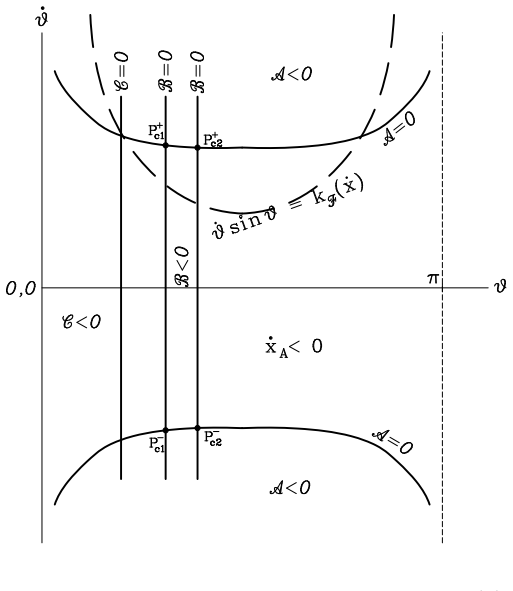
- The phase-plane exclusion of the critical points P±c1 and P±c2 depends on the boost u, so the qualitative behaviour inferred from the diagram is observer-dependent.
- Within the corrected Galilean-constraint framework, the only genuinely new prediction is that the condition ẋ_A < 0 must be included in the phase analysis, making the behaviour depend on the rod's linear velocity; the MII/MIII equivalence is then due to symmetry, not to a change of frame.
Where Pith is reading between the lines
- The critique generalizes: any mechanical analysis that identifies a velocity-dependent friction force with an absolute velocity, rather than a relative velocity, will inherit the same observer-dependence—for instance, viscous drag models that ignore the motion of the surrounding fluid.
- The proposed kinematic description suggests a testable taxonomy: for rigid but non-Galilean constraints the apparent forces must be included and are known, while for deformable constraints an event-driven impulsive formulation may be required; this could be compared against sliding-rod experiments with a moving or vibrating support.
- The invariance of the velocity jump Δv_A implies that the 'impact without collision' phenomenon, if real, is physically robust and should be observed identically by all observers; this is a sharper, checkable consequence of the paper's argument.
Editorial analysis
A structured set of objections, weighed in public.
Referee Report
Summary. This short note re-examines the 1999 Genot–Brogliato (GB) treatment of the Classical Painleve Problem, with emphasis on Galilean invariance. Section 1 summarizes GB's equations of motion, the Amontons–Coulomb–Morin law, and the classification into modes MII/MIII/MIV based on the sign of the horizontal velocity of the contact point, x_dot_A. Section 2 constructs a Galilean boost (Eqs. 7–11) and claims that the sign of x_dot_A, hence the direction of friction and the coefficient B, can change with the observer, so that the Painleve paradox may occur for one inertial observer but not for another. Section 3 introduces the standard definition of sliding velocity as a relative velocity (Eq. 15) and notes its frame invariance. Section 4 argues that a rough constraint requires a kinematic description of its material points. Section 5 discusses a reformulation and concedes that, for a Galilean-type constraint, there is a rest frame in which v = x_dot_A and that all inertial observers measure the same sliding velocity; only the phase-portrait reachability condition is presented as a genuinely new improvement.
Significance. If the claimed observer-dependence of the Painleve paradox were correct, it would be a significant finding, as it would imply that a standard result of rigid-body contact mechanics is not invariant under Galilean transformations. However, the central claim is not valid under the correct definition of sliding velocity, and the manuscript itself contains the concession that invalidates it. The genuinely useful contribution is the kinematic description of constraints in Section 4 and the resulting clarification that GB's notation is implicitly tied to a frame in which the constraint is at rest. This is a modest but legitimate point, and the phase-space reachability condition in Section 5(iv) is a further concrete refinement. The paper is not publishable in its present form, but the ingredients for a sound, smaller note are present.
major comments (3)
- [Section 2, Eqs. (7)-(11)] The central observer-dependence claim is not valid for a fixed physical constraint. Under the boost (7), the material points of the supporting line, which are at rest in F, move with velocity u in F*. The relative sliding velocity is therefore v_sl* = x_dot*_A - u = x_dot_A, by the definition (15) invoked in Section 3. The sign of the sliding velocity does not flip, so the frictional force in F* is still F_T = +mu F_N for x_dot_A < 0, and the balance equations (10), together with B* in (11), are not the correct description of the same physical system. The conclusion that the Painleve paradox occurs for one inertial observer but not another is an artifact of treating x_dot_A as the sliding velocity while ignoring the motion of the constraint. This is the load-bearing step of the paper.
- [Section 5(i)-(ii)] The paper itself concedes the point made above. For a Galilean-type constraint there is a rest frame; once that frame is chosen, the sliding velocity v is given by x_dot_A and all inertial observers measure the same v. This directly contradicts the abstract and Section 2, which claim that the classification depends on the observer. The concession reduces the actual new content to point (iv), the phase-portrait reachability condition. The manuscript must be restructured around the clarification and the kinematic description rather than around the claimed observer-dependence of the paradox.
- [Section 2, paragraph before Eq. (10)] The statement that F*_T = -mu F_N would be 'already unacceptable in itself' is presented as a contradiction, but it is simply a consequence of using the wrong expression for the sliding velocity. Forces are Galilean-invariant; the same contact force is measured in F and F*. The tangential component of the force cannot change sign under a boost unless the physical constraint state has changed. The symmetry observation after Eq. (11), concerning B versus B*, describes a spatial reflection theta -> pi - theta, not a change of observer, and is therefore irrelevant to the observer-dependence claim.
minor comments (3)
- [Section 2, Remark] The remark about v = 0 not implying |F_T| <= mu |F_N| is confusing. In standard Coulomb friction, this inequality is the necessary condition for sticking; if it is violated, the body cannot remain at rest. If the author intends a subtlety about instantaneous stopping in unilateral contact, it should be expanded and justified; otherwise it should be removed, as it is not used in the argument.
- [Section 3, last paragraph] The claim that the velocity jump Delta v_A = v_R_A - v_L_A is invariant under arbitrary changes of reference frame, including non-Galilean ones, is stated without proof. Although plausible, it should be justified explicitly, since the section emphasizes different invariance properties of different quantities.
- [Figures 3 and 4] Figures 3 and 4 are referenced in the text but are not included. They are needed to follow the discussion of k_F(x_dot) and the exclusion of critical points. Please add them or describe the relevant features in the text.
Circularity Check
No significant circularity: the Section 2 observer-dependence claim is an explicit conditional consequence of the v=ẋ_A reading, later retracted for Galilean constraints; self-citation [6] is not load-bearing.
full rationale
The paper's central critique (Section 2, Eqs. 7-11) is transparently conditional: it begins from the GB formulation 'where the assumption v = ẋ_A is implicitly adopted' and applies a Galilean boost. The resulting B* ≠ B follows by velocity addition and algebra; it is not imported from a fitted parameter or from a hidden uniqueness result. Section 3 then identifies the choice of identifying the sliding velocity v with the horizontal component ẋ_A as 'the main reason' and supplies the standard invariant definition v(sl)=v_P−v_P′ (Eq. 15), and Section 5(i)-(ii) explicitly concedes that for a Galilean-type constraint there is a rest frame and every inertial observer measures the same sliding velocity, so the §2 frame-dependence is not presented as a physical prediction. The only self-citation, [6], is an alternative impulsive-mechanics approach offered as a possible remedy; it does not support the observer-dependence claim and is therefore not load-bearing. No fitted-input-as-prediction, no self-citation chain, and no ansatz-smuggling steps are present. Accordingly the paper warrants a low circularity score, with the minor caveat that the strongest headline claim overstates an artifact of the v=ẋ_A assumption rather than a genuinely circular derivation.
Axiom & Free-Parameter Ledger
axioms (5)
- domain assumption Galilean observers measure the same forces and accelerations for a mechanical system.
- domain assumption The sliding velocity is the relative velocity between the contact points of the two surfaces (Johnson's definition, Eq. 15).
- domain assumption The Amontons–Coulomb–Morin friction law (2) is the correct constitutive model for dry friction.
- ad hoc to paper The kinematic description of the constraint is part of the data of the problem.
- domain assumption Velocity jumps from impacts are invariant under changes of reference frame.
read the original abstract
We reconsider the analysis of the Classical Painlev\'e Problem developed by F. G\'enot and B. Brogliato ([1] New results on Painlev\'e paradoxes. - European Journal of Mechanics-A/Solids, 18(4):653{677, 1999), focusing on the consistency of their results with Galilean invariance. We show that certain conclusions concerning the dynamical evolution of the mechanical system are not invariant under changes of Galilean observer and therefore cannot, in their present form, be interpreted as intrinsic properties of the system. In particular, we show that the classi?cation of motion states depends on the observer through the velocity{dependent characterization of the frictional constraint, and we trace the origin of this dependence to the Galilean velocity-addition theorem. We present and discuss possible reformulations of the model aimed at restoring observer-invariant descriptions of the problem.
Figures


Reference graph
Works this paper leans on
-
[1]
G´ enot and B
F. G´ enot and B. Brogliato. New results on Painlev´ e paradoxes. European Journal of Mechanics-A/Solids , 18(4):653–677, 1999
1999
-
[2]
J.H. Jellett. Treatise on the theory of friction. Dublin: Hodges, Foster and Co , 1872
-
[3]
Painleve
P. Painleve. Sur les lois du frottement de glissement. C. R. Acad. Sci. , (121):112–115, 1895
-
[4]
Champneys and P.L
A.R. Champneys and P.L. V´ arkonyi. The Painlev´ e parado x in contact mechanics. IMA Journal of Applied Mathematics , 81(3):538–588, 2016
2016
-
[5]
K.L. Johnson. Contact Mechanics . Cambridge University Press, 1987
1987
- [6]
discussion (0)
Sign in with ORCID, Apple, or X to comment. Anyone can read and Pith papers without signing in.