Post-Merger Gravitational-Wave Uncertainties of Binary Neutron Stars under Multi-Messenger EOS Constraints
Pith reviewed 2026-06-27 18:07 UTC · model grok-4.3
The pith
Multi-messenger constraints cut the spread in dominant post-merger gravitational-wave frequency to roughly 100 Hz once binary mass and compactness are fixed.
A machine-rendered reading of the paper's core claim, the machinery that carries it, and where it could break.
Core claim
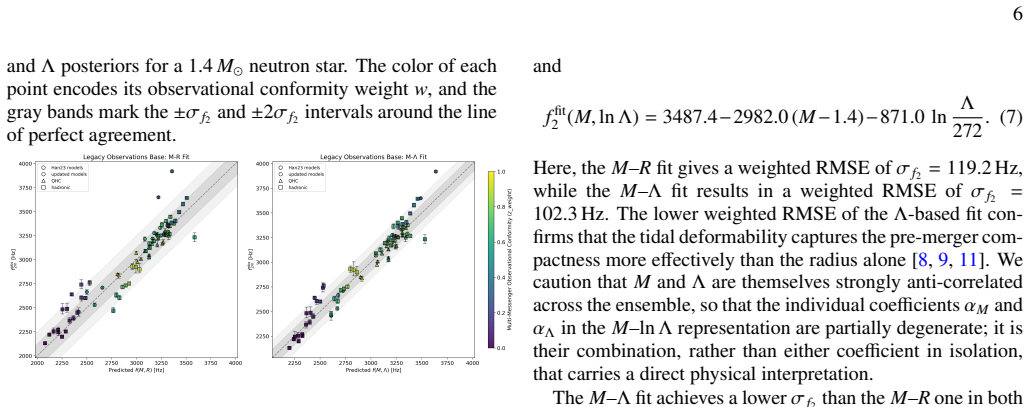
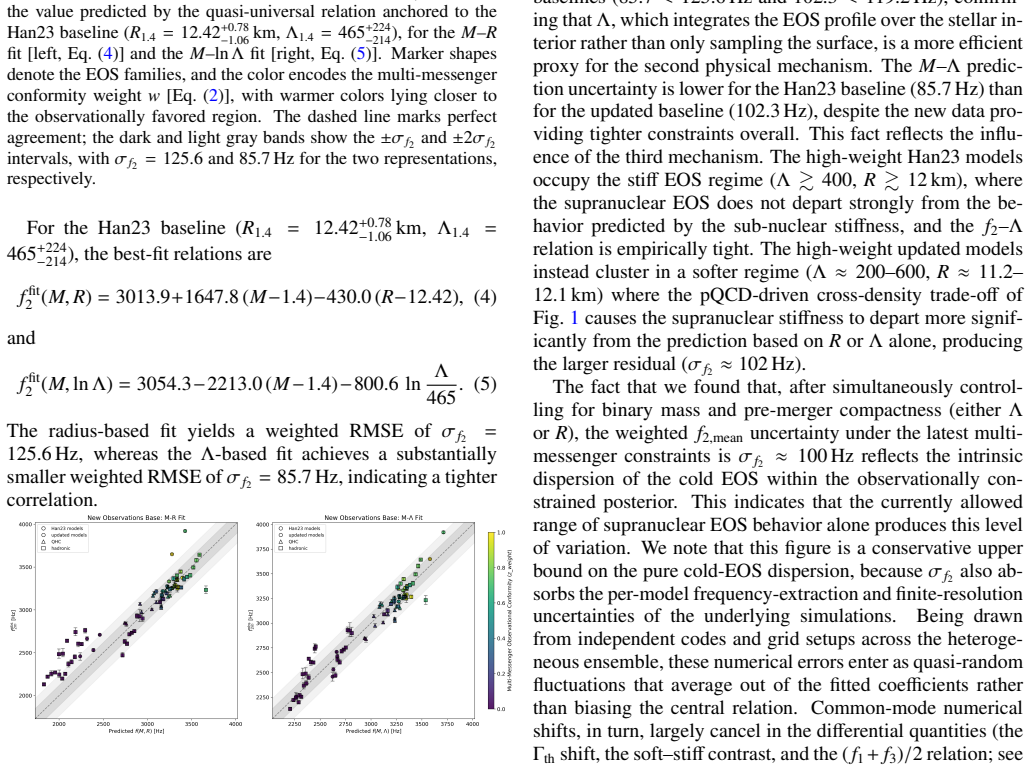
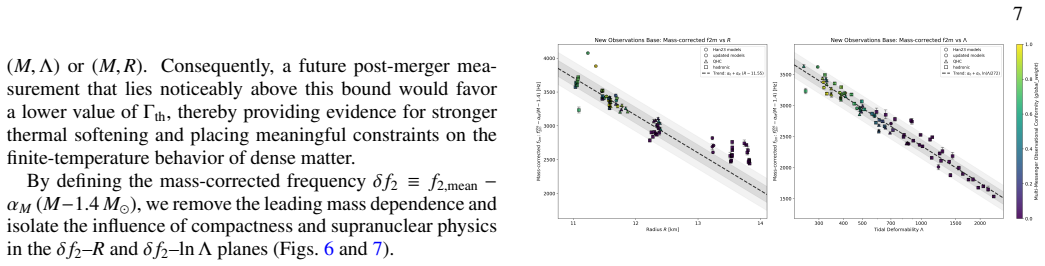
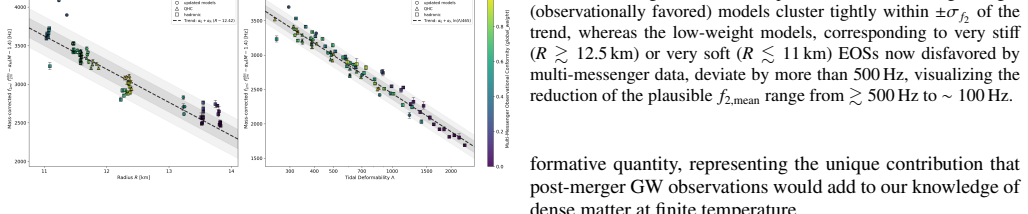
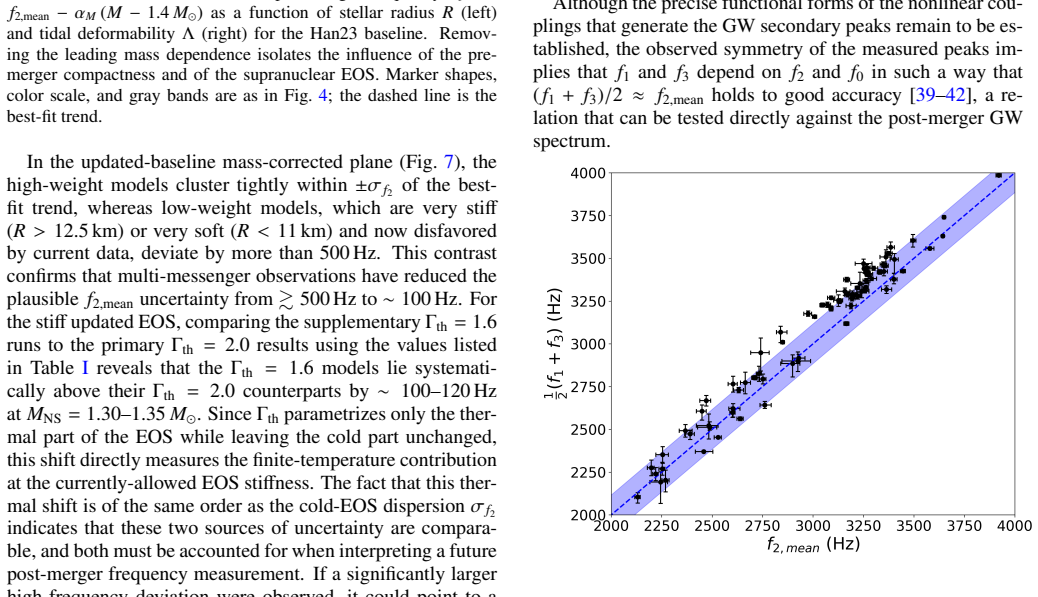
For each binary mass the softest and stiffest models drawn from the joint multi-messenger posterior are evolved in general-relativistic hydrodynamics; together with a larger literature set the runs show that, with binary mass and either tidal deformability or radius fixed, the residual spread in the dominant post-merger frequency f_{2,mean} shrinks to approximately 100 Hz, several times smaller than the range obtained from unconstrained equations of state. The quasi-universal relation (f_1 + f_3)/2 ≈ f_{2,mean} is recovered to within 116 Hz.
What carries the argument
The dominant post-merger frequency f_{2,mean} whose variation is suppressed once binary mass and a single compactness measure (Λ or R) are fixed under the multi-messenger equation-of-state posterior.
If this is right
- Any high-frequency detection lying outside the narrow predicted band directly signals additional physics such as a hadron-quark transition at finite temperature.
- The relation (f_1 + f_3)/2 ≈ f_{2,mean} supplies a model-independent estimate of the dominant frequency from the secondary peaks.
- The cold-matter contribution to post-merger signals is now calibrated tightly enough that equation-of-state uncertainty no longer dominates the interpretation of a future detection.
Where Pith is reading between the lines
- Future detectors could be tuned to search in a narrower frequency window once the binary mass is known from the inspiral.
- Combining a post-merger measurement with pre-merger tidal data may isolate temperature-dependent effects in the remnant that are invisible to cold equations of state.
- The same compactness-fixing argument could be applied to other post-merger observables such as the lifetime of the remnant or its electromagnetic emission.
Load-bearing premise
The softest and stiffest models chosen from the multi-messenger posterior, when evolved in general-relativistic hydrodynamics, sample the full range of post-merger frequencies still allowed by the constrained cold equations of state.
What would settle it
A gravitational-wave observation of f_{2,mean} values differing by more than roughly 100 Hz for two mergers that share the same total mass and the same compactness measure would falsify the reduced-spread claim.
Figures
read the original abstract
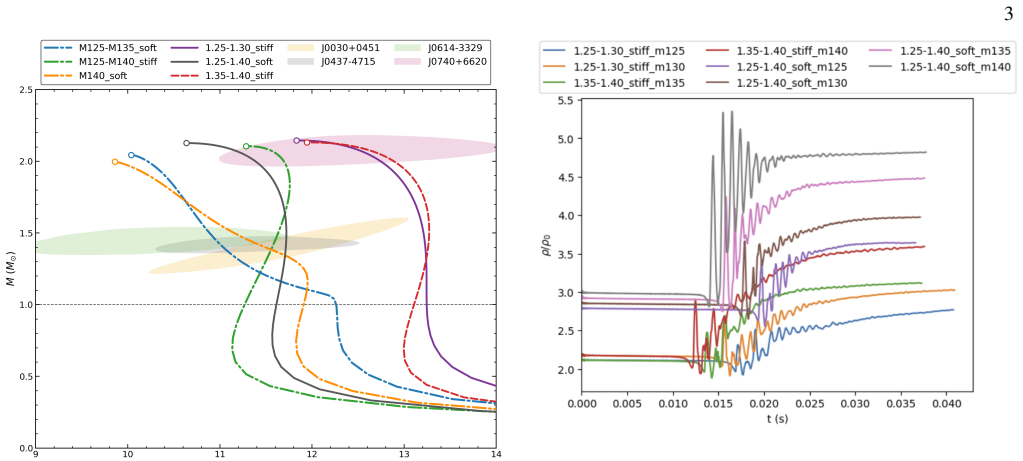
The high-frequency gravitational waves emitted by a binary neutron star merger remnant carry information on matter at densities and temperatures beyond those reached in isolated neutron stars. We quantify how tightly current multi-messenger constraints already determine the dominant post-merger frequency $f_{2,\rm mean}$. Adopting a set of cold equations of state (EOSs) constrained jointly by gravitational-wave tidal deformability, NICER mass--radius measurements, massive-pulsar masses, chiral effective field theory at low density, and perturbative QCD at asymptotically high density, for each binary mass we select the softest and stiffest models of the multi-messenger posterior and follow their coalescence with fully general-relativistic hydrodynamics simulations. Together with a broad set of EOSs drawn from the literature ($82$ models in total), these simulations show that, once the binary mass and a single measure of the stellar compactness ($\Lambda$ or $R$) are held fixed, the residual spread of $f_{2,\rm mean}$ is only $\sim 100\,{\rm Hz}$, a factor of several below the $\gtrsim 500\,{\rm Hz}$ range spanned by an EOSs set including those already disfavored by the data. This tight calibration of the cold-matter prediction implies that a future high-frequency detection departing from it would point directly to additional physics, such as a hadron--quark transition occurring at finite temperature. We further confirm the quasi-universal relation $(f_1+f_3)/2 \approx f_{2,\rm mean}$ to within $\sim 116\,{\rm Hz}$, which provides a model-independent estimate of $f_{2,\rm mean}$ from the secondary spectral peaks.
Editorial analysis
A structured set of objections, weighed in public.
Referee Report
Summary. The paper claims that multi-messenger constraints (GW tidal deformability, NICER M-R, pulsar masses, χEFT, pQCD) on cold EOSs tightly determine the dominant post-merger frequency f_{2,mean}. For each binary mass, the softest and stiffest models from the constrained posterior are evolved in GR hydrodynamics; combined with 82 literature EOSs, this shows that at fixed mass and compactness (Λ or R) the residual spread in f_{2,mean} is only ~100 Hz (versus ≳500 Hz for the unconstrained set). A quasi-universal relation (f1 + f3)/2 ≈ f_{2,mean} to within ~116 Hz is also confirmed.
Significance. If the central result holds, the work supplies a calibrated, observationally anchored prediction for post-merger frequencies under current cold-EOS constraints. This would allow future high-frequency detections to be interpreted as evidence for additional physics (e.g., finite-temperature phase transitions) rather than residual EOS uncertainty. The explicit use of a filtered posterior plus full GR hydro simulations, together with the broad literature comparison, strengthens the falsifiability of the claim.
major comments (2)
- [Abstract / model selection] Abstract (model-selection paragraph) and § on EOS posterior: the central claim that the residual spread in f_{2,mean} is only ~100 Hz at fixed mass and compactness rests on GR hydro simulations of solely the softest and stiffest models drawn from the multi-messenger posterior. No demonstration is given that these two extremes bound the variation permitted by other posterior samples whose sound-speed or density profiles remain allowed by the joint GW+NICER+pQCD constraints; if interior models produce larger excursions, the quoted residual spread would underestimate the true range.
- [Abstract / results] Abstract and results section on the 82-model set: while the broad literature ensemble demonstrates a ≳500 Hz range when disfavored EOSs are included, this does not substitute for sampling the interior of the actual constrained posterior; the paper therefore lacks a direct test that the ~100 Hz figure is robust against the full set of cold EOSs still allowed by the data.
minor comments (1)
- [Abstract] Notation: the symbol f_{2,mean} is introduced without an explicit definition equation in the abstract; a one-line definition (e.g., time-averaged frequency of the dominant post-merger peak) would aid readability.
Simulated Author's Rebuttal
We thank the referee for the careful and constructive report. The comments correctly identify that our central claim relies on simulations of the softest and stiffest posterior models, and we address this directly below while proposing targeted revisions for clarification.
read point-by-point responses
-
Referee: [Abstract / model selection] Abstract (model-selection paragraph) and § on EOS posterior: the central claim that the residual spread in f_{2,mean} is only ~100 Hz at fixed mass and compactness rests on GR hydro simulations of solely the softest and stiffest models drawn from the multi-messenger posterior. No demonstration is given that these two extremes bound the variation permitted by other posterior samples whose sound-speed or density profiles remain allowed by the joint GW+NICER+pQCD constraints; if interior models produce larger excursions, the quoted residual spread would underestimate the true range.
Authors: We agree that a direct demonstration using additional interior samples would strengthen the result. However, the softest and stiffest models are chosen specifically as the boundaries of the multi-messenger posterior; any other allowed EOS must lie between them in stiffness and in the density range probed by the constraints. At fixed mass and compactness, f_{2,mean} is governed primarily by these global properties, so intermediate models are not expected to produce excursions beyond the ~100 Hz range already measured between the extremes. We will revise the EOS-posterior section to state this bounding argument explicitly and add a short discussion of why sound-speed variations within the constrained set do not enlarge the spread. revision: partial
-
Referee: [Abstract / results] Abstract and results section on the 82-model set: while the broad literature ensemble demonstrates a ≳500 Hz range when disfavored EOSs are included, this does not substitute for sampling the interior of the actual constrained posterior; the paper therefore lacks a direct test that the ~100 Hz figure is robust against the full set of cold EOSs still allowed by the data.
Authors: We concur that the 82-model literature ensemble is intended only to illustrate the much larger spread that exists when disfavored EOSs are retained; it is not a substitute for the constrained posterior. The ~100 Hz residual is measured directly from the two posterior extremes at fixed mass and compactness. We will revise the results section to clarify this distinction and to note that the literature comparison serves solely as a contrast, not as the primary evidence for the constrained uncertainty. revision: partial
Circularity Check
No circularity; central result from independent GR hydro simulations on filtered EOS set
full rationale
The paper derives its claim of ~100 Hz residual spread in f_{2,mean} (at fixed binary mass and compactness) directly from fully general-relativistic hydrodynamics simulations of the softest/stiffest models drawn from the multi-messenger posterior plus an 82-model literature set. No equations, parameter fits, or self-citations reduce this numerical outcome to a tautology or to the paper's own inputs by construction. The confirmation of the (f1+f3)/2 ≈ f_{2,mean} relation is presented as an additional check, not a load-bearing premise. The derivation is therefore self-contained against external simulation benchmarks.
Axiom & Free-Parameter Ledger
axioms (1)
- domain assumption Cold equations of state selected from the multi-messenger posterior determine the post-merger frequency when binary mass and compactness are fixed.
Reference graph
Works this paper leans on
-
[1]
B. P. Abbottet al.(LIGO Scientific Collaboration and Virgo Collaboration), Phys. Rev. Lett.119, 161101 (2017)
2017
-
[2]
B. P. Abbottet al.(LIGO Scientific Collaboration and Virgo Collaboration), Astrophys. J. Lett.892, L3 (2020)
2020
-
[3]
M. C. Milleret al., Astrophys. J. Lett.887, L24 (2019)
2019
-
[4]
T. E. Rileyet al., Astrophys. J. Lett.887, L21 (2019)
2019
-
[5]
M. C. Milleret al., Astrophys. J. Lett.918, L28 (2021)
2021
-
[6]
T. E. Rileyet al., Astrophys. J. Lett.918, L27 (2021)
2021
-
[7]
Drischler, W
C. Drischler, W. Haxton, K. McElvain, E. Mereghetti, A. Nicholson, P. Vranas, and A. Walker-Loud, Progress in Par- ticle and Nuclear Physics121, 103888 (2021)
2021
-
[8]
Bauswein and H.-T
A. Bauswein and H.-T. Janka, Phys. Rev. Lett.108, 011101 (2012)
2012
-
[9]
Bernuzzi, A
S. Bernuzzi, A. Nagar, T. Dietrich, and T. Damour, Phys. Rev. Lett.114, 161103 (2015)
2015
-
[10]
Rezzolla and K
L. Rezzolla and K. Takami, Phys. Rev. D93, 124051 (2016)
2016
-
[11]
Breschi, S
M. Breschi, S. Bernuzzi, F. Zappa, M. Agathos, A. Perego, D. Radice, and A. Nagar, Phys. Rev. D100, 104024 (2019)
2019
- [12]
-
[13]
S. Hensh, Y .-J. Huang, T. Kojo, L. Baiotti, K. Takami, S. Na- gataki, and H. Sotani, Astrophys. J. Lett.991, L12 (2025), arXiv:2407.09446 [astro-ph.HE]
arXiv 2025
-
[14]
A. Prakash, I. Gupta, M. Breschi, R. Kashyap, D. Radice, S. Bernuzzi, D. Logoteta, and B. S. Sathyaprakash, Phys. Rev. D109, 103008 (2024), arXiv:2310.06025 [gr-qc]
arXiv 2024
-
[15]
Punturoet al., Class
M. Punturoet al., Class. Quant. Grav.27, 194002 (2010)
2010
-
[16]
Reitzeet al., Bull
D. Reitzeet al., Bull. Am. Astron. Soc.51, 035 (2019)
2019
-
[17]
A. Prakash, D. Radice, D. Logoteta, A. Perego, V . Nedora, I. Bombaci, R. Kashyap, S. Bernuzzi, and A. Endrizzi, Phys. Rev. D104, 083029 (2021), arXiv:2106.07885 [astro-ph.HE]
arXiv 2021
- [18]
-
[19]
S. Blacker, A. Bauswein, and S. Typel, Phys. Rev. D108, 063032 (2023), arXiv:2304.01971 [astro-ph.HE]
arXiv 2023
-
[20]
Y . Fujimoto, K. Fukushima, K. Hotokezaka, and K. Kyutoku, Phys. Rev. Lett.130, 091404 (2023), arXiv:2205.03882 [astro- ph.HE]
arXiv 2023
-
[21]
E. R. Most, A. Motornenko, J. Steinheimer, V . Dexheimer, M. Hanauske, L. Rezzolla, and H. Stoecker, Phys. Rev. D107, 043034 (2023), arXiv:2201.13150 [nucl-th]
arXiv 2023
- [22]
-
[23]
M.-Z. Han, Y . Gao, K. Kiuchi, and M. Shibata, Phys. Rev. D 112, 023005 (2025), arXiv:2504.08514 [astro-ph.HE]
arXiv 2025
-
[24]
M.-Z. Han, Y .-J. Huang, S.-P. Tang, and Y .-Z. Fan, Sci. Bull. 68, 913 (2023), arXiv:2207.13613 [astro-ph.HE]
arXiv 2023
- [25]
-
[26]
Y .-J. Huang, S.-P. Tang, and Y .-Z. Fan, arXiv e-prints (2026), arXiv:2605.08584 [astro-ph.HE]
Pith/arXiv arXiv 2026
-
[27]
X. Grundler and B.-A. Li, Phys. Rev. D113, 103012 (2026), arXiv:2602.06696 [nucl-th]
Pith/arXiv arXiv 2026
-
[28]
S.-P. Tang, Y .-J. Huang, and Y .-Z. Fan, arXiv e-prints (2026), arXiv:2606.03707 [astro-ph.HE]
Pith/arXiv arXiv 2026
-
[29]
T. Gorda, O. Komoltsev, A. Kurkela, and E. Sunde, Astrophys. J.1002, 40 (2026), arXiv:2512.18044 [astro-ph.HE]
Pith/arXiv arXiv 2026
-
[30]
Gourgoulhon, P
E. Gourgoulhon, P. Grandclément, K. Taniguchi, J.-A. Marck, and S. Bonazzola, Phys. Rev. D63, 064029 (2001)
2001
-
[31]
Radice, L
D. Radice, L. Rezzolla, and F. Galeazzi, Mon. Not. Roy. Astron. Soc.437, L46 (2014)
2014
-
[32]
Radice, L
D. Radice, L. Rezzolla, and F. Galeazzi, Class. Quant. Grav.31, 075012 (2014)
2014
-
[33]
Löffleret al., Class
F. Löffleret al., Class. Quant. Grav.29, 115001 (2012), einstein Toolkit release ET_2023_05
2012
-
[34]
Schnetter, S
E. Schnetter, S. H. Hawley, and I. Hawke, Class. Quant. Grav. 21, 1465 (2004)
2004
- [35]
-
[36]
A. Bauswein, H.-T. Janka, and R. Oechslin, Phys. Rev. D82, 084043 (2010), arXiv:1006.3315 [astro-ph.SR]
Pith/arXiv arXiv 2010
-
[37]
A. Kurkela, P. Romatschke, and A. Vuorinen, Phys. Rev. D81, 105021 (2010), arXiv:0912.1856 [hep-ph]
Pith/arXiv arXiv 2010
- [38]
-
[39]
N. Stergioulas, A. Bauswein, K. Zagkouris, and H.-T. Janka, "Mon. Not. Roy. Astron. Soc."418, 427 (2011), arXiv:1105.0368 [gr-qc]
Pith/arXiv arXiv 2011
-
[40]
K. Takami, L. Rezzolla, and L. Baiotti, Phys. Rev. Lett.113, 091104 (2014), arXiv:1403.5672 [gr-qc]
Pith/arXiv arXiv 2014
-
[41]
K. Takami, L. Rezzolla, and L. Baiotti, Phys. Rev. D91, 064001 (2015), arXiv:1412.3240 [gr-qc]
Pith/arXiv arXiv 2015
-
[42]
A. Bauswein and N. Stergioulas, Phys. Rev. D91, 124056 (2015), arXiv:1502.03176 [astro-ph.SR]
Pith/arXiv arXiv 2015
discussion (0)
Sign in with ORCID, Apple, or X to comment. Anyone can read and Pith papers without signing in.