REVIEW 5 major objections 5 minor 3 cited by
Bose-Einstein condensation in a rigidly rotating relativistic boson gas
T0 review · 5 major / 5 minor · reviewed 2026-08-12 · deepseek-v4-flash
Pith's one-line read Rigid rotation lowers the BEC critical temperature, changes the condensate-fraction exponent in the nonrelativistic gas, and makes the heat capacity discontinuous.
desk verdict Fresh analytic scaling laws for BEC under rigid rotation, but the new exponents rest on an unregulated infinite-volume mode sum and the text has a few fixable but real errors. read the letter →
The pith
A machine-rendered reading of the paper's core claim, the machinery that carries it, and where it could break.
The reading
What carries the argument
The argument runs on the partition function of a free charged scalar field in the rotating-frame metric, with the zero mode $\zeta$ of the field acting as the condensate. The central object is the effective single-particle energy $\omega-\mu-\ell\Omega$, where $\ell$ is the angular momentum quantum number, because summing over $\ell$ produces the geometric factor $(1-e^{-\beta j\Omega})^{-1}$; in slow rotation this is approximated by $1/(\beta j\Omega)$. That replacement effectively lengthens the thermal wavelength to $\lambda_{T,\Omega}=\lambda_T(\beta\Omega)^{1/3}$ and shifts the Bose function order from $3/2$ to $5/2$ in the nonrelativistic case and from $3$ to $4$ in the ultrarelativistic case. The condensate is fixed by minimizing the pressure with respect to $\zeta$, which forces $\mu=m$, and the resulting density formulas determine $T_c$ and the condensate fraction.
What would settle it
Compute the same free-boson partition function in a cylinder of radius $R\le1/\Omega$ with Dirichlet or Neumann boundary conditions and compare the $T_c$ versus $\Omega$ scaling: if the modified thermal length $\lambda_T(\beta\Omega)^{1/3}$ and the $5/2$ (or $4$) condensate exponent do not appear, the unbounded-plane treatment is what produces the paper's results.
Extended reading notes
Core claim
In the paper's own terms, slow rigid rotation ($\beta\Omega\ll1$) changes the order of the Bose-Einstein functions entering the thermodynamics and thereby changes the BEC scaling laws. For the nonrelativistic gas the critical temperature becomes $T_{c,\mathrm{nr}}=(2\pi/m)^{3/5}(n\Omega/\zeta(5/2))^{2/5}$ instead of $T_{c,\mathrm{nr}}^{(0)}=(2\pi/m)(n/\zeta(3/2))^{2/3}$, the condensate fraction becomes $n_0/n=1-(T/T_{c,\mathrm{nr}})^{5/2}$ instead of $1-(T/T_{c,\mathrm{nr}}^{(0)})^{3/2}$, and the heat capacity develops a jump at $T_c$, signaling a discontinuous transition. In the ultrarelativistic limit the analogous shift is from exponent 3 to exponent 4, with $T_{c,\mathrm{ur}}=(\pi^2 n\Omega/\zeta(4))^{1/4}$. The same calculation yields a critical angular velocity, an angular momentum density that is discontinuous at $T_c$, and a latent heat larger than the nonrotating value. The paper presents the pattern as evidence that a rotating nonrelativistic Bose gas mirrors a nonrotating ultrarelativistic Bose gas.
Load-bearing premise
Everything depends on treating the rotating gas as filling the whole infinite plane perpendicular to the rotation axis, with no boundary imposed at the radius $r=1/\Omega$ where the rotating-frame metric changes signature; if a wall or the light cylinder cuts off the integration, the $1/(\beta\Omega)$ factors and the new critical exponents may not survive.
Editorial extensions
If this is right
- For fixed density, a slowly rotating nonrelativistic Bose gas condenses at $T_c\propto(n\Omega)^{2/5}$, so increasing the rotation speed raises the critical temperature while keeping it below the nonrotating value.
- The condensate fraction law changes from $1-(T/T_c)^{3/2}$ to $1-(T/T_c)^{5/2}$, so relative to its own critical temperature the condensate is depleted more slowly.
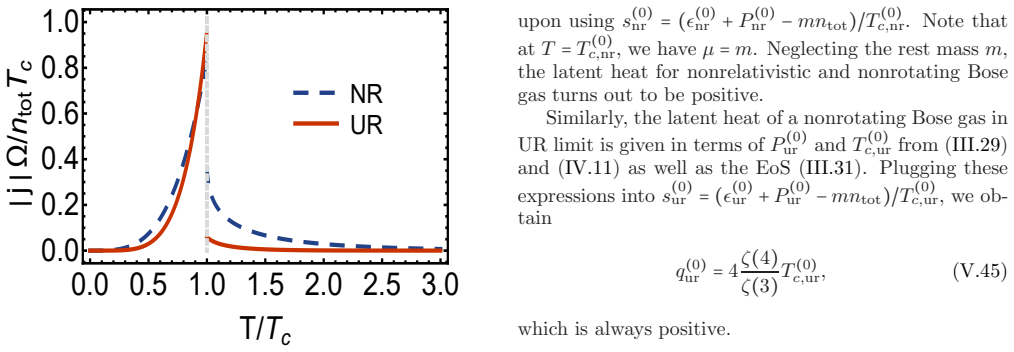
- The heat capacity jump and the nonzero latent heat computed at $T_c$ make the rotating nonrelativistic transition discontinuous rather than continuous.
- The equation of state becomes $\epsilon=(5/2)P$ in the rotating nonrelativistic gas and $\epsilon=4P$ in the rotating ultrarelativistic gas, reducing the speed of sound in both cases.
- The calculation introduces a critical angular velocity $\Omega_c$ for fixed temperature and density, with condensate and thermal fractions expressed through $\Omega/\Omega_c$.
Reading between the lines
- The authors do not impose any boundary at the light cylinder $r=1/\Omega$; a finite container with a wall at or inside that radius would break the $1/(\beta\Omega)$ enhancement, so the scaling laws could be tested by repeating the calculation with Dirichlet or Neumann boundary conditions.
- If the mapping to the ultrarelativistic gas survives adding interactions, rotating atomic condensates with synthetic rotation could serve as a laboratory analogue of massless-boson thermodynamics, with the $5/2$ condensate exponent as a clean observable.
- The latent-heat and angular-momentum jumps suggest that in rotating neutron-star or boson-star interiors, condensation could be diagnosed through discontinuities in transport quantities rather than in the specific heat, since heat capacity alone may be hard to measure there.
- The particle-only assumption restricts the results to charge-asymmetric systems; including antiparticles, as in the $\mu=0$ limit, would likely modify the critical exponent and is a natural next check.
Signed reviews
Editorial analysis
A structured set of objections, weighed in public.
Referee Report
Summary. The manuscript derives the grand canonical partition function for a free complex scalar field in a rigidly rotating frame, expands the pressure in nonrelativistic and ultrarelativistic limits under a slow-rotation assumption, and uses the result to compute BEC critical temperatures, condensate fractions, heat capacities, angular momentum densities, and a quantity labeled latent heat. The central claims are that rotation lowers the critical temperature, changes the critical exponent of the condensate fraction (to 5/2 in the nonrelativistic case and 4 in the ultrarelativistic case), and turns the nonrelativistic BEC transition from continuous to discontinuous.
Significance. If the derivation were valid, the paper would provide a compact field-theoretic treatment of rotation effects on BEC, with analytic predictions for the condensate fraction, heat capacity, and angular momentum density. The authors are careful to compare with standard nonrotating results and to display the analogy between a rotating nonrelativistic gas and a nonrotating ultrarelativistic gas. The derivation is analytical and self-contained, with no free parameters fitted to data. However, the significance is currently undermined by the uncontrolled treatment of the angular-momentum mode sum, the omission of ℓ=0 thermal modes, and several internal inconsistencies in the reported inequalities and in the abstract's characterization of the critical exponent.
major comments (5)
- [Sec. II, Eq. (II.18); Sec. III, Eqs. (III.6)-(III.12)] The slow-rotation expansion is performed on an infinite transverse plane with no boundary condition. The metric (II.2) has g00 = 1 - r^2 Ω^2, which changes signature at r = 1/Ω, yet the radial integral in (II.18) extends to infinity. The mode expansion (II.16) uses Bessel functions normalized on (0,∞), and the angular-momentum sum in (II.24) is unbounded. The convergence restriction in Section III discards all ℓ>0 modes (Eq. III.3), but these modes are present in the original partition function; for ℓ>0 and small ω_k the logarithm in (II.32) is not defined. The resulting replacement 1/(1-e^{-βjΩ}) ≈ 1/(βjΩ) and the modified thermal length λ_{T,Ω} in (III.12) therefore rest on an unregulated mode sum. A finite-cylinder calculation with a boundary at r=R (and R < 1/Ω) is the decisive check; without it, the new critical exponents in (IV.20)-(IV.22) and (IV.29)-(IV.31) are not established.
- [Sec. II, Eqs. (II.16) and (II.24)] The mode expansion excludes all ℓ=0 modes (the sum is over ℓ≠0), leaving only the constant condensate ζ for ℓ=0. As a result, the theory does not contain the azimuthally symmetric excited states that are essential in the nonrotating limit. The pressure (III.12) diverges as Ω→0 and the authors are forced to introduce the nonrotating results (III.16)-(III.17) as separate inputs; the rotating expressions do not reduce to them. This omission also biases the condensate fraction, because all non-condensate ℓ=0 states are absent. The calculation should include ℓ=0 thermal modes (or justify why they can be discarded) and should reproduce the Ω→0 limit smoothly.
- [Sec. IV, Eqs. (IV.26) and (IV.35)] The inequalities are reversed. For example, from (IV.19), the condensate is positive only when ntot > ζ(5/2)/λ^3_{T,Ω}, i.e., when Ω > Ω_{c,nr}; for Ω < Ω_{c,nr} the formula gives n0/ntot < 0. The correct statement is therefore n0/ntot = 1 - (Ω/Ω_c)^{-1} and nnr/ntot = (Ω/Ω_c)^{-1} for Ω ≥ Ω_{c,nr}, while for Ω ≤ Ω_{c,nr} one has nnr = ntot and n0 = 0. The same reversal occurs in (IV.35). As written, the inequalities, the associated Fig. 4, and Eqs. (IV.36)-(IV.37) are inconsistent with the preceding formulas.
- [Abstract; Sec. IV, Eqs. (IV.22) and (IV.31)] The abstract states that the critical exponent associated with the BE transition in a rotating gas is lower than in a nonrotating gas, but the derived condensate fractions (IV.22) and (IV.31) have exponents 5/2 and 4, respectively, compared with 3/2 and 3 in the nonrotating cases (IV.9) and (IV.13). The exponents are higher, not lower. This is a central claim in the abstract and must be corrected; Section VI avoids the word 'lower' but the introduction and abstract repeat it.
- [Sec. V.E, Eqs. (V.43)-(V.49)] The quantity q = Tc s/n at T=Tc is not a latent heat. For a continuous transition (the nonrotating case, which the authors themselves describe as having continuous CV), the latent heat is zero; for a discontinuous transition it is Tc times the entropy jump across the coexistence curve, not the total entropy per particle at Tc. The ratios q/q(0) plotted in Fig. 10 therefore do not support the claim that rotation increases the latent heat. The authors should either define a proper latent heat from the entropy discontinuity or relabel the quantity as a heat content per particle.
minor comments (5)
- [Sec. III, Eq. (III.22)] There are numerous typographical errors in cross-references and symbols; for example, Eq. (III.22) has 'd˜k e βjω k' instead of 'd˜k e^{-βjω_k}', and the last line of (V.30) uses T^{(0)}_{c,nr} where T^{(0)}_{c,ur} is intended.
- [Sec. V.C.2] The references to 'EoS ... given by (IV.15) and (IV.29)' should be to (III.15) and (III.28); as written, the cited equations do not contain the EoS.
- [Sec. IV.C, Eq. (IV.27)] The text says Eq. (IV.27) is plugged into 'IV.6', but it should be (IV.5); the equation numbering appears shifted.
- [Figure captions] The captions of Figs. 1, 2, 5 and 6 are difficult to parse because the same symbol Tc is used for both rotating and nonrotating critical temperatures; please use distinct notation (e.g., Tc^{(0)} versus Tc^{Ω}) throughout the captions and text.
- [Sec. III, beginning] The paper would benefit from a statement at the start of Section III explaining that the ℓ<0 restriction is a physical truncation (e.g., a boundary condition), not merely a convergence requirement.
Circularity Check
No significant circularity: the BEC formulas are derived algebraically from the stated Lagrangian and standard saddle-point condition; self-citations are technical, non-load-bearing details.
full rationale
The derivation is self-contained. Starting from the free complex scalar Lagrangian (II.1) and the rotating metric (II.2), the thermal pressure is obtained by Gaussian functional integration and the standard expansion ln(1−x)=−Σ x^j/j; the slow-rotation replacement 1/(1−e^{−βjΩ})→1/(βjΩ) is a mathematical limit, not a fitted parameter. The critical temperatures (IV.20) and (IV.29) follow from the saddle-point condition ∂P/∂ζ=0 (IV.4) combined with n_tot=n_0+n_th, exactly the same bookkeeping used for the nonrotating case; no target result is inserted by hand. The condensate fractions (IV.22) and (IV.31), pressures (V.31) and (V.32), and heat capacities (V.39) and (V.40) are then obtained by evaluating the same expressions at z=1 or by differentiation with respect to T at fixed n and Ω, so they are internally derived rather than equated to inputs. The self-citations [37] and [44] are used only for the mode expansion (II.16) and for a Mellin-Barnes integration technique, but the needed orthonormality and integral identities are reproduced in Appendices A and B, so these citations are not load-bearing in the sense of a uniqueness theorem or a fitted value. The paper itself states that the analytical results are valid only for βΩ≪1, and the physical caveat about integrating over the infinite transverse plane beyond the light cylinder is a modeling-validity concern, not a circularity: it does not assume any of the claimed critical exponents as an input. No prediction is set equal to a fitted value by construction, and no load-bearing claim reduces to a self-citation chain.
Assumptions & free parameters
assumptions (6)
- domain assumption The rigidly rotating frame is described by the metric (II.2) over the whole spacetime, with no boundary at the light cylinder r = 1/Omega.
- standard math The mode expansion (II.16) with Bessel functions and continuous k_perp is complete on the infinite cylinder.
- domain assumption Slow rotation permits the approximation 1/(1 - e^{-beta j Omega}) ~ 1/(beta j Omega) for beta Omega << 1 (Eq. III.11).
- domain assumption Only particle contributions are kept; antiparticle contributions are neglected.
- standard math Below the BEC transition the chemical potential is pinned to the mass, mu = m (Eq. IV.4).
- domain assumption In the ultrarelativistic limit, z = e^{beta m} is approximated as 1 by taking beta m -> 0.
Cite this review
Pith. "Pith review of Bose-Einstein condensation in a rigidly rotating relativistic boson gas." pith.science (2026). https://pith.science/paper/I63UELYJ
@misc{pith2026241112581,
  author       = {Pith},
  title        = {Pith review of: Bose-Einstein condensation in a rigidly rotating relativistic boson gas},
  year         = {2026},
  howpublished = {\url{https://pith.science/paper/I63UELYJ}},
  note         = {Machine review of arXiv:2411.12581}
}
read the original abstract
We study the Bose-Einstein condensation (BEC) of a free Bose gas under rigid rotation. The aim is to explore the impact of rotation on the thermodynamic quantities associated with BEC, including the Bose-Einstein (BE) transition temperature and condensate fraction. We begin by introducing the rotation in the Lagrangian density of free charged Klein-Gordon fields and determine the corresponding grand canonical partition function at finite temperature, chemical potential, and finite angular velocity. Assuming slow rotation, we derive analytical expressions for the pressure, energy, number, and angular momentum densities of a free Bose gas in nonrelativistic and ultrarelativistic limits in terms of the corresponding fugacities. We then focus on the phenomenon of BEC. We calculate the critical temperature of BEC transition and the condensate fraction in a slowly rotating Bose gas including only particles. Our findings indicate that the critical exponent associated with the BE transition in a rotating gas is lower compared to that in a nonrotating Bose gas. We also determine the fugacity in a rotating Bose gas in the aforementioned limits and examine how rotation affects its temperature dependence, both below and above the critical temperature. By analyzing the behavior of heat capacity at these temperatures, we demonstrate that in a nonrelativistic Bose gas, the rotation transforms the nature of the BE phase transition from a continuous to a discontinuous transition. In general, we find that a nonrelativistic Bose gas under rotation behaves similarly to a nonrotating Bose gas in ultrarelativistic limit.
Figures


Figures from the paper (7 more)



Forward citations
Cited by 3 Pith papers
-
On the origin of mixed inhomogeneous phase in vortical gluon plasma
The authors show that the inhomogeneous confinement/deconfinement phase in rotating gluon plasma is caused by the quadratic magnetovortical coupling of angular velocity to chromomagnetic gluon fields.
-
Weak Bose-Einstein condensation in a rigidly rotating magnetized charged Bose gas
Rigid rotation does not restore a sharp BEC transition in a magnetized charged Bose gas; it only changes thermodynamics, and can flip the magnetic response toward paramagnetism.
-
Chiral vortical catalysis constrained by LQCD simulations
By fitting an angular-velocity-dependent coupling to LQCD data, the NJL model exhibits chiral vortical catalysis: rotation enhances the chiral condensate and raises the transition temperature and critical endpoint.
Reference graph
Works this paper leans on
-
[1]
In NR limit, it is defined by z = eβ(µ−m) [see ( III.1)] and in UR limit by z = eβµ [see ( III.19)]
Nonrotating Bose gas in NR and UR limits As we have described in previous sections, the defi- nition of fugacity in NR and UR limits are different. In NR limit, it is defined by z = eβ(µ−m) [see ( III.1)] and in UR limit by z = eβµ [see ( III.19)]. As aforementioned, at temperatures below the critical temperature, the condi- tion for building the condensate ...
-
[2]
In Fig. 2(a) n0 ∈ {n(0) 0,nr, n0,nr} corresponds to the number density 9 T < Tc,nr (0) T = Tc,nr (0) T > Tc,nr (0) 0.2 0.4 0.6 0.8 1.0 0 1.0 1 2.0 2 βΩ Tc,nr (0) /Tc,nr (a) T < Tc,ur (0) T = Tc,ur (0) T > Tc,ur (0) 0.2 0.4 0.6 0.8 1.0 0.8 1.0 1.2 1.4 1.6 1.8 2.0 βΩ Tc,ur (0) /Tc,ur (b) FIG. 3. color online. The β Ω dependence of T ( 0) c, nr/slash.left Tc...
-
[3]
C. J. Pethick, T. Schaefer and A. Schwenk, Bose-Einstein condensates in neutron stars , [arXiv:1507.05839 [nucl-th]]
-
[4]
Rotating Bose gas in NR and UR limits Following the above procedure, we derive in this sec- tion the fugacity of a rotating Bose gas in NR and UR limits. Similar to a nonrotating Bose gas, the fugacity is equal to 1 below the critical temperature, z = 1 at T ≤ Tc,nr, z ≃ 1 at T ≤ Tc,ur. (V.17) At temperatures higher than Tc, however, the fugacity depends ...
-
[5]
Nonrotating Bose gas in NR and UR limits In Sec. III A, we determined the thermal parts of the pressure P (0) nr and P (0) ur for a nonrotating Bose gas in NR and UR limits [see ( III.16) and ( III.29)]. In this section, we reconsider these expressions and using the re- sults presented in Sec. IV, we compute these pressures at temperatures below and above...
-
[6]
Rotating Bose gas in NR and UR limits In Sec. III A, we compute the pressure P for a ro- tating Bose gas in NR and UR limits in terms of the corresponding fugacities [see ( III.12) and ( III.26)]. Simi- lar to the case of a nonrotating Bose gas in NR limit, we use ( III.12) and ( IV.21) to arrive at the thermal pressure of a rotating gas in this limit Pnr...
-
[7]
In Fig. 7, a comparison between the T /slash.left Tc,nr dependence of Pnr/slash.left ntotTc,nr of a rotating Bose gas in NR limit (dashed curve) with the T /slash.left T (0) c,ur dependence of P (0) ur /slash.left ntotT (0) c,ur of a nonrotating Bose gas in UR limit is made. The result shows that a nonrelativistic Bose gas under rigid rotation behaves alm...
-
[8]
The heat capacity is defined in ( II.29), where ǫ is the energy density of the medium
Nonrotating Bose gas in NR and UR limits Let us first consider a nonrotating Bose gas. The heat capacity is defined in ( II.29), where ǫ is the energy density of the medium. Its thermal part is related to the thermal pressure through the corresponding EoS. In the case of a nonrelativistic and nonrotating bosonic medium, the EoS is given by ( III.18). We thu...
Show all 60 references
-
[9]
III A and III B, the EoS of ro- tating Bose gas in NR and UR limits are given by ( IV.15) and ( IV.29)
Rotating Bose gas in NR and UR limits As it is shown in Sec. III A and III B, the EoS of ro- tating Bose gas in NR and UR limits are given by ( IV.15) and ( IV.29). The heat capacities in these two cases thus read CV,nr = /parenleft.alt3 ∂ǫnr ∂T /parenright.alt3 n,Ω = 5 2 /par...
-
[10]
Nonrotating Bose gas in NR and UR limits To determine the entropy density of a nonrotating gas in NR limit, snr, let us consider P (0) nr at T = T (0) c,nr from ( V.29). Using the EoS ( III.18), and the fact that n(0) nr = ntot at T = T (0) c,nr [see ( IV.9)], we arrive at q(0...
-
[11]
The latent heat of a nonrelativistic Bose gas under rigid rotation is thus given by qnr = 7 2 ζ(7/slash.left 2) ζ(5/slash.left 2)Tc,nr − m
Rotating Bose gas in NR and UR limits The entropy density of a rotating Bose gas in NR limit at Tc,nr can be derived from snr = (ǫnr +Pnr −mntot)/slash.left Tc,nr, where ǫnr = 5/slash.left 2Pnr [see the EoS from ( III.15)], with Pnr and from ( V.31). The latent heat of a nonre...
-
[12]
Nonrelativistic limit Let us consider Inr = /integral.disp d˜k e −βjω k , (B.2) with ωk ≈ k2 2m and k = (k2 ⊥+ k2 z )1/slash.left 2 in a cylindrical coor- dinate system. Using /integral.disp ∞ −∞ dkz e−αk2 z = /parenleft.alt3 π α /parenright.alt3 1/slash.left 2 and /integral.d...
-
[13]
Following the method presented in [37], and using the Mellin transformation of e−βωkj, we arrive first at e−βωkj = 1 2πi /integral.disp c+i∞ c−i∞ dzΓ (z)(βj )−z(ω2 k)−z/slash.left 2
Ultrarelativistic limit Let us consider Iur = /integral.disp d˜k e −βjω k , (B.6) with ωk ≈ k. Following the method presented in [37], and using the Mellin transformation of e−βωkj, we arrive first at e−βωkj = 1 2πi /integral.disp c+i∞ c−i∞ dzΓ (z)(βj )−z(ω2 k)−z/slash.left 2. ...
-
[14]
Busza, K
W. Busza, K. Rajagopal and W. van der Schee, Heavy- ion collisions: The big picture, and the big ques- tions, Ann. Rev. Nucl. Part. Sci. 68, 339 (2018), arXiv:1802.04801 [hep-ph]
2018 arXiv
-
[15]
Lovato, T
A. Lovato, T. Dore, R. D. Pisarski, B. Schenke, K. Chatziioannou, J. S. Read, P. Landry, P. Danielewicz, D. Lee and S. Pratt, et al. Long Range Plan: Dense matter theory for heavy-ion collisions and neutron stars , arXiv:2211.02224 [nucl-th]
-
[16]
Takeuchi, Josephson junction formed in the wormhole space time from the analysis for the critical temperature of Bose-Einstein condensate , Eur
S. Takeuchi, Josephson junction formed in the wormhole space time from the analysis for the critical temperature of Bose-Einstein condensate , Eur. Phys. J. C 81, 1119 (2021), arXiv:2108.08030 [hep-th]
2021 arXiv
-
[17]
Balaz, I
A. Balaz, I. Vidanovic, A. Bogojevic and A. Pelster, Ultra-fast converging path-integral approach for rotatin g ideal Bose-Einstein condensates, Phys. Lett. A 374, 1539 (2010), arXiv:1001.1463 [cond-mat.quant-gas]
2010 arXiv
-
[18]
R. K. Pathria and P. D. Beale, Statistical mechanics, 4th ed. (Academic Press, London, 2022)
2022
-
[19]
Bartelmann, B
M. Bartelmann, B. Feuerbacher, T. Kr¨ uger, D. L¨ ust, A. Rebhan and A. Wipf, Theoretische Physik 4, Ther- modynamik und Statistische Physik , (Springer Spektrum, Berlin, 2018)
2018
-
[20]
C. J. Pethick and H. Smith, Bose-Einstein condensation in dilute gases , 2nd ed. (Cambridge University Press, Cambridge, 2008)
2008
-
[21]
Pitaevski and S
L. Pitaevski and S. Stringari, Bose-Einstein condensa- tion and superfluidity , (Oxford University Press, Oxford, 2016)
2016
-
[22]
Gruber and A
C. Gruber and A. Pelster, A theory of finite-temperature Bose-Einstein condensates in neutron stars , Eur. Phys. J. D 68, 341 (2014), arXiv:1403.3812 [gr-qc]
2014 arXiv
-
[23]
F. E. Schunck and E. W. Mielke, General relativis- tic boson stars , Class. Quant. Grav. 20, R301 (2003), arXiv:0801.0307 [astro-ph]
2003 arXiv
-
[24]
S. J. Sin, Late time cosmological phase transition and galactic halo as Bose liquid , Phys. Rev. D 50, 3650 (1994), arXiv:hep-ph/9205208 [hep-ph]
1994 arXiv
-
[25]
C. G. Boehmer and T. Harko, Can dark matter be a Bose-Einstein condensate? , JCAP 06, 025 (2007), arXiv:0705.4158 [astro-ph]
2007 arXiv
-
[26]
P. S. Aswathi, P. S. Keerthi, O. P. Jyothilakshmi, L. J. Naik and V. Sreekanth, Rotating Bose-Einstein con- densate stars at finite temperature , Phys. Rev. D 108, 123001 (2023), arXiv:2311.01278 [gr-qc]
2023 arXiv
-
[27]
Sharma, G
A. Sharma, G. Kartvelishvili and J. Khoury, Finite tem- perature description of an interacting Bose gas , Phys. Rev. D 106, 045025 (2022), arXiv:2204.02423 [hep-th]
2022 arXiv
-
[28]
Takeuchi, Bose-Einstein condensation in the Rindler space , Phys
S. Takeuchi, Bose-Einstein condensation in the Rindler space , Phys. Lett. B 750, 209 (2015), arXiv:1501.07471 [hep-th]
2015 arXiv
-
[29]
V. V. Braguta, A. Y. Kotov, D. D. Kuznedelev and A. A. Roenko, Influence of relativistic rota- 20 tion on the confinement-deconfinement transition in gluodynamics, Phys. Rev. D 103, 094515 (2021), arXiv:2102.05084 [hep-lat]
2021 arXiv
-
[30]
Lombardo and H
U. Lombardo and H. J. Schulze, Superfluidity in neu- tron star matter , Lect. Notes Phys. 578, 30 (2001), arXiv:astro-ph/0012209 [astro-ph]
2001 arXiv
-
[31]
Khoury, Dark matter superfluidity , SciPost Phys
J. Khoury, Dark matter superfluidity , SciPost Phys. Lect. Notes 42, 1 (2022), arXiv:2109.10928 [astro-ph.CO]
2022 arXiv
-
[32]
Apart from fermions, the thermodynamic properties of bosons are also affected by rotation
is currently a subject of research. Apart from fermions, the thermodynamic properties of bosons are also affected by rotation. In[35], the prop- erties of a spin-one gluon gas are studied under rigid ro- tation, and the notions of supervorticity and negative Barnett effect are i...
-
[33]
Manuel, S
C. Manuel, S. Sarkar and L. Tolos, Thermal con- ductivity due to phonons in the core of superfluid neutron stars , Phys. Rev. C 90, 055803 (2014), arXiv:1407.7431 [astro-ph.SR]
2014 arXiv
-
[34]
J. B. Hartle and K. S. Thorne, Slowly rotating relativis- tic stars. II. Models for neutron stars and supermassive stars, Astrophys. J. 153, 807 (1968)
1968
-
[35]
Mortazavi Ghalati and N
H. Mortazavi Ghalati and N. Sadooghi, Magnetic dual chiral density wave phase in rotating cold quark matter , Phys. Rev. D 108, 5 (2023), arXiv:2306.04472 [nucl-th]
2023 arXiv
-
[36]
Yamamoto and Y
A. Yamamoto and Y. Hirono, Lattice QCD in ro- tating frames , Phys. Rev. Lett. 111, 081601 (2013), arXiv:1303.6292 [hep-lat]
2013 arXiv
-
[37]
Mameda and A
K. Mameda and A. Yamamoto, Magnetism and rotation in relativistic field theory , PTEP 2016, 093B05 (2016), arXiv:1504.05826 [hep-th]
2016 arXiv
-
[38]
H. L. Chen, K. Fukushima, X. G. Huang and K. Mameda, Analogy between rotation and density for Dirac fermions in a magnetic field , Phys. Rev. D 93, 104052 (2016), arXiv:1512.08974 [hep-ph]
2016 arXiv
-
[39]
M. N. Chernodub and S. Gongyo, Interacting fermions in rotation: chiral symmetry restoration, moment of inertia and thermodynamics , JHEP 01, 136 (2017), arXiv:1611.02598 [hep-th]
2017 arXiv
-
[40]
M. N. Chernodub and S. Gongyo, Effects of rotation and boundaries on chiral symmetry breaking of rela- tivistic fermions , Phys. Rev. D 95, 096006 (2017), arXiv:1702.08266 [hep-th]
2017 arXiv
-
[41]
M. N. Chernodub and S. Gongyo, Edge states and thermodynamics of rotating relativistic fermions un- der magnetic field , Phys. Rev. D 96, 096014 (2017), arXiv:1706.08448 [hep-th]
2017 arXiv
-
[42]
V. E. Ambru¸ s and E. Winstanley, Exact solutions in quantum field theory under rotation , Lect. Notes Phys. 987, 95 (2021), arXiv:1908.10244 [hep-th]
2021 arXiv
-
[43]
F. Sun, J. Shao, R. Wen, K. Xu and M. Huang, Chi- ral phase transition and spin alignment of vector me- son in the Polarized-Polyakov-loop Nambu-Jona-Lasinio model under rotation , Phys. Rev. D 109, 116017 (2024), arXiv:2402.16595 [hep-ph]
2024 arXiv
-
[44]
Sadooghi, S
N. Sadooghi, S. M. A. Tabatabaee Mehr and F. Taghi- navaz, Inverse magnetorotational catalysis and the phase diagram of a rotating hot and magnetized quark matter , Phys. Rev. D 104, 116022 (2021), arXiv:2108.12760 [hep-ph]
2021 arXiv
-
[45]
M. N. Chernodub, Inhomogeneous confining-deconfining phases in rotating plasmas , Phys. Rev. D 103, 054027 (2021), arXiv:2012.04924 [hep-ph]
2021 arXiv
-
[46]
Fukushima, K
K. Fukushima, K. Hattori and K. Mameda, Preponderant orbital polarization in relativistic magnetovortical mat ter, arXiv:2409.18652 [hep-ph]
-
[47]
Becattini, I
F. Becattini, I. Karpenko, M. Lisa, I. Upsal and S. Voloshin, Global hyperon polarization at local ther- modynamic equilibrium with vorticity, magnetic field and feed-down , Phys. Rev. C 95, 054902 (2017), arXiv:1610.02506 [nucl-th]
2017 arXiv
-
[48]
V. V. Braguta, M. N. Chernodub, I. E. Kudrov, A. A. Roenko and D. A. Sychev, Negative Bar- nett effect, negative moment of inertia of (quark- )gluon plasma and thermal evaporation of chromomag- netic condensate , Phys. Rev. D 110, 014511 (2024), arXiv:2310.16036 [hep-ph]
2024 arXiv
-
[49]
V. E. Ambru¸ s and M. N. Chernodub, Rigidly rotat- ing scalar fields: Between real divergence and imagi- nary fractalization , Phys. Rev. D 108, 085016 (2023), arXiv:2304.05998 [hep-th]
2023 arXiv
-
[50]
Siri and N
E. Siri and N. Sadooghi, Thermodynamic properties of a relativistic Bose gas under rigid rotation , Phys. Rev. D 110, 036016 (2024), arXiv:2405.09481 [hep-ph]
2024 arXiv
-
[51]
J. I. Kapusta, Bose-Einstein condensation, spontaneous symmetry breaking, and gauge theories , Phys. Rev. D 24, 426 (1981)
1981
-
[52]
H. E. Haber and H. A. Weldon, Thermodynamics of an ideal ultrarelativistic Bose gas , Phys. Rev. Lett. 46, 1497 (1981)
1981
-
[53]
H. E. Haber and H. A. Weldon, Finite temperature symmetry breaking as Bose-Einstein condensation , Phys. Rev. D 25, 502 (1982)
1982
-
[54]
E. J. Ferrer, V. de la Incera and A. E. Shabad, Bose- Einstein condensation in many particle gauge theories an external charge, Nuovo Cim. A 98, 245 (1987)
1987
-
[55]
J. I. Kapusta and C. Gale, Finite Temperature Field The- ory, Principles and Applications , 2nd ed. (Cambridge University Press, Cambridge, 2006)
2006
-
[56]
Kling and A
S. Kling and A. Pelster, Thermodynamical properties of a rotating ideal Bose gas , Phys. Rev. A 76, 023609 (2007), arXiv:cond-mat/0604162 [cond-mat.stat-mech]
2007 arXiv
-
[57]
Siri and N
E. Siri and N. Sadooghi, Boson propagator under rigid ro- tation; Mode expansion approach , TTMP 01, 105 (2024), arXiv:2408.06194 [hep-ph]
2024 arXiv
-
[58]
L. D. Landau and E. M. Lifshitz, Statistical Physics , 3rd ed., Course of Theoretical Physics, Vol. 5 (Elsevier Butterworth-Heinemann, Oxford, 1980)
1980
-
[59]
D. N. Voskresensky, Pion condensation at rotation in magnetic field, electric and scalar potential wells , arXiv:2410.12392 [hep-ph]
-
[60]
Gnatovskyy, D
V. Gnatovskyy, D. Anchishkin, D. Zhuravel and V. Karpenko, Phase diagrams of relativistic selfinter- acting boson system , Ukr. J. Phys. 69, 560 (2024), arXiv:2410.04580 [nucl-th]. 21
2024 arXiv
Reviewed August 12, 2026 · model on record in the stance chip above.
Discussion (0). Continue with ORCID to comment.