ExPerT: Personalizing LLM Responses to Users' Domain Expertise via Query-Wise Semantic and Keystroke Behavioral Cues
Pith reviewed 2026-07-04 01:41 UTC · model grok-4.3
The pith
ExPerT infers query-specific user expertise from text and keystrokes to tailor LLM responses.
A machine-rendered reading of the paper's core claim, the machinery that carries it, and where it could break.
Core claim
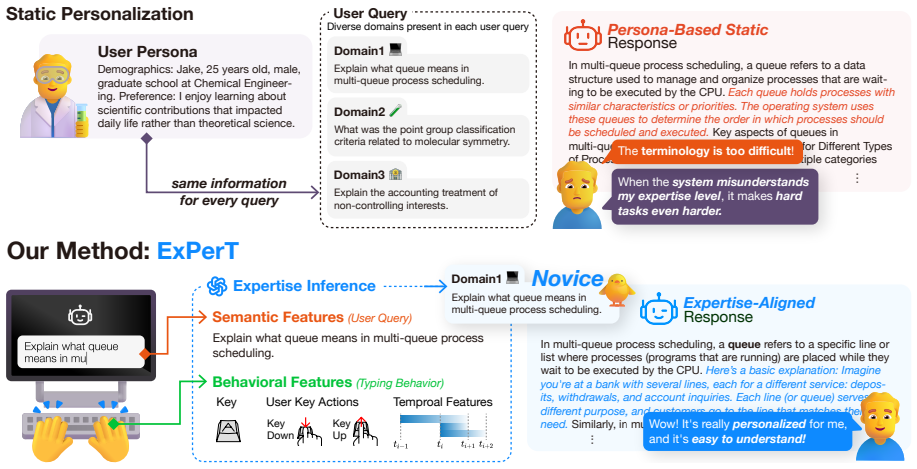
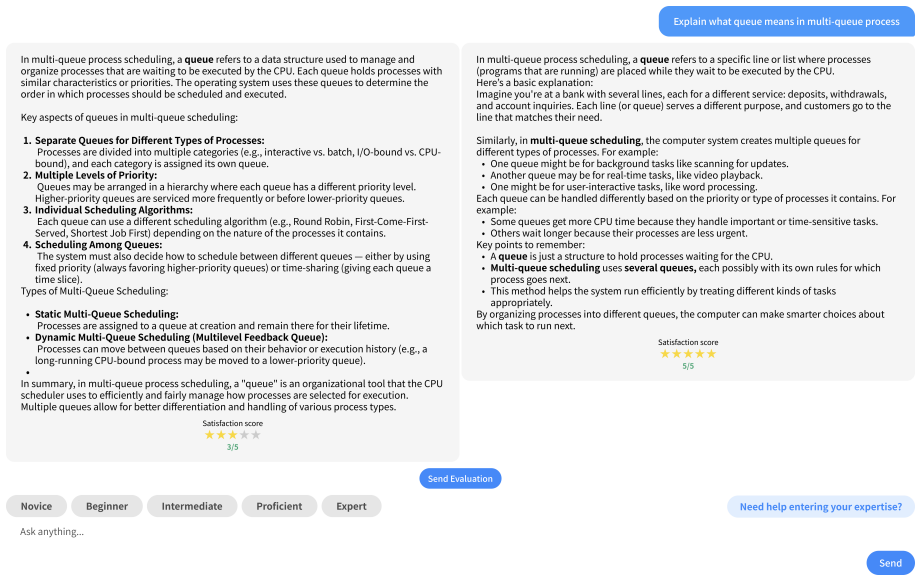
ExPerT is a query-wise personalization framework consisting of a semantic-behavioral expertise inference module that jointly interprets query text and keystroke dynamics via in-context LLM prompting, plus an expertise-conditioned response generation step that adapts the level of detail, terminology, and conceptual complexity; a user study with 40 participants and 1270 queries showed it reduced expertise inference error by 65.7 percent compared to the strongest baseline and improved response satisfaction by 17.52 percent.
What carries the argument
The semantic-behavioral expertise inference module, which jointly interprets query text and keystroke dynamics via in-context LLM prompting to estimate query-specific expertise.
If this is right
- LLM responses vary in detail, terminology, and complexity according to the inferred expertise for each individual query.
- Inference accuracy improves when keystroke dynamics are added to semantic cues rather than using either signal alone.
- User satisfaction rises when response style is conditioned on the per-query expertise estimate.
- The system operates without collecting or applying per-user calibration data across different topics.
Where Pith is reading between the lines
- If the method scales to live chat interfaces, it could allow automatic adjustment of explanation depth without users stating their background.
- Similar behavioral signals might be tested for other user states such as confusion or fatigue to broaden real-time adaptation.
- Widespread use would require safeguards around storing typing pattern data to address potential privacy risks.
Load-bearing premise
Keystroke dynamics combined with query semantics through LLM prompting give a reliable signal of query-specific domain expertise that transfers across users and topics without per-user calibration.
What would settle it
A new study with different users and topics in which the combined semantic-keystroke method shows no reduction in expertise inference error or satisfaction gain compared with a text-only baseline would falsify the central performance claim.
Figures
read the original abstract
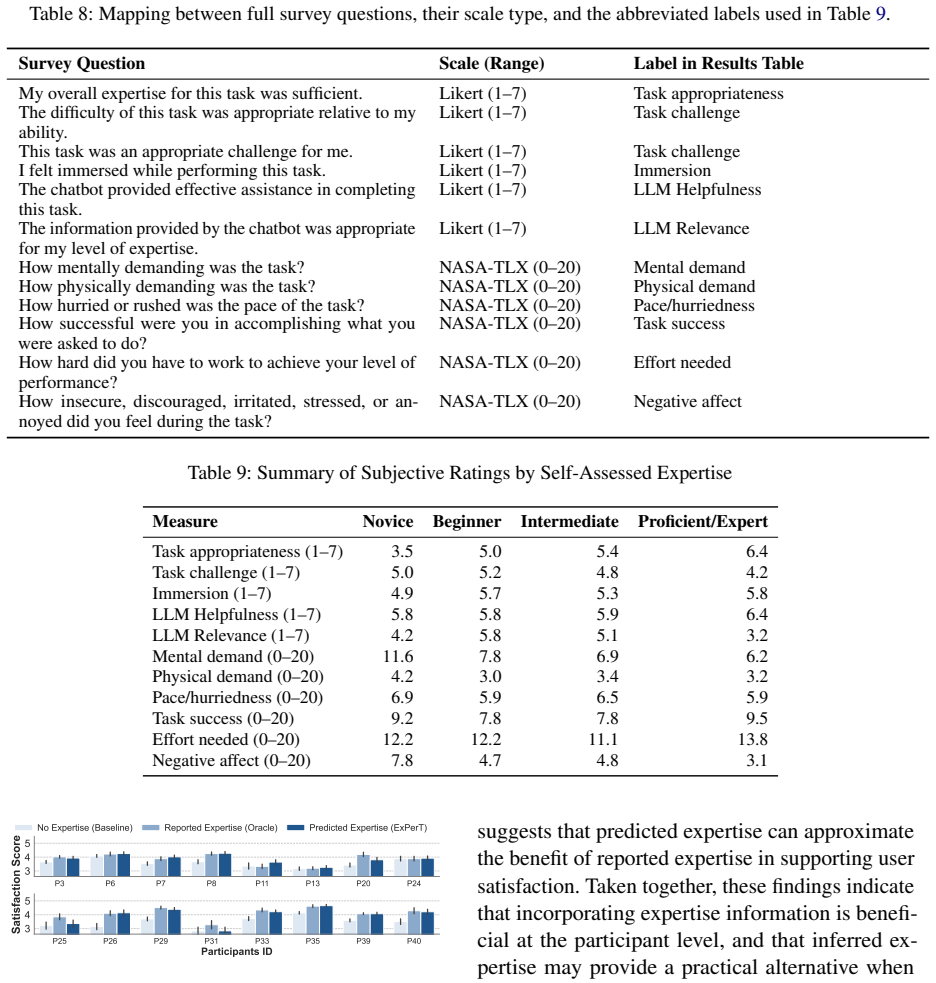
Large language models (LLMs) are increasingly used by end users, yet existing personalization methods relying on static profiles or text-only signals fail to capture query-specific expertise variation. We present ExPerT, a query-wise personalization framework that adapts LLM responses to users' query domain expertise by combining semantic and behavioral cues. ExPerT consists of two key components: (i) a semantic-behavioral expertise inference module that jointly interprets query text and keystroke dynamics via in-context LLM prompting, and (ii) an expertise-conditioned response generation that adapts the level of detail, terminology, and conceptual complexity. Our user study with 40 participants and 1270 queries demonstrated that ExPerT reduced expertise inference error by 65.7% compared to the strongest baseline (MAE = 0.398 vs. 1.162) and improved response satisfaction by 17.52% (from 3.71 to 4.36) on a 5-point Likert scale.
Editorial analysis
A structured set of objections, weighed in public.
Referee Report
Summary. The paper presents ExPerT, a query-wise personalization framework for LLMs that infers a user's domain expertise for each query by jointly processing semantic content and keystroke dynamics (e.g., speed, pauses) via in-context LLM prompting, then generates responses with adapted detail, terminology, and complexity. It reports that a 40-participant study with 1270 queries showed ExPerT reducing expertise inference MAE by 65.7% versus the strongest baseline (0.398 vs. 1.162) and raising response satisfaction by 17.52% (3.71 to 4.36 on a 5-point Likert scale).
Significance. If the quantitative gains are shown to arise from cross-user expertise signals rather than user-specific artifacts, the work would offer a practical advance in query-adaptive LLM personalization that avoids static profiles, per-user calibration, or fine-tuning. The use of readily available keystroke features alongside semantics is a notable strength for real-world deployment.
major comments (2)
- [User Study] User Study section: the manuscript does not state whether the train/test split for the expertise inference module was user-disjoint. Because keystroke dynamics vary far more between users than within a user across topics, this omission leaves open the possibility that the reported 65.7% MAE reduction (0.398 vs. 1.162) reflects stable user-identity signatures rather than transferable expertise inference.
- [Abstract / User Study] Abstract and User Study section: no details are supplied on the exact baselines, statistical tests (including correction for multiple comparisons), participant demographics, query topic distribution, or controls for confounds such as interface learning or query order. These omissions are load-bearing for the central claim of improved inference and satisfaction.
minor comments (1)
- [Expertise Inference Module] The precise format in which the LLM prompt returns the scalar expertise value (e.g., integer vs. float, range) should be stated explicitly to support reproducibility.
Simulated Author's Rebuttal
We thank the referee for their constructive comments, which highlight important aspects of the user study design and reporting. We address each major comment below and will incorporate clarifications and additional details into the revised manuscript.
read point-by-point responses
-
Referee: [User Study] User Study section: the manuscript does not state whether the train/test split for the expertise inference module was user-disjoint. Because keystroke dynamics vary far more between users than within a user across topics, this omission leaves open the possibility that the reported 65.7% MAE reduction (0.398 vs. 1.162) reflects stable user-identity signatures rather than transferable expertise inference.
Authors: The train/test split for the expertise inference module was performed in a fully user-disjoint manner, ensuring no user overlap between training and test sets. This design choice was made precisely to isolate transferable expertise signals from semantic and keystroke cues rather than user-specific identity artifacts. We will revise the User Study section to explicitly document this split and add supporting analysis (e.g., per-user performance breakdowns) to demonstrate that gains generalize across held-out users. revision: yes
-
Referee: [Abstract / User Study] Abstract and User Study section: no details are supplied on the exact baselines, statistical tests (including correction for multiple comparisons), participant demographics, query topic distribution, or controls for confounds such as interface learning or query order. These omissions are load-bearing for the central claim of improved inference and satisfaction.
Authors: We agree these details are necessary for full evaluation. The revised manuscript will expand the User Study section to specify: the exact baselines and their implementations, all statistical tests performed (including multiple-comparison corrections), participant demographics, the distribution of query topics across domains, and the experimental controls used for interface learning effects and query order randomization. These additions will be reflected in both the main text and any supplementary material. revision: yes
Circularity Check
No circularity: empirical user study with direct measurements
full rationale
The paper presents a system evaluated through a 40-participant, 1270-query user study reporting measured MAE (0.398 vs 1.162) and Likert satisfaction scores (4.36 vs 3.71). No derivation chain, equations, or first-principles predictions exist that could reduce to inputs by construction. The inference module uses in-context LLM prompting over text and keystroke features, but its outputs are assessed via independent participant data rather than fitted parameters renamed as predictions. No self-citation load-bearing steps, uniqueness theorems, or ansatzes are invoked. This is a standard empirical HCI evaluation whose headline numbers are externally falsifiable via the described study protocol.
Axiom & Free-Parameter Ledger
Reference graph
Works this paper leans on
-
[1]
Tensor Fusion Network for Multimodal Sentiment Analysis
Zadeh, Amir and Chen, Minghai and Poria, Soujanya and Cambria, Erik and Morency, Louis-Philippe. Tensor Fusion Network for Multimodal Sentiment Analysis. Proceedings of the 2017 Conference on Empirical Methods in Natural Language Processing. 2017. doi:10.18653/v1/D17-1115
-
[2]
Efficient Low-rank Multimodal Fusion With Modality-Specific Factors
Liu, Zhun and Shen, Ying and Lakshminarasimhan, Varun Bharadhwaj and Liang, Paul Pu and Bagher Zadeh, AmirAli and Morency, Louis-Philippe. Efficient Low-rank Multimodal Fusion With Modality-Specific Factors. Proceedings of the 56th Annual Meeting of the Association for Computational Linguistics (Volume 1: Long Papers). 2018. doi:10.18653/v1/P18-1209
-
[3]
Combating Human Trafficking with Multimodal Deep Models
Tong, Edmund and Zadeh, Amir and Jones, Cara and Morency, Louis-Philippe. Combating Human Trafficking with Multimodal Deep Models. Proceedings of the 55th Annual Meeting of the Association for Computational Linguistics (Volume 1: Long Papers). 2017. doi:10.18653/v1/P17-1142
-
[4]
Context-Dependent Sentiment Analysis in User-Generated Videos
Poria, Soujanya and Cambria, Erik and Hazarika, Devamanyu and Majumder, Navonil and Zadeh, Amir and Morency, Louis-Philippe. Context-Dependent Sentiment Analysis in User-Generated Videos. Proceedings of the 55th Annual Meeting of the Association for Computational Linguistics (Volume 1: Long Papers). 2017. doi:10.18653/v1/P17-1081
-
[5]
Proceedings of the Thirty-Second
Memory Fusion Network for Multi-view Sequential Learning , author=. Proceedings of the Thirty-Second
-
[6]
Proceedings of the 2016 CHI Conference on Human Factors in Computing Systems , pages =
Caine, Kelly , title =. Proceedings of the 2016 CHI Conference on Human Factors in Computing Systems , pages =. 2016 , isbn =. doi:10.1145/2858036.2858498 , abstract =
-
[7]
Proceedings of the 2021 CHI Conference on Human Factors in Computing Systems , articleno =
Pater, Jessica and Coupe, Amanda and Pfafman, Rachel and Phelan, Chanda and Toscos, Tammy and Jacobs, Maia , title =. Proceedings of the 2021 CHI Conference on Human Factors in Computing Systems , articleno =. 2021 , isbn =. doi:10.1145/3411764.3445734 , abstract =
-
[8]
Adaptive Testing and Debugging of NLP Models
Ribeiro, Marco Tulio and Lundberg, Scott. Adaptive Testing and Debugging of NLP Models. Proceedings of the 60th Annual Meeting of the Association for Computational Linguistics (Volume 1: Long Papers). 2022. doi:10.18653/v1/2022.acl-long.230
-
[9]
Human-in-the-Loop Synthetic Text Data Inspection with Provenance Tracking
Kang, Hong Jin and Harel-Canada, Fabrice and Gulzar, Muhammad Ali and Peng, Nanyun and Kim, Miryung. Human-in-the-Loop Synthetic Text Data Inspection with Provenance Tracking. Findings of the Association for Computational Linguistics: NAACL 2024. 2024. doi:10.18653/v1/2024.findings-naacl.197
-
[10]
Enhancing Model Transparency: A Dialogue System Approach to XAI with Domain Knowledge
Feustel, Isabel and Rach, Niklas and Minker, Wolfgang and Ultes, Stefan. Enhancing Model Transparency: A Dialogue System Approach to XAI with Domain Knowledge. Proceedings of the 25th Annual Meeting of the Special Interest Group on Discourse and Dialogue. 2024. doi:10.18653/v1/2024.sigdial-1.22
-
[11]
Dorbala, Vishnu Sashank and Chowdhury, Sanjoy and Manocha, Dinesh. Can LLM ' s Generate Human-Like Wayfinding Instructions? Towards Platform-Agnostic Embodied Instruction Synthesis. Proceedings of the 2024 Conference of the North American Chapter of the Association for Computational Linguistics: Human Language Technologies (Volume 2: Short Papers). 2024. ...
-
[12]
BYOC : Personalized Few-Shot Classification with Co-Authored Class Descriptions
Bohra, Arth and Verkes, Govert and Harutyunyan, Artem and Weinberger, Pascal and Campagna, Giovanni. BYOC : Personalized Few-Shot Classification with Co-Authored Class Descriptions. Findings of the Association for Computational Linguistics: EMNLP 2023. 2023. doi:10.18653/v1/2023.findings-emnlp.933
-
[13]
Tian, Yuan and Zhang, Zheng and Ning, Zheng and Li, Toby Jia-Jun and Kummerfeld, Jonathan K. and Zhang, Tianyi. Interactive Text-to- SQL Generation via Editable Step-by-Step Explanations. Proceedings of the 2023 Conference on Empirical Methods in Natural Language Processing. 2023. doi:10.18653/v1/2023.emnlp-main.1004
-
[14]
William H. Kruskal and W. Allen Wallis , title =. Journal of the American Statistical Association , volume =. 1952 , publisher =. doi:10.1080/01621459.1952.10483441 , URL =. https://www.tandfonline.com/doi/pdf/10.1080/01621459.1952.10483441 , abstract =
-
[15]
and Maxion, Roy A
Killourhy, Kevin S. and Maxion, Roy A. , booktitle=. Comparing anomaly-detection algorithms for keystroke dynamics , year=
-
[16]
Proceedings of the 2018 CHI Conference on Human Factors in Computing Systems , pages =
Dhakal, Vivek and Feit, Anna Maria and Kristensson, Per Ola and Oulasvirta, Antti , title =. Proceedings of the 2018 CHI Conference on Human Factors in Computing Systems , pages =. 2018 , isbn =. doi:10.1145/3173574.3174220 , abstract =
-
[17]
and Vera-Rodriguez, Ruben and Fierrez, Julian , journal=
Acien, Alejandro and Morales, Aythami and Monaco, John V. and Vera-Rodriguez, Ruben and Fierrez, Julian , journal=. TypeNet: Deep Learning Keystroke Biometrics , year=
-
[18]
Quantifying the Persona Effect in LLM Simulations
Hu, Tiancheng and Collier, Nigel. Quantifying the Persona Effect in LLM Simulations. Proceedings of the 62nd Annual Meeting of the Association for Computational Linguistics (Volume 1: Long Papers). 2024. doi:10.18653/v1/2024.acl-long.554
-
[19]
Proceedings of the 17th ACM International Conference on Web Search and Data Mining , pages =
Liu, Qijiong and Chen, Nuo and Sakai, Tetsuya and Wu, Xiao-Ming , title =. Proceedings of the 17th ACM International Conference on Web Search and Data Mining , pages =. 2024 , isbn =. doi:10.1145/3616855.3635845 , abstract =
-
[20]
Persona- DB : Efficient Large Language Model Personalization for Response Prediction with Collaborative Data Refinement
Sun, Chenkai and Yang, Ke and Gangi Reddy, Revanth and Fung, Yi and Chan, Hou Pong and Small, Kevin and Zhai, ChengXiang and Ji, Heng. Persona- DB : Efficient Large Language Model Personalization for Response Prediction with Collaborative Data Refinement. Proceedings of the 31st International Conference on Computational Linguistics. 2025
2025
-
[21]
Proceedings of the 38th International Conference on Neural Information Processing Systems , articleno =
Poddar, Sriyash and Wan, Yanming and Ivison, Hamish and Gupta, Abhishek and Jaques, Natasha , title =. Proceedings of the 38th International Conference on Neural Information Processing Systems , articleno =. 2025 , isbn =
2025
-
[22]
The Thirteenth International Conference on Learning Representations , year=
Pad: Personalized alignment at decoding-time , author=. The Thirteenth International Conference on Learning Representations , year=
-
[23]
2024 , eprint=
IntentGPT: Few-shot Intent Discovery with Large Language Models , author=. 2024 , eprint=
2024
-
[24]
Zhang, Shiquan and Ma, Ying and Fang, Le and Jia, Hong and D'Alfonso, Simon and Kostakos, Vassilis , title =. Companion of the 2024 on ACM International Joint Conference on Pervasive and Ubiquitous Computing , pages =. 2024 , isbn =. doi:10.1145/3675094.3677545 , abstract =
-
[25]
Cue- C o T : Chain-of-thought Prompting for Responding to In-depth Dialogue Questions with LLM s
Wang, Hongru and Wang, Rui and Mi, Fei and Deng, Yang and Wang, Zezhong and Liang, Bin and Xu, Ruifeng and Wong, Kam-Fai. Cue- C o T : Chain-of-thought Prompting for Responding to In-depth Dialogue Questions with LLM s. Findings of the Association for Computational Linguistics: EMNLP 2023. 2023. doi:10.18653/v1/2023.findings-emnlp.806
-
[26]
2025 , eprint=
ScholaWrite: A Dataset of End-to-End Scholarly Writing Process , author=. 2025 , eprint=
2025
-
[27]
Extended Abstracts of the 2023 CHI Conference on Human Factors in Computing Systems , articleno =
Song, Hayeong and Healey, Jennifer and Siu, Alexa F and Wigington, Curtis and Stasko, John , title =. Extended Abstracts of the 2023 CHI Conference on Human Factors in Computing Systems , articleno =. 2023 , isbn =. doi:10.1145/3544549.3585900 , abstract =
-
[28]
The Expertise Reversal Principle in Multimedia Learning , booktitle=
Kalyuga, Slava , editor=. The Expertise Reversal Principle in Multimedia Learning , booktitle=. 2021 , pages=
2021
-
[29]
Head, Andrew and Lo, Kyle and Kang, Dongyeop and Fok, Raymond and Skjonsberg, Sam and Weld, Daniel S. and Hearst, Marti A. , title =. Proceedings of the 2021 CHI Conference on Human Factors in Computing Systems , articleno =. 2021 , isbn =. doi:10.1145/3411764.3445648 , abstract =
-
[30]
2025 , eprint=
ExpertPrompting: Instructing Large Language Models to be Distinguished Experts , author=. 2025 , eprint=
2025
-
[31]
Speaking the Right Language: The Impact of Expertise (Mis)Alignment in User- AI Interactions
Palta, Shramay and Chandrasekaran, Nirupama and Rudinger, Rachel and Counts, Scott. Speaking the Right Language: The Impact of Expertise (Mis)Alignment in User- AI Interactions. Proceedings of the 14th International Joint Conference on Natural Language Processing and the 4th Conference of the Asia-Pacific Chapter of the Association for Computational Lingu...
-
[32]
and Le, Quoc V
Wei, Jason and Wang, Xuezhi and Schuurmans, Dale and Bosma, Maarten and Ichter, Brian and Xia, Fei and Chi, Ed H. and Le, Quoc V. and Zhou, Denny , title =. Proceedings of the 36th International Conference on Neural Information Processing Systems , articleno =. 2022 , isbn =
2022
-
[33]
Can C hat GPT Defend its Belief in Truth? Evaluating LLM Reasoning via Debate
Wang, Boshi and Yue, Xiang and Sun, Huan. Can C hat GPT Defend its Belief in Truth? Evaluating LLM Reasoning via Debate. Findings of the Association for Computational Linguistics: EMNLP 2023. 2023. doi:10.18653/v1/2023.findings-emnlp.795
-
[34]
and Phoha, Vir V
Belman, Amith K. and Phoha, Vir V. , booktitle=. DoubleType: Authentication Using Relationship Between Typing Behavior on Multiple Devices , year=
-
[35]
Epp, Clayton and Lippold, Michael and Mandryk, Regan L. , title =. Proceedings of the SIGCHI Conference on Human Factors in Computing Systems , pages =. 2011 , isbn =. doi:10.1145/1978942.1979046 , abstract =
-
[36]
Silva, Dennis R
da C. Silva, Dennis R. and Wang, Zelun and Gutierrez-Osuna, Ricardo , journal=. Towards Participant-Independent Stress Detection Using Instrumented Peripherals , year=
-
[37]
2024 , eprint=
LLM Roleplay: Simulating Human-Chatbot Interaction , author=. 2024 , eprint=
2024
-
[38]
Proceedings of the 17th ACM International Conference on Web Search and Data Mining , pages =
Abbasiantaeb, Zahra and Yuan, Yifei and Kanoulas, Evangelos and Aliannejadi, Mohammad , title =. Proceedings of the 17th ACM International Conference on Web Search and Data Mining , pages =. 2024 , isbn =. doi:10.1145/3616855.3635856 , abstract =
-
[39]
Chan, Szeyi and Li, Jiachen and Yao, Bingsheng and Mahmood, Amama and Huang, Chien-Ming and Jimison, Holly and Mynatt, Elizabeth D. and Wang, Dakuo , title =. Proc. ACM Hum.-Comput. Interact. , month = oct, articleno =. 2025 , issue_date =. doi:10.1145/3757442 , abstract =
-
[40]
Proceedings of the 2025 CHI Conference on Human Factors in Computing Systems , articleno =
Lin, Xinrui and Huang, Heyan and Huang, Kaihuang and Shu, Xin and Vines, John , title =. Proceedings of the 2025 CHI Conference on Human Factors in Computing Systems , articleno =. 2025 , isbn =. doi:10.1145/3706598.3713259 , abstract =
-
[41]
2024 , eprint=
Determinants of LLM-assisted Decision-Making , author=. 2024 , eprint=
2024
-
[42]
Proceedings of the 29th International Conference on Intelligent User Interfaces , pages =
Chiang, Chun-Wei and Lu, Zhuoran and Li, Zhuoyan and Yin, Ming , title =. Proceedings of the 29th International Conference on Intelligent User Interfaces , pages =. 2024 , isbn =. doi:10.1145/3640543.3645199 , abstract =
-
[43]
Keystroke dynamics as signal for shallow syntactic parsing
Plank, Barbara. Keystroke dynamics as signal for shallow syntactic parsing. Proceedings of COLING 2016, the 26th International Conference on Computational Linguistics: Technical Papers. 2016
2016
-
[44]
2024 , eprint=
AI PERSONA: Towards Life-long Personalization of LLMs , author=. 2024 , eprint=
2024
-
[45]
Companion Proceedings of the ACM on Web Conference 2025 , pages =
Wang, Tianfu and Zhan, Yi and Lian, Jianxun and Hu, Zhengyu and Yuan, Nicholas Jing and Zhang, Qi and Xie, Xing and Xiong, Hui , title =. Companion Proceedings of the ACM on Web Conference 2025 , pages =. 2025 , isbn =. doi:10.1145/3701716.3715244 , abstract =
-
[46]
Proceedings of the 30th International Conference on Intelligent User Interfaces , pages =
Dang, Hai and Lafreniere, Ben and Grossman, Tovi and Todi, Kashyap and Li, Michelle , title =. Proceedings of the 30th International Conference on Intelligent User Interfaces , pages =. 2025 , isbn =. doi:10.1145/3708359.3712164 , abstract =
-
[47]
Proceedings of the 23rd ACM Conference on Embedded Networked Sensor Systems , pages =
Ren, Zhiwei and Li, Junbo and Zhang, Minjia and Wang, Di and Fan, Xiaoran and Shangguan, Longfei , title =. Proceedings of the 23rd ACM Conference on Embedded Networked Sensor Systems , pages =. 2025 , isbn =
2025
-
[48]
2024 , eprint=
AutoLife: Automatic Life Journaling with Smartphones and LLMs , author=. 2024 , eprint=
2024
-
[49]
2024 , eprint=
On the Way to LLM Personalization: Learning to Remember User Conversations , author=. 2024 , eprint=
2024
-
[50]
The Thirteenth International Conference on Learning Representations , year=
Do LLMs Recognize Your Preferences? Evaluating Personalized Preference Following in LLMs , author=. The Thirteenth International Conference on Learning Representations , year=
-
[51]
Cheng, Chuanqi and Tu, Quan and Wu, Wei and Shang, Shuo and Mao, Cunli and Yu, Zhengtao and Yan, Rui. ``In-Dialogues We Learn'': Towards Personalized Dialogue Without Pre-defined Profiles through In-Dialogue Learning. Proceedings of the 2024 Conference on Empirical Methods in Natural Language Processing. 2024. doi:10.18653/v1/2024.emnlp-main.581
-
[52]
Ribeiro, Leonardo F. R. and Bansal, Mohit and Dreyer, Markus. Generating Summaries with Controllable Readability Levels. Proceedings of the 2023 Conference on Empirical Methods in Natural Language Processing. 2023. doi:10.18653/v1/2023.emnlp-main.714
-
[53]
Collins and Robert Evans , title =
H.M. Collins and Robert Evans , title =. Social Studies of Science , volume =. 2002 , doi =. https://doi.org/10.1177/0306312702032002003 , abstract =
-
[54]
Recognizing emotions on the basis of keystroke dynamics , year=
Kołakowska, Agata , booktitle=. Recognizing emotions on the basis of keystroke dynamics , year=
-
[55]
Nahin, A. F. M. Nazmul Haque and Alam, Jawad Mohammad and Mahmud, Hasan and Hasan, Kamrul , title =. 2014 , issue_date =. doi:10.1080/0144929X.2014.907343 , journal =
-
[56]
Mao, Jiaxin and Liu, Yiqun and Kando, Noriko and Zhang, Min and Ma, Shaoping , title =. ACM Trans. Inf. Syst. , month = jul, articleno =. 2018 , issue_date =. doi:10.1145/3223045 , abstract =
-
[57]
2026 , note =
GPT-5.3 Chat Model Documentation , howpublished =. 2026 , note =
2026
-
[58]
2024 , note =
GPT-4.1 Model Documentation , howpublished =. 2024 , note =
2024
-
[59]
2024 , note =
ChatGPT-4o Model Documentation , howpublished =. 2024 , note =
2024
-
[60]
2025 , note =
Introducing Claude 4 , howpublished =. 2025 , note =
2025
-
[61]
2025 , eprint=
Gemini 2.5: Pushing the Frontier with Advanced Reasoning, Multimodality, Long Context, and Next Generation Agentic Capabilities , author=. 2025 , eprint=
2025
-
[62]
Rethinking the Role of Demonstrations: What Makes In-Context Learning Work?
Min, Sewon and Lyu, Xinxi and Holtzman, Ari and Artetxe, Mikel and Lewis, Mike and Hajishirzi, Hannaneh and Zettlemoyer, Luke. Rethinking the Role of Demonstrations: What Makes In-Context Learning Work?. Proceedings of the 2022 Conference on Empirical Methods in Natural Language Processing. 2022. doi:10.18653/v1/2022.emnlp-main.759
-
[63]
Active Example Selection for In-Context Learning
Zhang, Yiming and Feng, Shi and Tan, Chenhao. Active Example Selection for In-Context Learning. Proceedings of the 2022 Conference on Empirical Methods in Natural Language Processing. 2022
2022
-
[64]
How Many Demonstrations Do You Need for In-context Learning?
Chen, Jiuhai and Chen, Lichang and Zhu, Chen and Zhou, Tianyi. How Many Demonstrations Do You Need for In-context Learning?. Findings of the Association for Computational Linguistics: EMNLP 2023. 2023. doi:10.18653/v1/2023.findings-emnlp.745
-
[65]
Proceedings of the 28th International Conference on Intelligent User Interfaces , pages =
Wu, Sherry and Shen, Hua and Weld, Daniel S and Heer, Jeffrey and Ribeiro, Marco Tulio , title =. Proceedings of the 28th International Conference on Intelligent User Interfaces , pages =. 2023 , isbn =. doi:10.1145/3581641.3584059 , abstract =
-
[66]
Advances in Neural Information Processing Systems (NeurIPS) , year=
On the Noise Robustness of In-Context Learning for Text Generation , author=. Advances in Neural Information Processing Systems (NeurIPS) , year=
-
[67]
2015 , eprint=
The Impact of Technical Domain Expertise on Search Behavior and Task Outcome , author=. 2015 , eprint=
2015
-
[68]
Knowledgeable Preference Alignment for LLM s in Domain-specific Question Answering
Zhang, Yichi and Chen, Zhuo and Fang, Yin and Lu, Yanxi and Fangming, Li and Zhang, Wen and Chen, Huajun. Knowledgeable Preference Alignment for LLM s in Domain-specific Question Answering. Findings of the Association for Computational Linguistics: ACL 2024. 2024. doi:10.18653/v1/2024.findings-acl.52
-
[69]
Proceedings of the ACM Web Conference 2024 , pages =
Baek, Jinheon and Chandrasekaran, Nirupama and Cucerzan, Silviu and Herring, Allen and Jauhar, Sujay Kumar , title =. Proceedings of the ACM Web Conference 2024 , pages =. 2024 , isbn =. doi:10.1145/3589334.3645404 , abstract =
-
[70]
2025 , eprint=
Dynamic Context-Aware Prompt Recommendation for Domain-Specific AI Applications , author=. 2025 , eprint=
2025
discussion (0)
Sign in with ORCID, Apple, or X to comment. Anyone can read and Pith papers without signing in.