REVIEW 4 major objections 4 minor 128 references
Full-parameter post-training of trillion-parameter Mixture-of-Experts models is feasible on Ascend NPU clusters, and a solver-grounded CPT-SFT workflow lifts operations-research accuracy above stronger models.
Reviewed by Pith at T0; open to challenge. T0 means a machine referee read the full paper against a public rubric. the ladder, T0–T4 →
T0 review · deepseek-v4-flash
2026-08-01 10:37 UTC pith:IAWCD73N
load-bearing objection Solid Ascend systems work; the OR benchmark claims need a held-out re-evaluation before they can be trusted. the 4 major comments →
SLAI T-Rex: Full-Parameter Post-training of the DeepSeek-V4 Family on Ascend SuperPOD
The pith
A machine-rendered reading of the paper's core claim, the machinery that carries it, and where it could break.
Core claim
The central discovery is that system optimizations and solver-grounded data quality reinforce each other: the optimized Ascend training stack runs full-parameter MoE training at 34.22% MFU, while the CPT-SFT workflow—where CPT is initialized on a solver-verified OR corpus and SFT uses cleaned, CoT-enhanced self-distilled samples—produces strong OR specialization. The largest CPT gains appear on structural equivalence, suggesting that continued pretraining supplies modeling priors that instruction tuning alone cannot.
What carries the argument
The load-bearing mechanisms are: (a) a hierarchical Ascend training framework (expert–tensor parallelism, overlapped MoE dispatch, double-buffered swap optimizer, VPP pipeline) plus an OR-guided kernel autotuning agent; and (b) a solver-verified data engine that generates optimization instances, verifies them with Gurobi, renders them into natural-language problems, and re-verifies forward-modeled answers, feeding CPT and SFT with 10K verified samples.
Load-bearing premise
The load-bearing premise is that the OR benchmarks used to select the CPT checkpoint and guide data cleaning are effectively held out; the paper does not demonstrate a disjoint validation split because the final checkpoint was selected to produce positive transfer on the primary OR benchmarks and error analysis on the same benchmarks guided the cleaning.
What would settle it
Re-run the pipeline using a strictly held-out validation set of solver-generated OR problems (never used for checkpoint selection or cleaning), then compare zero-shot Pass@1 on the public benchmarks; if the margin over GPT-5.4-Mini shrinks below a substantial threshold, the headline result is partly benchmark-adaptive rather than capability-level.
If this is right
- Trillion-parameter MoE post-training can run on NPU clusters at an MFU (34.22%) that makes full-parameter training practical.
- Domain-adaptive CPT provides the largest measured gain on structural-equivalence benchmarks, indicating that modeling priors matter beyond instruction following.
- Data verification and repair outperform raw scaling: 10K cleaned samples beat 50K uncleaned samples on natural-language modeling benchmarks.
- The workflow transfers across scales: DeepSeek-V4-Pro's OR score rises from 70.16% to 77.33% without broad general-capability collapse.
Where Pith is reading between the lines
- Because the CPT checkpoint and cleaning design were guided by the same OR benchmarks used in final evaluation, the reported scores are likely optimistic under a strict held-out protocol; a pre-registered validation split would clarify true generalization.
- The OR-guided tiling optimization inside the kernel autotuner could apply to other memory-bound accelerators, since it decouples tiling from heuristics and relies on cycle-level cost models.
- The non-monotonic scaling of self-distilled data suggests that synthetic-data pipelines need verifier-in-the-loop as volume grows; reinforcement learning from solver feedback might push the recipe further.
Editorial analysis
A structured set of objections, weighed in public.
Referee Report
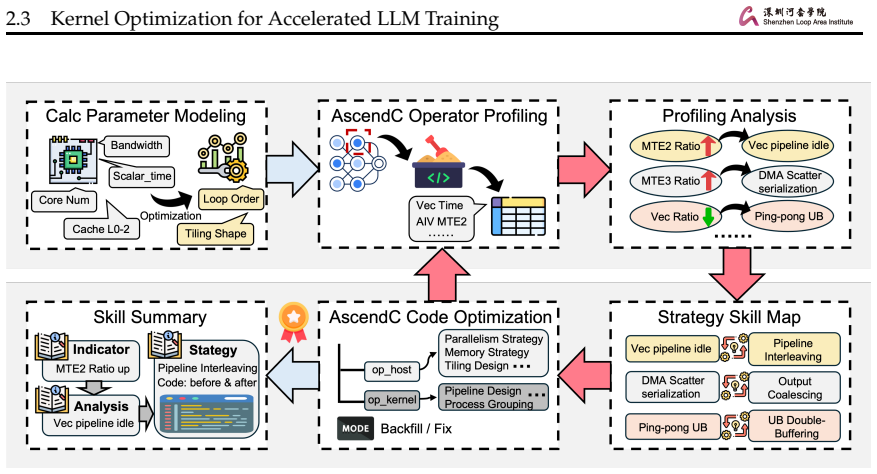
Summary. The paper presents SLAI T-Rex, a full-stack framework for post-training DeepSeek-V4-family models on Ascend CloudMatrix384 SuperPOD with Ascend 910C NPUs. It combines system-level optimizations (load-balanced pipeline scheduling, expert–tensor parallelism, overlapped MoE dispatch, double-buffered swap optimizer, and two kernel-optimization paths: AuraKernel and AscendC fusion/rewrite) with an OR-oriented CPT+SFT workflow built from solver-verified synthetic data and self-distilled SFT samples. The main claims are: (i) DeepSeek-V4-Pro training MFU improves from 11.67% to 34.22% (2.93×); (ii) the specialized DeepSeek-V4-Flash model achieves an average OR score of 71.81% across NL4OPT, OptiBench, B4O-Feasible, and B4O-ORGEval, exceeding GPT-5.4-Mini by 3.98 points; (iii) applying the workflow to DeepSeek-V4-Pro raises its average OR score from 70.16% to 77.33%. The paper releases prompts, contracts, curriculum schedules, and monitoring callbacks, and plans to release the optimized AscendC kernels.
Significance. If the reported results hold, the system-level contribution is significant: it is one of the few detailed demonstrations of full-parameter post-training of a trillion-parameter MoE model on non-GPU SIMD hardware, with extensive profiling, a concrete bottleneck taxonomy, and a verifiable kernel-optimization loop. The AuraKernel design — OR-guided tiling, correctness-gated candidate acceptance, and skill distillation — is a credible advance over purely heuristic kernel tuning, and the paper is unusually transparent about measurement conditions and reproducibility artifacts. The OR-specialization results are interesting and the matched CPT-to-SFT comparison (Section 4.5) is a well-designed experiment in isolation. However, as detailed in the major comments, the headline OR numbers are not demonstrated to be independent of the training and selection loop, which currently undermines the paper's central empirical claim.
major comments (4)
- [§3.2.1 and §4.6] OptiBench appears both as a collected CPT resource and as an evaluation benchmark. §3.2.1 states the collected corpus includes 'ReSocratic and OptiBench (Yang et al., 2025c)', while §4.6 and Table 15 report OptiBench as a held-out test benchmark. No split, exclusion, or deduplication of OptiBench instances from the CPT corpus is described. Consequently, the reported OptiBench scores, which contribute to the overall 71.81% average and the +3.98 vs. GPT-5.4-Mini claim, are potentially inflated by train/test overlap. The paper must either remove OptiBench from the training mixture and re-evaluate, or demonstrate instance-level exclusion with a concrete audit trail.
- [§3.2.3 and Tables 12/13/15] The final CPT checkpoint is explicitly selected to 'produce positive CPT-to-SFT transfer on the primary OR benchmarks' — the same NL4OPT/OptiBench/B4O numbers later reported as results. This is selection on the test set. The paper does not report a separate validation split that was used for checkpoint selection and then held out from the final evaluation. Without such a split, the reported CPT+SFT gains (e.g., +10.66 pp on B4O-ORGEval in Table 12) are not unbiased estimates of the pipeline's effect. A pre-registered or clearly separated validation protocol is required before the OR claims can be accepted.
- [§4.4 and §3.3.3] The cleaning and CoT design decisions are guided by error analysis on the same benchmarks that are later reported as final results. For example, §4.4 states that Clean-CoT is chosen because it improves NL4OPT and OptiBench, and §3.3.3 describes cleaning targets driven by failures on these benchmarks. This is an adaptive data-cleaning loop fitted to the test set. Unless the paper can show that the final reported scores were obtained from a locked pipeline on data never used for any development decision, the gains from cleaning (Table 11) and the headline end-to-end numbers are subject to selection bias. The paper should report results on a truly held-out OR benchmark set or apply a rigorous nested evaluation protocol.
- [§4.6, Table 15] The comparison against GPT-5.4-Mini, Gemini-3-Flash, Kimi-K2.6, and other baselines is central to the 'highest average score' claim. The text says 'All evaluations share the same prompt template and decoding budget for fair comparison,' but it is not stated whether the external model numbers were obtained by the authors under this shared protocol or taken from published reports with potentially different prompts, decoding settings, or answer extraction. If they were not run under identical conditions, the comparison is not controlled. Please specify the evaluation provenance for each external model and, if available, provide the pass rates under the same protocol.
minor comments (4)
- [§2.3.2] The sentence beginning 'Admittedly the' at the end of the AuraKernel description is incomplete and appears to cut off before the next paragraph. Either complete the thought or remove the fragment.
- [§2 and §4.1–4.3] The MFU, kernel speedup, and training-stability numbers are self-reported with no measurement uncertainty or run-to-run variation. Given the reproducibility artifacts promised, adding standard deviations or at least stating the number of repeated measurements would strengthen the system claims.
- [§4.7, Table 17] HumanEval is reported as 100.00% for both DeepSeek-V4-Pro and DeepSeek-V4-Pro+SFT, which is an unusually perfect score. A brief note on the evaluation setup (e.g., number of problems, pass@1 vs. pass@k, any known benchmark contamination) would help the reader calibrate this result.
- [§3.2.1] The 'separation between the data-generation assets and the ORGEval evaluation assets' is described only for ORGEval. The same level of separation should be documented for NL4OPT, OptiBench, and B4O-Feasible, since those benchmarks also appear in development decisions.
Circularity Check
OR benchmark gains are fitted to the same benchmarks used for evaluation: final CPT checkpoint selection, cleaning/CoT choices, and general-anchoring decisions all use NL4OPT/OptiBench/B4O scores that are later reported as held-out results, and OptiBench appears in the CPT corpus.
specific steps
-
fitted input called prediction
[§3.2.3 (Checkpoint Selection and CPT-to-SFT Transfer Validation), used in §4.6/§4.7]
"The final checkpoint is selected with a multi-objective criterion. A preferred checkpoint should reduce OR validation loss, maintain stable optimization signals during training, preserve general capabilities within the expected range, and produce positive CPT-to-SFT transfer on the primary OR benchmarks."
The 'primary OR benchmarks' named in §3.2.3 and evaluated in §4.6 are NL4OPT, OptiBench, B4O-Feasible, and B4O-ORGEval — exactly the four benchmarks whose averages (71.81% Flash; 77.33% Pro) are reported as the paper's headline OR results. Thus the reported scores are not independent predictions of CPT/SFT benefit: the checkpoint was chosen to maximize a criterion that includes those same scores. The +10.66 pp on B4O-ORGEval and the other Table 13/15 gains are partly the selection objective itself. The paper does not demonstrate that these downstream benchmarks are a held-out split distinct from the selection set.
-
other
[§3.2.1 (OR-CPT data mixture) vs §4.6 (Evaluation Setup)]
"The complete CPT corpus combines these solver-verified synthetic documents with collected OR-domain resources. The collected portion covers optimization modeling, mathematical reasoning, and solver-oriented problem solving, including OptMATH (Lu et al., 2025), ReSocratic and OptiBench (Yang et al., 2025c), Text2Opt-Bench (Gao et al., 2026), OR-Instruct (Huang et al., 2025), NLP4LP (Ahmaditeshnizi et al., 2024)..."
In §4.6, OptiBench is one of the four test benchmarks whose scores are reported (e.g., 63.33→67.12 in matched transfer). The paper never describes splitting or excluding OptiBench instances from the CPT training pool; the only explicit separation asserted is from ORGEval reference formulations and evaluator templates, not from OptiBench test items. Consequently the OptiBench improvement attributed to CPT is not clean evidence of domain generalization — it may reflect train/test overlap, making the 'CPT supplies OR-domain priors' claim partly circular with the composition of the CPT corpus.
-
fitted input called prediction
[§3.3.3 (Contract-Aware Cleaning and CoT Enhancement) and §4.4 (SFT Scaling and Cleaning Analysis)]
"The observations from preliminary SFT runs motivate a shift from merely enlarging the self-distilled dataset to improving the learnability of already distilled samples. In the comparison among 3K, 10K, and 50K reported in Section 4.4, the 10K dataset already significantly improves Bench4Opt protocol-oriented tasks, but it remains below the baseline on NL4OPT and OptiBench. Further scaling to 50K does not recover this ability. Therefore, ... we perform fine-grained cleaning of the existing 10K data."
The cleaning/CoT branch and the general-capability anchoring in §3.3.4 were chosen by examining performance and error types on NL4OPT and OptiBench (e.g., 'On NL4OPT, Clean-CoT reduces wrong_objective_or_model errors from 52 cases before cleaning to 31 cases'). The same benchmarks are then used in Tables 11–13 to validate Clean-CoT and the overall pipeline. This is a selection loop: the design was fitted to the evaluation set, and the reported NL4OPT/OptiBench gains are the return on that test-set information rather than an independent test of the cleaning hypothesis.
full rationale
The system-level contribution is not circular: the 34.22% MFU and 2.93× improvement are backed by measured end-to-end training on Ascend SuperPOD, and while the AuraKernel cost-model constants are fitted to hardware, the final operator speedups are measured on real NPUs rather than derived from the fitted model. The circularity is confined to the OR-specialization half. The final CPT checkpoint is explicitly selected to 'produce positive CPT-to-SFT transfer on the primary OR benchmarks', which are the same NL4OPT/OptiBench/B4O-Feasible/B4O-ORGEval numbers later reported as the result. Cleaning/CoT and general-capability anchoring decisions are likewise made from error analysis on NL4OPT and OptiBench, and OptiBench is listed inside the CPT corpus while also serving as a test benchmark, with no split or exclusion described. The paper therefore does not demonstrate that the reported OR gains are independent held-out evaluations: they are partly fitted to the evaluation set and possibly contaminated by train/test overlap. This is a partial circularity of the 'fitted input called prediction' kind, not a definitional identity, so the system MFU results and the general-capability checks keep the paper from being fully circular.
Axiom & Free-Parameter Ledger
free parameters (3)
- AuraKernel cycle-cost constants (Eq. 1) =
not reported
- CPT data mixture allocation =
~75% OR + retained general corpora (reported in §4.6)
- SFT recipe hyperparameters =
Stage I LR 5e-7, Stage II LR 1e-6, 220 steps, GBS 128, SEQ_LEN 8192
axioms (5)
- domain assumption Ascend 910C profiling counters and the MFU baseline recipe accurately reflect device utilization and fair comparison.
- domain assumption The four OR benchmarks (NL4OPT, OptiBench, B4O-Feasible, B4O-ORGEval) are valid, sufficient measures of OR modeling capability.
- domain assumption The synthetic data pipeline's leakage checks prevent overlap with evaluation benchmarks.
- domain assumption DeepSeek-V4-Flash is representative of the V4 family so that findings transfer to DeepSeek-V4-Pro.
- domain assumption The external baselines (GPT-5.4-Mini, Gemini-3-Flash, etc.) were evaluated under identical prompting and decoding settings.
read the original abstract
Full-parameter post-training of trillion-parameter-scale MoE models introduces substantial system-level challenges for large-scale distributed training, including severe memory pressure, non-overlapped communication overhead, and inefficient kernel execution. While most large-scale LLM training systems are built around GPU-based clusters, this report presents an end-to-end optimization practice on the Ascend NPU SuperPOD. Using the DeepSeek-V4 model family as the target workload, we develop a hierarchical optimization framework spanning model-level parallelism, computation-communication orchestration, and low-level kernel execution. The resulting system achieves 34.22% Model FLOPs Utilization (MFU) with a 2.93x improvement over the open-source baseline recipe while maintaining training stability. Building on this optimized infrastructure, we further establish a CPT and SFT workflow for complex Operations Research (OR) tasks. We refer to the integrated framework as SLAI T-Rex. Using DeepSeek-V4-Flash, we develop OR-oriented CPT and SFT data pipelines that combine collected domain resources with solver-verified synthetic optimization documents. The resulting dataset contains 10K high-quality SFT samples spanning four task categories and three problem representations. The specialized model achieves the highest average zero-shot Pass@1 score among the evaluated models, reaching 71.81% and outperforming GPT-5.4-Mini and the base DeepSeek-V4-Flash model by 3.98 and 11.27 percentage points, respectively. Overall, this work demonstrates a full-stack pathway from efficient trillion-parameter model post-training on Ascend infra to domain-specialized Flash models for solver-grounded mathematical modeling, advancing frontier-model systems for complex reasoning.
Figures






Reference graph
Works this paper leans on
-
[1]
arXiv , author =:1609.08675 , primaryclass =
YouTube-8M: A Large-Scale Video Classification Benchmark , url =. arXiv , author =:1609.08675 , primaryclass =
-
[2]
Findings of the Association for Computational Linguistics: ACL 2025 , year =
Autonomous Data Selection with Zero-shot Generative Classifiers for Mathematical Texts , author =. Findings of the Association for Computational Linguistics: ACL 2025 , year =
2025
-
[3]
, institution =
Li, Chao and Zhang, Yifan and Lu, Yanzhen and Yao, Andrew C. , institution =. 2025 , month = aug, url =
2025
-
[4]
Wang, Yudong and Fu, Zixuan and Cai, Jie and Tang, Peijun and Lyu, Hongya and Fang, Yewei and Zheng, Zhi and Zhou, Jie and Zeng, Guoyang and Xiao, Chaojun and Han, Xu and Liu, Zhiyuan , journal =
-
[5]
arXiv preprint arXiv:2602.09003 , year =
Data Science and Technology Towards AGI Part I: Tiered Data Management , author =. arXiv preprint arXiv:2602.09003 , year =
-
[6]
Long Ouyang and Jeffrey Wu and Xu Jiang and Diogo Almeida and Carroll L. Wainwright and Pamela Mishkin and Chong Zhang and Sandhini Agarwal and Katarina Slama and Alex Ray and John Schulman and Jacob Hilton and Fraser Kelton and Luke Miller and Maddie Simens and Amanda Askell and Peter Welinder and Paul F. Christiano and Jan Leike and Ryan Lowe , title =....
-
[7]
Guo, Daya and Yang, Dejian and Zhang, Haowei and Song, Junxiao and Wang, Peiyi and Zhu, Qihao and Xu, Runxin and Zhang, Ruoyu and Ma, Shirong and Bi, Xiao and Zhang, Xiaokang and Yu, Xingkai and Wu, Yu and Wu, Z. F. and Gou, Zhibin and Shao, Zhihong and Li, Zhuoshu and Gao, Ziyi and Liu, Aixin and Xue, Bing and Wang, Bingxuan and Wu, Bochao and Feng, Bei ...
-
[8]
Zhihong Shao and Peiyi Wang and Qihao Zhu and Runxin Xu and Junxiao Song and Mingchuan Zhang and Y. K. Li and Y. Wu and Daya Guo , title =. CoRR , volume =. 2024 , doi =
2024
-
[9]
Le and Geoffrey E
Noam Shazeer and Azalia Mirhoseini and Krzysztof Maziarz and Andy Davis and Quoc V. Le and Geoffrey E. Hinton and Jeff Dean , title =. 5th International Conference on Learning Representations, ICLR 2017 , publisher =. 2017 , url =
2017
-
[10]
9th International Conference on Learning Representations, ICLR 2021 , publisher =
Dmitry Lepikhin and HyoukJoong Lee and Yuanzhong Xu and Dehao Chen and Orhan Firat and Yanping Huang and Maxim Krikun and Noam Shazeer and Zhifeng Chen , title =. 9th International Conference on Learning Representations, ICLR 2021 , publisher =. 2021 , url =
2021
-
[11]
Journal of Machine Learning Research , volume =
William Fedus and Barret Zoph and Noam Shazeer , title =. Journal of Machine Learning Research , volume =. 2022 , url =
2022
-
[13]
Proceedings of the International Conference for High Performance Computing, Networking, Storage and Analysis, SC 2020 , pages =
Samyam Rajbhandari and Jeff Rasley and Olatunji Ruwase and Yuxiong He , title =. Proceedings of the International Conference for High Performance Computing, Networking, Storage and Analysis, SC 2020 , pages =. 2020 , doi =
2020
-
[14]
DeepSeek-AI and Aixin Liu and Bei Feng and Bing Xue and Bingxuan Wang and Bochao Wu and Chengda Lu and Chenggang Zhao and Chengqi Deng and Chenyu Zhang and Chong Ruan and Damai Dai and Daya Guo and Dejian Yang and Deli Chen and Dongjie Ji and Erhang Li and Fangyun Lin and Fucong Dai and Fuli Luo and Guangbo Hao and Guanting Chen and Guowei Li and H. Zhang...
-
[15]
Operations Research , volume =
Chenyu Huang and Zhengyang Tang and Shixi Hu and Ruoqing Jiang and Xin Zheng and Dongdong Ge and Benyou Wang and Zizhuo Wang , title =. Operations Research , volume =. 2025 , doi =
2025
-
[16]
Thirty-Ninth AAAI Conference on Artificial Intelligence, AAAI 2025 , pages =
Mahdi Mostajabdaveh and Timothy Tin Long Yu and Samarendra Chandan Bindu Dash and Rindra Ramamonjison and Jabo Serge Byusa and Giuseppe Carenini and Zirui Zhou and Yong Zhang , title =. Thirty-Ninth AAAI Conference on Artificial Intelligence, AAAI 2025 , pages =. 2025 , doi =
2025
-
[17]
Proceedings of the NeurIPS 2022 Competitions Track , pages =
NL4Opt Competition: Formulating Optimization Problems Based on Their Natural Language Descriptions , author =. Proceedings of the NeurIPS 2022 Competitions Track , pages =. 2022 , editor =
2022
-
[18]
CoRR , volume =
Zhuohan Wang and Ziwei Zhu and Ziniu Li and Congliang Chen and Yizhou Han and Yufeng Lin and Zhihang Lin and Angyang Gu and Xinglin Hu and Ruoyu Sun and Tian Ding , title =. CoRR , volume =. 2025 , doi =
2025
-
[19]
DeepSeek-AI and Anyi Xu and Bangcai Lin and Bing Xue and Bingxuan Wang and Bingzheng Xu and Bochao Wu and Bowei Zhang and Chaofan Lin and Chen Dong and Chenchen Ling and Chengda Lu and Chenggang Zhao and Chengqi Deng and Chengyu Hou and Chenhao Xu and Chenze Shao and Chong Ruan and Conner Sun and Damai Dai and Daya Guo and Dejian Yang and Deli Chen and Do...
-
[20]
Xiao, Ziyang and Xie, Jingrong and Xu, Lilin and Guan, Shisi and Zhu, Jingyan and Han, Xiongwei and Fu, Xiaojin and Yu, WingYin and Wu, Han and Shi, Wei and Kang, Qingcan and Duan, Jiahui and Zhong, Tao and Yuan, Mingxuan and Zeng, Jia and Wang, Yuan and Chen, Gang and Zhang, Dongxiang , title =. Proceedings of the Thirty-Fourth International Joint Confer...
-
[21]
Hongyang Chen and Zhongwu Sun and Hongfei Ye and Kunchi Li and Xuemin Lin , title =. CoRR , volume =. 2026 , eprinttype =. 2603.12658 , url =
arXiv 2026
-
[22]
French , title =
Robert M. French , title =. Trends in Cognitive Sciences , volume =. 1999 , doi =
1999
-
[23]
Don't Stop Pretraining: Adapt Language Models to Domains and Tasks , booktitle =
Suchin Gururangan and Ana Marasovi. Don't Stop Pretraining: Adapt Language Models to Domains and Tasks , booktitle =. 2020 , publisher =. doi:10.18653/v1/2020.acl-main.740 , url =
-
[24]
Haoran Que and Jiaheng Liu and Ge Zhang and Chenchen Zhang and Xingwei Qu and Yinghao Ma and Feiyu Duan and Zhiqi Bai and Jiakai Wang and Yuanxing Zhang and Xu Tan and Jie Fu and Wenbo Su and Jiamang Wang and Lin Qu and Bo Zheng , title =. CoRR , volume =. 2024 , eprinttype =. 2406.01375 , url =
Pith/arXiv arXiv 2024
-
[25]
Proceedings of the 2024 Conference on Empirical Methods in Natural Language Processing , pages =
Jiawei Gu and Zacc Yang and Chuanghao Ding and Rui Zhao and Fei Tan , title =. Proceedings of the 2024 Conference on Empirical Methods in Natural Language Processing , pages =. 2024 , publisher =
2024
-
[26]
Ningyuan Xi and Yetao Wu and Kun Fan and Teng Chen and Qingqing Gu and Peng Yu and Jinxian Qu and Chenxi Liu and Zhonglin Jiang and Yong Chen and others , title =. CoRR , volume =. 2024 , eprinttype =. 2409.06624 , url =
Pith/arXiv arXiv 2024
-
[27]
International Conference on Learning Representations , volume=
Mix-cpt: A domain adaptation framework via decoupling knowledge learning and format alignment , author=. International Conference on Learning Representations , volume=
-
[28]
Proceedings of the 42nd International Conference on Machine Learning , series =
Hongliang Lu and Zhonglin Xie and Yaoyu Wu and Can Ren and Yuxuan Chen and Zaiwen Wen , title =. Proceedings of the 42nd International Conference on Machine Learning , series =. 2025 , url =
2025
-
[29]
Bastian and Frederic Sala , title =
Zhiqi Gao and Albert Ge and Alexander Berenbeim and Nathaniel D. Bastian and Frederic Sala , title =. CoRR , volume =. 2026 , eprinttype =. 2605.21751 , doi =
Pith/arXiv arXiv 2026
-
[30]
Minwei Kong and Chonghe Jiang and Ao Qu and Wenbin Ouyang and Zhaoming Zeng and Xiaotong Guo and Zhekai Li and Junyi Li and Yi Fan and Xinshou Zheng and Xi Jing and Yikai Zhang and Zhiwei Liang and Seonghoo Kim and Runqing Yang and Zijian Zhou and Sirui Li and Han Zheng and Wangyang Ying and Ou Zheng and Chonghuan Wang and Jinglong Zhao and Hanzhang Qin a...
Pith/arXiv arXiv 2026
-
[31]
Proceedings of the 41st International Conference on Machine Learning , series =
Ali Ahmaditeshnizi and Wenzhi Gao and Madeleine Udell , title =. Proceedings of the 41st International Conference on Machine Learning , series =. 2024 , url =
2024
-
[32]
2025 , howpublished =
Albert Ge , title =. 2025 , howpublished =
2025
-
[33]
Xuhan Huang and Qingning Shen and Yan Hu and Anningzhe Gao and Benyou Wang , title =. CoRR , volume =. 2024 , eprinttype =. 2405.13144 , doi =
Pith/arXiv arXiv 2024
-
[34]
2026 , note =
Gurobi Modeling Examples , howpublished =. 2026 , note =
2026
-
[35]
2024 , howpublished =
Nicholas Lownes , title =. 2024 , howpublished =
2024
-
[36]
Proceedings of the 2025 Conference on Empirical Methods in Natural Language Processing , pages=
Demystifying domain-adaptive post-training for financial llms , author=. Proceedings of the 2025 Conference on Empirical Methods in Natural Language Processing , pages=
2025
-
[37]
Fu and Stefano Ermon and Atri Rudra and Christopher R\'
Tri Dao and Daniel Y. Fu and Stefano Ermon and Atri Rudra and Christopher R\'. Advances in Neural Information Processing Systems 35 (NeurIPS 2022) , year =. 2205.14135 , eprinttype =
Pith/arXiv arXiv 2022
-
[38]
The Twelfth International Conference on Learning Representations (ICLR 2024) , year =
Tri Dao , title =. The Twelfth International Conference on Learning Representations (ICLR 2024) , year =. 2307.08691 , eprinttype =
Pith/arXiv arXiv 2024
-
[39]
Jay Shah and Ganesh Bikshandi and Ying Zhang and Vijay Thakkar and Pradeep Ramani and Tri Dao , title =. CoRR , volume =. 2024 , url =. 2407.08608 , eprinttype =
Pith/arXiv arXiv 2024
-
[40]
Philippe Tillet and H. T. Kung and David Cox , title =. Proceedings of the 3rd ACM SIGPLAN International Workshop on Machine Learning and Programming Languages (MAPL 2019) , pages =. 2019 , doi =
2019
-
[41]
Pin-Lun Hsu and Yun Dai and Vignesh Kothapalli and Qingquan Song and Shao Tang and Siyu Zhu and Steven Shimizu and Shivam Sahni and Haowen Ning and Yanning Chen , title =. CoRR , volume =. 2024 , url =. 2410.10989 , eprinttype =
Pith/arXiv arXiv 2024
-
[42]
Proceedings of Machine Learning and Systems 7 (MLSys 2025) , year =
Zihao Ye and Lequn Chen and Ruihang Lai and Wuwei Lin and Yineng Zhang and Stephanie Wang and Tianqi Chen and Baris Kasikci and Vinod Grover and Arvind Krishnamurthy and Luis Ceze , title =. Proceedings of Machine Learning and Systems 7 (MLSys 2025) , year =. 2501.01005 , eprinttype =
Pith/arXiv arXiv 2025
-
[43]
Anjiang Wei and Tianran Sun and Yogesh Seenichamy and Hang Song and Anne Ouyang and Azalia Mirhoseini and Ke Wang and Alex Aiken , title =. CoRR , volume =. 2025 , url =. 2509.07506 , eprinttype =
arXiv 2025
-
[44]
Juncheng Dong and Yang Yang and Tao Liu and Yang Wang and Feng Qi and Vahid Tarokh and Kaushik Rangadurai and Shuang Yang , title =. CoRR , volume =. 2025 , url =. 2510.16996 , eprinttype =
arXiv 2025
-
[45]
Bytedance-Seed-Foundation-Code-Team and M-A-P , title =. CoRR , volume =. 2024 , url =. 2412.00535 , eprinttype =
Pith/arXiv arXiv 2024
-
[46]
Jiehao Wu and Zixiao Huang and Wenhao Li and Chuyun Shen and Junjie Sheng and Xiangfeng Wang , title =. CoRR , volume =. 2025 , url =. 2603.23566 , eprinttype =
Pith/arXiv arXiv 2025
-
[47]
Xinzi Cao and Jianyang Zhai and Pengfei Li and Zhiheng Hu and Cen Yan and Bingxu Mu and Guanghuan Fang and Bin She and Jiayu Li and Yihan Su and Dongyang Tao and Xiansong Huang and Fan Xu and Feidiao Yang and Yao Lu and Chang-Dong Wang and Yutong Lu and Weicheng Xue and Bin Zhou and Yonghong Tian , year=. 2601.07160 , archivePrefix=
-
[48]
Zhongzhen Wen and Shudi Shao and Zhong Li and Yu Ge and Tongtong Xu and Yuanyi Lin and Tian Zhang , year=. 2601.22760 , archivePrefix=
-
[49]
Proceedings of the Thirty-Fourth International Joint Conference on Artificial Intelligence , pages =
Ziyang Xiao and Jingrong Xie and Lilin Xu and Shisi Guan and Jingyan Zhu and Xiongwei Han and Xiaojin Fu and WingYin Yu and Han Wu and Wei Shi and Qingcan Kang and Jiahui Duan and Tao Zhong and Mingxuan Yuan and Jia Zeng and Yuan Wang and Gang Chen and Dongxiang Zhang , title =. Proceedings of the Thirty-Fourth International Joint Conference on Artificial...
2025
-
[50]
Yang Wang and Kai Li , title =. CoRR , volume =. 2025 , eprinttype =. 2509.18180 , doi =
arXiv 2025
-
[51]
Tinglong Dai and David Simchi-Levi and Michelle Xiao Wu and Yao Xie , title =. CoRR , volume =. 2025 , eprinttype =. 2512.23978 , doi =
Pith/arXiv arXiv 2025
-
[52]
Chain-of-Experts: When
Ziyang Xiao and Dongxiang Zhang and Yangjun Wu and Lilin Xu and Yuan Jessica Wang and Xiongwei Han and Xiaojin Fu and Tao Zhong and Jia Zeng and Mingli Song and Gang Chen , booktitle =. Chain-of-Experts: When. 2024 , url =
2024
-
[53]
Bowen Zhang and Pengcheng Luo and Genke Yang and Boon-Hee Soong and Chau Yuen , journal =
-
[54]
2026 , url =
Zezhen Ding and Zhen Tan and Jiheng Zhang and Tianlong Chen , booktitle =. 2026 , url =
2026
-
[55]
Ruicheng Ao and David Simchi-Levi and Xinshang Wang , journal =
-
[56]
arXiv preprint arXiv:2504.20073 , year=
RAGEN: Understanding Self-Evolution in LLM Agents via Multi-Turn Reinforcement Learning , author=. arXiv preprint arXiv:2504.20073 , year=
-
[57]
arXiv preprint arXiv:2503.09516 , year=
Search-R1: Training LLMs to Reason and Leverage Search Engines with Reinforcement Learning , author=. arXiv preprint arXiv:2503.09516 , year=
-
[58]
Proceedings of the AAAI Conference on Artificial Intelligence , volume=
Deepor: A deep reasoning foundation model for optimization modeling , author=. Proceedings of the AAAI Conference on Artificial Intelligence , volume=
-
[59]
Findings of the Association for Computational Linguistics: EMNLP 2025 , pages=
SCoder: Progressive Self-Distillation for Bootstrapping Small-Scale Data Synthesizers to Empower Code LLMs , author=. Findings of the Association for Computational Linguistics: EMNLP 2025 , pages=
2025
-
[60]
arXiv preprint arXiv:2605.26132 , year=
Self-Verified Distillation: Your Language Model Is Secretly Its Own Synthetic Data Pipeline , author=. arXiv preprint arXiv:2605.26132 , year=
-
[61]
Findings of the Association for Computational Linguistics: EMNLP 2025 , pages=
Training LLMs for Optimization Modeling via Iterative Data Synthesis and Structured Validation , author=. Findings of the Association for Computational Linguistics: EMNLP 2025 , pages=
2025
-
[62]
arXiv preprint arXiv:2505.03469 , year=
Long-short chain-of-thought mixture supervised fine-tuning eliciting efficient reasoning in large language models , author=. arXiv preprint arXiv:2505.03469 , year=
-
[63]
Proceedings of the 2025 Conference on Empirical Methods in Natural Language Processing , pages=
Facilitating long context understanding via supervised chain-of-thought reasoning , author=. Proceedings of the 2025 Conference on Empirical Methods in Natural Language Processing , pages=
2025
-
[64]
arXiv preprint arXiv:2502.03373 , year=
Demystifying long chain-of-thought reasoning in llms , author=. arXiv preprint arXiv:2502.03373 , year=
-
[65]
Findings of the Association for Computational Linguistics: ACL 2024 , pages=
A two-stage adaptation of large language models for text ranking , author=. Findings of the Association for Computational Linguistics: ACL 2024 , pages=
2024
-
[66]
arXiv preprint arXiv:2510.10071 , year=
ADEPT: Continual Pretraining via Adaptive Expansion and Dynamic Decoupled Tuning , author=. arXiv preprint arXiv:2510.10071 , year=
-
[67]
arXiv preprint arXiv:2402.17400 , year=
Investigating continual pretraining in large language models: Insights and implications , author=. arXiv preprint arXiv:2402.17400 , year=
-
[68]
arXiv preprint arXiv:2602.22859 , year=
From Blind Spots to Gains: Diagnostic-Driven Iterative Training for Large Multimodal Models , author=. arXiv preprint arXiv:2602.22859 , year=
-
[69]
Lane , booktitle=
Wanru Zhao and Yihong Chen and Yuzhi Tang and Wentao Ma and Shengchao Hu and Shell Xu Hu and Alex Iacob and Abhinav Mehrotra and Nicholas D. Lane , booktitle=. Rethinking Data Curation in. 2026 , url=
2026
-
[70]
Forty-second International Conference on Machine Learning , year=
Boosting multi-domain fine-tuning of large language models through evolving interactions between samples , author=. Forty-second International Conference on Machine Learning , year=
-
[71]
Proceedings of the 19th Conference of the European Chapter of the Association for Computational Linguistics (Volume 3: System Demonstrations) , pages=
The AI committee: A multi-agent framework for automated validation and remediation of web-sourced data , author=. Proceedings of the 19th Conference of the European Chapter of the Association for Computational Linguistics (Volume 3: System Demonstrations) , pages=
-
[72]
ICML 2025 Workshop on Computer Use Agents , year=
Reinforcing multi-turn reasoning in llm agents via turn-level credit assignment , author=. ICML 2025 Workshop on Computer Use Agents , year=
2025
-
[73]
Yuankang Fu and Xinrong Gong and Chen Gong and Tong Zhang and Kaixiang Yang , booktitle=. Cure-. 2026 , url=
2026
-
[74]
Advances in Neural Information Processing Systems , volume=
Curriculum Design for Trajectory-Constrained Agent: Compressing Chain-of-Thought Tokens in LLMs , author=. Advances in Neural Information Processing Systems , volume=
-
[75]
Xing and Sham M
Zhenting Qi and Fan Nie and Alexandre Alahi and James Zou and Himabindu Lakkaraju and Yilun Du and Eric P. Xing and Sham M. Kakade and Hanlin Zhang , booktitle=. Evo. 2026 , url=
2026
-
[76]
Proceedings of the 31st ACM SIGKDD Conference on Knowledge Discovery and Data Mining V
DCA-bench: a benchmark for dataset curation agents , author=. Proceedings of the 31st ACM SIGKDD Conference on Knowledge Discovery and Data Mining V. 2 , pages=
-
[77]
2025 , eprint=
gpt-oss-120b & gpt-oss-20b Model Card , author=. 2025 , eprint=
2025
-
[78]
GLM-5-Team and Aohan Zeng and Xin Lv and Zhenyu Hou and Zhengxiao Du and Qinkai Zheng and Bin Chen and Da Yin and Chendi Ge and Chenghua Huang and Chengxing Xie and Chenzheng Zhu and Congfeng Yin and Cunxiang Wang and Gengzheng Pan and Hao Zeng and Haoke Zhang and Haoran Wang and Huilong Chen and Jiajie Zhang and Jian Jiao and Jiaqi Guo and Jingsen Wang a...
-
[79]
Proceedings of the 2025 Conference on Empirical Methods in Natural Language Processing , pages=
MAIN: Mutual Alignment Is Necessary for instruction tuning , author=. Proceedings of the 2025 Conference on Empirical Methods in Natural Language Processing , pages=
2025
-
[80]
arXiv preprint arXiv:2406.14971 , year=
Domain adaptation of llama3-70b-instruct through continual pre-training and model merging: A comprehensive evaluation , author=. arXiv preprint arXiv:2406.14971 , year=
-
[81]
International Conference on Learning Representations , year=
Finetuned Language Models are Zero-Shot Learners , author=. International Conference on Learning Representations , year=
discussion (0)
Sign in with ORCID, Apple, or X to comment. Anyone can read and Pith papers without signing in.