REVIEW 3 major objections 4 minor 10 cited by
Murakkab: Resource-Efficient Agentic Workflow Orchestration in Cloud Platforms
T0 review · 3 major / 4 minor · reviewed 2026-08-05 · deepseek-v4-flash
Pith's one-line read This paper claims that serving agentic workflows as declarative DAGs, instead of opaque hard-coded pipelines, lets a profile-guided optimizer cut GPU usage by up to 2.8x, energy by 3.7x, and cost by 4.3x while preserving quality and latency
desk verdict A promising integrated system for agentic workflow serving whose efficiency gains are real but overstated—the SLO guarantee is definitional and the baseline is hand-crafted. read the letter →
The pith
A machine-rendered reading of the paper's core claim, the machinery that carries it, and where it could break.
The reading
What carries the argument
The central mechanism is the pairing of offline profile layers with a mixed-integer linear program (MILP), a mathematical optimization formulation that allocates resources under constraints. Workflow profiles record, per configuration, the response quality and per-executor token load; model profiles record time-to-first-token, time-per-output-token, energy, and cost across GPU types and tensor-parallelism settings. The MILP consumes profiles, arrival patterns, and resource constraints, separates peak provisioning from average utilization, and outputs instance counts and workflow-to-model assignments, while a runtime auto-scaler corrects short-term prediction error. This mechanism makes the e
What would settle it
Run the same production-derived 24-hour request mix on an imperative orchestration framework enhanced with dynamic autoscaling and per-request configuration selection, then compare total GPU-hours, energy, and the number of SLO violations. If the adaptive baseline uses no more GPUs and still meets all SLOs, the central claim that workflow-structure visibility is what unlocks the savings would be falsified.
Extended reading notes
Core claim
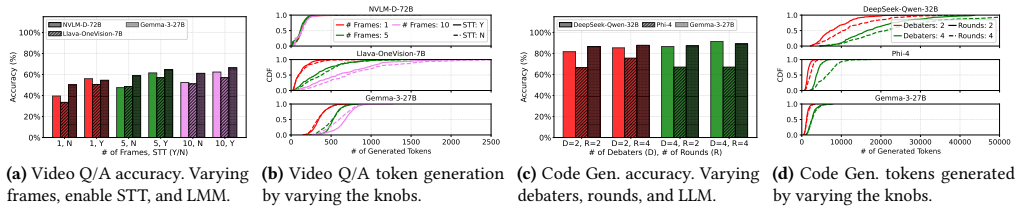
The core discovery is that the internal structure of an agentic workflow is a reusable optimization surface. By exposing workflows as typed DAGs of logical tasks, Murakkab can decouple the developer's intent from execution details and then solve a joint optimization problem: pick workflow-level knobs such as frame counts or debate rounds, map each task to a model or tool, choose GPU type and tensor parallelism, allocate instance counts, and multiplex load across workflows and SLO tiers. Offline profiles make this search tractable, with one layer for workflow quality and token load and another for model latency, energy, and cost under different hardware configurations. Every hour the optimize
Load-bearing premise
The evaluation treats a fixed, hand-chosen static GPU allocation as the representative production baseline and defines SLO tiers as percentiles of the profiled configuration set; if real deployments already adapt allocation to load or users require absolute SLO thresholds, the reported savings and the 'maintains SLOs' guarantee may not transfer.
Editorial extensions
If this is right
- Per-request SLO tiers become first-class: a request asking for a 'good' accuracy or latency tier can be served by a materially cheaper configuration than a 'best' request, and the system enforces that difference.
- Hourly reoptimization plus an auto-scaler lets the platform track diurnal demand, so GPU counts, model instances, and workflow configurations change with load rather than staying fixed.
- Multiplexing different workflows onto shared model instances yields additional 17-21% reductions beyond per-workflow optimization in the reported setup.
- Workflow DAG visibility lets the scheduler place cheap components on CPUs and reserve GPUs for latency-critical ones, meeting a 30-second SLO with fewer GPUs.
- A roughly 60-minute optimization epoch emerges as a balanced operating point: shorter intervals are dominated by transition overhead, longer intervals by demand-prediction error.
Reading between the lines
- The reported multiples compare against a fixed, hand-picked static allocation; against a baseline that already autoscales or dynamically selects models, the savings would likely shrink because the design's real advantage is joint cross-layer optimization, not adaptation alone.
- The same profile-guided decoupling could extend to workflows whose components span multiple cloud providers or proprietary APIs, treating external endpoints as just another model profile with cost, latency, and accuracy attributes.
- Because SLO tiers are defined as percentiles of the profiled configuration set, the meaning of 'best' shifts as new models are added; this makes the system self-improving but also means tiers are relative to the current library, not an absolute user contract.
- The hidden cost is profile freshness: as models and hardware churn, the profiles must be re-measured, and the paper's claims assume those profiles stay accurate throughout the 24-hour evaluation window.
Editorial analysis
A structured set of objections, weighed in public.
Referee Report
Summary. The paper presents Murakkab, a serving system for agentic workflows that decouples declarative workflow specifications from execution configuration, uses offline profiles and a MILP optimizer to select workflow/model/hardware knobs per SLO tier, and includes an adaptive runtime and auto-scaler for multi-tenant cloud platforms. The evaluation on video Q/A, code generation, and math Q/A workflows over 24-hour Azure traces reports up to 2.8x GPU reduction, 3.7x energy reduction, and 4.3x cost reduction relative to a static hand-crafted baseline, while claiming no SLO violations.
Significance. If the results held, Murakkab would be a substantial contribution to compound AI serving: exposing workflow DAGs to a profile-guided optimizer is a timely and plausible direction. The MILP formulation in Appendix A.5 is internally consistent, and the sensitivity analysis in Section 4.6 is a useful practical study. Credit is also due for the paper's transparency about the static baseline's limitations. However, the central efficiency and SLO-maintenance claims are not established by the evaluation as written: the SLO tiers are defined over the optimizer's own configuration set, the latency filter ignores DAG-level critical paths, and the only comparison is to a hand-crafted, non-adaptive baseline that itself violates SLOs. The idea deserves further development, but the current evidence does not support the headline numbers.
major comments (3)
- [Section 3.4 and Appendix A.5, Eqs. (4)-(5), (8)-(9)] The SLO tiers are defined as the best/95th/80th/50th percentiles of accuracy and latency among the profiled workflow/model/hardware configuration set. The MILP's SLO-filtering constraints then reject any configuration that falls below these self-referential thresholds. Consequently, every feasible solution satisfies the SLO by construction, and the 'no SLO violations' claim in Figure 10b is a design property, not an empirical result. To substantiate SLO maintenance, the evaluation must use absolute user-defined SLO targets or externally specified thresholds that are not derived from the optimizer's own profile distribution.
- [Appendix A.5, Eq. (5) and Eq. (9); Section 4.5] The only latency filter in the MILP rejects configuration c on model m when TTFT_m + t_c * TPOT_m > tau. This is a single-model generation-latency check. It does not model the DAG critical path: tool execution (frame extraction, Whisper, OmDet), parallel branches, queueing, or colocation effects. Section 4.5's own example shows end-to-end latency is determined by where tools run and how parallel branches overlap, not by one model's TTFT/TPOT. Thus the optimizer can admit configurations that violate the end-to-end latency SLO, so the claimed guarantee is not actually enforced by the formulation.
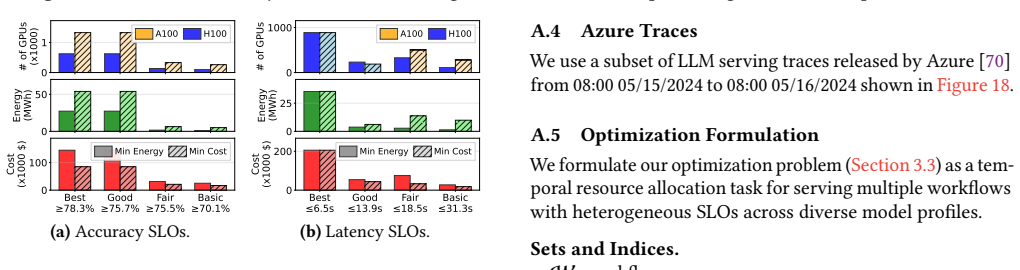
- [Section 4.1 and Table 1] The efficiency numbers are relative to a hand-crafted static baseline that uses a fixed Gemma-3-27B-on-A100 allocation for 24 hours, does not adapt to load, and does not distinguish SLO tiers. Calling this representative of 'state-of-the-art baselines like LangGraph' conflates an orchestration framework with a deployment policy; real deployments of LangChain/LangGraph can be run with autoscalers, and an autoscaling or SLO-aware baseline would likely close a large part of the reported gap. Since the baseline also violates SLOs (Figure 10b), the reported 2.8x/3.7x/4.3x improvements are not a fair measure of improvement over current practice.
minor comments (4)
- [Appendix A.5] Constraints (4)-(5) and (8)-(9) are duplicated verbatim, and the cost budget constraint appears as (6) and again as (10). This makes the formulation harder to read.
- [Section 4.3] Typo: 'itsholistic' should read 'its holistic'.
- [Section 4.1] The description of the static policy as 'hand-crafted' is clear, but the claim that it 'represents existing systems like LangGraph' is not supported, as LangGraph does not prescribe a static GPU allocation.
- [Figure 10b] The legend includes 'SLO' but the plot does not clearly label which bar/line corresponds to the SLO threshold, making it hard to visually verify the claimed violations.
Circularity Check
SLO compliance is definitional: Section 3.4 defines SLO tiers as percentiles of the optimizer's own configuration set, and the MILP filters to those percentiles, so the 'no SLO violations' claim is enforced by construction.
-
self definitional
[Section 3.4 (Execution, SLOs), enforced by Appendix A.5 constraints (4)-(5) and (8)-(9)]
"We assign four SLO tiers for quality and end-to-end latency: best, good, fair, and basic. The SLO tiers correspond to the best, 95th, 80th, and 50th percentile values of accuracy and latency available among the set of all workflow, model, and hardware configurations."
The SLO thresholds tau_{w,s} are defined as percentiles of accuracy and latency computed over the same configuration set C_w that the optimizer searches. The MILP then zeroes out any configuration whose accuracy is below tau (constraints 4/8) or whose latency estimate exceeds tau (constraints 5/9). Consequently, every feasible Murakkab allocation is SLO-compliant by construction: the filter removes configurations outside the chosen quantile, so 'maintaining SLOs' (and the absence of SLO violations in Figures 10b/17b) is a restatement of the definition, not an empirically tested outcome. The reported 2.8x/3.7x/4.3x savings in GPUs/energy/cost are still genuine resource-allocation comparisons against the static baseline, so the paper is only partially circular; but the 'while maintaining SLO
full rationale
The core efficiency results are not circular: the optimizer solves the MILP in Appendix A.5 against measured workflow and model profiles, and the GPU/energy/cost reductions are compared with a fixed static allocation; the Azure trace is external data, albeit partly author-affiliated, and no load-bearing uniqueness theorem or ansatz-smuggling citation appears. However, the companion claim of 'maintaining SLOs' is partly definitional. Section 3.4 defines the four SLO tiers as the best/95th/80th/50th percentiles of accuracy and latency over the same configuration set the optimizer explores, and Appendix A.5's constraints simply discard configurations below those percentiles (Eqs. 4-5 and 8-9). Any feasible allocation therefore satisfies the internally defined SLO by construction; the 'no SLO violations' reported for Murakkab in Figures 10b and 17b is not an independently measured outcome. In addition, the latency filter uses a single-model TTFT + tokens*TPOT formula rather than the DAG critical path, tool execution, or queueing/colocation effects, so even the defined latency feasibility is asserted through the optimizer's proxy rather than verified end-to-end. These issues do not invalidate the resource-efficiency comparisons, but they make the SLO-maintenance claim tautological with respect to the paper's own SLO definition. The hand-crafted static baseline is a comparison-validity concern, not a circularity. Overall: partial circularity, score 6.
Assumptions & free parameters
free parameters (7)
- Unified buffer factor alpha =
1.15
- EWMA smoothing alpha =
0.5
- Model-specific multiplexing factor mu_m
- Optimization epoch =
60 minutes
- SLO tier percentiles =
best, 95th, 80th, 50th
- Provisioning delay =
20 minutes
- Epsilon in accuracy objective =
0.001
assumptions (5)
- domain assumption Azure chat/coding traces represent agentic workflow arrival patterns.
- domain assumption Offline profiles accurately predict live accuracy, latency, energy, and cost.
- domain assumption An LLM with tool-calling can map declarative tasks to suitable executors.
- ad hoc to paper The statistical multiplexing model is accurate.
- ad hoc to paper Static allocations with no adaptation represent current practice.
Cite this review
Pith. "Pith review of Murakkab: Resource-Efficient Agentic Workflow Orchestration in Cloud Platforms." pith.science (2026). https://pith.science/paper/IBXH3FIA
@misc{pith2026250818298,
  author       = {Pith},
  title        = {Pith review of: Murakkab: Resource-Efficient Agentic Workflow Orchestration in Cloud Platforms},
  year         = {2026},
  howpublished = {\url{https://pith.science/paper/IBXH3FIA}},
  note         = {Machine review of arXiv:2508.18298}
}
abstract
Agentic workflows commonly coordinate multiple models and tools with complex control logic. They are quickly becoming the dominant paradigm for AI applications. However, serving them remains inefficient with today's frameworks. The key problem is that they expose workflows as opaque sequences of model and tool calls that tightly couple agent logic with model and hardware choices. Often, these workflow components are fragmented across different entities, preventing systems from reasoning about trade-offs across accuracy, latency, energy, and cost. This leads to resource waste and degraded service-level objectives (SLOs). We present Murakkab, a resource-efficient serving system for agentic workflows. Murakkab introduces a declarative abstraction that decouples workflow specification from execution configuration. A profile-guided optimizer and adaptive runtime jointly manage the full stack: orchestrating workflow components, mapping them to models and hardware, and dynamically reconfiguring execution to satisfy user-defined SLOs. By exposing the internal structure of agentic workflows, Murakkab enables cross-layer optimization that existing frameworks and cloud schedulers cannot achieve. Our evaluation on diverse workflows shows that Murakkab reduces GPU usage by up to 2.8$\times$, energy consumption by 3.7$\times$, and cost by 4.3$\times$ while maintaining SLOs.
Figures


Figures from the paper (15 more)




Forward citations
Cited by 10 Pith papers
-
FATE: Future-State-Aware Scheduling for Heterogeneous LLM Workflows
FATE reduces normalized makespan and P95 latency in real LLM workflow DAGs to 0.675 and 0.677 by jointly preserving multiple future execution states, outperforming RoundRobin by 32.5% and the strongest baseline by 8.9%.
-
Characterizing Performance-Energy Trade-offs of Large Language Models in Multi-Request Workflows
This work delivers the first measurements of performance-energy trade-offs across four multi-request LLM workflow patterns on A100 GPUs using vLLM and Parrot.
-
A Workflow-Aware Serving Layer for Agentic Applications
A workflow-aware serving layer compiles per-node model-verifier-backend plans with an ILP and adapts only uncommitted work via pre-solved pressure rungs and residual re-solves.
-
SwarmX: Agentic Scheduling for Low-Latency Agentic Systems
SwarmX deploys scheduling-specific neural predictors and a scheduler-agent framework that cut tail latency by up to 61.5% and double throughput versus prior schedulers in multi-agent code, research, and multimodal workloads.
-
SCALE: Scalable Cross-Attention Learning with Extrapolation for Agentic Workflow Scheduling
SCALE is a DRL scheduler using cross-attention and SRR regularization that generalizes from 16 to 48 nodes without retraining and reduces response time by 8.9% at N=48 versus the unregularized version.
-
Natural Language Query to Configuration for Retrieval Agents
BRANE maps queries to optimal retrieval pipeline configurations using LLM-derived features and per-configuration correctness predictors, improving the cost-quality Pareto frontier on three benchmarks.
-
ForkKV: Scaling Multi-LoRA Agent Serving via Copy-on-Write Disaggregated KV Cache
ForkKV uses copy-on-write disaggregated KV cache with DualRadixTree and ResidualAttention kernels to deliver up to 3x throughput over prior multi-LoRA serving systems with negligible quality loss.
-
Benchmarking Compound AI Applications for Hardware-Software Co-Design
Introduces a benchmarking suite for compound AI applications to support cross-stack performance, cost, and resource analysis for hardware-software co-design.
-
Rethinking Query Optimization for Multi-Agent Systems [Vision]
Agentic data pipelines are built by hand today; this paper sets a research agenda for automatically optimizing their structure, model choices, and execution engines jointly as a new query-optimization problem.
-
SwarmX: Agentic Scheduling for Low-Latency Agentic Systems
SwarmX deploys scheduling-specific neural predictors and a scheduler-agent framework to reduce tail latency by up to 61.5% and double throughput in agentic AI systems on large GPU-CPU clusters.
Reference graph
Works this paper leans on
-
[1]
CrewAI — The Leading Multi-Agent Platform
2025. CrewAI — The Leading Multi-Agent Platform. https://www. crewai.com/. Accessed: 19 August 2025
2025
-
[2]
Features | Cursor – The AI Code Editor
2025. Features | Cursor – The AI Code Editor. https://cursor.com/ features. Accessed: 19 August 2025
2025
-
[3]
GitHub Copilot · Your AI pair programmer
2025. GitHub Copilot · Your AI pair programmer. https://github.com/ features/copilot. Accessed: 19 August 2025
2025
-
[4]
2025. Plix AI. https://plix.ai/. Accessed: 19 August 2025
2025
-
[5]
Speaches – OpenAI-API compatible server for speech-to-text, speech-to-speech, and translation
2025. Speaches – OpenAI-API compatible server for speech-to-text, speech-to-speech, and translation. https://speaches.ai/. Accessed: 20 August 2025
2025
-
[6]
Hewett, Mojan Javaheripi, Piero Kauffmann, James R
Marah Abdin, Jyoti Aneja, Harkirat Behl, Sébastien Bubeck, Ronen Eldan, Suriya Gunasekar, Michael Harrison, Russell J. Hewett, Mojan Javaheripi, Piero Kauffmann, James R. Lee, Yin Tat Lee, Yuanzhi Li, Weishung Liu, Caio C. T. Mendes, Anh Nguyen, Eric Price, Gustavo de Rosa, Olli Saarikivi, Adil Salim, Shital Shah, Xin Wang, Rachel Ward, Yue Wu, Dingli Yu,...
arXiv 2024
-
[7]
Shubham Agrawal, Adeola Adesoba, Dhruv Nandakumar, Katherine Huang, and Vignesh Srinivasakumar. 2024. Build an Agentic Video Workflow with Video Search and Summarization. NVIDIA Devel- oper Blog. Available at: https://developer.nvidia.com/blog/build-an- agentic-video-workflow-with-video-search-and-summarization/
work page 2024
-
[8]
Sohaib Ahmad, Hui Guan, and Ramesh K. Sitaraman. 2024. Loki: A System for Serving ML Inference Pipelines with Hardware and Accuracy Scaling. In Proceedings of the 33rd International Symposium on High-Performance Parallel and Distributed Computing (Pisa, Italy) (HPDC ’24). Association for Computing Machinery, New York, NY, USA, 267–280. https://doi.org/10....
arXiv 2024
Show all 85 references
-
[9]
Anthropic. 2025. Claude Code: Deep coding at terminal velocity. https://www.anthropic.com/claude-code. Accessed: 19 August 2025
2025
-
[10]
AutoGen. 2024. AutoGen. https://microsoft.github.io/autogen/stable/ /index.html
2024
-
[11]
Microsoft Azure. 2025. Azure AI Foundry Tool Library. https://learn.microsoft.com/en-us/azure/ai-foundry/agents/how- to/tools/overview
2025
-
[12]
Microsoft Azure. 2025. Understanding costs associated with provisioned throughput units (PTU). https://learn.microsoft.com/en- us/azure/ai-foundry/openai/how-to/provisioned-throughput- onboarding
2025
-
[13]
Microsoft Azure. 2025. What is an AI Agent? https://learn.microsoft. com/en-us/azure/ai-foundry/agents/overview
2025
-
[14]
Marco Cascella, Jonathan Montomoli, Valentina Bellini, and Elena Bignami. 2023. Evaluating the feasibility of ChatGPT in healthcare: an analysis of multiple clinical and research scenarios. Journal of Medical Systems 47, 1 (2023), 33
2023
-
[15]
Lingjiao Chen, Jared Quincy Davis, Boris Hanin, Peter Bailis, Ion Stoica, Matei Zaharia, and James Zou. 2024. Are More LLM Calls All You Need? Towards Scaling Laws of Compound Inference Systems. arXiv:2403.02419 [cs.LG] https://arxiv.org/abs/2403.02419
2024 arXiv
-
[16]
Lingjiao Chen, Jared Quincy Davis, Boris Hanin, Peter Bailis, Matei Zaharia, James Zou, and Ion Stoica. 2025. Optimizing Model Selection for Compound AI Systems. arXiv:2502.14815 [cs.AI] https://arxiv.org/ abs/2502.14815
2025 arXiv
-
[17]
Mark Chen, Jerry Tworek, Heewoo Jun, Qiming Yuan, Henrique Ponde de Oliveira Pinto, Jared Kaplan, Harri Edwards, Yuri Burda, Nicholas Joseph, Greg Brockman, Alex Ray, Raul Puri, Gretchen Krueger, Michael Petrov, Heidy Khlaaf, Girish Sastry, Pamela Mishkin, Brooke Chan, Scott G...
2021 arXiv
-
[18]
Zhendong Chu, Shen Wang, Jian Xie, Tinghui Zhu, Yibo Yan, Jinheng Ye, Aoxiao Zhong, Xuming Hu, Jing Liang, Philip S Yu, et al . 2025. LLM agents for education: Advances and applications. arXiv preprint arXiv:2503.11733 (2025)
2025
-
[19]
Ma, Ruofan Wu, Oh Jun Kweon, Yuxuan Xia, Zhiyu Wu, and Mosharaf Chowdhury
Jae-Won Chung, Jiachen Liu, Jeff J. Ma, Ruofan Wu, Oh Jun Kweon, Yuxuan Xia, Zhiyu Wu, and Mosharaf Chowdhury. 2025. The ML.ENERGY Benchmark: Toward Automated Inference Energy Mea- surement and Optimization. arXiv:2505.06371 [cs.LG] https://arxiv. org/abs/2505.06371
2025
-
[20]
Petar Cisar, Saša Bošnjak, and Sanja Maravic Cisar. 2010. EWMA algorithm in network practice. International Journal of Computers Communications & Control 5, 2 (2010), 160–170
2010
-
[21]
Google Cloud. 2025. What are AI Agents? https://cloud.google.com/ discover/what-are-ai-agents
2025
-
[22]
Ling Dai, Yuan-Hao Jiang, Yuanyuan Chen, Zinuo Guo, Tian-Yi Liu, and Xiaobao Shao. 2024. Agent4EDU: Advancing AI for Education with Agentic Workflows. In Proceedings of the 2024 3rd International Conference on Artificial Intelligence and Education . 180–185
2024
-
[23]
Databricks. 2025. Databricks Large Language Model Serving. https: //docs.databricks.com/en/large-language-models/index.html
2025
-
[24]
DeepSeek-AI, Daya Guo, Dejian Yang, Haowei Zhang, Junxiao Song, Ruoyu Zhang, Runxin Xu, Qihao Zhu, Shirong Ma, Peiyi Wang, Xiao Bi, Xiaokang Zhang, Xingkai Yu, Yu Wu, Z. F. Wu, Zhibin Gou, Zhi- hong Shao, Zhuoshu Li, Ziyi Gao, Aixin Liu, Bing Xue, Bingxuan Wang, Bochao Wu, Bei...
2025 arXiv
-
[25]
Hugging Face. 2025. Hugging Face Models. https://huggingface.co/
2025
-
[26]
Tao Feng, Yanzhen Shen, and Jiaxuan You. 2025. GraphRouter: A Graph-based Router for LLM Selections. arXiv:2410.03834 [cs.AI] https://arxiv.org/abs/2410.03834
2025 arXiv
-
[27]
Chaoyou Fu, Yuhan Dai, Yongdong Luo, Lei Li, Shuhuai Ren, Renrui Zhang, Zihan Wang, Chenyu Zhou, Yunhang Shen, Mengdan Zhang, Peixian Chen, Yanwei Li, Shaohui Lin, Sirui Zhao, Ke Li, Tong Xu, Xi- awu Zheng, Enhong Chen, Caifeng Shan, Ran He, and Xing Sun. 2025. Video-MME: The ...
2025 arXiv
-
[28]
Yao Fu, Leyang Xue, Yeqi Huang, Andrei-Octavian Brabete, Dmitrii Ustiugov, Yuvraj Patel, and Luo Mai. 2024. ServerlessLLM: Low- Latency serverless inference for large language models. In18th USENIX Symposium on Operating Systems Design and Implementation (OSDI 24). 135–153
2024
-
[29]
Google. 2025. Google Vertex AI Agent Garden. https://console.cloud. google.com/vertex-ai/agents/agent-garden
2025
-
[30]
Sagar Goyal, Eti Rastogi, Sree Prasanna Rajagopal, Dong Yuan, Fen Zhao, Jai Chintagunta, Gautam Naik, and Jeff Ward. 2024. HealAI: A healthcare LLM for effective medical documentation. In Proceedings of the 17th ACM International Conference on Web Search and Data Mining . 1167–1168
2024
-
[31]
Aaron Grattafiori, Abhimanyu Dubey, Abhinav Jauhri, Abhi- nav Pandey, Abhishek Kadian, Ahmad Al-Dahle, Aiesha Letman, Akhil Mathur, et al . 2024. The Llama 3 Herd of Models. arXiv:2407.21783 [cs.CL] https://arxiv.org/abs/2407.21783
2024 arXiv
-
[32]
Gurobi Optimization, LLC. 2024. Gurobi Optimizer Reference Manual. https://www.gurobi.com
2024
-
[33]
Jianwei Hao, Ting Jiang, Wei Wang, and In Kee Kim. 2021. An empirical analysis of VM startup times in public IaaS clouds. In 2021 IEEE 14th International Conference on Cloud Computing (CLOUD). IEEE, 398–403
2021
-
[34]
Junda He, Christoph Treude, and David Lo. 2025. LLM-Based Multi- Agent Systems for Software Engineering: Literature Review, Vision, and the Road Ahead. ACM Transactions on Software Engineering and Methodology 34, 5 (2025), 1–30
2025
-
[35]
Dan Hendrycks, Collin Burns, Saurav Kadavath, Akul Arora, Steven Basart, Eric Tang, Dawn Song, and Jacob Steinhardt. 2021. Measuring Mathematical Problem Solving With the MATH Dataset. NeurIPS (2021)
2021
-
[36]
Haolin Jin, Linghan Huang, Haipeng Cai, Jun Yan, Bo Li, and Huam- ing Chen. 2024. From LLMs to LLM-based agents for software engi- neering: A survey of current, challenges and future. arXiv preprint arXiv:2408.02479 (2024)
2024 arXiv
-
[37]
Yunho Jin, Gu-Yeon Wei, and David Brooks. 2025. The Energy Cost of Reasoning: Analyzing Energy Usage in LLMs with Test-time Compute. arXiv:2505.14733 [cs.LG] https://arxiv.org/abs/2505.14733
2025
-
[38]
Jiin Kim, Byeongjun Shin, Jinha Chung, and Minsoo Rhu
-
[39]
Gonzalez, Hao Zhang, and Ion Stoica
Woosuk Kwon, Zhuohan Li, Siyuan Zhuang, Ying Sheng, Lianmin Zheng, Cody Hao Yu, Joseph E. Gonzalez, Hao Zhang, and Ion Stoica
-
[40]
LangChain. 2024. LangChain. https://github.com/langchain-ai/ langchain
2024
-
[41]
LangGraph. 2024. LangGraph. https://www.langchain.com/ langgraph
2024
-
[42]
Bo Li, Yuanhan Zhang, Dong Guo, Renrui Zhang, Feng Li, Hao Zhang, Kaichen Zhang, Peiyuan Zhang, Yanwei Li, Ziwei Liu, and Chunyuan Li. 2024. LLaVA-OneVision: Easy Visual Task Transfer. arXiv:2408.03326 [cs.CV] https://arxiv.org/abs/2408.03326
2024 arXiv
-
[43]
Zelong Li, Shuyuan Xu, Kai Mei, Wenyue Hua, Balaji Rama, Om Raheja, Hao Wang, He Zhu, and Yongfeng Zhang. 2024. Autoflow: Automated workflow generation for large language model agents. arXiv preprint arXiv:2407.12821 (2024)
2024 arXiv
-
[44]
Chaofan Lin, Zhenhua Han, Chengruidong Zhang, Yuqing Yang, Fan Yang, Chen Chen, and Lili Qiu. 2024. Parrot: efficient serving of LLM- based applications with semantic variable. In Proceedings of the 18th USENIX Conference on Operating Systems Design and Implementation (Santa C...
2024
-
[45]
Chunwei Liu, Matthew Russo, Michael Cafarella, Lei Cao, Peter Baile Chen, Zui Chen, Michael Franklin, Tim Kraska, Samuel Madden, Rana Shahout, and Gerardo Vitagliano. [n.d.]. Palimpzest: Optimizing AI- Powered Analytics with Declarative Query Processing. In Proceedings of the ...
2025
-
[46]
Chunwei Liu, Matthew Russo, Michael Cafarella, Lei Cao, Peter Baille Chen, Zui Chen, Michael Franklin, Tim Kraska, Samuel Madden, and Gerardo Vitagliano. 2024. A Declarative System for Optimizing AI Workloads. arXiv:2405.14696 [cs.CL]
2024 arXiv
-
[47]
Jerry Liu. 2022. LlamaIndex. https://github.com/jerryjliu/llama_index
2022
-
[48]
Jiale Liu, Yifan Zeng, Shaokun Zhang, Chi Zhang, Malte Højmark- Bertelsen, Marie Normann Gadeberg, Huazheng Wang, and Qingyun Wu. 2025. Divide, Optimize, Merge: Fine-Grained LLM Agent Opti- mization at Scale. arXiv:2505.03973 [cs.CL] https://arxiv.org/abs/2505. 03973
2025 arXiv
-
[49]
Zijun Liu, Yanzhe Zhang, Peng Li, Yang Liu, and Diyi Yang. 2024. A dynamic LLM-powered agent network for task-oriented agent collab- oration. In First Conference on Language Modeling
2024
-
[50]
Gonzalez, and Ion Stoica
Michael Luo, Xiaoxiang Shi, Colin Cai, Tianjun Zhang, Justin Wong, Yichuan Wang, Chi Wang, Yanping Huang, Zhifeng Chen, Joseph E. Gonzalez, and Ion Stoica. 2025. Autellix: An Efficient Serving Engine for LLM Agents as General Programs. arXiv:2502.13965 [cs.LG] https://arxiv.or...
2025 arXiv
-
[51]
Xupeng Miao, Chunan Shi, Jiangfei Duan, Xiaoli Xi, Dahua Lin, Bin Cui, and Zhihao Jia. 2023. SpotServe: Serving Generative Large Lan- guage Models on Preemptible Instances. arXiv:2311.15566 [cs.DC] https://arxiv.org/abs/2311.15566
2023 arXiv
-
[52]
Daye Nam, Andrew Macvean, Vincent Hellendoorn, Bogdan Vasilescu, and Brad Myers. 2024. Using an LLM to Help With Code Understand- ing. In Proceedings of the IEEE/ACM 46th International Conference on Software Engineering (Lisbon, Portugal) (ICSE ’24) . Association for Computing...
2024
-
[53]
Boye Niu, Yiliao Song, Kai Lian, Yifan Shen, Yu Yao, Kun Zhang, and Tongliang Liu. 2025. Flow: Modularized agentic workflow automation. arXiv preprint arXiv:2501.07834 (2025)
2025 arXiv
-
[54]
Diego Novillo. 2014. SamplePGO - The Power of Profile Guided Optimizations without the Usability Burden. In 2014 LLVM Compiler Infrastructure in HPC . 22–28. https://doi.org/10.1109/LLVM-HPC. 2014.8
2014 doi
-
[55]
NVIDIA. 2025. NeMo Agent Toolkit. https://developer.nvidia.com/ nemo-agent-toolkit
2025
-
[56]
NVIDIA. 2025. NVIDIA DOCA Overview. https://docs.nvidia.com/ doca/archive/2-9-0/nvidia+doca+overview/index.html. 13
2025
-
[57]
Gonzalez, M Waleed Kadous, and Ion Stoica
Isaac Ong, Amjad Almahairi, Vincent Wu, Wei-Lin Chiang, Tian- hao Wu, Joseph E. Gonzalez, M Waleed Kadous, and Ion Stoica
-
[58]
OpenAI. 2023. ChatGPT (Mar 14 version) [Large language model]. https://chat.openai.com/chat
2023
-
[59]
OpenAI. 2024. Whisper Large V3 Model. https://huggingface.co/ openai/whisper-large-v3
2024
-
[60]
arXiv:2406.18665 [cs.LG] https://arxiv.org/abs/2406.18665
RouteLLM: Learning to Route LLMs with Preference Data. arXiv:2406.18665 [cs.LG] https://arxiv.org/abs/2406.18665
-
[61]
OpenAI. 2025. OpenAI Agents SDK. https://openai.github.io/openai- agents-python/tools/
2025
-
[62]
OpenAI. 2025. OpenAI Large Language Models and API. https:// platform.openai.com/docs/
2025
-
[63]
OpenAI. 2025. Coding, Math, and Multimodal capabilities are the widely used benchmarks for agent and model evaluation. https: //openai.com/index/introducing-o3-and-o4-mini/
2025
-
[64]
Yujia Qin, Shihao Liang, Yining Ye, Kunlun Zhu, Lan Yan, Yaxi Lu, Yankai Lin, Xin Cong, Xiangru Tang, Bill Qian, et al. 2023. ToolLLM: Facilitating large language models to master 16000+ real-world APIs. arXiv preprint arXiv:2307.16789 (2023)
2023 arXiv
-
[65]
Deepti Raghavan, Keshav Santhanam, Muhammad Shahir Rahman, Nayani Modugula, Luis Gaspar Schroeder, Maximilien Cura, Houjun Liu, Pratiksha Thaker, Philip Levis, and Matei Zaharia. 2025. Alto: Or- chestrating Distributed Compound AI Systems with Nested Ancestry. arXiv:2403.04311...
2025 arXiv
-
[66]
Model Context Protocol. 2025. Model Context Protocol (MCP). https: //modelcontextprotocol.io/docs/getting-started/intro
2025
-
[67]
Francisco Romero, Johann Hauswald, Aditi Partap, Daniel Kang, Matei Zaharia, and Christos Kozyrakis. 2022. Optimizing Video Analytics with Declarative Model Relationships. Proc. VLDB Endow. 16, 3 (Nov. 2022), 447–460. https://doi.org/10.14778/3570690.3570695
2022
-
[68]
Yadwadkar, and Christos Kozyrakis
Francisco Romero, Mark Zhao, Neeraja J. Yadwadkar, and Christos Kozyrakis. 2021. Llama: A Heterogeneous & Serverless Framework for Auto-Tuning Video Analytics Pipelines. arXiv:2102.01887 [cs.DC] https://arxiv.org/abs/2102.01887
2021 arXiv
-
[69]
Matthew Renze and Erhan Guven. 2024. Self-reflection in llm agents: Effects on problem-solving performance. arXiv preprint arXiv:2405.06682 (2024)
2024 arXiv
-
[70]
Jovan Stojkovic, Chaojie Zhang, Íñigo Goiri, Josep Torrellas, and Esha Choukse. 2025. DynamoLLM: Designing LLM inference clusters for performance and energy efficiency. In 2025 IEEE International Sym- posium on High Performance Computer Architecture (HPCA) . IEEE, 1348–1362
2025
-
[71]
Xin Tan, Yimin Jiang, Yitao Yang, and Hong Xu. 2025. Teola: Towards End-to-End Optimization of LLM-based Applications. arXiv:2407.00326 [cs.DC] https://arxiv.org/abs/2407.00326
2025
-
[72]
Stanford NLP Group. 2023. DSPy: The Framework for Pro- gramming—Not Prompting—Language Models. https://github.com/ stanfordnlp/dspy
2023
-
[73]
Gemma Team, Aishwarya Kamath, Johan Ferret, Shreya Pathak, Nino Vieillard, Ramona Merhej, Sarah Perrin, Tatiana Matejovicova, Alexan- dre Ramé, Morgane Rivière, Louis Rouillard, Thomas Mesnard, Ge- offrey Cideron, Jean bastien Grill, Sabela Ramos, Edouard Yvinec, Michelle Casb...
2025 arXiv
-
[74]
Jize Wang, Ma Zerun, Yining Li, Songyang Zhang, Cailian Chen, Kai Chen, and Xinyi Le. 2024. GTA: a benchmark for general tool agents. Advances in Neural Information Processing Systems 37 (2024), 75749– 75790
2024
-
[75]
Yunlong Tang, Jing Bi, Siting Xu, Luchuan Song, Susan Liang, Teng Wang, Daoan Zhang, Jie An, Jingyang Lin, Rongyi Zhu, Ali Vosoughi, Chao Huang, Zeliang Zhang, Pinxin Liu, Mingqian Feng, Feng Zheng, Jianguo Zhang, Ping Luo, Jiebo Luo, and Chenliang Xu
-
[76]
arXiv:2312.17432 [cs.CV] https://arxiv.org/abs/2312.17432
Video Understanding with Large Language Models: A Survey. arXiv:2312.17432 [cs.CV] https://arxiv.org/abs/2312.17432
-
[77]
Shirley Wu, Parth Sarthi, Shiyu Zhao, Aaron Lee, Herumb Shandilya, Adrian Mladenic Grobelnik, Nurendra Choudhary, Eddie Huang, Karthik Subbian, Linjun Zhang, et al . 2025. Optimas: Optimizing Compound AI Systems with Globally Aligned Local Rewards. arXiv preprint arXiv:2507.03...
2025
-
[78]
Jiayi Zhang, Jinyu Xiang, Zhaoyang Yu, Fengwei Teng, Xionghui Chen, Jiaqi Chen, Mingchen Zhuge, Xin Cheng, Sirui Hong, Jinlin Wang, et al. 2024. Aflow: Automating agentic workflow generation. arXiv preprint arXiv:2410.10762 (2024)
2024 arXiv
-
[79]
Xingyao Wang, Yangyi Chen, Lifan Yuan, Yizhe Zhang, Yunzhu Li, Hao Peng, and Heng Ji. 2024. Executable Code Actions Elicit Better LLM Agents. In Forty-first International Conference on Machine Learning . https://openreview.net/forum?id=jJ9BoXAfFa
2024
-
[80]
Patrick Wintermeyer, Maria Apostolaki, Alexander Dietmüller, and Laurent Vanbever. 2020. P2GO: P4 profile-guided optimizations. In Proceedings of the 19th ACM Workshop on Hot Topics in Networks . 146– 152
2020
-
[81]
Tiancheng Zhao, Peng Liu, and Kyusong Lee. 2024. OmDet: Large-scale vision-language multi-dataset pre-training with multimodal detection network. IET Computer Vision 18, 5 (Jan. 2024), 626–639. https: //doi.org/10.1049/cvi2.12268 15 Coder-B(LLM)Question Multi-Round Self-Reflec...
2024 doi
-
[83]
Lu Zhang, Tiancheng Zhao, Heting Ying, Yibo Ma, and Kyu- song Lee. 2024. OmAgent: A Multi-modal Agent Framework 14 for Complex Video Understanding with Task Divide-and-Conquer. arXiv:2406.16620 [cs.CL] https://arxiv.org/abs/2406.16620
2024 arXiv
-
[84]
Yaolun Zhang, Yinxu Pan, Yudong Wang, and Jie Cai. 2024. PyBench: Evaluating LLM agent on various real-world coding tasks. arXiv preprint arXiv:2407.16732 (2024)
2024 arXiv
-
[2023]
In Proceedings of the ACM SIGOPS 29th Symposium on Operating Systems Principles
Efficient Memory Management for Large Language Model Serving with PagedAttention. In Proceedings of the ACM SIGOPS 29th Symposium on Operating Systems Principles
-
[2025]
arXiv:2506.04301 [cs.LG] https://arxiv.org/abs/2506.04301
The Cost of Dynamic Reasoning: Demystifying AI Agents and Test-Time Scaling from an AI Infrastructure Perspective. arXiv:2506.04301 [cs.LG] https://arxiv.org/abs/2506.04301
Reviewed August 5, 2026 · model on record in the stance chip above.
Discussion (0). Sign in to comment.