Wilson Holonomy and Spectral Monodromy in Spin-Orbit Rings: Effective Gauge Connections and Loop Observables
Pith reviewed 2026-06-28 16:47 UTC · model grok-4.3
The pith
Spin-orbit Hamiltonians separate into an energy-independent Wilson holonomy for interference and an energy-dependent monodromy for spectrum quantization.
A machine-rendered reading of the paper's core claim, the machinery that carries it, and where it could break.
Core claim
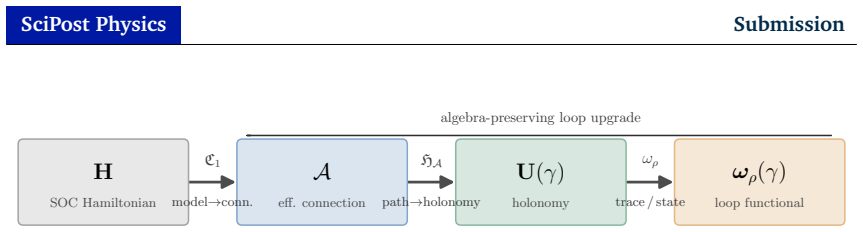
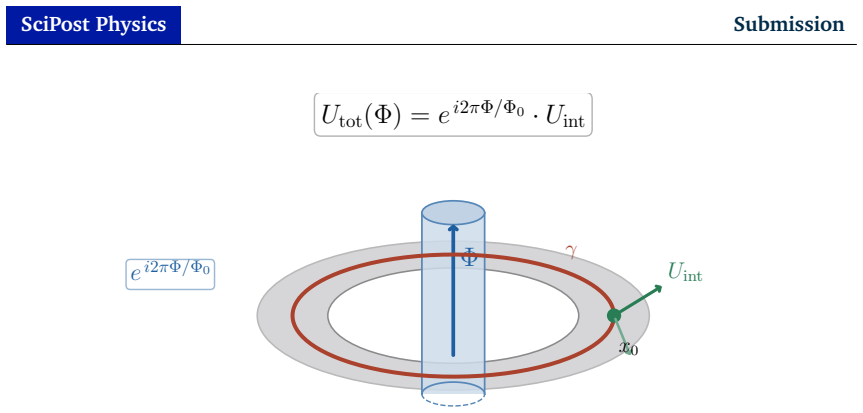
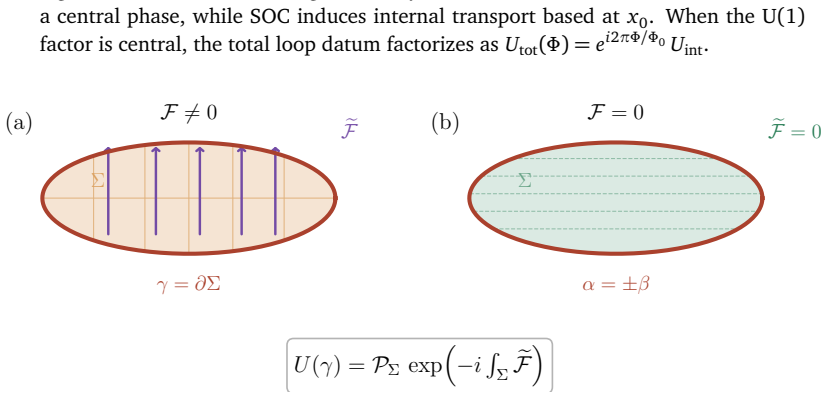
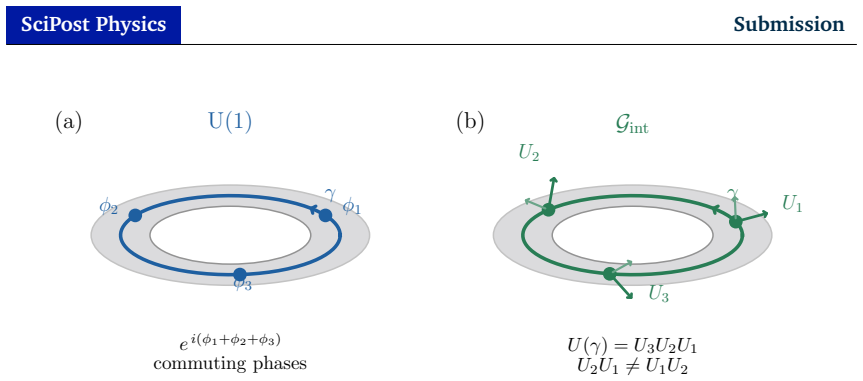
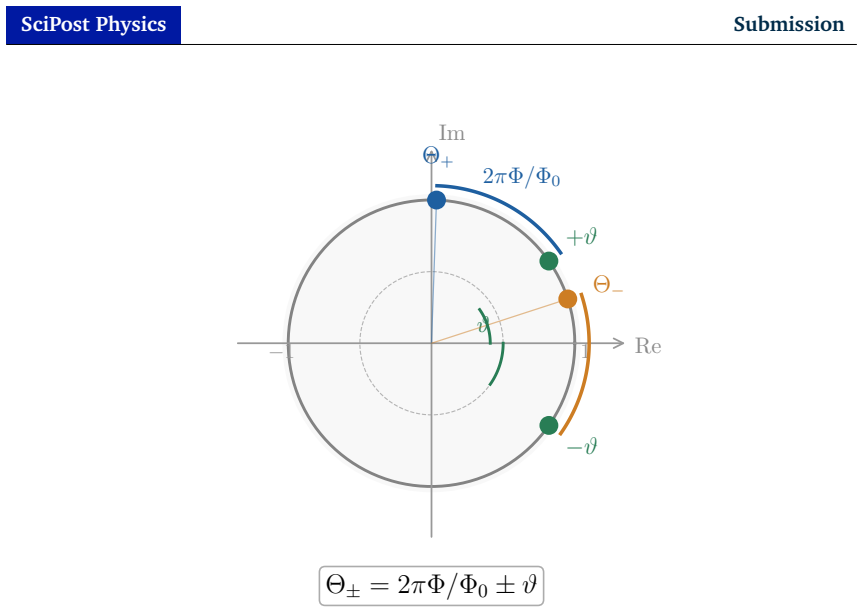
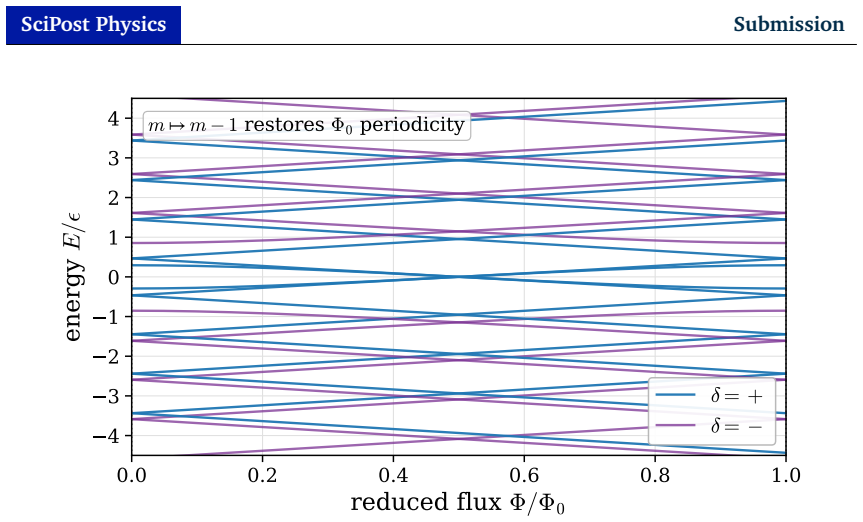
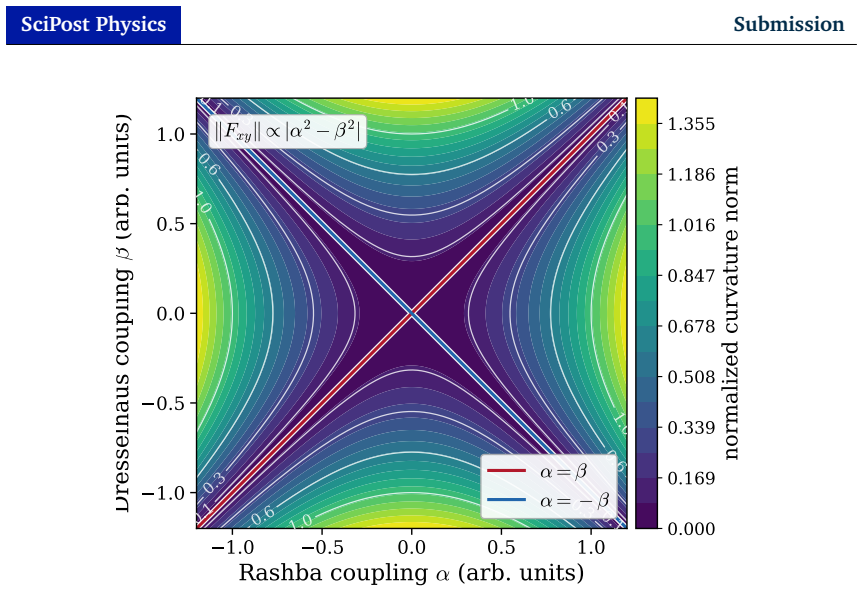
The construction maps a spin-orbit Hamiltonian to an effective U(1) plus internal non-Abelian connection, reduces it to a first-order transport problem, and reads physical predictions from holonomy, monodromy, curvature, and eigenphase data. For a Dirac ring with Rashba coupling and Aharonov-Bohm flux the total holonomy factorizes exactly into a commuting U(1) flux phase times an internal spin/pseudospin holonomy and the spectrum follows from a holonomy-eigenvalue condition. For a Rashba-Dresselhaus ring the internal SU(2) transport is genuinely non-Abelian away from the alpha equals plus or minus beta pure-gauge locus, where curvature controls path ordering, and spectral quantization requir
What carries the argument
The effective U(1) plus internal non-Abelian connection obtained by rewriting the spin-orbit Hamiltonian, which cleanly separates energy-independent Wilson holonomy from energy-dependent monodromy and reduces the dynamics to first-order transport.
If this is right
- In Dirac rings the spectrum is obtained from a holonomy-eigenvalue condition after exact factorization into U(1) and internal parts.
- In Rashba-Dresselhaus rings away from alpha equals plus or minus beta the non-Abelian internal transport requires explicit first-order reduction via phase-space doubling.
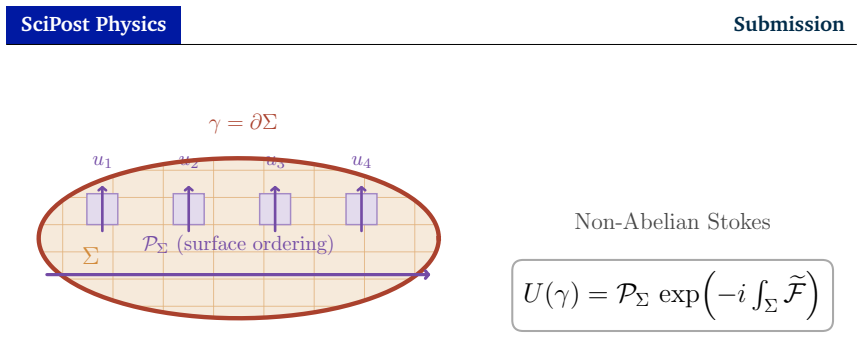
- Non-Abelian Stokes formulation and Magnus expansion serve as ordering diagnostics for path-dependent quantities.
- Physical predictions for interference, spin transport, and quantization are read directly from holonomy, monodromy, curvature, and eigenphase data.
Where Pith is reading between the lines
- The same separation of holonomy from monodromy may simplify transport calculations in other mesoscopic structures with spin-orbit coupling.
- The first-order reduction technique could be tested against existing numerical solvers for ring geometries with combined Rashba and Dresselhaus terms.
- The factorization observed in the Dirac-ring case suggests that similar commuting structures might appear in related pseudospin systems.
Load-bearing premise
The spin-orbit Hamiltonian admits an exact rewriting as an effective gauge connection such that the energy-independent Wilson holonomy and energy-dependent monodromy remain cleanly separable without additional approximations or energy mixing.
What would settle it
Compute the spectrum of a Rashba-Dresselhaus ring using the phase-space-doubled first-order reduction and check whether it matches direct numerical diagonalization of the original second-order Schrödinger equation at energies away from the pure-gauge locus.
Figures
read the original abstract
A spin-orbit Hamiltonian with an effective gauge structure carries two distinct loop objects that are routinely conflated: an energy-independent Wilson holonomy, which organizes interference and internal spin transport, and an energy-dependent monodromy, which quantizes the spectrum. We show that cleanly separating these objects supplies a precise, computable bridge between the loop/holonomy representation of gauge theories and condensed-matter spin-orbit transport. The construction maps a spin-orbit Hamiltonian to an effective $U(1)$ plus internal non-Abelian connection, reduces it to a first-order transport problem, and reads physical predictions from holonomy, monodromy, curvature, and eigenphase data. Two rings make the separation explicit. For a Dirac (graphene) ring with Rashba coupling and Aharonov-Bohm flux, the total holonomy factorizes exactly into a commuting $U(1)$ flux phase times an internal spin/pseudospin holonomy, and the spectrum follows from a holonomy-eigenvalue condition. For a Rashba-Dresselhaus ring, the internal $SU(2)$ transport is genuinely non-Abelian away from the $\alpha=\pm\beta$ pure-gauge locus, where curvature controls path ordering; spectral quantization then requires an explicit first-order reduction obtained by phase-space doubling of the second-order Schr\"odinger problem. A non-Abelian Stokes formulation and Magnus expansion serve as ordering diagnostics rather than spectral tools. Spin-network ideas enter only as historical geometric motivation, not as a dynamical import into spintronics.
Editorial analysis
A structured set of objections, weighed in public.
Referee Report
Summary. The paper claims that spin-orbit Hamiltonians with effective gauge structure admit a clean separation between an energy-independent Wilson holonomy (organizing interference and spin transport) and an energy-dependent monodromy (quantizing the spectrum). It maps the Hamiltonian to a U(1) plus internal non-Abelian connection, reduces the problem to first-order transport, and extracts predictions from holonomy, curvature, and eigenphase data. Explicit constructions are given for a Dirac ring with Rashba coupling plus Aharonov-Bohm flux (exact factorization into commuting factors) and a Rashba-Dresselhaus ring (non-Abelian SU(2) transport away from the pure-gauge locus, with spectral quantization via phase-space doubling of the second-order Schrödinger equation). Non-Abelian Stokes and Magnus expansions are used only as ordering diagnostics.
Significance. If the claimed exact factorization and first-order reduction hold without residual energy mixing, the work supplies a direct, computable dictionary between gauge-theoretic loop observables (holonomy, curvature, monodromy) and measurable quantities in mesoscopic spin-orbit systems. This could enable new analytic and numerical routes to transport predictions that bypass full diagonalization, particularly for rings where path ordering matters.
major comments (2)
- [Rashba-Dresselhaus ring] Rashba-Dresselhaus ring section: the central claim requires that phase-space doubling of the second-order Schrödinger problem produces a first-order transport operator whose parallel transport (Wilson holonomy) remains strictly energy-independent while the spectral condition stays energy-dependent. The manuscript must supply the explicit reduced operator and verify the absence of mixing terms that would couple distinct energies and invalidate the separation; without this check the factorization is not demonstrated.
- [Dirac ring] Dirac ring with Rashba + AB flux: the statement that the total holonomy factorizes exactly into a commuting U(1) flux phase times an internal spin/pseudospin holonomy is load-bearing. The derivation of this factorization (including the explicit form of the internal connection) must be shown to survive the full non-Abelian structure without additional approximations.
minor comments (2)
- The abstract is dense and would benefit from one or two explicit equations illustrating the claimed factorization before the narrative proceeds.
- Notation for the effective U(1) and internal non-Abelian connections should be introduced with a short table or diagram to aid readability for readers outside gauge-theory literature.
Simulated Author's Rebuttal
We thank the referee for the detailed and constructive report. The comments help clarify the presentation of the separation between Wilson holonomy and spectral monodromy. We address each major comment below and will revise the manuscript accordingly.
read point-by-point responses
-
Referee: [Rashba-Dresselhaus ring] Rashba-Dresselhaus ring section: the central claim requires that phase-space doubling of the second-order Schrödinger problem produces a first-order transport operator whose parallel transport (Wilson holonomy) remains strictly energy-independent while the spectral condition stays energy-dependent. The manuscript must supply the explicit reduced operator and verify the absence of mixing terms that would couple distinct energies and invalidate the separation; without this check the factorization is not demonstrated.
Authors: We agree that an explicit presentation of the reduced operator is necessary to fully demonstrate the energy independence of the holonomy. In the revised manuscript, we will derive and display the explicit first-order transport operator obtained via phase-space doubling. We will also verify the absence of mixing terms by showing that the operator preserves the energy sectors, confirming that the Wilson holonomy is energy-independent while the quantization condition remains energy-dependent. revision: yes
-
Referee: [Dirac ring] Dirac ring with Rashba + AB flux: the statement that the total holonomy factorizes exactly into a commuting U(1) flux phase times an internal spin/pseudospin holonomy is load-bearing. The derivation of this factorization (including the explicit form of the internal connection) must be shown to survive the full non-Abelian structure without additional approximations.
Authors: We will strengthen the manuscript by providing the full step-by-step derivation of the exact factorization in the Dirac ring case. This will include the explicit form of the internal non-Abelian connection and demonstrate that the factorization holds exactly due to the commuting nature of the U(1) flux and the internal holonomy, without relying on approximations, even in the presence of the full non-Abelian structure. revision: yes
Circularity Check
No circularity: structural rewriting and first-order reduction presented without reduction to fits or self-citations
full rationale
The provided abstract and description frame the central construction as an exact mapping of the spin-orbit Hamiltonian to an effective U(1) plus non-Abelian connection, followed by a first-order transport reduction via phase-space doubling. No equations are exhibited that equate a claimed prediction to a fitted parameter by construction, nor is any load-bearing premise justified solely by self-citation. The separation of energy-independent Wilson holonomy from energy-dependent monodromy is described as a structural factorization (e.g., commuting U(1) flux times internal holonomy), not a statistical or definitional identity. The phase-space doubling step is presented as an explicit reduction of the second-order Schrödinger problem rather than an ansatz smuggled in or a renaming of known results. Absent any quoted reduction that collapses the output to the input, the derivation chain remains self-contained against external benchmarks.
Axiom & Free-Parameter Ledger
axioms (2)
- domain assumption A spin-orbit Hamiltonian admits an exact mapping to an effective U(1) plus internal non-Abelian connection.
- domain assumption Wilson holonomy is strictly energy-independent while spectral monodromy is energy-dependent, allowing clean separation.
Reference graph
Works this paper leans on
-
[1]
R. Gambini, Loop representations in gauge theories and gravity, arXiv:hep-th/9403006 (1994), hep-th/9403006
Pith/arXiv arXiv 1994
-
[2]
Gambini and J
R. Gambini and J. Pullin, Loops, Knots, Gauge Theories and Quantum Gravity, Cambridge University Press, Cambridge (1996)
1996
-
[3]
M. Kalb and P. Ramond, Classical direct interstring action, Physical Review D 9, 2273 (1974), doi:10.1103/PhysRevD.9.2273
-
[4]
Gauge invariance and current algebra in non- relativistic many-body theory,
J. Fr \"o hlich and U. M. Studer, Gauge invariance and current algebra in nonrelativistic many-body theory, Reviews of Modern Physics 65, 733 (1993), doi:10.1103/RevModPhys.65.733
-
[5]
I. V. Tokatly and E. Y. Sherman, Gauge theory approach for diffusive and precessional spin dynamics in a two-dimensional electron gas, Annals of Physics 325(5), 1104 (2010), doi:10.1016/j.aop.2010.01.007, 0910.0951
work page internal anchor Pith review Pith/arXiv arXiv doi:10.1016/j.aop.2010.01.007 2010
-
[6]
N. Hatano, R. Shirasaki and H. Nakamura, Non-abelian gauge field theory of the spin--orbit interaction and a perfect spin filter, Physical Review A 75, 032107 (2007), doi:10.1103/PhysRevA.75.032107
-
[7]
P. Recher, B. Trauzettel, A. Rycerz and C. W. J. Beenakker, Aharonov--bohm effect and broken valley degeneracy in graphene rings, Physical Review B 76, 235404 (2007), doi:10.1103/PhysRevB.76.235404
-
[8]
A. Ashtekar and C. J. Isham, Representations of the holonomy algebras of gravity and non-abelian gauge theories, Classical and Quantum Gravity 9(6), 1433 (1992), doi:10.1088/0264-9381/9/6/004
-
[9]
R. Giles, Reconstruction of gauge potentials from wilson loops, Physical Review D 24, 2160 (1981), doi:10.1103/PhysRevD.24.2160
-
[10]
S. Blanes, F. Casas, J. A. Oteo and J. Ros, The magnus expansion and some of its applications, Physics Reports 470, 151 (2009), doi:10.1016/j.physrep.2008.11.001
-
[11]
Broda, Non-abelian stokes theorem in action, arXiv:math-ph/0012035 (2000), math-ph/0012035
B. Broda, Non-abelian stokes theorem in action, arXiv:math-ph/0012035 (2000), math-ph/0012035
Pith/arXiv arXiv 2000
-
[12]
R. L. Karp, F. Mansouri and J. S. Rno, Product integral formalism and non-abelian stokes theorem, Journal of Mathematical Physics 40, 6033 (1999), doi:10.1063/1.533068, hep-th/9910173
work page internal anchor Pith review Pith/arXiv arXiv doi:10.1063/1.533068 1999
-
[13]
B. Berche, N. Bol \' var, A. L \'o pez and E. Medina, Gauge transformations of spin-orbit interactions in graphene, The European Physical Journal B 88, 198 (2015), doi:10.1140/epjb/e2015-60257-4
-
[14]
H. Min, J. E. Hill, N. A. Sinitsyn, B. R. Sahu, L. Kleinman and A. H. MacDonald, Intrinsic and rashba spin-orbit interactions in graphene sheets, Physical Review B 74, 165310 (2006), doi:10.1103/PhysRevB.74.165310
-
[15]
Modeling space plasma dynamics with anisotropic Kappa distributions
J. Schelter, P. Recher and B. Trauzettel, The aharonov--bohm effect in graphene rings, Solid State Communications 152(15), 1411 (2012), doi:10.1016/j.ssc.2012.04.039, 1204.0363
work page internal anchor Pith review Pith/arXiv arXiv doi:10.1016/j.ssc.2012.04.039 2012
-
[16]
M. V. Berry and R. J. Mondragon, Neutrino billiards: time-reversal symmetry-breaking without magnetic fields, Proceedings of the Royal Society of London. Series A 412, 53 (1987), doi:10.1098/rspa.1987.0080
-
[17]
M. Wurm, A. Rycerz, K. Richter and \.I . Adagideli, Aharonov--bohm effect in graphene rings, Semiconductor Science and Technology 25, 034003 (2010), doi:10.1088/0268-1242/25/3/034003, 0904.3182
work page internal anchor Pith review Pith/arXiv arXiv doi:10.1088/0268-1242/25/3/034003 2010
-
[18]
Wilson loop and magnetic monopole through a non-Abelian Stokes theorem
K.-I. Kondo, Non-abelian stokes theorem and quark confinement in yang--mills gauge theory, Physical Review D 77, 085029 (2008), doi:10.1103/PhysRevD.77.085029, 0801.1274
work page internal anchor Pith review Pith/arXiv arXiv doi:10.1103/physrevd.77.085029 2008
-
[19]
M. Hirayama and M. Ueno, Non-abelian stokes theorem for wilson loops associated with general gauge groups, Progress of Theoretical Physics 103(1), 151 (2000), doi:10.1143/PTP.103.151
-
[20]
A. Iserles, H. Z. Munthe-Kaas, S. P. N rsett and A. Zanna, Lie-group methods, Acta Numerica 9, 215 (2000), doi:10.1017/S0962492900002154
-
[21]
B. A. Bernevig, J. Orenstein and S. C. Zhang, Exact su(2) symmetry and persistent spin helix in a spin-orbit coupled system, Phys. Rev. Lett. 97, 236601 (2006), doi:10.1103/PhysRevLett.97.236601
-
[22]
J. D. Koralek, C. P. Weber, J. Orenstein, B. A. Bernevig, S. C. Zhang, S. Mack and D. D. Awschalom, Emergence of the persistent spin helix in semiconductor quantum wells, Nature 458, 610 (2009), doi:10.1038/nature07871
discussion (0)
Sign in with ORCID, Apple, or X to comment. Anyone can read and Pith papers without signing in.