REVIEW 4 major objections 5 minor 85 references
Implication of preheating on gravity assisted baryogenesis in $R^2$-Higgs inflation
T0 review · 4 major / 5 minor · reviewed 2026-08-12 · deepseek-v4-flash
Pith's one-line read This paper establishes that preheating, driven mostly by Goldstone bosons, determines the reheating temperature and thereby pins the baryogenesis operator scale $\Lambda$ to a narrow window around $2.2 \times 10^{-5}\, M_{\rm P}$ for…
desk verdict A real step forward that turns the reheating temperature from a free parameter into a specific Λ window for gravity-assisted baryogenesis, but the quoted precision outruns the linear-order, backreaction-free preheating calculation. read the letter →
The pith
A machine-rendered reading of the paper's core claim, the machinery that carries it, and where it could break.
The reading
What carries the argument
The load-bearing object is the five-field scalar-tensor system obtained from the $R^2 + \xi_H |\Phi|^2 R + (R/\Lambda^2) B \tilde{F}$ action after Weyl rescaling, with field-space metric $G_{IJ} = \mathrm{diag}(1, e^{-\sqrt{2/3}\,\varphi/M_{\rm P}}, \ldots)$. The argument runs on the linearized mode equations for the Mukhanov-Sasaki variables $X^I$, the transverse $Z/W$/photon modes with effective frequencies $\omega^2 = k^2 + a^2 m^2 + \zeta^\lambda(\tau,k)$, and the Goldstone equations that acquire friction terms $E_{(I)}(\tau,k)$ and spike-like frequency enhancements at Higgs zero-crossings. These spikes drive exponential Goldstone production and set the preheating completion time; the completion density gives $T_{\rm rh}$ through $\rho_{\rm rh} = g_{\rm rh} \pi^2 T_{\rm rh}^4/30$, which then fixes the hypermagnetic helicity entering the baryon asymmetry formula. The baryogenesis side uses the anomaly relation between baryon number, hypermagnetic helicity and sphaleron washout, with constraints $R_m > 1$ and $T_{\rm CPI} < 10^5$ GeV bounding the viable $\Lambda$.
What would settle it
A fully nonlinear lattice simulation of preheating in $R^2$-Higgs inflation with $\xi_H = 1$ and $10$, tracking Higgs, Goldstone, $Z$, $W$, and photon fields together with rescattering, would directly test the completion times $N_{\rm rh} \approx 3.05$ and $1.83$ and the resulting $T_{\rm rh}$ values of $5 \times 10^{14}$ and $6 \times 10^{14}$ GeV; a materially different $T_{\rm rh}$ would move the required $\Lambda$ out of the quoted windows. A second check is whether the Goldstone friction spikes survive once backreaction on the Higgs condensate $h_0$ is included.
Extended reading notes
Core claim
The central claim is that the dimension-six gravity-assisted baryogenesis operator $(R/\Lambda^2) B_{\mu\nu}\tilde{B}^{\mu\nu}$ in $R^2$-Higgs inflation must have its cutoff $\Lambda$ in a specific narrow window, because the preheating stage fixes the reheating temperature: $\Lambda \sim 2.2 \times 10^{-5}\, M_{\rm P}$ for $\xi_H \approx 1$ and $\sim 2.6 \times 10^{-5}\, M_{\rm P}$ for $\xi_H \approx 10$, with the full baryogenesis-viable ranges $2.07 \times 10^{-5}\, M_{\rm P} \lesssim \Lambda \lesssim 2.30 \times 10^{-5}\, M_{\rm P}$ and $2.52 \times 10^{-5}\, M_{\rm P} \lesssim \Lambda \lesssim 2.76 \times 10^{-5}\, M_{\rm P}$. Preheating is dominated by Goldstone bosons, which reheat faster than the Higgs, transverse gauge bosons or inflaton quanta; for $\xi_H \approx 10$ the $Z$ and Higgs sectors also contribute, while for very small $\xi_H$ preheating does not occur unless $\Lambda$ is small enough to overproduce the asymmetry. The reheating temperature enters the baryogenesis calculation both through the hypermagnetic helicity at the start of the electroweak crossover and through the magnetic Reynolds number and chiral-plasma-instability constraints that must be satisfied for the helicity to survive.
Load-bearing premise
The quoted reheating temperatures and completion times come from a linear-order calculation that ignores backreaction and treats preheating as complete when the produced energy density equals the background density; if nonlinear effects deplete or delay the produced fields, the reheating temperature and hence the $\Lambda$ window shift.
Editorial extensions
If this is right
- For $\xi_H \approx 1$, successful baryogenesis in this model requires $\Lambda$ between $2.07$ and $2.30 \times 10^{-5}\, M_{\rm P}$, and for $\xi_H \approx 10$ between $2.52$ and $2.76 \times 10^{-5}\, M_{\rm P}$.
- Larger $\xi_H$ leads to earlier preheating, a higher reheating temperature, and therefore a larger $\Lambda$ to match the observed $\eta_B = 8.7 \times 10^{-11}$.
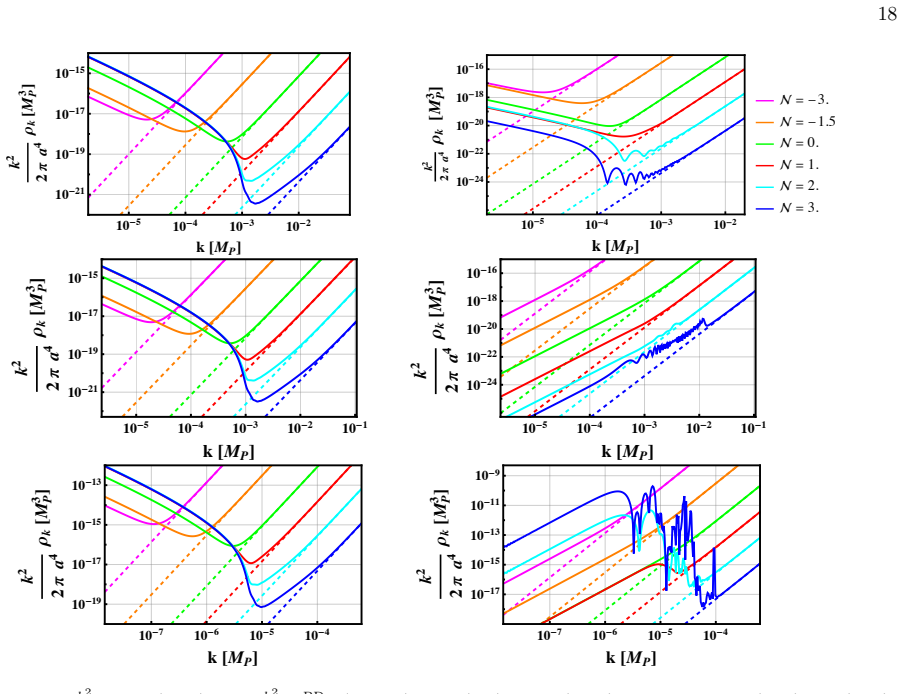
- Goldstone bosons, not the inflaton or the Higgs, are the fastest preheating channel in the mixed $R^2$-Higgs regime, and they set the reheating temperature in both benchmark points.
- In the deep $R^2$-like regime ($\xi_H \sim 10^{-3}$), no efficient preheating occurs unless $\Lambda$ is small, but such small values overproduce the baryon asymmetry, so that regime is disfavored for this mechanism.
- The predicted $\Lambda$ is of order $10^{-5}\, M_{\rm P}$, indicating a high-scale CP-violation source and no need for new degrees of freedom beyond the Standard Model in this baryogenesis channel.
Reading between the lines
- A fully nonlinear lattice treatment including backreaction and rescattering would test whether the Goldstone-driven completion times $N_{\rm rh} \approx 3.05$ and $1.83$ are stable; if the true completion occurs later or earlier, the quoted $\Lambda$ windows would shift correspondingly.
- The same doubly-covariant machinery could be applied to baryogenesis operators built from $W \tilde{W}$ or to other $f(R,\Phi)$ regimes, producing a $\Lambda$-versus-$\xi_H$ exclusion plane that collider and cosmological probes could in principle confront.
- Because the hypermagnetic helicity must survive until the electroweak crossover, the model implies a helical hypermagnetic field at $T \sim 135$ GeV whose magnitude is tied to $\Lambda$; future primordial-magnetic-field or cosmic-microwave-background bounds could provide an independent test of this window.
Editorial analysis
A structured set of objections, weighed in public.
Referee Report
Summary. This paper studies preheating in R^2-Higgs inflation using a doubly-covariant linear perturbation formalism that includes the inflaton, the Higgs, the three Goldstone bosons, and the full SU(2)_L x U(1)_Y gauge sector in Coulomb gauge. For three benchmark points (BP a, b, c) it computes the energy densities produced in each sector, identifies which fields can preheat the Universe, and reads off the reheating time, scale factor, energy density, and temperature at the moment rho_q = rho_inf. These quantities are then fed into the gravity-assisted baryogenesis formula, Eq. (8.8), to derive the allowed window for the dimension-six operator scale Lambda: Lambda ~ 2.07-2.30 x 10^-5 M_P for xi_H=1 and Lambda ~ 2.52-2.76 x 10^-5 M_P for xi_H=10. The central quantitative claim is that preheating dynamics fixes the scale Lambda needed to reproduce the observed baryon asymmetry.
Significance. If the central claim holds, the paper makes a useful step by connecting the preheating epoch in R^2-Higgs inflation to the scale of a dimension-six CP-violating operator, converting a previously free parameter into a constrained numerical range. The formal derivation is a strength: the equations of motion for background and perturbations, the quantization with Bunch-Davies vacuum subtraction, and the treatment of Goldstone bosons in a gauge where the unitary-gauge pathology at Higgs zero-crossings is avoided are all presented explicitly. The finding that Goldstone bosons preheat faster than Higgs or gauge sectors for xi_H ~ 1-10 is also a concrete, checkable result. The numerical Lambda window, however, is not yet robust because it rests on a completion criterion at the boundary of validity of the linear approximation and on an ad hoc decay treatment for only some of the produced species. If these uncertainties are quantified, the paper would be a significant advance for gravity-assisted baryogenesis models.
major comments (4)
- [Sec. 4, Table II, Eq. (8.8)] The preheating completion time used in Table II is defined by rho_q = rho_inf, a point at which the paper itself states that linear theory is not reliable: Sec. 4 notes that 'the linear analysis is not reliable when rho_q approaches rho_inf' and that the continued growth beyond N ~ 3 'should be shut off once decay, backreaction and rescattering are taken into account.' Since N_rh, a_rh, rho_rh, and T_rh for BP b and BP c are read exactly at this point and enter Eq. (8.8) through (T_rh a_rh)^3 as well as the Reynolds and CPI constraints in Eqs. (8.13) and (8.18), an error in the completion time directly rescales the entropy denominator and moves the quoted Lambda window. The claim that the results are 'not significantly impacted' by the choice of completion convention needs a quantitative comparison, for example evaluating T_rh and a_rh at rho_q = 0.1 rho_inf as in Ref. [53], rather than a heuristic statement.
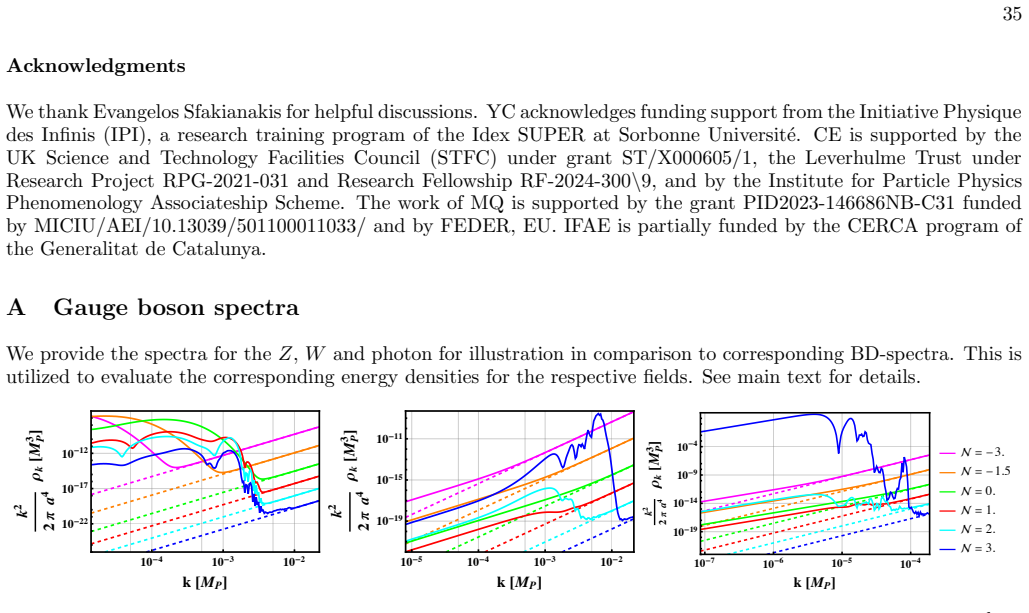
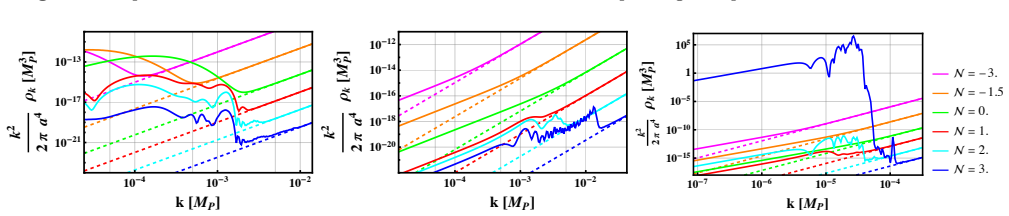
- [Sec. 7, Eq. (7.3), Table II] The decay correction exp(-integral Gamma) in Eq. (7.3) is applied only to the Z and W boson energy densities (Fig. 10), but the fields that actually set preheating completion in Table II are Goldstone bosons: phi3 and phi4 for BP b and phi2 for BP c. The paper's argument that Goldstone decays into gauge bosons are kinematically disallowed and that decays into fermions proceed too slowly is qualitative and not quantified with integrated depletion factors or a comparison to the Hubble rate. Because the reheating temperature is determined by these Goldstone fields, the omission of an analogous decay factor is a load-bearing gap in the derivation of the Lambda window.
- [Sec. 8, Eqs. (8.8), (8.10), (8.19)] The quoted Lambda range is obtained by solving Eq. (8.8) for Lambda such that eta_B equals the measured value; it is therefore a fitted range rather than an independent prediction. This is acceptable as a constraint, but the paper should state this explicitly and propagate the uncertainties of f_theta_W (Eq. (8.10)), T_step, and Delta_T (Eq. (8.5)) into the final range. As written, Eq. (8.19) quotes two significant digits while f_theta_W spans two orders of magnitude, and no error budget is given for the many input parameters that enter Eq. (8.8).
- [Sec. 7, Eq. (7.6)] The identification of rho_inf(arh) with the thermal bath energy density in Eq. (7.6) assumes instantaneous and complete thermalization of the produced Goldstone and gauge energy densities. No thermalization rate or efficiency factor is estimated, and the paper defers the perturbative reheating calculation to future work. Since T_rh is the central input to the baryogenesis computation, this assumption should be either justified with a quantitative estimate or explicitly included as a source of uncertainty in the Lambda window.
minor comments (5)
- [Sec. 7, Table II] The values in Table II are labeled approximate; it would help to state which figures are rounded and how a_rh is derived from N_rh for each benchmark point.
- [Sec. 4, Fig. 3] The text says 'For BP a and BP b, both rho_q(phi) and rho_q(h) are much smaller than rho_inf', but the corresponding panel does not show rho_inf; adding the background line to all panels or stating its value in the caption would improve readability.
- [Sec. 8, Eq. (8.8)] The notation HY is used for the hypermagnetic helicity at arh, while H(t) denotes the Hubble rate; this is not confusing in context but the two should be distinguished in symbols or by a sentence.
- [Fig. 13] The caption contains the typo 'see text tor detail' and should read 'see text for details'.
- [Secs. 3.1.2, 5.1] The notation for W boson mode functions is inconsistent: Eq. (5.6b) uses w^lambda_k while the text sometimes writes fW; unifying the notation would avoid confusion.
Circularity Check
No significant circularity: the quoted Lambda window is obtained by matching the observed baryon asymmetry, and the preheating inputs are computed independently of that target.
full rationale
The paper's central numbers come from two separate calculations. Table II (Nrh, arh, rhorho, Trh) is obtained by solving the linearized mode equations of Secs. 4-5 for the three benchmark points; the equations contain no input from the observed baryon asymmetry. The baryogenesis step (Sec. 8) then uses the transport formula of Eq. (8.8), taken from independent prior work, and scans Lambda so that the resulting eta_B matches the CMB value (8.2). Solving for a free model parameter (Lambda) from an observable is standard parameter determination rather than a derivation that reduces to its own input; the paper does not claim to predict eta_B without using it as input. The Lambda-dependence enters the helical hypermagnetic field production in Sec. 6, which is computed from first-order mode equations, so the fit is not inserted by definition elsewhere. Self-citations to Ref. [1] supply benchmark points and context, but the load-bearing reheating and baryogenesis calculations are performed in this paper with the cited external transport machinery. The admitted limitations - linear theory breaking down near completion, the ad hoc decay factor (7.3), and qualitative treatment of the Schwinger effect - are accuracy and systematic-error concerns, not circular steps. No equation was found in which a predicted quantity is identical by construction to a fitted input or to a self-citation.
Assumptions & free parameters
free parameters (6)
- xi_R =
BP a: 2.35e9, BP b: 2.55e9, BP c: 2.2e9
- xi_H =
BP a: 1e-3, BP b: 1, BP c: 10
- Initial field values phi(t_in), h0(t_in) =
BP a: 5.5 M_P, 2e-4 M_P; BP b: 5.5 M_P, 8.94e-4 M_P; BP c: 5.4 M_P, 5.00e-3 M_P
- Lambda =
2.07e-5 to 2.76e-5 M_P
- f_theta_W =
5.6e-4 to 0.32
- T_step and Delta_T =
T_step in 155-160 GeV, Delta_T in 5-20 GeV
assumptions (5)
- domain assumption The dimension-six operator (R/Lambda^2) B F-tilde is the sole CP-violating source driving helical hypermagnetic fields and the baryon asymmetry.
- ad hoc to paper Linear perturbation theory remains reliable up to the preheating completion time defined by rho_q = rho_inf.
- domain assumption The Kamada-Long baryogenesis transport equations and the lattice-based sphaleron rate apply to this model without modification.
- domain assumption The electroweak weak mixing angle evolution is accurately described by the smooth tanh step function in Eq. (8.5).
- domain assumption Fermion backreaction and the Schwinger effect can be neglected for the benchmark points used for baryogenesis.
Cite this review
Pith. "Pith review of Implication of preheating on gravity assisted baryogenesis in $R^2$-Higgs inflation." pith.science (2026). https://pith.science/paper/II5HXHIF
@misc{pith2026241111128,
  author       = {Pith},
  title        = {Pith review of: Implication of preheating on gravity assisted baryogenesis in $R^2$-Higgs inflation},
  year         = {2026},
  howpublished = {\url{https://pith.science/paper/II5HXHIF}},
  note         = {Machine review of arXiv:2411.11128}
}
abstract
We investigate the impact of preheating on baryogenesis in $R^2$-Higgs inflation. In this scenario, the inclusion of a dimension-six operator ${(R/ \Lambda^2)} B_{\mu\nu} \widetilde{B}^{\mu\nu} $ abundantly generates helical hypermagnetic fields during inflation, leading to a baryon asymmetric Universe at the electroweak crossover. Focusing on the $R^2$-like regime, we first derive the relevant dynamics of preheating using a doubly-covariant formalism. We find that preheating can happen for the Higgs, transverse gauge and Goldstone bosons, however, it is dependent on the value of the non-minimal coupling $\xi_H$ between the Standard Model Higgs field and the Ricci scalar. We identify the preheating temperature to determine the appropriate scale $\Lambda$ for driving baryogenesis, which is around $\Lambda \sim 2.2 \, (2.6) \times 10^{-5}\, M_{\rm P}$ for $\xi_H \sim 1 \, (10)$. Our results represent the most accurate estimation of the scale of gravity induced baryogenesis in $R^2$-Higgs inflation to date. Areas for further improvement are identified.
Figures


Figures from the paper (13 more)



Reference graph
Works this paper leans on
-
[53]
M. P. DeCross, D. I. Kaiser, A. Prabhu, C. Prescod-Weinstein, and E. I. Sfakianakis, Phys. Rev. D 97, 023526 (2018), arXiv:1510.08553 [astro-ph.CO]
arXiv 2018
-
[1]
(3.32) can then be brought to the form ï eZ′′ + a2KZ eZ ò + ik ß eZ ′ 0 + a2 e− √ 2 3 φ MP gZ 2 h0 eϕ2 ™ + 8iM 2 P ξRΛ2 ∂τ Å F (φI )e √ 2 3 φ MP ã Ä k × eZ ä = 0
(3.33) The three-components of Eq. (3.32) can then be brought to the form ï eZ′′ + a2KZ eZ ò + ik ß eZ ′ 0 + a2 e− √ 2 3 φ MP gZ 2 h0 eϕ2 ™ + 8iM 2 P ξRΛ2 ∂τ Å F (φI )e √ 2 3 φ MP ã Ä k × eZ ä = 0. (3.34) This is a system of three differential equations. A linear combination of them is obtained by multiplying both sides of Eq. (3.34) by ik and utilizing E...
-
[2]
completion
(3.47) Likewise, the three components of Eqs. (3.46) read as ï fW±′′ + a2KW fW± ò + ik ß fW ±′ 0 ± a2 e− √ 2 3 φ MP ie 2 √ 2sW h0( eϕ3 ± i eϕ4) ™ + 8iM 2 P ξRΛ2 ∂τ Å F (φI )e √ 2 3 φ MP ã Ä k × fW± ä = 0. (3.48) Applying the same procedure as for the Z boson, and using Eq. (3.48), we find fW ±′ 0 = ∓ a2 e− √ 2 3 φ MP ie 2 √ 2sW h0( eϕ3 ± i eϕ4). (3.49) Co...
2018
-
[3]
Y. Cado, C. Englert, T. Modak, and M. Quir´ os, Phys. Rev. D 109, 043026 (2024), arXiv:2312.10414 [astro-ph.CO]
arXiv 2024
-
[4]
M. E. Shaposhnikov, Nucl. Phys. B 287, 757 (1987)
1987
-
[5]
K. Kamada and A. J. Long, Phys. Rev. D 94, 063501 (2016), arXiv:1606.08891 [astro-ph.CO]
arXiv 2016
-
[6]
Magnetogenesis in Higgs-Starobinsky inflation
R. Durrer, O. Sobol, and S. Vilchinskii, Phys. Rev. D 106, 123520 (2022), arXiv:2207.05030 [gr-qc]
work page Pith review arXiv 2022
- [7]
Show all 85 references
-
[8]
Savchenko and Y
O. Savchenko and Y. Shtanov, JCAP 10, 040 (2018), arXiv:1808.06193 [astro-ph.CO]
2018 arXiv
-
[9]
Subramanian, Rept
K. Subramanian, Rept. Prog. Phys. 79, 076901 (2016), arXiv:1504.02311 [astro-ph.CO]. 36
2016 arXiv
-
[10]
Durrer and A
R. Durrer and A. Neronov, Astron. Astrophys. Rev. 21, 62 (2013), arXiv:1303.7121 [astro-ph.CO]
2013 arXiv
-
[11]
M. M. Anber and L. Sorbo, JCAP 10, 018 (2006), arXiv:astro-ph/0606534
2006 arXiv
- [12]
-
[13]
Bamba, C
K. Bamba, C. Q. Geng, and S. H. Ho, Phys. Lett. B 664, 154 (2008), arXiv:0712.1523 [hep-ph]
2008 arXiv
-
[14]
M. M. Anber and L. Sorbo, Phys. Rev. D 81, 043534 (2010), arXiv:0908.4089 [hep-th]
2010 arXiv
-
[15]
M. M. Anber and E. Sabancilar, Phys. Rev. D 92, 101501 (2015), arXiv:1507.00744 [hep-th]
2015 arXiv
- [16]
-
[17]
Kamada and A
K. Kamada and A. J. Long, Phys. Rev. D 94, 123509 (2016), arXiv:1610.03074 [hep-ph]
2016 arXiv
-
[18]
Jim´ enez, K
D. Jim´ enez, K. Kamada, K. Schmitz, and X.-J. Xu, JCAP 12, 011 (2017), arXiv:1707.07943 [hep-ph]
2017 arXiv
-
[19]
Domcke, B
V. Domcke, B. von Harling, E. Morgante, and K. Mukaida, JCAP 10, 032 (2019), arXiv:1905.13318 [hep-ph]
2019 arXiv
-
[20]
Y. Cado, B. von Harling, E. Mass´ o, and M. Quir´ os, JCAP07, 049 (2021), arXiv:2102.13650 [hep-ph]
2021 arXiv
-
[21]
Cado and M
Y. Cado and M. Quir´ os, Phys. Rev. D106, 055018 (2022), arXiv:2201.06422 [hep-ph]
2022 arXiv
-
[22]
Cado and M
Y. Cado and M. Quir´ os, Phys. Rev. D106, 123527 (2022), arXiv:2208.10977 [hep-ph]
2022 arXiv
-
[23]
Salvio and A
A. Salvio and A. Mazumdar, Phys. Lett. B 750, 194 (2015), arXiv:1506.07520 [hep-ph]
2015 arXiv
- [24]
-
[25]
Pi, Y.-l
S. Pi, Y.-l. Zhang, Q.-G. Huang, and M. Sasaki, JCAP 05, 042 (2018), arXiv:1712.09896 [astro-ph.CO]
2018 arXiv
-
[26]
Gorbunov and A
D. Gorbunov and A. Tokareva, Phys. Lett. B 788, 37 (2019), arXiv:1807.02392 [hep-ph]
2019 arXiv
-
[27]
Gundhi and C
A. Gundhi and C. F. Steinwachs, Nucl. Phys. B 954, 114989 (2020), arXiv:1810.10546 [hep-th]
2020 arXiv
-
[28]
M. He, R. Jinno, K. Kamada, S. C. Park, A. A. Starobinsky, and J. Yokoyama, Phys. Lett. B 791, 36 (2019), arXiv:1812.10099 [hep-ph]
2019 arXiv
-
[29]
D. Y. Cheong, S. M. Lee, and S. C. Park, JCAP 01, 032 (2021), arXiv:1912.12032 [hep-ph]
2021 arXiv
-
[30]
M. He, R. Jinno, K. Kamada, A. A. Starobinsky, and J. Yokoyama, JCAP 01, 066 (2021), arXiv:2007.10369 [hep-ph]
2021 arXiv
-
[31]
He, JCAP 05, 021 (2021), arXiv:2010.11717 [hep-ph]
M. He, JCAP 05, 021 (2021), arXiv:2010.11717 [hep-ph]
2021 arXiv
-
[32]
A. A. Starobinsky, Phys. Lett. B 91, 99 (1980)
1980
-
[33]
A. A. Starobinsky, Sov. Astron. Lett. 9, 302 (1983)
1983
-
[34]
Vilenkin, Phys
A. Vilenkin, Phys. Rev. D 32, 2511 (1985)
1985
-
[35]
M. B. Mijic, M. S. Morris, and W.-M. Suen, Phys. Rev. D 34, 2934 (1986)
1986
-
[36]
Maeda, Phys
K.-i. Maeda, Phys. Rev. D 37, 858 (1988)
1988
-
[37]
F. L. Bezrukov and M. Shaposhnikov, Phys. Lett. B 659, 703 (2008), arXiv:0710.3755 [hep-th]
2008 arXiv
-
[38]
A. O. Barvinsky, A. Y. Kamenshchik, and A. A. Starobinsky, JCAP 11, 021 (2008), arXiv:0809.2104 [hep-ph]
2008 arXiv
-
[39]
Bezrukov, A
F. Bezrukov, A. Magnin, M. Shaposhnikov, and S. Sibiryakov, JHEP 01, 016 (2011), arXiv:1008.5157 [hep-ph]
2011 arXiv
-
[40]
Bezrukov, Class
F. Bezrukov, Class. Quant. Grav. 30, 214001 (2013), arXiv:1307.0708 [hep-ph]
2013 arXiv
-
[41]
De Simone, M
A. De Simone, M. P. Hertzberg, and F. Wilczek, Phys. Lett. B 678, 1 (2009), arXiv:0812.4946 [hep-ph]
2009 arXiv
-
[42]
F. L. Bezrukov, A. Magnin, and M. Shaposhnikov, Phys. Lett. B 675, 88 (2009), arXiv:0812.4950 [hep-ph]
2009 arXiv
-
[43]
A. O. Barvinsky, A. Y. Kamenshchik, C. Kiefer, A. A. Starobinsky, and C. F. Steinwachs, Eur. Phys. J. C 72, 2219 (2012), arXiv:0910.1041 [hep-ph]
2012 arXiv
-
[44]
B. L. Spokoiny, Phys. Lett. B 147, 39 (1984)
1984
-
[45]
Futamase and K.-i
T. Futamase and K.-i. Maeda, Phys. Rev. D 39, 399 (1989)
1989
-
[46]
D. S. Salopek, J. R. Bond, and J. M. Bardeen, Phys. Rev. D 40, 1753 (1989)
1989
-
[47]
Fakir and W
R. Fakir and W. G. Unruh, Phys. Rev. D 41, 1783 (1990)
1990
-
[48]
Amendola, M
L. Amendola, M. Litterio, and F. Occhionero, Int. J. Mod. Phys. A 5, 3861 (1990)
1990
-
[49]
D. I. Kaiser, Phys. Rev. D 52, 4295 (1995), arXiv:astro-ph/9408044
1995 arXiv
-
[50]
J. L. Cervantes-Cota and H. Dehnen, Nucl. Phys. B 442, 391 (1995), arXiv:astro-ph/9505069
1995 arXiv
-
[51]
Komatsu and T
E. Komatsu and T. Futamase, Phys. Rev. D 59, 064029 (1999), arXiv:astro-ph/9901127
1999 arXiv
-
[52]
Akrami et al
Y. Akrami et al. (Planck), Astron. Astrophys. 641, A10 (2020), arXiv:1807.06211 [astro-ph.CO]
2020 arXiv
-
[54]
Y. Ema, R. Jinno, K. Mukaida, and K. Nakayama, JCAP 02, 045 (2017), arXiv:1609.05209 [hep-ph]
2017 arXiv
-
[55]
E. I. Sfakianakis and J. van de Vis, Phys. Rev. D 99, 083519 (2019), arXiv:1810.01304 [hep-ph]
2019 arXiv
-
[56]
Bezrukov, D
F. Bezrukov, D. Gorbunov, C. Shepherd, and A. Tokareva, Phys. Lett. B 795, 657 (2019), arXiv:1904.04737 [hep-ph]
2019 arXiv
-
[57]
Garcia-Bellido, D
J. Garcia-Bellido, D. G. Figueroa, and J. Rubio, Phys. Rev. D 79, 063531 (2009), arXiv:0812.4624 [hep-ph]
2009 arXiv
-
[58]
Bezrukov and C
F. Bezrukov and C. Shepherd, JCAP 12, 028 (2020), arXiv:2007.10978 [hep-ph]
2020 arXiv
-
[59]
D. G. Figueroa, A. Florio, T. Opferkuch, and B. A. Stefanek, SciPost Phys. 15, 077 (2023), arXiv:2112.08388 [astro-ph.CO]
2023 arXiv
-
[60]
Jeong, K
H. Jeong, K. Kamada, A. A. Starobinsky, and J. Yokoyama, JCAP 11, 023 (2023), arXiv:2305.14273 [hep-ph]
2023 arXiv
-
[61]
Gong and T
J.-O. Gong and T. Tanaka, JCAP 03, 015 (2011), [Erratum: JCAP 02, E01 (2012)], arXiv:1101.4809 [astro-ph.CO]
2011 arXiv
-
[62]
D. I. Kaiser, E. A. Mazenc, and E. I. Sfakianakis, Phys. Rev. D 87, 064004 (2013), arXiv:1210.7487 [astro-ph.CO]
2013 arXiv
-
[63]
Kodama and M
H. Kodama and M. Sasaki, Prog. Theor. Phys. Suppl. 78, 1 (1984)
1984
-
[64]
V. F. Mukhanov, H. A. Feldman, and R. H. Brandenberger, Phys. Rept. 215, 203 (1992)
1992
-
[65]
K. A. Malik and D. Wands, Phys. Rept. 475, 1 (2009), arXiv:0809.4944 [astro-ph]
2009 arXiv
-
[66]
Elliston, D
J. Elliston, D. Seery, and R. Tavakol, JCAP 11, 060 (2012), arXiv:1208.6011 [astro-ph.CO]
2012 arXiv
-
[67]
Sasaki, Prog
M. Sasaki, Prog. Theor. Phys. 76, 1036 (1986)
1986
-
[68]
V. F. Mukhanov, Sov. Phys. JETP 67, 1297 (1988)
1988
-
[69]
M. A. Amin, M. P. Hertzberg, D. I. Kaiser, and J. Karouby, Int. J. Mod. Phys. D 24, 1530003 (2014), arXiv:1410.3808 [hep-ph]. 37
2014 arXiv
-
[70]
M. P. DeCross, D. I. Kaiser, A. Prabhu, C. Prescod-Weinstein, and E. I. Sfakianakis, Phys. Rev. D 97, 023528 (2018), arXiv:1610.08916 [astro-ph.CO]
2018 arXiv
-
[71]
G. N. Felder, L. Kofman, and A. D. Linde, Phys. Rev. D 64, 123517 (2001), arXiv:hep-th/0106179
2001 arXiv
-
[72]
K. D. Lozanov and M. A. Amin, JCAP 06, 032 (2016), arXiv:1603.05663 [hep-ph]
2016 arXiv
-
[73]
Bezrukov, D
F. Bezrukov, D. Gorbunov, and M. Shaposhnikov, JCAP 06, 029 (2009), arXiv:0812.3622 [hep-ph]
2009 arXiv
- [74]
-
[75]
Aghanim et al
N. Aghanim et al. (Planck), Astron. Astrophys. 641, A6 (2020), [Erratum: Astron.Astrophys. 652, C4 (2021)], arXiv:1807.06209 [astro-ph.CO]
2020 arXiv
-
[76]
R. L. Workman et al. (Particle Data Group), PTEP 2022, 083C01 (2022)
2022
-
[77]
A. D. Sakharov, Pisma Zh. Eksp. Teor. Fiz. 5, 32 (1967)
1967
-
[78]
Kajantie, M
K. Kajantie, M. Laine, K. Rummukainen, and M. E. Shaposhnikov, Nucl. Phys. B 493, 413 (1997), arXiv:hep-lat/9612006
1997 arXiv
-
[79]
D’Onofrio and K
M. D’Onofrio and K. Rummukainen, Phys. Rev. D 93, 025003 (2016), arXiv:1508.07161 [hep-ph]
2016 arXiv
-
[80]
Y. D. Cado, Baryogenesis and Inflation from the Higgs sector, Ph.D. thesis, Barcelona, Autonoma U. (2023)
2023
-
[81]
D’Onofrio, K
M. D’Onofrio, K. Rummukainen, and A. Tranberg, Phys. Rev. Lett. 113, 141602 (2014), arXiv:1404.3565 [hep-ph]
2014 arXiv
-
[82]
Baym and H
G. Baym and H. Heiselberg, Phys. Rev. D 56, 5254 (1997), arXiv:astro-ph/9704214
1997 arXiv
-
[83]
P. B. Arnold, G. D. Moore, and L. G. Yaffe, JHEP 11, 001 (2000), arXiv:hep-ph/0010177
2000 arXiv
-
[84]
Joyce and M
M. Joyce and M. E. Shaposhnikov, Phys. Rev. Lett. 79, 1193 (1997), arXiv:astro-ph/9703005
1997 arXiv
-
[85]
Cado and M
Y. Cado and M. Quir´ os, Phys. Rev. D108, 023508 (2023), arXiv:2303.12932 [hep-ph]
2023 arXiv
Reviewed August 12, 2026 · model on record in the stance chip above.
Discussion (0). Continue with ORCID to comment.