REVIEW 3 major objections 5 minor 30 references
Online Planning for Decentralized Stochastic Control with Partial History Sharing
T0 review · 3 major / 5 minor · reviewed 2026-08-14 · deepseek-v4-flash
Pith's one-line read Under partial history sharing, decentralized agents can approach the team-optimal value online by each building an identical Monte-Carlo tree from a shared random seed, with no model and no communication.
desk verdict Useful POMCP-for-Dec-POMDP extension whose advertised convergence guarantee only holds for an idealized exact-belief version, not the particle-based algorithm that actually runs. read the letter →
The pith
A machine-rendered reading of the paper's core claim, the machinery that carries it, and where it could break.
The reading
What carries the argument
The central object is the virtual-history search tree, written $\mathcal{T}(h) = (N(h), V(h))$, whose nodes store the number of visits $N(h)$ and the mean simulated value $V(h)$ for each virtual history $h_t = \{\gamma_1, z_2, \gamma_2, \dots, \gamma_{t-1}, z_t\}$. Branches alternate joint prescriptions $\gamma_t \in \Gamma_t$ and innovations $z_{t+1} \in Z$; a node's children are created when a simulation first reaches that history. Search iterates between selecting prescriptions by the UCB1 rule, $V(h\delta) + \rho\sqrt{\log N(h)/N(h\delta)}$, and expanding the tree with samples from the generative model. The belief is maintained as a set of $K$ particles and updated by rejection sampling: only particles whose sampled innovation matches the true innovation survive. This machinery carries the argument because it converts an intractable multi-agent belief over joint histories into a centralized POMDP belief over a much smaller space, and because the shared random seed makes every agent's copy of the tree exactly the same.
What would settle it
A small PHS instance with a computable exact belief $\pi_\tau$ would settle the issue: if the $K$-particle algorithm's value estimates fail to approach $V^*_\tau(h_\tau)$ as visits grow while $K$ stays fixed, or if rejection sampling fails to collect $K$ particles for a reachable innovation, then the implemented algorithm does not inherit the claimed convergence guarantee.
Extended reading notes
Core claim
Under partial history sharing, the coordinator's problem—choosing prescriptions that map each agent's local memory to an action—has a belief state $\pi_t = P(x_t, m_t^1, \ldots, m_t^n \mid h_t)$ over the underlying state and all local memories, conditioned on the virtual history $h_t$ of joint prescriptions and innovations. The paper's discovery is that this belief can be used as the root of a POMCP-style (partially observable Monte-Carlo planning) search tree whose nodes are virtual histories and whose branches are joint prescriptions followed by innovations. In the version that assumes the true belief $\pi_\tau$, Lemma 1 (invoking the single-agent POMCP convergence theorem) states that the node value $V(h_\tau)$ converges in probability to $V^*_\tau(h_\tau)$, so the prescription $\hat{\gamma}_t^* = \arg\max_{\delta} V(h_t \delta)$ approximates the team-optimal joint prescription. Decentralization is obtained by a shared random seed: because all agents sample the same particles and generate the same rollouts, their trees are identical and each agent can independently read off its part of the joint prescription. The paper also claims a unifying status for the algorithm: when common information is empty, it reduces to solvers based on non-observable MDPs and occupancy-state MDPs.
Load-bearing premise
The load-bearing premise is that a fixed $K$-particle rejection-sampling belief behaves like the true common-information belief $\pi_\tau$; the convergence proof is stated only for the true belief, and the paper proves no convergence, rate, or error bound for the implemented finite-particle approximation.
Editorial extensions
If this is right
- Agents that share partial history can coordinate on a team-optimal joint policy without sending messages, provided they agree on a random seed and have access to a generative simulator.
- Because the tree only queries a black-box simulator, the algorithm applies when transition and observation probabilities are unknown but can be sampled, moving beyond model-based planning.
- The common-information reformulation shrinks the multi-agent belief to a distribution over the system state and local memories, so instances with substantial shared history may become tractable for online search.
- Existing Dec-POMDP heuristics—MAA* tree search and occupancy-state MDP solvers—appear as special cases, giving a single framework for several previously separate algorithms.
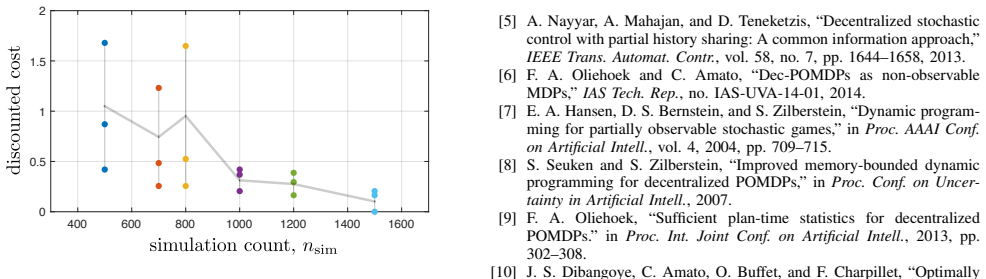
- In the delayed-sharing intrusion response testbed, higher simulation counts produce lower discounted cost, consistent with the claimed convergence behavior.
Reading between the lines
- If the finite-$K$ particle belief is treated as part of the algorithm rather than an implementation detail, a natural next step is to prove whether $K$-particle rejection sampling converges to $\pi_\tau$ and at what rate; a testable intermediate check is to compare the particle belief with exact belief updates on small instances.
- The common-seed device assumes agents can agree on and synchronize random number streams; in settings where that is impossible, one would need to replace it with consensus-based tree merging or shared randomness broadcast, and the convergence argument would have to be revisited.
- The branching factor of the tree is the number of joint prescriptions, $\prod_i |\mathcal{U}_i|^{|\mathcal{M}_t^i|}$, so scaling to larger multi-agent systems will likely require structure in the prescription space, such as factored action selection or bandit-style sampling over prescriptions.
- The collaborative intrusion-response model opens a decentralized treatment of network defense; extending the two-agent experiment to larger attack graphs and more defenders would show whether the empirical convergence persists as the prescription space grows.
Signed reviews
Editorial analysis
A structured set of objections, weighed in public.
Referee Report
Summary. The paper addresses decentralized stochastic control with partial history sharing (PHS). It uses the common-information POMDP reduction of Nayyar, Mahajan, and Teneketzis to transform the decentralized problem into a centralized POMDP, then proposes a decentralized online Monte-Carlo tree search algorithm (Algorithm 1) in which each agent builds an identical search tree using a shared random seed and a black-box generative model. The algorithm is claimed to be provably convergent to the team-optimal value function and to require no explicit communication among agents. The paper also relates the algorithm to existing Dec-POMDP solvers (MAA* and the occupancy-state MDP approach) and presents a novel collaborative intrusion response model with a two-agent numerical study showing that the estimated discounted cost decreases as the number of simulations grows.
Significance. If the convergence guarantee were fully established for the implemented algorithm, the paper would make a useful contribution: it combines a known reduction with POMCP-type online search, offers a decentralized execution scheme under a common randomness assumption, and provides a unified perspective on existing Dec-POMDP solvers. The collaborative intrusion response application is a relevant testbed, and the numerical experiment provides a sanity check of the convergence trend, although it does not compare against an optimal baseline. The paper is generally clearly written and the algorithmic construction is sensible. However, the advertised convergence result is only proven for an idealized version of the algorithm that uses exact beliefs, while the executed algorithm uses a finite-particle approximation; the gap is load-bearing for the central claim, and the transfer from value convergence to argmax convergence is also asserted without proof.
major comments (3)
- [Section III-C, Lemma 1] Lemma 1 assumes the true belief state πτ is available, but Algorithm 1 (Section III-B) represents the belief by a fixed set of K particles B(h) and updates it by rejection sampling. The paper gives no consistency theorem for the K-particle belief as K grows, no rate of convergence, and no argument that the POMCP-style value bound is preserved under this finite-particle approximation. Because SEARCH draws samples from B(h) rather than from πτ, the stated convergence does not apply to the algorithm whose results are reported in Section IV-B, where K = 400. This is the central gap between the proof and the abstract's claim of a 'provably convergent' algorithm.
- [Section III-C, paragraph after Lemma 1] The optimal prescription is chosen as argmaxδ∈Γ V(h_tδ), but the paper does not prove that convergence of the estimated value function V to the true value function V* transfers to convergence of the argmax to the team-optimal joint prescription. Pointwise convergence of values does not by itself imply convergence of the maximizing action unless additional conditions are imposed, such as a unique maximizer with a strictly positive value gap or uniform convergence of the value estimates. This step is asserted rather than derived, and it is essential for the claim that the algorithm yields the approximately optimal control action γ̂^i,*_t(m^i_t).
- [Section III-C, Lemma 1] Lemma 1 states convergence 'for any history hτ that are prefixed by ht with τ ≥ t,' which suggests a per-history guarantee at internal nodes of the search tree. The cited theorem from [15] is a root-level convergence result for POMCP under an exact belief state, and the manuscript does not explain how that root-level result extends to arbitrary non-root histories when those histories are reached through particle-based belief updates. Either the lemma must be restricted to the root with the true belief, or the authors need to prove the stronger statement they invoke.
minor comments (5)
- [Section III-B] Typo: 'The generate model avoids the need' should read 'The generative model avoids the need.'
- [Section IV-A] The detection-probability notation lists δj3 = 0.8 for j = 8, 9, 10, but there are only two alerts (a1 and a2) in the example; this appears to be a typo and should likely read δj2.
- [Section III-C] In the statement of Lemma 1, the phrase 'i.e., V(hτ) →p V*τ(hτ)' is awkward; consider writing 'that is, V(hτ) converges in probability to V*τ(hτ).'
- [Algorithm 1] In SIMULATE, the child initialization loop uses 'for all γ ∈ Γ' while the subsequent UCB selection uses δ for prescriptions; the notation is inconsistent and could confuse readers.
- [Figure 2] The caption does not explain what the gray line represents or how the individual points should be interpreted; please state that the gray line is the mean over sample paths and clarify the error bars or spread.
Circularity Check
No circularity found: the central convergence claim is imported from independent external results, and the paper's self-citations are not load-bearing.
full rationale
The paper's derivation chain is: (i) the decentralized PHS problem is reformulated as a centralized POMDP using the structural results of Nayyar, Mahajan, and Teneketzis [5]; (ii) the centralized POMDP is solved online by adapting POMCP [15]; and (iii) convergence is asserted by invoking Theorem 2 of [15] in Lemma 1. None of these load-bearing steps is equivalent to the paper's own inputs by construction. [5] and [15] are independent, externally published results; neither is authored by the present paper's authors, and neither contains the present paper's target claim as a definitional consequence. The paper's self-citations, e.g., [14], [22], [23], and [30], concern related multi-agent learning work and the cyber-network application model; they are not used to justify the convergence theorem or to define away any quantity being predicted. The numerical study varies the simulation count and reports cost, with no fitted parameter being renamed as a prediction. The one substantive weakness, noted in the skeptic's take, is that the implemented algorithm uses a finite K-particle belief approximation while Lemma 1 assumes the true belief state; this is a possible correctness or proof-completeness gap, but it is not a circularity. The advertised convergence is conditional on an idealized version of the algorithm, but the paper does not hide that condition: Lemma 1 explicitly says 'Given the true belief state πτ'. No equation or definition in the paper reduces a derived quantity to an input in a self-referential way, and no load-bearing argument rests on a self-citation. Accordingly, the appropriate circularity score is 0.
Assumptions & free parameters
free parameters (3)
- Exploration constant ρ =
10 (in experiments)
- Particle count K =
400
- Discount horizon threshold ε =
0.1
assumptions (5)
- domain assumption The coordinator's PHS problem is a centralized POMDP with state (x, m^1, ..., m^n), actions being joint prescriptions, and belief π_t = P(x, m | h_t) (Lemma 1 of [5]).
- standard math The single-agent POMCP value function converges in probability to the optimal value function given the true belief state (Theorem 2 of [15]).
- domain assumption Each agent has access to a generative model G that samples exactly from the true dynamics and observation distribution.
- ad hoc to paper All agents share a common source of randomness and identical copies of G and the belief representation, so their search trees are identical.
- domain assumption State, observation, action, and memory spaces are finite, so the prescription space Γ_t is finite.
Cite this review
Pith. "Pith review of Online Planning for Decentralized Stochastic Control with Partial History Sharing." pith.science (2026). https://pith.science/paper/IIM2ACRB
@misc{pith2026190802357,
  author       = {Pith},
  title        = {Pith review of: Online Planning for Decentralized Stochastic Control with Partial History Sharing},
  year         = {2026},
  howpublished = {\url{https://pith.science/paper/IIM2ACRB}},
  note         = {Machine review of arXiv:1908.02357}
}
read the original abstract
In decentralized stochastic control, standard approaches for sequential decision-making, e.g. dynamic programming, quickly become intractable due to the need to maintain a complex information state. Computational challenges are further compounded if agents do not possess complete model knowledge. In this paper, we take advantage of the fact that in many problems agents share some common information, or history, termed partial history sharing. Under this information structure the policy search space is greatly reduced. We propose a provably convergent, online tree-search based algorithm that does not require a closed-form model or explicit communication among agents. Interestingly, our algorithm can be viewed as a generalization of several existing heuristic solvers for decentralized partially observable Markov decision processes. To demonstrate the applicability of the model, we propose a novel collaborative intrusion response model, where multiple agents (defenders) possessing asymmetric information aim to collaboratively defend a computer network. Numerical results demonstrate the performance of our algorithm.
Figures

Reference graph
Works this paper leans on
-
[30]
A POMDP approach to the dynamic defense of large-scale cyber networks,
E. Miehling, M. Rasouli, and D. Teneketzis, “A POMDP approach to the dynamic defense of large-scale cyber networks,” IEEE Trans. Inf. Forensics Security, vol. 13, no. 10, pp. 2490–2505, 2018
work page 2018
-
[15]
Monte-Carlo planning in large POMDPs,
D. Silver and J. Veness, “Monte-Carlo planning in large POMDPs,” in Advances in Neural Inf. Process. Syst. , 2010, pp. 2164–2172
work page 2010
-
[1]
Optimal control strategies in delayed sharing information structures,
A. Nayyar, A. Mahajan, and D. Teneketzis, “Optimal control strategies in delayed sharing information structures,” IEEE Trans. Automat. Contr., vol. 56, no. 7, pp. 1606–1620, 2011
work page 2011
-
[2]
Separation of estimation and control for discrete time systems,
H. S. Witsenhausen, “Separation of estimation and control for discrete time systems,”Proc. of the IEEE, vol. 59, no. 11, pp. 1557–1566, 1971
work page 1971
-
[3]
Sufficient statistics in the optimum control of stochastic systems,
C. Striebel, “Sufficient statistics in the optimum control of stochastic systems,” J. of Math Anal. & Appl., vol. 12, no. 3, pp. 576–592, 1965
work page 1965
-
[4]
P. R. Kumar and P. Varaiya, Stochastic Systems: Estimation, Identifi- cation, and Adaptive Control . Prentice Hall, NJ, 1986
work page 1986
-
[5]
Decentralized stochastic control with partial history sharing: A common information approach,
A. Nayyar, A. Mahajan, and D. Teneketzis, “Decentralized stochastic control with partial history sharing: A common information approach,” IEEE Trans. Automat. Contr., vol. 58, no. 7, pp. 1644–1658, 2013
work page 2013
-
[6]
Dec-POMDPs as non-observable MDPs,
F. A. Oliehoek and C. Amato, “Dec-POMDPs as non-observable MDPs,” IAS Tech. Rep., no. IAS-UV A-14-01, 2014
work page 2014
Show all 30 references
-
[7]
Dynamic program- ming for partially observable stochastic games,
E. A. Hansen, D. S. Bernstein, and S. Zilberstein, “Dynamic program- ming for partially observable stochastic games,” in Proc. AAAI Conf. on Artificial Intell. , vol. 4, 2004, pp. 709–715
2004
-
[8]
Improved memory-bounded dynamic programming for decentralized POMDPs,
S. Seuken and S. Zilberstein, “Improved memory-bounded dynamic programming for decentralized POMDPs,” in Proc. Conf. on Uncer- tainty in Artificial Intell. , 2007
2007
-
[9]
Sufficient plan-time statistics for decentralized POMDPs
F. A. Oliehoek, “Sufficient plan-time statistics for decentralized POMDPs.” in Proc. Int. Joint Conf. on Artificial Intell. , 2013, pp. 302–308
2013
-
[10]
Optimally solving Dec-POMDPs as continuous-state MDPs,
J. S. Dibangoye, C. Amato, O. Buffet, and F. Charpillet, “Optimally solving Dec-POMDPs as continuous-state MDPs,” J. of Artificial Intell. Res., vol. 55, pp. 443–497, 2016
2016
-
[11]
Y ¨uksel and T
S. Y ¨uksel and T. Bas ¸ar, Stochastic Networked Control Systems . Birkh¨auser/Springer, 2013, vol. 10
2013
-
[12]
Learning to act in decentralized partially observable MDPs,
J. Dibangoye and O. Buffet, “Learning to act in decentralized partially observable MDPs,” in Proc. Int. Conf. on Mach. Learning , 2018, pp. 1233–1242
2018
-
[13]
Internet of vehicles: From intelligent grid to autonomous cars and vehicular clouds,
M. Gerla, E.-K. Lee, G. Pau, and U. Lee, “Internet of vehicles: From intelligent grid to autonomous cars and vehicular clouds,” in Internet of Things, IEEE World Forum on . IEEE, 2014, pp. 241–246
2014
-
[14]
Fully decen- tralized multi-agent reinforcement learning with networked agents,
K. Zhang, Z. Yang, H. Liu, T. Zhang, and T. Bas ¸ar, “Fully decen- tralized multi-agent reinforcement learning with networked agents,” in Proc. Int. Conf. on Mach. Learning , 2018, pp. 5872–5881
2018
-
[16]
MAA*: A heuristic search algorithm for solving decentralized POMDPs,
D. Szer, F. Charpillet, and S. Zilberstein, “MAA*: A heuristic search algorithm for solving decentralized POMDPs,” in Proc. Conf. on Uncertainty in Artificial Intell. , 2005, pp. 576–583
2005
-
[17]
Monte-carlo expectation maximization for decentralized POMDPs
F. Wu, S. Zilberstein, and N. R. Jennings, “Monte-carlo expectation maximization for decentralized POMDPs.” in Proc. Int. Joint Conf. on Artificial Intell., 2013, pp. 397–403
2013
-
[18]
Scalable planning and learning for multiagent POMDPs,
C. Amato, F. A. Oliehoek et al., “Scalable planning and learning for multiagent POMDPs,” in Proc. AAAI Conf. on Artificial Intell. , 2015, pp. 1995–2002
2015
-
[19]
Dec-MCTS: Decentralized planning for multi-robot active perception,
G. Best, O. M. Cliff, T. Patten, R. R. Mettu, and R. Fitch, “Dec-MCTS: Decentralized planning for multi-robot active perception,” The Int. J. of Robotics Res. , pp. 1–22, 2018
2018
-
[20]
Reinforcement learning in decentral- ized stochastic control systems with partial history sharing,
J. Arabneydi and A. Mahajan, “Reinforcement learning in decentral- ized stochastic control systems with partial history sharing,” in Proc. Amer. Contr. Conf. IEEE, 2015, pp. 5449–5456
2015
-
[21]
Tree-based solution methods for multiagent POMDPs with delayed communication,
F. A. Oliehoek and M. T. Spaan, “Tree-based solution methods for multiagent POMDPs with delayed communication,” in Proc. AAAI Conf. on Artificial Intell. , 2012
2012
-
[22]
Networked multi-agent reinforce- ment learning in continuous spaces,
K. Zhang, Z. Yang, and T. Bas ¸ar, “Networked multi-agent reinforce- ment learning in continuous spaces,” in Proc. Conf. on Decision and Contr. IEEE, 2018
2018
-
[23]
Finite-sample analyses for fully decentralized multi-agent reinforcement learning,
K. Zhang, Z. Yang, H. Liu, T. Zhang, and T. Bas ¸ar, “Finite-sample analyses for fully decentralized multi-agent reinforcement learning,” arXiv preprint arXiv:1812.02783 , 2018
2018 arXiv
-
[24]
Policy iteration for decentralized control of Markov decision processes,
D. S. Bernstein, C. Amato, E. A. Hansen, and S. Zilberstein, “Policy iteration for decentralized control of Markov decision processes,” J. of Artificial Intell. Res. , vol. 34, pp. 89–132, 2009
2009
-
[25]
Bas ¸ar and G
T. Bas ¸ar and G. J. Olsder, Dynamic Noncooperative Game Theory . SIAM, 1999, vol. 23
1999
-
[26]
Decentralized control of partially observable Markov Decision Processes,
C. Amato, G. Chowdhary, A. Geramifard, N. K. Ure, and M. J. Kochenderfer, “Decentralized control of partially observable Markov Decision Processes,” in Proc. Conf. on Decision and Contr. IEEE, 2013, pp. 2398–2405
2013
-
[27]
Finite-time analysis of the multiarmed bandit problem,
P. Auer, N. Cesa-Bianchi, and P. Fischer, “Finite-time analysis of the multiarmed bandit problem,” Mach. Learning , vol. 47, no. 2-3, pp. 235–256, 2002
2002
-
[28]
Taxonomy and survey of collaborative intrusion detection,
E. Vasilomanolakis, S. Karuppayah, M. M ¨uhlh¨auser, and M. Fischer, “Taxonomy and survey of collaborative intrusion detection,” ACM Comput. Surveys, vol. 47, no. 4, p. 55, 2015
2015
-
[29]
Scalable, graph-based network vulnerability analysis,
P. Ammann, D. Wijesekera, and S. Kaushik, “Scalable, graph-based network vulnerability analysis,” in Proc. Conf. on Comput. and Com- mun. Security. ACM, 2002, pp. 217–224
2002
Reviewed August 14, 2026 · model on record in the stance chip above.
Discussion (0). Continue with ORCID to comment.