REVIEW 4 major objections 4 minor 4 references
Constructive Quantum Field Theory on Curved Surfaces and Related Topics
T0 review · 4 major / 4 minor · reviewed 2026-08-06 · deepseek-v4-flash
Pith's one-line read The $P(\phi)_2$ quantum field model is constructed on curved Riemannian surfaces and proved to satisfy Segal's gluing axioms, with a mass gap on infinite periodic surfaces.
desk verdict A thesis that plausibly delivers a curved-surface P(phi)_2 Segal theory, but the key boundary-locality lemma sits in a section not in the review copy, so the main theorem remains unverified. read the letter →
The pith
A machine-rendered reading of the paper's core claim, the machinery that carries it, and where it could break.
The reading
What carries the argument
The load-bearing object is the local, regulator-independent Wick-renormalized interaction random variable $\int_M \chi(x){:}P(\phi(x)){:}\,dV_M(x)$, obtained by smoothing the Gaussian free field with admissible regulators $K_\varepsilon\to\mathbf{1}$ in the pseudodifferential symbol topology and then removing the divergent Wick contractions. Proposition 2.3.5 establishes that the $L^2(\mu_{\mathrm{GFF}})$ limit exists and is independent of which admissible local smoothing family is used, and this locality is what makes the interaction on a surface with boundary independent of any ambient closed surface. For the free field, the gluing argument is carried by the Markov property of the GFF together with a Bayes-type symmetry in successive conditioning, expressed through trace maps onto circles and the relation $j_\Sigma=\tau^*_\Sigma=(\Delta_M+m^2)\,PI^\Sigma_M\,(DN^\Sigma_M)^{-1}$ connecting the trace, the Poisson integral, and the Dirichlet-to-Neumann operator; the interacting case extends the same identity by the locality of the interaction.
What would settle it
Choose a flat cylinder $[0,L]\times S^1$ and two admissible smoothing families $K_\varepsilon$ and $\tilde K_{\varepsilon'}$ (for instance heat semigroup and the paper's geodesic-ball mollifier). Compute $\lim_{\varepsilon\to0}\int \chi(x){:}\phi_\varepsilon(x)^{2n}{:}\,dV$ for each and verify the difference tends to zero at the rate in Proposition 2.3.5; a residual difference would give two different interactions and break the gluing identity. Alternatively, evaluate a matrix element of $U_{\Omega_2\cup\Omega_1}$ and of $U_{\Omega_2}\circ U_{\Omega_1}$ on a cylinder cut into two pieces and check equality for a nontrivial observable.
Extended reading notes
Core claim
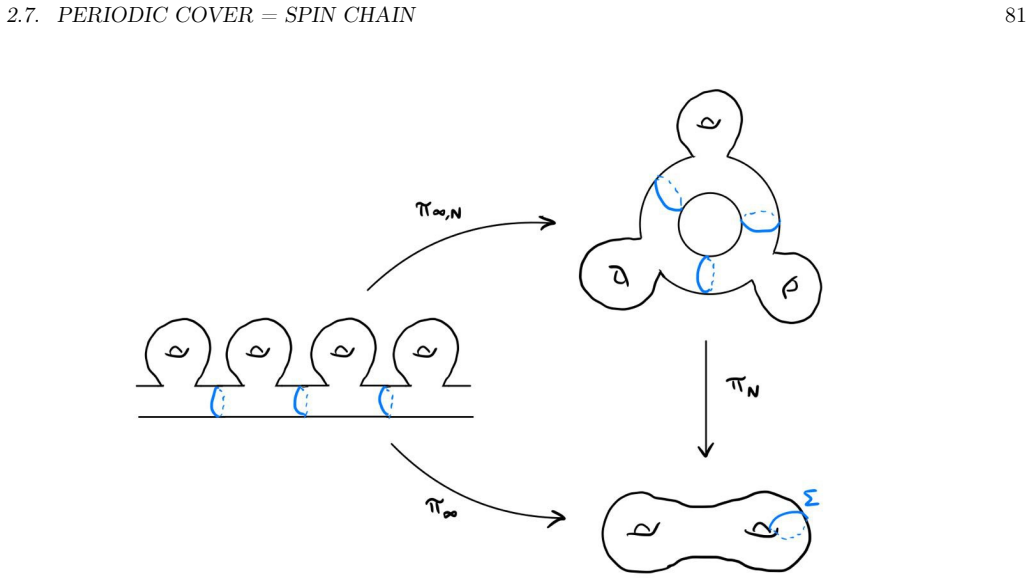
The central claim is Theorem 2.1: for every finite disjoint union $\Sigma$ of Riemannian circles there is a finite measure $\mu_\Sigma$ on $D'(\Sigma)$, and for every Riemannian surface $\Omega$ with boundary $\Sigma_{\mathrm{in}}\sqcup\Sigma_{\mathrm{out}}$ there is an operator $U_\Omega$ between the corresponding $L^2$ spaces, defined by a Radon-Nikodym density $A_\Omega$ between two mutually absolutely continuous measures on $D'(\Sigma_{\mathrm{in}})\times D'(\Sigma_{\mathrm{out}})$, such that glued surfaces give composed operators: $U_{\Omega_2\cup_\rho\Omega_1}=U_{\Omega_2}\circ U_{\Omega_1}$. The same Segal structure is then used to prove that the $P(\phi)_2$ Gibbs state on the infinite periodic surface has a mass gap, expressed as exponential mixing under the deck-group shift, and that the free-energy density on towers of cyclic covers converges to the logarithm of the leading eigenvalue of the transfer operator associated with the fundamental cobordism.
Load-bearing premise
The whole construction stands on the claim that the renormalized interaction energy of a field over a region is truly a sum of the energies of its pieces, independent of how one smooths the field and of the larger surface used to define it; if that locality fails, the amplitudes become ill-defined and gluing breaks.
Editorial extensions
If this is right
- Every finite disjoint union of Riemannian circles gets a Hilbert space of states, and every Riemannian surface with two boundary components gets a Hilbert-Schmidt operator, with disjoint unions mapping to tensor products and glued surfaces mapping to composed operators.
- The infinite-volume, infinite-genus periodic surface carries a $P(\phi)_2$ Gibbs state that is exponentially mixing under the deck-group shift, which is a mass gap.
- The free energy per unit volume on large cyclic covers converges to $\log\lambda_0$ with $\lambda_0$ the leading eigenvalue of the transfer operator attached to the fundamental cobordism, extending zeta-determinant asymptotics to interacting partition functions.
- Wick renormalization can be made compatible with locality, so the interaction on a surface with boundary is defined without reference to an ambient closed surface; spectral-cutoff regularization is explicitly non-local and fails reflection positivity.
- A rigorous derivation of the Cardy-Calabrese entanglement entropy formula follows from treating partition functions on branched covers as CFT correlation functions under Hadamard renormalization.
Reading between the lines
- One could test the same Segal-amplitude construction on the three-dimensional $\Phi^4_3$ model only after replacing the Radon-Nikodym formula: there the interacting measure is not absolutely continuous with respect to the Gaussian free field, so the amplitudes would have to be defined by a different limiting procedure.
- The Bayes-style symmetry used to glue free fields suggests a general recipe: any free field whose covariance inverse is a local elliptic operator should satisfy Segal gluing through trace-image measures and Radon-Nikodym densities, so the argument may carry over to vector bundles or higher-genus surfaces with the same structure.
- The entanglement-entropy construction, which recovers the Cardy-Calabrese formula from a Hadamard renormalization of the Polyakov anomaly, could be paired with the $P(\phi)_2$ Segal theory to define a rigorous replica entropy for an interacting theory on curved surfaces; the thesis leaves that combination to future work.
- If the transfer-operator interpretation of the free-energy limit is robust, the same argument may yield a proof that the leading eigenvalue of the interacting transfer operator controls phase transitions on towers of cyclic covers, not just the free energy.
Editorial analysis
A structured set of objections, weighed in public.
Referee Report
Summary. This doctoral thesis claims to construct the interacting P(phi)_2 Euclidean quantum field theory on arbitrary compact Riemannian surfaces with boundary and to verify Segal's axioms: Hilbert spaces H_Sigma = L^2(D'(Sigma), mu_Sigma) for finite unions of circles, operators U_Omega given by Radon-Nikodym kernels A_Omega, and the composition property U_{Omega2 cup_rho Omega1} = U_{Omega2} o U_{Omega1}. It further advertises a mass gap and exponential mixing for an infinite-volume P(phi)_2 Gibbs state on periodic covers (Thm. 2.3), asymptotics of P(phi)_2 partition functions on cyclic covers (Thm. 2.2), a counterexample to reflection positivity for spectrally cut-off GFF (Ch. 3), a derivation of Cardy-Calabrese entanglement entropy from a Hadamard renormalized Polyakov anomaly (Ch. 4), and asymptotics of zeta determinants on cyclic covers via heat kernels and via Segal axioms (Ch. 5). The text supplied for review contains the introduction, detailed background, and parts of Chapter 2 through section 2.4.1; sections 2.5-2.7 and Chapters 3-5 are listed but not included in the reviewed text.
Significance. If correct, Theorem 2.1 would be a significant step: it would be the first non-perturbative interacting field theory on curved surfaces verified against Segal's axioms, with the added consequence of a mass gap in a curved infinite-volume setting. The visible portions do contain genuine value: sections 2.2-2.3 give a careful treatment of Gaussian measures on D'(M), the Radon-Nikodym density for quadratic perturbations, and a regulator-independence result (Prop. 2.3.5) for the closed-manifold P(phi)_2 interaction, with quantitative L^2 bounds. The BFK gluing formula is used as an independent geometric input, so I see no circularity in that step. The Bochner-Minlos measure existence and heat-kernel estimates are assembled with useful references. However, the edition under review is incomplete, so the significance assessment is conditional on the missing sections delivering the promised boundary-locality and gluing proofs.
major comments (4)
- [Section 2.1.3 / Section 2.5.4 / Prop. 2.3.5] The regulator-independence proof is given only for a fixed closed manifold M (Prop. 2.3.5, Section 2.3.2). Theorem 2.1 requires more: the interaction S_Omega = int_Omega :P(phi): dV must be intrinsically defined on a surface with boundary, independent of the ambient closed extension, and compatible with the intrinsic Dirichlet GFF law on Omega. The thesis itself identifies this boundary-locality as the key novel ingredient ('A Transparent Treatment of Locality', Section 2.1.3) and refers to Section 2.5.4 for the strengthening of Nelson's argument, but Section 2.5.4 is not present in the reviewed text. Since Eq. (2.6.11) and the factorization S_{Omega1 cup Omega2} = S_{Omega1} + S_{Omega2} used in the gluing identity (2.1.12) depend on it, the central claim of Theorem 2.1 is not verifiable from the supplied text.
- [Section 2.6 / Eq. (2.1.12)] The composition axiom for arbitrary gluings is the main content of Theorem 2.1, not a corollary of the cylinder calculation in Section 1.5. The visible Section 1.5 discussion of gluing relies on two postulates (p. 34-35) rather than proved statements, and the proofs announced for free-field gluing (Prop. 2.6.10) and its extension to the interacting case (Section 2.6.5) are not included. The full Section 2.6 must be available for the composition identity U_{Omega2 cup_rho Omega1} = U_{Omega2} o U_{Omega1} to be checked.
- [Section 2.7 / Theorem 2.3] The mass gap and exponential mixing statement uses the Perron-Frobenius property and a transfer operator U_Omega, but the supporting arguments (Section 2.7.3 and Corollary 2.7.3) are absent from the reviewed text. In particular, it is not shown how the spectral gap of the transfer operator yields the stated rate O(alpha^k) uniformly in the cyclic covers as N goes to infinity. Since Theorem 2.3 is advertised as a first curved-space mass gap result for an interacting theory, this proof needs to be available for review.
- [Chapters 3-5] Chapters 3, 4, and 5 are summarized only in the abstract, the table of contents, and short paragraphs of Section 1.1.1; the actual arguments concerning non-reflection positivity of spectrally cut-off GFF, the Hadamard renormalized Polyakov anomaly and the Cardy-Calabrese entropy formula, and the zeta determinant asymptotics are not part of the supplied text. Their correctness therefore cannot be assessed. If the thesis is to be evaluated as a whole, the missing chapters must be included; if only Chapter 2 is under consideration, the title and abstract overstate the scope.
minor comments (4)
- [Prop. 2.2.10] 'Let (M,g) is a closed Riemannian surface' should read 'Let (M,g) be a closed Riemannian surface'.
- [Corollary 2.2.12] The notation mu^{Sigma,M}_{DN} does not display the boundary condition B imposed on the other boundary components of M; the parenthetical remark in the text is hard to implement in the statement as written.
- [Theorem 2.3] The exponential mixing estimate should specify whether k is an integer and in which limit the O(alpha^k) term is taken; as written, O(alpha^k) is not small for negative k.
- [Section 2.3.4 / Eq. (2.3.21)] The text calls mu^M_log a Gaussian measure and then says 'no random variables will be actually defined on mu^M_log'; the status of the covariance kernel -(1/2pi) log(m d(x,y)) as a genuine positive-definite covariance or as a purely formal device needs clarification.
Circularity Check
No significant circularity: the P(phi)_2 construction is built on GFF and independent gluing/determinant ingredients; self-citations are not load-bearing.
full rationale
Walking the derivation chain: (1) the free-field sector fixes Hilbert spaces via massive GFF measures whose covariance is (Delta+m^2)^{-1} (Section 2.2.1, Definition 2.2.1/2.2.2); (2) the interacting measure on closed surfaces is Nelson's P(phi)_2 construction, with regulator independence proved via kernel/symbol estimates (Proposition 2.3.5), not by assuming the target measure; (3) the gluing constants are fixed by the independent BFK determinant formula (Proposition 2.2.10), explicitly flagged as separate ingredients that must be tuned; (4) the free-field gluing is derived from a Bayes/conditioning symmetry (Proposition 2.5.12) and the Markov decomposition of the GFF; (5) the interacting extension is stated to require locality of the Wick renormalized interaction (Section 2.5.4), which the paper identifies as a new proof rather than an imported theorem. Nothing in the visible derivation sets a fitted parameter equal to the claimed prediction. The self-citations [Lin24], [EL25], [BDF+23] are adaptations of the author's own preprints, but the thesis reproduces the proofs and does not lean on an unverified uniqueness theorem. The boundary-locality premise is load-bearing, but it is a mathematical condition to be proved, not the conclusion restated; if it failed, the theorem would be false, not circular.
Assumptions & free parameters
assumptions (6)
- standard math Bochner-Minlos theorem guarantees existence of the massive GFF measure on D'(M) for a closed Riemannian manifold M and on D'(Ω°) for Dirichlet boundary conditions.
- standard math Zeta-regularized determinants and the BFK gluing formula detζ(Δ_M+m²) = detζ(Δ_{M\Σ,D}+m²) detζ(DN_Σ^M).
- standard math Hypercontractivity of Gaussian chaos (Nelson) gives L^p bounds and integrability of e^{-S}.
- domain assumption The Markov property of the massive GFF and its extension to trace maps via a Bayes-type identity (thesis Prop. 2.5.12).
- domain assumption Polyakov anomaly formula in CFT, used to define the renormalized partition function on conical surfaces in Chapter 4.
- domain assumption The identification of entanglement entropy with branched covers and the replica trick.
Cite this review
Pith. "Pith review of Constructive Quantum Field Theory on Curved Surfaces and Related Topics." pith.science (2026). https://pith.science/paper/IINX6VJA
@misc{pith2026250721655,
  author       = {Pith},
  title        = {Pith review of: Constructive Quantum Field Theory on Curved Surfaces and Related Topics},
  year         = {2026},
  howpublished = {\url{https://pith.science/paper/IINX6VJA}},
  note         = {Machine review of arXiv:2507.21655}
}
abstract
This is the Ph.D. thesis of the author. In this thesis, we construct the $ P(\phi)_2 $ Quantum Field Theory (QFT) model on curved surfaces and show that it satisfies Segal's axioms (arXiv:2403.12804). An important ingredient in this construction is the use of a local regularization procedure to define the interaction as a random variable with respect to the Gaussian Free Field (GFF). We provide a counterexample demonstrating that spectral truncation regularization violates locality (arXiv:2312.15511). We then explain how Segal's formalism can be extended to the gluing of surfaces with slits, which offers a geometric interpretation of the entanglement entropy. Using this interpretation, we exploit the Polyakov anomaly formula in Conformal Field Theory (CFT) and apply a simple renormalization procedure to define a quantity corresponding to entanglement entropy within this geometric interpretation. We then show that this quantity behaves like a CFT correlation function. This allows us to rigorously derive an entropy calculation of Cardy and Calabrese (arXiv:2501.19014). Finally, Segal's formalism is also related to the asymptotics of zeta determinants on surfaces of large genus where the genus tends to infinity (arXiv:2505.01586). We provide a geometric proof--independent of Segal's axioms--of the corresponding result using heat kernels, in addition to another proof based on Segal's axioms. Both proofs are presented in the thesis.
Figures


Figures from the paper (8 more)




Reference graph
Works this paper leans on
-
[4]
Coordonnées polaires sur les surfaces riemanniennes singulières
doi: 10.1007/978-3-031-33700-0. [TNA24] Behrad Taghavi, Ali Naseh, and Kuroush Allameh. Classical Liouville action and uniformiza- tion of orbifold Riemann surfaces. 2024. [Tro90] Marc Troyanov. “Coordonnées polaires sur les surfaces riemanniennes singulières”. In: Annales de l’Institut Fourier40.4 (1990), pp. 913–937.url: http://www.numdam.org/articles/1...
arXiv 1990
-
[855]
Two-dimensional perturbative scalar QFT and Atiyah- Segal gluing
issn: 1432-0916. doi: 10.1007/s00220- 016- 2789- 2. url: https://link.springer. com/article/10.1007/s00220-016-2789-2. [KMW21] S. Kandel, P. Mnev, and K. Wernli. “Two-dimensional perturbative scalar QFT and Atiyah- Segal gluing”. In:Adv. Theor. Math. Phys.25.7 (2021), pp. 1847–1952. [Kni87] V.G.Knizhnik. “AnalyticfieldsonRiemannsurfaces. II”. In: Communic...
arXiv 2021
-
[2002]
Entanglement Entropy and Cauchy-Hadamard Renormalization
isbn: 978-0-521-00754-2. [DZ16] SemyonDyatlovandMaciejZworski.“DynamicalzetafunctionsforAnosovflowsviamicrolocal analysis”. In:Ann. Scient. Éc. Norm. Sup49 (2016), pp. 543–577. [EKZ14] A. Eskin, M. Kontsevich, and A. Zorich. “Sum of Lyapunov exponents of the Hodge bundle with respect to the Teichmüller geodesic flow”. In:Publ.math.IHES 120 (2014), pp. 207...
work page Pith review arXiv 2016
-
[2008]
The Hartle-Hawking-Israel state on stationary black hole spacetimes
isbn: 978-1-4704-6483-7. [Fol89] Gerald B. Folland. Harmonic Analysis in Phase Space. (AM-122). Princeton University Press, 1989. [Fre19] Daniel S. Freed. Lectures on Field Theory and Topology. Vol. 133. CBMS Regional Conference Series in Mathematics. American Mathematical Society, 2019.isbn: 978-1-4704-5206-3. doi: 10.1090/cbms/133. [FV17] S. Friedli and...
work page Pith review arXiv 2021
Reviewed August 6, 2026 · model on record in the stance chip above.
Discussion (0). Continue with ORCID to comment.