REVIEW 5 major objections 4 minor 2 cited by
RBF++: Quantifying and Optimizing Reasoning Boundaries across Measurable and Unmeasurable Capabilities for Chain-of-Thought Reasoning
T0 review · 5 major / 4 minor · reviewed 2026-08-15 · deepseek-v4-flash
Pith's one-line read A weighted harmonic-mean law predicts when chain-of-thought reasoning succeeds and fails.
desk verdict A useful empirical extension wrapped around a combination law that is a restatement of its own definitions, with validation that is curve-fitting rather than a test. read the letter →
The pith
A machine-rendered reading of the paper's core claim, the machinery that carries it, and where it could break.
The reading
What carries the argument
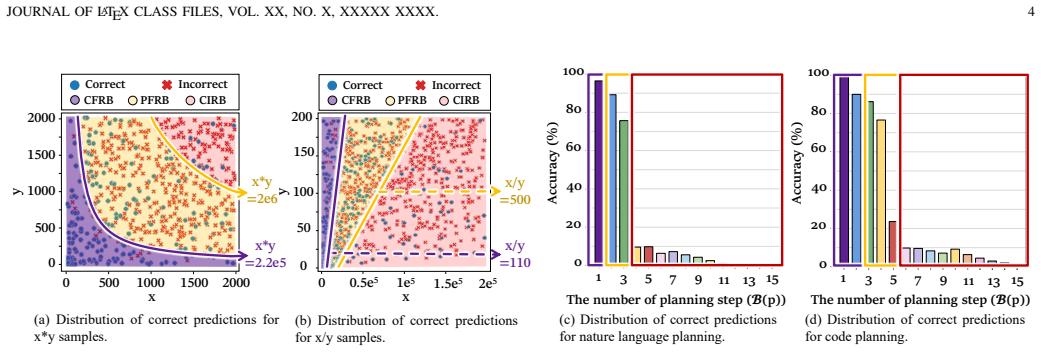
The load-bearing object is the reasoning boundary, $B^{\text{Acc}=K}(t|m)=\sup\{d:\text{Acc}(t|d,m)\ge K\}$, i.e. the hardest task level a model manages at a fixed accuracy target. The load-bearing identity is the combination law $B(t_1,\dots,t_n)\approx 1/\sum_i 1/B(t_i)$, which the paper derives in Appendix A from additive difficulty and independence. This single reciprocal relation does three jobs: it predicts combined performance from measured sub-boundaries, it lets unmeasurable sub-boundaries be absorbed into a constant $z_i$ in Eq. (4), and it makes boundary division possible because one combined boundary can be split into sub-boundaries that recombine by the same formula. The three boundary categories — completely feasible (accuracy $\ge 90\%$), partially feasible ($10\% <$ accuracy $< 90\%$), and completely infeasible (accuracy $\le 10\%$) — convert the identity into optimization guidance: operate inside the first, use consensus or decomposition in the second, and treat the third as requiring a capability change rather than a prompt change.
What would settle it
Construct a task with two measurable sub-boundaries in which the second sub-task's input is the output of the first, so an error in sub-task 1 changes the difficulty of sub-task 2 (e.g., a multi-step calculation where an early arithmetic slip makes later operands much larger). Measure $B(t_1)$ and $B(t_2)$ separately, compute the Eq. (3) prediction for the combined boundary, then measure the actual combined boundary. If the actual boundary falls systematically below the predicted value as the dependence between sub-tasks is strengthened, the additive-independence assumption is false and the combination law is falsified for that regime.
Extended reading notes
Core claim
The paper's central claim is that every task has a reasoning boundary $B^{\text{Acc}=K}(t|m)$, the greatest difficulty level $d$ at which accuracy exceeds threshold $K$, and that when a task combines sub-tasks $t_1,\dots,t_n$, the combined boundary satisfies $B(t_1,\dots,t_n)\approx 1/\sum_i 1/B(t_i)$ under a normalization. The derivation starts from an assumption that difficulty is additive and sub-boundaries are independent, then uses the reciprocal relation to justify the harmonic-mean formula. The same formula is extended to unmeasurable capabilities: a constant $z_i$ replaces any sub-boundary that cannot be measured directly, and a unified boundary such as $B(o,p,v)$ can be divided into finer boundaries $B(k)$ and $B(m_m)$ that still combine by the same law. Across 38 models and 13 tasks the paper reports that the predicted 90% and 10% boundary curves align with observed accuracy transitions, and that the three induced regions behave consistently: zero-shot rationales are correct mainly inside the completely feasible region, self-consistency voting helps mainly in the partially feasible region, and the completely infeasible region stays near chance even with voting. Based on this, the paper explains the success or failure of ten chain-of-thought strategies and proposes MARP/MARP++ prompting to stay within the feasible boundary.
Load-bearing premise
The load-bearing premise is the additive-difficulty assumption of Definition 1 and the mutual-independence assumption of Assumption 5 in Appendix A: $D(t_1,t_2)=D(t_1)+D(t_2)$ with sub-boundaries independent; if real reasoning difficulty is non-additive — for instance when later steps depend on earlier answers so errors compound superlinearly, or when the model spends one shared effort budget across sub-tasks — then the harmonic-mean law does not follow and the paper's quantitative boundary predictions collapse.
Editorial extensions
If this is right
- Given separately measured sub-boundaries, the combined boundary can be predicted without running the combined task, so a model's likely performance on a new multi-step task can be estimated in advance.
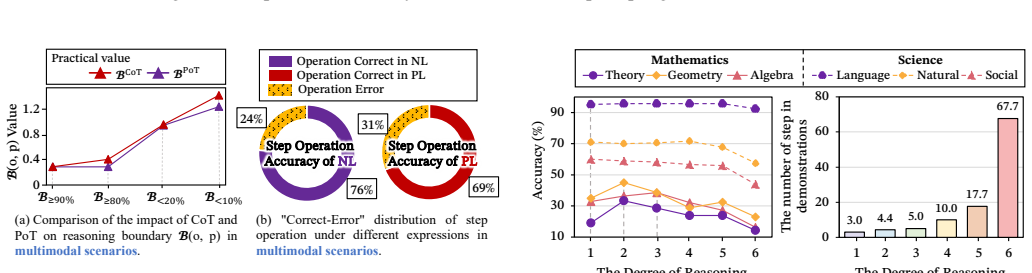
- Tool use and program-of-thought improve textual reasoning because they push the calculation sub-boundary toward infinity, making the combined boundary equal to the planning boundary; in multimodal settings the perception constant is not expanded, so the same strategies fail.
- Decomposing problems with Complex-CoT or Least-to-Most helps only while the smaller steps stay within the planning boundary; beyond that point added planning pressure erases the gain, which explains the observed performance reversal.
- Self-consistency voting is predicted to improve accuracy only inside the partially feasible region, not in the already-mastered or hopeless regions, so sampling more reasoning paths has a region-dependent payoff.
- For reasoning-tuned models, a large gain in the completely infeasible region with little gain in the completely feasible region explains why a model like o3-mini can outperform on hard problems yet trail on medium-difficulty benchmarks.
Reading between the lines
- If the harmonic-mean law holds generally, a model's combined reasoning capacity is limited by its weakest sub-skill, so optimization effort should target the smallest sub-boundary first; the paper does not formulate this budgeting rule explicitly.
- The constant assumption suggests a direct perception-focused experiment the paper does not run: fix the text reasoning and vary image difficulty systematically, and check whether Eq. (13) predicts the boundary shift with a single fitted constant across all difficulty levels.
- The same reciprocal law could be applied to multi-model systems where sub-tasks are executed by different agents or models; the prediction would be that the system boundary is dominated by the weakest component, which would be a testable implication for agent orchestrators.
- Because the law assumes independence, real tasks with correlated errors (e.g., cascading mistakes in a long plan) are where the framework should over-predict; finding a parametric correction for correlated sub-boundaries would be a natural extension.
Signed reviews
Editorial analysis
A structured set of objections, weighed in public.
Referee Report
Summary. The paper introduces RBF++, a framework for quantifying and optimizing the reasoning boundaries (RBs) of LLMs in chain-of-thought reasoning. The main components are: a definition of RB as the maximum task difficulty at which a model maintains a target accuracy; a "combination law" stating that the combined RB is approximately the reciprocal of the sum of reciprocals of sub-RBs (Eq. 3); a constant assumption for unmeasurable boundaries in multimodal settings (Eq. 4); a reasoning-boundary division mechanism (Eqs. 5-7, 12-13); and a three-way categorization of boundaries (CFRB, PFRB, CIRB). The paper also contributes the BigGSM and BigGSM++ benchmarks, the MARP and MARP++ prompting methods, and a broad empirical study across 38 models and 13 tasks. The authors claim the framework explains why strategies such as Program-of-Thought, Tool Usage, Complex-CoT, and Least-to-Most succeed or fail in different modalities.
Significance. If the harmonic-mean combination law were a validated quantitative law, the paper would provide a practically useful theory for predicting and optimizing CoT performance, and the MARP/MARP++ methods show concrete accuracy gains. The paper has notable strengths: a large experimental scope, detailed benchmark-construction procedures, clear prompting recipes, and a reproducible code/data release. However, the central quantitative claim is not currently established: the derivation in Appendix A restates the model's assumptions, and the empirical validation relies on unreported free parameters and visual inspection. The significance of the framework is therefore conditional on a serious revision that either reframes the combination law as an explicit, testable assumption or derives it from a more substantive model of accuracy and difficulty.
major comments (5)
- [Appendix A, Definitions 1-2, Eq. (23)] The harmonic-mean combination law is a restatement of the model's assumptions rather than a derived theorem. Definition 1 stipulates that difficulty is additive, D(t1,t2)=D(t1)+D(t2), and Definition 2 makes RB the reciprocal of difficulty. Consequently, 1/B(t1,...,tn)=Σ 1/B(ti) follows algebraically, and the Taylor expansion in Eqs. (18)-(22) adds no content. The proof also discards k'_i and k0 on the empirical assertion that they vanish, and at Eq. (23) it substitutes B(t_i) for t_i as a "quantized substitute," which reintroduces the reciprocal-of-difficulty identification. As written, Eq. (3) is an identity under the definitions, not a falsifiable prediction. Please either present the combination law as an explicit axiom whose empirical content is stated clearly, or derive it from a model of accuracy as a function of difficulty.
- [§IV-B, §VI-A, Figs. 3 and 11] The claimed verification of the combination law is visual only. The manuscript does not report fitted values of N_i, b_i, or z, no confidence intervals, no goodness-of-fit statistics, and no residuals. It also does not compare the harmonic-mean law against alternative combination rules (e.g., arithmetic mean, geometric mean, max/min). Because Eq. (2) contains per-task scaling factors N_i and b_i, overlaying a theoretical line on a scatter of observed samples cannot distinguish the law from an interpolating curve. Please report parameter estimates with uncertainty, perform a quantitative model comparison, and evaluate predictions on held-out data rather than on the same tasks used to estimate parameters.
- [§VI-A/B, Eqs. (4), (11), (13)] The constant assumption makes the division-mechanism validation hard to falsify. In Eq. (11), z1 is measured from direct-prompt performance on the same task that is then used to check Eq. (11); in Eq. (13), the multimodal perception RB is absorbed into an unspecified constant z'. A scenario-specific constant fitted to the same data can absorb systematic discrepancies between predicted and observed boundaries. The paper should specify how z is estimated (for example, from a calibration task disjoint from the evaluation task) and test how the conclusions depend on the choice of z.
- [§IV-C.4, Fig. 4 caption] The claim that LLMs have self-awareness of their own reasoning boundaries is weakened by the paper's own caption: "all samples in CIRB are special value points, like 25000×1000. In fact, no real CIRB samples are obtained." The finding that generated samples concentrate in CFRB is compatible with the model avoiding implausible or extreme numeric values rather than knowing its own reasoning boundary. This limitation should be acknowledged in the main text, and the self-awareness claim should be softened accordingly.
- [§IV-D, §VI-D, Eqs. (9), (13)] The explanations of why Tool Usage and Program-of-Thought help in text but not multimodal settings, and why Complex-CoT and Least-to-Most behave as observed, are all obtained by taking limits of Eq. (3). Since Eq. (3) is not independently validated, these explanations do not provide independent support for the framework; they are conditional consequences of the same combination law. The paper should state this explicitly, rather than presenting these analyses as confirmatory evidence.
minor comments (4)
- [Eq. (1)] The formal definition B^{Acc=K1}(t|m) = sup{d | Acc(t|d,m) ≤ K1} conflicts with the accompanying text, which says the boundary is the greatest difficulty at which accuracy exceeds K1. The inequality sign should be reversed or the definition should be reworded.
- [Notation throughout] Notation is inconsistent: the paper uses B^{Acc=K1}(t|m), BCoT(c,p), BT(c,p), B(p,o,v), and B(o,p,v) without a single defining list. Please collect all boundary symbols and their meanings in one table or definition block.
- [Appendix A, Eq. (18)] The Taylor expansion writes D(x1,...,xn) as a sum of univariate expansions in each xi and omits constant and cross terms without justification. The notation O(x_i) is also undefined for vector arguments; please clarify the expansion and its remainder terms.
- [§III, Experimental Setup] The statement that temperature is chosen from the interval [0,1] with temperature serving as the primary error variable is vague. Please specify the exact sampling protocol, number of runs, and how randomness is otherwise controlled.
Circularity Check
The harmonic-mean combination law is a restatement of the additive-difficulty and reciprocal-RB definitions, and its validation uses free scaling parameters and scenario-fitted constants, so the central quantitative claim is not independently tested.
-
self definitional
[Appendix A, Definitions 1 and 2, Assumption 5; Section II-B, Eqs. (2)-(3)]
"Definition 1: The difficulty of solving a certain problem during model reasoning is an independent constant. That is, the difficulty D(t1,t2) satisfies: D(t1,t2|m)=D(t1|m)+D(t2|m)=K1+K2 ... Definition 2: The RB is defined as the reciprocal of the difficulty of solving the problem. The greater the difficulty of solving the problem, the lower the RB and the smaller the feasible area."
With difficulty declared additive in Definition 1 and RB declared to be the reciprocal of difficulty in Definition 2, the combined boundary B(t1,...,tn) ≈ 1 / Σ_i (1/B(t_i)) in Eq. (3) is an algebraic restatement: 1/B_comb ∝ D_comb = Σ_i D_i ∝ Σ_i 1/B_i. The 'combination law' is therefore not an independent empirical discovery; it is the definitional pair rewritten. The experiments in Section IV-B can only check whether real tasks happen to satisfy the assumed additivity and independence, and no independent measure of D is supplied to break the definitional identity.
-
fitted input called prediction
[Appendix A, Eqs. (18)-(23); Section II-B, Eq. (2)]
"We set ti = 1/xi + bi and 1/B(t1,t2,...,tn|m) ∝ D(x1,x2,...,xn|m). Then the original formula is expressed as: B(...)≈ N0/(Σ_i [N_i1/(t_i−b_i) − N_i1 k_i] + N_i1 k0) ... Given the minimal change in the derivative within the observable range, N′i1 = Ni1/N0 is treated as a constant Ni in this task for simplicity. Experimental results show that, if sub-RBs are separated independently, k′i = ki/N0 and k0 is typically 0."
The derivation turns the derivative N_i1 and the offset b_i into free task-specific parameters of Eq. (2), and it disposes of the constants k'_i and k0 by the paper's own empirical assertion ('Experimental results show') rather than by derivation or external measurement. Because N_i and b_i are not reported in the verification figures, the 'theoretical' boundary lines in Section IV-B are flexible curve fits to the observed boundaries, not predictions from independently measured sub-boundaries. The fitted form is then reused as the 'combination law' that the experiments are said to confirm.
2 more flagged steps
-
fitted input called prediction
[Section VI-A, Eq. (11) and Fig. 11(a)]
"We evaluate this by assessing the model's performance using direct prompts without CoT outputs. The resulting performance is used to measure B(v) as z1, which aids in determining the corresponding constant. Thus, the combined RB is defined as: B(p,o,v) = 1/(1/B(p)+1/B(o)+z1)."
The scenario-specific constant z1 is measured from the same model and task whose combined boundary is then displayed as satisfying Eq. (11). Substituting a per-scenario fitted constant into the formula and then showing that the data lie on the resulting curve is not an independent validation of the constant assumption; any systematic discrepancy can be absorbed by z1. The same pattern is repeated in Eq. (13), where the multimodal perception RB is set to a free constant z' before the 'validation' in Fig. 11(b).
-
other
[Fig. 4 caption, Section IV-C (self-awareness analysis)]
"For Fig. (c), all samples in CIRB are special value points, like 25000×1000. In fact, no real CIRB samples are obtained."
This is not itself a circular reduction, but it is an explicit missing-support flag for the claim that 'LLMs possess an inherent understanding of their RBs': the CIRB column of the supporting figure contains no representative samples by the authors' own caption, so the asserted boundary-awareness evidence for the CIRB region is absent. This limitation is weighed in the overall assessment even though it is not a circularity.
full rationale
The core quantitative claim of RBF++ is the harmonic-mean combination law, Eq. (3). The paper's own Appendix A defines task difficulty to be additive (Definition 1) and defines RB as the reciprocal of difficulty (Definition 2), with mutual independence assumed (Assumption 5). Under those definitions, Eq. (3) follows by substitution: 1/B_comb is proportional to the sum of the inverse sub-boundaries. That makes the combination law a definitional restatement rather than a testable prediction, so the 'verification' plots in Sections IV-B, VI-A, and VI-B confirm the equation the authors built into the definitions. The Taylor-expansion derivation in Eqs. (18)-(23) does not rescue the empirical content: it drops k'_i and k0 by asserting 'Experimental results show' that they vanish, and it leaves N_i and b_i unreported free parameters, so the plotted 'theoretical intervals' can be fit to the observed boundary. In the multimodal setting, the constant assumption is implemented by measuring z1 from the same task (Section VI-A) and by assuming a free constant z' in the division mechanism, which again makes the subsequent agreement with Eqs. (11) and (13) partly tautological. The paper does contain substantive independent measurements: the existence of RB regions, the 100x CIRB improvement for DeepSeek-R1, correlations between RB values and benchmark accuracy, and qualitative comparisons of CoT strategies. These parts are not circular. Self-citations to the authors' prior RBF paper [1] are present but are not the main load-bearing mechanism, because the derivation is reproduced in this manuscript. The admitted absence of real CIRB samples in Fig. 4(c) is a further limitation, but it is a missing-support issue rather than a circular step. Overall, because the central law is definitional and its validation relies on hidden fitted parameters and scenario-measured constants, the score is 7 rather than 0-2; the framework's auxiliary empirical findings keep it from being a fully vacuous renaming.
Assumptions & free parameters
free parameters (3)
- N_i, b_i (task-specific scaling factors) =
Not reported; estimated by eye to align curves.
- z (multimodal perception constant) =
Measured as no-CoT direct-prompt accuracy on the same task (e.g., z1 in Eq 11).
- MARP/MARP++ operation limits (5 operations, 1.5e5 multiplication cap) =
5 basic operations per step; multiplication less than 1.5e5.
assumptions (4)
- domain assumption Task difficulty is additive: D(t1,t2|m) = D(t1|m) + D(t2|m).
- domain assumption All basic reasoning boundaries are mutually independent.
- standard math The combination-law function is continuously differentiable everywhere.
- ad hoc to paper Unmeasurable boundaries can be replaced by scenario-specific constants z.
invented entities (1)
-
Reasoning boundary (B)
Cite this review
Pith. "Pith review of RBF++: Quantifying and Optimizing Reasoning Boundaries across Measurable and Unmeasurable Capabilities for Chain-of-Thought Reasoning." pith.science (2026). https://pith.science/paper/IKIED77A
@misc{pith2026250513307,
  author       = {Pith},
  title        = {Pith review of: RBF++: Quantifying and Optimizing Reasoning Boundaries across Measurable and Unmeasurable Capabilities for Chain-of-Thought Reasoning},
  year         = {2026},
  howpublished = {\url{https://pith.science/paper/IKIED77A}},
  note         = {Machine review of arXiv:2505.13307}
}
read the original abstract
Chain-of-Thought (CoT) reasoning has proven effective in enhancing large language models (LLMs) on complex tasks, spurring research into its underlying mechanisms. However, two primary challenges remain for real-world applications: (1) the lack of quantitative metrics and actionable guidelines for evaluating and optimizing measurable boundaries of CoT capability, and (2) the absence of methods to assess boundaries of unmeasurable CoT capability, such as multimodal perception. To address these gaps, we introduce the Reasoning Boundary Framework++ (RBF++). To tackle the first challenge, we define the reasoning boundary (RB) as the maximum limit of CoT performance. We also propose a combination law for RBs, enabling quantitative analysis and offering actionable guidance across various CoT tasks. For the second challenge, particularly in multimodal scenarios, we introduce a constant assumption, which replaces unmeasurable RBs with scenario-specific constants. Additionally, we propose the reasoning boundary division mechanism, which divides unmeasurable RBs into two sub-boundaries, facilitating the quantification and optimization of both unmeasurable domain knowledge and multimodal perception capabilities. Extensive experiments involving 38 models across 13 tasks validate the feasibility of our framework in cross-modal settings. Additionally, we evaluate 10 CoT strategies, offer insights into optimization and decay from two complementary perspectives, and expand evaluation benchmarks for measuring RBs in LLM reasoning. We hope this work advances the understanding of RBs and optimization strategies in LLMs. Code and data are available at https://github.com/LightChen233/reasoning-boundary.
Figures


Figures from the paper (8 more)




Forward citations
Cited by 2 Pith papers
-
AI4Research: A Survey of Artificial Intelligence for Scientific Research
A survey that organizes AI-for-research work into five tasks, comprehension, survey, discovery, writing, and peer review, and compiles associated tools and benchmarks.
-
Perception, Reason, Think, and Plan: A Survey on Large Multimodal Reasoning Models
A survey organizes multimodal reasoning research into a staged roadmap and proposes native large multimodal reasoning models that unify perception, generation, and agentic planning.
Reference graph
Works this paper leans on
-
[1]
Q. Chen, L. Qin, J. Wang, J. Zhou, and W. Che, “Unlocking the capabilities of thought: A reasoning boundary framework to quantify and optimize chain-of-thought,” inAdvances in Neural Information Processing Systems, vol. 37. Curran Associates, Inc., 2024, pp. 54 872– 54 904
work page 2024
-
[2]
A survey of large language models,
W. X. Zhao, K. Zhou, J. Li, T. Tang, X. Wang, Y . Hou, Y . Min, B. Zhang, J. Zhang, Z. Donget al., “A survey of large language models,”arXiv preprint arXiv:2303.18223, 2023
arXiv 2023
-
[3]
A preliminary evaluation of chatgpt for zero-shot dialogue understanding,
W. Pan, Q. Chen, X. Xu, W. Che, and L. Qin, “A preliminary evaluation of chatgpt for zero-shot dialogue understanding,”arXiv preprint arXiv:2304.04256, 2023
arXiv 2023
-
[4]
Large language models meet nlp: A survey,
L. Qin, Q. Chen, X. Feng, Y . Wu, Y . Zhang, Y . Li, M. Li, W. Che, and P. S. Yu, “Large language models meet nlp: A survey,”arXiv preprint arXiv:2405.12819, 2024
arXiv 2024
-
[5]
Language models are few-shot learners,
T. Brown, B. Mann, N. Ryder, M. Subbiah, J. D. Kaplan, P. Dhariwal, A. Neelakantan, P. Shyam, G. Sastry, A. Askellet al., “Language models are few-shot learners,”Advances in neural information processing systems, vol. 33, pp. 1877–1901, 2020
1901
- [6]
-
[7]
A. Jaech, A. Kalai, A. Lerer, A. Richardson, A. El-Kishky, A. Low, A. Helyar, A. Madry, A. Beutel, A. Carneyet al., “Openai o1 system card,”arXiv preprint arXiv:2412.16720, 2024
arXiv 2024
-
[8]
A. Liu, B. Feng, B. Xue, B. Wang, B. Wu, C. Lu, C. Zhao, C. Deng, C. Zhang, C. Ruanet al., “Deepseek-v3 technical report,”arXiv preprint arXiv:2412.19437, 2024
arXiv 2024
Show all 73 references
-
[9]
Deepseek-r1: Incentivizing reasoning capability in llms via reinforcement learning,
D. Guo, D. Yang, H. Zhang, J. Song, R. Zhang, R. Xu, Q. Zhu, S. Ma, P. Wang, X. Biet al., “Deepseek-r1: Incentivizing reasoning capability in llms via reinforcement learning,”arXiv preprint arXiv:2501.12948, 2025
2025 arXiv
-
[10]
Show your work: Scratchpads for intermediate computation with language models,
M. Nye, A. J. Andreassen, G. Gur-Ari, H. Michalewski, J. Austin, D. Bieber, D. Dohan, A. Lewkowycz, M. Bosma, D. Luanet al., “Show your work: Scratchpads for intermediate computation with language models,” inDeep Learning for Code Workshop, 2022
2022
-
[11]
Chain-of-thought prompting elicits reasoning in large language models,
J. Wei, X. Wang, D. Schuurmans, M. Bosma, F. Xia, E. Chi, Q. V . Le, D. Zhouet al., “Chain-of-thought prompting elicits reasoning in large language models,”Advances in neural information processing systems, vol. 35, pp. 24 824–24 837, 2022
2022
-
[12]
Navcot: Boosting llm-based vision-and-language navigation via learning disentangled reasoning,
B. Lin, Y . Nie, Z. Wei, J. Chen, S. Ma, J. Han, H. Xu, X. Chang, and X. Liang, “Navcot: Boosting llm-based vision-and-language navigation via learning disentangled reasoning,”IEEE Transactions on Pattern Analysis and Machine Intelligence, pp. 1–13, 2025
2025
-
[13]
Large language models are zero-shot reasoners,
T. Kojima, S. S. Gu, M. Reid, Y . Matsuo, and Y . Iwasawa, “Large language models are zero-shot reasoners,”Advances in neural information processing systems, vol. 35, pp. 22 199–22 213, 2022
2022
-
[14]
Tree-planner: Efficient close-loop task planning with large language models,
M. Hu, Y . Mu, X. C. Yu, M. Ding, S. Wu, W. Shao, Q. Chen, B. Wang, Y . Qiao, and P. Luo, “Tree-planner: Efficient close-loop task planning with large language models,” inThe Twelfth International Conference on Learning Representations, 2024
2024
-
[15]
Cross-lingual prompting: Improving zero-shot chain-of-thought reasoning across languages,
L. Qin, Q. Chen, F. Wei, S. Huang, and W. Che, “Cross-lingual prompting: Improving zero-shot chain-of-thought reasoning across languages,” in Proceedings of the 2023 Conference on Empirical Methods in Natural Language Processing, 2023, pp. 2695–2709
2023
-
[16]
Reason and discovery: A new paradigm for open set recognition,
Y . Fu, Z. Liu, and J. Lyu, “Reason and discovery: A new paradigm for open set recognition,”IEEE Transactions on Pattern Analysis and Machine Intelligence, pp. 1–14, 2025
2025
-
[17]
M 3CoT: A novel benchmark for multi-domain multi-step multi-modal chain-of- thought,
Q. Chen, L. Qin, J. Zhang, Z. Chen, X. Xu, and W. Che, “M 3CoT: A novel benchmark for multi-domain multi-step multi-modal chain-of- thought,” inProceedings of the 62nd Annual Meeting of the Association for Computational Linguistics (Volume 1: Long Papers). Bangkok, Thailand: A...
2024
-
[18]
What makes chain-of- thought prompting effective? a counterfactual study,
A. Madaan, K. Hermann, and A. Yazdanbakhsh, “What makes chain-of- thought prompting effective? a counterfactual study,” inFindings of the Association for Computational Linguistics: EMNLP 2023. Singapore: Association for Computational Linguistics, Dec. 2023, pp. 1448–1535
2023
-
[19]
Towards understanding chain-of-thought prompting: An empirical study of what matters,
B. Wang, S. Min, X. Deng, J. Shen, Y . Wu, L. Zettlemoyer, and H. Sun, “Towards understanding chain-of-thought prompting: An empirical study of what matters,” inProceedings of the 61st Annual Meeting of the Association for Computational Linguistics (Volume 1: Long Papers). Tor...
2023
-
[20]
When do program-of-thought works for reasoning?
Z. Bi, N. Zhang, Y . Jiang, S. Deng, G. Zheng, and H. Chen, “When do program-of-thought works for reasoning?” inProceedings of the AAAI Conference on Artificial Intelligence, vol. 38, no. 16, 2024, pp. 17 691–17 699
2024
-
[21]
Towards revealing the mystery behind chain of thought: a theoretical perspective,
G. Feng, B. Zhang, Y . Gu, H. Ye, D. He, and L. Wang, “Towards revealing the mystery behind chain of thought: a theoretical perspective,” Advances in Neural Information Processing Systems, vol. 36, 2024
2024
-
[22]
Towards reasoning era: A survey of long chain-of-thought for reasoning large language models,
Q. Chen, L. Qin, J. Liu, D. Peng, J. Guan, P. Wang, M. Hu, Y . Zhou, T. Gao, and W. Che, “Towards reasoning era: A survey of long chain-of-thought for reasoning large language models,”arXiv preprint arXiv:2503.09567, 2025
2025 arXiv
-
[23]
OlympiadBench: A challenging benchmark for promoting AGI with olympiad-level bilingual multimodal scientific problems,
C. He, R. Luo, Y . Bai, S. Hu, Z. Thai, J. Shen, J. Hu, X. Han, Y . Huang, Y . Zhang, J. Liu, L. Qi, Z. Liu, and M. Sun, “OlympiadBench: A challenging benchmark for promoting AGI with olympiad-level bilingual multimodal scientific problems,” inProceedings of the 62nd Annual Me...
2024
-
[24]
PAL: Program-aided language models,
L. Gao, A. Madaan, S. Zhou, U. Alon, P. Liu, Y . Yang, J. Callan, and G. Neubig, “PAL: Program-aided language models,” inProceedings of the 40th International Conference on Machine Learning, ser. Proceedings of Machine Learning Research, vol. 202. PMLR, 23–29 Jul 2023, pp. 10 ...
2023
-
[25]
Causal abstraction for chain-of-thought reasoning in arithmetic word problems,
J. T. Tan, “Causal abstraction for chain-of-thought reasoning in arithmetic word problems,” inProceedings of the 6th BlackboxNLP Workshop: Analyzing and Interpreting Neural Networks for NLP, 2023, pp. 155– 168
2023
-
[26]
A theory for length generalization in learning to reason,
C. Xiao and B. Liu, “A theory for length generalization in learning to reason,”arXiv preprint arXiv:2404.00560, 2024
2024 arXiv
-
[27]
Hotpotqa: A dataset for diverse, explainable multi-hop question answering,
Z. Yang, P. Qi, S. Zhang, Y . Bengio, W. Cohen, R. Salakhutdinov, and C. D. Manning, “Hotpotqa: A dataset for diverse, explainable multi-hop question answering,” inProceedings of the 2018 Conference on Empirical Methods in Natural Language Processing, 2018, pp. 2369–2380
2018
-
[28]
Automatic chain of thought prompting in large language models,
Z. Zhang, A. Zhang, M. Li, and A. Smola, “Automatic chain of thought prompting in large language models,” inThe Eleventh International Conference on Learning Representations, 2022
2022
-
[29]
Self-consistency improves chain of thought reasoning in language models,
X. Wang, J. Wei, D. Schuurmans, Q. Le, E. Chi, S. Narang, A. Chowdhery, and D. Zhou, “Self-consistency improves chain of thought reasoning in language models,”arXiv preprint arXiv:2203.11171, 2022
2022 arXiv
-
[30]
Syn- thetic prompting: Generating chain-of-thought demonstrations for large language models,
Z. Shao, Y . Gong, Y . Shen, M. Huang, N. Duan, and W. Chen, “Syn- thetic prompting: Generating chain-of-thought demonstrations for large language models,” inInternational Conference on Machine Learning. PMLR, 2023, pp. 30 706–30 775
2023
-
[31]
React: Synergizing reasoning and acting in language models,
S. Yao, J. Zhao, D. Yu, N. Du, I. Shafran, K. R. Narasimhan, and Y . Cao, “React: Synergizing reasoning and acting in language models,” inThe Eleventh International Conference on Learning Representations, 2023
2023
-
[32]
Program of thoughts prompting: Disentangling computation from reasoning for numerical reasoning tasks,
W. Chen, X. Ma, X. Wang, and W. W. Cohen, “Program of thoughts prompting: Disentangling computation from reasoning for numerical reasoning tasks,”Transactions on Machine Learning Research, 2023
2023
-
[33]
Art: Automatic multi-step reasoning and tool-use for large language models,
B. Paranjape, S. Lundberg, S. Singh, H. Hajishirzi, L. Zettlemoyer, and M. T. Ribeiro, “Art: Automatic multi-step reasoning and tool-use for large language models,”arXiv preprint arXiv:2303.09014, 2023
2023 arXiv
-
[34]
The impact of reasoning step length on large language models,
M. Jin, Q. Yu, H. Zhao, W. Hua, Y . Meng, Y . Zhang, M. Duet al., “The impact of reasoning step length on large language models,”arXiv preprint arXiv:2401.04925, 2024
2024 arXiv
-
[35]
Complexity- based prompting for multi-step reasoning,
Y . Fu, H. Peng, A. Sabharwal, P. Clark, and T. Khot, “Complexity- based prompting for multi-step reasoning,” inThe Eleventh International Conference on Learning Representations, 2023
2023
-
[36]
Code prompting: a neural symbolic method for complex reasoning in large language models,
Y . Hu, H. Yang, Z. Lin, and M. Zhang, “Code prompting: a neural symbolic method for complex reasoning in large language models,”arXiv preprint arXiv:2305.18507, 2023
2023 arXiv
-
[37]
Unveiling the mathematical reasoning in deepseek models: A comparative study of large language models,
A. Jahin, A. H. Zidan, Y . Bao, S. Liang, T. Liu, and W. Zhang, “Unveiling the mathematical reasoning in deepseek models: A comparative study of large language models,”arXiv preprint arXiv:2503.10573, 2025
2025 arXiv
-
[38]
Deeplogic: Joint learning of neural perception and logical reasoning,
X. Duan, X. Wang, P. Zhao, G. Shen, and W. Zhu, “Deeplogic: Joint learning of neural perception and logical reasoning,”IEEE Transactions on Pattern Analysis and Machine Intelligence, vol. 45, no. 4, pp. 4321– 4334, 2023
2023
-
[39]
Visual reasoning: From state to transformation,
X. Hong, Y . Lan, L. Pang, J. Guo, and X. Cheng, “Visual reasoning: From state to transformation,”IEEE Transactions on Pattern Analysis and Machine Intelligence, vol. 45, no. 9, pp. 11 352–11 364, 2023
2023
-
[40]
Least-to-most prompting enables complex reasoning in large language models,
D. Zhou, N. Schärli, L. Hou, J. Wei, N. Scales, X. Wang, D. Schuurmans, C. Cui, O. Bousquet, Q. V . Leet al., “Least-to-most prompting enables complex reasoning in large language models,” inThe Eleventh International Conference on Learning Representations, 2022
2022
-
[41]
Language models are greedy reasoners: A systematic formal analysis of chain-of-thought,
A. Saparov and H. He, “Language models are greedy reasoners: A systematic formal analysis of chain-of-thought,” inThe Eleventh International Conference on Learning Representations, 2023
2023
-
[42]
Solving math word problems by combining language models with symbolic solvers,
J. He-Yueya, G. Poesia, R. Wang, and N. Goodman, “Solving math word problems by combining language models with symbolic solvers,” inThe 3rd Workshop on Mathematical Reasoning and AI at NeurIPS’23, 2023. JOURNAL OF LATEX CLASS FILES, VOL. XX, NO. X, XXXXX XXXX. 12
2023
-
[43]
Pattern-aware chain-of-thought prompting in large language models,
Y . Zhang, X. Wang, L. Wu, and J. Wang, “Pattern-aware chain-of-thought prompting in large language models,”arXiv preprint arXiv:2404.14812, 2024
2024 arXiv
-
[44]
Rethinking the bounds of llm reasoning: Are multi-agent discussions the key?
Q. Wang, Z. Wang, Y . Su, H. Tong, and Y . Song, “Rethinking the bounds of llm reasoning: Are multi-agent discussions the key?”arXiv preprint arXiv:2402.18272, 2024
2024 arXiv
-
[45]
Why think step by step? reasoning emerges from the locality of experience,
B. Prystawski, M. Li, and N. Goodman, “Why think step by step? reasoning emerges from the locality of experience,”Advances in Neural Information Processing Systems, vol. 36, 2024
2024
-
[46]
Can language models learn from explanations in context?
A. Lampinen, I. Dasgupta, S. Chan, K. Mathewson, M. Tessler, A. Creswell, J. McClelland, J. Wang, and F. Hill, “Can language models learn from explanations in context?” inFindings of the Association for Computational Linguistics: EMNLP 2022. Abu Dhabi, United Arab Emirates: As...
2022
-
[47]
Causal abstraction for chain-of-thought reasoning in arithmetic word problems,
J. T. Tan, “Causal abstraction for chain-of-thought reasoning in arithmetic word problems,” inProceedings of the 6th BlackboxNLP Workshop: Analyzing and Interpreting Neural Networks for NLP. Singapore: Association for Computational Linguistics, Dec. 2023, pp. 155–168
2023
-
[48]
How large language models implement chain-of-thought?
Y . Wang, S. Hu, Y . Zhang, X. Tian, X. Liu, Y . Chen, X. Shen, and J. Ye, “How large language models implement chain-of-thought?” 2023
2023
-
[49]
How does gpt-2 compute greater- than?: Interpreting mathematical abilities in a pre-trained language model,
M. Hanna, O. Liu, and A. Variengien, “How does gpt-2 compute greater- than?: Interpreting mathematical abilities in a pre-trained language model,” Advances in Neural Information Processing Systems, vol. 36, 2024
2024
-
[50]
How to think step-by-step: A mechanistic understanding of chain-of-thought reasoning,
S. Dutta, J. Singh, S. Chakrabarti, and T. Chakraborty, “How to think step-by-step: A mechanistic understanding of chain-of-thought reasoning,” arXiv preprint arXiv:2402.18312, 2024
2024 arXiv
-
[51]
How far are we on the decision-making of llms? evaluating llms’ gaming ability in multi-agent environments,
J.-t. Huang, E. J. Li, M. H. Lam, T. Liang, W. Wang, Y . Yuan, W. Jiao, X. Wang, Z. Tu, and M. R. Lyu, “How far are we on the decision-making of llms? evaluating llms’ gaming ability in multi-agent environments,” arXiv preprint arXiv:2403.11807, 2024
2024 arXiv
-
[52]
Ecm: A unified electronic circuit model for explaining the emergence of in-context learning and chain-of-thought in large language model,
Q. Chen, L. Qin, J. Liu, D. Peng, J. Wang, M. Hu, Z. Chen, W. Che, and T. Liu, “Ecm: A unified electronic circuit model for explaining the emergence of in-context learning and chain-of-thought in large language model,”arXiv preprint arXiv:2502.03325, 2025
2025
-
[53]
The expressive power of transformers with chain of thought,
W. Merrill and A. Sabharwal, “The expressive power of transformers with chain of thought,” inThe Twelfth International Conference on Learning Representations, 2023
2023
-
[54]
Chain of thought empowers transformers to solve inherently serial problems,
Z. Li, H. Liu, D. Zhou, and T. Ma, “Chain of thought empowers transformers to solve inherently serial problems,” inThe Twelfth International Conference on Learning Representations, 2023
2023
-
[55]
Llama: Open and efficient foundation language models,
H. Touvron, T. Lavril, G. Izacard, X. Martinet, M.-A. Lachaux, T. Lacroix, B. Rozière, N. Goyal, E. Hambro, F. Azharet al., “Llama: Open and efficient foundation language models,”arXiv preprint arXiv:2302.13971, 2023
2023 arXiv
-
[56]
Llama 2: Open foundation and fine-tuned chat models,
H. Touvron, L. Martin, K. Stone, P. Albert, A. Almahairi, Y . Babaei, N. Bashlykov, S. Batra, P. Bhargava, S. Bhosaleet al., “Llama 2: Open foundation and fine-tuned chat models,”arXiv preprint arXiv:2307.09288, 2023
2023 arXiv
-
[57]
Llama 3,
Meta, “Llama 3,” 2024
2024
-
[58]
Code llama: Open foundation models for code,
B. Roziere, J. Gehring, F. Gloeckle, S. Sootla, I. Gat, X. E. Tan, Y . Adi, J. Liu, T. Remez, J. Rapinet al., “Code llama: Open foundation models for code,”arXiv preprint arXiv:2308.12950, 2023
2023 arXiv
-
[59]
Mistral 7b,
A. Q. Jiang, A. Sablayrolles, A. Mensch, C. Bamford, D. S. Chaplot, D. d. l. Casas, F. Bressand, G. Lengyel, G. Lample, L. Saulnieret al., “Mistral 7b,”arXiv preprint arXiv:2310.06825, 2023
2023 arXiv
-
[60]
Gemini: a family of highly capable multimodal models,
G. Team, R. Anil, S. Borgeaud, Y . Wu, J.-B. Alayrac, J. Yu, R. Soricut, J. Schalkwyk, A. M. Dai, A. Hauthet al., “Gemini: a family of highly capable multimodal models,”arXiv preprint arXiv:2312.11805, 2023
2023 arXiv
-
[61]
The claude 3 model family: Opus, sonnet, haiku,
Anthropic, “The claude 3 model family: Opus, sonnet, haiku,” 2024
2024
-
[62]
Gpt-4 technical report,
J. Achiam, S. Adler, S. Agarwal, L. Ahmad, I. Akkaya, F. L. Aleman, D. Almeida, J. Altenschmidt, S. Altman, S. Anadkatet al., “Gpt-4 technical report,”arXiv preprint arXiv:2303.08774, 2023
2023 arXiv
-
[63]
Mammoth: Building math generalist models through hybrid instruction tuning,
X. Yue, X. Qu, G. Zhang, Y . Fu, W. Huang, H. Sun, Y . Su, and W. Chen, “Mammoth: Building math generalist models through hybrid instruction tuning,” inThe Twelfth International Conference on Learning Representations, 2023
2023
-
[64]
Openmathinstruct-1: A 1.8 million math instruction tuning dataset,
S. Toshniwal, I. Moshkov, S. Narenthiran, D. Gitman, F. Jia, and I. Gitman, “Openmathinstruct-1: A 1.8 million math instruction tuning dataset,”arXiv preprint arXiv:2402.10176, 2024. Qiguang Chenis currently a PhD student in Harbin Institute of Technology (HIT). He is a member...
2024 arXiv
-
[65]
That is, the difficultyD(t 1, t2)satisfies: D(t1, t2|m) =D(t 1|m) +D(t 2|m) =K 1 +K 2,(14) where, K1, K2 denotes the relevant constants
Definitions & Assumptions:In order to further quantify and analyze the combination law of RB, we will define the concept of difficulties for different tasks: Definition 1:The difficulty of solving a certain problem during model reasoning is an independent constant. That is, th...
-
[66]
Proof.Following Eq
The Proof of Combination Law:Based on the above definitions and assumptions, we need to prove that the combi- nation law is a combined RB and is the weighted harmonic average of two basic RBs. Proof.Following Eq. (15),D(x1, x2, . . . , xn|m) can be defined as: D(x1, x2, . . . ...
-
[67]
The prompt provided to the model is: Generate a scenario-related template involving multiple mathematical steps to solve a real-world problem
Domain Template Generation:We begin by using a prompt-driven LLM (GPT-4 and GPT-4o) to generate complex scenarios that require multi-step calculations, alongside initial example templates. The prompt provided to the model is: Generate a scenario-related template involving mult...
-
[68]
To facilitate the generation of extended sequences, we decompose the templates into smaller, loopable segments that incrementally meet the multi- step reasoning demands
Natural Language Template Creation:Recognizing that LLMs can produce errors and logical inconsistencies, we refine these initial templates to improve their accuracy and add mathematical calculations. To facilitate the generation of extended sequences, we decompose the template...
-
[69]
Domain Template Augmentation:To overcome the limited diversity of individual samples and better assess LLMs’ mathematical capabilities, we use GPT-4 to generate at least three alternative augmented templates for each original template and step. The generation prompt is: Create...
-
[70]
This step evaluates the models’ performance across a broad range of numerical challenges
Numeric Filling:After preparing the templates, we test the LLMs’ computational reasoning limits by introducing numerical values ranging from 1 to 1e5 in multiplication tasks. This step evaluates the models’ performance across a broad range of numerical challenges
-
[71]
Three experts were then hired to assess whether the samples were correct
Manual Annotation:To ensure the accuracy and logical coherence of our synthetic samples, we manually review them to correct any errors from the automated generation process. Three experts were then hired to assess whether the samples were correct. Only those samples with conse...
-
[72]
Minimum Acceptable Reasoning Paths (MARP):To address the limitations of previous CoT strategies, we propose JOURNAL OF LATEX CLASS FILES, VOL. XX, NO. X, XXXXX XXXX. 15 x(b)Distributionofcorrectpredictionsforx+ysamples. (c)Distributionofcorrectpredictionsforx-ysamples. y Corre...
-
[73]
You should break down the task into manageable steps (less than 15 steps) within your capabilities but always consider the broader objective to ensure coherence in the approach
Minimum Acceptable Reasoning Paths++ (MARP++): You are required to perform multi-step reasoning, en- suring that each step operates within clearly defined boundaries: • Global Planning Boundary: Focus on the overall strategy and high-level goal. You should break down the task ...
Reviewed August 15, 2026 · model on record in the stance chip above.
Discussion (0). Continue with ORCID to comment.