REVIEW 3 major objections 5 minor 44 references
Beyond Fixed Luminance: Towards Panchromatic and Orthochromatic Image Colorization
T0 review · 3 major / 5 minor · reviewed 2026-08-15 · deepseek-v4-flash
Pith's one-line read The paper's central claim is that colorization should predict full RGB output from grayscale input rather than preserve an input-derived luminance channel, because fixed luminance cannot brighten the dark red regions produced by…
desk verdict A credible, well-motivated recipe for luminance-agnostic colorization, with one load-bearing gap: the claimed ortho robustness is only demonstrated on the same synthetic grayscale transform used in training. read the letter →
The pith
A machine-rendered reading of the paper's core claim, the machinery that carries it, and where it could break.
The reading
What carries the argument
The load-bearing machinery is the Mixed Grayscale Objective combined with a full-RGB diffusion backbone. For each ground-truth image, the paper constructs two conditioning images, standard panchromatic grayscale $I^{pan}_{gray}=0.299I_R+0.587I_G+0.114I_B$ with prompt 'colorize', and simulated orthochromatic grayscale $I^{ortho}_{gray}=(I_B+I_G)/2$ with prompt 'colorize ortho'. The backbone is a rectified-flow diffusion transformer (the 4-billion-parameter FLUX.2-klein model) fine-tuned with LoRA on the DiT blocks only, with a frozen VAE and text encoder; it is trained with the velocity-matching loss $L=\mathbb{E}_{z_0,z_1,t}\|v_\theta(z_t,t,c_{text},I_{gray})-(z_1-z_0)\|_2^2$. This setup does the work: the text prompt tells the model which grayscale formation produced the input, and because the output is full RGB rather than chroma conditioned on fixed L, the model can change brightness as well as hue. LoRA keeps trainable parameters at roughly 23.1 million, about 0.5% of the backbone.
What would settle it
Photograph a color chart containing saturated red, green, and blue patches on real orthochromatic glass plates, scan the plates, and run the model on both the scans and on synthetic $(I_B+I_G)/2$ versions of the same chart. If the model brightens and correctly colorizes the dark red patch in the synthetic case but fails on the real plate, then the simplified simulation, not the luminance-agnostic architecture, is producing the reported gain.
Extended reading notes
Core claim
The central discovery is that the failure mode of existing colorizers on historical photography is not a data problem but a formulation problem. Because the luminance channel is treated as immutable ground truth, a Lab-based model cannot assign a bright color to a dark input pixel; and orthochromatic film, being insensitive to red, produces grayscale values that are darker than human-perceived luminance exactly where the scene was red. The paper's luminance-agnostic framework removes that constraint by having a diffusion image-editing model regress the entire RGB image, conditioned on the grayscale input and a text prompt. Trained on the mixed objective, the model learns to reinterpret the same luminance values differently depending on whether the prompt marks the input as panchromatic or orthochromatic, which lets it lift dark red regions. The paper reports that on simulated orthochromatic inputs the method leads most metrics on ImageNet and is best or second-best on COCO and Multi-Instance, while on standard inputs it remains competitive with the strongest baselines; a human evaluation records fewer artifact-flagged outputs, and grayscale-reprojection checks show structure is preserved.
Load-bearing premise
The load-bearing premise is that averaging the blue and green channels, $(I_B+I_G)/2$, faithfully represents how real orthochromatic film darkened red regions; real film has varied spectral sensitivity, blue bias, fading, and chemical aging, so if the simulation is unrepresentative, the robustness results may not transfer to actual archives.
Editorial extensions
If this is right
- On standard panchromatic grayscale inputs, abandoning fixed luminance does not cost reconstruction quality: the paper reports FID-family scores that are competitive with strong baselines and often second-best.
- On orthochromatic inputs, fixed-luminance baselines degrade sharply while the proposed method stays close to its panchromatic performance, so the approach targets the actual cause of red-region failures rather than patching colors.
- Because the model outputs full RGB, it can brighten dark red regions in scanned historical glass-plate negatives, something Lab-based methods cannot do by construction.
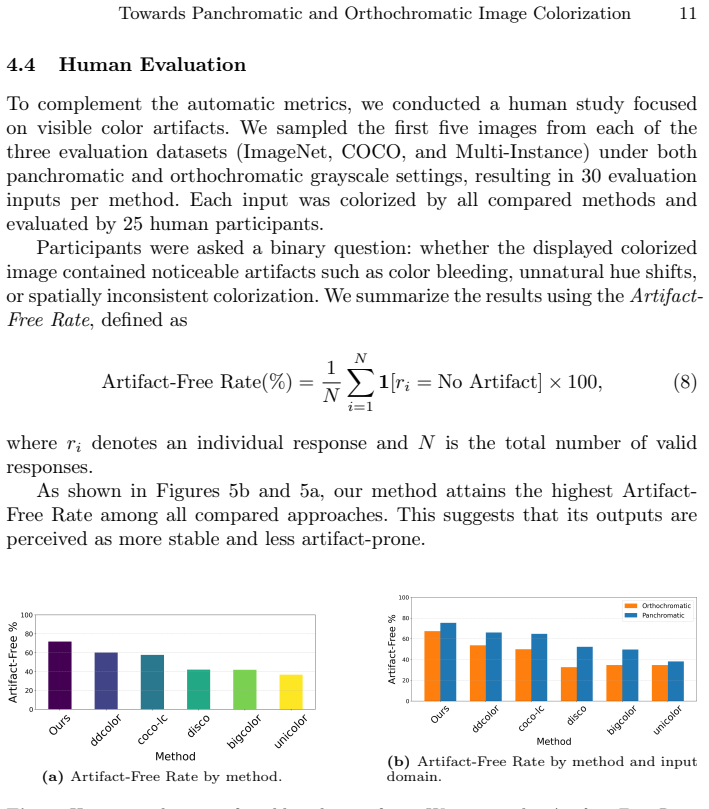
- The human study indicates fewer visible color artifacts—bleeding, unnatural hue shifts, inconsistent colorization—under both input types, so the full-RGB formulation does not come at the cost of perceptual cleanliness.
- Grayscale-reprojection checks show the fine-tuned model preserves input structure (SSIM around 0.81–0.88 versus 0.36 for the non-fine-tuned backbone), suggesting the generative prior is not hallucinating content.
Reading between the lines
- Beyond the paper, the mixed grayscale objective is effectively a domain-randomization strategy over grayscale formations; a straightforward extension would train on a continuum of spectral-sensitivity curves rather than two fixed modes, which the paper's limitations section already hints at.
- Beyond the paper, because the method follows multi-color text prompts correctly (e.g., assigning blue, yellow, and cyan to three cups), full-RGB colorization could become a controllable editing tool where a user specifies object-level colors, not just a global palette.
- Beyond the paper, the fixed-luminance argument implies a diagnostic that can be applied to any colorizer: take a dark grayscale patch that should be a bright red or yellow surface and check whether the output's RGB luminance can exceed the input's; for Lab-based models this is impossible.
- Beyond the paper, if the simulation $(I_B+I_G)/2$ is representative, the same training recipe should transfer to other non-standard inputs such as infrared or channel-drop imagery, though the paper does not test this.
Signed reviews
Editorial analysis
A structured set of objections, weighed in public.
Referee Report
Summary. The paper proposes a luminance-agnostic image colorization framework built on a foundation image-editing model (FLUX.2-klein). Instead of predicting chroma under a fixed luminance channel, the method fine-tunes the model with LoRA to generate full RGB output directly from grayscale input, conditioned on a text prompt. To handle both modern panchromatic and historical orthochromatic imagery, the authors introduce a mixed grayscale objective that trains on two synthetic grayscale formations: standard luminance (Eq. 1) and a simplified orthochromatic formation (Eq. 2), I_ortho_gray = (I_B + I_G)/2. Experiments on COCO, ImageNet, and a multi-instance benchmark report FID-family and colorfulness metrics for pan and ortho settings, structural-fidelity checks via grayscale reprojection, a small human study on artifacts, and qualitative results on real historical glass-plate photographs. The central claim is that the method is competitive on standard grayscale inputs and substantially more robust on orthochromatic inputs.
Significance. If substantiated, the paper addresses a genuine limitation of the fixed-luminance paradigm in colorization: such methods cannot brighten dark regions when the input grayscale deviates from natural luminance, which is exactly the situation for red-insensitive orthochromatic film. The proposed full-RGB editing formulation is a sensible alternative, and the mixed-objective training idea is a reasonable way to expose the model to multiple grayscale formations. The paper's strengths include a clear articulation of the bottleneck, a concrete training recipe with publicly described configuration, structural-fidelity verification that fine-tuning preserves input structure, and the inclusion of real archival images as qualitative evidence. However, the quantitative support for the central orthochromatic-robustness claim is currently limited to the same synthetic transform used in training, and the contribution of the mixed objective is not ablated on the color metrics that drive the headline results. The human study is small and lacks statistical analysis.
major comments (3)
- [Section 3, Eq. (2), Section 4.3, Tables 1-3] The quantitative orthochromatic evaluation uses exactly the same synthetic grayscale formation, I_ortho_gray = (I_B + I_G)/2, that was used to construct the training distribution. This creates a train/test distributional coupling: the model is trained to invert this specific blue-green average, while all baselines are evaluated on a formation they never saw. The real-archive evaluation in Figure 4 is qualitative only, with no FID, color metrics, or artifact-free rates. The Limitations section explicitly concedes that the simulation is a simplified approximation of historical film response. As a result, the central claim of 'substantially more robust on orthochromatic inputs' is currently supported only on a self-generated distribution. I recommend either adding quantitative evaluation on real orthochromatic photographs (or on a diverse set of physically motivated spectral-sensitivity models), or explicitly scoping the claim to robustness under the simulated (B+G)/2 formation rather than to historical orthochromatic imagery in general.
- [Section 4.3, Tables 4-6] The Mixed Grayscale Objective is the paper's claimed core contribution, but it is never ablated on the color metrics that appear in Tables 1-3. Tables 4-6 compare Not-FT, Normal-FT, and Mixed-FT only on grayscale reprojection fidelity (L1/L2/SSIM), and on those structural metrics Mixed-FT is not consistently better than Normal-FT (e.g., Table 4, ortho SSIM: Mixed-FT 0.811 vs Normal-FT 0.828; Table 5, ortho SSIM: 0.842 vs 0.857). Without reporting FID, sFID, FID-DINO, Colorfulness, Col-diverse, Saturation, or ColorNet for the Normal-FT variant, it is impossible to attribute the ortho robustness gains in Tables 1-3 to the mixed objective rather than to the full-RGB fine-tuning alone. Please add the Normal-FT model to the ortho rows of Tables 1-3 (or provide a dedicated ablation table with these color metrics).
- [Section 4.4, Eq. (8)] The human study is based on only 30 inputs per method (5 images × 3 datasets × 2 grayscale settings) and 25 participants, and it reports only a binary artifact-free rate without any statistical test or confidence interval. The claim that 'our method attains the highest Artifact-Free Rate' is therefore not established beyond chance. Given that this evidence is cited in the abstract and conclusion, please either add a statistical analysis (e.g., bootstrap confidence intervals, a mixed-effects model with participant as a random effect) or soften the wording to indicate an exploratory result.
minor comments (5)
- [Section 4.3, Tables 1-3] In the text, ImageNet is described as 'strongest overall in the ortho setting,' but on COCO the method does not achieve the best FID or sFID; please make the per-benchmark descriptions precise to avoid over-generalization.
- [Section 2.1] There is a typo in the HistoryNet sentence: 'andalargeold-moviedataset' should read 'and a large old-movie dataset.'
- [Section 4.4] The Artifact-Free Rate equation uses N for total valid responses, but the preceding text says '30 evaluation inputs per method'; please clarify whether N is the number of images or the number of participant responses.
- [Section 3] The notation for prompts, c_pan and c_ortho, is clear, but it is not stated explicitly how the caption component is obtained for the Multi-Instance dataset versus the other datasets; a sentence clarifying the captioning pipeline would improve reproducibility.
- [Tables 4-6] Please define 'Normal-FT' and 'Mixed-FT' unambiguously in a caption or in the text: specifically, that Normal-FT is fine-tuned only on panchromatic grayscale with the pan prompt, while Mixed-FT is fine-tuned on both modes.
Circularity Check
The derivation is self-contained; the synthetic ortho train/eval overlap is an acknowledged external-validity limitation, not circularity.
full rationale
The paper's derivation chain is self-contained: Equations (1) and (2) define the two grayscale inputs, Equations (3) and (4) define the rectified-flow training objective with the network predicting z1 - z0, and all reported FID, sFID, FID-DINO, colorfulness, chroma-diversity, saturation, and ColorNet scores are computed externally from generated outputs and ground-truth images. No reported metric is used as a training loss or fitted parameter, and no claimed prediction is an algebraic rearrangement of its own input. The only overlap is that orthochromatic evaluation uses the same (I_B + I_G)/2 transform that defines the orthochromatic training distribution; this is a train/eval distribution match rather than a circular reduction, and all baselines are evaluated on the identical inputs, so the comparison is not forced by construction. The paper explicitly concedes in the Limitations section that 'our orthochromatic simulation is a simplified approximation of historical film response, while real archival imagery exhibits diverse capture and aging effects,' and the real glass-plate results in Figure 4 provide qualitative external grounding. No load-bearing self-citation or imported uniqueness theorem appears, and the method is not derived from the metrics it reports. The central claim therefore has independent empirical content, even though generalization to real historical film remains an external-validity question rather than a circularity problem.
Assumptions & free parameters
free parameters (1)
- Orthochromatic grayscale coefficients =
0.5 (blue), 0.5 (green)
assumptions (5)
- domain assumption Standard luminance formula in Eq. (1) models panchromatic grayscale.
- domain assumption Orthochromatic film is effectively insensitive to red light.
- ad hoc to paper The simplified ortho formula (B+G)/2 adequately represents historical red-insensitive film response.
- domain assumption FLUX.2-klein's image-editing prior transfers to colorization via LoRA fine-tuning.
- domain assumption The reported metrics (FID, sFID, FID-DINO, Colorfulness, Col-diverse, Saturation, ColorNet) reflect colorization quality.
Cite this review
Pith. "Pith review of Beyond Fixed Luminance: Towards Panchromatic and Orthochromatic Image Colorization." pith.science (2026). https://pith.science/paper/ILAU55MZ
@misc{pith2026260810798,
  author       = {Pith},
  title        = {Pith review of: Beyond Fixed Luminance: Towards Panchromatic and Orthochromatic Image Colorization},
  year         = {2026},
  howpublished = {\url{https://pith.science/paper/ILAU55MZ}},
  note         = {Machine review of arXiv:2608.10798}
}
abstract
Most image colorization systems operate in $Lab$ space by predicting chroma ($ab$) while preserving an input-derived luminance channel ($L$). While effective on standard benchmarks, this fixed-luminance design restricts brightness changes and becomes unreliable when grayscale formation deviates from natural-image luminance, as in historical orthochromatic photography. We propose a luminance-agnostic colorization framework that formulates colorization as full-RGB image editing using a foundation image-editing model. To bridge modern panchromatic and historical orthochromatic conditions, we introduce a mixed grayscale objective that trains the model under both standard luminance grayscale and a red-insensitive grayscale formation. Experiments on COCO, ImageNet, and a multi-instance benchmark show that our method is competitive on standard grayscale inputs and substantially more robust under orthochromatic inputs, with qualitative comparisons and a human study indicating fewer visible color artifacts.
Figures


Figures from the paper (3 more)


Reference graph
Works this paper leans on
-
[1]
Antic, J.: Deoldify: A deep learning based project for colorizing and restoring old images (and video!) (2019),https://github.com/jantic/DeOldify, accessed: 2026-02-15
2019
-
[2]
In: ACM SIGGRAPH 2024 Conference Papers
Bozic, V., Djelouah, A., Zhang, Y., Timofte, R., Gross, M., Schroers, C.: Versatile vision foundation model for image and video colorization. In: ACM SIGGRAPH 2024 Conference Papers. pp. 1–11 (2024)
2024
-
[3]
arXiv preprint arXiv:1809.11096 (2018) Towards Panchromatic and Orthochromatic Image Colorization 15
Brock, A., Donahue, J., Simonyan, K.: Large scale gan training for high fidelity natural image synthesis. arXiv preprint arXiv:1809.11096 (2018) Towards Panchromatic and Orthochromatic Image Colorization 15
arXiv 2018
-
[4]
In:ProceedingsoftheIEEEconferenceoncomputervisionandpatternrecognition
Caesar, H., Uijlings, J., Ferrari, V.: Coco-stuff: Thing and stuff classes in context. In:ProceedingsoftheIEEEconferenceoncomputervisionandpatternrecognition. pp. 1209–1218 (2018)
2018
-
[5]
In: NeurIPS (2023)
Chang, Z., Weng, S., Zhang, P., Li, Y., Li, S., Shi, B.: L-cad: Language-based colorization with any-level descriptions using diffusion priors. In: NeurIPS (2023)
2023
-
[6]
In: CVPR (2023)
Chang, Z., Weng, S., Zhang, P., Li, Y., Li, S., Shi, B.: L-coins: Language-based colorization with instance awareness. In: CVPR (2023)
2023
-
[7]
Available:https://github.com/chaofengc/IQA-PyTorch(2022), accessed: 2026-02-15
Chen,C.,Mo,J.:IQA-PyTorch:Pytorchtoolboxforimagequalityassessment.[On- line]. Available:https://github.com/chaofengc/IQA-PyTorch(2022), accessed: 2026-02-15
2022
-
[8]
Accessed: 2026-02-15
Commission Internationale de l’Éclairage (CIE): Colorimetry—part 4: Cie 1976 l*a*b* colour space (2007),https://cie.co.at/publications/colorimetry- part-4-cie-1976-lab-colour-space-1, standard CIE S 014-4/E:2007. Accessed: 2026-02-15
2007
Show all 44 references
-
[9]
arXiv preprint arXiv:2011.07466 (2020)
Ding, X., Wang, Y., Xu, Z., Welch, W.J., Wang, Z.J.: Continuous conditional generative adversarial networks for image generation: Novel losses and label input mechanisms. arXiv preprint arXiv:2011.07466 (2020)
2020 arXiv
-
[10]
arXiv preprint arXiv:2408.04172 (2024)
Du, X., Zhou, Z., Wang, Y., Wang, Z., Zheng, Y., Jin, C.: Multicolor: Image col- orization by learning from multiple color spaces. arXiv preprint arXiv:2408.04172 (2024)
2024 arXiv
-
[11]
com/technology/orthochromatic-film, describes orthochromatic films as sensi- tive to violet/blue/green/yellow but not to red
Encyclopaedia Britannica: Orthochromatic film (nd),https://www.britannica. com/technology/orthochromatic-film, describes orthochromatic films as sensi- tive to violet/blue/green/yellow but not to red. Accessed: 2026-02-15
2026
-
[12]
Accessed: 2026-02-15
Film Colors: Orthochromatic stock (nd),https://filmcolors.org/timeline- entry/1346/, historical note: sensitivity extended to record green as well as blue (Vogel, 1873). Accessed: 2026-02-15
2026
-
[13]
In: Human vision and electronic imaging VIII
Hasler, D., Suesstrunk, S.E.: Measuring colorfulness in natural images. In: Human vision and electronic imaging VIII. vol. 5007, pp. 87–95. SPIE (2003)
2003
-
[14]
In: NeurIPS (2017)
Heusel,M.,Ramsauer,H.,Unterthiner,T.,Nessler,B.,Hochreiter,S.:Ganstrained by a two time-scale update rule converge to a local nash equilibrium. In: NeurIPS (2017)
2017
-
[15]
ACM TOG (2022)
Huang, Z., Zhao, N., Liao, J.: Unicolor: A unified framework for multi-modal col- orization with transformer. ACM TOG (2022)
2022
-
[16]
In: ECCV (2022)
Ji, X., Jiang, B., Luo, D., Tao, G., Chu, W., Xie, Z., Wang, C., Tai, Y.: Color- former: Image colorization via color memory assisted hybrid-attention transformer. In: ECCV (2022)
2022
-
[17]
In: ACM MM (2021)
Jin, X., Li, Z., Liu, K., Zou, D., Li, X., Zhu, X., Zhou, Z., Sun, Q., Liu, Q.: Focusing on persons: Colorizing old images learning from modern historical movies. In: ACM MM (2021)
2021
-
[18]
com/competitions/imagenet-object-localization-challenge/data, accessed: 2026-02-15
Kaggle: Imagenet object localization challenge (2020),https://www.kaggle. com/competitions/imagenet-object-localization-challenge/data, accessed: 2026-02-15
2020
-
[19]
In: ICCV (2023)
Kang, X., Yang, T., Ouyang, W., Ren, P., Li, L., Xie, X.: Ddcolor: Towards photo- realistic image colorization via dual decoders. In: ICCV (2023)
2023
-
[20]
In: ECCV (2022)
Kim,G.,Kang,K.,Kim,S.,Lee,H.,Kim,S.,Kim,J.,Baek,S.H.,Cho,S.:Bigcolor: Colorization using a generative color prior for natural images. In: ECCV (2022)
2022
-
[21]
Kodak: Basic sensitometry and characteristics of film (film essentials, module
-
[22]
Accessed: 2026-02-15
(nd),https://www.kodak.com/uploadedfiles/motion/US_plugins_acrobat_ en_motion_newsletters_filmEss_06_Characteristics_of_Film.pdf, states or- thochromatic films are sensitive mainly to the blue-green portions of the visible spectrum. Accessed: 2026-02-15. 16 S. Maheshwari et al
2026
-
[23]
Orthochromatic (Ortho) Film
Kodak: Glossary of motion picture terms (nd),https://www.kodak.com/en/ motion / page / glossary - of - motion - picture - terms/, entry: “Orthochromatic (Ortho) Film” (sensitive to only blue and green light). Accessed: 2026-02-15
2026
-
[24]
Kumar,M.,Weissenborn,D.,Kalchbrenner,N.:Colorizationtransformer.In:ICLR (2021)
2021
-
[25]
Labs, B.F.: FLUX.2: Frontier Visual Intelligence.https://bfl.ai/blog/flux-2 (2025), accessed: 2026-02-15
2025
-
[26]
Labs,B.F.,Batifol,S.,Blattmann,A.,Boesel,F.,Consul,S.,Diagne,C.,Dockhorn, T., English, J., English, Z., Esser, P., Kulal, S., Lacey, K., Levi, Y., Li, C., Lorenz, D., Müller, J., Podell, D., Rombach, R., Saini, H., Sauer, A., Smith, L.: Flux.1 kontext: Flow matching for in-con...
2025 arXiv
-
[27]
In: International conference on machine learning
Li, J., Li, D., Savarese, S., Hoi, S.: Blip-2: Bootstrapping language-image pre- training with frozen image encoders and large language models. In: International conference on machine learning. pp. 19730–19742. PMLR (2023)
2023
-
[28]
In: ACM MM (2024)
Li, Y., Bai, Y., Yang, S., Liu, J.: Coco-lc: Colorfulness controllable language-based colorization. In: ACM MM (2024)
2024
-
[29]
arXiv:2402.10855 (2024)
Liang, Z., Li, Z., Zhou, S., Li, C., Loy, C.C.: Control color: Multimodal diffusion- based interactive image colorization. arXiv:2402.10855 (2024)
2024 arXiv
-
[30]
arXiv preprint arXiv:2304.11105 (2023)
Liu, H., Xing, J., Xie, M., Li, C., Wong, T.T.: Improved diffusion-based image colorization via piggybacked models. arXiv preprint arXiv:2304.11105 (2023)
2023 arXiv
-
[31]
ACM Transactions on Graphics (Proceedings of ACM SIG- GRAPH Asia 2021)40(6) (12 2021).https://doi.org/https://doi.org/10
Luo, X., Zhang, X., Yoo, P., Martin-Brualla, R., Lawrence, J., Seitz, S.M.: Time- travel rephotography. ACM Transactions on Graphics (Proceedings of ACM SIG- GRAPH Asia 2021)40(6) (12 2021).https://doi.org/https://doi.org/10. 1145/3478513.3480485
2021
-
[32]
Minnesota Digital Li- brary (2024),https://collection.mndigital.org/?f%5Bphysical_format_ssi% 5D%5B%5D=Glass+plate+negatives, accessed: 2026-02-15
Minnesota Digital Library: Glass plate negatives collection. Minnesota Digital Li- brary (2024),https://collection.mndigital.org/?f%5Bphysical_format_ssi% 5D%5B%5D=Glass+plate+negatives, accessed: 2026-02-15
2024
-
[33]
Oquab, M., Darcet, T., Moutakanni, T., Vo, H.V., Szafraniec, M., Khalidov, V., Fernandez,P.,Haziza,D.,Massa,F.,El-Nouby,A.,Howes,R.,Huang,P.Y.,Xu,H., Sharma, V., Li, S.W., Galuba, W., Rabbat, M., Assran, M., Ballas, N., Synnaeve, G., Misra, I., Jegou, H., Mairal, J., Labatut, ...
2023
-
[34]
International journal of computer vision115, 211–252 (2015)
Russakovsky, O., Deng, J., Su, H., Krause, J., Satheesh, S., Ma, S., Huang, Z., Karpathy, A., Khosla, A., Bernstein, M., et al.: Imagenet large scale visual recog- nition challenge. International journal of computer vision115, 211–252 (2015)
2015
-
[35]
In: CVPR (2020)
Su, J.W., Chu, H.K., Huang, J.B.: Instance-aware image colorization. In: CVPR (2020)
2020
-
[36]
In: WACV (March 2020)
Vitoria, P., Raad, L., Ballester, C.: Chromagan: Adversarial picture colorization with semantic class distribution. In: WACV (March 2020)
2020
-
[37]
In: ECCV (2022)
Weng, S., Sun, J., Li, Y., Li, S., Shi, B.: Ct2: Colorization transformer via color tokens. In: ECCV (2022)
2022
-
[38]
Wu, C., Li, J., Zhou, J., Lin, J., Gao, K., Yan, K., ming Yin, S., Bai, S., Xu, X., Chen, Y., Chen, Y., Tang, Z., Zhang, Z., Wang, Z., Yang, A., Yu, B., Cheng, C., Liu, D., Li, D., Zhang, H., Meng, H., Wei, H., Ni, J., Chen, K., Cao, K., Peng, L., Qu, L., Wu, M., Wang, P., Yu,...
2025 arXiv
-
[39]
In: CVPR (2021) Towards Panchromatic and Orthochromatic Image Colorization 17
Wu, Y., Wang, X., Li, Y., Zhang, H., Zhao, X., Shan, Y.: Towards vivid and diverse image colorization with generative color prior. In: CVPR (2021) Towards Panchromatic and Orthochromatic Image Colorization 17
2021
-
[40]
ACM TOG (2022)
Xia, M., Hu, W., Wong, T.T., Wang, J.: Disentangled image colorization via global anchors. ACM TOG (2022)
2022
-
[41]
In: SIGGRAPH Asia 2023 Conference Papers (2023)
Zabari, N., Azulay, A., Gorkor, A., Halperin, T., Fried, O.: Diffusing colors: Im- age colorization with text guided diffusion. In: SIGGRAPH Asia 2023 Conference Papers (2023)
2023
-
[42]
In: 2019 IEEE International Conference on Image Processing (ICIP)
Zerman, E., Rana, A., Smolic, A.: Colornet-estimating colorfulness in natural im- ages. In: 2019 IEEE International Conference on Image Processing (ICIP). pp. 3791–3795. IEEE (2019)
2019
-
[43]
In: CVPR (2023)
Zhang, L., Rao, A., Agrawala, M.: Adding conditional control to text-to-image diffusion models. In: CVPR (2023)
2023
-
[44]
In: ECCV (2016)
Zhang, R., Isola, P., Efros, A.A.: Colorful image colorization. In: ECCV (2016)
2016
Reviewed August 15, 2026 · model on record in the stance chip above.
Discussion (0). Continue with ORCID to comment.