REVIEW 2 major objections 1 minor 46 references
The superconducting state in electron-doped rhombohedral tetralayer graphene carries a finite orbital magnetic moment.
Reviewed by Pith at T0; open to challenge. T0 means a machine referee read the full paper against a public rubric. the ladder, T0–T4 →
T0 review · grok-4.3
2026-06-29 05:32 UTC pith:INOZA4PX
load-bearing objection Tetralayer data shows finite orbital moment inside the zero-resistance state, but normal-state inhomogeneity undercuts the clean attribution to chiral SC. the 2 major comments →
Visualizing orbital magnetism in electron doped rhombohedral multilayer graphene
The pith
A machine-rendered reading of the paper's core claim, the machinery that carries it, and where it could break.
Core claim
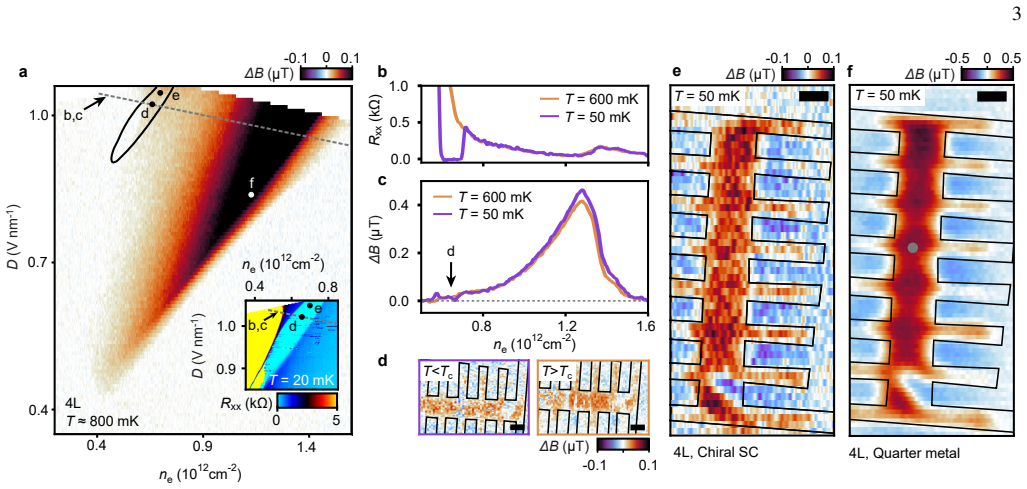
Correlating transport and local magnetometry data in a tetralayer sample reveals that the superconducting state has a finite orbital magnetic moment, providing direct evidence of its chiral nature.
What carries the argument
NanoSQUID-on-tip magnetometry that resolves the local orbital magnetization and correlates it with simultaneous transport measurements inside the zero-resistance regime.
Load-bearing premise
The measured local magnetization signal inside the zero-resistance regime originates only from the orbital moment of a finite-momentum chiral Cooper-pair condensate.
What would settle it
A scan that finds zero net orbital magnetization throughout the superconducting transition while zero resistance is still observed would falsify the finite-moment claim.
If this is right
- The quarter-metal magnetization peaks at finite density because Berry curvature concentrates along a ring of finite momentum.
- The zero-resistance state is a chiral superconductor formed by a finite-momentum Cooper-pair condensate.
- Density-tuned sign reversal of the valley magnetic moment produces metastable domains and enables gate-controlled switching of the orbital moment.
- Strain-tuned competition between magnetic and non-magnetic states appears as inhomogeneity inside the apparent normal state of the superconductor.
Where Pith is reading between the lines
- The same local-magnetometry approach could be applied to other candidate chiral superconductors to test for finite orbital moments.
- Gate sequences that avoid crossing the sign-change line may suppress domain formation and stabilize the superconducting state over larger areas.
- The narrow layer-number window for chiral superconductivity may reflect a delicate balance between strain and the magnetic energy scale.
Editorial analysis
A structured set of objections, weighed in public.
Referee Report
Summary. This paper uses nanoSQUID-on-tip magnetometry to map orbital magnetization in electron-doped rhombohedral multilayer graphene devices (3-13 layers). Magnetization in quarter-metal phases peaks at finite density, consistent with Berry curvature concentration in a 'ring of fire'. Correlating transport and local magnetometry in a tetralayer sample shows the superconducting state has a finite orbital magnetic moment, interpreted as direct evidence of its chiral nature with finite-momentum pairing. Stochastic resistivity switching is attributed to density-tuned sign changes in valley-resolved magnetic moments leading to metastable domains, and magnetic inhomogeneity is observed specifically in the apparent normal state of the chiral superconductor, suggestive of strain-tuned competition between magnetic and non-magnetic ground states.
Significance. If the attribution of the zero-resistance magnetization signal to the chiral superconducting condensate can be isolated from other sources, the work would provide important direct local-probe evidence linking orbital magnetism to chiral superconductivity in a flat-band system. The spatially resolved visualization of magnetization, electric-field control of orbital moments, and observations of competing orders would strengthen understanding of pairing and ground-state competition in rhombohedral graphene multilayers.
major comments (2)
- [Abstract] Abstract: The central claim that the local magnetization signal correlated with zero resistance originates purely from the orbital moment of the finite-momentum chiral Cooper pair condensate (providing 'direct evidence' of chirality) is load-bearing, yet the abstract explicitly reports magnetic inhomogeneity specific to the apparent normal state. This raises the possibility of contributions from normal-state domains or strain effects, and the manuscript does not describe explicit spatial mapping, density-dependent controls, or subtraction procedures in the tetralayer data to isolate the superconducting contribution.
- [Abstract] Abstract: The presentation of correlations between transport and magnetometry lacks quantitative details on signal magnitudes, error analysis, background subtraction methods, or how the local signal is distinguished from trapped flux or other artifacts, which are required to support the interpretation that the moment proves the chiral nature of the superconducting state.
minor comments (1)
- The abstract would benefit from explicit reference to the specific figures or sections presenting the tetralayer transport-magnetometry correlation data.
Simulated Author's Rebuttal
We thank the referee for their careful reading and constructive comments. We address the two major comments point by point below, with planned revisions to improve clarity and support for the central claims.
read point-by-point responses
-
Referee: [Abstract] Abstract: The central claim that the local magnetization signal correlated with zero resistance originates purely from the orbital moment of the finite-momentum chiral Cooper pair condensate (providing 'direct evidence' of chirality) is load-bearing, yet the abstract explicitly reports magnetic inhomogeneity specific to the apparent normal state. This raises the possibility of contributions from normal-state domains or strain effects, and the manuscript does not describe explicit spatial mapping, density-dependent controls, or subtraction procedures in the tetralayer data to isolate the superconducting contribution.
Authors: We agree that the reported normal-state inhomogeneity requires explicit isolation of any superconducting contribution to support the interpretation. The manuscript correlates the appearance of a uniform magnetization signal with the onset of zero resistance in the tetralayer device, and notes that this signal is absent or inhomogeneous above the transition. To strengthen this, the revised manuscript will add a dedicated subsection detailing the spatial maps acquired across the density-tuned transition, the density-dependent controls performed, and the precise subtraction procedures (including reference scans above Tc) used to isolate the superconducting-state moment from normal-state or strain-related backgrounds. revision: yes
-
Referee: [Abstract] Abstract: The presentation of correlations between transport and magnetometry lacks quantitative details on signal magnitudes, error analysis, background subtraction methods, or how the local signal is distinguished from trapped flux or other artifacts, which are required to support the interpretation that the moment proves the chiral nature of the superconducting state.
Authors: We concur that quantitative details are needed to robustly distinguish the observed moment from artifacts. The revised version will report the measured magnetization values (in units of Bohr magnetons per area) in the superconducting regime together with standard errors from repeated scans, describe the background subtraction protocol (including comparison to normal-state and high-temperature reference data to rule out trapped flux), and include an analysis showing that the signal magnitude and spatial uniformity are inconsistent with normal-state domain contributions or flux-trapping artifacts. revision: yes
Circularity Check
No circularity: purely experimental measurements with independent observables
full rationale
The paper reports nanoSQUID-on-tip magnetometry maps of orbital magnetization correlated against transport data in multilayer graphene devices. No derivations, ansatze, fitted parameters renamed as predictions, or self-citation load-bearing steps appear in the abstract or described methods. Central claims rest on direct spatial correlations between zero-resistance regimes and local magnetization signals, which are independent external benchmarks rather than reductions to the paper's own inputs. This matches the default expectation for experimental reports with no derivation chain.
Axiom & Free-Parameter Ledger
axioms (1)
- domain assumption Zero-resistance state arises from a chiral superconductor with finite-momentum pairing
read the original abstract
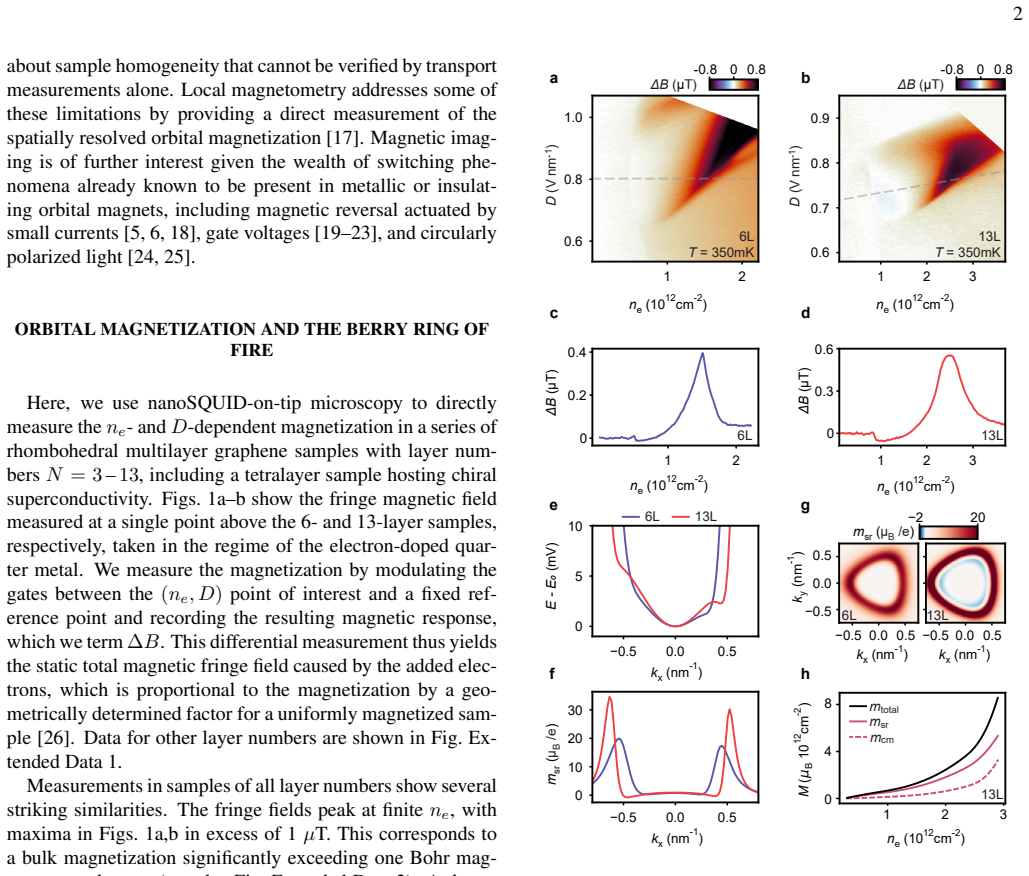
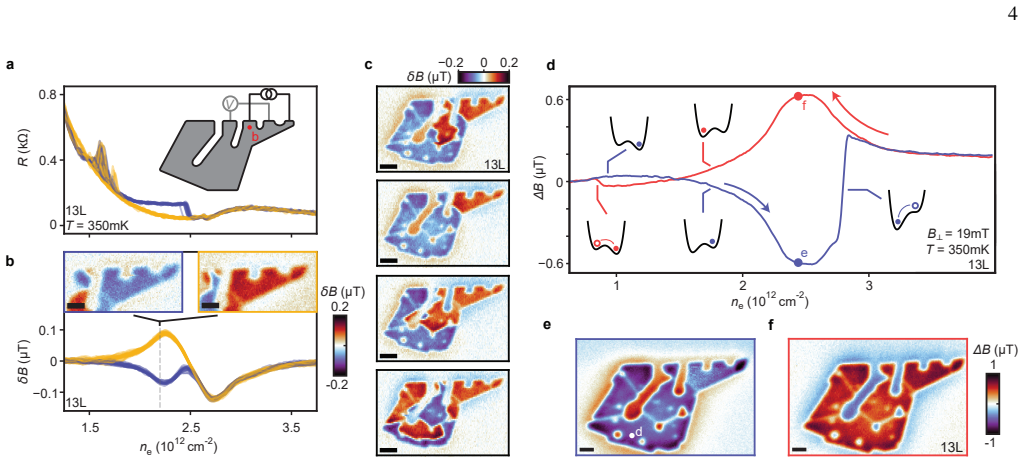
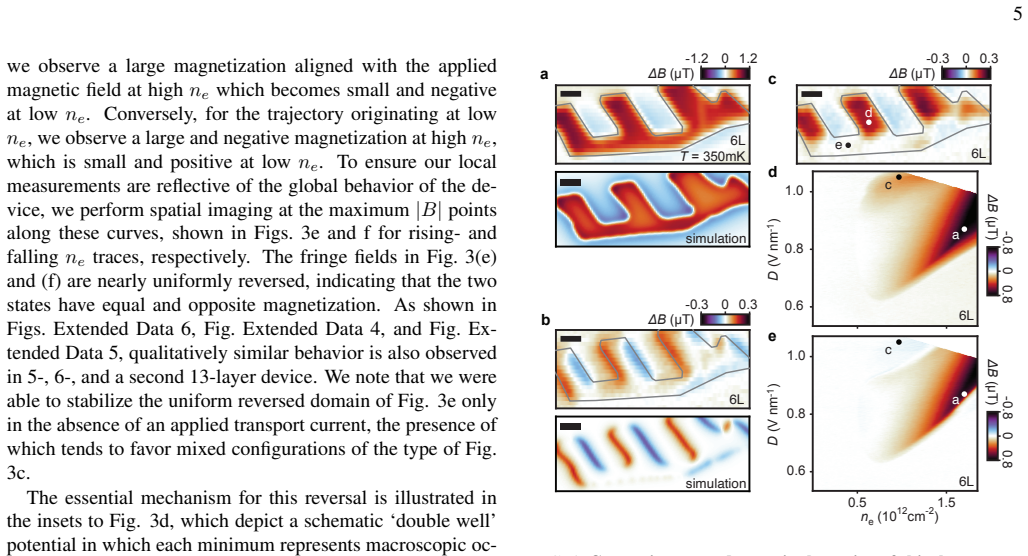
Electron doped rhombohedral multilayer graphene at high displacement field features an exceptionally flat band minimum with near-ideal quantum geometry. Experiments in this regime observe the formation of a 'quarter metal,' in which the electron liquid condenses into a single spin- and valley flavor. Remarkably, recent experiments have found a zero resistance state in the same region of the density- and displacement-field-tuned parameter space, attributed to the formation of a chiral superconductor characterized by a finite-momentum Cooper pair condensate. Here, we use nanoSQUID-on-tip magnetometry to map the orbital magnetization of electron-doped rhombohedral graphene devices ranging in thickness between 3 and 13 layers. Magnetization within the quarter metal phases peaks at finite density, consistent with concentration of the Berry curvature in a finite-momentum 'ring of fire'. Correlating transport and local magnetometry data in a tetralayer sample reveals that the superconducting state has a finite orbital magnetic moment, providing direct evidence of its chiral nature. We further show that widely observed stochastic switching of the resistivity in the metallic regime arises from a density-tuned sign change in the valley-resolved total magnetic moment. This leads to the formation of metastable magnetic domains under typical gate control sequences and can also be harnessed for electric-field controlled switching of orbital moment across the entire device. Unexpectedly, we find magnetic inhomogeneity specific to the apparent normal state of the chiral superconductor, suggestive of a strain-tuned competition between magnetic and non-magnetic ground states. Our results point to a subtle energetic competition underlying the observation of chiral superconductivity in a narrow range of layer numbers.
Figures
Reference graph
Works this paper leans on
-
[1]
Zhou,et al.,Nature598, 429 (2021)
H. Zhou,et al.,Nature598, 429 (2021)
2021
-
[2]
Han,et al.,Naturepp
T. Han,et al.,Naturepp. 1–3 (2025)
2025
-
[3]
Zhang, J
F. Zhang, J. Jung, G. A. Fiete, Q. Niu, A. H. MacDonald,Phys- ical Review Letters106, 156801 (2011)
2011
-
[4]
A. S. Patri, M. Franz,Phys. Rev. B112, 214505 (2025)
2025
-
[5]
A. L. Sharpe,et al.,Science365, 605 (2019)
2019
-
[6]
Serlin,et al.,Science367, 900 (2020)
M. Serlin,et al.,Science367, 900 (2020)
2020
-
[7]
C. L. Tschirhart,et al.,Science372, 1323 (2021)
2021
-
[8]
Xiao, M.-C
D. Xiao, M.-C. Chang, Q. Niu,Reviews of Modern Physics 2010, 1959 (2010)
2010
-
[9]
Vanderbilt,Berry phases in electronic structure theory: elec- tric polarization, orbital magnetization and topological insula- tors(Cambridge University Press, 2018)
D. Vanderbilt,Berry phases in electronic structure theory: elec- tric polarization, orbital magnetization and topological insula- tors(Cambridge University Press, 2018)
2018
-
[10]
Qin,et al., Extreme anisotropy in the metallic and supercon- ducting phases of rhombohedral hexalayer graphene (2026)
P. Qin,et al., Extreme anisotropy in the metallic and supercon- ducting phases of rhombohedral hexalayer graphene (2026)
2026
- [11]
-
[12]
Verma, R
N. Verma, R. Queiroz,Proceedings of the National Academy of Sciences122, e2405837122 (2025)
2025
-
[13]
Peotta, P
S. Peotta, P. T ¨orm¨a,Nature communications6, 8944 (2015)
2015
-
[14]
Yu,et al.,npj Quantum Materials10, 101 (2025)
J. Yu,et al.,npj Quantum Materials10, 101 (2025)
2025
- [15]
-
[16]
May-Mann, T
J. May-Mann, T. Helbig, T. Devakul,npj Quantum Materials (2026)
2026
-
[17]
Finkler,et al.,Review of Scientific Instruments83(2012)
A. Finkler,et al.,Review of Scientific Instruments83(2012)
2012
-
[18]
C. L. Tschirhart,et al.,Nature Physicspp. 1–7 (2023)
2023
-
[19]
Polshyn,et al.,Nature588, 66 (2020)
H. Polshyn,et al.,Nature588, 66 (2020)
2020
-
[20]
Han,et al.,Nature623, 41 (2023)
T. Han,et al.,Nature623, 41 (2023). Number: 7985 Publisher: Nature Publishing Group
2023
-
[21]
Choi,et al.,Naturepp
Y . Choi,et al.,Naturepp. 1–6 (2025)
2025
-
[22]
Zhu, J.-J
J. Zhu, J.-J. Su, A. H. MacDonald,Physical Review Letters125, 227702 (2020)
2020
-
[23]
Bocarsly,et al.,arXiv preprint arXiv:2603.21973(2026)
M. Bocarsly,et al.,arXiv preprint arXiv:2603.21973(2026)
-
[24]
Holtzmann,et al.,Nature649, 1147 (2026)
W. Holtzmann,et al.,Nature649, 1147 (2026)
2026
-
[25]
Persky,et al.,Nature Physicspp
E. Persky,et al.,Nature Physicspp. 1–8 (2026)
2026
-
[26]
C. L. Patterson,et al.,Nature641, 632 (2025)
2025
-
[27]
H. Zhou, T. Xie, T. Taniguchi, K. Watanabe, A. F. Young,Na- ture598, 434 (2021)
2021
- [28]
-
[29]
Li,et al.,Naturepp
Q. Li,et al.,Naturepp. 1–7 (2026)
2026
-
[30]
Reconfigurable chiral superconductivity
S. Dutta,et al.,arXiv preprint arXiv:2605.13303(2026)
work page internal anchor Pith review Pith/arXiv arXiv 2026
-
[31]
Pendharkar,et al.,Proceedings of the National Academy of Sciences121(2024)
M. Pendharkar,et al.,Proceedings of the National Academy of Sciences121(2024)
2024
-
[32]
Kim,et al.,Naturepp
H. Kim,et al.,Naturepp. 1–7 (2023)
2023
-
[33]
Cryogenic shock exfoliation for ultrahigh mobility rhombohedral graphite nanoelectronics
L. Holleis,et al.,arXiv preprint arXiv:2604.21912(2026)
work page internal anchor Pith review Pith/arXiv arXiv 2026
-
[34]
Holleis,et al.,Nano Letters25, 12487 (2025)
L. Holleis,et al.,Nano Letters25, 12487 (2025)
2025
-
[35]
C. H. Lui,et al.,Nano Letters11, 164 (2011)
2011
-
[36]
Zhang,et al.,Carbon99, 118 (2016)
X. Zhang,et al.,Carbon99, 118 (2016)
2016
-
[37]
Lu,et al.,Nature637, 1090 (2025)
Z. Lu,et al.,Nature637, 1090 (2025)
2025
-
[38]
Feng,et al.,Physical Review Applied23, 034012 (2025)
Z. Feng,et al.,Physical Review Applied23, 034012 (2025). Publisher: American Physical Society
2025
-
[39]
Flat band surface state superconductiv- ity in thick rhombohedral graphene,
Y . Guo,et al.,arXiv preprint arXiv:2511.17423(2025)
-
[40]
Anahory,et al.,Nanoscale12, 3174 (2020)
Y . Anahory,et al.,Nanoscale12, 3174 (2020)
2020
-
[41]
M. E. Huber,et al.,IEEE Transactions on Applied Supercon- ductivity11, 1251 (2001)
2001
-
[42]
Arp,et al.,Nature Physics20, 1413 (2024)
T. Arp,et al.,Nature Physics20, 1413 (2024)
2024
-
[43]
Zhang,et al.,arXiv preprint arXiv:2603.25807(2026)
R. Zhang,et al.,arXiv preprint arXiv:2603.25807(2026)
-
[44]
Auerbach,et al.,Nature Physics21, 1765 (2025)
N. Auerbach,et al.,Nature Physics21, 1765 (2025)
2025
-
[45]
Y . Park, Y . Kim, B. L. Chittari, J. Jung,Phys. Rev. B108, 155406 (2023)
2023
-
[46]
Pulay,Chemical Physics Letters73, 393 (1980)
P. Pulay,Chemical Physics Letters73, 393 (1980). 7 ACKNOWLEDGMENTS The authors would like to acknowledge discussions with Erez Berg, Mathieu Haguier, Julian May-Mann and Yaar Vi- turi. Work in the Young lab at UCSB was primarily supported by a MURI project of the Air Force Office of Scientific Re- search under grant number FA9550-25-1-0287. Additional sup...
1980
discussion (0)
Sign in with ORCID, Apple, or X to comment. Anyone can read and Pith papers without signing in.