REVIEW 4 major objections 5 minor 6 references
Be Decisive: Noise-Induced Layouts for Multi-Subject Generation
T0 review · 4 major / 5 minor · reviewed 2026-08-07 · deepseek-v4-flash
Pith's one-line read Multi-subject images get layouts read from the seed noise instead of imposed boxes
desk verdict Noise-derived layout is a real idea, but the evidence needs error bars and code before I trust the generalization claims. read the letter →
The pith
A machine-rendered reading of the paper's core claim, the machinery that carries it, and where it could break.
The reading
What carries the argument
The soft-layout is the central object: a timestep-dependent feature map whose per-pixel vectors are close exactly when those pixels belong to the same subject. A lightweight readout network, built on the Readout Guidance head design, predicts it from attention features of the denoising model and was trained with a triplet loss on roughly 1,500 auto-segmented images. K-means turns the soft-layout into a hard-layout of k subject clusters plus background, labeled by cross-attention responses via the Hungarian algorithm; decisive guidance then optimizes the latent so the next soft-layout agrees with the current hard-layout, mixing a cross-attention term, a variance term that compacts clusters, and a Dice term that stabilizes boundaries across timesteps.
What would settle it
Decode a fixed set of initial noises once with the paper's full method and once with vanilla SDXL, segment both sets of outputs with the same segmentation model, and compare the overlap between the first-step hard layout and the final subject regions; if that overlap is no better than a random partition's overlap with those regions, the seed noise is not the carrier of the layout.
Extended reading notes
Core claim
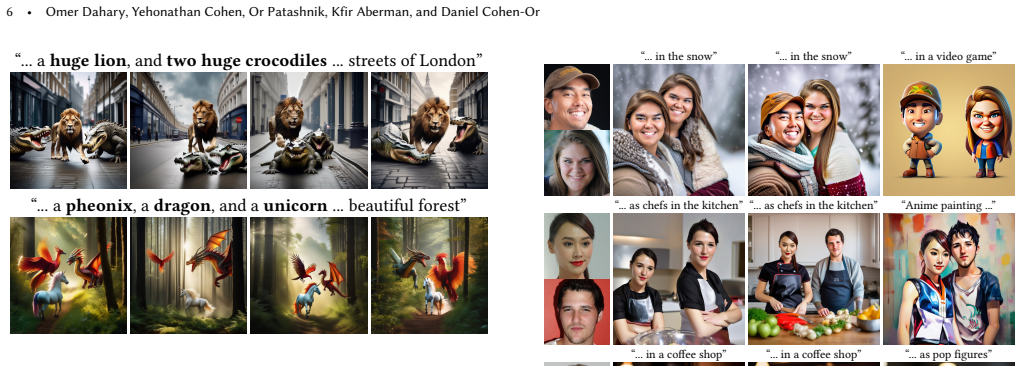
On the paper's own terms, the central discovery is that the spatial arrangement of a multi-subject image is fixed early by the initial noise, and that a lightweight network can expose this arrangement well enough to use as a layout. The method then commits to that layout, refining it slightly rather than replacing it. Concretely, a soft-layout feature map is predicted from self-attention keys and cross-attention queries; K-means clusters it into subject and background segments; and a decisive-guidance loss keeps each cluster tight and its boundaries stable across timesteps while Bounded Attention suppresses inter-subject leakage. The reported result is that prompts with several classes, attributes, and quantities are rendered accurately, with layout diversity that matches the prior rather than the restricted diversity of LLM-generated layouts.
Load-bearing premise
The method rests on the premise that the initial noise of the diffusion model already contains a spatial layout for the final image that is prompt-alignable and that a small network can read it at every denoising step; if the noise does not carry that layout, the predicted hard masks will not track real subject regions and leakage will not be prevented.
Editorial extensions
If this is right
- External layout inputs, whether user-drawn boxes or LLM-generated layouts, become unnecessary for multi-subject prompts.
- Multi-class, multi-attribute, and quantity-sensitive prompts score higher on T2I-CompBench color, texture, single-class, and multi-class metrics than the compared layout-based and layout-free alternatives.
- Sampling different seeds yields diverse, natural compositions because the denoising trajectory follows the seed's own noise-induced layout rather than an imposed one.
- The method composes with personalization: integrating it with a subject-injection method turns single-person personalization into multi-person images.
- The same Bounded Attention mask, when driven by a noise-derived layout, avoids the artifacts that appear when masks are prescribed externally.
Reading between the lines
- If the seed-noise layout premise generally holds, a similar readout could be trained once and reused across related tasks that need layout stability without user input, such as inpainting, editing with moving subjects, or consistent multi-subject video frames.
- Because the layout is read from the model's own prior, the method inherits the model's blind spots: prompts requiring spatial relations the model never learned will still fail, as the paper itself notes. A testable extension is whether enlarging the small auto-segmented training set with spatial-relation prompts would push that ceiling.
- The guidance step is the computational bottleneck; the paper's stated future direction of replacing iterative optimization with feature injection from a control map could be validated by checking whether the soft-layout network alone, without the loss, already yields the same final regions.
Editorial analysis
A structured set of objections, weighed in public.
Referee Report
Summary. The paper proposes "Be Decisive", an inference-time method for multi-subject text-to-image generation that removes the need for externally prescribed layouts. A small neural network predicts a time-varying "soft-layout" from SDXL's attention features at each denoising step; this soft-layout is clustered into a hard-layout used to bound attention (following Bounded Attention) and to define a "decisiveness" guidance loss that stabilizes subject boundaries across timesteps. The claimed contribution is that, by deriving the layout from the initial noise rather than imposing an external one, the method respects the model's prior, yielding diverse, prompt-aligned compositions. Experiments on T2I-CompBench, a user study, ablations, and a non-curated comparison support the qualitative and quantitative claims, although several load-bearing evaluations rely on the method's own predicted layouts or lack statistical rigor.
Significance. If the central claim holds, the method offers a practical way to achieve multi-subject alignment without user-provided layouts, addressing a known failure mode of text-to-image models. The idea of predicting a time-varying layout from the noise and then committing to it is elegant, and the paper includes several valuable components: a lightweight predictor trained on auto-generated data, an ablation study isolating the loss terms, a user study, and a non-curated comparison. The significance is conditional on the soft-layout predictor generalizing far beyond its narrow training distribution and on the layout-diversity metric actually measuring image diversity; both remain unestablished, so the contribution is promising but not yet fully demonstrated.
major comments (4)
- [§4.1, §4.3, Appendix A.2, Conclusion] The load-bearing component of the method is the soft-layout predictor, yet its generalization is asserted rather than measured. The predictor is trained on ~1,500 SDXL outputs from 20 MSCOCO classes with 1–3 classes, quantities 1–10, and generic prefixes/postfixes, but at inference it is applied to arbitrary prompts (e.g., four bear species in Fig. 8) and to latents that have been altered by the decisive guidance described in §4.3; the Conclusion itself concedes that guidance pushes the latent away from the prior. Because the hard-layouts of §4.2 and all three guidance losses of §4.3 are computed from the predicted soft-layout, a distribution-shift failure of the predictor would turn the masks into arbitrary K-Means splits and the guidance into a source of artifacts. Please provide a quantitative evaluation of layout-prediction accuracy (e.g., mask IoU against GroundedSAM on unseen complex prompts) and an analysis of predictor behavior under guidance-modified latents.
- [§5.2, Table 2] The quantitative claims of 'consistently high scores across all metrics' rest on point estimates without error bars, significance tests, or multiple trials (Table 2). More importantly, the layout-diversity metric is computed from the method's own predicted hard-layouts (for Ours) or from LLM-generated layouts (for LLM+BA), not from the actual generated images; this makes the diversity comparison confounded with the layout-prediction/generation process and does not directly measure the variability of the final compositions. The paper should either measure diversity on the generated images (e.g., via segmentation of the outputs) or justify why predicted-layout diversity is a faithful proxy.
- [§5.1, Figure 11] The non-curated comparison uses a single prompt and seven seeds. The claim that 'our method is able to correctly adhere to the prompt in each image' is made without a stated criterion for correctness, a blind evaluation, or an inter-rater agreement measure. Given that the user study (Table 1) is the primary evidence for semantic-leakage superiority, the single-prompt non-curated figure should be supported by a broader non-curated evaluation or by a quantitative correctness rate.
- [§1, Figure 2] The paper's central narrative assumes that the initial noise encodes a prompt-alignable layout that the predictor can discover. Figure 2 shows qualitative agreement, but there is no quantitative measure of how well the predicted layout at early timesteps matches the final image layout. Since the method's advantages are attributed to following the noise-induced layout rather than an external one, a quantitative test of this assumption (e.g., comparing predicted early layouts against final segmentation) would strengthen the causal claim and mitigate the risk that the predictor is merely segmenting attention without truly reading the noise-induced structure.
minor comments (5)
- [Captions of Fig. 6 and Fig. 10] The captions contain a typo: 'noise-induce layouts' should be 'noise-induced layouts'.
- [§4.1] The text says 'We now turn to formally define the soft-layout' but gives no formal definition; the soft-layout is described only textually and via the triplet loss in Eq. (1). Please add an explicit definition or equation.
- [Appendix A.2] The claim that 'our soft-layout network generalizes well to unseen object classes, backgrounds, and prompt structures' is not supported by any experiments in the appendix or main text; this is the same issue raised in the first major comment.
- [Table 3] The 'w/o Ldecisive' row reports a prompt-alignment accuracy of 0.016, which is far below chance (0.5) in a forced-choice user study; please explain how participants could select the method's images so rarely and whether this row reflects the same number of comparisons as the other rows.
- [§5.2] The paper does not mention whether code or checkpoints will be released; given the dependency on a trained predictor and the high resource usage (36 GB VRAM), reproducibility would benefit from a release statement.
Circularity Check
No significant circularity: the soft-layout predictor is a learned model with external evaluation, and self-citations are to a published base method rather than a load-bearing uniqueness claim.
full rationale
The paper's derivation chain is not circular. The soft-layout network (§4.1) is trained with a triplet loss on SDXL-generated images segmented by GroundedSAM; this is self-supervision on the base model, not an input that already contains the claimed result. Hard-layouts (§4.2) are obtained by K-Means clustering and Hungarian label assignment, and the decisive guidance (§4.3) enforces consistency between timesteps; no equation defines the output in terms of the predicted quantity. The main self-citation is to Bounded Attention [Dahary et al. 2025], which is the externally published attention-masking base being extended; it is not invoked as a uniqueness theorem and does not by itself force the paper's contribution. Quantitative evaluation uses T2I-CompBench, GroundedSAM counts, and a user study; the layout-diversity metric is aligned with the method's noise-following design but is an evaluation choice, not a fitted parameter renamed as a finding. The unsupported generalization assertion in Appendix A.2 and the distribution-shift caveat in the Conclusion are correctness and robustness concerns, not circularity.
Assumptions & free parameters
free parameters (7)
- alpha_cross =
0.3
- alpha_var =
0.21
- alpha_dice =
0.49
- tau =
15
- sigma_cluster^2 =
0.025
- w =
30
- triplet margin alpha =
0.5
assumptions (5)
- domain assumption The initial noise of the diffusion model determines the coarse spatial layout of the final image.
- domain assumption GroundedSAM segmentation maps of SDXL-generated images provide reliable supervision for subject regions.
- domain assumption The soft-layout network trained on about 1,500 synthetic prompts generalizes to unseen classes, backgrounds, and prompt structures.
- ad hoc to paper The number of subject instances k can be extracted from the prompt.
- domain assumption Cross-attention maps at the final timestep localize subject nouns and support Hungarian label assignment.
Cite this review
Pith. "Pith review of Be Decisive: Noise-Induced Layouts for Multi-Subject Generation." pith.science (2026). https://pith.science/paper/IOMNRZMO
@misc{pith2026250521488,
  author       = {Pith},
  title        = {Pith review of: Be Decisive: Noise-Induced Layouts for Multi-Subject Generation},
  year         = {2026},
  howpublished = {\url{https://pith.science/paper/IOMNRZMO}},
  note         = {Machine review of arXiv:2505.21488}
}
read the original abstract
Generating multiple distinct subjects remains a challenge for existing text-to-image diffusion models. Complex prompts often lead to subject leakage, causing inaccuracies in quantities, attributes, and visual features. Preventing leakage among subjects necessitates knowledge of each subject's spatial location. Recent methods provide these spatial locations via an external layout control. However, enforcing such a prescribed layout often conflicts with the innate layout dictated by the sampled initial noise, leading to misalignment with the model's prior. In this work, we introduce a new approach that predicts a spatial layout aligned with the prompt, derived from the initial noise, and refines it throughout the denoising process. By relying on this noise-induced layout, we avoid conflicts with externally imposed layouts and better preserve the model's prior. Our method employs a small neural network to predict and refine the evolving noise-induced layout at each denoising step, ensuring clear boundaries between subjects while maintaining consistency. Experimental results show that this noise-aligned strategy achieves improved text-image alignment and more stable multi-subject generation compared to existing layout-guided techniques, while preserving the rich diversity of the model's original distribution.
Figures


Figures from the paper (10 more)




Reference graph
Works this paper leans on
-
[2]
arXiv preprint arXiv:2406.10210 (2024)
Make It Count: Text-to-Image Generation with an Accurate Number of Objects. arXiv preprint arXiv:2406.10210 (2024). Agneet Chatterjee, Gabriela Ben Melech Stan, Estelle Aflalo, Sayak Paul, Dhruba Ghosh, Tejas Gokhale, Ludwig Schmidt, Hannaneh Hajishirzi, Vasudev Lal, Chitta Baral, et al. 2024. Getting it right: Improving spatial consistency in text-to-ima...
arXiv 2024
-
[3]
In Proceedings of the IEEE/CVF Conference on Computer Vision and Pattern Recognition
Readout guidance: Learning control from diffusion features. In Proceedings of the IEEE/CVF Conference on Computer Vision and Pattern Recognition . 8217–8227. Tuna Han Salih Meral, Enis Simsar, Federico Tombari, and Pinar Yanardag. 2024. Con- form: Contrast is all you need for high-fidelity text-to-image diffusion models. In Proceedings of the IEEE/CVF Con...
work page 2024
-
[4]
movie scene with a meerkat, a bunny, a fox, and a frog dancing hula in Hawaii
Compositional Text-to-Image Generation with Dense Blob Representations. arXiv preprint arXiv:2405.08246 (2024). Be Decisive: Noise-Induced Layouts for Multi-Subject Generation • 9 "... movie scene with a meerkat, a bunny, a fox, and a frog dancing hula in Hawaii" "... serene and exotic scene with a wooden cabin, a brick house, and the golden temple on a h...
arXiv 2024
-
[2022]
High-resolution image synthesis with latent diffusion models. In Proceedings of the IEEE/CVF conference on computer vision and pattern recognition . 10684–10695. Chitwan Saharia, William Chan, Saurabh Saxena, Lala Li, Jay Whang, Emily L Denton, Kamyar Ghasemipour, Raphael Gontijo Lopes, Burcu Karagol Ayan, Tim Salimans, et al. 2022. Photorealistic text-to...
arXiv 2022
-
[2023]
In Proceedings of the IEEE/CVF International Conference on Computer Vision
Localizing object-level shape variations with text-to-image diffusion models. In Proceedings of the IEEE/CVF International Conference on Computer Vision . 23051– 23061. Quynh Phung, Songwei Ge, and Jia-Bin Huang. 2024. Grounded text-to-image synthesis with attention refocusing. In Proceedings of the IEEE/CVF Conference on Computer Vision and Pattern Recog...
arXiv 2023
-
[2024]
In ACM SIGGRAPH 2024 Conference Papers
Separate-and-Enhance: Compositional Finetuning for Text-to-Image Diffusion Models. In ACM SIGGRAPH 2024 Conference Papers . 1–10. Omer Bar-Tal, Lior Yariv, Yaron Lipman, and Tali Dekel. 2023. Multidiffusion: Fusing diffusion paths for controlled image generation. (2023). Lital Binyamin, Yoad Tewel, Hilit Segev, Eran Hirsch, Royi Rassin, and Gal Chechik
work page 2023
Reviewed August 7, 2026 · model on record in the stance chip above.
Discussion (0). Sign in to comment.