On radiation from hyperbolic motion, behavior of electromagnetic fields, and coordinate transformations at infinity
Pith reviewed 2026-06-30 15:03 UTC · model grok-4.3
The pith
Radiation from a uniformly accelerating charge escapes the Rindler wedge with no flux through infinity inside it.
A machine-rendered reading of the paper's core claim, the machinery that carries it, and where it could break.
Core claim
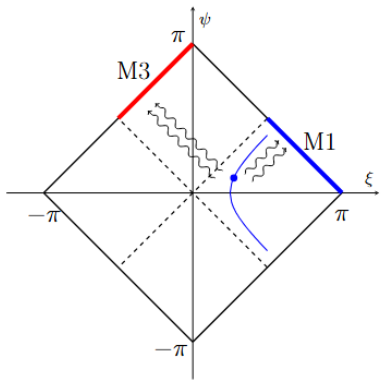
Radiation from a uniformly accelerating charge escapes outside Rindler wedge, while within Rindler wedge there is no flux through infinity, neither in the Minkowski frame nor in the Rindler frame. This remains true despite the fact that the coordinate transformation between the Rindler and Minkowski frames is not trivial at infinity.
What carries the argument
The electromagnetic field of a hyperbolically moving charge together with the surface integral of the Poynting vector at infinity after Rindler-Minkowski coordinate transformation.
If this is right
- The radiated energy leaves the Rindler wedge rather than accumulating or crossing infinity inside it.
- Observers confined to the interior of the wedge measure no outgoing radiation at large distances.
- The zero-flux result is recovered independently in both coordinate systems.
- The non-trivial character of the coordinate map at infinity does not produce a nonzero flux inside the wedge.
Where Pith is reading between the lines
- The result suggests that any apparent radiation reaction inside the wedge must be accounted for without invoking energy flux at infinity within the wedge.
- Similar flux calculations could be performed for other trajectories that remain inside a Rindler wedge to test whether escape is generic.
Load-bearing premise
The electromagnetic field of the accelerating charge and the definition of flux through infinity remain well-defined and correctly transformed under the Rindler-Minkowski coordinate change even at asymptotic regions where the map is non-trivial.
What would settle it
An explicit integration of the Minkowski-frame Poynting vector over the asymptotic surface inside the Rindler wedge that yields a nonzero net flux.
Figures
read the original abstract
We show explicitly that radiation from a uniformly accelerating charge escapes outside Rindler wedge, while within Rindler wedge there is no flux through infinity, neither in the Minkowski frame nor in the Rindler frame. This remains true despite the fact that the coordinate transformation between the Rindler and Minkowski frames is not trivial at infinity.
Editorial analysis
A structured set of objections, weighed in public.
Referee Report
Summary. The paper claims to demonstrate explicitly, via direct calculation of the electromagnetic fields of a uniformly accelerating charge and the associated surface integrals, that radiation escapes outside the Rindler wedge while the net flux through infinity vanishes inside the wedge in both Minkowski and Rindler coordinates. This conclusion is asserted to hold even though the Rindler-Minkowski coordinate map is non-trivial at asymptotic infinity.
Significance. If the explicit field expressions and flux integrals are correct, the result clarifies the localization of radiation relative to the Rindler horizon and confirms consistency of the Poynting theorem under the coordinate change at infinity. It supplies a concrete, calculational resolution to a classic issue in classical radiation theory without introducing free parameters or ad-hoc regularizations.
major comments (1)
- [Section discussing coordinate transformations at infinity and flux integrals] The central claim rests on the assertion that the transformed fields and area elements yield zero net flux inside the wedge. Without an explicit expression for the Jacobian of the coordinate transformation evaluated on the asymptotic surface (or the precise definition of that surface), it is not possible to verify that the non-trivial map at infinity does not introduce a hidden contribution to the integral.
minor comments (2)
- [Abstract] The abstract states the conclusion but contains no field components or integral expressions; moving at least the key field formulas or the final flux result into the abstract would improve accessibility.
- [Throughout the flux sections] Notation for the asymptotic surfaces (e.g., the precise limits taken for 'infinity' in each frame) should be defined once and used consistently in all flux calculations.
Simulated Author's Rebuttal
We thank the referee for the careful reading of our manuscript and the constructive comment. We address the major point below and will revise the manuscript to incorporate the requested explicit details.
read point-by-point responses
-
Referee: [Section discussing coordinate transformations at infinity and flux integrals] The central claim rests on the assertion that the transformed fields and area elements yield zero net flux inside the wedge. Without an explicit expression for the Jacobian of the coordinate transformation evaluated on the asymptotic surface (or the precise definition of that surface), it is not possible to verify that the non-trivial map at infinity does not introduce a hidden contribution to the integral.
Authors: We agree that an explicit expression for the Jacobian on the asymptotic surface would strengthen verifiability. The manuscript computes the electromagnetic fields of the uniformly accelerating charge directly in Minkowski coordinates and transforms them to Rindler coordinates, then evaluates the Poynting flux integrals on surfaces at infinity in both frames, obtaining zero net flux inside the wedge. To address the concern, the revised manuscript will add the explicit Jacobian determinant of the Rindler-Minkowski coordinate transformation evaluated in the limit of spatial infinity within the wedge, together with a precise definition of the asymptotic surface (Minkowski radial coordinate r → ∞ with the trajectory remaining inside the Rindler wedge). This will confirm that the non-trivial map introduces no hidden net-flux contribution. revision: yes
Circularity Check
No significant circularity; derivation is self-contained
full rationale
The manuscript derives its central claims via explicit computation of the electromagnetic fields of the uniformly accelerating charge in both frames, followed by direct evaluation of the flux integrals over the relevant asymptotic surfaces. These steps rely on standard Maxwell equations and coordinate transformations applied to the known Liénard-Wiechert fields, with no reduction of any 'prediction' to a fitted input, no self-definitional closure, and no load-bearing appeal to prior self-citations. The non-trivial map at infinity is handled by substitution into the transformed components and area elements, yielding an independent verification of zero net flux inside the wedge.
Axiom & Free-Parameter Ledger
Reference graph
Works this paper leans on
-
[1]
Born, Annalen Phys.30, 840 (1909) doi:10.1002/andp.19093351102
M. Born, Annalen Phys.30, 840 (1909) doi:10.1002/andp.19093351102
-
[2]
Pauli, Theory Relativity, Pergamon Press (1958)
W. Pauli, Theory Relativity, Pergamon Press (1958)
1958
-
[3]
T. Fulton and F. Rohrlich, Classical radiation from a uniformly accelerated charge, Annals of Physics9, Issue 4, 499-517 (1960) doi:10.1016/0003-4916(60)90105-6
-
[4]
R. Peierls, Surprises in Theoretical Physics, Princeton University Press (1979) doi:10.1515/9780691217888
-
[5]
Boulware, Annals of Physics124, Issue 1, 169 (1980)
D. Boulware, Annals of Physics124, Issue 1, 169 (1980). doi:10.1016/0003-4916(80)90360-7
-
[6]
W. G. Unruh, Phys. Rev. D14, 870 (1976) doi:10.1103/PhysRevD.14.870
-
[7]
Wald, General Relativity, Chicago Univ
R. Wald, General Relativity, Chicago Univ. Pr. (1984) doi:10.7208/chicago/9780226870373.001.0001
-
[8]
Weinberg, Gravitation and Cosmology, John Wiley and Sons, Inc
S. Weinberg, Gravitation and Cosmology, John Wiley and Sons, Inc. (1972) ISBN 978-0-471- 92567-5
1972
-
[9]
E. T. Akhmedov and M. Milovanova, Phys. Rev. D111, no.12, 124047 (2025) doi:10.1103/4lvr- ssjh [arXiv:2503.00064 [physics.class-ph]]
-
[10]
S. Fulling, Phys. Rev. D7, 2850 (1973) doi:10.1103/PhysRevD.7.2850
-
[11]
R. Penrose, Phys. Rev. Lett.10, 66 (1963) doi:10.1103/PhysRevLett.10.66
-
[12]
H. Bondi, M. van der Burg, A. Metzner, Proc. Roy. Soc. Lond. A269, 21-52 (1962) doi:10.1098/rspa.1962.0161
-
[13]
D. Kalinov, Phys. Rev. D92, no.8, 084048 (2015) doi:10.1103/PhysRevD.92.084048 [arXiv:1508.04281 [hep-th]]. 6
discussion (0)
Sign in with ORCID, Apple, or X to comment. Anyone can read and Pith papers without signing in.