REVIEW 4 major objections 4 minor 11 cited by
Adaptive item-response testing can evaluate a language model with tens of items instead of thousands, and the resulting ability score separates models that have identical accuracy.
Reviewed by Pith at T0; open to challenge. T0 means a machine referee read the full paper against a public rubric. the ladder, T0–T4 →
2026-08-04 08:03 UTC pith:IQZRABNH
load-bearing objection ATLAS is a solid engineering contribution with real code and data, but the 'finer discrimination' claim rests on an unvalidated unidimensional 3PL model, so the rank-shift numbers are suggestive rather than established. the 4 major comments →
Adaptive Testing for LLM Evaluation: A Psychometric Alternative to Static Benchmarks
The pith
A machine-rendered reading of the paper's core claim, the machinery that carries it, and where it could break.
Core claim
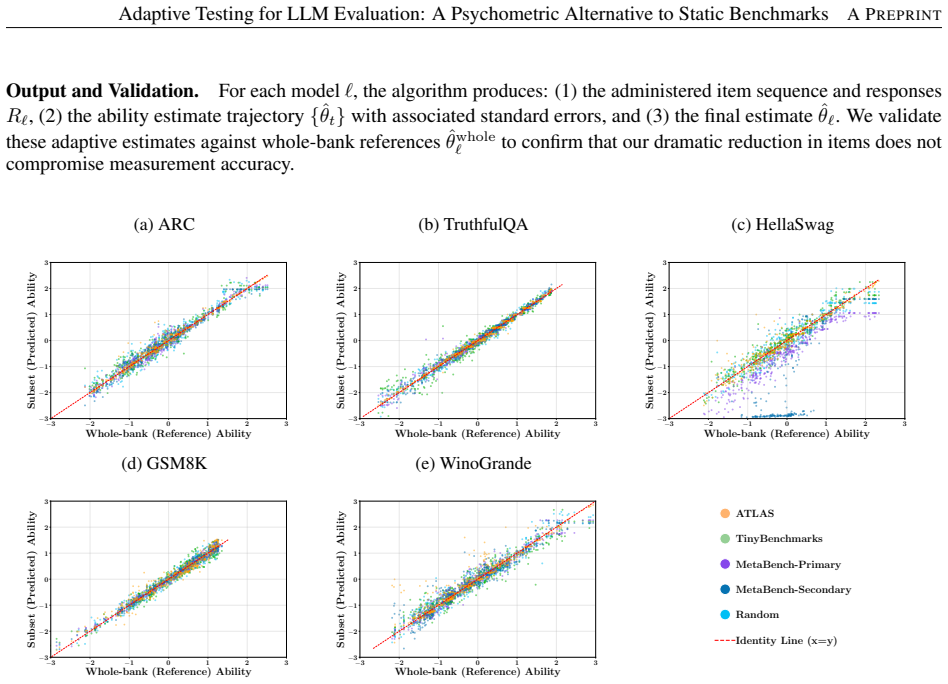
The paper's central claim is that LLM evaluation can be posed as a psychometric measurement problem and solved adaptively. A model's correctness probability on an item is governed by three item parameters—discrimination, difficulty, and guessing—plus the model's latent ability θ. After calibrating these parameters once, the ATLAS procedure administers items dynamically: it picks the item with maximum Fisher information at the current θ estimate, updates θ with an expected-a-posteriori step, and stops when the standard error falls below a chosen threshold. The result is that a short adaptive test recovers the whole-bank θ (e.g., MAE 0.157 using 41 of 5,600 items on HellaSwag), reconstructed a
What carries the argument
The three-parameter logistic (3PL) item response model: the probability of a correct response equals a guessing floor plus (1 − floor) divided by 1 + exp(−discrimination × (ability − difficulty)). This model gives each item a difficulty, a discrimination slope, and a guessing parameter. ATLAS uses Fisher information (the squared relative slope of the response curve) to select the next item, expected-a-posteriori estimation to update the ability after each response, and a precision-based stopping rule that ends the test once the standard error crosses a threshold. A randomesque top-5 item-selection step prevents overdependence on a single item type.
Load-bearing premise
The load-bearing premise enters at the three-parameter item response model (Eq. 1): a single ability dimension is assumed to explain all responses, and no dimensionality or local-independence test is reported; if that premise fails, the whole-bank θ used as the reference is not a valid ground truth, and agreement between the adaptive estimate and the reference shows only internal consistency.
What would settle it
Fit a two-dimensional item response model to the same response matrix and check whether it fits substantially better than the one-dimensional model; if it does, the ability estimates are not measuring a single trait. A second check: run ATLAS twice on the same model with different random seeds (the randomesque top-5 selection) and see whether the resulting ability estimates differ by more than the reported standard errors; if they do, the claimed precision is not real.
If this is right
- Evaluation of a model can be reduced from thousands of items to tens while keeping ability estimates close to the whole-bank reference, with MAE around 0.06–0.18 across five benchmarks.
- Accuracy can be reconstructed from the ability estimate within about five percentage points, so the familiar accuracy metric remains available even when the primary score is θ.
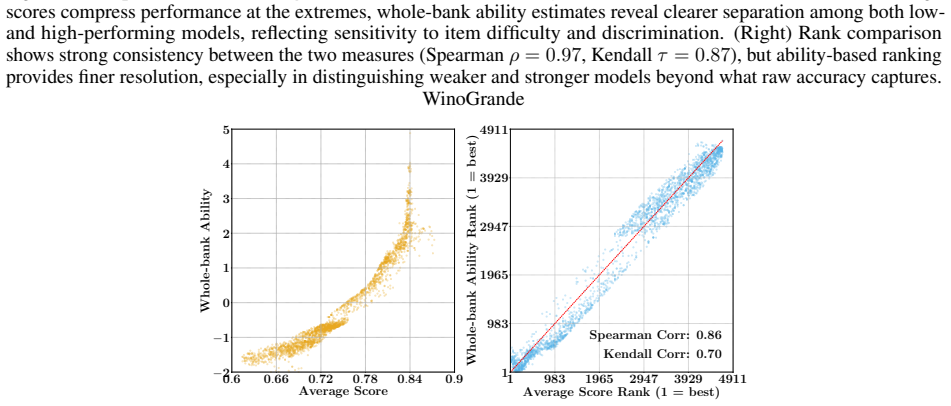
- Rankings based on ability differ from accuracy-based rankings for 23–31% of models, so published orderings in saturated performance ranges are not fixed.
- Items are not equally informative: selecting high-Fisher-information items is what makes short tests work, so future benchmarks should publish item parameters rather than treat all items equally.
- Precision-based stopping gives every model a comparable standard error on its ability estimate, which fixed-length static tests cannot guarantee.
Where Pith is reading between the lines
- If θ is taken as a stable trait, the 23–31% rank reordering implies that many published benchmark comparisons are item-selection artifacts; re-ranking models on adaptive estimates would be a cheap check.
- The same fitted item parameters could be used in reverse to detect memorization: a model that solves a very hard item while failing easier ones produces an implausible response pattern that a static accuracy score would hide.
- A natural extension is a multidimensional ability profile: reporting a single θ may conceal that two models reach the same score through different skill mixes, and a two-factor item response model would test whether that matters.
- For benchmark builders, the paper's implication is that publishing calibrated item parameters (difficulty, discrimination, guessing) would let anyone construct short adaptive tests for new models without re-running the full evaluation.
Editorial analysis
A structured set of objections, weighed in public.
Referee Report
Summary. The paper proposes ATLAS, an adaptive testing framework that replaces static LLM benchmarks with a computerized adaptive test based on a three-parameter logistic (3PL) item response theory model. Items are calibrated on a large pool of 3,000+ models from the Open LLM Leaderboard; at evaluation time, items are selected by Fisher information and the test stops when the standard error of the EAP ability estimate falls below a threshold. The authors report that ATLAS reduces item usage by up to 90% while matching whole-bank ability estimates (e.g., 0.157 MAE with 41 items on HellaSwag), that reconstructed accuracies are close to raw accuracies, and that IRT-based ability rankings shift 23–31% of models by more than 10 positions compared with accuracy-based rankings. Code and calibrated item banks are made available.
Significance. If the central validity claims hold, ATLAS would be a practically valuable contribution: it could lower the cost of large-scale LLM evaluation, provide uncertainty-aware ability estimates, and reveal differences that average accuracy masks. The paper has clear strengths: a large and diverse calibration sample, released code and item banks, explicit comparison with TinyBenchmarks and MetaBench, and reporting of model-fit statistics (RMSEA from M2), which is rare in this literature. However, the core precision claim is validated only against a whole-bank ability estimate that is produced by the same fitted 3PL model used for item selection and scoring. Without external validity evidence—dimensionality checks, local-independence tests, or holdout validation on items not used in calibration—the reported MAE values and rank shifts may reflect internal consistency of the model rather than measurement of a stable ability. The paper is therefore promising but requires additional validation before the 90% item-reduction claim can be accepted as evidence of maintained measurement precision.
major comments (4)
- [§3.2] Item filtering is performed before the train/test split. The text states that models are split after the low-variance and point-biserial filters have been applied, meaning the 10% test models' responses influence which items are retained. The reported MAE on the test set is therefore not fully held-out. This is load-bearing for the central efficiency claim. Please restrict all item filtering, including the r_pb threshold and low-variance/mean-accuracy cutoffs, to the training split only, and report whether the Table 2 results change.
- [§3.3, §3.4, Tables 2 and 6] The reference θ̂whole is estimated from the same 3PL model (Eq. 1) and the same calibrated item parameters that ATLAS uses for item selection and EAP scoring. The ability-space MAE therefore shows that ATLAS recovers the composite defined by that fitted model, not that it measures an externally meaningful ability. The RMSEA values in Table 1 are a limited-information overall fit index and do not test unidimensionality or local independence. Please add dimensionality assessment (e.g., DETECT, parallel analysis, or a bifactor/CFA comparison) and local-dependence diagnostics (e.g., Q3 or LD-X²), and provide a validation of rank shifts against held-out items that were not used in calibration.
- [Algorithm 1, line 13] The stopping rule uses SE(θ̂t) = 1/√∑ I_j(θ̂t), which is the asymptotic standard error of maximum-likelihood ability estimation evaluated at the current estimate. For EAP with sparse response patterns and early termination, this formula is an approximation, and it is not validated against the empirical sampling distribution of θ̂. Since the claimed 90% item reduction is driven by this stopping rule, please calibrate it empirically—e.g., by repeated administration or bootstrap resampling—to show that tests that stop at SE ≤ τ actually achieve the nominal standard error, especially for models at ability extremes.
- [Eq. (1), GSM8K results] The 3PL model assumes every item has a nonzero lower asymptote c_i. For an open-form benchmark such as GSM8K, random guessing is not a well-defined response process, so the c_i parameter is conceptually questionable. The rank-shift and finer-discrimination results for GSM8K could be artifacts of forcing a guessing parameter onto items where it does not apply. Please report item-fit statistics or compare 3PL with 2PL/1PL fits on GSM8K, and show that the main conclusions—especially the 23% rank-shift figure—are robust to the choice of IRT model.
minor comments (4)
- [Table 1] The header says 'RMSEA Fit' and the text says 'Avg. RMSEA'; clarify how the average is computed across subsets and whether the M2 statistic was computed on each partition or on the full bank after linking.
- [Appendix G.3] Many MMLU-subject rows report test overlap and item exposure equal to 1.000 (e.g., College Chemistry, Computer Security, Jurisprudence, Public Relations, US Foreign Policy). This contradicts the general statement in §4.2 that ATLAS maintains low redundancy and broad item utilization; please qualify the claim for small item banks.
- [Table 7] On GSM8K, the accuracy-reconstruction MAE for ATLAS_0.1 (0.039) is worse than that of Random100 (0.026). The claim in §4.2 that reconstructed accuracies 'closely match' raw accuracies is still defensible, but the comparison to the random baseline should be acknowledged for this benchmark.
- [§3.2] The filtering thresholds (SD < 1%, mean accuracy > 95%, r_pb < 0.1) are introduced without sensitivity analysis. Since these choices affect the item bank and all downstream results, a brief robustness check or a rationale from prior psychometric literature would strengthen the presentation.
Circularity Check
Central precision claim is validated only against the same fitted 3PL model's whole-bank theta; rank-shift finding restates the model definition; held-out split gives item reduction independent content.
specific steps
-
self definitional
[Section 3.3 (Eq. 1) and Section 3.4 'Output and Validation']
"The calibration stage estimates item parameters (ai, bi, ci) and computes reference ability estimates θ̂whole_ℓ for each LLM ℓ for validation. ... Output and Validation. For each model ℓ, the algorithm produces ... We validate these adaptive estimates against whole-bank references θ̂whole_ℓ to confirm that our dramatic reduction in items does not compromise measurement accuracy."
The validation target θ̂whole_ℓ is not an external criterion: it is the WLE under the same calibrated 3PL model (Eq. 1) whose item parameters drive ATLAS's Fisher-information selection, EAP updates (Eq. 3), and SE-based stopping. The MAE in Table 2 therefore measures agreement between two estimators of the same model-defined latent quantity. If Eq. (1) is misspecified (e.g., multidimensional or locally dependent responses, or an inappropriate guessing model for GSM8K), subset and whole-bank estimates can be biased in the same direction. Thus 'maintaining measurement precision' is an internal-consistency claim, not validation against an independent ability scale.
-
renaming known result
[Section 4.3 'Discriminating Models at Performance Extremes' and Figure 3]
"The right panels reveal substantial rank reordering: 23–31% of models shift by more than 10 positions when ranked by IRT rather than accuracy. ... IRT separates models with identical accuracies by accounting for which items they solve correctly. ... Two models with identical accuracy (0.833) on WinoGrande receive different ability estimates (θ̂A = 1.2 vs θ̂B = 0.6)."
In Eq. (1), θ is defined as the latent variable that, together with item difficulty bi and discrimination ai, determines response probabilities. A model that answers harder items correctly is assigned higher θ by construction. The observation that identical total accuracy can correspond to different θ, and that accuracy-equivalent models are re-ranked, is therefore a restatement of the 3PL model's ordering property rather than an independent empirical discovery. The paper presents this model-internal consequence as evidence that θ 'provides finer discrimination,' but no external criterion is used to show the reordering is more truthful.
full rationale
The item-reduction claim is not a pure tautology: item parameters are calibrated on a 90% training split and applied to held-out test models, and ATLAS's subset ability estimates use genuinely observed responses to adaptively selected items. So the MAE against whole-bank ability is an out-of-sample internal-consistency check. The circular aspect is that the whole-bank reference is itself produced by the same Eq. (1) 3PL model and calibrated item parameters used in ATLAS; no external anchor (e.g., an independent ability measure, dimensionality assessment, or local-independence test) is provided. Hence 'maintaining measurement precision' is conditional on the model being true. The finer-discrimination and rank-shift results are consequences of defining θ through item difficulties and discriminations in Eq. (1); showing examples is illustrative, not validating. The paper does report model-fit statistics (RMSEA/M2), which mitigates but does not resolve the circularity, since limited-information fit is not a test of unidimensionality or local independence. Self-citations in the related work are not load-bearing for the central claims. Overall this is partial circularity, not a full reduction of the derivation to its inputs.
Axiom & Free-Parameter Ledger
free parameters (7)
- 3PL item parameters (a_i, b_i, c_i) =
estimated for each retained item
- Item filter thresholds =
std <1%, mean accuracy >95%, rpb <0.1
- SE stopping thresholds tau =
0.1, 0.2, 0.3
- Min/max items =
30 / 500
- Randomesque top-k =
5
- Initial ability theta_0 =
0
- Number of calibration partitions K =
10/6/50/12/8 per benchmark
axioms (7)
- domain assumption Unidimensional 3PL IRT model (Eq. 1) is the correct generative model for LLM item responses.
- domain assumption Responses are locally independent given theta.
- domain assumption The guessing parameter c_i in 3PL is identifiable and appropriate for every benchmark, including open-ended GSM8K.
- domain assumption Open LLM Leaderboard response data are complete and accurate.
- standard math Mean-sigma common-person linking places partitioned calibrations on a common scale.
- standard math WLE and EAP estimators have the stated consistency/bias properties under the 3PL model.
- ad hoc to paper The SE of the EAP ability estimate equals 1/sqrt(test information at the estimate).
invented entities (1)
-
Unidimensional latent ability theta for LLMs
no independent evidence
Cite this review
Pith. "Pith review of Adaptive Testing for LLM Evaluation: A Psychometric Alternative to Static Benchmarks." pith.science (2026). https://pith.science/paper/IQZRABNH
@misc{pith2026251104689,
  author       = {Pith},
  title        = {Pith review of: Adaptive Testing for LLM Evaluation: A Psychometric Alternative to Static Benchmarks},
  year         = {2026},
  howpublished = {\url{https://pith.science/paper/IQZRABNH}},
  note         = {Machine review of arXiv:2511.04689}
}
read the original abstract
Evaluating large language models (LLMs) typically requires thousands of benchmark items, making the process expensive, slow, and increasingly impractical at scale. Existing evaluation protocols rely on average accuracy over fixed item sets, treating all items as equally informative despite substantial variation in difficulty and discrimination. We introduce ATLAS, an adaptive testing framework based on Item Response Theory (IRT) that estimates model ability using Fisher information-guided item selection. ATLAS reduces the number of required items by up to 90% while maintaining measurement precision. For instance, it matches whole-bank ability estimates using only 41 items (0.157 MAE) on HellaSwag (5,600 items). We further reconstruct accuracy from ATLAS's ability estimates and find that reconstructed accuracies closely match raw accuracies across all five benchmarks, indicating that ability ${\theta}$ preserves the global performance structure. At the same time, ${\theta}$ provides finer discrimination within accuracy-equivalent models: among more than 3,000 evaluated models, 23-31% shift by more than 10 rank positions, and models with identical accuracies receive meaningfully different ability estimates. Code and calibrated item banks are available at https://github.com/Peiyu-Georgia-Li/ATLAS.git.
Figures




Forward citations
Cited by 11 Pith papers
-
Every Eval Ever: A Unifying Schema and Community Repository for AI Evaluation Results
Introduces the first community-governed unified JSON schema and crowdsourced repository for AI evaluation results, with converters and a database spanning 22,235 models and 2,273 benchmarks.
-
The Masked Advantage: Uncovering Local-Language Access to Cultural Knowledge in LLMs
Using a 1PL IRT model on real cultural questions across 13 locales, the study identifies a local-language knowledge-access advantage masked by lower proficiency in raw accuracy.
-
FailureScope: Cross-Regime Behavioral Diagnosis of Language Model Weaknesses
FailureScope clusters evaluation probes by cross-model failure patterns via LOMO to produce stable taxonomies that generalize across single-turn, multi-turn, and adversarial regimes, with reported metrics of Kendall's...
-
Auditing LLM Benchmarks with Item Response Theory
An IRT-based detector identifies mislabeled examples in LLM benchmarks at 95% precision in the top 200 cases, outperforming supervised classifiers and revealing reward-model specialization on style over facts.
-
Capturing LLM Capabilities via Evidence-Calibrated Query Clustering
ECC calibrates semantic embeddings with posterior model comparisons and Bradley-Terry capability profiles to create flexible, mixed-membership query clusters that improve LLM capability ranking.
-
Capturing LLM Capabilities via Evidence-Calibrated Query Clustering
ECC calibrates semantic embeddings with model comparisons via Bradley-Terry profiles and mixture weights to cluster queries by latent LLM capabilities, claiming 17-18 point gains in ranking quality over baselines.
-
Beyond Fixed Benchmarks and Worst-Case Attacks: Dynamic Boundary Evaluation for Language Models
Dynamic Boundary Evaluation locates each LLM's performance boundary at ~50% pass probability via a calibrated item bank and Skill-Guided Boundary Search algorithm to enable unified, adaptive evaluations across safety,...
-
Beyond Fixed Benchmarks and Worst-Case Attacks: Dynamic Boundary Evaluation for Language Models
Dynamic Boundary Evaluation adaptively identifies each LLM's performance boundary on a shared difficulty scale using a calibrated item bank and a search algorithm.
-
Growing Pains: Extensible and Efficient LLM Benchmarking Via Fixed Parameter Calibration
A fixed-parameter multidimensional IRT calibration approach allows extending LLM benchmark suites over time, predicting full performance within 2-3 points and preserving rankings (Spearman ρ ≥ 0.9) using only 100 anch...
-
CoT-Core: Accelerating LLM Evaluation via CoT-Aware Coreset Selection
Clustering LLM-generated chain-of-thought trajectories, rather than raw question text, selects coresets that estimate full-benchmark scores with lower error than text-only selection on some benchmarks.
-
DualEval: Joint Model-Item Calibration for Unified LLM Evaluation
DualEval jointly calibrates LLM abilities and item difficulties/sharpness in a shared latent space using static labels and reward-model scores to unify benchmark and arena-style evaluation.
Reference graph
Works this paper leans on
-
[5]
D Detailed Experimental Setup and Metrics D.1 Benchmarks and Datasets We conduct experiments on five diverse benchmarks covering different cognitive domains: •WinoGrande: Commonsense reasoning with pronoun resolution •TruthfulQA: Factual consistency and truthfulness evaluation •HellaSwag: Procedural inference and common sense completion •GSM8K: Mathematic...
2024
-
[9]
Despite the small number of items per subject, ATLAS consistently demonstrates robust adaptive evaluation performance. As the selection threshold is relaxed ( SE≤0.1→0.3 ), the mean absolute error (MAE) increases moderately (e.g., from 0.099 to 0.235 inAnatomy), while the number of evaluated items is substantially reduced (approximately 80%). This indicat...
2061
-
[11]
doi: https://doi.org/10.1007/978-0-387-85461-8
-
[100]
Average Item Exposure Rate.Let hi denote the number of models administered item i, with |I| total items and |L| total models
Values greater than 1 indicate lower efficiency, meaning the method uses more items and/or yields higher error than the baseline. Average Item Exposure Rate.Let hi denote the number of models administered item i, with |I| total items and |L| total models. The item exposure probability for itemiis P(A i) = hi |L| .(5) The average item exposure rate is then...
2013
-
[1982]
doi: https://doi.org/10.1177/014662168200600405. Brennan, R. L.Test equating, Scaling, and Linking-Methods and practices. Springer-verlag New York Incorporated,
-
[1989]
doi: https://doi.org/10.1007/BF02294627. Weiss, D. J. Improving measurement quality and efficiency with adaptive testing.Applied psychological measurement, 6(4):473–492,
-
[1991]
Measuring massive multitask language understanding.arXiv preprint arXiv:2009.03300,
Hendrycks, D., Burns, C., Basart, S., Zou, A., Mazeika, M., Song, D., and Steinhardt, J. Measuring massive multitask language understanding.arXiv preprint arXiv:2009.03300,
Pith/arXiv arXiv 2009
-
[2000]
doi: https://doi.org/10.4324/9781410605931. Warm, T. A. Weighted likelihood estimation of ability in item response theory.Psychometrika, 54(3):427–450,
-
[2004]
doi: https://doi.org/10.1201/9781482276725. Birnbaum, A. Some latent trait models and their use in inferring an examinee’s ability.Statistical theories of mental test scores,
-
[2009]
Clark, P., Cowhey, I., Etzioni, O., Khot, T., Sabharwal, A., Schoenick, C., and Tafjord, O
doi: https: //doi.org/10.1348/000711008X304376. Clark, P., Cowhey, I., Etzioni, O., Khot, T., Sabharwal, A., Schoenick, C., and Tafjord, O. Think you have solved question answering? try arc, the ai2 reasoning challenge.arXiv preprint arXiv:1803.05457,
-
[2010]
Do large language model benchmarks test reliability?arXiv preprint arXiv:2502.03461,
Vendrow, J., Vendrow, E., Beery, S., and Madry, A. Do large language model benchmarks test reliability?arXiv preprint arXiv:2502.03461,
-
[2012]
doi: 10.18637/jss.v048.i06. Chang, H.-H. Psychometrics behind computerized adaptive testing.Psychometrika, 80(1):1–20,
-
[2015]
doi: https://doi.org/10.1177/0146621614544519. Zhuang, Y ., Liu, Q., Ning, Y ., Huang, W., Lv, R., Huang, Z., Zhao, G., Zhang, Z., Mao, Q., Wang, S., et al. Efficiently measuring the cognitive ability of llms: An adaptive testing perspective.arXiv preprint arXiv:2306.10512,
-
[2018]
Training verifiers to solve math word problems.arXiv preprint arXiv:2110.14168,
Cobbe, K., Kosaraju, V ., Bavarian, M., Chen, M., Jun, H., Kaiser, L., Plappert, M., Tworek, J., Hilton, J., Nakano, R., Hesse, C., and Schulman, J. Training verifiers to solve math word problems.arXiv preprint arXiv:2110.14168,
-
[2021]
P., Leang, J
Gema, A. P., Leang, J. O. J., Hong, G., Devoto, A., Mancino, A. C. M., Saxena, R., He, X., Zhao, Y ., Du, X., Madani, M. R. G., et al. Are we done with mmlu? InProceedings of the 2025 Conference of the Nations of the Americas Chapter of the Association for Computational Linguistics: Human Language Technologies (Volume 1: Long Papers), pp. 5069–5096,
2025
-
[2024]
is a probabilistic scoring method used to compute expected accuracy when only a subset of benchmark items is observed. Conceptually, p-IRT is grounded in the Test Characteristic Curve (TCC) (Lord & Novick, 2008; Hambleton et al., 1991), which maps a model’s ability ˆθ to its expected probability of correctly answering items under the calibrated 3PL model....
2008
This paper was first reviewed by deepseek-v4-flash on August 4, 2026.
discussion (0)
Sign in with ORCID, Apple, or X to comment. Anyone can read and Pith papers without signing in.