REVIEW 3 major objections 7 minor 56 references
Probing up-down quark matter via gravitational waves
T0 review · 3 major / 7 minor · reviewed 2026-08-14 · deepseek-v4-flash
Pith's one-line read The paper claims that up-down quark stars, alone or paired with hadronic stars, can account for the GW170817 tidal-deformability constraints, narrowing the effective bag constant to about 50 MeV per cubic femtometer.
desk verdict A clean, internally consistent model prediction for GW170817 as a udQS merger, conditional on an unproven stability premise from the author's own model; worth refereeing with a push on the abstract's compatibility claim. read the letter →
The pith
A machine-rendered reading of the paper's core claim, the machinery that carries it, and where it could break.
The reading
What carries the argument
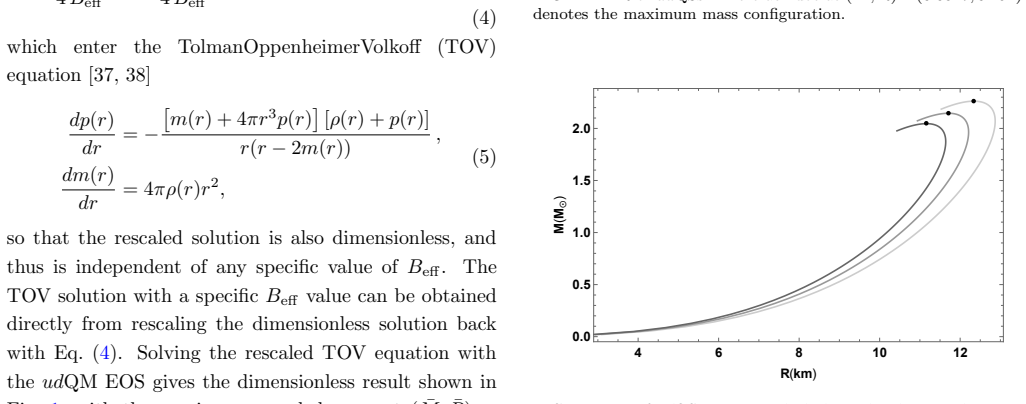
The load-bearing tool is a dimensionless rescaling of the Tolman-Oppenheimer-Volkoff equations, $\bar{r}=r\sqrt{4B_{\rm eff}}$, $\bar{m}=m\sqrt{4B_{\rm eff}}$, $\bar{\rho}=\rho/(4B_{\rm eff})$, and $\bar{p}=p/(4B_{\rm eff})$, applied to the approximate linear equation of state $p=(\rho-4B_{\rm eff})/3$ for ud quark matter. Because the equation of state is linear, one universal solution gives mass-radius curves and tidal Love numbers $k_2$ for every bag constant by simple rescaling; a surface matching condition $y_R^{\rm ext}=y_R^{\rm int}-4\pi R^3\rho_s/M$ accounts for the finite surface density of quark stars. This machinery converts the two requirements, $A_{\min}\gtrsim 300$ and the most massive observed compact star being a udQS, into the sharp window $B_{\rm eff}\approx 50$ MeV/fm$^3$.
What would settle it
A precise measurement of a compact star with mass around $2.1M_\odot$ whose radius or tidal deformability falls outside the udQS band for $B_{\rm eff}\in[49.5,55]$ MeV/fm$^3$ would rule out the interpretation; so would a demonstration that matter with baryon number above 300 is less stable than ordinary nuclei, which would remove the physical basis for the entire window.
Extended reading notes
Core claim
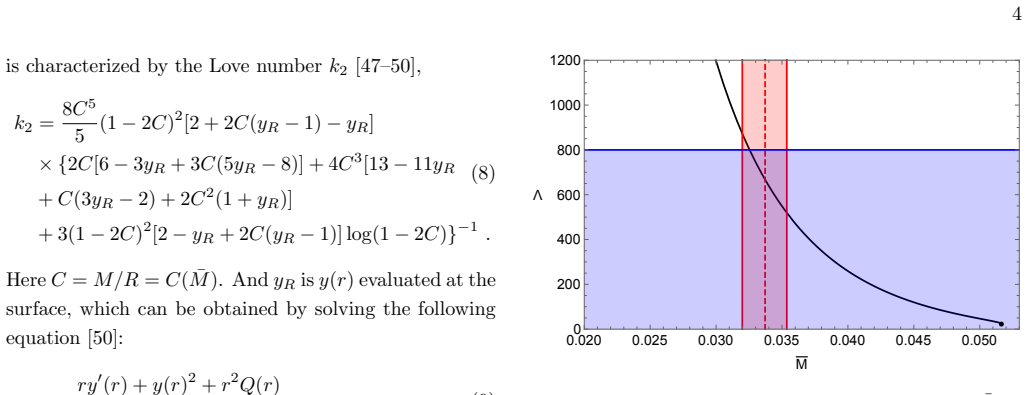
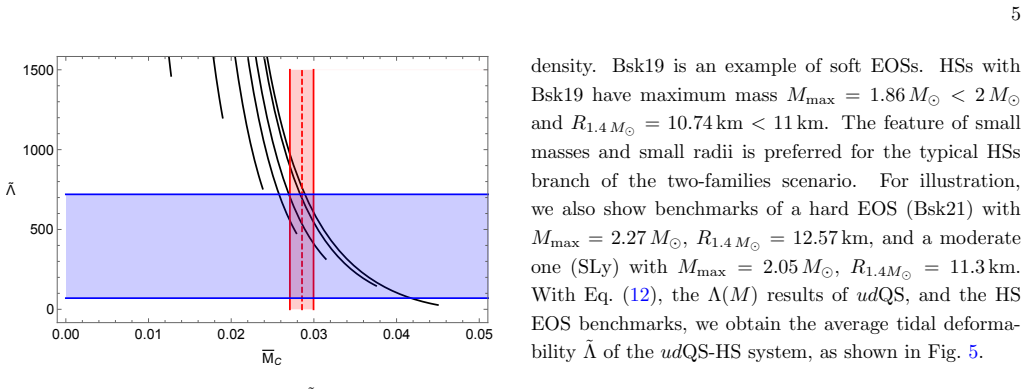
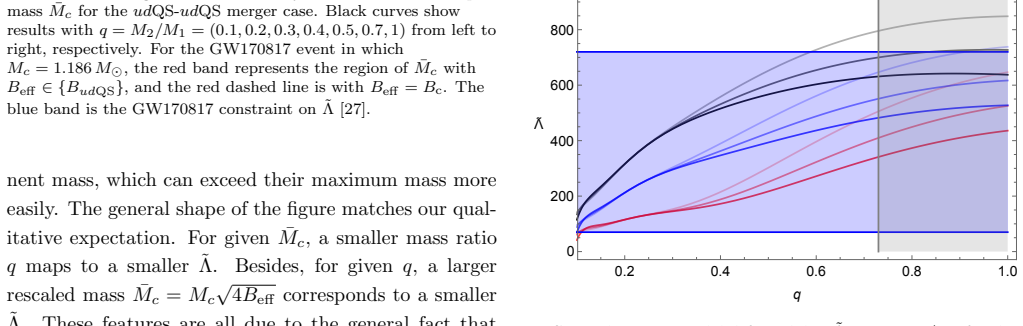
On the paper's own terms, the central discovery is that ud quark stars pass the GW170817 tidal-deformability test. For an effective bag constant $B_{\rm eff}$ between 45 and 55 MeV/fm$^3$, the computed $\Lambda(1.4M_\odot)$ lies in the range 530 to 857, overlapping the measured upper bound $\Lambda(1.4M_\odot)\lesssim 800$; combining the tidal upper bound with the binary mass-ratio constraint tightens the window to $B_{\rm eff}\in[49.5,55]$ MeV/fm$^3$. In the udQS-udQS merger case the average tidal deformability $\tilde{\Lambda}$ matches the GW170817 posterior for mass ratios $q$ between about 0.4 and 1, and in the udQS-HS case the merger is compatible for hadronic equations of state softer than the stiffest benchmark considered. The paper concludes that GW170817 could have been a udQS-udQS or a udQS-HS merger.
Load-bearing premise
The argument stands on the premise that quark matter made only of up and down quarks is the true ground state of baryonic matter for baryon numbers above about 300, as predicted by the quark-meson model.
Editorial extensions
If this is right
- If the claim is right, GW170817 need not have involved ordinary neutron stars: a udQS-udQS or udQS-HS binary fits the observed gravitational-wave signal.
- The allowed quark-matter parameter space is squeezed to $B_{\rm eff}\in[49.5,55]$ MeV/fm$^3$, so any future equation-of-state measurement outside that window would disfavor the udQS interpretation.
- Future mergers with different chirp masses can be tested against the same universal rescaled curves, since the analysis is parameter-free once $B_{\rm eff}$ is fixed.
- In the two-families picture, a compact star above two solar masses with a large radius would naturally be read as a udQS rather than a hadronic star.
Reading between the lines
- If udQS binaries are common, the compact-star mass-radius relation should show two separated branches, and a future sample of accurate radius measurements could look for that bimodality even before individual quark stars are identified.
- The same rescaling could be turned around: a future gravitational-wave event with a well-measured average tidal deformability and chirp mass would map directly onto a value of the effective bag constant.
- Because ejected udQM would destabilize quickly into ordinary or heavy nuclei, kilonova signals from udQS mergers may be systematically fainter or faster than standard neutron-star kilonovae, a difference the paper leaves implicit.
- A null result from collider searches for high-electric-charge objects with baryon number above roughly 300 would put pressure on the stability premise that the whole window depends on.
Signed reviews
Editorial analysis
A structured set of objections, weighed in public.
Referee Report
Summary. The paper studies compact stars composed of 'up-down quark matter' (udQM), in which only u and d quarks are deconfined, within the two-families scenario where these ud quark stars (udQSs) coexist with ordinary hadronic stars (HSs). The udQM equation of state is approximated by the linear form p = (ρ − ρ_s)/3 with ρ_s = 4B_eff, so the model has a single parameter, the effective bag constant B_eff. Combining the absolute-stability requirement A_min ≳ 300 (B_eff ≳ 50 MeV/fm^3, Eq. 3) with the maximum-mass constraint from PSR J0740+6620 (B_eff ≲ 50.3 MeV/fm^3, Eq. 6), and adding a 10% 'conservative' relaxation, the paper adopts the window B_eff ∈ [45,55] MeV/fm^3. Using a dimensionless rescaling of the TOV equations and the standard Love-number formalism, it computes the mass–radius relation, Λ(1.4M⊙) ∈ [530,857], and the average tidal deformability Λ̃ for udQS-udQS and udQS-HS binaries with the GW170817 chirp mass M_c = 1.186M⊙. The paper claims compatibility with the GW170817 90% constraints, derives a trimmed udQS-udQS window B_eff ∈ [49.5,55] MeV/fm^3, and suggests that GW170817 may have involved at least one udQS.
Significance. Conditional on the absolute stability of udQM, this is a clean and largely parameter-free application: the dimensionless rescaling of Section II makes the M–R and tidal-deformability curves one-parameter families that are immediately reusable for arbitrary chirp mass and B_eff, and the GW170817 comparison is transparent and reproducible from the text. The paper makes falsifiable statements — a udQS-udQS reading of GW170817 requires B_eff ≳ 49.5 MeV/fm^3, and the stiff hadronic benchmark Bsk21 is excluded in the udQS-HS case — and it is honest about which published constraints assume neutron-star EOSs and therefore are not applied. The principal caveat is that the entire analysis inherits the absolute-stability hypothesis for udQM from the author's own quark-meson model (Ref. [6]); the Introduction itself notes that most other improved models conclude neither udQM nor SQM is more stable than ordinary nuclei, and the cited LHC search reported no detection.
major comments (3)
- [Section I; Section II, Eq. (3)] The lower edge of the central window, B_eff ≳ 50 MeV/fm^3, and with it the predicted band Λ(1.4M⊙) ∈ [530,857] and the udQS interpretation of GW170817, rest entirely on the absolute-stability result of Ref. [6], a quark-meson model co-authored by the present author. The Introduction itself states that the common conclusion of other improved models is that neither udQM nor SQM is more stable than ordinary nuclei, and that the existing LHC search (Ref. [10]) reported no detection of the predicted high-charge objects; the stability premise is therefore not independently established. Because Section IV presents the constraints as unconditional results, the manuscript should explicitly frame the udQS scenario as a working hypothesis, propagate the 10% robustness quoted from Ref. [6] into the bounds of Eqs. (2) and (3), and state in the conclusions that the B_eff window and the GW170817 compatibility claim hold only if udQM is indeed the absolute ground state of baryonic matter for A > A_min.
- [Abstract; Section II, Fig. 3] The paper's own numbers contradict the blanket compatibility statement for the full advertised window: for B_eff = 45 MeV/fm^3 the paper obtains Λ(1.4M⊙) ≈ 857, which lies above the 90% upper limit Λ(1.4M⊙) ≲ 800 quoted from GW170817 (Ref. [11]). The sentence in Section II saying the results are 'well compatible' with this constraint is therefore only correct after the paper itself trims the window to B_eff ≳ 47.9 MeV/fm^3 (and, for the udQS-udQS case, to B_eff ≳ 49.5 MeV/fm^3 in Section III.A). The abstract's claim that the tidal deformabilities 'are all in good compatibility with the experimental constraints of GW170817' should be replaced by a statement that compatibility holds for the sub-window selected using those same constraints.
- [Section II, Eqs. (6)–(7); Section IV] The allowed interval [45,55] MeV/fm^3 is not derived as an uncertainty interval but imposed as a ±10% relaxation 'to be conservative' around the critical value B_c ≈ 50 MeV/fm^3. The strict bounds obtained in the paper are B_eff ∈ [50, 50.3] MeV/fm^3 from Eqs. (3) and (6), i.e., essentially a single allowed value at the central inputs. Since the quantitative predictions Λ(1.4M⊙) ∈ [530,857] and the final window B_eff ∈ [49.5,55] are computed over the relaxed window, they depend on an unspecified uncertainty budget; the ±10% is not propagated from the stated model and pulsar-mass uncertainties. The authors should either supply a concrete error budget that justifies the relaxation or present the tight intersection (B_eff ≈ [49.5,50.3] for the GW-trimmed udQS-udQS case) as the primary result, with [45,55] clearly labeled as an exploratory display range.
minor comments (7)
- [Section II, Eq. (1)] The notation '3√(2π(χ^3B_eff)^{1/4})' is ambiguous between 3 × √(…) and a cube root; please write the prefactor explicitly and state the units in which B_eff is to be inserted so that Eqs. (2) and (3) are directly checkable.
- [Section II] The phrase 'TolmanOppenheimerVolkoff equation' is missing separators; it should read 'Tolman–Oppenheimer–Volkoff equation'.
- [Section I] The phrase 'the more strict lower bounds' should read 'the stricter lower bounds'.
- [Section III.B] The conclusion that the udQS-HS case 'is also well compatible with the GW170817 constraints' holds only for the softer benchmarks SLy and Bsk19; by the paper's own Fig. 5, Bsk21 is excluded, so the sentence should state the benchmark dependence explicitly.
- [Section I and Section III] Since the paper declines to use the kilonova-based lower bounds (Λ(1.4M⊙) ≳ 200 and Λ̃ ≳ 242) because they assume neutron-star EOSs, it would be useful to note that the predicted udQS values are nevertheless well above those lower bounds, which would prevent any appearance of cherry-picking constraints.
- [Section II, Eq. (6)] The central value of the PSR J0740+6620 mass has since been revised downward in later analyses (M ≈ 2.08 ± 0.07 M⊙); the authors should verify whether the bound B_eff ≲ 50.3 MeV/fm^3 and the final parameter windows remain valid under the updated measurement.
- [Section I] The claim that ejected udQM is 'quickly destabilized by the finite-size effects and converts into ordinary or heavy nuclei' is asserted without a quantitative estimate; a timescale estimate or a reference to a dedicated calculation would materially support the reply to the kilonova-based objection against the QS-QS case.
Circularity Check
No circular derivation: the GW tidal predictions are computed from a B_eff window fixed by A_min and the maximum-mass constraint, not fitted to GW170817; the self-cited udQM stability premise is an independent input assumption.
full rationale
The derivation is not circular. B_eff is not fitted to GW170817 tidal data: the lower bound B_eff ≳ 50 MeV/fm^3 is fixed by requiring A_min ≳ 300 for ordinary-nucleus stability (Eq. 3, from the quark-meson model of Ref. [6]), and the upper bound B_eff ≲ 50.3 MeV/fm^3 is fixed by requiring the udQS maximum mass to reach the observed 2.14 M_sun pulsar J0740+6620 (Eq. 6); the 10% relaxation to [45,55] MeV/fm^3 is a stated uncertainty band, not a fit to Lambda. The tidal deformabilities are then computed from the TOV equations (Eq. 5) and the Love-number equation (Eqs. 8-11) for this pre-specified EOS family and compared with GW170817. The refined bounds B_eff >= 47.9 MeV/fm^3 (from Lambda(1.4) <= 800) and B_eff >= 49.5 MeV/fm^3 (from q >= 0.73 and Lambda_tilde <= 720) are constraints derived from the GW data, not quantities claimed as independent predictions. The only self-citation is the udQM absolute-stability premise from Ref. [6] (Holdom, Ren, and Zhang, including the present author); this is a prior input assumption with stated assumptions that do not include the GW tidal deformability, and it is externally testable (e.g., the LHC search cited as Ref. [10]). The paper explicitly acknowledges that other models reach the opposite stability conclusion, so the load-bearing nature of this assumption is a scientific risk, not a circular reduction of the paper's tidal-deformability claim. No equation in the paper is equivalent to its input by construction.
Assumptions & free parameters
free parameters (2)
- Effective bag constant B_eff =
45-55 MeV/fm^3, central 50 MeV/fm^3
- A_min threshold =
approximately 300
assumptions (6)
- domain assumption udQM is absolutely stable for baryon number A > A_min with A_min ~ 300, as predicted by the quark-meson model of Ref. [6].
- domain assumption The two-families scenario is valid: hadronic stars and quark stars can coexist, with conversion rates neither too fast nor too slow.
- domain assumption The most massive pulsar J0740+6620 (M ~ 2.14 M_sun) is a udQS when deriving the upper bound on B_eff.
- standard math The standard TOV equations and the relativistic Love-number formalism of Hinderer and Damour-Nagar apply to udQSs.
- domain assumption GW170817 low-spin prior constraints Lambda(1.4M_sun) <= 800 and Lambda_tilde = 300 (+420, -230) with q = 0.73 to 1.00 are applicable, while kilonova-based lower bounds are not used because they assume neutron-star EOS.
- domain assumption The EOS p = 1/3 (rho - rho_s) with rho_s = 4 B_eff approximates udQM, with B_eff effectively constant in the density range of interest.
Cite this review
Pith. "Pith review of Probing up-down quark matter via gravitational waves." pith.science (2026). https://pith.science/paper/IR54P2YY
@misc{pith2026190810355,
  author       = {Pith},
  title        = {Pith review of: Probing up-down quark matter via gravitational waves},
  year         = {2026},
  howpublished = {\url{https://pith.science/paper/IR54P2YY}},
  note         = {Machine review of arXiv:1908.10355}
}
abstract
Recently, it was shown that quark matter with only $u$ and $d$ quarks ($ud$QM) can be the ground state of matter for baryon numbers $A>A_\textrm{min}$ with $A_{\rm min}\gtrsim 300$. In this paper, we explore $ud$ quark stars ($ud$QSs) that are composed of $ud$QM, in the context of the two-families scenario in which $ud$QSs and hadronic stars (HSs) can coexist. Distinct signatures are discussed compared to the conventional study regarding strange quark stars (SQSs). We show that the requirements of $A_{\rm min}\gtrsim 300$ and the most massive compact star observed being a $ud$QS together may put stringent constraints on the allowed parameter space of $ud$QSs. Then, we study the related gravitational-wave probe of the tidal deformability in binary star mergers, including the $ud$QS-$ud$QS and $ud$QS-HS cases. The obtained values of the tidal deformability at 1.4 solar masses and the average tidal deformability are all in good compatibility with the experimental constraints of GW170817. This study points to a new possible interpretation of the GW170817 binary merger event, where $ud$QS may be at least one component of the binary system detected.
Figures

Figures from the paper (2 more)
Reference graph
Works this paper leans on
-
[6]
Bob Holdom, Jing Ren and Chen Zhang, Phys. Rev. Lett. 120, no. 22, 222001 (2018) [arXiv:1707.06610 [hep-ph]]
arXiv 2018
- [10]
-
[11]
B. P. Abbott et al. [LIGO Scientific and Virgo Collab- orations], Phys. Rev. Lett. 119, no. 16, 161101 (2017) [arXiv:1710.05832 [gr-qc]]
arXiv 2017
-
[1]
A. R. Bodmer, Phys. Rev. D 4, 1601 (1971)
1971
-
[2]
Witten, Phys
E. Witten, Phys. Rev. D 30, 272 (1984)
1984
-
[3]
Terazawa, INS-Report-336 (INS, University of Tokyo, Tokyo) May, 1979
H. Terazawa, INS-Report-336 (INS, University of Tokyo, Tokyo) May, 1979
work page 1979
-
[4]
Strange quark matter with dynamically generated quark masses
M. Buballa and M. Oertel, Phys. Lett. B 457, 261 (1999) [hep-ph/9810529]
work page Pith review arXiv 1999
-
[5]
P. Wang, V. E. Lyubovitskij, T. Gutsche and A. Faessler, Phys. Rev. C 67, 015210 (2003) [hep-ph/0205251]
work page Pith review arXiv 2003
Show all 56 references
-
[7]
Q. Wang, T. Zhao and H. S. Zong, arXiv:1908.01325 [hep-ph]
1908 arXiv
-
[8]
A. A. Osipov, B. Hiller and A. H. Blin, Phys. Rev. D 88, 054032 (2013) [arXiv:1309.2497 [hep-ph]]
2013 arXiv
-
[9]
Moreira, J
J. Moreira, J. Morais, B. Hiller, A. A. Osipov and A. H. Blin, Phys. Rev. D 98, no. 7, 074010 (2018) [arXiv:1806.00327 [hep-ph]]
2018 arXiv
-
[12]
P., et al
Abbott, B. P., et al. 2017b, Astrophys. J., 848, L13; . 2017c, Astrophys. J., 848, L12
-
[13]
B. P. Abbott et al. [LIGO Scientific and Virgo Collab- orations], Phys. Rev. Lett. 121, no. 16, 161101 (2018) [arXiv:1805.11581 [gr-qc]]
2018 arXiv
-
[14]
Radice, A
D. Radice, A. Perego, F. Zappa and S. Bernuzzi, Astro- phys. J. 852, no. 2, L29 (2018) [arXiv:1711.03647 [astro- ph.HE]]
2018 arXiv
-
[15]
Bauswein et al
A. Bauswein et al. , AIP Conf. Proc. 2127, no. 1, 020013 (2019) [arXiv:1904.01306 [astro-ph.HE]]
2019 arXiv
-
[16]
Kiuchi, K
K. Kiuchi, K. Kyutoku, M. Shibata and K. Taniguchi Astrophys. J. bf 876, no. 2, L31 (2019) [arXiv:1903.01466 [astro-ph.HE]]
2019 arXiv
-
[17]
Annala, T
E. Annala, T. Gorda, A. Kurkela and A. Vuorinen, Phys. Rev. Lett. 120, no. 17, 172703 (2018) [arXiv:1711.02644 [astro-ph.HE]]
2018 arXiv
-
[18]
F. J. Fattoyev, J. Piekarewicz and C. J. Horowitz, Phys. Rev. Lett. 120, no. 17, 172702 (2018) [arXiv:1711.06615 [nucl-th]]
2018 arXiv
-
[19]
S. De, D. Finstad, J. M. Lattimer, D. A. Brown, E. Berger and C. M. Biwer, Phys. Rev. Lett. 121, no. 9, 091102 (2018) Erratum: [Phys. Rev. Lett. 121, no. 25, 259902 (2018)] [arXiv:1804.08583 [astro-ph.HE]]
2018 arXiv
-
[20]
Drago and G
A. Drago and G. Pagliara, Astrophys. J. 852, no. 2, L32 (2018) [arXiv:1710.02003 [astro-ph.HE]]
2018 arXiv
-
[21]
G. F. Burgio, A. Drago, G. Pagliara, H. J. Schulze and J. B. Wei, Astrophys. J. 860, no. 2, 139 (2018) [arXiv:1803.09696 [astro-ph.HE]]
2018 arXiv
-
[22]
E. R. Most, L. R. Weih, L. Rezzolla and J. Schaffner- Bielich, Phys. Rev. Lett. 120, no. 26, 261103 (2018) 7 [arXiv:1803.00549 [gr-qc]]
2018 arXiv
-
[23]
E. R. Most, L. J. Papenfort, V. Dexheimer, M. Hanauske, S. Schramm, H. St¨ ocker, and L. Rezzolla, Phys. Rev. Lett. 122, no. 6, 061101 (2019) [arXiv:1807.03684 [astro- ph.HE]]
2019 arXiv
-
[24]
L. R. Weih, E. R. Most and L. Rezzolla, Astrophys. J. 881, 73 (2019) [arXiv:1905.04900 [astro-ph.HE]]
2019 arXiv
-
[25]
Montana, L
G. Montana, L. Tolos, M. Hanauske and L. Rezzolla, Phys. Rev. D 99, no. 10, 103009 (2019) [arXiv:1811.10929 [astro-ph.HE]]
2019 arXiv
-
[26]
Dexheimer, L
V. Dexheimer, L. T. T. Soethe, J. Roark, R. O. Gomes, S. O. Kepler and S. Schramm, Int. J. Mod. Phys. E 27, no. 11, 1830008 (2018) [arXiv:1901.03252 [astro-ph.HE]]
2018 arXiv
-
[27]
B. P. Abbott et al. [LIGO Scientific and Virgo Col- laborations], Phys. Rev. X 9, no. 1, 011001 (2019) [arXiv:1805.11579 [gr-qc]]
2019 arXiv
-
[28]
Demorest, T
P. Demorest, T. Pennucci, S. Ransom, M. Roberts and J. Hessels, Nature 467, 1081 (2010) [arXiv:1010.5788 [astro-ph.HE]]
2010 arXiv
-
[29]
Antoniadis et al
J. Antoniadis et al. , Science 340, 6131 (2013) [arXiv:1304.6875 [astro-ph.HE]]
2013 arXiv
-
[30]
H. T. Cromartie et al. , arXiv:1904.06759 [astro-ph.HE]
1904 arXiv
-
[31]
Drago, A
A. Drago, A. Lavagno and G. Pagliara, Phys. Rev. D 89, no. 4, 043014 (2014) [arXiv:1309.7263 [nucl-th]]
2014 arXiv
-
[32]
E. P. Zhou, X. Zhou and A. Li, Phys. Rev. D 97, no. 8, 083015 (2018) [arXiv:1711.04312 [astro-ph.HE]]
2018 arXiv
-
[33]
T. Zhao, W. Zheng, F. Wang, C. M. Li, Y. Yan, Y. F. Huang and H. S. Zong, Phys. Rev. D 100, no. 4, 043018 (2019) [arXiv:1904.09744 [nucl-th]]
2019 arXiv
-
[34]
Drago, G
A. Drago, G. Pagliara, S. B. Popov, S. Traversi and G. Wiktorowicz, Universe 4, no. 3, 50 (2018) [arXiv:1802.02495 [astro-ph.HE]]
2018 arXiv
-
[35]
J. L. Zdunik, Astron. Astrophys. 359, 311 (2000) [astro- ph/0004375]
2000
-
[36]
Haensel, A
P. Haensel, A. Y. Potekhin and D. G. Yakovlev, Astro- phys. Space Sci. Libr. 326, pp.1 (2007)
2007
-
[37]
R. C. Tolman, Phys. Rev. 55, 364 (1939)
1939
-
[38]
J. R. Oppenheimer and G. M. Volkoff, Phys. Rev. 55, 374 (1939)
1939
-
[39]
M. S. Berger and R. L. Jaffe, Phys. Rev. C35, 213 (1987)
1987
-
[40]
Lugones, A
G. Lugones, A. G. Grunfeld and M.A. Ajmi, Phys. Rev. C 88, no. 4, 045803 (2013) [arXiv:1308.1452 [hep-ph]]
2013 arXiv
-
[41]
W. y. Ke and Y. x. Liu, Phys. Rev. D 89, no. 7, 074041 (2014) [arXiv:1312.2295 [hep-ph]]
2014 arXiv
-
[42]
A. F. Garcia and M. B. Pinto, Phys. Rev. C 88, no. 2, 025207 (2013) [arXiv:1306.3090 [hep-ph]]
2013 arXiv
-
[43]
L. F. Palhares and E. S. Fraga, Phys. Rev. D 82, 125018 (2010) [arXiv:1006.2357 [hep-ph]]
2010 arXiv
-
[44]
M. B. Pinto, V. Koch and J. Randrup, Phys. Rev. C 86, 025203 (2012) [arXiv:1207.5186 [hep-ph]]
2012 arXiv
-
[45]
E. S. Fraga, M. Hippert and A. Schmitt, Phys. Rev. D 99, no. 1, 014046 (2019) [arXiv:1810.13226 [hep-ph]]
2019 arXiv
-
[46]
Weissenborn, I
S. Weissenborn, I. Sagert, G. Pagliara, M. Hempel and J. Schaffner-Bielich, Astrophys. J. 740, L14 (2011) [arXiv:1102.2869 [astro-ph.HE]]
2011 arXiv
-
[47]
A. E. H. Love, Proc. R. Soc. A 82, 73 (1909)
1909
-
[48]
Hinderer, Astrophys
T. Hinderer, Astrophys. J. 677, 1216 (2008) [arXiv:0711.2420 [astro-ph]]
2008 arXiv
-
[49]
Hinderer, B
T. Hinderer, B. D. Lackey, R. N. Lang and J. S. Read, Phys. Rev. D 81, 123016 (2010) [arXiv:0911.3535 [astro- ph.HE]]
2010 arXiv
-
[50]
Postnikov, M
S. Postnikov, M. Prakash and J. M. Lattimer, Phys. Rev. D 82, 024016 (2010) [arXiv:1004.5098 [astro-ph.SR]]
2010 arXiv
-
[51]
Damour and A
T. Damour and A. Nagar, Phys. Rev. D 80, 084035 (2009) [arXiv:0906.0096 [gr-qc]]
2009 arXiv
-
[52]
E. L. Oter, A. Windisch, F. J. Llanes-Estrada and M. Alford, J. Phys. G 46, no. 8, 084001 (2019) [arXiv:1901.05271 [gr-qc]]
2019 arXiv
-
[53]
Douchin and P
F. Douchin and P. Haensel, Astron. Astrophys. 380, 151 (2001) [astro-ph/0111092]
2001 arXiv
-
[54]
Haensel and A
P. Haensel and A. Y. Potekhin, Astron. Astrophys. 428, 191 (2004) [astro-ph/0408324]
2004 arXiv
-
[55]
A. Y. Potekhin, A. F. Fantina, N. Chamel, J. M. Pear- son and S. Goriely, Astron. Astrophys. 560, A48 (2013) [arXiv:1310.0049 [astro-ph.SR]]
2013 arXiv
-
[56]
Q. Wang, C. Shi and H. S. Zong, Phys. Rev. D 100, no. 12, 123003 (2019) Erratum: [Phys. Rev. D 100, no. 12, 129903 (2019)] [arXiv:1908.06558 [hep-ph]]
2019 arXiv
Reviewed August 14, 2026 · model on record in the stance chip above.
Discussion (0). Continue with ORCID to comment.