REVIEW 3 major objections 5 minor 100 references
Two fluid CFL strange quark stars with scalar dark matter: critical mass and mass gap implications
T0 review · 3 major / 5 minor · reviewed 2026-07-08 · grok-4.5
Pith's one-line read Scalar dark matter in two-fluid CFL strange quark stars produces a critical dark-matter mass for M_TOV and can place objects in the lower mass gap while remaining qualitatively compatible with GW170817 tidal bounds.
desk verdict Clean structural result: non-monotonic M_TOV vs scalar DM mass with a critical mass; the mass-gap-plus-Λ story is weaker because it leans on single-fluid bounds the authors themselves call only qualitative. read the letter →
The pith
A machine-rendered reading of the paper's core claim, the machinery that carries it, and where it could break.
The reading
What carries the argument
The two-fluid hydrostatic structure equations with a perturbative-QCD CFL strange-quark-matter equation of state and a free scalar bosonic dark-matter component, controlled by the pairing gap Δ and the central pressure fraction f_r. Separate fluid responses produce extended dark-matter halos (tracked by R_DM/R_SQM) and the non-monotonic M_TOV behavior.
What would settle it
A dedicated two-fluid tidal-deformability calculation showing that every mass-gap sequence with an extended dark-matter halo lies outside the GW170817 Λ window, or a multi-messenger exclusion of compact objects in the lower mass gap that possess dark-matter-like extended envelopes.
Extended reading notes
Core claim
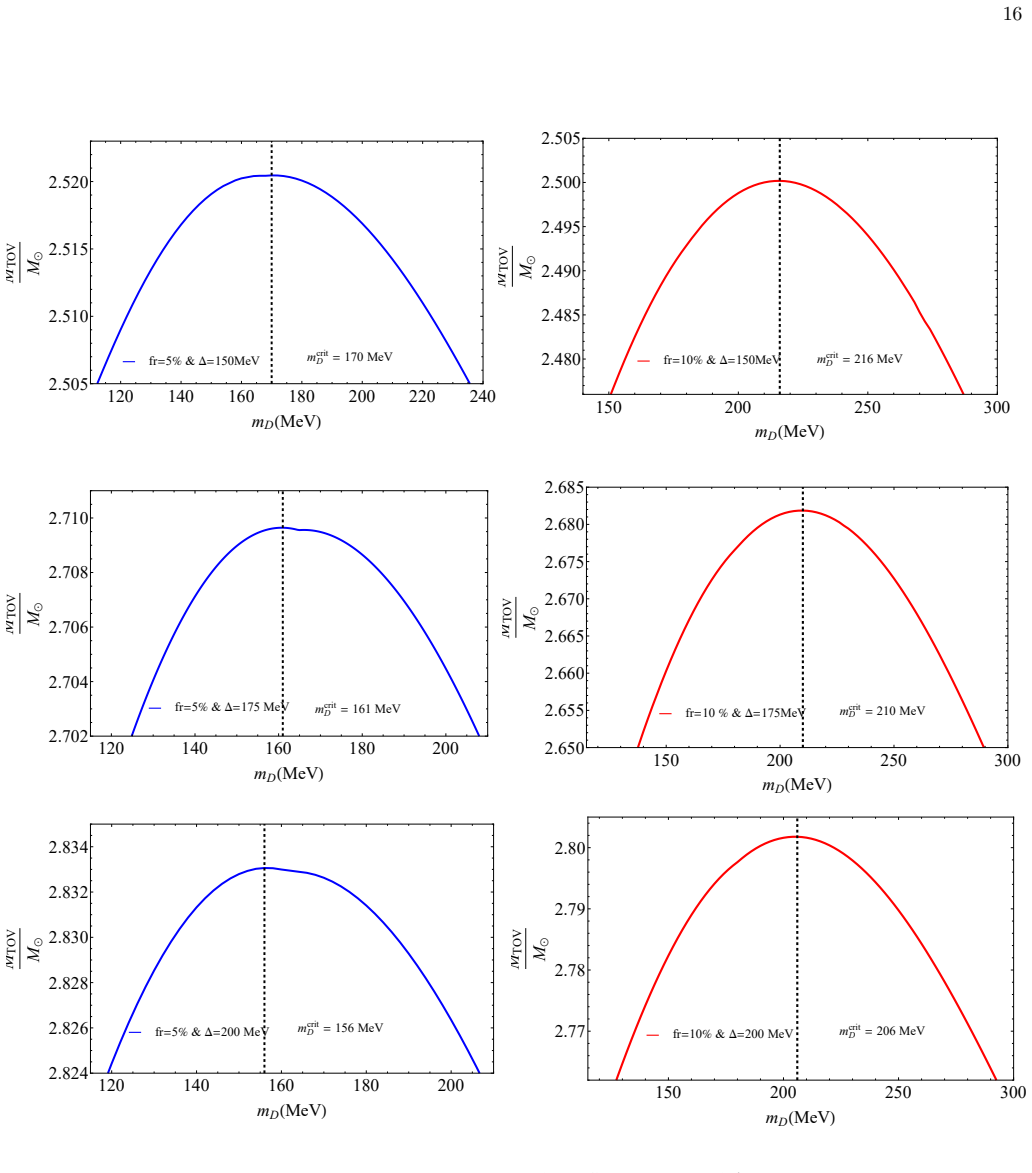
Within the scanned parameter space, the Tolman–Oppenheimer–Volkoff maximum mass of two-fluid CFL strange quark stars is a non-monotonic function of scalar dark-matter mass, rising to a critical value and then declining. Adding the dark-matter fluid allows sequences that reach lower-mass-gap objects (for example the secondary component of GW190814) while remaining qualitatively inside the GW170817 Λ range; some pure CFL models that reach the same masses do not.
Load-bearing premise
Single-fluid GW170817 tidal-deformability bounds remain even qualitatively informative for two-fluid stars that can grow extended dark-matter halos, and the non-interacting two-fluid treatment with chosen f_r and Δ fully captures the relevant microphysics.
Editorial extensions
If this is right
- Two-fluid CFL sequences can reproduce the mass of the GW190814 secondary while staying qualitatively inside the GW170817 Λ range.
- M_TOV peaks at a critical dark-matter mass and declines beyond it, giving a structural signature of the dark-matter component.
- Some pure stiff CFL models that reach mass-gap masses become disfavored by tidal constraints that the corresponding two-fluid models can still satisfy.
- A subset of the two-fluid mass–radius sequences remains compatible with recent NICER measurements of compact-star radii.
Reading between the lines
- If the non-monotonic M_TOV versus dark-matter-mass curve is generic, precise mass measurements of compact objects could constrain the scalar dark-matter particle mass scale.
- The authors’ own caveat that single-fluid Λ bounds are only qualitative for halo stars implies that dedicated two-fluid tidal-response calculations are required before the mass-gap compatibility claim can be made quantitative.
- Analogous critical-mass behavior may appear in two-fluid constructions that replace CFL with other condensed quark phases, offering a broader diagnostic of dark-matter content in exotic stars.
Signed reviews
Editorial analysis
A structured set of objections, weighed in public.
Referee Report
Summary. The manuscript studies the structure of color–flavor–locked (CFL) strange quark stars admixed with scalar bosonic dark matter in a non-interacting two-fluid TOV framework matched to perturbative QCD. Scanning dark-matter particle mass, the CFL pairing gap Δ, and the central dark-matter pressure fraction f_r, the authors report a non-monotonic dependence of M_TOV on dark-matter mass, with a critical mass beyond which M_TOV decreases, and they map R_DM/R_SQM and the dimensionless tidal deformability Λ. They further argue that some pure CFL configurations that reach the lower mass gap (e.g., the GW190814 secondary) fail to remain compatible with the GW170817 Λ window, whereas two-fluid CFL+DM models can occupy that mass-gap region while remaining only qualitatively compatible with the same Λ range, and they compare mass–radius curves to NICER constraints. The abstract and discussion explicitly caveat that GW170817 Λ bounds were inferred in single-fluid frameworks and supply only qualitative guidance for two-fluid halo stars.
Significance. If the structural results hold under the stated microphysics, the non-monotonic M_TOV(m_DM) relation with a critical mass is a concrete two-fluid outcome of interest for dark-matter-admixed compact stars and for interpreting objects in the lower mass gap. The work also contributes a systematic scan of CFL+scalar-DM configurations against NICER and GW190814 mass scales. Significance is tempered by the multi-parameter phenomenological character of the scan (m_DM, Δ, f_r, and pQCD/CFL EOS inputs) and by the authors’ own caveat that single-fluid GW170817 Λ bounds are only qualitative for extended DM halos; the mass-gap-plus-Λ discriminator is therefore less robust than the internal M_TOV structural finding. No machine-checked proofs or parameter-free derivations are claimed; the value is primarily phenomenological and comparative within the scanned space.
major comments (3)
- [Abstract; results on Λ and mass-gap comparison] The headline claim that two-fluid CFL+DM configurations can occupy the lower mass gap (e.g. GW190814 secondary) while remaining compatible with the GW170817 Λ range, whereas some pure CFL models that reach the gap do not, rests on treating single-fluid GW170817 Λ bounds as at least a qualitative discriminator for two-fluid stars. The manuscript itself states that those bounds were inferred in single-fluid frameworks and provide only qualitative guidance for two-fluid halo configurations. When R_DM/R_SQM > 1 the exterior spacetime and tidal response are set by an extended DM halo whose density profile and microphysics lie outside the baryonic EOS families used to extract the GW170817 window; the mapping is then not a small correction and can reorder which configurations are allowed. Either a two-fluid tidal-deformability calculation appropriate to halo configurations must be provided and
- [Parameter scan; pure CFL vs two-fluid mass-gap discussion] Compatibility with NICER and with the GW190814 secondary is obtained by exploring a multi-parameter space (scalar DM mass, Δ, f_r, and pQCD/CFL EOS scale parameters). The paper should state clearly, for each pure-CFL versus CFL+DM comparison that underpins the mass-gap claim, which parameters are held fixed and which are retuned. Without a controlled comparison (e.g. same CFL/pQCD inputs, only f_r and m_DM varied, or an explicit prior volume), it remains possible that the apparent advantage of DM is an artifact of extra freedom rather than a robust two-fluid effect. A table or figure that isolates the pure-CFL failing cases against the DM-enabled cases under matched EOS inputs would make the claim load-bearing rather than scan-dependent.
- [Two-fluid formalism; f_r definition and tidal analysis] The two-fluid treatment assumes non-interacting fluids with relative structure fixed by a central pressure fraction f_r, and ignores relative fluid motion and any portal coupling for both hydrostatic structure and tides. For configurations with extended DM halos this is a strong assumption: even small couplings or differential rotation/oscillation can change the effective tidal response and the stable mass range. The manuscript should either justify why these effects are negligible over the reported (m_DM, Δ, f_r) domain or mark the mass-gap and Λ conclusions as conditional on the non-interacting, static two-fluid idealization, with a brief estimate of how a portal coupling would shift M_TOV and Λ.
minor comments (5)
- [Methods / two-fluid setup] Define f_r at first use with an explicit equation (central DM pressure over total central pressure, or the precise convention used) and keep that notation consistent in all figures and tables.
- [Figures showing Λ and M–R] When quoting the GW170817 Λ range next to two-fluid models, label every such comparison as “qualitative / single-fluid proxy” in figure captions so readers do not read the bands as strict two-fluid constraints.
- [Numerical methods] Report the numerical TOV and tidal pipeline (integrator, matching to pQCD, convergence tests, and how Λ is computed for two-fluid stars with R_DM ≠ R_SQM) in enough detail for reproduction; if a public code or notebook exists, cite it.
- [Dark-matter model] Clarify the scalar bosonic DM EOS (self-interaction strength, condensate vs. ideal Bose gas assumptions) and the range of particle masses scanned, with units, in one place.
- [Abstract] Tighten abstract wording so the non-monotonic M_TOV result is stated as the primary structural finding and the mass-gap statement is explicitly conditional on the single-fluid Λ caveat already present in the text.
Simulated Author's Rebuttal
We thank the referee for a careful and constructive report. The three major comments correctly identify where our mass-gap-plus-Λ discussion leans on qualitative use of single-fluid GW170817 bounds, where the pure-CFL versus CFL+DM comparison needs tighter control of the EOS inputs, and where the non-interacting two-fluid idealization should be stated more explicitly as a condition on the conclusions. We agree that the primary, load-bearing result of the work is the structural non-monotonic M_TOV(m_DM) relation with a critical mass; the mass-gap and Λ discussion is secondary and more model-dependent. We will revise the abstract, results, and discussion to (i) further soften and condition the Λ-based claims, (ii) add a controlled pure-CFL versus CFL+DM comparison under matched CFL/pQCD inputs, and (iii) mark the hydrostatic and tidal conclusions as conditional on the static, non-interacting two-fluid framework, with a brief qualitative discussion of portal couplings. We do not claim a full two-fluid tidal calculation or a quantitative portal-coupling scan in this revision; those are left as future work and are listed among the standing limitations.
read point-by-point responses
-
Referee: The headline claim that two-fluid CFL+DM can occupy the lower mass gap while remaining compatible with the GW170817 Λ range, whereas some pure CFL models that reach the gap do not, rests on treating single-fluid GW170817 Λ bounds as a qualitative discriminator for two-fluid stars. When R_DM/R_SQM > 1 the exterior spacetime and tidal response are set by an extended DM halo outside the baryonic EOS families used to extract the GW170817 window; the mapping is then not a small correction. Either a two-fluid tidal-deformability calculation for halo configurations must be provided, or the claim must be substantially weakened.
Authors: We agree with the substance of this comment. The manuscript already states that the GW170817 Λ window was inferred in single-fluid frameworks and supplies only qualitative guidance for two-fluid halo stars; we did not intend the Λ comparison to be read as a rigorous, quantitative discriminator. For configurations with R_DM/R_SQM > 1 the exterior is DM-dominated, so single-fluid Λ bounds cannot be applied as a small correction, and they can in principle reorder which models appear allowed. A dedicated two-fluid tidal calculation for extended halos is beyond the scope of the present revision and is not claimed. In the revised manuscript we will: (1) further soften the abstract and discussion language so that we no longer phrase the result as “remaining compatible” with the GW170817 Λ range, but only as “qualitatively consistent within the limitations of single-fluid bounds”; (2) state explicitly that the mass-gap-plus-Λ argument is exploratory and secondary to the structural M_TOV(m_DM) finding; and (3) flag all Λ-based statements for halo configurations as conditional on the single-fluid mapping. The pure-CFL versus CFL+DM contrast will be retained only as a qualitative illustration under those caveats, not as a firm observational discriminator. revision: yes
-
Referee: Compatibility with NICER and with the GW190814 secondary is obtained by exploring a multi-parameter space (m_DM, Δ, f_r, and pQCD/CFL EOS scale parameters). The paper should state clearly, for each pure-CFL versus CFL+DM comparison that underpins the mass-gap claim, which parameters are held fixed and which are retuned. Without a controlled comparison (same CFL/pQCD inputs, only f_r and m_DM varied, or an explicit prior volume), the apparent advantage of DM may be an artifact of extra freedom. A table or figure isolating pure-CFL failing cases against DM-enabled cases under matched EOS inputs would make the claim load-bearing rather than scan-dependent.
Authors: This is a fair and important point. In the present draft, pure-CFL and CFL+DM sequences that reach the lower mass gap are not always compared under identical CFL/pQCD inputs, so part of the apparent advantage of DM could reflect the extra freedom in (m_DM, f_r) rather than a robust two-fluid effect alone. We will revise the mass-gap discussion to make the comparison controlled: for each pure-CFL case that reaches the GW190814 secondary mass scale but fails the qualitative Λ window under a given (Δ, pQCD/CFL) choice, we will show the corresponding two-fluid sequences obtained by holding those same CFL/pQCD inputs fixed and varying only m_DM and f_r. We will add a dedicated table (and, where helpful, a figure panel) that lists the matched inputs, the pure-CFL M_TOV and Λ, and the DM-enabled M_TOV, R_DM/R_SQM, and Λ under those fixed inputs. We will also state explicitly which parameters are held fixed versus retuned in every pure-CFL versus CFL+DM comparison that underpins the mass-gap claim. This does not remove the multi-parameter character of the broader scan, but it makes the specific pure-CFL-versus-DM contrast load-bearing under matched microphysics rather than scan-dependent. revision: yes
-
Referee: The two-fluid treatment assumes non-interacting fluids with relative structure fixed by a central pressure fraction f_r, and ignores relative fluid motion and any portal coupling for both hydrostatic structure and tides. For extended DM halos this is a strong assumption: even small couplings or differential rotation/oscillation can change the effective tidal response and the stable mass range. The manuscript should either justify why these effects are negligible over the reported (m_DM, Δ, f_r) domain or mark the mass-gap and Λ conclusions as conditional on the non-interacting, static two-fluid idealization, with a brief estimate of how a portal coupling would shift M_TOV and Λ.
Authors: We agree that the non-interacting, static two-fluid idealization is a strong assumption, especially for extended DM halos. The present work does not include portal couplings, relative fluid motion, or differential oscillation modes; hydrostatic structure is fixed by the central pressure fraction f_r alone, and the tidal analysis inherits that idealization. We cannot rigorously justify that these effects are negligible over the full (m_DM, Δ, f_r) domain without additional microphysical input. In the revision we will therefore mark the mass-gap and Λ conclusions explicitly as conditional on the non-interacting, static two-fluid framework. We will add a short discussion noting that even a weak portal coupling (or relative fluid motion) can modify the effective EOS support, the stable mass range, and the tidal response of halo configurations, and that quantitative shifts in M_TOV and Λ would require a coupled two-fluid calculation with a specified portal. A controlled numerical estimate of those shifts is outside the present scope and would depend on the choice of coupling; we will not invent a quantitative estimate without a defined portal model. The structural non-monotonic M_TOV(m_DM) result is likewise understood within the same idealization, which we will state clearly. revision: yes
- A full two-fluid tidal-deformability calculation appropriate to extended DM halo configurations is not provided in this revision; Λ conclusions remain qualitative and conditional on single-fluid bounds.
- No quantitative estimate of how a portal coupling (or relative fluid motion) would shift M_TOV and Λ is given, because such an estimate requires a specified portal model and a coupled two-fluid calculation beyond the present scope.
Circularity Check
Standard multi-parameter two-fluid TOV scan; no derivation reduces to its inputs by construction.
full rationale
The paper solves the two-fluid TOV equations for a CFL strange-quark EOS (pQCD + pairing gap Δ) plus a non-interacting scalar bosonic dark-matter fluid, scanning m_DM, Δ, and the central pressure fraction f_r. Structural outputs (M_TOV, R_DM/R_SQM, Λ, M–R curves) are numerical consequences of those equations and inputs; they are not algebraically identical to any fitted target. Compatibility with NICER, the GW190814 secondary mass, and a qualitative GW170817 Λ window is assessed after the scan, not enforced by construction. The non-monotonic M_TOV(m_DM) feature with a critical mass is an emergent result of the two-fluid hydrostatic structure, not a renamed input. The authors themselves flag that single-fluid GW170817 Λ bounds supply only qualitative guidance for halo configurations, so the mass-gap claim is presented as a phenomenological possibility within the scanned space rather than a forced prediction. No load-bearing uniqueness theorem, self-definitional identity, or fitted-parameter-as-prediction step is present. Minor self-citation of prior CFL/EOS work by overlapping authors is normal background and is not used to forbid alternatives or close the argument. Score 1 reflects ordinary self-citation without circular reduction of the central claims.
Assumptions & free parameters
free parameters (4)
- scalar dark-matter particle mass
- CFL pairing gap Δ
- central dark-matter pressure fraction f_r
- pQCD / CFL EOS scale parameters (e.g. bag-like or renormalization-scale inputs)
assumptions (4)
- domain assumption Two non-interacting fluids in hydrostatic equilibrium (separate energy-momentum tensors, coupled only through gravity).
- domain assumption Strange quark matter in the CFL phase is described by a perturbative QCD EOS with a pairing gap Δ.
- domain assumption Dark matter is a scalar bosonic fluid that can form a stable stellar component characterized by a particle mass and central pressure fraction.
- ad hoc to paper Single-fluid GW170817 Λ bounds supply at least qualitative guidance for two-fluid halo stars.
invented entities (1)
-
scalar bosonic dark-matter stellar fluid component
Cite this review
Pith. "Pith review of Two fluid CFL strange quark stars with scalar dark matter: critical mass and mass gap implications." pith.science (2026). https://pith.science/paper/IRWL7A27
@misc{pith2026260705972,
  author       = {Pith},
  title        = {Pith review of: Two fluid CFL strange quark stars with scalar dark matter: critical mass and mass gap implications},
  year         = {2026},
  howpublished = {\url{https://pith.science/paper/IRWL7A27}},
  note         = {Machine review of arXiv:2607.05972}
}
abstract
We investigate the structure of strange quark stars (SQSs) in the color--flavor--locked (CFL) phase in the presence of scalar bosonic dark matter within a two--fluid formalism employing perturbative QCD. By considering different dark matter masses and varying the pairing gap $\Delta$ and {the central dark matter pressure fraction} $f_r$, we analyze the impact of dark matter on the structural properties of SQSs, including the maximum gravitational mass $M_{\mathrm{TOV}}$, the ratio of dark matter to strange-quark-matter radii $R_{\mathrm{DM}}/R_{\mathrm{SQM}}$, and the dimensionless tidal deformability $\Lambda$. We further examine the compatibility of the resulting mass--radius relations with the recent NICER measurements of compact stars. Within the parameter space considered in this study, we find that $M_{\mathrm{TOV}}$ exhibits a non-monotonic dependence on the dark matter mass, with a critical value beyond which $M_{\mathrm{TOV}}$ decreases. We also show that some pure CFL strange quark star configurations, particularly those associated with very stiff EOSs and larger maximum masses, may not simultaneously remain compatible with the $\Lambda$ range inferred from GW170817 while occupying the lower mass--gap region. In contrast, the inclusion of dark matter allows two-fluid CFL strange quark star configurations to reproduce the observed properties of massive compact objects in the lower mass--gap region, such as the secondary component of GW190814, while remaining qualitatively compatible with the $\Lambda$ range inferred from GW170817. We note, however, that the GW170817 constraints were originally inferred within single-fluid compact-star frameworks and therefore provide only {qualitative guidance} for the present two-fluid halo configurations. Our results suggest that exotic compact-star configurations may populate part of the conventionally defined lower mass--gap region.
Figures


Figures from the paper (17 more)




Reference graph
Works this paper leans on
-
[1]
de Martino et al., Universe6, 107, (2020)
I. de Martino et al., Universe6, 107, (2020)
work page 2020
- [2]
- [3]
- [4]
- [5]
- [6]
-
[7]
S. W. Allen, A. E. Evrard, and A. B. Mantz, Annu. Rev. Astron. Astrophys.49, 409 (2011)
work page 2011
-
[8]
C. S. Frenk and S. D. M. White, Ann. Phys.524, 507 (2012)
work page 2012
Show all 100 references
-
[9]
C. L. Bennett et al., Astrophys. J. Suppl. Ser.208, 20 (2013)
2013
-
[10]
B. W. Lee and S. Weinberg, Phys. Rev. Lett39, 165 (1977)
1977
-
[11]
M. W. Goodman and E. Witten, Phys. Rev. D31, 3059 (1985)
1985
-
[12]
M. I. Vysotskii, A. D. Dolgov, and Z. Y. B, J. Exp. Theor. Phys. Lett.26, 188 (1977)
1977
-
[13]
Adhikari et al
G. Adhikari et al. (COSINE-100 Collaboration) Phys. Rev. D108, L041301 (2023)
2023
-
[14]
Weinberg, Phys
S. Weinberg, Phys. Rev. D40, 223 (1978)
1978
-
[15]
Preskill, M.B
J. Preskill, M.B. Wise, and F. Wilczek, Phys. Lett. B 120, 127 (1983)
1983
-
[16]
Abbott and P
L.F. Abbott and P. Sikivie, Phys. Lett. B120, 133 (1983)
1983
-
[17]
Roszkowski, E
L. Roszkowski, E. M. Sessolo, and S. Trojanowski, Rept. Prog. Phys.81, 066201 (2018)
2018
-
[18]
R. B. Wiringa, V. Fiks, and A. Fabrocini, Phys. Rev. C 38, 1010 (1988)
1988
-
[19]
J. R. Stone, P. A. M. Guichon, H. H. Matevosyan, and A. W. Thomas, Nucl. Phys. A792, 341 (2007)
2007
-
[20]
J. M. Pearson et al., Mon. Not. Roy. Astron. Soc.481, 2994 (2018)
2018
-
[21]
Negreiros et al., Astrophys
R. Negreiros et al., Astrophys. J.863, 104 (2018)
2018
-
[22]
Moeini and G
H. Moeini and G. H. Bordbar, Eur. Phys. J. Plus139, 620 (2024)
2024
-
[23]
G. H. Bordbar, M. Mazhari, and A. Poostforush, Eur. Phys. J. Plus139, 167 (2024)
2024
-
[24]
G. H. Bordbar and M. Karami, Eur. Phys. J. C82, 74 (2022)
2022
-
[25]
Eslam Panah, G
B. Eslam Panah, G. H. Bordbar, S. H. Hendi, R. Ruffini, Z. Rezaei, and R. Moradi, Astrophys. J.848, 24 (2017)
2017
-
[26]
Blaschke, H
D. Blaschke, H. Grigorian, and D. Voskresensky, Astron. Astrophys.368, 561 (2001)
2001
-
[27]
G. F. Burgio, H. J. Schulze, and F. Weber, Astron. As- trophys.408, 675 (2003)
2003
-
[28]
Alford, M
M. Alford, M. Braby, M. Paris, and S. Reddy, Astro- phys. J.629, 969 (2005)
2005
-
[29]
S. Pal, S. Podder, D. Sen, and G. Chaudhuri, Phys. Rev. D107, 063019 (2023)
2023
-
[30]
I. A. Rather et al., Astrophys. J.94352 (2023)
2023
-
[31]
J. J. Li, A. Sedrakian, and M. Alford, Phys. Rev. D 107, 023018 (2023)
2023
-
[32]
Yazdizadeh, G
T. Yazdizadeh, G. H. Bordbar, and B. Eslam Panah, Phys. Dark Univ.35, 100982 (2022)
2022
-
[33]
Eslam Panah, T
B. Eslam Panah, T. Yazdizadeh, and G. H. Bordbar, Eur. Phys. J. C79, 815 (2019)
2019
-
[34]
F. C. Michel, Phys. Rev. Lett.60, 677 (1988)
1988
-
[35]
Drago, and A
A. Drago, and A. Lavagno, Phys. Lett. B511, 229 (2001)
2001
-
[36]
Kurkela, P
A. Kurkela, P. Romatschke, and A. Vuorinen, Phys. Rev. D81, 105021 (2010)
2010
-
[37]
Q. Wang, C. Shi, and H. -S. Zong, Phys. Rev. D100, 123003 (2019)
2019
-
[38]
D. Deb, B. Mukhopadhyay, and F. Weber, Astrophys. J.922, 149 (2021)
2021
-
[39]
Sedaghat, S
J. Sedaghat, S. M. Zebarjad, G. H. Bordbar, and B. Eslam Panah, Phys. Lett. B829, 137032 (2022)
2022
-
[40]
Sedaghat, S
J. Sedaghat, S. M. Zebarjad, G. H. Bordbar, B. Es- lam Panah, and R. Moradi, Phys. Lett. B833, 137388 (2022)
2022
-
[41]
Sedaghat, B
J. Sedaghat, B. Eslam Panah, R. Moradi, S. M. Zebar- jad, and G. H. Bordbar, Eur. Phys. J. C84, 171 (2024)
2024
-
[42]
Sedaghat, G
J. Sedaghat, G. H. Bordbar, and S. M. Zebarjad, Ann. Phys.472, 169864 (2025)
2025
-
[43]
Sedaghat, G
J. Sedaghat, G. H. Bordbar, M. Haghighat, and S. M. Zebarjad, Eur. Phys. J. C85, 283 (2025)
2025
-
[44]
Pal and G
S. Pal and G. Chaudhuri, J. Cosmol. Astropart. Phys. 10, 064 (2024)
2024
-
[45]
Shahrbafet et al., arXiv:2402.18686v2 [nucl-th]
M. Shahrbafet et al., arXiv:2402.18686v2 [nucl-th]
-
[46]
Anzuini et al., J
F. Anzuini et al., J. Cosmol. Astropart. Phys.04, E02 (2024)
2024
-
[47]
Routaray et al., J
P. Routaray et al., J. Cosmol. Astropart. Phys.10, 073 (2023)
2023
-
[48]
A. Das, T. Malik and A.C. Nayak, Phys. Rev. D99, 043016 (2019)
2019
-
[49]
Panotopoulos and I
G. Panotopoulos and I. Lopes, Phys. Rev. D96, 083004 (2017)
2017
-
[50]
Karkevandi, S
D.R. Karkevandi, S. Shakeri, V. Sagun, and O. Ivanyt- skyi, Phys. Rev. D105, 023001 (2022)
2022
-
[51]
Shakeri and D.R
S. Shakeri and D.R. Karkevandi, Phys. Rev. D109, 043029 (2024)
2024
-
[52]
D. R. Karkevandi, M. Shahrbaf, S. Shakeri, and S. Typel 2024, Particles7, 201 (2024)
2024
-
[53]
S. H. Yang, C. M. Pi, and F. Weber, Phys. Rev. D111, 043037 (2025)
2025
-
[54]
C. D. Bailyn et al., Astrophys. J. 499, 367 (1998)
1998
-
[55]
¨Ozel et al., Astrophys
F. ¨Ozel et al., Astrophys. J.725, 1918 (2010)
1918
-
[57]
Abbott et al., Astrophys
R. Abbott et al., Astrophys. J. Lett.896, L44 (2020)
2020
-
[58]
Kanakis-Pegios, P.S
A. Kanakis-Pegios, P.S. Koliogiannis, and Ch.C. Mous- takidis, Symmetry13, 183, (2021)
2021
-
[59]
R. W. Romani et al., Astrophys. J. Lett.934, L17 (2022)
2022
-
[60]
M. C. Miller et al., Astrophys. J. Lett. 918, L28 (2021)
2021
-
[61]
Annala et al., Nature Phys.16, 907 (2020)
E. Annala et al., Nature Phys.16, 907 (2020)
2020
-
[62]
L. L. Lopes and H. C. Das, J. Cosmol. Astropart. Phys., 05, 034 (2023)
2023
-
[63]
Panotopoulos and I
G. Panotopoulos and I. Lopes, Phys. Rev. D96, 023002 (2017)
2017
-
[64]
Vermaseren, S
J. Vermaseren, S. Larin, and T. Van Ritbergen, Phys. Lett. B405, 327 (1997)
1997
-
[65]
E. S. Fraga, Nucl. Phys. A774, 819 (2006)
2006
-
[66]
Navas et al., Phys
S. Navas et al., Phys. Rev. D110, 030001 (2024) and 2025 update
2024
-
[67]
M. G. Alford et al., Rev. Mod. Phys.80, 1455 (2008)
2008
-
[68]
Rajagopal, and F
K. Rajagopal, and F. Wilczek, Phys. Rev. Lett.86, 3492 (2001). 23
2001
-
[69]
I. A. Shovkovy, Found. Phys.35, 1309 (2005)
2005
-
[70]
Schmitt, I
A. Schmitt, I. A. Shovkovy, and Q. Wang, Phys. Rev. D73, 034012 (2006)
2006
-
[71]
Gholami, M
H. Gholami, M. Hofmann, and M. Buballa, Phys. Rev. D111, 014006 (2025)
2025
-
[72]
M. G. Alford and S. Reddy, Phys. Rev. D67, 074024 (2003)
2003
-
[73]
Page et al., Astrophys
D. Page et al., Astrophys. J.7071131-1140 (2009)
2009
-
[74]
J. F. Xu et al., Phys. Rev. D92, 025025 (2025)
2025
-
[75]
C. J. Xia et al., Phys. Rev. D89, 105207 (2014)
2014
-
[76]
Lopes and G
I. Lopes and G. Panotopoulos, Phys. Rev. D97, 024030 (2018)
2018
-
[77]
R. C. Tolman, Phys. Rev.55, 364 (1939)
1939
-
[78]
J. R. Oppenheimer and G. M. Volkoff, Phys. Rev.55, 374 (1939)
1939
-
[79]
C. M. Li et al., Phys. Rev. D101, 063023 (2020)
2020
-
[80]
Hinderer, B
T. Hinderer, B. D. Lackey, R. N. Lang, and J. S. Read, Phys. Rev. D81, 123016 (2010)
2010
-
[81]
Postnikov, M
S. Postnikov, M. Prakash, and J.M. Lattimer, Phys. Rev. D82, 024016 (2010)
2010
-
[82]
L. L. Lopes and D.P. Menezes, Astrophys. J.936, 41 (2022)
2022
-
[83]
Lenzi et al., Eur
C. Lenzi et al., Eur. Phys. J. C83, 226 (2023)
2023
-
[84]
Gholami et al., Phys
H. Gholami et al., Phys. Rev. D111, 103034 (2025)
2025
-
[85]
Roupas, G
Z. Roupas, G. Panotopoulos, and I. Lopes, Phys. Rev. D103, 083015 (2021)
2021
-
[86]
Kurkela, K
A. Kurkela, K. Rajagopal, and R. Steinhorst, Phys. Rev. Lett.132, 262701 (2024)
2024
-
[87]
Z. B. Stubbs and I. Lopes, Phys. Rev. D109, 043043 (2024)
2024
-
[88]
Linares, T
M. Linares, T. Shahbaz, and J. Casares, Astrophys. J. 859, 54 (2018)
2018
-
[89]
P. C. C. Freire et al., Astrophys. J.675, 670 (2008)
2008
-
[90]
H. T. Cromartie et al., Nature Astron.4, 72 (2019)
2019
-
[91]
T. E. Riley et al., Astrophys. J. Lett.887, L21 (2019)
2019
-
[92]
Choudhury et al., Astrophys
D. Choudhury et al., Astrophys. J. Lett.971, L20 (2024)
2024
-
[93]
Mauviard et al., Astrophys
L. Mauviard et al., Astrophys. J.995, 60 (2025)
2025
-
[94]
Antoniadis et al., Science340, 1233232 (2013)
J. Antoniadis et al., Science340, 1233232 (2013)
2013
-
[95]
Demorest et al., Nature467, 1081 (2010)
P.B. Demorest et al., Nature467, 1081 (2010)
2010
-
[96]
Gangopadhyay, S
T. Gangopadhyay, S. Ray, X.-D. Li, J. Dey and M. Dey, Mon. Not. R. Astron. Soc.431, 3216 (2013)
2013
-
[97]
B. P. Abbott et al. (LIGO Scientific Collaboration and Virgo Collaboration), Phys. Rev. Lett.121, 161101 (2018)
2018
-
[98]
C. D. Bailyn et al., Astrophys. J.499, 367 (1998)
1998
-
[99]
Belczynski et al., Astrophys
K. Belczynski et al., Astrophys. J.757, 91 (2012)
2012
-
[100]
Bombaci et al., Phys
I. Bombaci et al., Phys. Rev. Lett.126, 162702 (2021)
2021
-
[101]
C. D. Capano et al., Nat. Astron.4, 625 (2020)
2020
Reviewed July 8, 2026 · model on record in the stance chip above.
Discussion (0). Continue with ORCID to comment.