REVIEW 4 major objections 5 minor 24 references
Strengthening the Case for a Bayesian Approach to Car-following Model Calibration and Validation using Probabilistic Programming
T0 review · 4 major / 5 minor · reviewed 2026-08-14 · deepseek-v4-flash
Pith's one-line read A hierarchical Bayesian calibration assigns each driver their own car-following parameter distribution, beating pooled, per-driver, and genetic-algorithm baselines on the data set.
desk verdict Clear hierarchical Bayesian shrinkage result, but the headline superiority claim is not supported by the in-sample and heuristically chosen comparisons. read the letter →
The pith
A machine-rendered reading of the paper's core claim, the machinery that carries it, and where it could break.
The reading
What carries the argument
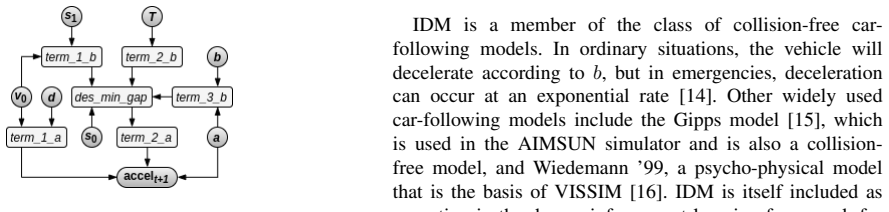
The load-bearing object is the non-centered hierarchical model: $\theta_d = \mu_d + \sigma_d \times \theta_{d,\mathrm{norm}}$, with $\theta_{d,\mathrm{norm}}\sim\mathcal{N}^k(0,I)$, $\mu_d\sim\mathcal{N}^k(\mu_\mu,\sigma_\mu)$, and $\sigma_d\sim\mathcal{N}^k(\mu_\sigma,\sigma_\sigma)$, together with the Intelligent Driver Model, a deterministic acceleration equation with seven parameters, used as the likelihood and a normal model for the observed acceleration response. Hamiltonian Monte Carlo, a gradient-guided Markov chain Monte Carlo sampler, performs the posterior inference. The hierarchy is what carries the argument: individual drivers' parameters are pulled toward shared population means, which regularizes the estimates for data-poor drivers and preserves genuine between-driver variation for data-rich ones.
What would settle it
Hold out whole car-following instances from the 54-driver data set, fit the hierarchical, pooled, and differential-evolution models on the remaining instances, and compare each model's root-mean-square error and Kullback-Leibler divergence on the held-out trajectories; if the pooled or differential-evolution fits generalize at least as well as the hierarchy, the paper's outperformance claim fails.
Extended reading notes
Core claim
The paper's central claim is that a two-level hierarchical Bayesian formulation of the Intelligent Driver Model calibrates car-following behavior better than the standard alternatives. In the hierarchy, the seven IDM parameters for each driver are treated as draws from population-level distributions, so information flows across drivers instead of being estimated independently or pooled into a single global set. The results show the hierarchical model achieving the lowest root-mean-square error and average Kullback-Leibler divergence for every prior strength tested, and it is the only formulation that yields stable, plausible per-driver parameter distributions; the independent per-driver model overfits on drivers with few instances, and the differential-evolution search that achieved a lower raw RMSE was rejected because its parameters exploded to implausible values. The paper also claims that Bayesian model criticism, information criteria and Bayesian two-sample tests, offers a more informative validation path for car-following models than RMSE alone.
Load-bearing premise
The central claim assumes that fitting the calibration data well and producing plausible-looking parameter values (the paper's own limits in Sections VII.E and VI.C.3) will translate into better simulated driving behavior in new situations, which the paper does not test.
Editorial extensions
If this is right
- A traffic simulator can draw each simulated driver's IDM parameters from that driver's posterior distribution, preserving heterogeneity instead of imposing one global parameter set.
- Calibration of a new driver with few observations can borrow strength from the population-level distribution, so unique parameters per driver no longer require a large per-driver data set.
- Parameter uncertainty from calibration can be propagated through simulation traces, so simulation outputs can carry error bars rather than single deterministic values.
- Bayesian validation tools, such as information criteria, posterior predictive checks, and Bayesian two-sample tests, give a firmer basis for comparing car-following models than RMSE alone.
- The same probabilistic-programming formulation can be carried over to other differentiable car-following models, with a gradient-free sampler needed for models with conditional driving regimes.
Reading between the lines
- If the central claim holds, the common practice of using a single calibrated parameter set for all drivers is not merely a simplification but a likely source of bias in simulated traffic performance, and replacing it with hierarchical per-driver posteriors could change predicted capacity and delays.
- A direct next test is to hold out whole car-following instances per driver and compare predictive error of hierarchical posteriors against pooled and differential-evolution fits; if the hierarchy wins there, the case for per-driver calibration is much stronger than the in-sample comparison alone.
- The paper's hierarchical-sharing idea may also improve calibration for other data-sparse agent-based models, since borrowing strength across agents is a general remedy for per-agent overfitting, not a car-following-specific trick.
Signed reviews
Editorial analysis
A structured set of objections, weighed in public.
Referee Report
Summary. The paper proposes a hierarchical Bayesian calibration procedure for the Intelligent Driver Model (IDM) using the probabilistic programming framework Edward2/TensorFlow Probability, applied to 207 car-following instances from 54 drivers in a naturalistic driving study. It compares three probabilistic formulations (pooled, hierarchical, and individual per-driver) under three prior scale choices, reporting in-sample root mean square error and KL divergence in Table I. It also compares the Bayesian results with a differential evolution (DE) optimizer, claiming that the Bayesian approach outperforms industry-standard calibration methods and yields unique per-driver parameters even with small data. The paper further discusses Bayesian model validation tools (WAIC, PSIS-LOO, two-sample tests) and frames simulation-based validation as future work.
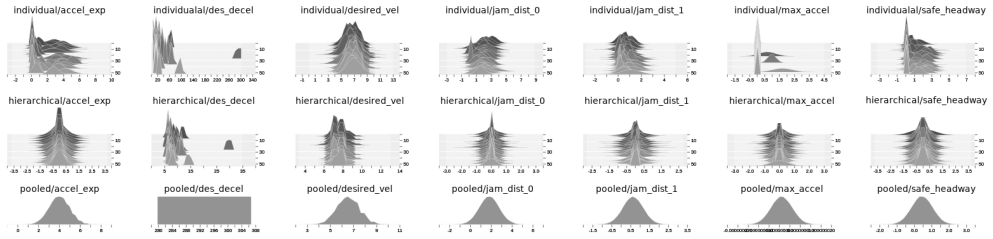
Significance. The paper makes a useful practical contribution by demonstrating that modern probabilistic programming tools can be applied to car-following calibration without bespoke MCMC implementations, and it makes the source code publicly available. The hierarchical model's consistent in-sample advantage over pooled and individual formulations in Table I, together with the shrinkage visible in Figure 2, is a concrete and reproducible result. However, the headline claim that the method outperforms industry-standard approaches is not supported by the evidence presented: the performance measures are in-sample only, and the DE comparison is acknowledged in the manuscript to rely on arbitrary judgement. If supplemented by proper out-of-sample or simulation-based validation, the hierarchical Bayesian approach could be a valuable addition to the traffic calibration toolbox, but as it stands the paper's central superiority claim is overstated.
major comments (4)
- [Section VI.B and VII.B.3] The claim that the Bayesian method outperforms the industry standard is not supported by the reported DE comparison. In Section VI.B the grid-search DE run achieved a lower average RMSE (0.1185) than the best Bayesian result (0.1493), but the DE solution was discarded because at least one parameter 'exploded in value.' Section VII.B.3 then concedes that the comparison was 'based on arbitrary judgement of how convincing the model parameter values resulting from those competing procedures were.' Rejecting a numerically better solution on a post-hoc plausibility criterion, without a pre-specified bound or a formal penalty, does not constitute evidence of superiority. The manuscript should either report a principled comparison (e.g., DE with physically constrained parameter bounds, or a combined accuracy-plus-plausibility objective) or explicitly restrict the claim to the Bayesian formulations only.
- [Section VII.E and V.A] All reported RMSE and KL values in Table I are in-sample fits to the same 207 instances used for inference. The manuscript states in Section VII.E that cross-validation is foregone 'in order to avoid contributing additional uncertainty into the calibration results,' and Section V.A acknowledges that 'the ultimate test of performance remains direct observation of the simulated driving behavior resulting from the application of each model, a task reserved for future work.' Consequently, the abstract's claim that the results 'outperform industry standard approaches' is not established by the evidence in the paper: in-sample error can favor regularized or over-parameterized models without implying better prediction or more realistic simulation. The authors should either add out-of-sample validation (e.g., cross-validation for the pooled and hierarchical models, or simulation-based trajectory comparison) or temper the claim to 'better in-sample calibration fit.'
- [Table I and Section V.A] The central internal claim that 'the hierarchical model outperforms each of the other two models for every combination of prior sigma and measure of error' rests on point estimates without any measure of uncertainty. For example, at prior sigma = 100 the hierarchical RMSE is 0.1493 versus 0.1548 for the individual model, a difference of about 0.0055; no confidence intervals, posterior predictive checks, or repeated-run variability are reported. It is therefore unclear whether the observed ordering is statistically robust or within Monte Carlo noise. The authors should quantify uncertainty in the error measures, for example by reporting credible intervals from posterior predictive samples or by running multiple MCMC chains with different random seeds.
- [Section VI.C.3 and VII.B.2] The discussion of model comparison is internally inconsistent about what validation can be performed. Section VII.B.2 says information criteria such as WAIC and PSIS-LOO are appropriate for the hierarchical model, but Section VI.C.3 says cross-validation 'could be performed on the pooled Bayesian model and on the genetic model' with the hierarchical model excluded because of single-point layer-1 groups. WAIC and PSIS-LOO are themselves approximations to leave-one-out cross-validation and are known to be unreliable when a group has a single observation. The manuscript should clarify whether the proposed validation tools are actually applicable to the hierarchical model, and if so, provide these metrics for all three formulations; otherwise, the discussion overstates the availability of Bayesian validation for the proposed approach.
minor comments (5)
- [Abstract and Section I] The phrase 'outperform industry standard approaches' appears in the abstract and introduction, but the comparison in the body is against one differential evolution implementation with a specific, regularized objective; this should be stated more precisely early on to avoid overgeneralization.
- [Section IV.C.2] The MCMC convergence criterion is described only as an 'arbitrary threshold' on the difference in joint probability between consecutive runs. Please report the actual threshold value and the number of runs used, so that readers can assess the sensitivity of the results to this choice.
- [Section VI.B] The sentence describing the DE regularization term is grammatically incomplete: 'We introduce a third hyperparameter, lambda, which scales the regularization term.' should state the explicit form of the objective (e.g., average RMSE + lambda * Euclidean distance).
- [Section VII.D] The question posed in this subsection ('How many parameter samples must be drawn...') is open-ended and no partial answer is offered; either remove it or connect it concretely to the planned simulation experiments.
- [General] There are several typographical errors, including 'woudl' in Section VI.C, 'oucome' in Section VI.B, and 'Mazinur' in Section II (probably referring to a previous author's work). The paper would benefit from a careful proofread.
Circularity Check
No significant circularity: the hierarchical-versus-pooled/individual comparison is a direct empirical contrast, and the in-sample and heuristic-DE concerns are external-validity limitations, not construction-dependent reductions.
full rationale
The paper's central comparison—hierarchical versus pooled versus individual Bayesian IDM calibrations—is an empirical contrast on the same 207 instances, with no fitted constant or post-hoc quantity reused as the measure of success; the hierarchical model's lower RMSE/KL in Table I is a reported outcome, not an identity, and the non-centered implementation choice is a computational reparameterization rather than a target-derived definition. The in-sample evaluation (Section VII.E: 'we forego the use of CV in order to avoid contributing additional uncertainty into the calibration results') and the heuristic DE comparison (Section VI.C.3: 'based on arbitrary judgement of how convincing the model parameter values...were') weaken the external validity of the 'outperform industry standard' claim, but these are scientific validity limitations, not circular derivations: the DE baseline is an external algorithm with its own objective, and the paper independently reports that the best DE RMSE was lower than the Bayesian result. No load-bearing premise is justified solely by a self-citation or by a uniqueness theorem from the authors, and no quantity defined in terms of the target outcome is renamed as a prediction. The paper explicitly defers the decisive simulation-based test to future work, which further shows the reported results are calibration fits, not concealed predictions. I therefore find no circularity under the enumerated patterns.
Assumptions & free parameters
free parameters (3)
- prior standard deviation sigma =
1, 10, 100 (swept, not fitted)
- MCMC convergence threshold =
not specified numerically
- DE regularization scale lambda =
between 0 and 0.0001 via grid search; optimized via Bayesian optimization
assumptions (5)
- domain assumption The Intelligent Driver Model (Eq. 1-2) is the correct generative model for the observed following behavior.
- domain assumption Per-instance response values are normally distributed given the model.
- domain assumption Car-following instances are statistically independent, with dependence only within instances.
- domain assumption The Volpe naturalistic driving subset is sufficiently complete for car-following calibration.
- standard math Hamiltonian Monte Carlo converges to the stationary distribution under the stated restart rule.
Cite this review
Pith. "Pith review of Strengthening the Case for a Bayesian Approach to Car-following Model Calibration and Validation using Probabilistic Programming." pith.science (2026). https://pith.science/paper/IURN5POJ
@misc{pith2026190802427,
  author       = {Pith},
  title        = {Pith review of: Strengthening the Case for a Bayesian Approach to Car-following Model Calibration and Validation using Probabilistic Programming},
  year         = {2026},
  howpublished = {\url{https://pith.science/paper/IURN5POJ}},
  note         = {Machine review of arXiv:1908.02427}
}
read the original abstract
Compute and memory constraints have historically prevented traffic simulation software users from fully utilizing the predictive models underlying them. When calibrating car-following models, particularly, accommodations have included 1) using sensitivity analysis to limit the number of parameters to be calibrated, and 2) identifying only one set of parameter values using data collected from multiple car-following instances across multiple drivers. Shortcuts are further motivated by insufficient data set sizes, for which a driver may have too few instances to fully account for the variation in their driving behavior. In this paper, we demonstrate that recent technological advances can enable transportation researchers and engineers to overcome these constraints and produce calibration results that 1) outperform industry standard approaches, and 2) allow for a unique set of parameters to be estimated for each driver in a data set, even given a small amount of data. We propose a novel calibration procedure for car-following models based on Bayesian machine learning and probabilistic programming, and apply it to real-world data from a naturalistic driving study. We also discuss how this combination of mathematical and software tools can offer additional benefits such as more informative model validation and the incorporation of true-to-data uncertainty into simulation traces.
Figures
Reference graph
Works this paper leans on
-
[1]
C. D. Yang and T. Morton, “Trends of transportation simulation and modeling based on a selection of exploratory advanced research projects: Workshop summary report,” Office of Operations Research and Development, Federal Highway Administration, U.S. Department of Transportation, Tech. Rep., Jul. 2012
work page 2012
-
[2]
B. Hammit, R. James, and M. Ahmed, “A case for online traffic simulation: Systematic procedure to calibrate car-following models using vehicle data,” 11 2018, pp. 3785–3790
work page 2018
-
[3]
M. Rahman, M. Chowdhury, T. Khan, and P. Bhavsar, “Improving the efficacy of car-following models with a new stochastic parameter estimation and calibration method,” IEEE Transactions on Intelligent Transportation Systems, vol. 16, no. 5, pp. 2687–2699, Oct 2015
work page 2015
-
[4]
Combining field data and computer simulations for calibration and prediction,
D. Higdon, M. Kennedy, J. C. Cavendish, J. A. Cafeo, and R. D. Ryne, “Combining field data and computer simulations for calibration and prediction,” SIAM J. Sci. Comput
-
[5]
Simple, Distributed, and Accelerated Probabilistic Programming
D. Tran, M. Hoffman, D. Moore, C. Suter, S. Vasudevan, A. Radul, M. Johnson, and R. A. Saurous, “Simple, Distributed, and Accelerated Probabilistic Programming,” arXiv e-prints, p. arXiv:1811.02091, Nov 2018
work page Pith review arXiv 2018
-
[6]
Assessing uncertainties in traffic simulation: A key component in model calibration and validation,
M. J. Bayarri, J. O. Berger, G. Molina, N. Rouphail, and J. Sacks, “Assessing uncertainties in traffic simulation: A key component in model calibration and validation,” Transportation Research Record , vol. 1876, pp. 32–40, 01 2004
work page 2004
-
[7]
Statistical inverse analysis for a network microsimulator,
G. Molina, M. J. Bayarri, and J. O. Berger, “Statistical inverse analysis for a network microsimulator,” Technometrics, vol. 47, no. 4, pp. 388– 398, 2005
work page 2005
-
[8]
R. Zhong, K. Fu, A. Sumalee, D. Ngoduy, and W. Lam, “A cross-entropy method and probabilistic sensitivity analysis framework for calibrating microscopic traffic models,” Transportation Research Part C: Emerging Technologies , vol. 63, pp. 147 – 169, 2016. [Online]. Available: http://www.sciencedirect.com/science/article/pii/ S0968090X15004222
work page 2016
Show all 24 references
-
[9]
Congested traffic states in empirical observations and microscopic simulations,
M. Treiber, A. Hennecke, and D. Helbing, “Congested traffic states in empirical observations and microscopic simulations,” Physical Review E, vol. 62, pp. 1805–1824, 02 2000
2000
-
[10]
A simplified car-following theory: a lower order model,
G. Newell, “A simplified car-following theory: a lower order model,” Transportation Research Part B: Methodological , vol. 36, no. 3, pp. 195 – 205, 2002. [Online]. Available: http://www.sciencedirect.com/ science/article/pii/S0191261500000448
2002
-
[11]
A survey of probabilistic models using the bayesian programming methodology as a unifying framework,
J. Diard, P. Bessi `ere, and E. Mazer, “A survey of probabilistic models using the bayesian programming methodology as a unifying framework,” 2003
2003
-
[12]
A maximization technique occurring in the statistical analysis of probabilistic functions of markov chains,
L. E. Baum, T. E. Petrie, G. Soules, and N. R. Weiss, “A maximization technique occurring in the statistical analysis of probabilistic functions of markov chains,” 1970
1970
-
[13]
Probabilistic program- ming in python using pymc3,
J. Salvatier, T. V Wiecki, and C. Fonnesbeck, “Probabilistic program- ming in python using pymc3,” 01 2016
2016
-
[14]
A probabilistic model checking analysis of vehicular ad-hoc networks,
B. Ferreira, F. A. F. Braz, A. A. F. Loureiro, and S. V . A. Campos, “A probabilistic model checking analysis of vehicular ad-hoc networks,” in 2015 IEEE 81st Vehicular Technology Conference (VTC Spring) , May 2015, pp. 1–7
2015
-
[15]
A behavioural car-following model for computer simula- tion,
P. Gipps, “A behavioural car-following model for computer simula- tion,” Transportation Research Part B: Methodological , vol. 15, pp. 105–111, 04 1981
1981
-
[16]
Barcelo, Fundamentals of Traffic Simulation , 01 2010
J. Barcelo, Fundamentals of Traffic Simulation , 01 2010
2010
-
[17]
Flow: Deep reinforcement learning for control in sumo,
N. Kheterpal, K. Parvate, C. Wu, A. Kreidieh, Eug `ene, E. Vinitsky, and A. M. Bayen, “Flow: Deep reinforcement learning for control in sumo,” 2018
2018
-
[19]
Gelman, Prior Distribution
A. Gelman, Prior Distribution . American Cancer Society, 2006. [Online]. Available: https://onlinelibrary.wiley.com/doi/abs/10.1002/ 9780470057339.vap039
2006
-
[20]
A simple and global optimization al- gorithm for engineering problems: Differential evolution algorithm,
D. Karaboa and S. Okdem, “A simple and global optimization al- gorithm for engineering problems: Differential evolution algorithm,” Turkish Journal of Electrical Engineering and Computer Sciences , vol. 12, pp. 53–60, 01 2004
2004
-
[21]
Asymptotic equivalence of bayes cross validation and widely applicable information criterion in singular learning theory,
S. Watanabe, “Asymptotic equivalence of bayes cross validation and widely applicable information criterion in singular learning theory,” J. Mach. Learn. Res
-
[22]
Practical bayesian model evaluation using leave-one-out cross-validation and waic,
A. Vehtari, A. Gelman, and J. Gabry, “Practical bayesian model evaluation using leave-one-out cross-validation and waic,” Statistics and Computing , vol. 27, no. 5, pp. 1413–1432, Sep 2017. [Online]. Available: https://doi.org/10.1007/s11222-016-9696-4
2017 doi
-
[23]
Methods to explore driving behavior heterogeneity using shrp2 naturalistic driving study trajectory-level driving data,
B. Hammit, “Methods to explore driving behavior heterogeneity using shrp2 naturalistic driving study trajectory-level driving data,” Ph.D. dissertation, University of Wyoming, 9 2018
2018
-
[24]
Statistical model criticism using kernel two sample tests,
J. R. Lloyd and Z. Ghahramani, “Statistical model criticism using kernel two sample tests,” in Proceedings of the 28th International Conference on Neural Information Processing Systems - Volume 1 , ser. NIPS’15. Cambridge, MA, USA: MIT Press, 2015, pp. 829–
2015
-
[837]
Available: http://dl.acm.org/citation.cfm?id=2969239
[Online]. Available: http://dl.acm.org/citation.cfm?id=2969239. 2969332
Reviewed August 14, 2026 · model on record in the stance chip above.
Discussion (0). Continue with ORCID to comment.