REVIEW 3 major objections 5 minor 22 references
Leveraging Offline Supervision for Efficient and Generalizable Reinforcement Learning in Large-Scale Vision-Language-Action Models
T0 review · 3 major / 5 minor · reviewed 2026-08-02 · deepseek-v4-flash
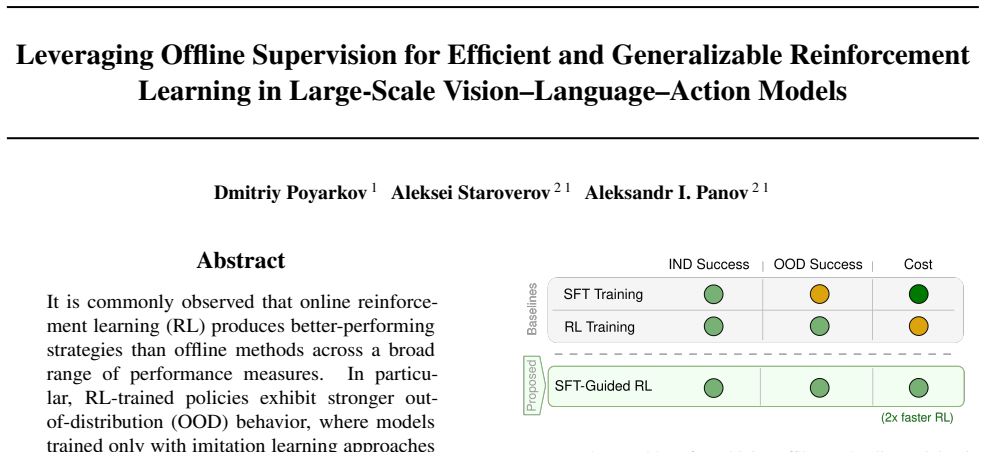
Pith's one-line read Adding offline supervision to PPO lets vision-language-action models match a twice-longer reinforcement learning run in half the environment steps, preserving out-of-distribution gains.
desk verdict The paper's core sample-efficiency result is credible for environment steps; the 'half the training budget' claim needs to be scoped to that axis, or backed with compute numbers. read the letter →
The pith
A machine-rendered reading of the paper's core claim, the machinery that carries it, and where it could break.
The reading
What carries the argument
The central object is a modified PPO objective with an auxiliary offline-supervision term. RefKL adds a Kullback-Leibler divergence penalty between the current policy and a frozen reference policy (the supervised model) on sampled minibatches; DataBC adds a behavior-cloning log-likelihood loss on the offline demonstration batch. Both use a curriculum schedule that holds the auxiliary coefficient constant for the first phase, linearly anneals it, and then removes it, allowing the policy to finish training with pure RL. This mechanism supplies a supervised prior during the phase when the on-policy RL signal is weak, and the paper argues it preserves RL's out-of-distribution gains while improvi
What would settle it
Run the 1M-step RefKL and the 2M-step standard PPO on identical hardware and measure total wall-clock time and FLOPs. If the guided run is not faster than the longer PPO run, then the efficiency claim, which the paper bases on environment steps, is falsified in practical terms.
Extended reading notes
Core claim
The central claim is that when offline supervision is included in the RL objective—either as a KL penalty to a frozen supervised reference policy or as behavior cloning on the offline dataset—the resulting guided PPO reaches the same operating point as standard PPO with roughly half the online environment interactions. Concretely, at 1M environment steps both guided variants show higher in-distribution and out-of-distribution success than standard PPO at the same budget, and RefKL matches the average OOD success of the 2M-step PPO checkpoint. The authors interpret this as evidence that offline supervision supplies a strong behavioral prior that stabilizes early optimization, after which a cu
Load-bearing premise
The paper's 'half the training budget' claim holds only if the budget is measured in environment interactions; the reference-guided variant requires extra forward passes through the frozen reference policy on every minibatch, so under wall-clock or FLOP accounting the savings may shrink or disappear.
Editorial extensions
If this is right
- At equal 1M-step budgets, both RefKL and DataBC PPO outperform standard PPO on in-distribution and out-of-distribution success.
- RefKL PPO at 1M steps matches the average OOD success of standard PPO at 2M steps, supporting the 'half the online budget' claim under the environment-step measure.
- Stronger initial guidance (higher beta) improves both IND and OOD outcomes; the constant-beta schedule adds compute without measurable benefit.
- Initializing PPO from the supervised adapter is weaker than both guided variants at the same budget, suggesting the auxiliary loss, not the initialization, is what accelerates training.
- The best configuration uses strong initial guidance with a curriculum that removes the auxiliary term later, allowing the policy to finish as pure RL.
Reading between the lines
- If the efficiency gain is measured in environment steps, the method is most valuable where real-robot interactions dominate the cost; in cheap simulation the extra forward passes through the reference policy may erode the savings.
- The reference-policy regularizer is essentially a soft distillation from a frozen policy, so a wider class of offline-guided RL objectives could be built from any pretrained policy or ensemble.
- The curriculum schedule implies the auxiliary term matters most early on; testing even earlier removal or an adaptive schedule driven by policy improvement could reveal whether the 300k-step annealing is near-optimal.
- The finding that supervised-initialized RL underperforms guided RL hints that fitting the supervised distribution too hard before RL can hinder later adaptation, which may generalize across parameter-efficient fine-tuning regimes.
Editorial analysis
A structured set of objections, weighed in public.
Referee Report
Summary. The paper studies whether offline supervision can be incorporated into PPO-based RL fine-tuning of large vision-language-action (VLA) models to improve training efficiency without sacrificing the out-of-distribution (OOD) generalization advantages of RL. Two guided variants are proposed: RefKL, which adds a KL penalty to a frozen SFT reference policy (Eqs. 4–5), and DataBC, which augments PPO with a behavior-cloning loss on the offline dataset (Eqs. 6–7), both with a curriculum schedule for the guidance coefficient (Eq. 8). Experiments on the RL4VLA benchmark with OpenVLA and LoRA adaptation show that, at 1M environment steps, both guided variants outperform standard PPO at the same budget, and RefKL matches the OOD success of a 2M-step PPO run (0.77 vs. 0.77). The paper concludes that offline guidance acts as an optimization prior that accelerates the early phase of RL while preserving OOD robustness.
Significance. The question is timely and practically relevant: large-scale VLA RL is sample-expensive, and any method that halves the online budget while retaining OOD generalization would be useful. The paper's strengths include the use of an established external benchmark (RL4VLA), a controlled LoRA-based OpenVLA setup, simple and clearly specified objectives, a useful ablation of the guidance strength, and an honest limitations section. The equal-budget comparison in Table 2 is internally consistent and suggestive. If the efficiency claim is confirmed with proper variance reporting and a clearly stated resource axis, the hybrid training recipe would be a meaningful empirical contribution.
major comments (3)
- [Abstract, §6.1, Table 1] The headline claim 'roughly half of the training budget' is only supported for environment interactions, not for total compute. RefKL's objective (Eq. 5) requires an additional forward pass through the frozen reference policy (Eq. 4) for every minibatch, and §5.5 states that constant-β schedules add 'additional forward passes...unnecessary computational overhead.' No wall-clock, GPU-hour, or FLOP accounting is reported anywhere. If 'budget' means compute, the 1M-step RefKL vs. 2M-step PPO comparison in Table 1 may not correspond to half the budget; if it means environment steps, that axis must be stated explicitly in the abstract and §6.1. This is load-bearing for the paper's central efficiency claim.
- [§5.3, Tables 2–3] All reported success rates are point estimates. Section 5.3 says experiments use 1–2 training seeds and 3 evaluation seeds, with some configurations from a single run, yet no standard errors, per-seed values, or confidence intervals are provided. The central quantitative claims—RefKL at 1M matching PPO at 2M (0.77 vs. 0.77) and the deltas in Table 2 (e.g., +0.18 vs. PPO for RefKL IND)—could be within run-to-run variance. Without variance reporting, the 'match' and even the ranking of methods is not firmly established. Please report per-seed results and error bars for all configurations.
- [§5.2] The reference SFT checkpoint is an early-stopped 2k-demo, 7.5k-step model that 'achieves stronger performance than the published SFT result' and is used as the reference for RefKL and DataBC. No protocol is given for selecting this checkpoint (e.g., a fixed schedule independent of evaluation vs. selection based on validation performance). If the checkpoint was chosen because it evaluated well on the test tasks, the reference policy is optimistically biased and the guided variants' gains are inflated. State the checkpoint-selection rule and, ideally, report sensitivity to the SFT checkpoint choice.
minor comments (5)
- [Tables 1–2] The column headers are ambiguous: 'IND OOD' spans five columns (Act, Lang, Vis, Avg). Please split into explicit IND and OOD subheadings so readers can map columns to categories.
- [Eq. (4)] Specify the KL divergence direction (π_ref ∥ π_θ or π_θ ∥ π_ref) and note explicitly that π_ref is frozen. Also define |B| as the minibatch size.
- [§4.5] The schedule (Eq. 8) uses 'training step' t; clarify whether this is an optimizer step or environment step, since the paper otherwise reports budgets in environment steps.
- [Fig. 5] Indicate whether the curves are means over training seeds and add error bars, or state that only single runs are shown.
- [§5.3] The sentence 'Reported success rates are averaged across both evaluation seeds and training seeds' conflicts with the preceding sentence that some configurations are reported from a single run. Clarify which configurations have 1 vs. 2 seeds.
Circularity Check
No significant circularity: the guided objectives are standard PPO plus an auxiliary supervised term, and the reported successes are measured independently on the external RL4VLA benchmark.
full rationale
The paper's central claims are empirical comparisons of training objectives. RefKL (Eqs. 4–5) is PPO plus a KL penalty toward a frozen SFT reference policy, and DataBC (Eqs. 6–7) is PPO plus behavior cloning on the offline dataset; these are defined independently of the reported evaluation metrics. The headline result—that RefKL at 1M environment steps matches the 2M-step PPO checkpoint on average OOD success—is a measured outcome from the external RL4VLA benchmark, not something forced by the definitions of the objectives. Hyperparameters such as β, t1, and t2 are tuned, but the success rates in Tables 1–3 are not defined in terms of those parameters, so there is no fitted-input-called-prediction pattern. The paper explicitly reproduces the RL4VLA and SFT baselines rather than importing prior fitted numbers, and it does not invoke any self-citation as a load-bearing justification or uniqueness argument. The only notable weakness is the interpretation of 'training budget' as environment interactions while RefKL adds an extra reference-model forward pass per minibatch; that is a measurement/efficiency concern, not a circularity concern. No construction-level circularity is present.
Assumptions & free parameters
free parameters (3)
- beta (offline-guidance coefficient) =
0.6 (ablated over 0.1, 0.3, 0.6)
- Curriculum endpoints t1, t2 =
t1=100,000, t2=300,000
- Reference SFT training budget =
2k demonstrations, 7.5k steps
assumptions (5)
- domain assumption RL4VLA's modified Simpler environments and its OOD split (vision/language/action shifts) are a valid proxy for VLA out-of-distribution generalization.
- domain assumption The sparse difference-based task-progress reward (Section 3) provides a sufficient learning signal for PPO in this setting.
- domain assumption A zero-initialized LoRA adapter on frozen OpenVLA-warmup, plus the RL4VLA value-head, is a representative parameter-efficient VLA RL configuration.
- domain assumption KL divergence between the reference and current policy over minibatch observations (Eq. 4) is a well-defined behavior regularizer for the tokenized action distribution.
- domain assumption Success rates from 64 IND / 960 OOD episodes and 3 evaluation seeds are stable enough to support point estimates, despite 1-2 training seeds.
Cite this review
Pith. "Pith review of Leveraging Offline Supervision for Efficient and Generalizable Reinforcement Learning in Large-Scale Vision-Language-Action Models." pith.science (2026). https://pith.science/paper/IX3GR6IV
@misc{pith2026260719399,
  author       = {Pith},
  title        = {Pith review of: Leveraging Offline Supervision for Efficient and Generalizable Reinforcement Learning in Large-Scale Vision-Language-Action Models},
  year         = {2026},
  howpublished = {\url{https://pith.science/paper/IX3GR6IV}},
  note         = {Machine review of arXiv:2607.19399}
}
read the original abstract
It is commonly observed that online reinforcement learning (RL) produces better-performing strategies than offline methods across a broad range of performance measures. In particular, RL-trained policies exhibit stronger out-of-distribution (OOD) behavior, where models trained only with imitation learning approaches often struggle. A recent study introduced an OOD-focused benchmark and reported that RL-trained vision-language-action (VLA) policies achieve noticeably better OOD performance and slightly better in-distribution (IND) performance than their counterparts trained with supervised fine-tuning (SFT). In this work, we investigate whether hybrid offline-online training can combine the advantages of both approaches. Specifically, we study RL methods regularized by offline supervision via either offline data or an offline-trained reference policy. We evaluate these approaches on the OOD benchmark and compare them with both offline-only training and standard RL. Our results show that although offline training achieves limited OOD performance by itself, incorporating offline supervision into RL preserves strong OOD capability while substantially improving training efficiency. In particular, the guided methods reach performance close to that of standard RL while requiring roughly half of the training budget. Rather than producing a trade-off between speed and OOD performance, the hybrid approach retains strong OOD capability while achieving this efficiency gain. Project page: https://alstar8.github.io/offline-supervision-vla-rl
Figures


Figures from the paper (1 more)

Reference graph
Works this paper leans on
-
[1]
Liu and F
J. Liu and F. Gao and B. Wei and X. Chen and Q. Liao and Y. Wu and C. Yu and Y. Wang , title =. Advances in Neural Information Processing Systems , year =
-
[2]
A. Nair and M. Dalal and A. Gupta and S. Levine , title =. arXiv preprint arXiv:2006.09359 , year =
arXiv 2006
-
[3]
Nakamoto and Y
M. Nakamoto and Y. Zhai and A. Singh and M. Sobol Mark and Y. Ma and C. Finn and A. Kumar and S. Levine , title =. Advances in Neural Information Processing Systems , volume =
-
[4]
A. J. Hancock and X. Wu and L. Zha and O. Russakovsky and A. Majumdar , title =. arXiv preprint arXiv:2509.22195 , year =
-
[5]
S. Schmitt and J. J. Hudson and A. Zidek and S. Osindero and C. Doersch and W. M. Czarnecki and J. Z. Leibo and H. Kuttler and A. Zisserman and K. Simonyan and S. M. A. Eslami , title =. arXiv preprint arXiv:1803.03835 , year =
-
[6]
Spigler , title =
G. Spigler , title =. Transactions on Machine Learning Research , year =
-
[7]
Ouyang and J
L. Ouyang and J. Wu and X. Jiang and D. Almeida and C. L. Wainwright and P. Mishkin and C. Zhang and S. Agarwal and K. Slama and A. Ray and J. Schulman and J. Hilton and F. Kelton and L. Miller and M. Simens and A. Askell and P. Welinder and P. Christiano and J. Leike and R. Lowe , title =. Advances in Neural Information Processing Systems , volume =
-
[8]
Baker and I
B. Baker and I. Akkaya and P. Zhokhov and J. Huizinga and J. Tang and A. Ecoffet and B. Houghton and R. Sampedro and J. Clune , title =. Advances in Neural Information Processing Systems , volume =
Show all 22 references
-
[9]
E. J. Hu and Y. Shen and P. Wallis and Z. Allen-Zhu and Y. Li and S. Wang and L. Wang and W. Chen , title =. International Conference on Learning Representations , year =
-
[10]
M. J. Kim and K. Pertsch and S. Karamcheti and T. Xiao and A. Balakrishna and S. Nair and R. Rafailov and E. Foster and G. Lam and P. Sanketi and Q. Vuong and T. Kollar and B. Burchfiel and R. Tedrake and D. Sadigh and S. Levine and P. Liang and C. Finn , title =. Proceedings ...
-
[11]
Schulman and F
J. Schulman and F. Wolski and P. Dhariwal and A. Radford and O. Klimov , title =. arXiv preprint arXiv:1707.06347 , year =
-
[12]
B. D. Argall and S. Chernova and M. Veloso and B. Browning , title =. Robotics and Autonomous Systems , volume =
-
[13]
Ross and G
S. Ross and G. Gordon and J. A. Bagnell , title =. Proceedings of the 14th International Conference on Artificial Intelligence and Statistics , pages =
-
[14]
Ren and A
Y. Ren and A. Pacchiano and P. L. Bartlett and L. Jordan and A. Z. Pan , title =. Proceedings of the 5th Conference on Robot Learning , pages =
-
[15]
Lee and Y
S. Lee and Y. Seo and K. Lee and P. Abbeel and J. Shin , title =. Proceedings of the 6th Conference on Robot Learning , pages =
-
[16]
Kang and Z
B. Kang and Z. Jie and J. Feng , title =. Proceedings of the 35th International Conference on Machine Learning , pages =
-
[17]
Kirkpatrick and R
J. Kirkpatrick and R. Pascanu and N. Rabinowitz and J. Veness and G. Desjardins and A. A. Rusu and K. Milan and J. Quan and T. Ramalho and A. Grabska-Barwinska and D. Hassabis and C. Clopath and D. Kumaran and R. Hadsell , title =. Proceedings of the National Academy of Scienc...
-
[18]
Brohan and N
A. Brohan and N. Brown and J. Carbajal and Y. Chebotar and X. Chen and K. Choromanski and T. Ding and D. Driess and P. Florence and C. Fu and others , title =. arXiv preprint arXiv:2212.06817 , year =
-
[19]
Zitkovich and T
B. Zitkovich and T. Yu and S. Singh and P. Xu and J. Xiao and F. Xia and D. Driess and A. Brohan and N. Brown and C. M. de L. M. Ruiz and others , title =. Proceedings of the 7th Conference on Robot Learning , year =
-
[20]
Octo Model Team and T. O. Xiao and O. Padalkar and K. Pertsch and H. Huang and S. Nair and A. Bhat and K.-H. Lee and P. Liang and C. Finn , title =. International Conference on Learning Representations , year =
-
[21]
Black and N
K. Black and N. Jao and M. R. A. Tian and E. Ferigo and N. Duan and A. Mahler and M. Ahn and P. Bahl and C. Finn and R. E. Wang and others , title =. Robotics: Science and Systems , year =
-
[22]
Finn and K
Physical Intelligence and C. Finn and K. Black and N. Duan and T. Kollar and M. Ahn and collaborators , title =. Proceedings of the 9th Conference on Robot Learning , year =
Reviewed August 2, 2026 · model on record in the stance chip above.
Discussion (0). Continue with ORCID to comment.