REVIEW 5 minor 23 references
Kemeny aggregation is already NP-complete with three rankings, even when every pair splits 2-to-1.
Reviewed by Pith at T0; open to challenge. T0 means a machine referee read the full paper against a public rubric. the ladder, T0–T4 →
Kemeny Score is NP-complete for three all-2-to-1 rankings; winner/precedence problems are Θ₂ᵖ-complete and recognition is coNP-complete, with a sharp 2/3 support dichotomy for every fixed profile size.
T0 review reviewed 2026-07-31 challenge →
load-bearing objection Closes the open three-ranking Kemeny case cleanly, with matching dichotomies and exact Max-Cut recovery; the long reduction checks out.
The Complexity of Kemeny Aggregation with Three Rankings
The pith
A machine-rendered reading of the paper's core claim, the machinery that carries it, and where it could break.
The reading
Core claim
Kemeny Score is NP-complete for exactly three unweighted full rankings that are all-2-to-1; on those profiles the winner, unique-winner, and possible- and necessary-precedence problems are Θ₂ᵖ-complete and the two consensus-recognition problems are coNP-complete. The hard majority tournaments have majority dimension exactly 3. For every fixed profile size q ≥ 3 and minimum support s, the same seven problems are hard precisely when 3s ≤ 2q and become polynomial once 3s > 2q.
What carries the argument
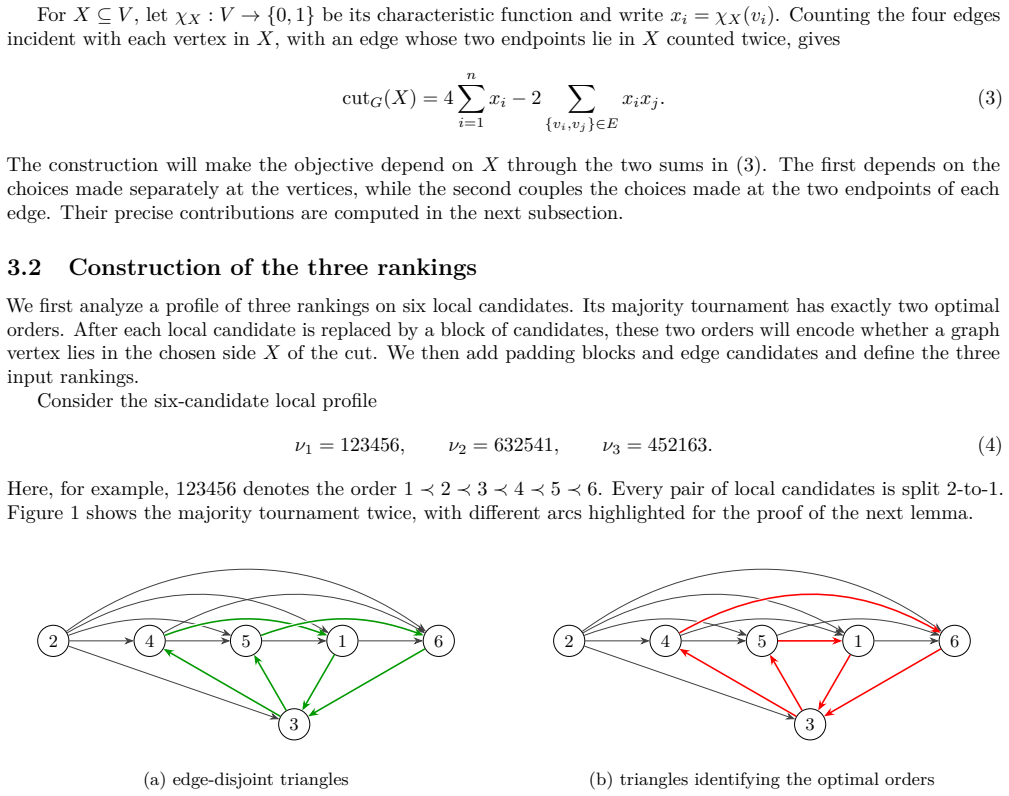
A polynomial reduction from Max-Cut on simple 4-regular graphs that encodes each vertex by six blocks whose two optimal local orders represent the two sides of a cut, inserts one edge candidate per graph edge, and chooses block size M large enough that the optimal Kemeny score separates consecutive cut values and recovers a maximum cut from any optimal aggregate.
Load-bearing premise
The block-size parameter must be large enough that all additive errors from normalizing blocks and placing edge candidates stay strictly smaller than the score gap created by improving the cut by one.
What would settle it
Either exhibit a polynomial-time algorithm that correctly decides Kemeny Score on every three-ranking all-2-to-1 profile, or find a 4-regular Max-Cut instance on which the constructed profile’s optimal Kemeny score fails to match the formula that recovers the true max-cut value.
If this is right
- Every fixed profile size q ≥ 3 makes Kemeny Score NP-complete, the four winner/precedence problems Θ₂ᵖ-complete, and both recognition problems coNP-complete.
- The same hardness transfers directly to Slater orders, permutation medians, and maximum-likelihood central rankings under the Mallows model with fixed dispersion.
- Minimum pairwise support above two-thirds forces a unique, polynomial-time Kemeny ranking (the topological order of the transitive majority tournament).
- Both Kemeny Score and Kendall–Tau Center remain NP-complete for three pairwise-equidistant rankings whose common distance attains the maximum possible value ⅔ binomial(N,2).
- From any Kemeny-optimal aggregate of the constructed profile one can recover a maximum cut of the source graph in polynomial time.
Where Pith is reading between the lines
- The sharp two-thirds support threshold suggests that practical Kemeny solvers can safely short-circuit to a topological sort whenever every pairwise majority exceeds two-thirds, and should reserve expensive search for the complementary regime.
- Because the reduction also yields an explicit affine map from optimal Kemeny score to max-cut value, any future approximation or FPT algorithm for three-ranking Kemeny immediately yields the same guarantee for Max-Cut on 4-regular graphs via the same instances.
- The six-copy equidistant lift implies that hardness for the center objective cannot be blamed on uneven distances among the inputs; the obstacle is combinatorial even under perfect symmetry.
Editorial analysis
A structured set of objections, weighed in public.
Referee Report
Summary. The paper proves that Kemeny Score is NP-complete for exactly three unweighted full rankings, even under the all-2-to-1 restriction (every pair split 2-to-1). On the same profiles it establishes Θ₂ᵖ-completeness of the winner, unique-winner, and possible/necessary-precedence problems and coNP-completeness of consensus and unique-consensus recognition; the hard majority tournaments have majority dimension exactly 3. The Max-Cut reduction yields exact-value and solution-recovery statements. For every fixed q≥3 and minimum support s, a sharp dichotomy is obtained: hardness when 3s≤2q and polynomial-time solvability (unique topological order of a transitive majority tournament) when 3s>2q, with exact-support and adjacent-support strengthenings. A six-copy construction transfers hardness to three pairwise-equidistant all-2-to-1 rankings and to Kendall–Tau Center, with affine formulas relating the optima and a characterization of optimal orders. The results transfer to Slater orders, permutation medians, and Mallows central rankings, completing the fixed-profile-size classification.
Significance. The three-ranking case was the principal remaining open fixed-profile-size question for Kemeny aggregation (and the permutation-median literature). Closing it with an all-2-to-1 restriction, majority dimension exactly 3, exact-value recovery from Max-Cut, and a complete support-threshold dichotomy is a substantial contribution. The six-copy equidistant construction and the transfers to Slater, PCM-3, crossing minimization, and Mallows ML estimation broaden the impact. The concurrent independent proof of the core three-ranking claim further supports reliability. The manuscript supplies fully explicit polynomial reductions, normalization and insertion-cost lemmas, and affine identities rather than existence arguments alone.
minor comments (5)
- [Section 3.5, Lemma 11] The insertion-cost case analysis in Lemma 11 (odd/even ke, extra candidates in Bi,1, midpoint μe) is correct but dense; a short summary table of the five gap ranges and the resulting ϕe(X) formula would help readers verify the bound without re-deriving every sign pattern.
- [Section 4.2] In the winner/precedence reduction (Section 4.2), the block-size choice M=10(n+m+1)² and the three-candidate edge blocks are introduced abruptly; a one-sentence pointer that the larger M absorbs the extra (3m+2)Nblock error relative to the Score reduction would improve readability.
- [Section 3.7, Proposition 13] Proposition 13’s recovery formula is valuable; stating explicitly that β and the ce constants are computed once from G (independent of t) would make the polynomial-time claim immediate for implementers.
- [Section 5.4, Table 1] Table 1 is helpful; adding a footnote that the s=q/2 row is a minimum-support promise (hardness uses supports in {q/2,q/2+1}) would prevent misreading against Corollary 33’s exact-support polynomial case.
- [Abstract / Section 1] A few long sentences in the abstract and introduction pack multiple completeness statements; splitting the recognition and support-dichotomy claims would improve scannability without changing content.
Circularity Check
No circularity: standard Max-Cut → three-ranking Kemeny reduction with affine score identities; Opt-preserving lifts are intentional hardness transfers, not self-definitional predictions.
full rationale
The paper is a pure complexity-theoretic classification. Theorem 1 reduces Max-Cut on simple 4-regular graphs (Lemma 6, via Yannakakis edge-deletion) to Kemeny Score on an explicitly constructed all-2-to-1 three-ranking profile; the optimal Kemeny score is an affine function of maxcut (Proposition 13, eqs. (12)–(15)), not a restatement of the target. Winner/precedence/recognition hardness (Theorem 2) adapts the same construction against independent-set comparison and maximum-independent-set recognition, both externally established. Support and four-ranking lifts (Lemmas 26–31, Theorem 32) apply positive affine transforms that preserve Opt sets by design—standard many-one hardness transfer, not fitted parameters renamed as predictions. The six-copy equidistant construction (Theorem 40) likewise gives explicit affine formulas for K* and R* from the original score. No self-definitional loop, no empirical fit, no load-bearing self-citation uniqueness theorem, and no renaming of a known empirical pattern. Concurrent independent work by Peters is acknowledged but not used. Score 0 is the correct outcome.
Axiom & Free-Parameter Ledger
free parameters (1)
- Block scale M = 4(n+m+1)² (and analogues 10(n+m+1)², 20(n+m+1)⁵ in later reductions) =
4(3n+1)² in main reduction
axioms (5)
- standard math Max-Cut is NP-complete on simple 4-regular graphs (Lemma 6, via Yannakakis cubic edge-deletion to bipartite).
- standard math Kemeny objective equals B_Π plus weighted backward majority arcs (Lemma 4); for uniform margin Δ, K = ((q-Δ)/2)binom(N,2) + Δ b(σ) (Lemma 5).
- domain assumption If every pairwise majority has support >2q/3, the majority tournament is transitive (classical quota; Vidu).
- standard math Min-Card-Vertex-Cover-Compare is Θ₂ᵖ-complete (Hemaspaandra–Spakowski–Vogel), used to lift winner/precedence hardness.
- domain assumption Profiles are explicitly represented unweighted full strict rankings; decision problems are many-one polynomial reductions.
invented entities (2)
-
Six-block vertex encoding (ω₀/ω₁ local orders) plus padding and midpoint edge-candidate placement
no independent evidence
-
Six-copy equidistant profile construction (Theorem 40)
no independent evidence
Cite this review
Pith. "Pith review of The Complexity of Kemeny Aggregation with Three Rankings." pith.science (2026). https://pith.science/paper/IYU2EWPS
@misc{pith2026260728588,
  author       = {Pith},
  title        = {Pith review of: The Complexity of Kemeny Aggregation with Three Rankings},
  year         = {2026},
  howpublished = {\url{https://pith.science/paper/IYU2EWPS}},
  note         = {Machine review of arXiv:2607.28588}
}
abstract
The Kemeny rule aggregates rankings by minimizing their total Kendall-tau distance from an aggregate order. We prove that Kemeny Score is NP-complete for exactly three unweighted rankings, even when every candidate pair is split $2$-to-$1$. On the same profiles, the winner, unique-winner, and possible- and necessary-precedence problems are $\Theta_2^p$-complete, while recognizing a Kemeny-optimal or uniquely Kemeny-optimal aggregate is coNP-complete. The hard instances induce tournaments of majority dimension exactly $3$. The reduction also determines the exact maximum-cut value from the optimal Kemeny score and recovers a maximum cut from any Kemeny-optimal aggregate. For every fixed $q\geq3$ and $\lceil q/2\rceil\leq s\leq q$, minimum pairwise support $s$ yields a sharp dichotomy: the score problem is NP-complete, the winner and precedence problems are $\Theta_2^p$-complete, and the recognition problems are coNP-complete when $3s\leq2q$; for $3s>2q$, the majority tournament is transitive and its unique topological order is the unique Kemeny-optimal aggregate. Exact support $s$ suffices in the hard case when $s>q/2$, and supports in ${s,s+1}$ suffice when $s=q/2$. These results give complete fixed-profile-size classifications and transfer to Slater orders, permutation medians, and maximum-likelihood central rankings in the Mallows model. Finally, a six-copy construction proves NP-completeness of both Kemeny Score and Kendall--Tau Center for three pairwise-equidistant rankings that still split every pair $2$-to-$1$. For $N$ output candidates, their common distance is $\frac23\binom N2$, the largest possible for an equidistant triple. The construction gives affine formulas for both optimal values, characterizes all Kemeny-optimal output orders, and shows that the output has a unique Kemeny-optimal order and a unique center exactly when the input has a unique Kemeny-optimal order.
Figures
Reference graph
Works this paper leans on
-
[1]
N. Alon. Ranking tournaments.SIAM J. Discrete Math., 20(1):137–142, 2006
2006
-
[2]
Y. H. Y. Alvin and D. Chakraborty. Approximate maximum rank aggregation: Beyond the worst-case. In P. Bouyer and S. Srinivasan, editors,43rd IARCS Annual Conference on Foundations of Software Technology and Theoretical Computer Science (FSTTCS 2023), volume 284 ofLeibniz International Proceedings in Informatics, pages 12:1–12:21. Schloss Dagstuhl–Leibniz-...
2023
-
[3]
Bachmaier, F
C. Bachmaier, F. J. Brandenburg, A. Gleißner, and A. Hofmeier. On the hardness of maximum rank aggregation problems.J. Discrete Algorithms, 31:2–13, 2015
2015
-
[4]
Bachmeier, F
G. Bachmeier, F. Brandt, C. Geist, P. Harrenstein, K. Kardel, D. Peters, and H. G. Seedig.k-majority digraphs and the hardness of voting with a constant number of voters.J. Comput. System Sci., 105:130–157, 2019
2019
-
[5]
J. J. Bartholdi, III, C. A. Tovey, and M. A. Trick. Voting schemes for which it can be difficult to tell who won the election.Soc. Choice Welf., 6(2):157–165, 1989
1989
-
[6]
Betzler, M
N. Betzler, M. R. Fellows, J. Guo, R. Niedermeier, and F. A. Rosamond. Fixed-parameter algorithms for Kemeny scores. In R. Fleischer and J. Xu, editors,Algorithmic Aspects in Information and Management, volume 5034 ofLecture Notes in Computer Science, pages 60–71. Springer, 2008
2008
-
[7]
Betzler, M
N. Betzler, M. R. Fellows, J. Guo, R. Niedermeier, and F. A. Rosamond. Fixed-parameter algorithms for Kemeny rankings.Theoret. Comput. Sci., 410(45):4554–4570, 2009
2009
-
[8]
Biedl, F
T. Biedl, F. J. Brandenburg, and X. Deng. On the complexity of crossings in permutations.Discrete Math., 309(7):1813–1823, 2009
2009
-
[9]
G. Blin, M. Crochemore, S. Hamel, and S. Vialette. Median of an odd number of permutations.Pure Math. Appl., 21(2):161–175, 2011
2011
-
[10]
Fitzsimmons and E
Z. Fitzsimmons and E. Hemaspaandra. Kemeny consensus complexity. In Z.-H. Zhou, editor,Proceedings of the Thirtieth International Joint Conference on Artificial Intelligence, IJCAI-21, pages 196–202. International Joint Conferences on Artificial Intelligence Organization, 2021. Main Track
2021
-
[11]
Hemaspaandra, H
E. Hemaspaandra, H. Spakowski, and J. Vogel. The complexity of Kemeny elections.Theoret. Comput. Sci., 349(3):382–391, 2005
2005
-
[12]
P. Jain and A. Thakur. Bribery’s influence on ranked aggregation.arXiv preprint arXiv:2603.28574, 2026. 45
arXiv 2026
-
[13]
J. G. Kemeny. Mathematics without numbers.Daedalus, 88(4):577–591, 1959
1959
-
[14]
M. G. Kendall. A new measure of rank correlation.Biometrika, 30(1–2):81–93, 1938
1938
-
[15]
Kenyon-Mathieu and W
C. Kenyon-Mathieu and W. Schudy. How to rank with few errors. InProceedings of the Thirty-Ninth Annual ACM Symposium on Theory of Computing (STOC 2007), pages 95–103. ACM, 2007
2007
-
[16]
M. Lampis. Determining a Slater winner is complete for parallel access to NP. In39th International Symposium on Theoretical Aspects of Computer Science, volume 219 ofLeibniz International Proceedings in Informatics, pages 45:1–45:14. Schloss Dagstuhl–Leibniz-Zentrum für Informatik, 2022
2022
-
[17]
P. Lederer, D. Peters, and T. Wąs. The squared Kemeny rule for averaging rankings. InProceedings of the 25th ACM Conference on Economics and Computation (EC 2024), page 755. ACM, 2024. Extended version: arXiv:2404.08474
Pith/arXiv arXiv 2024
-
[18]
C. L. Mallows. Non-null ranking models. I.Biometrika, 44(1–2):114–130, 1957
1957
-
[19]
D. Peters. Kemeny rank aggregation is NP-hard for three voters. arXiv:2607.25540, 28 July 2026
Pith/arXiv arXiv 2026
-
[20]
P. Slater. Inconsistencies in a schedule of paired comparisons.Biometrika, 48(3–4):303–312, 1961
1961
-
[21]
L. Vidu. The minimal quota for a complete majority relation to be transitive.Group Decis. Negot., 9(6):531–534, 2000
2000
-
[22]
Yannakakis
M. Yannakakis. Node- and edge-deletion NP-complete problems. InProceedings of the Tenth Annual ACM Symposium on Theory of Computing, pages 253–264. ACM, 1978
1978
-
[23]
H. P. Young and A. Levenglick. A consistent extension of Condorcet’s election principle.SIAM J. Appl. Math., 35(2):285–300, 1978. 46
1978
This paper was first reviewed by grok-4.5 on July 31, 2026.
discussion (0)
Sign in with ORCID, Apple, or X to comment. Anyone can read and Pith papers without signing in.