REVIEW 4 major objections 5 minor 2 cited by
BenchDepth: Are We on the Right Way to Evaluate Depth Foundation Models?
T0 review · 4 major / 5 minor · reviewed 2026-08-06 · deepseek-v4-flash
Pith's one-line read This paper argues that evaluating depth foundation models with alignment-based metrics is biased, and proposes a proxy-task benchmark in which raw depth predictions are fed into five downstream tasks, finding that DA V2-Rel ranks best.
desk verdict A substantial and useful benchmark for depth foundation models, but the central fairness claim about bypassing alignment is not established. read the letter →
The pith
A machine-rendered reading of the paper's core claim, the machinery that carries it, and where it could break.
The reading
What carries the argument
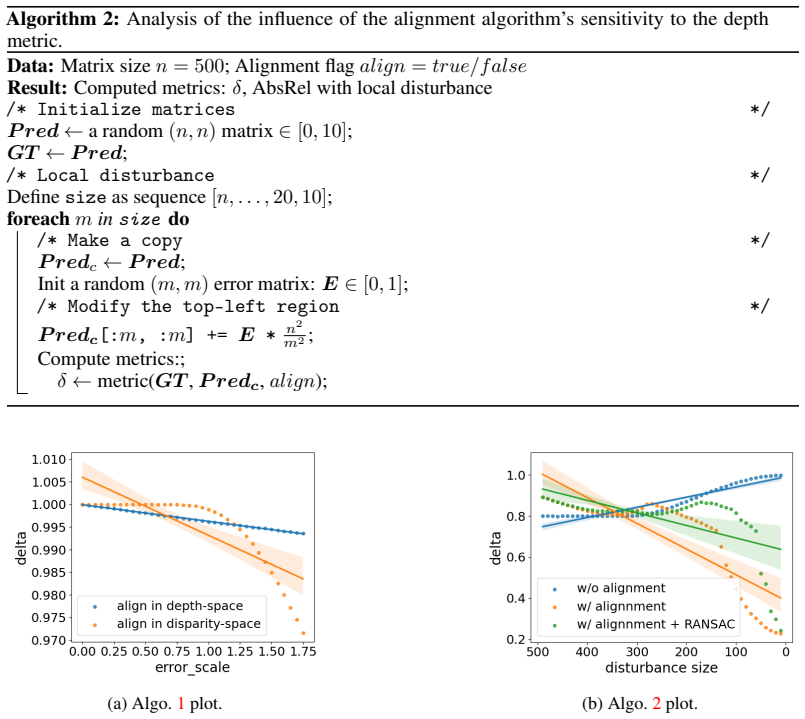
The load-bearing mechanism is the proxy-task protocol: each downstream framework (DepthPrompting for completion, IGEV for stereo, Flash3D for monocular 3DGS, NICER-SLAM for SLAM, and SpatialBench for VLM spatial understanding) receives the depth foundation model's raw prediction as extra guidance injected through zero convolutions, while the rest of the framework is kept fixed. Zero convolutions—layers initialized to zero so the base network is unchanged at the start of fine-tuning—provide a controlled way to add depth guidance without altering the proxy network's core. The two synthetic alignment experiments (Alg. 1 and Alg. 2) are the supporting evidence that the alignment procedure being replaced is biased.
What would settle it
Train or evaluate each proxy task with depth guidance whose global scale and shift are randomly changed per image; if downstream performance does not drop, the proxy networks are ignoring depth values, which would falsify the claim that BenchDepth measures depth quality.
Extended reading notes
Core claim
The central claim is that alignment-based evaluation of depth foundation models is unfair and that proxy-task evaluation is a workable replacement. On the evidence of two synthetic experiments, the paper shows that least-squares alignment behaves differently in depth space versus disparity space, and that alignment inverts the expected monotonicity of the $\delta$ metric when outliers are present. BenchDepth then feeds raw depth predictions from eight models—metric depth, affine-invariant depth, affine-invariant disparity, and point maps—into five fixed downstream task frameworks using zero convolutions, with no alignment, and ranks the models by average rank across tasks. The observed winner is DA V2-Rel, followed by DA V2-Met; metric depth models from Metric3DV2 and UniDepth generally underperform, and for VLM spatial understanding all models perform similarly.
Load-bearing premise
The load-bearing premise is that feeding raw depth predictions from very different representations directly into the proxy-task networks, with no alignment and no check that the networks re-learn scale and shift, yields a fair comparison of the models themselves.
Editorial extensions
If this is right
- If BenchDepth is accepted, ranking depth foundation models by alignment-based benchmarks will be seen as measuring artifacts of the alignment solver rather than depth quality.
- DA V2-Rel is the most practically useful of the eight tested depth foundation models, with the best average rank across the five proxy tasks.
- Affine-invariant disparity representations are not a mere implementation detail; they carry practical advantages over metric depth in these downstream tasks.
- Metric depth models trained with large real-world mixtures, such as Metric3DV2 and UniDepth, can underperform a single-dataset model like DA V2-Met, suggesting dataset composition and representation matter more than raw metric accuracy.
- Adding depth maps to VLMs does not currently unlock spatial reasoning; all tested depth models give comparable VLM performance.
Reading between the lines
- Beyond the paper: the same alignment-free proxy-task logic could be applied to other geometry outputs—surface normals, point maps, optical flow—and would likely reveal task-dependent winners rather than a single best representation.
- Beyond the paper: because the five proxy tasks disagree with each other on specific models, a practical benchmark might weight tasks by deployment cost or application domain instead of averaging ranks.
- Beyond the paper: the VLM result suggests a clean test of whether language models can use depth at all: train the VLM with depth rendered in different colormaps or with metric depth values, and see if performance changes; BenchDepth only checks pretrained models.
- Beyond the paper: the paper does not report whether the proxy networks learn to rescale the injected depth during fine-tuning; checking the learned zero-convolution weights would settle whether alignment has truly been removed or merely hidden.
Editorial analysis
A structured set of objections, weighed in public.
Referee Report
Summary. The paper proposes BenchDepth, a benchmark for evaluating depth foundation models (DFMs) through five downstream proxy tasks: depth completion, stereo matching, feed-forward monocular 3D reconstruction, SLAM, and VLM spatial understanding. Eight DFMs are compared by injecting their predicted depth into each proxy network via zero convolutions, without explicit alignment, and rankings are derived from task performance. The main claims are that this protocol bypasses problematic alignment procedures, that proxy-task performance is a fairer and more practical measure of DFM quality, and that DA V2-Rel achieves the best overall results.
Significance. If the central claim is supported, BenchDepth would be a valuable complement to alignment-based depth evaluation, offering a practically oriented and representation-agnostic comparison protocol. The paper has notable strengths: it covers five diverse tasks from low-level to high-level vision, uses a simple and uniform injection mechanism, benchmarks eight representative DFMs, and reports several interesting findings, such as the strong performance of affine-invariant disparity methods and the effectiveness of DA V2-Met despite single-dataset fine-tuning. The benchmark is also made publicly available, which supports community use. However, the load-bearing claim that the protocol 'bypasses problematic alignment procedures' is not yet established by the evidence presented, because the trainable injection layers and end-to-end fine-tuning can implicitly learn representation-specific alignment. The paper's value as a benchmark resource is real, but its fairness and ranking conclusions require additional analysis.
major comments (4)
- [Section 4, Fig. 3 (Depth Completion and Stereo Matching)] The central claim that BenchDepth 'bypasses problematic alignment procedures' is not established. The depth predictions are injected through zero convolutions into networks that are trained end-to-end per DFM. A zero-convolution layer initialized at zero is a trainable gate that can learn to rescale, shift, and otherwise transform each model's raw predictions into the metric target domain. In depth completion, the alignment module of DepthPrompting is explicitly omitted, but the network can re-learn an implicit alignment from sparse depth and image cues. In stereo matching, there is no sparse depth, yet the network must map affine-invariant disparity, affine-invariant point maps, or metric depth into metric disparity, and this mapping is learned from data. No analysis is provided of what the first layers learn, no control is run for representation-specific 'ease of alignment,' and no evidence shows that rankings are invariant to scale or shift. The headline result that DA V2-Rel ranks first could reflect that its representation is easiest for the proxy networks to align, not that it is best 'without alignment.' Please add an analysis of the learned injection weights, a control experiment with randomly scaled/shifted predictions, and a comparison against explicit alignment baselines.
- [Section 3, Algorithms 1 and 2] The motivational analysis of alignment bias relies on synthetic experiments with randomly generated matrices and arbitrary disturbance distributions. The conclusions that alignment in disparity space behaves asymmetrically and that alignment favors smoother predictions are based on Gaussian error matrices with magnitudes scaled by arbitrary factors (m=1.8, d×0.01), without validation on real predicted depth or disparity maps from the eight DFMs under evaluation. Since the entire motivation for proxy-task evaluation rests on these claims, please add experiments using actual predictions from the benchmarked models, or at least report error distributions from the models and show that the synthetic simulations reproduce their behavior.
- [Tables 1-4 (Benchmark Results)] The ordinal claims, including Finding 2 that DA V2 achieves the best results, are presented without error bars or statistical significance testing. All proxy-task results appear to be single runs, and several reported differences are small; for example, in Table 3, MiDaS (+5.24) and DA V2-Rel (+4.21) are close, and in Table 2, DA V2-Rel (+5.77) and MoGe (+2.70) differ by a few percent in an averaged improvement ratio. Given that the paper's purpose is ranking DFMs, please report variance across multiple seeds or runs, and where differences are not significant, state so explicitly rather than relying on rank values alone.
- [Section 4 (Task Design and Exclusions)] Several task-specific choices could affect the ranking and need sensitivity analysis. Metric3DV2 is excluded from SLAM because it was trained on Replica, Marigold is replaced by a one-step fine-tuned version [47], and metric models are evaluated under default camera parameter assumptions. These choices are defensible, but they interact with the fairness claim. Please report the ranking sensitivity to these choices, for example by including Metric3DV2 in SLAM despite the training overlap (as the paper notes there is no evidence of overfitting), or by testing whether the one-step Marigold version changes conclusions relative to the original model where feasible.
minor comments (5)
- [Throughout] The benchmark name is inconsistent: 'BenchDepth' is used in the abstract and most of the paper, but Section 1 and Figure 1 refer to 'DepthBench' in several places. Please unify the terminology.
- [Section 2.2 and Section 5] There are several typos, including 'introducs' in Section 2.2, 'eightstate-of-the-art' and 'we proposeBenchDepth' in Section 1, and 'performs worse that the baseline' in Section 5. A copyediting pass is needed.
- [Figure 4 and Section 5 (VLM Spatial Understanding)] The text prompt in Figure 4 refers to a 'disparity image' and mentions that 'deeper (farther) areas are depicted in black,' while the surrounding text alternately calls the input a depth map or disparity map. Please clarify exactly what is rendered and how the color mapping is defined.
- [Table 5 (VLM Spatial Understanding)] The statement that 'all depth methods yield similar results' is supported only by the decision to omit the rank column. Please provide a quantitative comparison, such as a bootstrap confidence interval or a paired test across the SpatialBench items, to justify the claim that the methods are statistically indistinguishable.
- [Reproducibility] The paper does not provide training hyperparameters (e.g., learning rates, number of epochs, seeds) for the proxy-task fine-tuning, nor does it mention whether evaluation code and trained models will be released. For a benchmark whose value depends on reproducible rankings, please include these details or a pointer to a public code repository with exact configurations.
Circularity Check
No circular derivation: BenchDepth's rankings are empirical; the main caveat is a confound, not circularity.
full rationale
BenchDepth contains no formal derivation chain whose outputs are equivalent to its inputs. The benchmark protocol feeds frozen DFM predictions into five proxy networks and measures downstream task performance; rankings are empirical results computed on public datasets (NYU Depth V2, SceneFlow, Middlebury, ETH3D, RealEstate10k, Replica, SpatialBench) under fixed training recipes, so no equation reduces a headline ranking to a fitted parameter. The main weakness is not circularity: the paper claims to 'bypass problematic alignment procedures' by injecting guidance with zero convolutions, but zero-conv layers are trainable and can learn model-specific scale/shift transforms, so performance may partly reflect ease of implicit alignment rather than raw DFM quality. This is a validity and confound concern, not a self-referential reduction. The authors are also co-authors of DA V2, the top-ranked model, but the results are measured rather than assumed; this is a minor self-citation context, not a load-bearing citation chain. The limitations section acknowledges task coverage and cost, which does not affect circularity. Overall circularity is minor at most.
Assumptions & free parameters
free parameters (4)
- Disturbance factor m and noise scale in Alg. 1 =
m=1.8, noise std=0.01*d
- Disturbance size sequence in Alg. 2 =
[n,...,20,10] and E in [0,1] scaled by n^2/m^2
- Sparse depth sample counts in depth completion =
100, 32, 8, 4, 1
- Rank aggregation rule =
average rank across tasks and settings
assumptions (4)
- domain assumption Proxy task performance is a valid and sufficient measure of practical utility of a depth model.
- domain assumption Injecting depth predictions via zero convolutions treats all depth representations fairly without hidden alignment.
- domain assumption No information leakage from downstream training data into the evaluated depth models is present.
- ad hoc to paper The random-matrix simulations in Alg. 1 and 2 are representative of real alignment behavior.
Cite this review
Pith. "Pith review of BenchDepth: Are We on the Right Way to Evaluate Depth Foundation Models?." pith.science (2026). https://pith.science/paper/J3DYNBOU
@misc{pith2026250715321,
  author       = {Pith},
  title        = {Pith review of: BenchDepth: Are We on the Right Way to Evaluate Depth Foundation Models?},
  year         = {2026},
  howpublished = {\url{https://pith.science/paper/J3DYNBOU}},
  note         = {Machine review of arXiv:2507.15321}
}
read the original abstract
Depth estimation is a fundamental task in computer vision with diverse applications. Recent advancements in deep learning have led to powerful depth foundation models (DFMs), yet their evaluation remains challenging due to inconsistencies in existing protocols. Traditional benchmarks rely on alignment-based metrics that introduce biases, favor certain depth representations, and complicate fair comparisons. In this work, we propose BenchDepth, a new benchmark that evaluates DFMs through five carefully selected downstream proxy tasks: depth completion, stereo matching, monocular feed-forward 3D scene reconstruction, SLAM, and vision-language spatial understanding. Unlike conventional evaluation protocols, our approach assesses DFMs based on their practical utility in real-world applications, bypassing problematic alignment procedures. We benchmark eight state-of-the-art DFMs and provide an in-depth analysis of key findings and observations. We hope our work sparks further discussion in the community on best practices for depth model evaluation and paves the way for future research and advancements in depth estimation.
Figures


Figures from the paper (1 more)

Forward citations
Cited by 2 Pith papers
-
Compact and robust optical frequency reference module based on reproducible and redistributable optical design
A reproducible, compact optical frequency reference module is claimed to maintain frequency stability for months with 4g vibration tolerance, based on openly shared design files.
-
Boosting Monocular Metric Depth Estimation via Bokeh Rendering
A two-stage method that synthesizes bokeh stacks from one image and uses them to boost the metric accuracy of monocular depth estimation.
Reference graph
Works this paper leans on
-
[47]
Fine-tuning image-conditional diffusion models is easier than you think,
G. M. Garcia, K. A. Zeid, C. Schmidt, D. de Geus, A. Hermans, and B. Leibe, “Fine-tuning image-conditional diffusion models is easier than you think,”arXiv preprint arXiv:2409.11355, 2024
arXiv 2024
-
[1]
Adding conditional control to text-to-image diffusion models,
L. Zhang, A. Rao, and M. Agrawala, “Adding conditional control to text-to-image diffusion models,” inICCV, pp. 3836–3847, 2023. 9
work page 2023
-
[2]
Bevdepth: Acquisition of reliable depth for multi-view 3d object detection,
Y . Li, Z. Ge, G. Yu, J. Yang, Z. Wang, Y . Shi, J. Sun, and Z. Li, “Bevdepth: Acquisition of reliable depth for multi-view 3d object detection,” inAAAI, vol. 37, pp. 1477–1485, 2023
work page 2023
-
[3]
Nicer-slam: Neural implicit scene encoding for rgb slam,
Z. Zhu, S. Peng, V . Larsson, Z. Cui, M. R. Oswald, A. Geiger, and M. Pollefeys, “Nicer-slam: Neural implicit scene encoding for rgb slam,” in2024 International Conference on 3D Vision (3DV), pp. 42–52, IEEE, 2024
2024
-
[4]
Flash3d: Feed-forward generalisable 3d scene reconstruction from a single image,
S. Szymanowicz, E. Insafutdinov, C. Zheng, D. Campbell, J. F. Henriques, C. Rupprecht, and A. Vedaldi, “Flash3d: Feed-forward generalisable 3d scene reconstruction from a single image,” arXiv preprint arXiv:2406.04343, 2024
arXiv 2024
-
[5]
Depth map prediction from a single image using a multi-scale deep network,
D. Eigen, C. Puhrsch, and R. Fergus, “Depth map prediction from a single image using a multi-scale deep network,”NeurIPS, vol. 27, 2014
work page 2014
-
[6]
Zoedepth: Zero-shot transfer by combining relative and metric depth,
S. F. Bhat, R. Birkl, D. Wofk, P. Wonka, and M. Müller, “Zoedepth: Zero-shot transfer by combining relative and metric depth,”arXiv preprint arXiv:2302.12288, 2023
arXiv 2023
-
[7]
Repurposing diffusion-based image generators for monocular depth estimation,
B. Ke, A. Obukhov, S. Huang, N. Metzger, R. C. Daudt, and K. Schindler, “Repurposing diffusion-based image generators for monocular depth estimation,” inCVPR, pp. 9492–9502, 2024
work page 2024
Show all 53 references
-
[8]
Depth anything v2,
L. Yang, B. Kang, Z. Huang, Z. Zhao, X. Xu, J. Feng, and H. Zhao, “Depth anything v2,”arXiv preprint arXiv:2406.09414, 2024
2024 arXiv
-
[9]
Towards robust monocular depth estimation: Mixing datasets for zero-shot cross-dataset transfer,
R. Ranftl, K. Lasinger, D. Hafner, K. Schindler, and V . Koltun, “Towards robust monocular depth estimation: Mixing datasets for zero-shot cross-dataset transfer,”IEEE TPAMI, vol. 44, no. 3, 2022
2022
-
[10]
Moge: Unlocking accurate monocular geometry estimation for open-domain images with optimal training supervision,
R. Wang, S. Xu, C. Dai, J. Xiang, Y . Deng, X. Tong, and J. Yang, “Moge: Unlocking accurate monocular geometry estimation for open-domain images with optimal training supervision,” arXiv preprint arXiv:2410.19115, 2024
2024 arXiv
-
[11]
Vggt: Visual geometry grounded transformer,
J. Wang, M. Chen, N. Karaev, A. Vedaldi, C. Rupprecht, and D. Novotny, “Vggt: Visual geometry grounded transformer,” inCVPR, pp. 5294–5306, 2025
2025
-
[12]
Geobench: Benchmark- ing and analyzing monocular geometry estimation models,
Y . Ge, G. Xu, Z. Zhao, L. Sun, Z. Huang, Y . Sun, H. Chen, and C. Shen, “Geobench: Benchmark- ing and analyzing monocular geometry estimation models,”arXiv preprint arXiv:2406.12671, 2024
2024 arXiv
-
[13]
Unidepth: Universal monocular metric depth estimation,
L. Piccinelli, Y .-H. Yang, C. Sakaridis, M. Segu, S. Li, L. Van Gool, and F. Yu, “Unidepth: Universal monocular metric depth estimation,” inCVPR, pp. 10106–10116, 2024
2024
-
[14]
Metric3d v2: A versatile monocular geometric foundation model for zero-shot metric depth and surface normal estimation,
M. Hu, W. Yin, C. Zhang, Z. Cai, X. Long, H. Chen, K. Wang, G. Yu, C. Shen, and S. Shen, “Metric3d v2: A versatile monocular geometric foundation model for zero-shot metric depth and surface normal estimation,”IEEE TPAMI, 2024
2024
-
[15]
What matters when repur- posing diffusion models for general dense perception tasks?,
G. Xu, Y . Ge, M. Liu, C. Fan, K. Xie, Z. Zhao, H. Chen, and C. Shen, “What matters when repur- posing diffusion models for general dense perception tasks?,”arXiv preprint arXiv:2403.06090, 2024
2024 arXiv
-
[16]
Depth prompting for sensor-agnostic depth estimation,
J.-H. Park, C. Jeong, J. Lee, and H.-G. Jeon, “Depth prompting for sensor-agnostic depth estimation,” inCVPR, pp. 9859–9869, 2024
2024
-
[17]
Defom-stereo: Depth foundation model based stereo matching,
H. Jiang, Z. Lou, L. Ding, R. Xu, M. Tan, W. Jiang, and R. Huang, “Defom-stereo: Depth foundation model based stereo matching,”arXiv preprint arXiv:2501.09466, 2025
2025 arXiv
-
[18]
Monster: Marry monodepth to stereo unleashes power,
J. Cheng, L. Liu, G. Xu, X. Wang, Z. Zhang, Y . Deng, J. Zang, Y . Chen, Z. Cai, and X. Yang, “Monster: Marry monodepth to stereo unleashes power,”arXiv preprint arXiv:2501.08643, 2025
2025
-
[19]
Gpt-4 technical report,
J. Achiam, S. Adler, S. Agarwal, L. Ahmad, I. Akkaya, F. L. Aleman, D. Almeida, J. Altenschmidt, S. Altman, S. Anadkat,et al., “Gpt-4 technical report,”arXiv preprint arXiv:2303.08774, 2023
2023 arXiv
-
[20]
Blip-2: Bootstrapping language-image pre-training with frozen image encoders and large language models,
J. Li, D. Li, S. Savarese, and S. Hoi, “Blip-2: Bootstrapping language-image pre-training with frozen image encoders and large language models,” inInternational conference on machine learning, pp. 19730–19742, PMLR, 2023
2023
-
[21]
Momentum contrast for unsupervised visual representation learning,
K. He, H. Fan, Y . Wu, S. Xie, and R. Girshick, “Momentum contrast for unsupervised visual representation learning,” inCVPR, pp. 9729–9738, 2020. 10
2020
-
[22]
Dinov2: Learning robust visual features without supervision,
M. Oquab, T. Darcet, T. Moutakanni, H. V o, M. Szafraniec, V . Khalidov, P. Fernandez, D. Haziza, F. Massa, A. El-Nouby,et al., “Dinov2: Learning robust visual features without supervision,” arXiv preprint arXiv:2304.07193, 2023
2023 arXiv
-
[23]
Iterative geometry encoding volume for stereo matching,
G. Xu, X. Wang, X. Ding, and X. Yang, “Iterative geometry encoding volume for stereo matching,” inCVPR, pp. 21919–21928, 2023
2023
-
[24]
Towards foundation models for 3d vision: How close are we?,
Y . Zuo, K. Kayan, M. Wang, K. Jeon, J. Deng, and T. L. Griffiths, “Towards foundation models for 3d vision: How close are we?,”arXiv preprint arXiv:2410.10799, 2024
2024 arXiv
-
[25]
Hypersim: A photorealistic synthetic dataset for holistic indoor scene understanding,
M. Roberts, J. Ramapuram, A. Ranjan, A. Kumar, M. A. Bautista, N. Paczan, R. Webb, and J. M. Susskind, “Hypersim: A photorealistic synthetic dataset for holistic indoor scene understanding,” inICCV, pp. 10912–10922, 2021
2021
-
[26]
Patchrefiner: Leveraging synthetic data for real-domain high-resolution monocular metric depth estimation,
Z. Li, S. F. Bhat, and P. Wonka, “Patchrefiner: Leveraging synthetic data for real-domain high-resolution monocular metric depth estimation,”arXiv preprint arXiv:2406.06679, 2024
2024 arXiv
-
[27]
High-resolution image synthesis with latent diffusion models,
R. Rombach, A. Blattmann, D. Lorenz, P. Esser, and B. Ommer, “High-resolution image synthesis with latent diffusion models,” inCVPR, pp. 10684–10695, 2022
2022
-
[28]
Vision meets robotics: The kitti dataset,
A. Geiger, P. Lenz, C. Stiller, and R. Urtasun, “Vision meets robotics: The kitti dataset,”The international journal of robotics research, vol. 32, no. 11, pp. 1231–1237, 2013
2013
-
[29]
Indoor segmentation and support inference from rgbd images,
N. Silberman, D. Hoiem, P. Kohli, and R. Fergus, “Indoor segmentation and support inference from rgbd images,” inECCV, pp. 746–760, Springer, 2012
2012
-
[30]
Are we ready for autonomous driving? the kitti vision benchmark suite,
A. Geiger, P. Lenz, and R. Urtasun, “Are we ready for autonomous driving? the kitti vision benchmark suite,” inCVPR, pp. 3354–3361, IEEE, 2012
2012
-
[31]
The cityscapes dataset for semantic urban scene understanding,
M. Cordts, M. Omran, S. Ramos, T. Rehfeld, M. Enzweiler, R. Benenson, U. Franke, S. Roth, and B. Schiele, “The cityscapes dataset for semantic urban scene understanding,” inCVPR, pp. 3213–3223, 2016
2016
-
[32]
Depthformer: Exploiting long-range correlation and local information for accurate monocular depth estimation,
Z. Li, Z. Chen, X. Liu, and J. Jiang, “Depthformer: Exploiting long-range correlation and local information for accurate monocular depth estimation,”Machine Intelligence Research, pp. 1–18, 2023
2023
-
[33]
Adabins: Depth estimation using adaptive bins,
S. F. Bhat, I. Alhashim, and P. Wonka, “Adabins: Depth estimation using adaptive bins,” in CVPR, pp. 4009–4018, 2021
2021
-
[34]
Patchfusion: An end-to-end tile-based framework for high- resolution monocular metric depth estimation,
Z. Li, S. F. Bhat, and P. Wonka, “Patchfusion: An end-to-end tile-based framework for high- resolution monocular metric depth estimation,”arXiv preprint arXiv:2312.02284, 2023
2023 arXiv
-
[35]
Single-image depth perception in the wild,
W. Chen, Z. Fu, D. Yang, and J. Deng, “Single-image depth perception in the wild,”NeurIPS, vol. 29, 2016
2016
-
[36]
Deep ordinal regression network for monocular depth estimation,
H. Fu, M. Gong, C. Wang, K. Batmanghelich, and D. Tao, “Deep ordinal regression network for monocular depth estimation,” inCVPR, pp. 2002–2011, 2018
2002
-
[37]
Binsformer: Revisiting adaptive bins for monocular depth estimation,
Z. Li, X. Wang, X. Liu, and J. Jiang, “Binsformer: Revisiting adaptive bins for monocular depth estimation,”arXiv preprint arXiv:2204.00987, 2022
2022 arXiv
-
[38]
Scaling laws for neural language models,
J. Kaplan, S. McCandlish, T. Henighan, T. B. Brown, B. Chess, R. Child, S. Gray, A. Rad- ford, J. Wu, and D. Amodei, “Scaling laws for neural language models,”arXiv preprint arXiv:2001.08361, 2020
2001 arXiv
-
[39]
Depth anything: Unleashing the power of large-scale unlabeled data,
L. Yang, B. Kang, Z. Huang, X. Xu, J. Feng, and H. Zhao, “Depth anything: Unleashing the power of large-scale unlabeled data,”arXiv preprint arXiv:2401.10891, 2024
2024 arXiv
-
[40]
Dust3r: Geometric 3d vision made easy,
S. Wang, V . Leroy, Y . Cabon, B. Chidlovskii, and J. Revaud, “Dust3r: Geometric 3d vision made easy,” inCVPR, pp. 20697–20709, 2024
2024
-
[41]
E3d-bench: A benchmark for end-to-end 3d geometric foundation models,
W. Cong, Y . Liang, Y . Zhang, Z. Yang, Y . Wang, B. Ivanovic, M. Pavone, C. Chen, Z. Wang, and Z. Fan, “E3d-bench: A benchmark for end-to-end 3d geometric foundation models,”arXiv preprint arXiv:2506.01933, 2025
2025 arXiv
-
[42]
C. L. Lawson and R. J. Hanson,Solving least squares problems. SIAM, 1995
1995
-
[43]
M. T. Heath,Scientific computing: an introductory survey, revised second edition. SIAM, 2018
2018
-
[44]
3d gaussian splatting for real-time radiance field rendering.,
B. Kerbl, G. Kopanas, T. Leimkühler, and G. Drettakis, “3d gaussian splatting for real-time radiance field rendering.,”ACM Trans. Graph., vol. 42, no. 4, pp. 139–1, 2023. 11
2023
-
[45]
Neural fields in visual computing and beyond,
Y . Xie, T. Takikawa, S. Saito, O. Litany, S. Yan, N. Khan, F. Tombari, J. Tompkin, V . Sitzmann, and S. Sridhar, “Neural fields in visual computing and beyond,” inComputer Graphics Forum, vol. 41, pp. 641–676, Wiley Online Library, 2022
2022
-
[46]
Spatialbot: Precise spatial understanding with vision language models,
W. Cai, I. Ponomarenko, J. Yuan, X. Li, W. Yang, H. Dong, and B. Zhao, “Spatialbot: Precise spatial understanding with vision language models,”arXiv preprint arXiv:2406.13642, 2024
2024 arXiv
-
[48]
A large dataset to train convolutional networks for disparity, optical flow, and scene flow estimation,
N. Mayer, E. Ilg, P. Hausser, P. Fischer, D. Cremers, A. Dosovitskiy, and T. Brox, “A large dataset to train convolutional networks for disparity, optical flow, and scene flow estimation,” in CVPR, pp. 4040–4048, 2016
2016
-
[49]
High-resolution stereo datasets with subpixel-accurate ground truth,
D. Scharstein, H. Hirschmüller, Y . Kitajima, G. Krathwohl, N. Neši´c, X. Wang, and P. Westling, “High-resolution stereo datasets with subpixel-accurate ground truth,” inPattern Recognition: 36th German Conference, GCPR 2014, Münster, Germany, September 2-5, 2014, Proceedings ...
2014
-
[50]
A multi-view stereo benchmark with high-resolution images and multi-camera videos,
T. Schops, J. L. Schonberger, S. Galliani, T. Sattler, K. Schindler, M. Pollefeys, and A. Geiger, “A multi-view stereo benchmark with high-resolution images and multi-camera videos,” in CVPR, pp. 3260–3269, 2017
2017
-
[51]
U-net: Convolutional networks for biomedical image segmentation,
O. Ronneberger, P. Fischer, and T. Brox, “U-net: Convolutional networks for biomedical image segmentation,” 2015
2015
-
[52]
Stereo magnification: Learning view synthesis using multiplane images,
T. Zhou, R. Tucker, J. Flynn, G. Fyffe, and N. Snavely, “Stereo magnification: Learning view synthesis using multiplane images,”arXiv preprint arXiv:1805.09817, 2018
2018 arXiv
-
[53]
The replica dataset: A digital replica of indoor spaces,
J. Straub, T. Whelan, L. Ma, Y . Chen, E. Wijmans, S. Green, J. J. Engel, R. Mur-Artal, C. Ren, S. Verma,et al., “The replica dataset: A digital replica of indoor spaces,”arXiv preprint arXiv:1906.05797, 2019. 12
1906 arXiv
Reviewed August 6, 2026 · model on record in the stance chip above.
Discussion (0). Sign in to comment.