REVIEW 1 major objections 1 minor 1 cited by
An axisymmetric Bianchi I model reduces to a single quadrupole VSH term whose axis aligns with maximum expansion anisotropy.
Reviewed by Pith at T0; open to challenge. T0 means a machine referee read the full paper against a public rubric. the ladder, T0–T4 →
T0 review · grok-4.3
2026-06-29 05:26 UTC pith:J7MRCHER
load-bearing objection Gaia quasar proper motions show a quadrupole in each redshift bin but the amplitude fails to rise with z as the Bianchi I model requires, leaving the anisotropy claim under-supported. the 1 major comments →
Mapping the Universe as a Bianchi I cosmology with Gaia data
The pith
A machine-rendered reading of the paper's core claim, the machinery that carries it, and where it could break.
Core claim
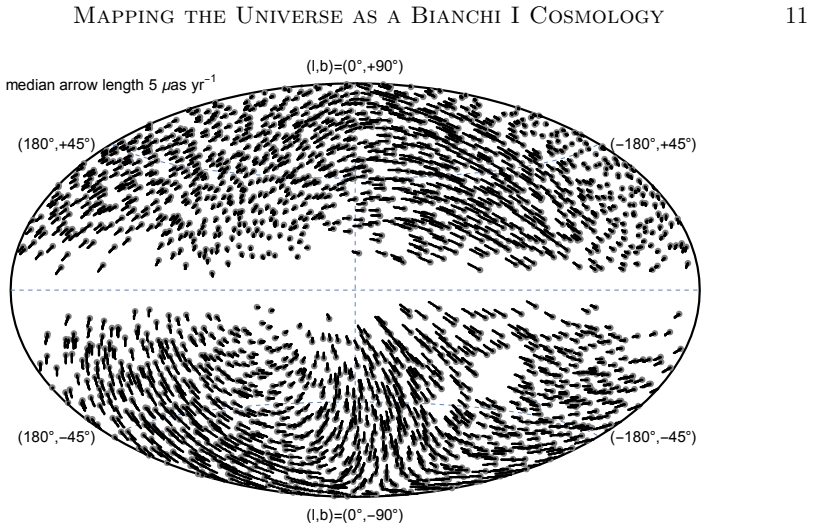
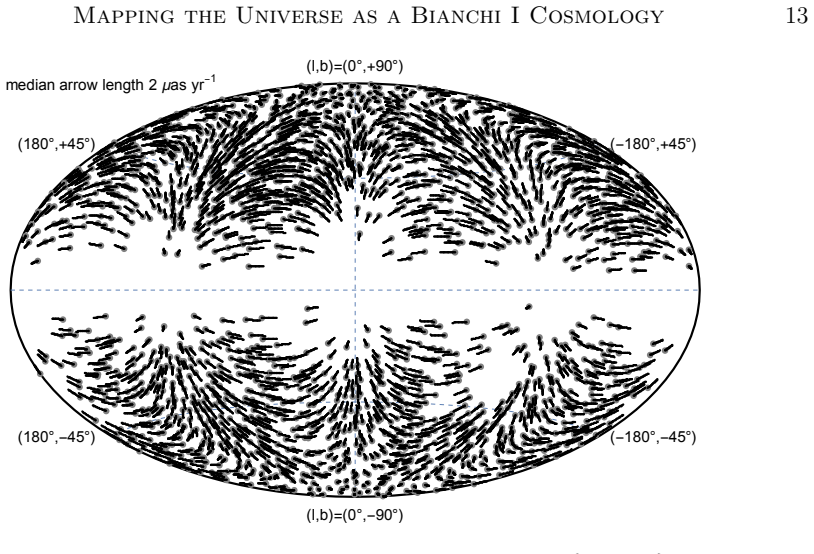
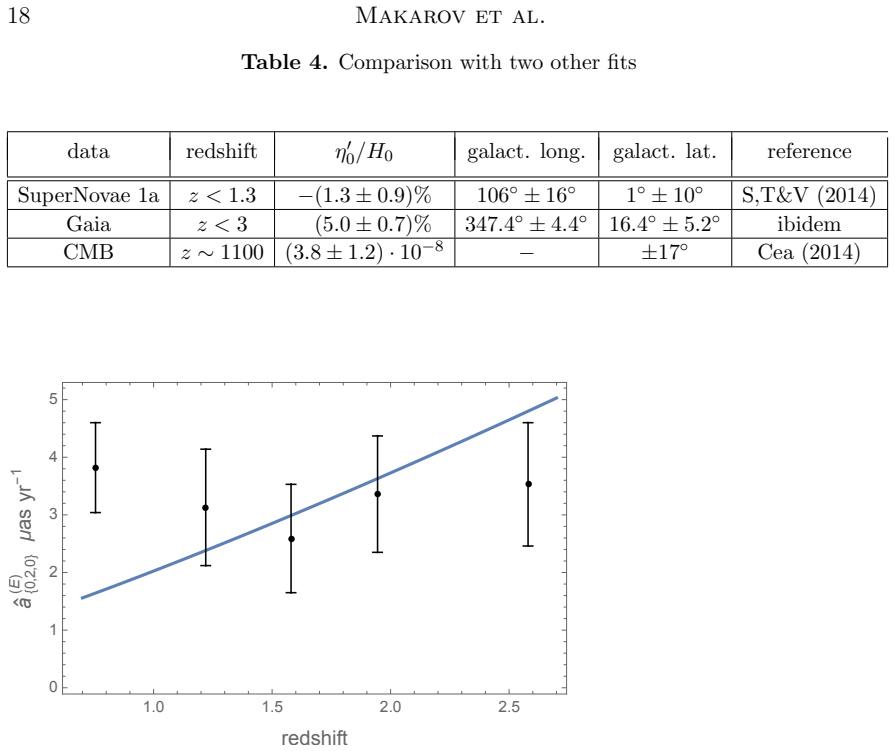
An axisymmetric Bianchi I cosmology generates a position drift field that reduces exactly to a single quadrupole vector spherical harmonic term whose eigendirection coincides with the axis of maximum expansion anisotropy. When this term is fitted to Gaia DR3 proper motions of quasars in separate redshift slices, the data yield a preferred direction and amplitude estimates at each slice, although the predicted growth of amplitude with redshift is not observed and the derived shear value is larger than anticipated.
What carries the argument
The exact reduction of an axisymmetric Bianchi I metric to a single quadrupole term in the vector spherical harmonic expansion of the position drift field.
Load-bearing premise
The detected quadrupole signal in the proper motion data is produced by cosmological expansion anisotropy rather than residual systematics, selection effects, or astrophysical contributions.
What would settle it
A measurement in which the quadrupole amplitude stays constant or decreases across the redshift bins 0.5–3 instead of increasing as required by the Bianchi I shear evolution.
If this is right
- The VSH eigendirection obtained from the fit supplies an estimate of the axis of maximum expansion anisotropy.
- Point estimates of signal amplitude become available in separate redshift intervals.
- The local expansion shear implied by the amplitude exceeds the value expected from other cosmological data.
- Time-dependent anisotropy or rotation terms may be required to reconcile the missing redshift trend.
Where Pith is reading between the lines
- Future Gaia releases with larger samples could tighten the redshift-binned amplitude test and decide whether the signal grows as predicted.
- Cross-checks of the fitted direction against the CMB dipole or other large-scale axes would test whether the same anisotropy appears in independent tracers.
- If the quadrupole persists in cleaner subsamples, models with time-varying shear become natural next steps for describing high-redshift kinematics.
Editorial analysis
A structured set of objections, weighed in public.
Referee Report
Summary. The paper theoretically demonstrates that an axisymmetric Bianchi I cosmology produces a proper motion signal on the celestial sphere that is captured by a single quadrupole vector spherical harmonic (VSH) term whose eigendirection aligns with the axis of maximum expansion anisotropy. It then fits second-degree VSH to Gaia DR3 proper motions of 1.2 million quality-filtered quasars split into five non-overlapping redshift bins (0.5–3), extracts amplitudes and directions, and reports a statistically significant quadrupole in every bin. However, the amplitude does not show the redshift increase predicted by the model, and the inferred local shear exceeds standard expectations; the authors discuss possible extensions to time-dependent anisotropy.
Significance. The theoretical mapping from Bianchi I to a single aligned quadrupole VSH term is a clean, falsifiable result that strengthens the paper's contribution. If the observed quadrupoles were shown to arise from cosmological anisotropy rather than systematics, the work would supply an independent, high-redshift test of the cosmological principle using tangential drifts. The explicit acknowledgment that the key redshift-scaling prediction is not confirmed is methodologically honest but limits the strength of any cosmological claim.
major comments (1)
- [Abstract] Abstract and results section on redshift dependence: the manuscript states that 'the increase of the amplitude of the signal with redshift predicted by the Bianchi I model is not confidently confirmed.' Because this scaling is the model's distinctive, load-bearing prediction (derived from the expansion anisotropy), its absence means the detected quadrupole is equally consistent with residual systematics, selection effects, or a different (e.g., time-dependent) anisotropy; this directly weakens the bridge from the theoretical mapping to a cosmological interpretation of the Gaia data.
minor comments (1)
- The description of the VSH fitting procedure and error budget for the five redshift bins would benefit from an explicit table or equation showing how the quadrupole coefficients are converted to the anisotropy amplitude and direction; this would make the point-estimate step fully reproducible.
Simulated Author's Rebuttal
We thank the referee for their careful and constructive review. The major comment is addressed point-by-point below.
read point-by-point responses
-
Referee: [Abstract] Abstract and results section on redshift dependence: the manuscript states that 'the increase of the amplitude of the signal with redshift predicted by the Bianchi I model is not confidently confirmed.' Because this scaling is the model's distinctive, load-bearing prediction (derived from the expansion anisotropy), its absence means the detected quadrupole is equally consistent with residual systematics, selection effects, or a different (e.g., time-dependent) anisotropy; this directly weakens the bridge from the theoretical mapping to a cosmological interpretation of the Gaia data.
Authors: We agree that the absence of the predicted redshift scaling is a central limitation for any cosmological interpretation in terms of a standard (constant-shear) Bianchi I model. The manuscript already states this limitation explicitly in the abstract, results, and discussion, and does not claim that the detected quadrupole constitutes evidence for Bianchi I anisotropy. The paper's contribution is the clean theoretical mapping of axisymmetric Bianchi I to a single aligned quadrupole VSH term, together with the observational report of a significant quadrupole whose amplitude fails to follow the expected scaling. This mismatch is presented as motivation for considering extensions such as time-dependent anisotropy or rotation, rather than as support for the baseline model. Because the limitation is already foregrounded, we do not view the current framing as overstating the cosmological interpretation. revision: no
Circularity Check
No significant circularity; theoretical mapping and data fit are independent.
full rationale
The paper derives from first principles that an axisymmetric Bianchi I metric produces a proper-motion field equivalent to a single quadrupole VSH term aligned with the expansion axis; this is a calculational result, not a self-definition or fitted input renamed as prediction. Amplitudes and directions are then extracted via standard VSH fits to Gaia DR3 subsets in redshift bins, and the model's predicted redshift scaling is explicitly tested against the data (and not confirmed). No load-bearing self-citation, uniqueness theorem, or ansatz smuggling is present in the provided text. The central claim therefore remains a genuine mapping plus an external test, not a reduction to its own inputs.
Axiom & Free-Parameter Ledger
free parameters (2)
- anisotropy amplitude
- preferred eigendirection
axioms (1)
- domain assumption An axisymmetric Bianchi I metric is a sufficient phenomenological description of possible departures from the cosmological principle.
read the original abstract
Measurements of tangential drifts of distant quasars and galactic nuclei on the celestial sphere provide a novel and independent method of testing cosmological hypotheses. In this work, we employ an axisymmetric Bianchi I model as a relatively simple phenomenological model that is useful for quantifying departures from the cosmological principle. Using a quality-filtered sample of 1.2 million proper motion vectors of distant quasars from Gaia Data Release 3, we perform global fits of the position drift fields with vector spherical harmonics (VSH) to second degree for five non-overlapping subsets of the sources with redshifts from 0.5 to 3, and assess the ability of the Bianchi I model to describe the signal. We theoretically demonstrate that an axisymmetric Bianchi I model produces a signal that can be described as a single quadrupole VSH term with an eigendirection which is aligned with the axis of maximum expansion anisotropy. We estimate this preferred direction from the Gaia data and the VSH fit, and perform point-estimates of the amplitude of the signal as a function of redshift. Although a significant quadrupole signal is detected in each bin, the increase of the amplitude of the signal with redshift predicted by the Bianchi I model is not confidently confirmed. The estimated value of the local expansion shear is higher than expected. Possible advances in describing the kinematic patterns of a high-redshift Universe with more complex cosmologies accommodating time-dependent anisotropy and rotation are discussed.
Figures
Forward citations
Cited by 1 Pith paper
-
Axial Bianchi IX meets Gaia data
In axial Bianchi IX universes with dust and a cosmological constant, the linearized cosmic drift equals that of axial Bianchi I, so curvature drops out of the drift at first order.
Reference graph
Works this paper leans on
-
[1]
thebibliography [1] 20pt to REFERENCES 6pt =0pt -12pt 10pt plus 3pt =0pt =0pt =1pt plus 1pt =0pt =0pt -12pt =13pt plus 1pt =20pt =13pt plus 1pt \@M =10000 =-1.0em =0pt =0pt 0pt =0pt =1.0em @enumiv\@empty 10000 10000 `\.\@m \@noitemerr \@latex@warning Empty `thebibliography' environment \@ifnextchar \@reference \@latexerr Missing key on reference command E...
-
[2]
On average properties of inhomogeneous fluids in general relativity I: dust cosmologies
@article Buchert:1999er, author = "Buchert, Thomas", title = " On average properties of inhomogeneous fluids in general relativity. 1. Dust cosmologies ", eprint = "gr-qc/9906015", archivePrefix = "arXiv", reportNumber = "CERN-TH-99-165", doi = "10.1023/A:1001800617177", journal = "Gen. Rel. Grav.", volume = "32", pages = "105--125", year = "2000"
work page internal anchor Pith review Pith/arXiv arXiv doi:10.1023/a:1001800617177 2000
-
[3]
On average properties of inhomogeneous fluids in general relativity II: perfect fluid cosmologies
@article Buchert:2001sa, author = "Buchert, Thomas", title = " On average properties of inhomogeneous fluids in general relativity: Perfect fluid cosmologies ", eprint = "gr-qc/0102049", archivePrefix = "arXiv", doi = "10.1023/A:1012061725841", journal = "Gen. Rel. Grav.", volume = "33", pages = "1381--1405", year = "2001"
work page internal anchor Pith review Pith/arXiv arXiv doi:10.1023/a:1012061725841 2001
-
[4]
Regional averaging and scaling in relativistic cosmology
@article buchertcarfora, author = Buchert , T. and Carfora , M. , journal = "Gen. Relativ. Grav.", pages = "6109", title = " Regional averaging and scaling in relativistic cosmology ", volume = "19", year = "2002", note = [gr-qc/0210037 https://arxiv.org/abs/gr-qc/0210037] ,
work page internal anchor Pith review Pith/arXiv arXiv 2002
-
[5]
Averaging inhomogeneous Newtonian cosmologies
@article buchertehlers, author = Buchert , T. and Ehlers , J. , journal = "Astron. Astrophys.", pages = "1", title = " Averaging inhomogeneous Newtonian cosmologies ", volume = "320", year = "1997", note = [astro-ph/9510056 https://arxiv.org/abs/astro-ph/9510056] ,
work page internal anchor Pith review Pith/arXiv arXiv 1997
-
[6]
Geometrical order-of-magnitude estimates for spatial curvature in realistic models of the Universe
@article curvatureestimate, author = Buchert , T. and Ellis , G. F. R. and van Elst , H. , journal = "Gen. Relativ. Grav.", pages = "2017", title = " Averaging inhomogeneous Newtonian cosmologies ", volume = "41", year = "2009", note = [arXiv:0906.0134 https://arxiv.org/abs/0906.0134] ,
work page internal anchor Pith review Pith/arXiv arXiv 2017
-
[7]
Cosmological backreaction and its dependence on spacetime foliation
@article foliations, author = Buchert , T. and Mourier , P. and Roy , X. , journal = "Class. Quantum Grav. Lett.", pages = "24LT02", title = " On cosmological backreaction and its dependence on space-time foliation ", volume = "35", year = "2018", note = [arXiv:1805.10455 https://arxiv.org/abs/1805.10455] ,
work page internal anchor Pith review Pith/arXiv arXiv 2018
-
[8]
Buchert, T. and Mourier, P. and Roy, X
@article Buchert:2019mvq, author = "Buchert, T. and Mourier, P. and Roy, X.", title = " On average properties of inhomogeneous fluids in general relativity III: general fluid cosmologies ", eprint = "1912.04213", archivePrefix = "arXiv", primaryClass = "gr-qc", doi = "10.1007/s10714-020-02670-6", journal = "Gen. Rel. Grav.", volume = "52", number = "3", p...
-
[9]
Backreaction in late-time cosmology
@article buchertrasanen, author = Buchert , T. and R \"a s \"a nen , S. , journal = "Annu. Rev. Nucl. Part. Sci.", pages = "57", title = " Backreaction in Late--Time Cosmology ", volume = "62", year = "2012", note = [arXiv:1112.5335 http://arxiv.org/abs/arXiv:1112.5335] ,
work page internal anchor Pith review Pith/arXiv arXiv 2012
-
[10]
@article ellisreview, author = Clarkson , C. A. and Ellis , G. F. R. and Larena , J. and Umeh , O. C. , journal = "Rep. Prog. Phys.", pages = "112901", title = " On cosmological backreaction and its dependence on space-time foliation ", volume = "74", year = "2011", note = [arXiv:1109.2314 https://arxiv.org/abs/1109.2314] ,
work page internal anchor Pith review Pith/arXiv arXiv 2011
-
[11]
Phys. Rev. D
@article ellis:vorticity, author = Ellis , G. F. R. and Bruni , M. and Hwang , J. , journal = "Phys. Rev. D", pages = "1035", title = " Density-gradient--vorticity relation in perfect-fluid Robertson-Walker perturbations ", volume = "42", year = "1990",
1990
-
[12]
The universe seen at different scales
@article ellisbuchert, author = Ellis , G. F. R. and Buchert , T. , journal = "Phys. Lett. A", pages = "38", title = " Density-gradient--vorticity relation in perfect-fluid Robertson-Walker perturbations ", volume = "347", year = "2005", note = [gr-qc/0506106 https://arxiv.org/abs/gr-qc/0506106] ,
work page internal anchor Pith review Pith/arXiv arXiv 2005
-
[13]
Gauge invariant averages for the cosmological backreaction
@article generalbackreac1, author = Gasperini , M. and Marozzi , G. and Veneziano , G. , journal = "J. Cosmol. Astropart. Phys.", pages = "011", title = " Gauge invariant averages for the cosmological backreaction ", number = "03", year = "2009", note = [arXiv:0901.1303 https://arxiv.org/abs/0901.1303] ,
work page internal anchor Pith review Pith/arXiv arXiv 2009
-
[14]
A covariant and gauge invariant formulation of the cosmological "backreaction"
@article Gasperini:2009mu, author = "Gasperini, M. and Marozzi, G. and Veneziano, G.", title = " A Covariant and gauge invariant formulation of the cosmological 'backreaction' ", eprint = "0912.3244", archivePrefix = "arXiv", primaryClass = "gr-qc", reportNumber = "BA-TH-623-09, CERN-PH-TH-2009-249", doi = "10.1088/1475-7516/2010/02/009", journal = "JCAP"...
work page internal anchor Pith review Pith/arXiv arXiv doi:10.1088/1475-7516/2010/02/009 2009
-
[15]
Light-cone averaging in cosmology: formalism and applications
@article Gasperini:2011us, author = "Gasperini, M. and Marozzi, G. and Nugier, F. and Veneziano, G.", title = " Light-cone averaging in cosmology: Formalism and applications ", eprint = "1104.1167", archivePrefix = "arXiv", primaryClass = "astro-ph.CO", reportNumber = "BA-TH-641-11, CERN-PH-TH-2011-071, LPTENS-11-15", doi = "10.1088/1475-7516/2011/07/008"...
work page internal anchor Pith review Pith/arXiv arXiv doi:10.1088/1475-7516/2011/07/008 2011
-
[16]
Geometric optics in general relativity using bilocal operators
@article Grasso:2018mei, author = "Grasso, Michele and Korzy\'nski, Miko aj and Serbenta, Julius", title = " Geometric optics in general relativity using bilocal operators ", eprint = "1811.10284", archivePrefix = "arXiv", primaryClass = "gr-qc", doi = "10.1103/PhysRevD.99.064038", journal = "Phys. Rev. D", volume = "99", number = "6", pages = "064038", y...
work page internal anchor Pith review Pith/arXiv arXiv doi:10.1103/physrevd.99.064038 2019
-
[18]
Light propagation in statistically homogeneous and isotropic universes with general matter content
@article rasanen, author = R \"a s \"a nen , S. , journal = "J. Cosmol. Astropart. Phys.", pages = "018", title = " Light propagation in statistically homogeneous and isotropic universes with general matter content ", number = "03", year = "2010", note = [arXiv:0912.3370 https://arxiv.org/abs/0912.3370] ,
work page internal anchor Pith review Pith/arXiv arXiv 2010
-
[19]
Inhomogeneity implies Accelerated Expansion
@article massweighted, author = Skarke , H. , journal = "Phys. Rev. D", pages = "043506", title = " Inhomogeneity implies accelerated expansion ", volume = "89", year = "2014", note = [arXiv:1310.1028 https://arxiv.org/abs/1310.1028] ,
work page internal anchor Pith review Pith/arXiv arXiv 2014
-
[20]
Quasi-local variables and inhomogeneous cosmological sources with spherical symmetry
@article sussman1, author = Sussman , R. A. , journal = "AIP Conf.\ Proc.", pages = "228", title = " Quasi--local variables and inhomogeneous cosmological sources with spherical symmetry ", volume = "1", year = "2008", note = [arXiv:0810.1120 https://arxiv.org/abs/0810.1120] ,
work page internal anchor Pith review Pith/arXiv arXiv 2008
-
[21]
Back-reaction and effective acceleration in generic LTB dust models
@article sussman2, author = Sussman , R. A. , journal = "Class. Quantum Grav.", title = " Back-reaction and effective acceleration in generic LTB dust models ", volume = "28", pages = "235002", year = "2011", note = [arXiv:1102.2663 https://arxiv.org/abs/1102.2663] ,
work page internal anchor Pith review Pith/arXiv arXiv 2011
-
[22]
3+1 Formalism in general relativity. Bases of numerical relativity
@book gourg:foliation, author = Gourgoulhon , E. , title= " 3+1 Formalism in general relativity. Bases of numerical relativity ", publisher="Springer", year="2012",
2012
-
[23]
Non-comoving baryons and cold dark matter in cosmic voids
@article Ismael, author = Delgado Gaspar , I. and Hidalgo , J. C. and Sussman , R. A. , journal = "Eur. Phys. J. C", pages = "106", title = " Non-comoving baryons and cold dark matter in cosmic voids ", volume = "79", year = "2019", note = [arXiv:1811.03634 https://arxiv.org/abs/1811.03634] ,
work page internal anchor Pith review Pith/arXiv arXiv 2019
-
[24]
Reduced phase space optics for general relativity: Symplectic ray bundle transfer
@article nezihe, author = Uzun , N. , title = " Reduced phase space optics for general relativity: Symplectic ray bundle transfer ", year = "2018", note = [arXiv:1811.10917 https://arxiv.org/abs/1811.10917] ,
-
[25]
What is dust? - Physical foundations of the averaging problem in cosmology
@article Wiltshire:2011vy, author = "Wiltshire, David L.", title = " What is dust? - Physical foundations of the averaging problem in cosmology ", eprint = "1106.1693", archivePrefix = "arXiv", primaryClass = "gr-qc", doi = "10.1088/0264-9381/28/16/164006", journal = "Class. Quant. Grav.", volume = "28", pages = "164006", year = "2011"
work page internal anchor Pith review Pith/arXiv arXiv doi:10.1088/0264-9381/28/16/164006 2011
-
[26]
Cosmological equivalence principle and the weak-field limit
@article CEP, author = Wiltshire , D. L. , journal = "Phys. Rev. D", title = " Cosmological equivalence principle and the weak--field limit ", volume = "78", pages = "084032", year = "2008", note = [arXiv:0809.1183 https://arxiv.org/abs/0809.1183] ,
work page internal anchor Pith review Pith/arXiv arXiv 2008
-
[27]
Observational Evidence from Supernovae for an Accelerating Universe and a Cosmological Constant
@article SupernovaSearchTeam:1998fmf, author = "Riess, Adam G. and others", collaboration = "Supernova Search Team", title = " Observational evidence from supernovae for an accelerating universe and a cosmological constant ", eprint = "astro-ph/9805201", archivePrefix = "arXiv", doi = "10.1086/300499", journal = "Astron. J.", volume = "116", pages = "1009...
work page internal anchor Pith review Pith/arXiv arXiv doi:10.1086/300499 1998
-
[28]
Measurements of Omega and Lambda from 42 High-Redshift Supernovae
@article SupernovaCosmologyProject:1998vns, author = "Perlmutter, S. and others", collaboration = "Supernova Cosmology Project", title = " Measurements of and from 42 high redshift supernovae ", eprint = "astro-ph/9812133", archivePrefix = "arXiv", reportNumber = "LBNL-41801, LBL-41801", doi = "10.1086/307221", journal = "Astrophys. J.", volume = "517", p...
work page internal anchor Pith review Pith/arXiv arXiv doi:10.1086/307221 1999
-
[29]
Cosmology from Type Ia Supernovae
@article acceleration_perlmutter_1998, author = Perlmutter et al. , S. , journal = " Bulletin of the American Astronomical Society ", title = " Cosmology from Type Ia Supernovae ", volume = "29", pages = "1351", year = "1997", note = [astro-ph/9812473 https://arxiv.org/abs/astro-ph/9812473] ,
work page internal anchor Pith review Pith/arXiv arXiv 1997
-
[30]
An absorption profile centred at 78 megahertz in the sky-averaged spectrum
@article bowman, author = Bowman , J. D. and Rogers , A. E. E. and Monsalve , R. A. and Mozdzen , T. J. and N. Mahesh , journal = "Nature", title = " An absorption profile centred at 78 megahertz in the sky-averaged spectrum ", volume = "555", pages = "67", year = "2018", note = [arXiv:1810.05912 https://arxiv.org/abs/1810.05912] ,
work page internal anchor Pith review Pith/arXiv arXiv 2018
-
[31]
The Impossibly Early Galaxy Problem
@article steinhardt, author = Steinhardt , C. L. and Capak , P. and Masters , D. and Speagle , J. S. , journal = "Astrophys. J.", title = " The impossibly early galaxy problem ", volume = "824", pages = "21", year = "2016", note = [arXiv:1506.01377 https://arxiv.org/abs/1506.01377] ,
work page internal anchor Pith review Pith/arXiv arXiv 2016
-
[32]
How unusual are the Shapley Supercluster and the Sloan Great Wall?
@article sheth, author = Sheth , R. K. and Diaferio , A. , journal = " ", title = " How unusual are the Shapley Supercluster and the Sloan Great Wall? ", volume = "417", pages = "2938", year = "2011", note = [arXiv:1105.3378 https://arxiv.org/abs/1105.3378] ,
work page internal anchor Pith review Pith/arXiv arXiv 2011
-
[33]
Observational Challenges for the Standard FLRW Model
@article tensions, author = Buchert , T. and Coley , A. A. and Kleinert , H. and Roukema , B. F. and Wiltshire , D. L. , journal = "Int. J. Mod. Phys. D", title = " Observational Challenges for the Standard FLRW Model ", volume = "25", pages = "1630007", year = "2016", note = [arXiv:1512.03313 https://arxiv.org/abs/1512.03313] ,
work page internal anchor Pith review Pith/arXiv arXiv 2016
-
[34]
Global gravitational instability of FLRW backgrounds - interpreting the dark sectors
@article roy:instability, author = Roy , X. and Buchert , T. and Carloni , S. and Obadia , N. , journal = "Class. Quantum Grav.", title = " Global gravitational instability of FLRW backgrounds - interpreting the dark sectors ", volume = "28", pages = "165004", year = "2011", note = [arXiv:1103.1146 https://arxiv.org/abs/1103.1146] ,
work page internal anchor Pith review Pith/arXiv arXiv 2011
-
[35]
Correspondence between kinematical backreaction and scalar field cosmologies - the `morphon field'
@article morphon2006, author = Buchert , T. and Larena , J. and Alimi , J.-M. , journal = "Class. Quantum Grav.", title = " Correspondence between kinematical backreaction and scalar field cosmologies - the `morphon field' ", volume = "23", pages = "6379", year = "2006", note = [gr-qc/0606020 https://arxiv.org/abs/gr-qc/0606020] ,
work page internal anchor Pith review Pith/arXiv arXiv 2006
-
[36]
Testing backreaction effects with observations
@article larena2009, author = Larena , J. and Alimi , J.-M. and Buchert , T. and Kunz , M. and Corasaniti P.-S. , journal = " ", title = " Testing backreaction effects with observations ", volume = "79", pages = "083011", year = "2009", note = [arXiv:0808.1161 https://arxiv.org/abs/0808.1161] ,
work page internal anchor Pith review Pith/arXiv arXiv 2009
-
[37]
@article Chinese2018, author = Cao , S.-L. and Teng , H.-Y. and Wan , H.-Y. and Yu , H.-R. and Zhang T.-J. , journal = "Eur.\ Phys.\ J.\ C", title = " Testing backreaction effects with observational Hubble parameter data ", volume = "78", pages = "170", year = "2018", note = [arXiv:1704.01774 https://arxiv.org/abs/1704.01774] ,
-
[38]
Average observational quantities in the timescape cosmology
@article TS2009forma, author = Wiltshire , D. L. , journal = " ", title = " Average observational quantities in the timescape cosmology ", volume = "80", pages = "123512", year = "2009", note = [arXiv:0909.0749 https://arxiv.org/abs/0909.0749] ,
work page internal anchor Pith review Pith/arXiv arXiv 2009
-
[39]
Improved cosmological constraints from a joint analysis of the SDSS-II and SNLS supernova samples
@article JLA2014, author = Betoule et al. , M. , journal = " Astron. Astrophys. ", title = " Improved cosmological constraints from a joint analysis of the SDSS-II and SNLS supernova samples ", volume = "568", pages = "A22", year = "2014", note = [arXiv:1401.4064 https://arxiv.org/abs/1401.4064] ,
work page internal anchor Pith review Pith/arXiv arXiv 2014
-
[40]
@article kasai, author = Kasai , M. , journal = "Prog. Theor. Phys.", title = " Apparent Acceleration through the Large-scale Inhomogeneities: Post-Friedmannian effects of inhomogeneities on the luminosity distance ", volume = "117", pages = "1067", year = "2007", note = [astro-ph/0703298 https://arxiv.org/abs/astro-ph/0703298] ,
work page internal anchor Pith review Pith/arXiv arXiv 2007
-
[41]
Dark Energy from structure: a status report
@article Buchert2008, author = Buchert , T. , journal = "Gen. Relativ. Gravit.", title = " Dark Energy from structure: a status report ", volume = "40", pages = "467", year = "2008", note = [arXiv:0707.2153 https://arxiv.org/abs/0707.2153] ,
work page internal anchor Pith review Pith/arXiv arXiv 2008
-
[42]
@article stichel, author = Stichel , P. C. , journal = "Phys. Rev. D", title = " Analytical solutions for two inhomogeneous cosmological models with energy flow and dynamical curvature ", volume = "98", pages = "104022", year = "2018", note = [arXiv:1805.08459 https://arxiv.org/abs/1805.08459] ,
work page internal anchor Pith review Pith/arXiv arXiv 2018
-
[43]
Improved constraints on cosmological parameters from SNIa data
@article Likelihoodconstruction, author = March , M. C. and Trotta , R. and Berkes , P. and Starkman , G. D. and Vaudrevange , P. M. , journal = " ", title = " Improved constraints on cosmological parameters from SNIa data ", volume = "418", pages = "2308", year = "2011", note = [arXiv:1102.3237 https://arxiv.org/abs/1102.3237] ,
work page internal anchor Pith review Pith/arXiv arXiv 2011
-
[44]
Marginal evidence for cosmic acceleration from Type Ia supernovae
@article NGS16_noacceleration, author = Nielsen , J. T. and Guffanti , A. and Sarkar , S. , journal = "Sci. Rep.", title = " Marginal evidence for cosmic acceleration from Type Ia supernovae ", volume = "6", pages = "35596", year = "2016", note = [arXiv:1506.01354 https://arxiv.org/abs/1506.01354] ,
work page internal anchor Pith review Pith/arXiv arXiv 2016
-
[45]
Is the expansion of the universe accelerating? All signs point to yes
@article RH16_yesacceleration, author = Rubin , D. and Hayden , B. , journal = " ", title = " Is the expansion of the universe accelerating? All signs point to yes ", volume = "833", pages = "L30", year = "2016", note = [arXiv:1610.08972 https://arxiv.org/abs/1610.08972] ,
work page internal anchor Pith review Pith/arXiv arXiv 2016
-
[46]
The WiggleZ Dark Energy Survey: the transition to large-scale cosmic homogeneity
@article Scrimgeour, author = Scrimgeour et al. , M. , journal = " ", title = " The WiggleZ Dark Energy Survey: the transition to large-scale cosmic homogeneity ", volume = "425", pages = "116", year = "2012", note = [arXiv:1205.6812 https://arxiv.org/abs/1205.6812] ,
work page internal anchor Pith review Pith/arXiv arXiv 2012
-
[47]
@article Wiegand, author = Wiegand , A. and Buchert , T. and Ostermann , M. , journal = " ", title = " Direct Minkowski Functional analysis of large redshift surveys: a new high--speed code tested on the luminous red galaxy Sloan Digital Sky Survey-DR7 catalogue ", volume = "443", pages = "241", year = "2014", note = [arXiv:1311.3661 https://arxiv.org/abs...
work page internal anchor Pith review Pith/arXiv arXiv 2014
-
[48]
@article Riess2007, author = Riess et al. , A. G. , journal = "Astrophys. J.", title = " New Hubble Space Telescope Discoveries of Type Ia Supernovae at z > 1 : Narrowing Constraints on the Early Behavior of Dark Energy ", volume = "659", pages = "98", year = "2007", note = [astro-ph/0611572 https://arxiv.org/abs/astro-ph/0611572] ,
work page internal anchor Pith review Pith/arXiv arXiv 2007
-
[49]
@article Lagrangian2013, author = Buchert , T. and Nayet , C. and Wiegand , A. , journal = " ", title = " Lagrangian theory of structure formation in relativistic cosmology II: average properties of a generic evolution model ", volume = "87", pages = "123503", year = "2013", note = [arXiv:1303.6193 https://arxiv.org/abs/1303.6193] ,
work page internal anchor Pith review Pith/arXiv arXiv 2013
-
[50]
IEEE Trans. Automat. Contr
@article Akaike, author = Akaike , H. , journal = "IEEE Trans. Automat. Contr.", title = " A new look at the statistical model identification ", volume = "19", pages = "716", year = "1974",
1974
-
[51]
Model Independent Expansion History from Supernovae: Cosmology versus Systematics
@article PantheonHuiller, author = L'Huillier , B. and Shafieloo , A. and Linder , E. V. and Kim , A. G. , journal = " ", title = " Model Independent Expansion History from Supernovae: Cosmology versus Systematics ", volume = "485", pages = "2783", year = "2019", note = [arXiv:1812.03623 https://arxiv.org/abs/1812.03623] ,
work page internal anchor Pith review Pith/arXiv arXiv 2019
-
[52]
A general test of the Copernican Principle
@article Clarkson, author = Clarkson , C. and Bassett , B. and Lu , T. H. , journal = "Phys. Rev. Lett.", title = " A general test of the Copernican Principle ", volume = "101", pages = "011301", year = "2008", note = [arXiv:0712.3457 https://arxiv.org/abs/0712.3457] ,
work page internal anchor Pith review Pith/arXiv arXiv 2008
-
[53]
Backreaction and FRW consistency conditions
@article MontanariRasanen, author = Montanari , F. and R\" a s\" a nen , S. , journal = " ", title = " Backreaction and FRW consistency conditions ", number = "11", pages = "032", year = "2017", note = [arXiv:1709.06022 https://arxiv.org/abs/1709.06022] ,
work page internal anchor Pith review Pith/arXiv arXiv 2017
-
[54]
Multiscale cosmology and structure-emerging Dark Energy: A plausibility analysis
@article WiegandBuchert, author = Wiegand , A. and Buchert , T. , journal = "Phys. Rev. D", title = " Multiscale cosmology and structure-emerging Dark Energy: A plausibility analysis ", volume = "82", pages = "023523", year = "2010", note = [arXiv:1002.3912 https://arxiv.org/abs/1002.3912] ,
work page internal anchor Pith review Pith/arXiv arXiv 2010
-
[55]
Master thesis M1, \'Ecole Normale Sup\'erieure de Lyon
@article Krastanov, author = Krastanov , S. , journal = "Master thesis M1, \'Ecole Normale Sup\'erieure de Lyon", title = " Constraints from Observations on Backreaction Models ", year = "2012",
2012
-
[56]
@article EuclidTheoryWG, author = Amendola et al. , L. , journal = "Living Rev. Rel.", title = " Cosmology and Fundamental Physics with the Euclid Satellite ", volume = "21", pages = "1", year = "2018", note = [arXiv:1606.00180 https://arxiv.org/abs/1606.00180] ,
-
[57]
", title =
@article peeplesBAO, author = Peebles , P. J. E. and Yu , J. T. , journal = " ", title = " Primeval Adiabatic Perturbation in an Expanding Universe ", volume = "162", pages = "815", year = "1970",
1970
-
[58]
Ap&SS", title =
@article SunZeldovich, author = Sunyaev , R. A. and Zeldovich , Y. B. , journal = "Ap&SS", title = " Small-Scale Fluctuations of Relic Radiation ", volume = "7", pages = "3", year = "1970",
1970
-
[59]
Baryonic Features in the Matter Transfer Function
@article EisensteinHu, author = Eisenstein , D. J. and Hu , W. , journal = " ", title = " Baryonic Features in the Matter Transfer Function ", volume = "496", pages = "605", year = "1998", note = [astro-ph/9709112 https://arxiv.org/abs/astro-ph/9709112] ,
work page internal anchor Pith review Pith/arXiv arXiv 1998
-
[60]
Correlation Function in Deep Redshift Space as a Cosmological Probe
@article Matsu, author = Matsubara , T. , journal = " ", title = " Correlation Function in Deep Redshift Space as a Cosmological Probe ", volume = "615", pages = "573", year = "2004", note = [astro-ph/0408349 https://arxiv.org/abs/astro-ph/0408349] ,
work page internal anchor Pith review Pith/arXiv arXiv 2004
-
[61]
@article Cole, author = Cole et al. , S. , journal = " ", title = " The 2dF Galaxy Redshift Survey: Power-spectrum analysis of the final dataset and cosmological implications ", volume = "362", pages = "505", year = "2005", note = [astro-ph/0501174 https://arxiv.org/abs/astro-ph/0501174] ,
work page internal anchor Pith review Pith/arXiv arXiv 2005
-
[62]
@article EisensteinDetection, author = Eisenstein et al. , D. J. , journal = " ", title = " Detection of the Baryon Acoustic Peak in the Large-Scale Correlation Function of SDSS Luminous Red Galaxies ", volume = "633", pages = "560", year = "2005", note = [astro-ph/0501171 https://arxiv.org/abs/astro-ph/0501171] ,
work page internal anchor Pith review Pith/arXiv arXiv 2005
-
[63]
@article BlakeCov, author = Blake et al. , C. , journal = " ", title = " The WiggleZ Dark Energy Survey: mapping the distance-redshift relation with baryon acoustic oscillations ", volume = "418", pages = "1707", year = "2011", note = [arXiv:1108.2635 https://arxiv.org/abs/1108.2635] ,
work page internal anchor Pith review Pith/arXiv arXiv 2011
-
[64]
@article Deff, author = Alam et al. , S. , journal = " ", title = " The clustering of galaxies in the completed SDSS-III Baryon Oscillation Spectroscopic Survey: cosmological analysis of the DR12 galaxy sample ", volume = "470", pages = "2617", year = "2017", note = [arXiv:1607.03155 https://arxiv.org/abs/1607.03155] ,
work page internal anchor Pith review Pith/arXiv arXiv 2017
-
[65]
Baryon Acoustic Oscillations in the Ly-\alpha\ forest of BOSS quasars
@article Busca, author = Busca et al. , N. G. , journal = " ", title = " Baryon acoustic oscillations in the Ly forest of BOSS quasars ", volume = "552", pages = "A96", year = "2013", note = [arXiv:1211.2616 https://arxiv.org/abs/1211.2616] ,
work page internal anchor Pith review Pith/arXiv arXiv 2013
-
[66]
Baryon Acoustic Oscillations in the Ly{\alpha} forest of BOSS DR11 quasars
@article Delubac, author = Delubac et al. , T. , journal = " ", title = " Baryon acoustic oscillations in the Ly forest of BOSS DR11 quasars ", volume = "574", pages = "A59", year = "2015", note = [arXiv:1404.1801 https://arxiv.org/abs/1404.1801] ,
work page internal anchor Pith review Pith/arXiv arXiv 2015
-
[67]
Planck 2018 results. VI. Cosmological parameters
@article planckParams, author = Aghanim et al. , N. , journal = "e-Print arXiv:1807.06209", title = " Planck 2018 results. VI. Cosmological parameters ", year = "2018", note = [arXiv:1807.06209 https://arxiv.org/abs/1807.06209] ,
work page internal anchor Pith review Pith/arXiv arXiv 2018
-
[68]
Cosmology at at Crossroads: Tension with the Hubble Constant
@article WendyFreedman, author = Freedman , W. L. , journal = " ", title = " Cosmology at a Crossroads ", volume = "1", pages = "0121", year = "2017", note = [arXiv:1706.02739 https://arxiv.org/abs/1706.02739] ,
work page internal anchor Pith review Pith/arXiv arXiv 2017
-
[69]
Planck 2015 results. XXIV. Cosmology from Sunyaev-Zeldovich cluster counts
@article clustercounts, author = Ade et al. , P. A. R. , journal = " ", title = " Planck 2015 results. XXIV. Cosmology from Sunyaev-Zeldovich cluster counts ", volume = "594", pages = "A24", year = "2016", note = [arXiv:1502.01597 https://arxiv.org/abs/1502.01597] ,
work page internal anchor Pith review Pith/arXiv arXiv 2015
-
[70]
KiDS-450: Cosmological parameter constraints from tomographic weak gravitational lensing
@article kids, author = Hildebrandt et al. , H. , journal = " ", title = " KiDS-450: Cosmological parameter constraints from tomographic weak gravitational lensing ", volume = "465", pages = "1454", year = "2017", note = [arXiv:1606.05338 https://arxiv.org/abs/1606.05338] ,
work page internal anchor Pith review Pith/arXiv arXiv 2017
-
[71]
@article lymanalpha, author = Bourboux et al. , H. M. , journal = " ", title = " Baryon acoustic oscillations from the complete SDSS-III Ly -quasar cross-correlation function at z=2.4 ", volume = "608", pages = "A130", year = "2017", note = [arXiv:1708.02225 https://arxiv.org/abs/1708.02225] ,
work page internal anchor Pith review Pith/arXiv arXiv 2017
-
[72]
The Primordial Lithium Problem
@article primordialLithium, author = Fields , B. D. , journal = " ", title = " The primordial lithium problem ", volume = "61", pages = "47", year = "2011", note = [arXiv:1203.3551 https://arxiv.org/abs/1203.3551] ,
work page internal anchor Pith review Pith/arXiv arXiv 2011
-
[73]
@article clocks, author = Wiltshire , D. L. , journal = "New J.\ Phys.", title = " Cosmic clocks, cosmic variance and cosmic averages ", volume = "9", pages = "337", year = "2007", note = [arXiv:0702.0732 https://arxiv.org/abs/0702.0732] ,
-
[74]
Exact solution to the averaging problem in cosmology
@article sol, author = Wiltshire , D. L. , journal = " ", title = " Exact solution to the averaging problem in cosmology ", volume = "99", pages = "251101", year = "2007", note = [arXiv:0709.0732 https://arxiv.org/abs/0709.0732] ,
work page internal anchor Pith review Pith/arXiv arXiv 2007
-
[75]
Average expansion rate and light propagation in a cosmological Tardis spacetime
@article tardis, author = Lavinto , M. and R\"as\"anen , S. and Szybka , S. J. , journal = " ", title = " Average expansion rate and light propagation in a cosmological Tardis spacetime ", number = "12", pages = "051", year = "2013", note = [arXiv:1308.6731 https://arxiv.org/abs/1308.6731] ,
work page internal anchor Pith review Pith/arXiv arXiv 2013
-
[76]
Curvature vs Distances: testing the FLRW cosmology
@article smn14, author = Sapone , D. and Majerotto , E. and Nesseris , S. , journal = " ", title = " Curvature versus distances: Testing the FLRW cosmology ", volume = "90", pages = "023012", year = "2014", note = [arXiv:1402.2236 https://arxiv.org/abs/1402.2236] ,
work page internal anchor Pith review Pith/arXiv arXiv 2014
-
[77]
@article wedgefit, author = Anderson et al. , L. , journal = " ", title = " The clustering of galaxies in the SDSS-III Baryon Oscillation Spectroscopic Survey: baryon acoustic oscillations in the Data Releases 10 and 11 Galaxy samples ", volume = "441", pages = "24", year = "2014", note = [arXiv:1312.4877 https://arxiv.org/abs/1312.4877] ,
work page internal anchor Pith review Pith/arXiv arXiv 2014
-
[78]
@article Standardresults, author = Cuesta et al. , A. J. , journal = " ", title = " The clustering of galaxies in the SDSS-III Baryon Oscillation Spectroscopic Survey: Baryon Acoustic Oscillations in the correlation function of LOWZ and CMASS galaxies in Data Release 12 ", volume = "457", pages = "1770", year = "2016", note = [arXiv:1509.06371 https://arx...
work page internal anchor Pith review Pith/arXiv arXiv 2016
-
[79]
Improving Cosmological Distance Measurements by Reconstruction of the Baryon Acoustic Peak
@article reconstruction, author = Eisenstein , D. J. and Seo , H. and Sirko , E. and Spergel , D. , journal = " ", title = " Improving Cosmological Distance Measurements by Reconstruction of the Baryon Acoustic Peak ", volume = "664", pages = "675", year = "2007", note = [astro-ph/0604362 https://arxiv.org/abs/astro-ph/0604362] ,
work page internal anchor Pith review Pith/arXiv arXiv 2007
-
[80]
@article environmentBlake, author = Blake , C. and Achitouv , I. and Burden , A. and Rasera , Y. , journal = " ", title = " The environmental dependence of the baryon acoustic peak in the Baryon Oscillation Spectroscopic Survey CMASS sample ", volume = "482", pages = "578", year = "2018", note = [arXiv:1810.01655 https://arxiv.org/abs/1810.01655] ,
work page internal anchor Pith review Pith/arXiv arXiv 2018
-
[81]
Evidence for an environment-dependent shift in the baryon acoustic oscillation peak
@article environmentRoukema, author = Roukema , B. F. and Buchert , T. and Ostrowski , J. J. and France , M. J. , journal = " ", title = " Evidence for an environment-dependent shift in the baryon acoustic oscillation peak ", volume = "448", pages = "1660", year = "2015", note = [arXiv:1410.1687 https://arxiv.org/abs/1410.1687] ,
work page internal anchor Pith review Pith/arXiv arXiv 2015
discussion (0)
Sign in with ORCID, Apple, or X to comment. Anyone can read and Pith papers without signing in.