REVIEW 4 major objections 5 minor 75 references
One Frozen Simulator Is Not Enough: Simulator Collapse in Multi-Agent RL
T0 review · 4 major / 5 minor · reviewed 2026-08-16 · deepseek-v4-flash
Pith's one-line read The paper shows that using a single frozen LLM as a user simulator in multi-agent RL causes the policy to overfit to the simulator's dominant response mode, collapse its own entropy, and transfer poorly to unseen simulators and real…
desk verdict A strong, referee-worthy paper whose practical claim holds up, but the mode-collapse mechanism is asserted more strongly than the evidence supports. read the letter →
The pith
A machine-rendered reading of the paper's core claim, the machinery that carries it, and where it could break.
The reading
What carries the argument
The load-bearing object is the per-turn collapse error $\epsilon_\phi(s,a^\pi)$, the probability that the simulator $\phi$ deviates from its most likely response at a visited history, accumulated over the horizon as $\bar\epsilon_H(\theta)=\mathbb{E}[\sum_{t=1}^H \epsilon_\phi(s_t,a^\pi_t)]$. Theorem 3.2 couples the real simulator rollout to a deterministic mode-user rollout and bounds the resulting gradient bias by $2BR_{\max}\bar\epsilon_H(\theta)$; Lemma 3.3 shows collapse removes simulator-side reward variance from the group-relative advantage; Proposition 3.4 and Corollary 3.5 convert that persistent mode advantage into geometric concentration of strategy mass on the mode-exploit set $A_x$; Proposition 3.6 converts the concentration into a lower bound on deployment regret when real-user behaviors fall outside $A_x$. The two proposed fixes attack the chain at different points: Verbalized Sampling replaces the collapsed token distribution with a verbalized distribution that approximates the simulator's pre-aligned reference distribution, and Co-Training continually re-randomizes the exploit set so the geometric concentration has no fixed target.
What would settle it
Estimate $\epsilon_\phi(s_t,a^\pi_t)$ directly on states reached by the training policy: for a sample of visited histories, draw multiple simulator responses and compute the average probability of deviating from the modal response. If that average is large (roughly $>1/H$, making $\bar\epsilon_H(\theta)$ non-negligible), Theorem 3.2's bound is vacuous and the predicted collapse should not occur; conversely, if a deliberately de-modalized simulator that is forced to respond diversely at visited states still produces the peak-then-degrade OOD curve, the collapse story would need revision. The paper's own proxy, zero-variance batch fraction, cannot settle this because sparse rewards and all-failure batches also give zero variance.
Extended reading notes
Core claim
At the paper's core is a negative discovery with a mechanism attached: an LLM policy trained against a single frozen LLM user simulator does not merely underperform, it collapses. The paper defines the simulator's mode at each turn as its most likely response, and defines simulator collapse as a small probability of deviating from that mode on the histories the policy actually visits. It then proves that under such collapse the REINFORCE gradient differs from the gradient against a deterministic mode-emitting simulator by at most $2BR_{\max}\bar\epsilon_H(\theta)$, where $\bar\epsilon_H(\theta)$ is the accumulated per-turn collapse error; simulator-side reward variance disappears, so group-relative advantages rank trajectories by how well they exploit the mode; a KL-regularized softmax update then concentrates policy mass on the mode-exploit set geometrically fast, producing a low-entropy policy with bounded deployment regret against users whose behaviors lie outside that set. The fixes follow from the mechanism: Verbalized Sampling makes the simulator sample from a verbalized response distribution, approximately recovering the pre-alignment reference gradient, while Co-Training makes the simulator a moving target by updating it on the same rollouts so no fixed exploit set accumulates odds. The empirical section shows the predicted peak-then-collapse training curves, recovery on the held-out simulator panel, and transfer of the gains to human users.
Load-bearing premise
The argument only binds if, at the dialogue turns the policy actually practices, the simulated user almost always gives its single most-likely reply; if the simulator is genuinely varied exactly where the policy goes, the gradient-bias and entropy-collapse chain need not hold, and the paper's zero-variance diagnostic cannot rule that out because all-failure batches also produce zero variance.
Editorial extensions
If this is right
- Single-simulator RL should not be read by its best-checkpoint number: the paper's curves show that number is a transient peak, and by end of training the policy falls back toward an untrained baseline.
- Verbalized Sampling recovers most of the held-out gain (up to 9 points on $\tau^2$-bench) without retraining the simulator or the policy, because it restores within-simulator response diversity at every turn.
- Co-Training and Population Co-Training push held-out success further (up to 14 points) and keep policy entropy in a healthy range, because the simulator's mode moves as training proceeds.
- The mechanism also applies to symmetric cooperation: against a fixed partner, cross-play plateaus and then loses conversation turns to a short exploit, while self-play and population self-play continue improving.
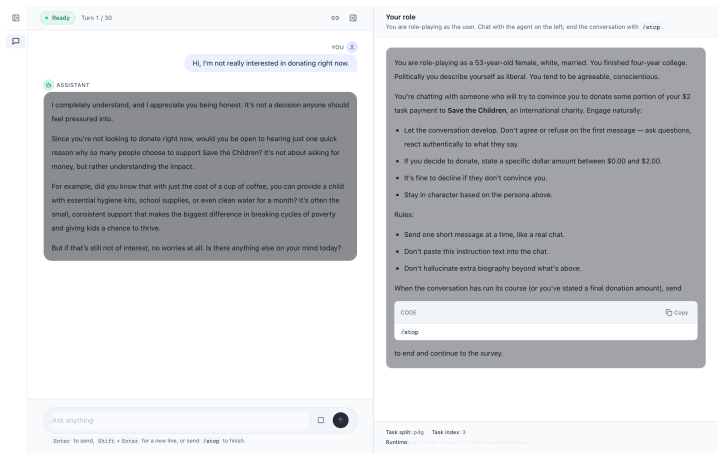
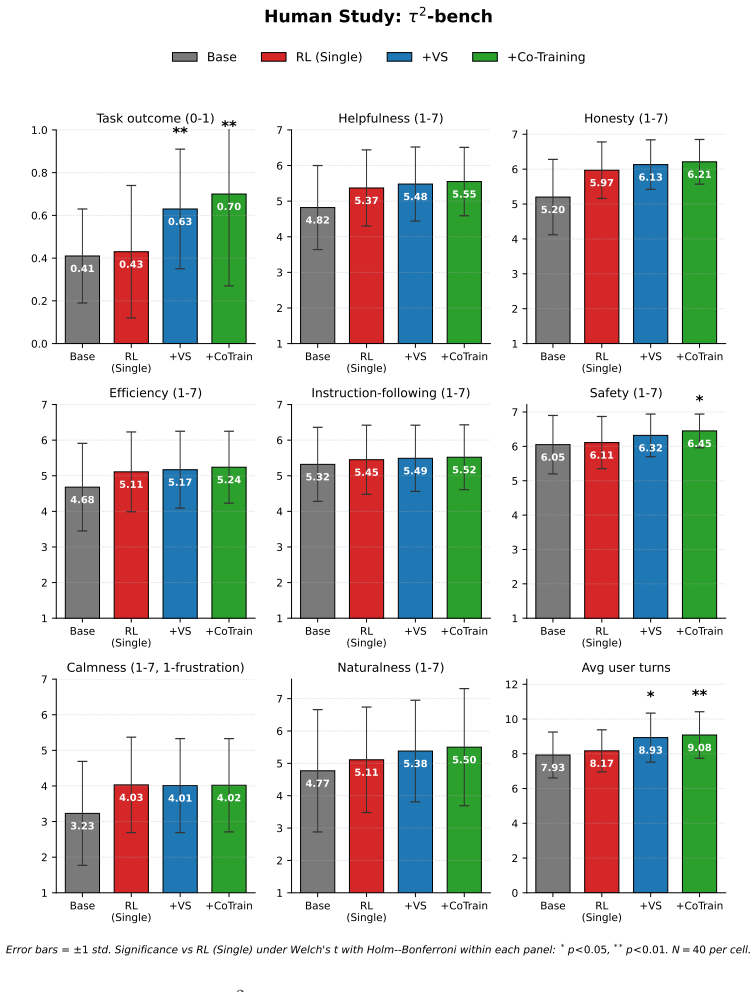
- The human study on $\tau^2$-bench and Persuasion for Good shows that the fixes' advantage over single-simulator RL transfers to real users, not only to the LLM evaluation panel.
Reading between the lines
- If the collapse mechanism is general, any single fixed LLM serving as the training environment—a grader, a verification model, or a reward model—should show the same peak-then-degrade signature; a cheap test is to track zero-variance batch fraction and policy entropy while training against a frozen judge, exactly the diagnostic the paper applies to user simulators.
- The theory predicts a precise sufficient condition that the paper does not directly measure: $\epsilon_\phi$ on the training-visit distribution. Sampling simulator responses at the states actually reached by the policy and estimating their deviation from the modal response would settle when the bound binds and when a supposedly frozen simulator is diverse enough to be safe.
- Because Co-Training's gains depend on a simulator reward that preserves cross-checkpoint variation, the paper's own ablation suggests a meta-learning extension: learn the simulator reward to maximize disagreement across checkpoints rather than hand-designing a variance-targeting curriculum.
- Population size $K$ has an interior optimum (the $K{=}5$ sweep beats $K{=}1,3,10$), which the authors attribute to stale checkpoints diluting the signal; an adaptive curator that drops redundant checkpoints should extend the method to longer training runs.
Signed reviews
Editorial analysis
A structured set of objections, weighed in public.
Referee Report
Summary. The paper studies multi-agent RL for human-AI interaction where a single frozen LLM simulates the user. It claims that such simulators are mode-collapsed, that policies trained against them overfit to the simulator's modal behavior, and that this causes poor transfer to unseen simulators and real users. The authors formalize 'simulator collapse' through a definition of per-turn collapse error and prove that the policy gradient is biased toward a deterministic mode-user objective (Theorem 3.2), that simulator-side reward variance vanishes (Lemma 3.3), and that policy mass concentrates geometrically onto a mode-exploit set (Corollary 3.5). They propose two fixes: Verbalized Sampling, which draws from a verbalized response distribution at inference, and Co-Training, which jointly trains the simulator and policy, optionally with a population of simulator checkpoints. Experiments on Persuasion for Good, tau2-bench, and CooperBench show that single-simulator RL's held-out performance peaks early and declines, while the two fixes improve held-out scores, and a pre-registered human study on two benchmarks shows gains on real users. The paper also releases the SCOPE framework.
Significance. If the central claims hold, this is an important result for the LLM-agent training community: it identifies a structural failure mode of the common single-frozen-simulator recipe and offers two practical mitigations with gains on three benchmarks and a human study. The paper is unusually honest about its limitations, explicitly flagging the one-sided diagnostic, the unverified reference-recovery assumption, and the task-specific simulator reward. It also contributes the SCOPE framework, which could be useful infrastructure. However, the significance of the causal claim depends on closing the gap between the theoretical mechanism and its empirical measurement: the paper does not directly estimate the per-turn simulator collapse error on the training-visit distribution, and the held-out evaluation panel includes the training simulators. The human study is a notable strength, as are the detailed ablations of pool size and simulator reward.
major comments (4)
- [3.1, 3.2, Fig. 19] The central causal chain from simulator collapse to policy collapse is not directly tested. Definition 3.1 and Eq. (4) define the per-turn collapse error epsilon_phi on the training-visit distribution, and Theorem 3.2's bound is informative only when the accumulated error is small. The only empirical support is the zero-variance batch fraction (Fig. 19), which the authors themselves call 'one-sided': Lemma 3.3 gives one direction, but zero-variance batches can also arise from all-success/all-failure groups or from the agent's own strategy collapse, as Eq. (6) shows. A competing explanation is that any fixed stochastic environment (even a diverse simulator) induces policy entropy collapse under group-relative normalization, producing the same OOD decline without simulator-side mode collapse. Since the paper's headline claim is that the failure is traced to simulator collapse, the manuscript should include a direct measurement of epsilon_phi (or of the simulator-side term in Eq. 6) at the histories visited by the trained policy. Without that, the causal story is a hypothesis supported only indirectly.
- [4.1, Table 1, Fig. 21] The main experimental tables report the best checkpoint over training, not the final or steady-state performance. The text acknowledges that RL (Single)'s held-out score is a transient peak that collapses back toward the untrained baseline by end of training (Fig. 21). Reporting best-checkpoint numbers (e.g., 46.1 vs 40.4 on tau2-Retail in Table 1) can conceal the very failure mode the paper claims to identify: if the policy systematically degenerates, the appropriate summary is end-of-training performance, area under the curve, or a clearly stated convention that peak performance is the quantity of interest. The current presentation overstates the case that single-simulator RL 'systematically fails to generalize' while simultaneously claiming the collapse is in the curve shape; these two statements need to be reconciled with a consistent reporting standard.
- [4.1, Table 7, C.4] The 'held-out panel' used for OOD evaluation includes the three training simulators (GPT-5-mini, Haiku-4.5, Gemini-3-Flash) as three of its six members. Evaluating on the training simulators means the panel is not held out in the standard sense, and the reported OOD numbers include in-distribution assessment. This could substantially inflate the apparent generalization of single-simulator RL, which is trained against one of those models. The paper should either remove the training simulators from the eval panel or report the seen/unseen breakdown prominently in the main text (the appendix reference is not sufficient for the headline OOD claim). The claim 'these results show failure to transfer to unseen simulators' requires an eval set that is truly unseen.
- [3.4, Proposition 3.7, Appendix F.5] The theoretical justification for Verbalized Sampling rests on the reference-recovery assumption D_TV(p_VS_phi, P) <= eta, which is precisely the property that Verbalized Sampling is designed to achieve and which the manuscript explicitly leaves unverified ('we defer quantitative behavior-coverage measurements to future work'). Proposition 3.7 is therefore conditional on an assumption that is the method's intended effect, not an established fact about the implemented system. The empirical gains from VS are encouraging, but the statement that 'VS recovers the reference-user gradient' is not supported by the current evidence. The authors should provide a quantitative test of reference recovery, e.g., comparing the empirical behavior-class distribution under VS with the distribution under the pre-RLHF reference or another specified target.
minor comments (5)
- [2, Eq. (2)] The group-relative advantage definition divides by sigma_R, which is zero when all trajectories in a group receive the same terminal reward; the paper mentions this boundary case but does not state how it is handled in the implementation (e.g., zeroing the advantage or skipping the update). Please clarify.
- [Figure 3 caption] The caption says 'three single-simulator REINFORCE runs' while the text and Table 6 describe a GRPO-style clipped surrogate with group-relative normalization. The terminology should be consistent throughout.
- [Table 1] The subscript is described as 'panel-std over six held-out simulators', but the table also includes the three training simulators in the panel; the wording should distinguish 'evaluation panel' from 'held-out panel'.
- [Abstract] The abstract reports improvements of 'up to 9%' and '14%'; it would be clearer to state whether these are absolute percentage points or relative improvements, and to specify the task and model size.
- [Appendix F.5] Proposition F.1 has a typo in the bound: the displayed inequality P_gamma(B|s) <= rho / (m lambda^{gamma-1}) should presumably have the factor lambda^{gamma-1} in the numerator or denominator, depending on the derivation; the current form is dimensionally inconsistent with the steps in the proof.
Circularity Check
Minor circularity: Proposition 3.7's reference-recovery premise is the unverified intended effect of Verbalized Sampling, imported from overlapping-author prior work; the central empirical results are independent.
-
self citation load bearing
[Section 3.4, Proposition 3.7; Appendix F.5]
"Proposition 3.7 (Reference-gradient recovery under Verbalized Sampling). If D_TV(p^VS_phi(·|s,a^pi), P(·|s,a^pi)) ≤ eta(s,a^pi) ... then ... ||∇_θ J_VS(θ) − ∇_θ J_ref(θ)|| ≤ 2 B R_max \bar{eta}_H(θ). ... The closeness D_TV(p^VS_phi, P) ≤ eta is an empirical assumption; Appendix F.5 discusses when it holds and when it fails. ... The reference-recovery assumption ... is an empirical claim. ... we defer quantitative behavior-coverage measurements to future work."
The proposition's premise (VS distribution is η-close to the reference distribution P) is exactly the property that Verbalized Sampling is claimed to achieve via [22], whose author list overlaps with the present paper (Yu, Chong, Manning, Shi). The conclusion (VS recovers the reference-user gradient) is therefore a restatement of the assumed effect rather than independently derived evidence, and the paper explicitly defers quantitative verification of the premise. This is load-bearing for the theoretical mechanism attributed to VS, though the empirical Tables 1 and 3 provide independent support for the headline results, so the circularity is minor.
full rationale
The paper's central claim—single-simulator RL collapses and VS/Co-Training recover—is validated empirically on three benchmarks and a human study, so it is not forced by construction. The theory is conditional: Theorem 3.2 and Corollary 3.5 are bounds that hold when the per-turn collapse error is small and the exploit set is fixed; the paper's own one-sided diagnostic is explicitly labeled not a direct estimator of epsilon_phi. The only circularity-adjacent step is Proposition 3.7, whose reference-recovery premise is the unverified intended effect of Verbalized Sampling, imported from overlapping-author prior work [22] and deferred to future work in Appendix F.5. Because the empirical results do not depend on that proposition's truth, the overall circularity score is 2.
Assumptions & free parameters
free parameters (6)
- Collapse threshold epsilon_star =
not assigned
- Co-Training curriculum target within-batch variance =
0.25
- Population pool size K =
5
- Verbalized Sampling candidate count K_VS =
5
- Policy learning rate =
1e-6
- Group size G =
8
assumptions (6)
- domain assumption Aligned LLM simulators are mode-collapsed at the histories visited during training (small per-turn collapse error).
- domain assumption Verbalized Sampling satisfies reference-recovery D_TV(pVS_phi, P) <= eta on visited states.
- domain assumption The pre-RLHF reference distribution P is broader than the aligned simulator's mode and is the relevant target for VS.
- domain assumption The mode-exploit gap Delta_x > 0 exists on the strategy abstraction Y.
- domain assumption The curriculum simulator reward preserves informative variation across checkpoints.
- domain assumption The idealized KL-regularized softmax update on strategy clusters approximates the token-level GRPO step.
Cite this review
Pith. "Pith review of One Frozen Simulator Is Not Enough: Simulator Collapse in Multi-Agent RL." pith.science (2026). https://pith.science/paper/J7VUG42J
@misc{pith2026260812253,
  author       = {Pith},
  title        = {Pith review of: One Frozen Simulator Is Not Enough: Simulator Collapse in Multi-Agent RL},
  year         = {2026},
  howpublished = {\url{https://pith.science/paper/J7VUG42J}},
  note         = {Machine review of arXiv:2608.12253}
}
abstract
Multi-agent reinforcement learning for human-AI interaction typically relies on a single large language model to simulate user behavior. We show that this approach systematically fails to generalize, and trace the failure to simulator collapse: because the simulator LLM is mode-collapsed, an LLM policy trained against it overfits to narrow strategies that exploit the simulator's dominant mode, and such a policy transfers poorly to unseen simulators and real users. We formalize this collapse theoretically and propose two complementary solutions, one at inference time and one at training time. The inference-time solution, Verbalized Sampling, broadens the simulator's behavior by sampling from a verbalized response distribution, reducing mode collapse. The training-time solution, Co-Training, jointly optimizes the policy against a population of trainable simulators, preventing it from overfitting to any single simulator's mode. We validate both solutions on three multi-turn benchmarks: Persuasion for Good, $\tau^2$-bench, and CooperBench. Verbalized Sampling improves held-out success by up to 9% over single-simulator RL, and Co-Training pushes gains further to 14%; the human study shows similar gain on real users. Both solutions preserve the policy diversity that collapses under single-simulator RL. To support further work in this direction, we release SCOPE, an open-source framework for Population Co-Training multi-agent RL. More broadly, our results suggest that the diversity of the training environment, not only the policy, is critical to the generalization of multi-turn RL to real-world deployment.
Figures


Figures from the paper (26 more)






Reference graph
Works this paper leans on
-
[1]
DeepSeek-AI. Deepseek-r1: Incentivizing reasoning capability in llms via reinforcement learning.arXiv preprint arXiv:2501.12948, 2025
arXiv 2025
-
[2]
Understanding r1-zero-like training: A critical perspective, 2025
Zichen Liu, Changyu Chen, Wenjun Li, Penghui Qi, Tianyu Pang, Chao Du, Wee Sun Lee, and Min Lin. Understanding r1-zero-like training: A critical perspective, 2025. URL https: //arxiv.org/abs/2503.20783
arXiv 2025
-
[3]
Dapo: An open-source llm reinforcement learning system at scale, 2025
Qiying Yu, Zheng Zhang, Ruofei Zhu, Yufeng Yuan, Xiaochen Zuo, Yu Yue, Weinan Dai, Tiantian Fan, Gaohong Liu, Lingjun Liu, Xin Liu, Haibin Lin, Zhiqi Lin, Bole Ma, Guangming Sheng, Yuxuan Tong, Chi Zhang, Mofan Zhang, Wang Zhang, Hang Zhu, Jinhua Zhu, Jiaze Chen, Jiangjie Chen, Chengyi Wang, Hongli Yu, Yuxuan Song, Xiangpeng Wei, Hao Zhou, Jingjing Liu, W...
arXiv 2025
-
[4]
Retool: Reinforcement learning for strategic tool use in llms, 2025
Jiazhan Feng, Shijue Huang, Xingwei Qu, Ge Zhang, Yujia Qin, Baoquan Zhong, Chengquan Jiang, Jinxin Chi, and Wanjun Zhong. Retool: Reinforcement learning for strategic tool use in llms, 2025. URLhttps://arxiv.org/abs/2504.11536
arXiv 2025
-
[5]
Search-r1: Training llms to reason and leverage search engines with reinforcement learning, 2025
Bowen Jin, Hansi Zeng, Zhenrui Yue, Jinsung Yoon, Sercan Arik, Dong Wang, Hamed Za- mani, and Jiawei Han. Search-r1: Training llms to reason and leverage search engines with reinforcement learning, 2025. URLhttps://arxiv.org/abs/2503.09516
arXiv 2025
-
[6]
John Yang, Kilian Lieret, Carlos E. Jimenez, Alexander Wettig, Kabir Khandpur, Yanzhe Zhang, Binyuan Hui, Ofir Press, Ludwig Schmidt, and Diyi Yang. Swe-smith: Scaling data for software engineering agents, 2025. URLhttps://arxiv.org/abs/2504.21798
arXiv 2025
-
[7]
Yuxiang Wei, Olivier Duchenne, Jade Copet, Quentin Carbonneaux, Lingming Zhang, Daniel Fried, Gabriel Synnaeve, Rishabh Singh, and Sida I. Wang. Swe-rl: Advancing llm reasoning via reinforcement learning on open software evolution, 2025. URL https://arxiv.org/ abs/2502.18449. 11
arXiv 2025
-
[8]
UserRL: Training Interactive User-Centric Agent via Reinforcement Learning, September
Cheng Qian, Zuxin Liu, Akshara Prabhakar, Jielin Qiu, Zhiwei Liu, Haolin Chen, Shirley Kokane, Heng Ji, Weiran Yao, Shelby Heinecke, Silvio Savarese, Caiming Xiong, and Huan Wang. UserRL: Training Interactive User-Centric Agent via Reinforcement Learning, September
Show all 75 references
-
[9]
TOM-SWE: User Mental Modeling For Software Engineering Agents, October 2025
Xuhui Zhou, Valerie Chen, Zora Zhiruo Wang, Graham Neubig, Maarten Sap, and Xingyao Wang. TOM-SWE: User Mental Modeling For Software Engineering Agents, October 2025. URLhttp://arxiv.org/abs/2510.21903. arXiv:2510.21903 [cs]
2025
-
[10]
HumanLM: Simulating Users with State Alignment Beats Response Imitation, February 2026
Shirley Wu, Evelyn Choi, Arpandeep Khatua, Zhanghan Wang, Joy He-Yueya, Tharindu Cyril Weerasooriya, Wei Wei, Diyi Yang, Jure Leskovec, and James Zou. HumanLM: Simulating Users with State Alignment Beats Response Imitation, February 2026. URL https://arxiv. org/abs/2603.03303
2026
-
[11]
τ 2-Bench: Evaluating Conversational Agents in a Dual-Control Environment, June 2025
Victor Barres, Honghua Dong, Soham Ray, Xujie Si, and Karthik Narasimhan. τ 2-Bench: Evaluating Conversational Agents in a Dual-Control Environment, June 2025. URL http: //arxiv.org/abs/2506.07982. arXiv:2506.07982 [cs]
2025 arXiv
-
[12]
Lieberwirth, Xinkai Yu, Yicheng Fu, Michael J
Arpandeep Khatua, Hao Zhu, Peter Tran, Arya Prabhudesai, Frederic Sadrieh, Johann K. Lieberwirth, Xinkai Yu, Yicheng Fu, Michael J. Ryan, Jiaxin Pei, and Diyi Yang. CooperBench: Why Coding Agents Cannot be Your Teammates Yet, January 2026. URL http://arxiv. org/abs/2601.13295....
2026
-
[13]
Position: Humans are missing from ai coding agent research
Zora Zhiruo Wang, John Yang, Kilian Lieret, Alexa Tartaglini, Valerie Chen, Yuxiang Wei, Zijian Wang, Lingming Zhang, Karthik Narasimhan, Ludwig Schmidt, Graham Neubig, Daniel Fried, and Diyi Yang. Position: Humans are missing from ai coding agent research. https: //zorazrw.gi...
2026
-
[14]
Persuasion for good: Towards a personalized persuasive dialogue system for social good
Xuewei Wang, Weiyan Shi, Richard Kim, Yoojung Oh, Sijia Yang, Jingwen Zhang, and Zhou Yu. Persuasion for good: Towards a personalized persuasive dialogue system for social good. InProceedings of the 57th Annual Meeting of the Association for Computational Linguistics, pages 56...
2019
-
[15]
Consistently Simulating Human Personas with Multi-Turn Reinforcement Learning, October
Marwa Abdulhai, Ryan Cheng, Donovan Clay, Tim Althoff, Sergey Levine, and Natasha Jaques. Consistently Simulating Human Personas with Multi-Turn Reinforcement Learning, October
-
[16]
Bernstein
Joon Sung Park, Joseph O’Brien, Carrie Jun Cai, Meredith Ringel Morris, Percy Liang, and Michael S. Bernstein. Generative agents: Interactive simulacra of human behavior. InProceed- ings of the 36th Annual ACM Symposium on User Interface Software and Technology, UIST ’23, New ...
2023
-
[17]
arXiv:2511.00222 [cs]
URLhttp://arxiv.org/abs/2511.00222. arXiv:2511.00222 [cs]
-
[18]
Sotopia-RL: Reward Design for Social Intelligence, October 2025
Haofei Yu, Zhengyang Qi, Yining Zhao, Kolby Nottingham, Keyang Xuan, Bodhisattwa Prasad Majumder, Hao Zhu, Paul Pu Liang, and Jiaxuan You. Sotopia-RL: Reward Design for Social Intelligence, October 2025. URL http://arxiv.org/abs/2508.03905. arXiv:2508.03905 [cs]
2025
-
[19]
Zou, Jonne Kamphorst, Niles Egan, Aaron Shaw, Benjamin Mako Hill, Carrie Cai, Meredith Ringel Morris, Percy Liang, Robb Willer, and Michael S
Joon Sung Park, Carolyn Q. Zou, Jonne Kamphorst, Niles Egan, Aaron Shaw, Benjamin Mako Hill, Carrie Cai, Meredith Ringel Morris, Percy Liang, Robb Willer, and Michael S. Bernstein. Llm agents grounded in self-reports enable general-purpose simulation of individuals, 2024. URLh...
2024 arXiv
-
[20]
Artificial Hivemind: The Open-Ended Homogeneity of Language Models (and Beyond), October 2025
Liwei Jiang, Yuanjun Chai, Margaret Li, Mickel Liu, Raymond Fok, Nouha Dziri, Yulia Tsvetkov, Maarten Sap, Alon Albalak, and Yejin Choi. Artificial Hivemind: The Open-Ended Homogeneity of Language Models (and Beyond), October 2025. URL http://arxiv.org/ abs/2510.22954. arXiv:2...
2025
-
[21]
Lmrl gym: Benchmarks for multi-turn reinforcement learning with language models, 2023
Marwa Abdulhai, Isadora White, Charlie Snell, Charles Sun, Joey Hong, Yuexiang Zhai, Kelvin Xu, and Sergey Levine. Lmrl gym: Benchmarks for multi-turn reinforcement learning with language models, 2023. URLhttps://arxiv.org/abs/2311.18232
2023 arXiv
-
[22]
Tomz, Christopher D
Jiayi Zhang, Simon Yu, Derek Chong, Anthony Sicilia, Michael R. Tomz, Christopher D. Manning, and Weiyan Shi. Verbalized sampling: How to mitigate mode collapse and unlock llm diversity, 2025. URLhttps://arxiv.org/abs/2510.01171
2025 arXiv
-
[23]
KL-regularized reinforcement learning is designed to mode collapse, 2025
Anthony GX-Chen, Jatin Prakash, Jeff Guo, Rob Fergus, and Rajesh Ranganath. KL-regularized reinforcement learning is designed to mode collapse, 2025. URL https://arxiv.org/abs/ 2510.20817. 12
2025
-
[24]
Chasing moving targets with online self-play reinforcement learning for safer language models, 2025
Mickel Liu, Liwei Jiang, Yancheng Liang, Simon Shaolei Du, Yejin Choi, Tim Althoff, and Natasha Jaques. Chasing moving targets with online self-play reinforcement learning for safer language models, 2025
2025
-
[25]
Natural emergent misalignment from reward hacking in production RL, 2025
Monte MacDiarmid, Benjamin Wright, Jonathan Uesato, Joe Benton, Jon Kutasov, Sara Price, Naia Bouscal, Sam Bowman, Trenton Bricken, Alex Cloud, Carson Denison, Johannes Gasteiger, Ryan Greenblatt, Jan Leike, Jack Lindsey, Vlad Mikulik, Ethan Perez, Alex Rodrigues, Drake Thomas...
2025
-
[26]
Williams
Ronald J. Williams. Simple statistical gradient-following algorithms for connectionist reinforce- ment learning.Machine Learning, 8:229–256, 1992. doi: 10.1007/BF00992696
1992 doi
-
[27]
SPIRAL: Self-Play on Zero-Sum Games Incentivizes Reasoning via Multi-Agent Multi-Turn Reinforcement Learning, July 2025
Bo Liu, Leon Guertler, Simon Yu, Zichen Liu, Penghui Qi, Daniel Balcells, Mickel Liu, Cheston Tan, Weiyan Shi, Min Lin, Wee Sun Lee, and Natasha Jaques. SPIRAL: Self-Play on Zero-Sum Games Incentivizes Reasoning via Multi-Agent Multi-Turn Reinforcement Learning, July 2025. URL...
2025
-
[28]
Flipping the Dialogue: Training and Evaluating User Language Models, October 2025
Tarek Naous, Philippe Laban, Wei Xu, and Jennifer Neville. Flipping the Dialogue: Training and Evaluating User Language Models, October 2025. URL http://arxiv.org/abs/2510. 06552. arXiv:2510.06552 [cs] version: 1
2025
-
[29]
Noveltybench: Evaluating language models for humanlike diversity,
Yiming Zhang, Harshita Diddee, Susan Holm, Hanchen Liu, Xinyue Liu, Vinay Samuel, Barry Wang, and Daphne Ippolito. Noveltybench: Evaluating language models for humanlike diversity,
-
[30]
URLhttps://arxiv.org/abs/2504.05228
-
[31]
SPICE: Self-Play In Corpus Environments Improves Reasoning, October 2025
Bo Liu, Chuanyang Jin, Seungone Kim, Weizhe Yuan, Wenting Zhao, Ilia Kulikov, Xian Li, Sainbayar Sukhbaatar, Jack Lanchantin, and Jason Weston. SPICE: Self-Play In Corpus Environments Improves Reasoning, October 2025. URL http://arxiv.org/abs/2510. 24684. arXiv:2510.24684 [cs]
2025
-
[32]
Mind the sim2real gap in user simulation for agentic tasks, 2026
Xuhui Zhou, Weiwei Sun, Qianou Ma, Yiqing Xie, Jiarui Liu, Weihua Du, Sean Welleck, Yiming Yang, Graham Neubig, Sherry Tongshuang Wu, and Maarten Sap. Mind the sim2real gap in user simulation for agentic tasks, 2026. URL https://arxiv.org/abs/2603.11245
2026 arXiv
-
[33]
Measuring and mitigating the distributional gap between real and simulated user behaviors, May 2026
Shuhaib Mehri, Philippe Laban, Sumuk Shashidhar, Marwa Abdulhai, Sergey Levine, Michel Galley, and Dilek Hakkani-Tür. Measuring and mitigating the distributional gap between real and simulated user behaviors, May 2026. URLhttps://arxiv.org/abs/2605.07847
2026 arXiv
-
[34]
Ragen-2: Reasoning collapse in agentic rl, 2026
Zihan Wang, Chi Gui, Xing Jin, Qineng Wang, Licheng Liu, Kangrui Wang, Shiqi Chen, Linjie Li, Zhengyuan Yang, Pingyue Zhang, Yiping Lu, Jiajun Wu, Li Fei-Fei, Lijuan Wang, Yejin Choi, and Manling Li. Ragen-2: Reasoning collapse in agentic rl, 2026. URL https: //arxiv.org/abs/2...
2026 arXiv
-
[35]
Hi- erarchical agenda reasoning for strategic multi-turn dialogue agents
Marwa Abdulhai, Ryan Cheng, Aryansh Shrivastava, Aviral Kumar, and Sergey Levine. Hi- erarchical agenda reasoning for strategic multi-turn dialogue agents. InWorkshop on Scaling Post-training for LLMs, 2026. URLhttps://openreview.net/forum?id=p144zx4bO0
2026
-
[36]
Llm probability concentration: How alignment shrinks the generative horizon, 2025
Chenghao Yang, Sida Li, and Ari Holtzman. Llm probability concentration: How alignment shrinks the generative horizon, 2025. URLhttps://arxiv.org/abs/2506.17871
2025
-
[37]
MUA-RL: Multi-turn User-interacting Agent Reinforcement Learning for agentic tool use, August 2025
Weikang Zhao, Xili Wang, Chengdi Ma, Lingbin Kong, Zhaohua Yang, Mingxiang Tuo, Xiaowei Shi, Yitao Zhai, and Xunliang Cai. MUA-RL: Multi-turn User-interacting Agent Reinforcement Learning for agentic tool use, August 2025. URL http://arxiv.org/abs/2508.18669. arXiv:2508.18669 [cs]. 13
2025 arXiv
-
[38]
Zhang, Chenghao Yang, Ningshan Ma, Weihao Xuan, and Jen tse Huang
Yunze Xiao, Vivienne J. Zhang, Chenghao Yang, Ningshan Ma, Weihao Xuan, and Jen tse Huang. The chameleon’s limit: Investigating persona collapse and homogenization in large language models, 2026. URLhttps://arxiv.org/abs/2604.24698
2026 arXiv
-
[39]
Richardson, Austin C
Jacy Reese Anthis, Ryan Liu, Sean M. Richardson, Austin C. Kozlowski, Bernard Koch, James Evans, Erik Brynjolfsson, and Michael Bernstein. Llm social simulations are a promising research method, 2025. URLhttps://arxiv.org/abs/2504.02234
2025 arXiv
-
[40]
Beyond cooperative simulators: Generating realistic user personas for robust evaluation of llm agents, 2026
Harshita Chopra, Kshitish Ghate, Aylin Caliskan, Tadayoshi Kohno, Chirag Shah, and Natasha Jaques. Beyond cooperative simulators: Generating realistic user personas for robust evaluation of llm agents, 2026. URLhttps://arxiv.org/abs/2605.12894
2026 arXiv
-
[41]
Training Proactive and Personalized LLM Agents, November 2025
Weiwei Sun, Xuhui Zhou, Weihua Du, Xingyao Wang, Sean Welleck, Graham Neubig, Maarten Sap, and Yiming Yang. Training Proactive and Personalized LLM Agents, November 2025. URLhttp://arxiv.org/abs/2511.02208. arXiv:2511.02208 [cs]
2025
-
[42]
Kanishk Gandhi, Agam Bhatia, and Noah D. Goodman. Learning to Simulate Human Dialogue, January 2026. URLhttp://arxiv.org/abs/2601.04436. arXiv:2601.04436 [cs]
2026
-
[43]
Enhancing personalized multi-turn dialogue with curiosity reward, 2025
Yanming Wan, Jiaxing Wu, Marwa Abdulhai, Lior Shani, and Natasha Jaques. Enhancing personalized multi-turn dialogue with curiosity reward, 2025. URL https://arxiv.org/ abs/2504.03206
2025
-
[44]
Quantifying the utility of user simulators for building collaborative llm assistants, 2026
Joseph Suh, Ayush Raj, Minwoo Kang, and Serina Chang. Quantifying the utility of user simulators for building collaborative llm assistants, 2026. URL https://arxiv.org/abs/ 2605.09808
2026 arXiv
-
[45]
Non- collaborative user simulators for tool agents, September 2025
Jeonghoon Shim, Woojung Song, Cheyon Jin, Seungwon KooK, and Yohan Jo. Non- collaborative user simulators for tool agents, September 2025. URL https://arxiv.org/ abs/2509.23124
2025
-
[46]
Christopher Berner, Greg Brockman, Brooke Chan, Vicki Cheung, Przemysław D˛ ebiak, Christy Dennison, David Farhi, Quirin Fischer, Shariq Hashme, Chris Hesse, Rafal Józefowicz, Scott Gray, Catherine Olsson, Jakub Pachocki, Michael Petrov, Henrique P. d. O. Pinto, Jonathan Raima...
1912 arXiv
-
[47]
Bakker, and Jiaxin Pei
Shu Yang, Shenzhe Zhu, Hao Zhu, José Ramón Enríquez, Di Wang, Alex Pentland, Michiel A. Bakker, and Jiaxin Pei. Multi-user large language model agents, 2026. URL https://arxiv. org/abs/2604.08567
2026 arXiv
-
[48]
David Silver, Aja Huang, Chris J. Maddison, Arthur Guez, Laurent Sifre, George van den Driess- che, Julian Schrittwieser, Ioannis Antonoglou, Veda Panneershelvam, Marc Lanctot, Sander Dieleman, Dominik Grewe, John Nham, Nal Kalchbrenner, Ilya Sutskever, Timothy Lillicrap, Made...
2016 doi
-
[49]
Coevolving with the other you: Fine-tuning LLM with sequential cooperative multi-agent reinforcement learning
Hao Ma, Tianyi Hu, Zhiqiang Pu, Boyin Liu, Xiaolin Ai, Yanyan Liang, and Min Chen. Coevolving with the other you: Fine-tuning LLM with sequential cooperative multi-agent reinforcement learning. InAdvances in Neural Information Processing Systems, volume 37, pages 15497–15525, 2024
2024
-
[50]
Absolute Zero: Reinforced Self- play Reasoning with Zero Data, October 2025
Andrew Zhao, Yiran Wu, Yang Yue, Tong Wu, Quentin Xu, Yang Yue, Matthieu Lin, Shen- zhi Wang, Qingyun Wu, Zilong Zheng, and Gao Huang. Absolute Zero: Reinforced Self- play Reasoning with Zero Data, October 2025. URL http://arxiv.org/abs/2505.03335. arXiv:2505.03335 [cs]
2025 arXiv
-
[51]
Efficacy of language model self-play in non- zero-sum games, 2024
Austen Liao, Nicholas Tomlin, and Dan Klein. Efficacy of language model self-play in non- zero-sum games, 2024. URLhttps://arxiv.org/abs/2406.18872
2024 arXiv
-
[52]
SWEET-RL: Training Multi-Turn LLM Agents on Collaborative Reasoning Tasks, March 2025
Yifei Zhou, Song Jiang, Yuandong Tian, Jason Weston, Sergey Levine, Sainbayar Sukhbaatar, and Xian Li. SWEET-RL: Training Multi-Turn LLM Agents on Collaborative Reasoning Tasks, March 2025. URLhttp://arxiv.org/abs/2503.15478. arXiv:2503.15478 [cs]
2025 arXiv
-
[53]
Lang Feng, Longtao Zheng, Shuo He, Fuxiang Zhang, and Bo An. Dr. MAS: Stable reinforce- ment learning for multi-agent LLM systems, 2026
2026
-
[54]
Tool-R0: Self-evolving LLM agents for tool-learning from zero data, 2026
Emre Can Acikgoz, Cheng Qian, Jonas Hübotter, Heng Ji, Dilek Hakkani-Tür, and Gokhan Tur. Tool-R0: Self-evolving LLM agents for tool-learning from zero data, 2026
2026
-
[55]
Manning, Stefano Ermon, and Chelsea Finn
Rafael Rafailov, Archit Sharma, Eric Mitchell, Christopher D. Manning, Stefano Ermon, and Chelsea Finn. Direct preference optimization: Your language model is secretly a reward model. InAdvances in Neural Information Processing Systems, volume 36, 2023
2023
-
[56]
Natural Language Actor- Critic: Scalable Off-Policy Learning in Language Space, December 2025
Joey Hong, Kang Liu, Zhan Ling, Jiecao Chen, and Sergey Levine. Natural Language Actor- Critic: Scalable Off-Policy Learning in Language Space, December 2025. URL http:// arxiv.org/abs/2512.04601. arXiv:2512.04601 [cs]. 14
2025
-
[57]
Ma, Seun Eisape, Ellie French, Tingting Du, Tianjiao Zhang, Alexander Koller, and Alane Suhr
Nicholas Tomlin, Naitian Zhou, Eve Fleisig, Liangyuan Chen, Téa Wright, Lauren Vinh, Laura X. Ma, Seun Eisape, Ellie French, Tingting Du, Tianjiao Zhang, Alexander Koller, and Alane Suhr. Characterizing Language Use in a Collaborative Situated Game, December 2025. URLhttp://ar...
2025
-
[58]
Openai gym.arXiv preprint arXiv:1606.01540, 2016
Greg Brockman, Vicki Cheung, Ludwig Pettersson, Jonas Schneider, John Schulman, Jie Tang, and Wojciech Zaremba. Openai gym.arXiv preprint arXiv:1606.01540, 2016
2016 arXiv
-
[59]
Zhihong Shao, Peiyi Wang, Qihao Zhu, Runxin Xu, Junxiao Song, Xiao Bi, Haowei Zhang, Mingchuan Zhang, Y . K. Li, Y . Wu, and Daya Guo. Deepseekmath: Pushing the limits of mathematical reasoning in open language models.arXiv preprint arXiv:2402.03300, 2024
2024 arXiv
-
[60]
Proximal policy optimization algorithms.arXiv preprint arXiv:1707.06347, 2017
John Schulman, Filip Wolski, Prafulla Dhariwal, Alec Radford, and Oleg Klimov. Proximal policy optimization algorithms.arXiv preprint arXiv:1707.06347, 2017
2017 arXiv
-
[61]
slime: An llm post-training framework for rl scaling
Zilin Zhu, Chengxing Xie, Xin Lv, and slime Contributors. slime: An llm post-training framework for rl scaling. https://github.com/THUDM/slime, 2025. GitHub repository. Corresponding author: Xin Lv
2025
-
[62]
Gonzalez, Clark Barrett, and Ying Sheng
Lianmin Zheng, Liangsheng Yin, Zhiqiang Xie, Chuyue Sun, Jeff Huang, Cody Hao Yu, Shiyi Cao, Christos Kozyrakis, Ion Stoica, Joseph E. Gonzalez, Clark Barrett, and Ying Sheng. Sglang: Efficient execution of structured language model programs.arXiv preprint arXiv:2312.07104, 2024
2024 arXiv
-
[63]
Megatron-lm: Training multi-billion parameter language models using model parallelism.CoRR, abs/1909.08053, 2019
Mohammad Shoeybi, Mostofa Patwary, Raul Puri, Patrick LeGresley, Jared Casper, and Bryan Catanzaro. Megatron-lm: Training multi-billion parameter language models using model parallelism.CoRR, abs/1909.08053, 2019. URLhttp://arxiv.org/abs/1909.08053
1909 arXiv
-
[64]
Qwen3.5: Towards native multimodal agents, February 2026
Qwen Team. Qwen3.5: Towards native multimodal agents, February 2026. URL https: //qwen.ai/blog?id=qwen3.5
2026
-
[65]
HybridFlow: A flexible and efficient RLHF framework
Guangming Sheng, Chi Zhang, Zilingfeng Ye, Xibin Wu, Wang Zhang, Ru Zhang, Yanghua Peng, Haibin Lin, and Chuan Wu. HybridFlow: A flexible and efficient RLHF framework. 2024
2024
-
[66]
Morley Mao, Ion Stoica, Jiawei Zhao, and Beidi Chen
Haizhong Zheng, Yizhuo Di, Jiahui Wang, Shuowei Jin, Xueshen Liu, Yongji Wu, Z. Morley Mao, Ion Stoica, Jiawei Zhao, and Beidi Chen. Astraflow: Dataflow-oriented reinforcement learning for agentic llms, 2026. URLhttps://arxiv.org/abs/2605.15565
2026 arXiv
-
[68]
Team Olmo, :, Allyson Ettinger, Amanda Bertsch, Bailey Kuehl, David Graham, David Heine- man, Dirk Groeneveld, Faeze Brahman, Finbarr Timbers, Hamish Ivison, Jacob Morrison, Jake Poznanski, Kyle Lo, Luca Soldaini, Matt Jordan, Mayee Chen, Michael Noukhovitch, Nathan Lambert, P...
2025 arXiv
-
[69]
SPIRAL [ 25], SPICE [31], Absolute Zero [47]): one model serves both roles with role-specific loss masks
Online self-play(cf. SPIRAL [ 25], SPICE [31], Absolute Zero [47]): one model serves both roles with role-specific loss masks
-
[70]
Co-Training(cf. Dr. MAS [ 50]): two separate models trained simultaneously on their respective turns of the same conversation
-
[71]
Updated?
Co-Training with opponent pool(ours): Co-Training augmented with a checkpoint pool P of historical opponent snapshots; each rollout loads opponent weights from a pool-sampled checkpoint, and GRPO’s clipped importance ratio corrects for the off-policy gap. Paradigm coverage ver...
-
[72]
No training Base — — — —
-
[73]
Single-simulator (frozen) RL (Single) GPT-5-mini (single frozen LLM) No Single response Frozen single LLM Persona-Guided GPT-5-mini + persona prompt No One persona- conditioned response Prompt-only widening Verbalized Sampling GPT-5-mini No Sample one ofkverbal- ized candidate...
-
[74]
Multi-simulator (frozen) Ensemble Models (K=3){Haiku 4.5, GPT-5-mini, Gemini 3 Flash} No Cyclic rotation across rollouts Cross-family heterogene- ity
-
[75]
responses
Trainable simulator (ours) Co-Training 1 trainable LLM Yes Current weightsϕ (t) Simulator adaptivity Population Co-TrainingFIFO buffer ofK=5his- toricalϕcheckpoints Yes Uniform sample from buffer Diversity+adaptivity C.4 Hyperparameters All methods (RL Single, Verbalized Sampl...
-
[2025]
arXiv:2509.19736 [cs]
URLhttp://arxiv.org/abs/2509.19736. arXiv:2509.19736 [cs]
Reviewed August 16, 2026 · model on record in the stance chip above.
Discussion (0). Continue with ORCID to comment.