REVIEW 4 major objections 5 minor
One Frozen Simulator Is Not Enough: Simulator Collapse in Multi-Agent RL
T0 review · 4 major / 5 minor · reviewed 2026-08-16 · deepseek-v4-flash
Pith's one-line read The paper shows that using a single frozen LLM as a user simulator in multi-agent RL causes the policy to overfit to the simulator's dominant response mode, collapse its own entropy, and transfer poorly to unseen simulators and real…
desk verdict A strong, referee-worthy paper whose practical claim holds up, but the mode-collapse mechanism is asserted more strongly than the evidence supports. read the letter →
The pith
A machine-rendered reading of the paper's core claim, the machinery that carries it, and where it could break.
The reading
What carries the argument
The load-bearing object is the per-turn collapse error $\epsilon_\phi(s,a^\pi)$, the probability that the simulator $\phi$ deviates from its most likely response at a visited history, accumulated over the horizon as $\bar\epsilon_H(\theta)=\mathbb{E}[\sum_{t=1}^H \epsilon_\phi(s_t,a^\pi_t)]$. Theorem 3.2 couples the real simulator rollout to a deterministic mode-user rollout and bounds the resulting gradient bias by $2BR_{\max}\bar\epsilon_H(\theta)$; Lemma 3.3 shows collapse removes simulator-side reward variance from the group-relative advantage; Proposition 3.4 and Corollary 3.5 convert that persistent mode advantage into geometric concentration of strategy mass on the mode-exploit set $A_x$; Proposition 3.6 converts the concentration into a lower bound on deployment regret when real-user behaviors fall outside $A_x$. The two proposed fixes attack the chain at different points: Verbalized Sampling replaces the collapsed token distribution with a verbalized distribution that approximates the simulator's pre-aligned reference distribution, and Co-Training continually re-randomizes the exploit set so the geometric concentration has no fixed target.
What would settle it
Estimate $\epsilon_\phi(s_t,a^\pi_t)$ directly on states reached by the training policy: for a sample of visited histories, draw multiple simulator responses and compute the average probability of deviating from the modal response. If that average is large (roughly $>1/H$, making $\bar\epsilon_H(\theta)$ non-negligible), Theorem 3.2's bound is vacuous and the predicted collapse should not occur; conversely, if a deliberately de-modalized simulator that is forced to respond diversely at visited states still produces the peak-then-degrade OOD curve, the collapse story would need revision. The paper's own proxy, zero-variance batch fraction, cannot settle this because sparse rewards and all-failure batches also give zero variance.
Extended reading notes
Core claim
At the paper's core is a negative discovery with a mechanism attached: an LLM policy trained against a single frozen LLM user simulator does not merely underperform, it collapses. The paper defines the simulator's mode at each turn as its most likely response, and defines simulator collapse as a small probability of deviating from that mode on the histories the policy actually visits. It then proves that under such collapse the REINFORCE gradient differs from the gradient against a deterministic mode-emitting simulator by at most $2BR_{\max}\bar\epsilon_H(\theta)$, where $\bar\epsilon_H(\theta)$ is the accumulated per-turn collapse error; simulator-side reward variance disappears, so group-relative advantages rank trajectories by how well they exploit the mode; a KL-regularized softmax update then concentrates policy mass on the mode-exploit set geometrically fast, producing a low-entropy policy with bounded deployment regret against users whose behaviors lie outside that set. The fixes follow from the mechanism: Verbalized Sampling makes the simulator sample from a verbalized response distribution, approximately recovering the pre-alignment reference gradient, while Co-Training makes the simulator a moving target by updating it on the same rollouts so no fixed exploit set accumulates odds. The empirical section shows the predicted peak-then-collapse training curves, recovery on the held-out simulator panel, and transfer of the gains to human users.
Load-bearing premise
The argument only binds if, at the dialogue turns the policy actually practices, the simulated user almost always gives its single most-likely reply; if the simulator is genuinely varied exactly where the policy goes, the gradient-bias and entropy-collapse chain need not hold, and the paper's zero-variance diagnostic cannot rule that out because all-failure batches also produce zero variance.
Editorial extensions
If this is right
- Single-simulator RL should not be read by its best-checkpoint number: the paper's curves show that number is a transient peak, and by end of training the policy falls back toward an untrained baseline.
- Verbalized Sampling recovers most of the held-out gain (up to 9 points on $\tau^2$-bench) without retraining the simulator or the policy, because it restores within-simulator response diversity at every turn.
- Co-Training and Population Co-Training push held-out success further (up to 14 points) and keep policy entropy in a healthy range, because the simulator's mode moves as training proceeds.
- The mechanism also applies to symmetric cooperation: against a fixed partner, cross-play plateaus and then loses conversation turns to a short exploit, while self-play and population self-play continue improving.
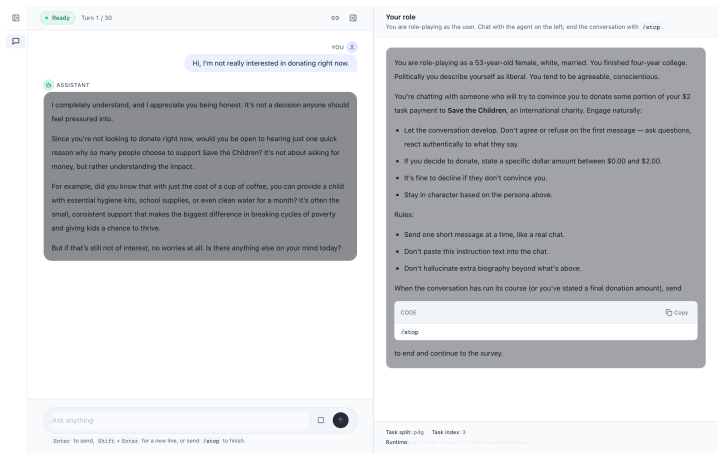
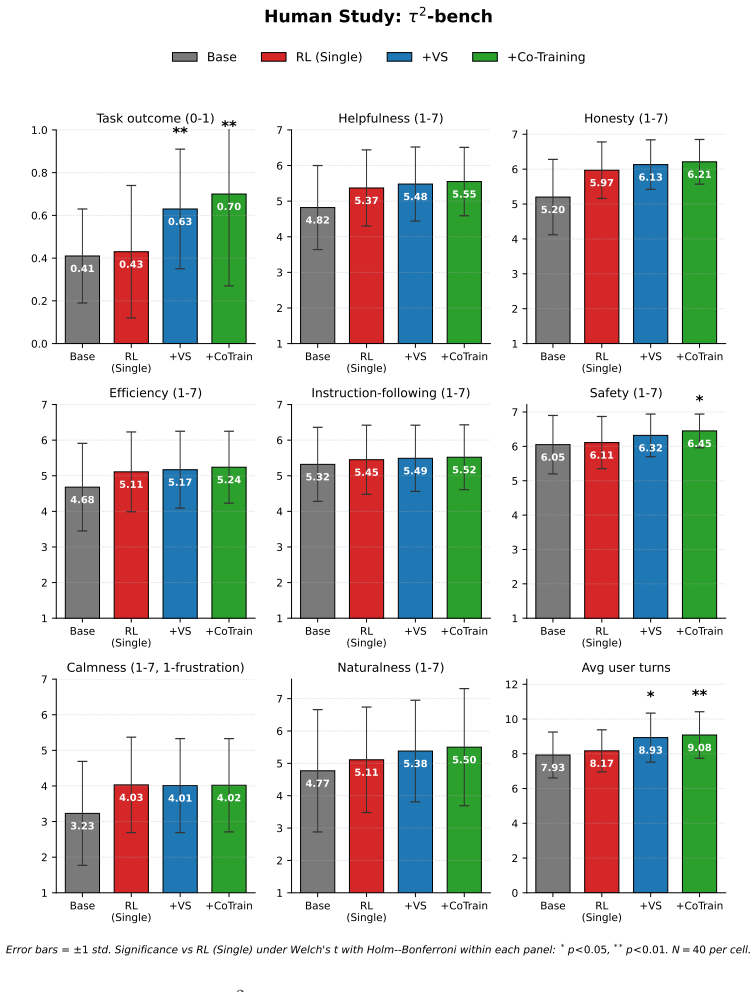
- The human study on $\tau^2$-bench and Persuasion for Good shows that the fixes' advantage over single-simulator RL transfers to real users, not only to the LLM evaluation panel.
Reading between the lines
- If the collapse mechanism is general, any single fixed LLM serving as the training environment—a grader, a verification model, or a reward model—should show the same peak-then-degrade signature; a cheap test is to track zero-variance batch fraction and policy entropy while training against a frozen judge, exactly the diagnostic the paper applies to user simulators.
- The theory predicts a precise sufficient condition that the paper does not directly measure: $\epsilon_\phi$ on the training-visit distribution. Sampling simulator responses at the states actually reached by the policy and estimating their deviation from the modal response would settle when the bound binds and when a supposedly frozen simulator is diverse enough to be safe.
- Because Co-Training's gains depend on a simulator reward that preserves cross-checkpoint variation, the paper's own ablation suggests a meta-learning extension: learn the simulator reward to maximize disagreement across checkpoints rather than hand-designing a variance-targeting curriculum.
- Population size $K$ has an interior optimum (the $K{=}5$ sweep beats $K{=}1,3,10$), which the authors attribute to stale checkpoints diluting the signal; an adaptive curator that drops redundant checkpoints should extend the method to longer training runs.
Signed reviews
Editorial analysis
A structured set of objections, weighed in public.
Referee Report
Summary. The paper studies multi-agent RL for human-AI interaction where a single frozen LLM simulates the user. It claims that such simulators are mode-collapsed, that policies trained against them overfit to the simulator's modal behavior, and that this causes poor transfer to unseen simulators and real users. The authors formalize 'simulator collapse' through a definition of per-turn collapse error and prove that the policy gradient is biased toward a deterministic mode-user objective (Theorem 3.2), that simulator-side reward variance vanishes (Lemma 3.3), and that policy mass concentrates geometrically onto a mode-exploit set (Corollary 3.5). They propose two fixes: Verbalized Sampling, which draws from a verbalized response distribution at inference, and Co-Training, which jointly trains the simulator and policy, optionally with a population of simulator checkpoints. Experiments on Persuasion for Good, tau2-bench, and CooperBench show that single-simulator RL's held-out performance peaks early and declines, while the two fixes improve held-out scores, and a pre-registered human study on two benchmarks shows gains on real users. The paper also releases the SCOPE framework.
Significance. If the central claims hold, this is an important result for the LLM-agent training community: it identifies a structural failure mode of the common single-frozen-simulator recipe and offers two practical mitigations with gains on three benchmarks and a human study. The paper is unusually honest about its limitations, explicitly flagging the one-sided diagnostic, the unverified reference-recovery assumption, and the task-specific simulator reward. It also contributes the SCOPE framework, which could be useful infrastructure. However, the significance of the causal claim depends on closing the gap between the theoretical mechanism and its empirical measurement: the paper does not directly estimate the per-turn simulator collapse error on the training-visit distribution, and the held-out evaluation panel includes the training simulators. The human study is a notable strength, as are the detailed ablations of pool size and simulator reward.
major comments (4)
- [3.1, 3.2, Fig. 19] The central causal chain from simulator collapse to policy collapse is not directly tested. Definition 3.1 and Eq. (4) define the per-turn collapse error epsilon_phi on the training-visit distribution, and Theorem 3.2's bound is informative only when the accumulated error is small. The only empirical support is the zero-variance batch fraction (Fig. 19), which the authors themselves call 'one-sided': Lemma 3.3 gives one direction, but zero-variance batches can also arise from all-success/all-failure groups or from the agent's own strategy collapse, as Eq. (6) shows. A competing explanation is that any fixed stochastic environment (even a diverse simulator) induces policy entropy collapse under group-relative normalization, producing the same OOD decline without simulator-side mode collapse. Since the paper's headline claim is that the failure is traced to simulator collapse, the manuscript should include a direct measurement of epsilon_phi (or of the simulator-side term in Eq. 6) at the histories visited by the trained policy. Without that, the causal story is a hypothesis supported only indirectly.
- [4.1, Table 1, Fig. 21] The main experimental tables report the best checkpoint over training, not the final or steady-state performance. The text acknowledges that RL (Single)'s held-out score is a transient peak that collapses back toward the untrained baseline by end of training (Fig. 21). Reporting best-checkpoint numbers (e.g., 46.1 vs 40.4 on tau2-Retail in Table 1) can conceal the very failure mode the paper claims to identify: if the policy systematically degenerates, the appropriate summary is end-of-training performance, area under the curve, or a clearly stated convention that peak performance is the quantity of interest. The current presentation overstates the case that single-simulator RL 'systematically fails to generalize' while simultaneously claiming the collapse is in the curve shape; these two statements need to be reconciled with a consistent reporting standard.
- [4.1, Table 7, C.4] The 'held-out panel' used for OOD evaluation includes the three training simulators (GPT-5-mini, Haiku-4.5, Gemini-3-Flash) as three of its six members. Evaluating on the training simulators means the panel is not held out in the standard sense, and the reported OOD numbers include in-distribution assessment. This could substantially inflate the apparent generalization of single-simulator RL, which is trained against one of those models. The paper should either remove the training simulators from the eval panel or report the seen/unseen breakdown prominently in the main text (the appendix reference is not sufficient for the headline OOD claim). The claim 'these results show failure to transfer to unseen simulators' requires an eval set that is truly unseen.
- [3.4, Proposition 3.7, Appendix F.5] The theoretical justification for Verbalized Sampling rests on the reference-recovery assumption D_TV(p_VS_phi, P) <= eta, which is precisely the property that Verbalized Sampling is designed to achieve and which the manuscript explicitly leaves unverified ('we defer quantitative behavior-coverage measurements to future work'). Proposition 3.7 is therefore conditional on an assumption that is the method's intended effect, not an established fact about the implemented system. The empirical gains from VS are encouraging, but the statement that 'VS recovers the reference-user gradient' is not supported by the current evidence. The authors should provide a quantitative test of reference recovery, e.g., comparing the empirical behavior-class distribution under VS with the distribution under the pre-RLHF reference or another specified target.
minor comments (5)
- [2, Eq. (2)] The group-relative advantage definition divides by sigma_R, which is zero when all trajectories in a group receive the same terminal reward; the paper mentions this boundary case but does not state how it is handled in the implementation (e.g., zeroing the advantage or skipping the update). Please clarify.
- [Figure 3 caption] The caption says 'three single-simulator REINFORCE runs' while the text and Table 6 describe a GRPO-style clipped surrogate with group-relative normalization. The terminology should be consistent throughout.
- [Table 1] The subscript is described as 'panel-std over six held-out simulators', but the table also includes the three training simulators in the panel; the wording should distinguish 'evaluation panel' from 'held-out panel'.
- [Abstract] The abstract reports improvements of 'up to 9%' and '14%'; it would be clearer to state whether these are absolute percentage points or relative improvements, and to specify the task and model size.
- [Appendix F.5] Proposition F.1 has a typo in the bound: the displayed inequality P_gamma(B|s) <= rho / (m lambda^{gamma-1}) should presumably have the factor lambda^{gamma-1} in the numerator or denominator, depending on the derivation; the current form is dimensionally inconsistent with the steps in the proof.
Circularity Check
Minor circularity: Proposition 3.7's reference-recovery premise is the unverified intended effect of Verbalized Sampling, imported from overlapping-author prior work; the central empirical results are independent.
-
self citation load bearing
[Section 3.4, Proposition 3.7; Appendix F.5]
"Proposition 3.7 (Reference-gradient recovery under Verbalized Sampling). If D_TV(p^VS_phi(·|s,a^pi), P(·|s,a^pi)) ≤ eta(s,a^pi) ... then ... ||∇_θ J_VS(θ) − ∇_θ J_ref(θ)|| ≤ 2 B R_max \bar{eta}_H(θ). ... The closeness D_TV(p^VS_phi, P) ≤ eta is an empirical assumption; Appendix F.5 discusses when it holds and when it fails. ... The reference-recovery assumption ... is an empirical claim. ... we defer quantitative behavior-coverage measurements to future work."
The proposition's premise (VS distribution is η-close to the reference distribution P) is exactly the property that Verbalized Sampling is claimed to achieve via [22], whose author list overlaps with the present paper (Yu, Chong, Manning, Shi). The conclusion (VS recovers the reference-user gradient) is therefore a restatement of the assumed effect rather than independently derived evidence, and the paper explicitly defers quantitative verification of the premise. This is load-bearing for the theoretical mechanism attributed to VS, though the empirical Tables 1 and 3 provide independent support for the headline results, so the circularity is minor.
full rationale
The paper's central claim—single-simulator RL collapses and VS/Co-Training recover—is validated empirically on three benchmarks and a human study, so it is not forced by construction. The theory is conditional: Theorem 3.2 and Corollary 3.5 are bounds that hold when the per-turn collapse error is small and the exploit set is fixed; the paper's own one-sided diagnostic is explicitly labeled not a direct estimator of epsilon_phi. The only circularity-adjacent step is Proposition 3.7, whose reference-recovery premise is the unverified intended effect of Verbalized Sampling, imported from overlapping-author prior work [22] and deferred to future work in Appendix F.5. Because the empirical results do not depend on that proposition's truth, the overall circularity score is 2.
Assumptions & free parameters
free parameters (6)
- Collapse threshold epsilon_star =
not assigned
- Co-Training curriculum target within-batch variance =
0.25
- Population pool size K =
5
- Verbalized Sampling candidate count K_VS =
5
- Policy learning rate =
1e-6
- Group size G =
8
assumptions (6)
- domain assumption Aligned LLM simulators are mode-collapsed at the histories visited during training (small per-turn collapse error).
- domain assumption Verbalized Sampling satisfies reference-recovery D_TV(pVS_phi, P) <= eta on visited states.
- domain assumption The pre-RLHF reference distribution P is broader than the aligned simulator's mode and is the relevant target for VS.
- domain assumption The mode-exploit gap Delta_x > 0 exists on the strategy abstraction Y.
- domain assumption The curriculum simulator reward preserves informative variation across checkpoints.
- domain assumption The idealized KL-regularized softmax update on strategy clusters approximates the token-level GRPO step.
Cite this review
Pith. "Pith review of One Frozen Simulator Is Not Enough: Simulator Collapse in Multi-Agent RL." pith.science (2026). https://pith.science/paper/J7VUG42J
@misc{pith2026260812253,
  author       = {Pith},
  title        = {Pith review of: One Frozen Simulator Is Not Enough: Simulator Collapse in Multi-Agent RL},
  year         = {2026},
  howpublished = {\url{https://pith.science/paper/J7VUG42J}},
  note         = {Machine review of arXiv:2608.12253}
}
abstract
Multi-agent reinforcement learning for human-AI interaction typically relies on a single large language model to simulate user behavior. We show that this approach systematically fails to generalize, and trace the failure to simulator collapse: because the simulator LLM is mode-collapsed, an LLM policy trained against it overfits to narrow strategies that exploit the simulator's dominant mode, and such a policy transfers poorly to unseen simulators and real users. We formalize this collapse theoretically and propose two complementary solutions, one at inference time and one at training time. The inference-time solution, Verbalized Sampling, broadens the simulator's behavior by sampling from a verbalized response distribution, reducing mode collapse. The training-time solution, Co-Training, jointly optimizes the policy against a population of trainable simulators, preventing it from overfitting to any single simulator's mode. We validate both solutions on three multi-turn benchmarks: Persuasion for Good, $\tau^2$-bench, and CooperBench. Verbalized Sampling improves held-out success by up to 9% over single-simulator RL, and Co-Training pushes gains further to 14%; the human study shows similar gain on real users. Both solutions preserve the policy diversity that collapses under single-simulator RL. To support further work in this direction, we release SCOPE, an open-source framework for Population Co-Training multi-agent RL. More broadly, our results suggest that the diversity of the training environment, not only the policy, is critical to the generalization of multi-turn RL to real-world deployment.
Figures


Figures from the paper (26 more)






Reviewed August 16, 2026 · model on record in the stance chip above.
Discussion (0). Continue with ORCID to comment.